

ASTM F3328-18
(Practice)Standard Practice for the One-Step (Solvent Cement Only) Method of Joining Poly (Vinyl Chloride) (PVC) or Chlorinated Poly (Vinyl Chloride) (CPVC) Pipe and Piping Components with Tapered Sockets
General Information
- Abstract
SIGNIFICANCE AND USE
5.1 Solvent cement bonder/installers shall follow all procedures to produce consistently strong and leak-free joints, either in shop operations or in the field.
SCOPE
1.1 This practice describes a one-step (solvent cement only) method of joining pipe to fittings (and or piping components) that employ tapered sockets that provide an interference fit 1/3 to 2/3 ’s of the socket depth. This practice applies to poly(vinyl chloride) (PVC), or chlorinated poly(vinyl chloride) (CPVC).
1.2 This practice shall only be used with products (pipe, fitting, fitting component and solvent cement) where manufacturer’s literature and local codes reference this ASTM standard practice: ASTM F3328.
Note 1: Where conflicts occur between the code and the manufacturer’s installation instructions, the more restrictive provisions apply.
1.3 Due to inherent hazards associated with testing components and systems with compressed air or other compressed gases, some manufacturers do not allow pneumatic testing of their products. Consult with specific product/component manufacturers for their specific testing procedures prior to pneumatic testing.
Note 2: Pressurized (compressed) air or other compressed gases contain large amounts of stored energy which present serious safety hazards should a system fail for any reason.
1.4 Techniques covered are applicable to joining PVC to PVC, or CPVC to CPVC pipe and piping components with tapered sockets. In the remainder of this standard practice, the term “piping components with tapered sockets”, whether it be bell end pipe, spigot connections, or any other type of tapered connections, will be referred to as “fittings.”
1.5 Text of this practice references notes and footnotes that provide explanatory material. These notes and footnotes (excluding those in tables and figures) shall not be considered as requirements of the practice.
1.6 Units—The values stated in inch-pound units are to be regarded as standard. The values given in parentheses are mathematical conversions to SI units that are provided for information only and are not considered standard.
1.7 This standard does not purport to address all of the safety concerns, if any, associated with its use. It is the responsibility of the user of this standard to establish appropriate safety, health, and environmental practices and determine the applicability of regulatory limitations prior to use.
1.8 This international standard was developed in accordance with internationally recognized principles on standardization established in the Decision on Principles for the Development of International Standards, Guides and Recommendations issued by the World Trade Organization Technical Barriers to Trade (TBT) Committee.
- Status
- Published
- Publication Date
- 31-Jul-2018
- Technical Committee
- F17 - Plastic Piping Systems
- Drafting Committee
- F17.20 - Joining
Overview
ASTM F3328-18 outlines the standard practice for the one-step (solvent cement only) method of joining Poly(Vinyl Chloride) (PVC) or Chlorinated Poly(Vinyl Chloride) (CPVC) pipe and piping components using tapered sockets. This practice is instrumental in ensuring strong, leak-free connections in plastic piping systems commonly used for water distribution and other applications. Developed by ASTM International, this standard provides procedures for installers and bonders to achieve reliable joints both in the field and in shop environments, while emphasizing safety, product compatibility, and adherence to manufacturer and local code requirements.
Key Topics
- One-Step Solvent Cement Joining: Specifies using only solvent cement (without primer) to connect PVC or CPVC pipes and fittings with tapered sockets designed for interference fits.
- Applicability: Restricted to products and piping components where both the manufacturer’s literature and local codes reference ASTM F3328.
- Socket and Fit Requirements: Describes the interference fit, typically realized at one-third to two-thirds of the socket depth, which is essential for successful fusion and bonding.
- Surface Preparation and Cleaning: Addresses methods to clean pipe and fitting surfaces, the use of approved chemical cleaners, and avoidance of abrasives that could weaken the joint.
- Proper Application: Recommends techniques for applying solvent cement uniformly and assembling joints immediately to ensure strong adhesion.
- Set and Cure Times: Stresses the importance of following the solvent cement manufacturer’s guidelines for set and cure times, which are influenced by variables such as pipe size, temperature, and humidity.
- Safety Considerations: Warns of hazards related to compressed air testing, solvent cement flammability, and the need for appropriate ventilation and personal protective equipment.
- Regulatory Compliance: Directs users to always follow the more restrictive provisions if conflicts arise between codes and manufacturer’s instructions.
Applications
ASTM F3328-18 serves as a valuable reference for professionals working with:
- PVC and CPVC Water Distribution Systems: Ensuring durable, watertight joints for residential, commercial, and industrial piping networks.
- Field and Shop Fabrication: Facilitating consistent procedures for installers whether assembling pipe runs in controlled environments or during on-site installations.
- Maintenance and Repairs: Providing best practices for replacing or repairing sections of piping by stipulating the correct approach to solvent cement joining.
- Inspection and Quality Control: Offering criteria for evaluating joint integrity, including visual inspection of cement application and recommendations for pressure testing using approved methods.
Related Standards
To fully comply with ASTM F3328-18 and achieve optimal results, reference to the following standards is recommended:
- ASTM D2564: Specification for solvent cements used with PVC piping systems.
- ASTM F493: Specification for solvent cements for CPVC piping.
- ASTM F402: Practice for the safe handling of solvent cements, primers, and cleaners.
- ASTM F412: Terminology relating to plastic piping systems, providing definitions and technical terms.
- ASTM D1600: Terminology for abbreviated terms relating to plastics.
Practical Value
Implementing ASTM F3328-18:
- Enhances joint integrity, reducing risk of leaks or system failures.
- Supports compliance with local codes and manufacturer requirements.
- Mitigates safety risks associated with improper handling of chemicals and testing with compressed gases.
- Improves workmanship uniformity among installers, leading to longer service life for piping systems.
Keywords: ASTM F3328-18, solvent cement joining, PVC piping, CPVC piping, tapered sockets, plastic pipe installation, solvent cement safety, plumbing standards, leak-free joints, piping components, one-step solvent cement, water distribution, piping installation procedures, ASTM standards.
Relations
- Effective Date
- 01-Apr-2020
- Effective Date
- 01-Jan-2019
- Effective Date
- 01-Aug-2018
- Refers
ASTM D1600-18 - Standard Terminology for Abbreviated Terms Relating to Plastics (Withdrawn 2024) - Effective Date
- 01-Jan-2018
- Effective Date
- 01-Aug-2017
- Effective Date
- 01-Feb-2017
- Effective Date
- 15-Nov-2016
- Effective Date
- 01-Aug-2016
- Effective Date
- 01-Jun-2015
- Effective Date
- 01-Nov-2014
- Effective Date
- 01-Feb-2014
- Effective Date
- 15-Apr-2013
- Effective Date
- 15-Feb-2013
- Effective Date
- 01-Aug-2012
- Effective Date
- 01-Apr-2012
Get Certified
Connect with accredited certification bodies for this standard

DIN CERTCO
DIN Group product certification.

Smithers Quality Assessments
US management systems and product certification.
Sponsored listings
Frequently Asked Questions
ASTM F3328-18 is a standard published by ASTM International. Its full title is "Standard Practice for the One-Step (Solvent Cement Only) Method of Joining Poly (Vinyl Chloride) (PVC) or Chlorinated Poly (Vinyl Chloride) (CPVC) Pipe and Piping Components with Tapered Sockets". This standard covers: SIGNIFICANCE AND USE 5.1 Solvent cement bonder/installers shall follow all procedures to produce consistently strong and leak-free joints, either in shop operations or in the field. SCOPE 1.1 This practice describes a one-step (solvent cement only) method of joining pipe to fittings (and or piping components) that employ tapered sockets that provide an interference fit 1/3 to 2/3 ’s of the socket depth. This practice applies to poly(vinyl chloride) (PVC), or chlorinated poly(vinyl chloride) (CPVC). 1.2 This practice shall only be used with products (pipe, fitting, fitting component and solvent cement) where manufacturer’s literature and local codes reference this ASTM standard practice: ASTM F3328. Note 1: Where conflicts occur between the code and the manufacturer’s installation instructions, the more restrictive provisions apply. 1.3 Due to inherent hazards associated with testing components and systems with compressed air or other compressed gases, some manufacturers do not allow pneumatic testing of their products. Consult with specific product/component manufacturers for their specific testing procedures prior to pneumatic testing. Note 2: Pressurized (compressed) air or other compressed gases contain large amounts of stored energy which present serious safety hazards should a system fail for any reason. 1.4 Techniques covered are applicable to joining PVC to PVC, or CPVC to CPVC pipe and piping components with tapered sockets. In the remainder of this standard practice, the term “piping components with tapered sockets”, whether it be bell end pipe, spigot connections, or any other type of tapered connections, will be referred to as “fittings.” 1.5 Text of this practice references notes and footnotes that provide explanatory material. These notes and footnotes (excluding those in tables and figures) shall not be considered as requirements of the practice. 1.6 Units—The values stated in inch-pound units are to be regarded as standard. The values given in parentheses are mathematical conversions to SI units that are provided for information only and are not considered standard. 1.7 This standard does not purport to address all of the safety concerns, if any, associated with its use. It is the responsibility of the user of this standard to establish appropriate safety, health, and environmental practices and determine the applicability of regulatory limitations prior to use. 1.8 This international standard was developed in accordance with internationally recognized principles on standardization established in the Decision on Principles for the Development of International Standards, Guides and Recommendations issued by the World Trade Organization Technical Barriers to Trade (TBT) Committee.
SIGNIFICANCE AND USE 5.1 Solvent cement bonder/installers shall follow all procedures to produce consistently strong and leak-free joints, either in shop operations or in the field. SCOPE 1.1 This practice describes a one-step (solvent cement only) method of joining pipe to fittings (and or piping components) that employ tapered sockets that provide an interference fit 1/3 to 2/3 ’s of the socket depth. This practice applies to poly(vinyl chloride) (PVC), or chlorinated poly(vinyl chloride) (CPVC). 1.2 This practice shall only be used with products (pipe, fitting, fitting component and solvent cement) where manufacturer’s literature and local codes reference this ASTM standard practice: ASTM F3328. Note 1: Where conflicts occur between the code and the manufacturer’s installation instructions, the more restrictive provisions apply. 1.3 Due to inherent hazards associated with testing components and systems with compressed air or other compressed gases, some manufacturers do not allow pneumatic testing of their products. Consult with specific product/component manufacturers for their specific testing procedures prior to pneumatic testing. Note 2: Pressurized (compressed) air or other compressed gases contain large amounts of stored energy which present serious safety hazards should a system fail for any reason. 1.4 Techniques covered are applicable to joining PVC to PVC, or CPVC to CPVC pipe and piping components with tapered sockets. In the remainder of this standard practice, the term “piping components with tapered sockets”, whether it be bell end pipe, spigot connections, or any other type of tapered connections, will be referred to as “fittings.” 1.5 Text of this practice references notes and footnotes that provide explanatory material. These notes and footnotes (excluding those in tables and figures) shall not be considered as requirements of the practice. 1.6 Units—The values stated in inch-pound units are to be regarded as standard. The values given in parentheses are mathematical conversions to SI units that are provided for information only and are not considered standard. 1.7 This standard does not purport to address all of the safety concerns, if any, associated with its use. It is the responsibility of the user of this standard to establish appropriate safety, health, and environmental practices and determine the applicability of regulatory limitations prior to use. 1.8 This international standard was developed in accordance with internationally recognized principles on standardization established in the Decision on Principles for the Development of International Standards, Guides and Recommendations issued by the World Trade Organization Technical Barriers to Trade (TBT) Committee.
ASTM F3328-18 is classified under the following ICS (International Classification for Standards) categories: 83.180 - Adhesives. The ICS classification helps identify the subject area and facilitates finding related standards.
ASTM F3328-18 has the following relationships with other standards: It is inter standard links to ASTM F412-20, ASTM F412-19, ASTM D2564-12(2018), ASTM D1600-18, ASTM F412-17a, ASTM F412-17, ASTM F412-16a, ASTM F412-16, ASTM F412-15, ASTM F493-14, ASTM D1600-14, ASTM D1600-13, ASTM F412-13, ASTM D2564-12, ASTM F412-12. Understanding these relationships helps ensure you are using the most current and applicable version of the standard.
ASTM F3328-18 is available in PDF format for immediate download after purchase. The document can be added to your cart and obtained through the secure checkout process. Digital delivery ensures instant access to the complete standard document.
Standards Content (Sample)
This international standard was developed in accordance with internationally recognized principles on standardization established in the Decision on Principles for the
Development of International Standards, Guides and Recommendations issued by the World Trade Organization Technical Barriers to Trade (TBT) Committee.
Designation: F3328 − 18 An American National Standard
Standard Practice for
the One-Step (Solvent Cement Only) Method of Joining Poly
(Vinyl Chloride) (PVC) or Chlorinated Poly (Vinyl Chloride)
(CPVC) Pipe and Piping Components with Tapered Sockets
This standard is issued under the fixed designation F3328; the number immediately following the designation indicates the year of
original adoption or, in the case of revision, the year of last revision. A number in parentheses indicates the year of last reapproval. A
superscript epsilon (´) indicates an editorial change since the last revision or reapproval.
1. Scope 1.7 This standard does not purport to address all of the
safety concerns, if any, associated with its use. It is the
1.1 This practice describes a one-step (solvent cement only)
responsibility of the user of this standard to establish appro-
method of joining pipe to fittings (and or piping components)
priate safety, health, and environmental practices and deter-
that employ tapered sockets that provide an interference fit ⁄3
mine the applicability of regulatory limitations prior to use.
to ⁄3 ’s of the socket depth. This practice applies to poly(vinyl
1.8 This international standard was developed in accor-
chloride) (PVC), or chlorinated poly(vinyl chloride) (CPVC).
dance with internationally recognized principles on standard-
1.2 This practice shall only be used with products (pipe,
ization established in the Decision on Principles for the
fitting, fitting component and solvent cement) where manufac-
Development of International Standards, Guides and Recom-
turer’s literature and local codes reference thisASTM standard
mendations issued by the World Trade Organization Technical
practice: ASTM F3328.
Barriers to Trade (TBT) Committee.
NOTE 1—Where conflicts occur between the code and the manufactur-
er’s installation instructions, the more restrictive provisions apply.
2. Referenced Documents
1.3 Due to inherent hazards associated with testing compo-
2.1 ASTM Standards:
nents and systems with compressed air or other compressed
D1600 Terminology forAbbreviatedTerms Relating to Plas-
gases, some manufacturers do not allow pneumatic testing of
tics
their products. Consult with specific product/component manu-
D2564 Specification for Solvent Cements for Poly(Vinyl
facturers for their specific testing procedures prior to pneu-
Chloride) (PVC) Plastic Piping Systems
matic testing.
F402 Practice for Safe Handling of Solvent Cements,
Primers, and Cleaners Used for Joining Thermoplastic
NOTE 2—Pressurized (compressed) air or other compressed gases
Pipe and Fittings
contain large amounts of stored energy which present serious safety
hazards should a system fail for any reason.
F412 Terminology Relating to Plastic Piping Systems
F493 Specification for Solvent Cements for Chlorinated
1.4 Techniques covered are applicable to joining PVC to
Poly(Vinyl Chloride) (CPVC) Plastic Pipe and Fittings
PVC, or CPVC to CPVC pipe and piping components with
tapered sockets. In the remainder of this standard practice, the
3. Terminology
term “piping components with tapered sockets”, whether it be
bell end pipe, spigot connections, or any other type of tapered
3.1 Definitions—Definitions are in accordance with Termi-
connections, will be referred to as “fittings.”
nology F412, and abbreviations are in accordance with Termi-
nology D1600, unless otherwise specified.
1.5 Text of this practice references notes and footnotes that
provide explanatory material. These notes and footnotes (ex-
4. Summary of Practice
cluding those in tables and figures) shall not be considered as
requirements of the practice.
4.1 In order to achieve consistently strong and leak-free
joining of Poly(Vinyl Chloride) (PVC) or Chlorinated Poly(Vi-
1.6 Units—The values stated in inch-pound units are to be
nyl Chloride) (CPVC) pipe and fittings, the following prin-
regarded as standard. The values given in parentheses are
ciples need to be clearly understood and followed:
mathematical conversions to SI units that are provided for
information only and are not considered standard.
1 2
This test method is under the jurisdiction of ASTM Committee F17 on Plastic For referenced ASTM standards, visit the ASTM website, www.astm.org, or
Piping Systems and is the direct responsibility of Subcommittee F17.20 on Joining. contact ASTM Customer Service at service@astm.org. For Annual Book of ASTM
Current edition approved Aug. 1, 2018. Published August 2018. DOI: 10.1520/ Standards volume information, refer to the standard’s Document Summary page on
F3328–18 the ASTM website.
Copyright © ASTM International, 100 Barr Harbor Drive, PO Box C700, West Conshohocken, PA 19428-2959. United States
F3328 − 18
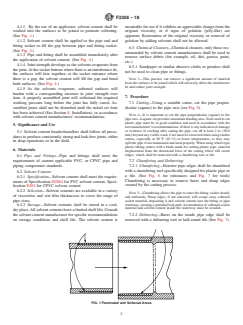
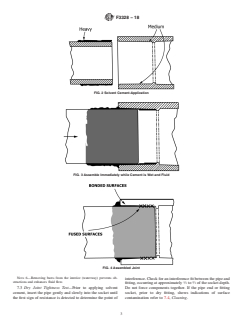
4.1.1 By the use of an applicator, solvent cement shall be unsuitable for use if it exhibits an appreciable change from the
worked into the surfaces to be joined to promote softening. original viscosity, or if signs of gelation (jelly-like) are
(See Fig. 1.) apparent. Restoration of the original viscosity or removal of
4.1.2 Solvent cement shall be applied to the pipe end and gelation by adding solvents shall not be allowed.
fitting socket to fill the gap between pipe and fitting socket.
6.3 Chemical Cleaners—Chemical cleaners, only those rec-
(See Fig. 2.)
ommended by solvent cement manufacturers shall be used to
4.1.3 Pipe and fitting shall be assembled immediately after
remove surface debris (for example, oil, dirt, grease, paint,
the application of solvent cement. (See Fig. 3.)
etc.).
4.1.4 Joint strength develops as the solvents evaporate from
6.3.1 Sandpaper or similar abrasive cloths or grinders shall
thejoint.Atthesocketbottomwherethereisaninterferencefit,
not be used to clean pipe or fittings.
the surfaces will fuse together; at the socket entrance where
there is a gap, the solvent cement will fill the gap and bond NOTE 3—This practice can remove a significant amount of material
from the surfaces to be joined which will adversely affect the interference
both surfaces. (See Fig. 4.)
fit and reduce joint strength.
4.1.5 As the solvents evaporate, softened surfaces will
harden with a corresponding increase in joint strength over
7. Procedure
time. A properly assembled joint will withstand the required
working pressure long before the joint has fully cured. As- 7.1 Cutting—Using a suitable cutter, cut the pipe perpen-
sembled joints shall not be disturbed until the initial set time
dicular (square) to the pipe axis (see Fig. 5).
has been achieved (See Section 8, Installation), in accordance
NOTE 4—It is important to cut the pipe perpendicular (square) to the
with solvent cement manufacturers’ recommendations.
pipe axis.Asquare cut provides maximum bonding area.Tools used to cut
plastic pipe must be in good condition and used in accordance with the
5. Significance and Use
toolmanufacturer’srecommendations.Ifthereisanyindicationofdamage
or evidence of cracking after cutting the pipe, cut off at least 2 in. (50.8
5.1 Solvent cement bonder/installers shall follow all proce-
mm) beyond any visible crack. Care must be exercised when using ratchet
dures to produce consistently strong and leak-free joints, either
cutters, especially at 50 °F (10 °C) or lower temperatures, as they may
in shop operations or in the field.
split the pipe if not maintained and used properly. When using wheel-type
plastic tubing cutters with a blade made for cutting plastic pipe, material
6. Materials
displacement from the downward force of the cutting wheel will create
ridges, which shall be removed with a chamfering tool or file
6.1 Pipe and Fittings—Pipe and fittings shall meet the
requirements of current applicable PVC, or CPVC pipe and
7.2 Chamfering and Deburring:
piping components standards.
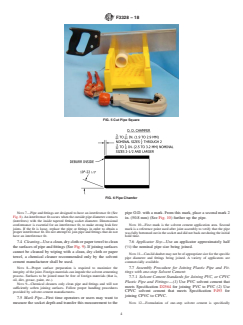
7.2.1 Chamfering—Exterior pipe edges shall be chamfered
with a chamfering tool specifically designed for plastic pipe or
6.2 Solvent Cement:
a file. (See Fig. 6 for tolerances and Fig. 7 for tools)
6.2.1 Specification—Solvent cement shall meet the require-
Chamfering is necessary to remove burrs and sharp edges
ments of Specification D2564 for PVC solvent cement, Speci-
created by the cutting process.
fication F493 for CPVC solvent cement
6.2.2 Selection—Solvent cements are available in a variety
NOTE 5—Chamfering allows the pipe to enter the fitting socket cleanly
of viscosities and wet film thicknesses to cover the range of
and uniformly. Sharp edges, if not removed, will scrape away softened
pipe sizes. socket material, depositing it and solvent cement into the fitting or pipe
waterway, creating a potential leak path.Accumulation of softened socket
6.2.3 Storage—Solvent cements shall be stored in a cool,
material and solvent cement inside the waterway must be avoided.
dryplace.Allsolventcementshavealimitedshelflife.Consult
the solvent cement manufacturer for specific recommendations 7.2.2 Deburring—Burrs on the inside pipe edge shall be
on storage conditions and shelf life. The solvent cement is removed with a deburring tool or half-round file (See Fig. 7).
FIG. 1 Penetrated and Softened Areas
F3328 − 18
FIG. 2 Solvent Cement-Application
FIG. 3 Assemble Immediately while Cement is Wet and Fluid
FIG. 4 Assembled Joint
NOTE 6—Removing burrs from the interior (waterway) prevents ob-
interference. Check for an interference fit between the pipe and
structions and enhances fluid flow.
1 2
fitting, occurring at approximately ⁄3 to ⁄3 of the socket depth.
7.3 Dry Joint Tightness Test—Prior to applying solvent Do not force components together. If the pipe end or fitting
cement, insert the pipe gently and slowly into the socket until socket, prior to dry fitting, shows indications of surface
the first sign of resistance is detected to determine the point of contamination refer to 7.4, Cleaning.
F3328 − 18
FIG. 5 Cut Pipe Square
FIG. 6 Pipe Chamfer
NOTE 7—Pipe and fittings are designed to have an interference fit (See
pipe O.D. with a mark. From this mark, place a second mark 2
Fig. 8).An interference fit occurs when the outside pipe diameter contacts
in. (50.8 mm) (See Fig. 10) further up the pipe.
(interferes) with the inside tapered fitting socket diameter. Dimensional
conformance is essential for an interference fit, to make strong leak free NOTE 10—First mark is the solvent cement application area. Second
joints. If the fit is loose, replace the pipe or fittings in order to obtain a
mark is a reference point used after joint assembly to verify that the pipe
proper interference fit. Do not attempt to join pipe and fittings that do not wasfullybottomedoutinthesocketanddidnotbackoutduringtheinitial
have an interference fit.
hold time.
7.4 Cleaning—Useaclean,dryclothorpapertoweltoclean 7.6 Applicator Size—Use an applicator approximately half
the surfaces of pipe and fittings (See Fig. 9). If joining surfaces ( ⁄2) the nominal pipe size being joined.
cannot be cleaned by wiping with a clean, dry cloth or paper
NOTE11—Can-liddaubermaynotbeofappropriatesizeforthespecific
towel, a chemical cleaner recommended only
...