

ASTM C953-17
(Test Method)Standard Test Method for Time of Setting of Grouts for Preplaced-Aggregate Concrete in the Laboratory
General Information
- Abstract
SIGNIFICANCE AND USE
5.1 This test method determines the time of setting of grout mixed to the fluid consistency required for its use in PA concrete.
5.2 The time of setting is also useful in determining the acceptability of components of grout that must be mixed to the fluid consistency required for production of PA concrete.
SCOPE
1.1 This method covers the determination test of time of setting of hydraulic cement grout mixtures used in preplaced-aggregate (PA) concrete using the Vicat apparatus.
1.2 The values stated in SI units are to be regarded as standard. No other units of measurement are included in this standard.
1.3 This standard does not purport to address all of the safety concerns, if any, associated with its use. It is the responsibility of the user of this standard to establish appropriate safety, health, and environmental practices and determine the applicability of regulatory limitations prior to use.Warning—Fresh hydraulic cementitious mixtures are caustic and may cause chemical burns to skin and tissue upon prolonged exposure.2
1.4 This international standard was developed in accordance with internationally recognized principles on standardization established in the Decision on Principles for the Development of International Standards, Guides and Recommendations issued by the World Trade Organization Technical Barriers to Trade (TBT) Committee.
- Status
- Published
- Publication Date
- 14-Dec-2017
- Technical Committee
- C09 - Concrete and Concrete Aggregates
- Drafting Committee
- C09.41 - Hydraulic Cement Grouts
Buy Documents
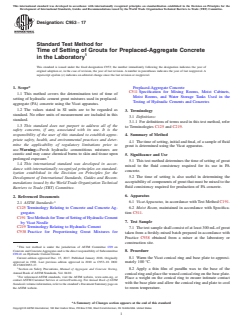


ASTM C953-17 - Standard Test Method for Time of Setting of Grouts for Preplaced-Aggregate Concrete in the Laboratory
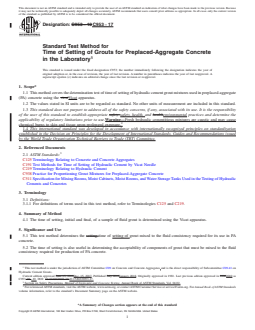
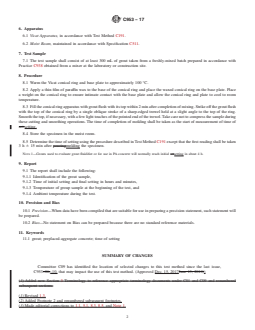


REDLINE ASTM C953-17 - Standard Test Method for Time of Setting of Grouts for Preplaced-Aggregate Concrete in the Laboratory
Overview
ASTM C953-17: Standard Test Method for Time of Setting of Grouts for Preplaced-Aggregate Concrete in the Laboratory is a recognized method established by ASTM International. This standard specifies laboratory procedures for determining the setting times of hydraulic cement grout mixtures, which are used in the production of preplaced-aggregate (PA) concrete. The test uses the Vicat apparatus and provides a standardized approach to assess when grout transitions from a fluid to a set state, crucial for ensuring optimal performance and quality in PA concrete construction.
This standard is applicable to grout mixed to the fluid consistency required for use in PA concrete, supporting reliable measurement of both initial and final setting times under controlled laboratory conditions.
Key Topics
- Time of Setting: The standard defines procedures for measuring both initial and final set times of hydraulic cement grouts. These measurements are vital for understanding the working window and scheduling subsequent construction steps.
- Use of Vicat Apparatus: The method employs the Vicat apparatus in accordance with Test Method ASTM C191, ensuring reproducible and accurate results.
- Sample Preparation: Grout samples must be prepared from freshly mixed batches, using procedures that simulate actual job site conditions.
- Reporting Requirements: Results are reported with detailed sample identification, set times, and temperature conditions, supporting traceability and quality assurance.
- Safety Considerations: The standard highlights health and safety practices, noting that hydraulic cementitious mixtures are caustic and may cause chemical burns upon prolonged exposure.
Applications
- Preplaced-Aggregate Concrete Production: This test method is essential during the preparation and application of PA concrete, where fluid grout is used to bind preplaced aggregates into a solid mass. Proper setting time impacts structural performance and workability.
- Quality Control and Component Evaluation: Determining setting times helps assess the suitability of grout materials and component mixes intended for PA concrete. It ensures compliance with project requirements and assists in optimizing construction sequences.
- Research and Development: Laboratories and manufacturers utilize the method to compare new grout formulations, additives, or to validate performance improvements in mix designs.
- Construction Site Validation: The standardized laboratory approach offers valuable data for construction teams, helping align field practices with specified performance standards for grout and concrete applications.
Related Standards
ASTM C953-17 references several additional ASTM standards that are frequently used alongside it:
- ASTM C125: Terminology Relating to Concrete and Concrete Aggregates
- ASTM C191: Test Methods for Time of Setting of Hydraulic Cement by Vicat Needle
- ASTM C219: Terminology Relating to Hydraulic Cement
- ASTM C938: Practice for Proportioning Grout Mixtures for Preplaced-Aggregate Concrete
- ASTM C511: Specification for Mixing Rooms, Moist Cabinets, Moist Rooms, and Water Storage Tanks Used in the Testing of Hydraulic Cements and Concretes
By following ASTM C953-17, professionals in the concrete and construction industries ensure consistency, reliability, and compliance when measuring grout setting times, ultimately supporting the durability and structural performance of preplaced-aggregate concrete installations.
Keywords: ASTM C953-17, grout setting time, preplaced-aggregate concrete, hydraulic cement grout, Vicat apparatus, laboratory test, concrete standards, ASTM International.
Relations
- Effective Date
- 15-Dec-2017
- Effective Date
- 01-Apr-2024
- Effective Date
- 01-Aug-2020
- Effective Date
- 01-Apr-2020
- Effective Date
- 15-Dec-2019
- Effective Date
- 15-Nov-2019
- Effective Date
- 01-Jun-2019
- Refers
ASTM C938-19 - Standard Practice for Proportioning Grout Mixtures for Preplaced-Aggregate Concrete - Effective Date
- 01-May-2019
- Effective Date
- 01-Jan-2019
- Effective Date
- 01-Oct-2018
- Effective Date
- 01-Jul-2018
- Effective Date
- 01-Jan-2018
- Effective Date
- 15-Dec-2016
- Refers
ASTM C938-16 - Standard Practice for Proportioning Grout Mixtures for Preplaced-Aggregate Concrete - Effective Date
- 01-Feb-2016
- Effective Date
- 15-Dec-2015
Buy Documents
ASTM C953-17 - Standard Test Method for Time of Setting of Grouts for Preplaced-Aggregate Concrete in the Laboratory
REDLINE ASTM C953-17 - Standard Test Method for Time of Setting of Grouts for Preplaced-Aggregate Concrete in the Laboratory
Get Certified
Connect with accredited certification bodies for this standard

DIBt (Deutsches Institut für Bautechnik)
German Institute for Building Technology.
DIN CERTCO
DIN Group product certification.

Aboma Certification B.V.
Specialized in construction, metal, and transport sectors.
Sponsored listings
Frequently Asked Questions
ASTM C953-17 is a standard published by ASTM International. Its full title is "Standard Test Method for Time of Setting of Grouts for Preplaced-Aggregate Concrete in the Laboratory". This standard covers: SIGNIFICANCE AND USE 5.1 This test method determines the time of setting of grout mixed to the fluid consistency required for its use in PA concrete. 5.2 The time of setting is also useful in determining the acceptability of components of grout that must be mixed to the fluid consistency required for production of PA concrete. SCOPE 1.1 This method covers the determination test of time of setting of hydraulic cement grout mixtures used in preplaced-aggregate (PA) concrete using the Vicat apparatus. 1.2 The values stated in SI units are to be regarded as standard. No other units of measurement are included in this standard. 1.3 This standard does not purport to address all of the safety concerns, if any, associated with its use. It is the responsibility of the user of this standard to establish appropriate safety, health, and environmental practices and determine the applicability of regulatory limitations prior to use.Warning—Fresh hydraulic cementitious mixtures are caustic and may cause chemical burns to skin and tissue upon prolonged exposure.2 1.4 This international standard was developed in accordance with internationally recognized principles on standardization established in the Decision on Principles for the Development of International Standards, Guides and Recommendations issued by the World Trade Organization Technical Barriers to Trade (TBT) Committee.
SIGNIFICANCE AND USE 5.1 This test method determines the time of setting of grout mixed to the fluid consistency required for its use in PA concrete. 5.2 The time of setting is also useful in determining the acceptability of components of grout that must be mixed to the fluid consistency required for production of PA concrete. SCOPE 1.1 This method covers the determination test of time of setting of hydraulic cement grout mixtures used in preplaced-aggregate (PA) concrete using the Vicat apparatus. 1.2 The values stated in SI units are to be regarded as standard. No other units of measurement are included in this standard. 1.3 This standard does not purport to address all of the safety concerns, if any, associated with its use. It is the responsibility of the user of this standard to establish appropriate safety, health, and environmental practices and determine the applicability of regulatory limitations prior to use.Warning—Fresh hydraulic cementitious mixtures are caustic and may cause chemical burns to skin and tissue upon prolonged exposure.2 1.4 This international standard was developed in accordance with internationally recognized principles on standardization established in the Decision on Principles for the Development of International Standards, Guides and Recommendations issued by the World Trade Organization Technical Barriers to Trade (TBT) Committee.
ASTM C953-17 is classified under the following ICS (International Classification for Standards) categories: 91.100.30 - Concrete and concrete products. The ICS classification helps identify the subject area and facilitates finding related standards.
ASTM C953-17 has the following relationships with other standards: It is inter standard links to ASTM C953-10, ASTM C219-24, ASTM C219-20a, ASTM C219-20, ASTM C125-19a, ASTM C219-19a, ASTM C219-19, ASTM C938-19, ASTM C125-19, ASTM C125-18b, ASTM C125-18a, ASTM C125-18, ASTM C125-16, ASTM C938-16, ASTM C125-15b. Understanding these relationships helps ensure you are using the most current and applicable version of the standard.
ASTM C953-17 is available in PDF format for immediate download after purchase. The document can be added to your cart and obtained through the secure checkout process. Digital delivery ensures instant access to the complete standard document.
Standards Content (Sample)
This international standard was developed in accordance with internationally recognized principles on standardization established in the Decision on Principles for the
Development of International Standards, Guides and Recommendations issued by the World Trade Organization Technical Barriers to Trade (TBT) Committee.
Designation: C953 − 17
Standard Test Method for
Time of Setting of Grouts for Preplaced-Aggregate Concrete
in the Laboratory
This standard is issued under the fixed designation C953; the number immediately following the designation indicates the year of
original adoption or, in the case of revision, the year of last revision. A number in parentheses indicates the year of last reapproval. A
superscript epsilon (´) indicates an editorial change since the last revision or reapproval.
1. Scope* Preplaced-Aggregate Concrete
C511 Specification for Mixing Rooms, Moist Cabinets,
1.1 This method covers the determination test of time of
Moist Rooms, and Water Storage Tanks Used in the
setting of hydraulic cement grout mixtures used in preplaced-
Testing of Hydraulic Cements and Concretes
aggregate (PA) concrete using the Vicat apparatus.
1.2 The values stated in SI units are to be regarded as
3. Terminology
standard. No other units of measurement are included in this
3.1 Definitions:
standard.
3.1.1 For definitions of terms used in this test method, refer
1.3 This standard does not purport to address all of the
to Terminologies C125 and C219.
safety concerns, if any, associated with its use. It is the
responsibility of the user of this standard to establish appro- 4. Summary of Method
priate safety, health, and environmental practices and deter-
4.1 The time of setting, initial and final, of a sample of fluid
mine the applicability of regulatory limitations prior to
grout is determined using the Vicat apparatus.
use.Warning—Fresh hydraulic cementitious mixtures are
caustic and may cause chemical burns to skin and tissue upon
5. Significance and Use
prolonged exposure.
5.1 This test method determines the time of setting of grout
1.4 This international standard was developed in accor-
mixed to the fluid consistency required for its use in PA
dance with internationally recognized principles on standard-
concrete.
ization established in the Decision on Principles for the
5.2 The time of setting is also useful in determining the
Development of International Standards, Guides and Recom-
acceptability of components of grout that must be mixed to the
mendations issued by the World Trade Organization Technical
fluid consistency required for production of PA concrete.
Barriers to Trade (TBT) Committee.
6. Apparatus
2. Referenced Documents
6.1 Vicat Apparatus, in accordance with Test Method C191.
2.1 ASTM Standards:
C125 Terminology Relating to Concrete and Concrete Ag- 6.2 Moist Room, maintained in accordance with Specifica-
gregates
tion C511.
C191 TestMethodsforTimeofSettingofHydraulicCement
7. Test Sample
by Vicat Needle
C219 Terminology Relating to Hydraulic Cement
7.1 The test sample shall consist of at least 300 mLof grout
C938 Practice for Proportioning Grout Mixtures for
taken from a freshly-mixed batch prepared in accordance with
Practice C938 obtained from a mixer at the laboratory or
construction site.
This test method is under the jurisdiction of ASTM Committee C09 on
Concrete and ConcreteAggregates and is the direct responsibility of Subcommittee
8. Procedure
C09.41 on Hydraulic Cement Grouts.
8.1 Warm the Vicat conical ring and base plate to approxi-
Current edition approved Dec. 15, 2017. Published January 2018. Originally
approved in 1981. Last previous edition approved in 2010 as C953–10. DOI:
mately 100 °C.
10.1520/C0953-17.
8.2 Apply a thin film of paraffin wax to the base of the
Section on Safety Precautions, Manual of Aggregate and Concrete Testing,
Annual Book of ASTM Standards, Vol. 04.02.
conical ring and place the waxed conical ring on the base plate.
For referenced ASTM standards, vis
...
This document is not an ASTM standard and is intended only to provide the user of an ASTM standard an indication of what changes have been made to the previous version. Because
it may not be technically possible to adequately depict all changes accurately, ASTM recommends that users consult prior editions as appropriate. In all cases only the current version
of the standard as published by ASTM is to be considered the official document.
Designation: C953 − 10 C953 − 17
Standard Test Method for
Time of Setting of Grouts for Preplaced-Aggregate Concrete
in the Laboratory
This standard is issued under the fixed designation C953; the number immediately following the designation indicates the year of
original adoption or, in the case of revision, the year of last revision. A number in parentheses indicates the year of last reapproval. A
superscript epsilon (´) indicates an editorial change since the last revision or reapproval.
1. Scope*
1.1 This method covers the determination test of time of setting of hydraulic cement grout mixtures used in preplaced-aggregate
(PA) concrete using the vicatVicat apparatus.
1.2 The values stated in SI units are to be regarded as standard. No other units of measurement are included in this standard.
1.3 This standard does not purport to address all of the safety concerns, if any, associated with its use. It is the responsibility
of the user of this standard to establish appropriate safety safety, health, and healthenvironmental practices and determine the
applicability of regulatory limitations prior to use.Warning—Fresh hydraulic cementitious mixtures are caustic and may cause
chemical burns to skin and tissue upon prolonged exposure.
1.4 This international standard was developed in accordance with internationally recognized principles on standardization
established in the Decision on Principles for the Development of International Standards, Guides and Recommendations issued
by the World Trade Organization Technical Barriers to Trade (TBT) Committee.
2. Referenced Documents
2.1 ASTM Standards:
C125 Terminology Relating to Concrete and Concrete Aggregates
C191 Test Methods for Time of Setting of Hydraulic Cement by Vicat Needle
C219 Terminology Relating to Hydraulic Cement
C938 Practice for Proportioning Grout Mixtures for Preplaced-Aggregate Concrete
C511 Specification for Mixing Rooms, Moist Cabinets, Moist Rooms, and Water Storage Tanks Used in the Testing of Hydraulic
Cements and Concretes
3. Terminology
3.1 Definitions:
3.1.1 For definitions of terms used in this test method, refer to Terminologies C125 and C219.
4. Summary of Method
4.1 The time of setting, initial and final, of a sample of fluid grout is determined using the Vicat apparatus.
5. Significance and Use
5.1 This test method determines the setting time of setting of grout mixed to the fluid consistency required for its use in PA
concrete.
5.2 The time of setting is also useful in determining the acceptability of components of grout that must be mixed to the fluid
consistency required for production of PA concrete.
This test method is under the jurisdiction of ASTM Committee C09 on Concrete and Concrete Aggregates and is the direct responsibility of Subcommittee C09.41 on
Hydraulic Cement Grouts.
Current edition approved June 15, 2010Dec. 15, 2017. Published July 2010January 2018. Originally approved in 1981. Last previous edition approved in 20062010 as
C953–06.–10. DOI: 10.1520/C0953-10.10.1520/C0953-17.
Section on Safety Precautions, Manual of Aggregate and Concrete Testing, Annual Book of ASTM Standards, Vol. 04.02.
For referenced ASTM standards, visit the ASTM website, www.astm.org, or contact ASTM Customer Service at service@astm.org. For Annual Book of ASTM Standards
volume information, refer to the standard’s Document Summary page on the ASTM website.
*A Summary of Changes section appears at the end of this standard
Copyright © ASTM International, 100 Barr Harbor Drive, PO Box C700, West Conshohocken, PA 19428-2959. United States
C953 − 17
6. Apparatus
6.1 Vicat Apparatus, in accordance with Test Method C191.
6.2 Moist Room, maintained in accordance with Specificat
...