

ASTM D2295-96(2016)
(Test Method)Standard Test Method for Strength Properties of Adhesives in Shear by Tension Loading at Elevated Temperatures (Metal-to-Metal)
General Information
- Abstract
SIGNIFICANCE AND USE
4.1 Comparative strength of adhesive bonds at elevated temperatures allows for better selection of adhesives that must perform at temperatures above normal. This test method is useful in supplying such information.
SCOPE
1.1 This test method covers the determination of the comparative shear strengths of adhesives for bonding metals when tested on a standard specimen and under specified conditions of preparation and testing at elevated temperatures.
1.2 This test method is applicable to the temperature range from 315 to 850°C (600 to 1500°F).
1.3 The values stated in SI units are to be regarded as the standard. The values given in parentheses are for information only.
1.4 This standard does not purport to address all of the safety concerns, if any, associated with its use. It is the responsibility of the user of this standard to consult and establish appropriate safety and health practices and determine the applicability of regulatory limitations prior to use.
- Status
- Published
- Publication Date
- 30-Apr-2016
- Technical Committee
- D14 - Adhesives
- Drafting Committee
- D14.80 - Metal Bonding Adhesives


Overview
ASTM D2295-96(2016) - Standard Test Method for Strength Properties of Adhesives in Shear by Tension Loading at Elevated Temperatures (Metal-to-Metal) is a widely recognized standard developed by ASTM International for testing the shear strength of adhesives used to bond metal materials under high-temperature conditions. This standard provides essential guidance for evaluating the performance and suitability of metal-to-metal adhesives operating in applications with temperatures ranging from 315°C to 850°C (600°F to 1500°F).
Adhesives used in industrial and engineering contexts may be subject to elevated temperatures that can significantly affect bond strength and integrity. ASTM D2295-96(2016) enables manufacturers, engineers, and quality assurance professionals to comparatively assess adhesive shear strength through a consistent test method, ensuring reliable material selection for demanding environments.
Key Topics
- Scope of Testing: The method covers the determination of comparative shear strengths of adhesives for bonding metals using a standardized test specimen and specified preparation and testing conditions at elevated temperatures.
- Temperature Range: Applicable for evaluating adhesives at temperatures between 315°C and 850°C (600°F to 1500°F), ensuring coverage of most industrial high-temperature applications.
- Test Procedures: Test specimens are prepared using recommended metal grades and are tested in specialized equipment with precise heating control, as outlined in the standard.
- Safety Considerations: The standard emphasizes the user's responsibility to implement appropriate safety and health practices, as the procedure involves high temperatures and specialized equipment.
Applications
ASTM D2295-96(2016) is invaluable in the following practical applications:
- Aerospace and Aviation: Selection of adhesives for bonding aircraft and spacecraft structural components where high thermal resistance is essential.
- Automotive Engineering: Assessment of metal-bonding adhesives used in exhaust systems, engine components, and other under-the-hood applications subjected to elevated temperatures.
- Industrial Manufacturing: Qualifying adhesives for heat exchangers, furnace linings, and process equipment that operates above traditional temperature ranges.
- Research and Development: Comparative analysis of new adhesive formulations for metal-to-metal bonding under thermal stress.
- Quality Control and Specification Compliance: Ensuring adhesive products meet supplier and industry requirements for performance under specified thermal conditions.
This standard supports enhanced material selection, risk mitigation, and improved product endurance in high-temperature metal-to-metal adhesive applications.
Related Standards
Professionals utilizing ASTM D2295-96(2016) may also find the following related standards relevant:
- ASTM D907 - Terminology of Adhesives: Provides crucial definitions to support consistent understanding across adhesive testing.
- ASTM D1002 - Test Method for Apparent Shear Strength of Single-Lap-Joint Adhesively Bonded Metal Specimens by Tension Loading (Metal-to-Metal): A complementary method for shear testing under different conditions.
- ASTM D638 - Test Method for Tensile Properties of Plastics: Referenced for test equipment requirements.
- ASTM A167 (Withdrawn 2014) - Specification for Stainless and Heat-Resisting Chromium-Nickel Steel Plate, Sheet, and Strip: Cited as suitable base materials.
- MIL-S-25043 - Military Specification for Steel Plate, Sheet, and Strip, Corrosion-Resistant, Precipitation Hardened: Used for specimen preparation and selection.
Adherence to ASTM D2295-96(2016) ensures robust, comparable, and reliable adhesive performance data for applications where metal bonding must endure elevated temperatures, supporting quality assurance and optimal material selection. For more technical information and guidance, access the full standard at ASTM International.
Relations
- Effective Date
- 01-May-2016
- Effective Date
- 01-Apr-2019
- Effective Date
- 01-Jul-2012
- Effective Date
- 01-May-2012
- Effective Date
- 01-Dec-2011
- Effective Date
- 01-Jan-2011
- Effective Date
- 15-May-2010
- Effective Date
- 01-May-2009
- Effective Date
- 01-Oct-2008
- Effective Date
- 15-Aug-2008
- Effective Date
- 01-Mar-2008
- Effective Date
- 01-Dec-2006
- Effective Date
- 01-Oct-2005
- Effective Date
- 01-Apr-2005
- Effective Date
- 01-Apr-2005
Get Certified
Connect with accredited certification bodies for this standard

DIN CERTCO
DIN Group product certification.

Smithers Quality Assessments
US management systems and product certification.
Sponsored listings
Frequently Asked Questions
ASTM D2295-96(2016) is a standard published by ASTM International. Its full title is "Standard Test Method for Strength Properties of Adhesives in Shear by Tension Loading at Elevated Temperatures (Metal-to-Metal)". This standard covers: SIGNIFICANCE AND USE 4.1 Comparative strength of adhesive bonds at elevated temperatures allows for better selection of adhesives that must perform at temperatures above normal. This test method is useful in supplying such information. SCOPE 1.1 This test method covers the determination of the comparative shear strengths of adhesives for bonding metals when tested on a standard specimen and under specified conditions of preparation and testing at elevated temperatures. 1.2 This test method is applicable to the temperature range from 315 to 850°C (600 to 1500°F). 1.3 The values stated in SI units are to be regarded as the standard. The values given in parentheses are for information only. 1.4 This standard does not purport to address all of the safety concerns, if any, associated with its use. It is the responsibility of the user of this standard to consult and establish appropriate safety and health practices and determine the applicability of regulatory limitations prior to use.
SIGNIFICANCE AND USE 4.1 Comparative strength of adhesive bonds at elevated temperatures allows for better selection of adhesives that must perform at temperatures above normal. This test method is useful in supplying such information. SCOPE 1.1 This test method covers the determination of the comparative shear strengths of adhesives for bonding metals when tested on a standard specimen and under specified conditions of preparation and testing at elevated temperatures. 1.2 This test method is applicable to the temperature range from 315 to 850°C (600 to 1500°F). 1.3 The values stated in SI units are to be regarded as the standard. The values given in parentheses are for information only. 1.4 This standard does not purport to address all of the safety concerns, if any, associated with its use. It is the responsibility of the user of this standard to consult and establish appropriate safety and health practices and determine the applicability of regulatory limitations prior to use.
ASTM D2295-96(2016) is classified under the following ICS (International Classification for Standards) categories: 83.180 - Adhesives. The ICS classification helps identify the subject area and facilitates finding related standards.
ASTM D2295-96(2016) has the following relationships with other standards: It is inter standard links to ASTM D2295-96(2008), ASTM D1002-10(2019), ASTM D907-12a, ASTM D907-12, ASTM D907-11a, ASTM D907-11, ASTM D638-10, ASTM A167-99(2009), ASTM D907-08b, ASTM D907-08a, ASTM D907-08, ASTM D907-06, ASTM D1002-05, ASTM D907-05e1, ASTM D907-05. Understanding these relationships helps ensure you are using the most current and applicable version of the standard.
ASTM D2295-96(2016) is available in PDF format for immediate download after purchase. The document can be added to your cart and obtained through the secure checkout process. Digital delivery ensures instant access to the complete standard document.
Standards Content (Sample)
This international standard was developed in accordance with internationally recognized principles on standardization established in the Decision on Principles for the
Development of International Standards, Guides and Recommendations issued by the World Trade Organization Technical Barriers to Trade (TBT) Committee.
Designation: D2295 − 96 (Reapproved 2016)
Standard Test Method for
Strength Properties of Adhesives in Shear by Tension
Loading at Elevated Temperatures (Metal-to-Metal)
This standard is issued under the fixed designation D2295; the number immediately following the designation indicates the year of
original adoption or, in the case of revision, the year of last revision. A number in parentheses indicates the year of last reapproval. A
superscript epsilon (´) indicates an editorial change since the last revision or reapproval.
1. Scope 3. Terminology
1.1 This test method covers the determination of the com- 3.1 Many terms in this test method are defined in Terminol-
parative shear strengths of adhesives for bonding metals when ogy D907.
testedonastandardspecimenandunderspecifiedconditionsof
4. Significance and Use
preparation and testing at elevated temperatures.
4.1 Comparative strength of adhesive bonds at elevated
1.2 This test method is applicable to the temperature range
temperatures allows for better selection of adhesives that must
from 315 to 850°C (600 to 1500°F).
perform at temperatures above normal. This test method is
1.3 The values stated in SI units are to be regarded as the
useful in supplying such information.
standard. The values given in parentheses are for information
only.
5. Apparatus
1.4 This standard does not purport to address all of the
5.1 Testing Machine,conformingtotherequirementsofTest
safety concerns, if any, associated with its use. It is the
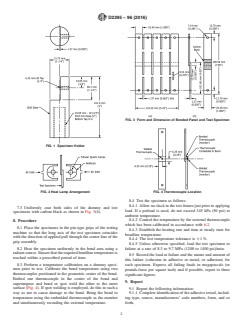
MethodD638.Usepin-typegripsasshowninFig.1toholdthe
responsibility of the user of this standard to consult and
test specimen.
establish appropriate safety and health practices and deter-
5.2 Heating Equipment, consisting of a radiant heat source,
mine the applicability of regulatory limitations prior to use.
backed by a high-efficiency reflector for the purpose of
obtaining the desired heat flux. A suitable lamp arrangement
2. Referenced Documents
for heating a specimen is shown in Fig. 2.
2.1 ASTM Standards:
A167 Specification for Stainless and Heat-Resisting 6. Test Specimens
Chromium-Nickel Steel Plate, Sheet, and Strip (With-
6.1 Cut test specimens from panels shown in Fig. 3(a).
drawn 2014)
These test specimens’ form and dimensions are shown in Fig.
D638 Test Method for Tensile Properties of Plastics
3(b). The specimens are similar to the tension lap shear
D907 Terminology of Adhesives
specimen described in Fig. 1 of Test Method D1002, except
D1002 Test Method for Apparent Shear Strength of Single-
that pin-type grips are used.
Lap-Joint Adhesively Bonded Metal Specimens by Ten-
6.2 Base the selection of materials on the test temperature
sion Loading (Metal-to-Metal)
range. The following grades of steel are recommended, al-
2.2 Military Specifications:
though use of other types of heat-resistant steel is permitted:
MIL-S-25043 Steel Plate, Sheet, and Strip
Metal Designation
Steel, corrosion-resistant (18-8) plate, sheet, and A167, Type 302
strip
Steel plate, sheet, and strip 17-7PH, TH 1050, MIL-S-25043
This test method is under the jurisdiction of ASTM Committee D14 on
corrosion-resistant, precipitation hardened
Adhesives and is the direct responsibility of Subcommittee D14.80 on Metal
Bonding Adhesives.
The nominal thickness for the sheet 1.270 mm (0.050 in.).
Current edition approved May 1, 2016. Published May 2016. Originally
approved in 1964. Last previous edition approved in 2008 as D2295 – 96 (2008).
7. Preparation of Test Specimens
DOI: 10.1520/D2295-96R16.
For referenced ASTM standards, visit the ASTM website, www.astm.org, or
7.1 Cut test specimens as shown in Fig. 3(b) to dimensions
contact ASTM Customer Service at service@astm.org. For Annual Book of ASTM
from the test panel. Measure the width of the specimen and the
Standards volume information, refer to the standard’s Document Summary page on
length of the overlap to the nearest 0.25 mm (0.01 in.).
the ASTM website.
The last approved version of this historical standard is referenced on
7.2 Prepare test specimens by bonding individual strips as
www.astm.org.
shown in Fig. 3(b). Machine unbonded individual strips to size
Available from DLA Document Services, Building 4/D, 700 Robbins Ave.,
Philadelphia, PA 19111-5094, http://quicksearch.dla.mil. and free from burrs or other irregularities.
Copyright © ASTM International, 100 Barr Harbor Drive, PO Box C700, West Conshohocken, PA 19428-2959. United States
D2295 − 96 (2016)
(a)(b)
FIG. 3 Form and Dimen
...