


ASTM F1428-23
(Specification)Standard Specification for Aluminum Particle-Filled Basecoat/Organic or Inorganic Topcoat, Corrosion Protective Coatings for Fasteners
Standard Specification for Aluminum Particle-Filled Basecoat/Organic or Inorganic Topcoat, Corrosion Protective Coatings for Fasteners
ABSTRACT
This specification covers corrosion-resistant coating consisting of an inorganic aluminum particle-filled basecoat and an organic or inorganic topcoat. The basecoat is a water-dilutable slurry containing aluminum particles dispersed in a liquid binder of chromate/phosphate compounds. The organic topcoats consist of polymer resins and dispersed pigments. The inorganic topcoats consist of ceramic oxide pigments dispersed in a liquid binder of chromate/phosphate compounds. These coatings are applied by conventional dip/spin, dip/drain, or spray methods. The coating systems defined by this specification can be applied to ferrous alloy steels, aluminum, and ferritic and austenitic stainless steels. The inorganic aluminum particle-filled basecoat and the subsequent topcoats are classified into three groups, with subsequent subgroups. Materials shall be tested and the individual grades shall conform to specified values of appearance, adhesion, corrosion, thread-fit, weathering, coating thickness, and humidity.
SCOPE
1.1 This specification covers the basic requirements for a corrosion-resistant coating consisting of an inorganic aluminum particle-filled basecoat and an organic or inorganic topcoat, depending on the specific requirements.
1.2 The coating may be specified with basecoat only, or with the top coated with compatible organic polymer or inorganic topcoats, depending on the specific requirements.
1.3 The basecoat is a water-dilutable slurry containing aluminum particles dispersed in a liquid binder of chromate/phosphate compounds.
1.4 The organic topcoats consist of polymer resins and dispersed pigments and are for service where temperatures do not exceed 230 °C (450 °F).
1.5 The inorganic topcoats consist of ceramic oxide pigments dispersed in a liquid binder of chromate/phosphate compounds and are for service where temperatures do not exceed 645 °C (1200 °F).
1.6 These coatings are applied by conventional dip/spin, dip/drain, or spray methods.
1.7 The coating process does not normally induce hydrogen embrittlement, provided that the parts to be coated have not been subjected to an acid cleaner or pretreatment (see Note 1).
Note 1: Although this coating material contains water, it has a relatively low susceptibility to inducing hydrogen embrittlement in steel parts of tensile strengths equal to or greater than 1000 MPa (approximately RC31). Normal precautions for preparing, descaling, and cleaning steels of these tensile strengths must be observed. An initial stress relief treatment should be considered prior to any chemical treatment or cleaning operation. Acids or other treatments that evolve hydrogen should be avoided. Mechanical cleaning methods may be considered. Some steels are more susceptible to hydrogen embrittlement than others and may also require hydrogen embrittlement relief baking after cleaning but before coating. Since no process can completely guarantee freedom from embrittlement, careful consideration must be given to the entire coating process and the specific steel alloy employed.
1.8 The coating systems defined by this specification can be applied to ferrous alloy steels, aluminum, and ferritic and austenitic stainless steels.
1.9 The values stated in SI units are to be regarded as the standard. The values given in parentheses are for information only.
1.10 The following safety hazards caveat pertains only to the test methods portion, Section 6, of this specification: This standard does not purport to address all of the safety concerns, if any, associated with its use. It is the responsibility of the user of this standard to establish appropriate safety, health, and environmental practices and determine the applicability of regulatory limitations prior to use.
1.11 This international standard was developed in accordance with internationally recognized principles on standardization established in the Decision on Principles for the Development of Inte...
General Information
- Status
- Published
- Publication Date
- 31-Jan-2023
- Technical Committee
- F16 - Fasteners
- Drafting Committee
- F16.03 - Coatings on Fasteners
Relations
- Effective Date
- 01-Jun-2020
- Effective Date
- 01-May-2019
- Effective Date
- 01-Nov-2017
- Effective Date
- 01-Dec-2015
- Effective Date
- 01-Oct-2011
- Effective Date
- 01-Aug-2011
- Effective Date
- 01-Jul-2011
- Refers
ASTM D2247-10 - Standard Practice for Testing Water Resistance of Coatings in 100% Relative Humidity - Effective Date
- 01-Jul-2010
- Refers
ASTM B568-98(2009) - Standard Test Method for Measurement of Coating Thickness by X-Ray Spectrometry - Effective Date
- 01-Sep-2009
- Effective Date
- 01-Aug-2009
- Effective Date
- 01-Jul-2009
- Effective Date
- 01-Jun-2009
- Effective Date
- 15-Dec-2007
- Effective Date
- 01-Nov-2007
- Effective Date
- 01-Oct-2007
Overview
ASTM F1428-23 is the international standard specification for corrosion protective coatings applied to fasteners using aluminum particle-filled basecoats and either organic or inorganic topcoats. Developed by ASTM International, this standard defines quality requirements and application guidelines for multi-layered coatings designed to enhance corrosion resistance on fasteners made from ferrous alloy steels, aluminum, and stainless steels.
By following ASTM F1428-23, users can ensure fastener durability in aggressive environments and compliance with recognized international practices, supporting safety and performance in critical assemblies.
Key Topics
Coating System Composition
- Basecoat: Inorganic, water-dilutable slurry with aluminum particles in a chromate/phosphate binder.
- Topcoats:
- Organic: Polymer resins and dispersed pigments, intended for service temperatures up to 230 °C (450 °F).
- Inorganic: Ceramic oxide pigments in a chromate/phosphate binder, suitable for higher temperatures up to 645 °C (1200 °F).
Application Methods
- Conventional dip/spin, dip/drain, or spray processes ensure coverage and uniform thickness.
Performance Criteria
- Requirements for appearance, adhesion, corrosion resistance, thread-fit, weathering, coating thickness, and humidity resistance.
- Testing includes salt spray corrosion testing and humidity exposure, in line with referenced ASTM methods.
Safety Considerations
- Minimized risk of hydrogen embrittlement when standard procedures are followed.
- Emphasis on mechanical cleaning and avoidance of acid treatments, particularly for high-strength steels.
Applications
ASTM F1428-23 coatings are widely used in sectors where fastener corrosion resistance is critical:
Construction:
Protects structural bolts and fasteners against rust in outdoor or marine environments.Automotive and Transportation:
Ensures the longevity of chassis and engine fasteners exposed to road salts and moisture.Industrial Equipment:
Prolongs fastener life in chemical processing and manufacturing settings.Energy Infrastructure:
Used on fasteners in wind, solar, and power plant assemblies prone to weathering and chemical exposure.Aerospace and Defense:
Delivers reliable protection for fasteners exposed to high temperatures and corrosive agents.
This standard allows users to specify basecoat-only systems, or multi-layer coatings tailored to their temperature and environmental requirements. Grades and classifications are available to meet different service conditions and performance expectations.
Related Standards
To ensure comprehensive testing and compliance, ASTM F1428-23 references several important standards:
- ASTM B117: Salt Spray (Fog) Testing
- ASTM B487 / B568 / E376 / D1186: Coating Thickness Measurement
- ASTM D2247: Water Resistance (Humidity) Testing
- ASTM D3359: Adhesion Testing
- ASTM E122: Statistical Sampling Methods
These standards are essential for material inspection, quality control, and performance validation of coated fasteners.
Keywords: ASTM F1428-23, corrosion protective coatings, aluminum basecoat, organic topcoat, inorganic topcoat, fastener coating, corrosion resistance, dip/spin coating, high-temperature fasteners, threaded fasteners, industrial coatings, adhesion testing, salt spray testing, hydrogen embrittlement, quality standards.
Buy Documents
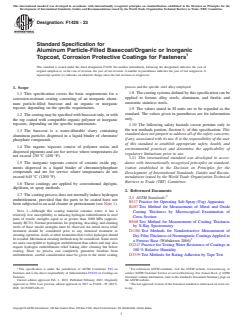
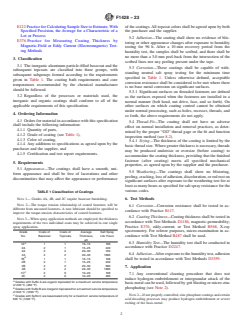


ASTM F1428-23 - Standard Specification for Aluminum Particle-Filled Basecoat/Organic or Inorganic Topcoat, Corrosion Protective Coatings for Fasteners
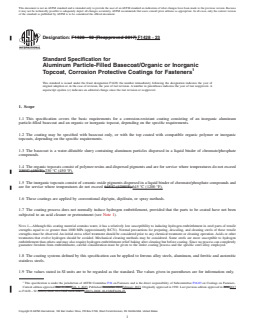
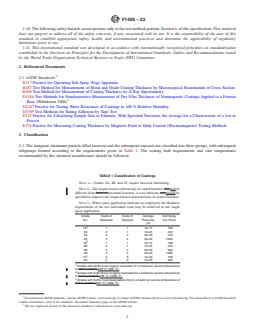
REDLINE ASTM F1428-23 - Standard Specification for Aluminum Particle-Filled Basecoat/Organic or Inorganic Topcoat, Corrosion Protective Coatings for Fasteners
Frequently Asked Questions
ASTM F1428-23 is a technical specification published by ASTM International. Its full title is "Standard Specification for Aluminum Particle-Filled Basecoat/Organic or Inorganic Topcoat, Corrosion Protective Coatings for Fasteners". This standard covers: ABSTRACT This specification covers corrosion-resistant coating consisting of an inorganic aluminum particle-filled basecoat and an organic or inorganic topcoat. The basecoat is a water-dilutable slurry containing aluminum particles dispersed in a liquid binder of chromate/phosphate compounds. The organic topcoats consist of polymer resins and dispersed pigments. The inorganic topcoats consist of ceramic oxide pigments dispersed in a liquid binder of chromate/phosphate compounds. These coatings are applied by conventional dip/spin, dip/drain, or spray methods. The coating systems defined by this specification can be applied to ferrous alloy steels, aluminum, and ferritic and austenitic stainless steels. The inorganic aluminum particle-filled basecoat and the subsequent topcoats are classified into three groups, with subsequent subgroups. Materials shall be tested and the individual grades shall conform to specified values of appearance, adhesion, corrosion, thread-fit, weathering, coating thickness, and humidity. SCOPE 1.1 This specification covers the basic requirements for a corrosion-resistant coating consisting of an inorganic aluminum particle-filled basecoat and an organic or inorganic topcoat, depending on the specific requirements. 1.2 The coating may be specified with basecoat only, or with the top coated with compatible organic polymer or inorganic topcoats, depending on the specific requirements. 1.3 The basecoat is a water-dilutable slurry containing aluminum particles dispersed in a liquid binder of chromate/phosphate compounds. 1.4 The organic topcoats consist of polymer resins and dispersed pigments and are for service where temperatures do not exceed 230 °C (450 °F). 1.5 The inorganic topcoats consist of ceramic oxide pigments dispersed in a liquid binder of chromate/phosphate compounds and are for service where temperatures do not exceed 645 °C (1200 °F). 1.6 These coatings are applied by conventional dip/spin, dip/drain, or spray methods. 1.7 The coating process does not normally induce hydrogen embrittlement, provided that the parts to be coated have not been subjected to an acid cleaner or pretreatment (see Note 1). Note 1: Although this coating material contains water, it has a relatively low susceptibility to inducing hydrogen embrittlement in steel parts of tensile strengths equal to or greater than 1000 MPa (approximately RC31). Normal precautions for preparing, descaling, and cleaning steels of these tensile strengths must be observed. An initial stress relief treatment should be considered prior to any chemical treatment or cleaning operation. Acids or other treatments that evolve hydrogen should be avoided. Mechanical cleaning methods may be considered. Some steels are more susceptible to hydrogen embrittlement than others and may also require hydrogen embrittlement relief baking after cleaning but before coating. Since no process can completely guarantee freedom from embrittlement, careful consideration must be given to the entire coating process and the specific steel alloy employed. 1.8 The coating systems defined by this specification can be applied to ferrous alloy steels, aluminum, and ferritic and austenitic stainless steels. 1.9 The values stated in SI units are to be regarded as the standard. The values given in parentheses are for information only. 1.10 The following safety hazards caveat pertains only to the test methods portion, Section 6, of this specification: This standard does not purport to address all of the safety concerns, if any, associated with its use. It is the responsibility of the user of this standard to establish appropriate safety, health, and environmental practices and determine the applicability of regulatory limitations prior to use. 1.11 This international standard was developed in accordance with internationally recognized principles on standardization established in the Decision on Principles for the Development of Inte...
ABSTRACT This specification covers corrosion-resistant coating consisting of an inorganic aluminum particle-filled basecoat and an organic or inorganic topcoat. The basecoat is a water-dilutable slurry containing aluminum particles dispersed in a liquid binder of chromate/phosphate compounds. The organic topcoats consist of polymer resins and dispersed pigments. The inorganic topcoats consist of ceramic oxide pigments dispersed in a liquid binder of chromate/phosphate compounds. These coatings are applied by conventional dip/spin, dip/drain, or spray methods. The coating systems defined by this specification can be applied to ferrous alloy steels, aluminum, and ferritic and austenitic stainless steels. The inorganic aluminum particle-filled basecoat and the subsequent topcoats are classified into three groups, with subsequent subgroups. Materials shall be tested and the individual grades shall conform to specified values of appearance, adhesion, corrosion, thread-fit, weathering, coating thickness, and humidity. SCOPE 1.1 This specification covers the basic requirements for a corrosion-resistant coating consisting of an inorganic aluminum particle-filled basecoat and an organic or inorganic topcoat, depending on the specific requirements. 1.2 The coating may be specified with basecoat only, or with the top coated with compatible organic polymer or inorganic topcoats, depending on the specific requirements. 1.3 The basecoat is a water-dilutable slurry containing aluminum particles dispersed in a liquid binder of chromate/phosphate compounds. 1.4 The organic topcoats consist of polymer resins and dispersed pigments and are for service where temperatures do not exceed 230 °C (450 °F). 1.5 The inorganic topcoats consist of ceramic oxide pigments dispersed in a liquid binder of chromate/phosphate compounds and are for service where temperatures do not exceed 645 °C (1200 °F). 1.6 These coatings are applied by conventional dip/spin, dip/drain, or spray methods. 1.7 The coating process does not normally induce hydrogen embrittlement, provided that the parts to be coated have not been subjected to an acid cleaner or pretreatment (see Note 1). Note 1: Although this coating material contains water, it has a relatively low susceptibility to inducing hydrogen embrittlement in steel parts of tensile strengths equal to or greater than 1000 MPa (approximately RC31). Normal precautions for preparing, descaling, and cleaning steels of these tensile strengths must be observed. An initial stress relief treatment should be considered prior to any chemical treatment or cleaning operation. Acids or other treatments that evolve hydrogen should be avoided. Mechanical cleaning methods may be considered. Some steels are more susceptible to hydrogen embrittlement than others and may also require hydrogen embrittlement relief baking after cleaning but before coating. Since no process can completely guarantee freedom from embrittlement, careful consideration must be given to the entire coating process and the specific steel alloy employed. 1.8 The coating systems defined by this specification can be applied to ferrous alloy steels, aluminum, and ferritic and austenitic stainless steels. 1.9 The values stated in SI units are to be regarded as the standard. The values given in parentheses are for information only. 1.10 The following safety hazards caveat pertains only to the test methods portion, Section 6, of this specification: This standard does not purport to address all of the safety concerns, if any, associated with its use. It is the responsibility of the user of this standard to establish appropriate safety, health, and environmental practices and determine the applicability of regulatory limitations prior to use. 1.11 This international standard was developed in accordance with internationally recognized principles on standardization established in the Decision on Principles for the Development of Inte...
ASTM F1428-23 is classified under the following ICS (International Classification for Standards) categories: 87.040 - Paints and varnishes. The ICS classification helps identify the subject area and facilitates finding related standards.
ASTM F1428-23 has the following relationships with other standards: It is inter standard links to ASTM D2247-15(2020), ASTM E376-19, ASTM E376-17, ASTM D2247-15, ASTM B117-11, ASTM E122-09e1, ASTM E376-11, ASTM D2247-10, ASTM B568-98(2009), ASTM E122-09, ASTM B117-09, ASTM D3359-09e1, ASTM B117-07a, ASTM D3359-07, ASTM E122-07. Understanding these relationships helps ensure you are using the most current and applicable version of the standard.
ASTM F1428-23 is available in PDF format for immediate download after purchase. The document can be added to your cart and obtained through the secure checkout process. Digital delivery ensures instant access to the complete standard document.
Standards Content (Sample)
This international standard was developed in accordance with internationally recognized principles on standardization established in the Decision on Principles for the
Development of International Standards, Guides and Recommendations issued by the World Trade Organization Technical Barriers to Trade (TBT) Committee.
Designation: F1428 − 23
Standard Specification for
Aluminum Particle-Filled Basecoat/Organic or Inorganic
Topcoat, Corrosion Protective Coatings for Fasteners
This standard is issued under the fixed designation F1428; the number immediately following the designation indicates the year of
original adoption or, in the case of revision, the year of last revision. A number in parentheses indicates the year of last reapproval. A
superscript epsilon (´) indicates an editorial change since the last revision or reapproval.
process and the specific steel alloy employed.
1. Scope
1.8 The coating systems defined by this specification can be
1.1 This specification covers the basic requirements for a
applied to ferrous alloy steels, aluminum, and ferritic and
corrosion-resistant coating consisting of an inorganic alumi-
austenitic stainless steels.
num particle-filled basecoat and an organic or inorganic
topcoat, depending on the specific requirements.
1.9 The values stated in SI units are to be regarded as the
standard. The values given in parentheses are for information
1.2 The coating may be specified with basecoat only, or with
only.
the top coated with compatible organic polymer or inorganic
topcoats, depending on the specific requirements.
1.10 The following safety hazards caveat pertains only to
the test methods portion, Section 6, of this specification: This
1.3 The basecoat is a water-dilutable slurry containing
standard does not purport to address all of the safety concerns,
aluminum particles dispersed in a liquid binder of chromate/
if any, associated with its use. It is the responsibility of the user
phosphate compounds.
of this standard to establish appropriate safety, health, and
1.4 The organic topcoats consist of polymer resins and
environmental practices and determine the applicability of
dispersed pigments and are for service where temperatures do
regulatory limitations prior to use.
not exceed 230 °C (450 °F).
1.11 This international standard was developed in accor-
1.5 The inorganic topcoats consist of ceramic oxide pig- dance with internationally recognized principles on standard-
ments dispersed in a liquid binder of chromate/phosphate
ization established in the Decision on Principles for the
compounds and are for service where temperatures do not Development of International Standards, Guides and Recom-
exceed 645 °C (1200 °F).
mendations issued by the World Trade Organization Technical
Barriers to Trade (TBT) Committee.
1.6 These coatings are applied by conventional dip/spin,
dip/drain, or spray methods.
2. Referenced Documents
1.7 The coating process does not normally induce hydrogen
2.1 ASTM Standards:
embrittlement, provided that the parts to be coated have not
B117 Practice for Operating Salt Spray (Fog) Apparatus
been subjected to an acid cleaner or pretreatment (see Note 1).
B487 Test Method for Measurement of Metal and Oxide
NOTE 1—Although this coating material contains water, it has a
Coating Thickness by Microscopical Examination of
relatively low susceptibility to inducing hydrogen embrittlement in steel
Cross Section
parts of tensile strengths equal to or greater than 1000 MPa (approxi-
B568 Test Method for Measurement of Coating Thickness
mately RC31). Normal precautions for preparing, descaling, and cleaning
by X-Ray Spectrometry
steels of these tensile strengths must be observed. An initial stress relief
treatment should be considered prior to any chemical treatment or
D1186 Test Methods for Nondestructive Measurement of
cleaning operation. Acids or other treatments that evolve hydrogen should
Dry Film Thickness of Nonmagnetic Coatings Applied to
be avoided. Mechanical cleaning methods may be considered. Some steels 3
a Ferrous Base (Withdrawn 2006)
are more susceptible to hydrogen embrittlement than others and may also
D2247 Practice for Testing Water Resistance of Coatings in
require hydrogen embrittlement relief baking after cleaning but before
100 % Relative Humidity
coating. Since no process can completely guarantee freedom from
embrittlement, careful consideration must be given to the entire coating
D3359 Test Methods for Rating Adhesion by Tape Test
1 2
This specification is under the jurisdiction of ASTM Committee F16 on For referenced ASTM standards, visit the ASTM website, www.astm.org, or
Fasteners and is the direct responsibility of Subcommittee F16.03 on Coatings on contact ASTM Customer Service at service@astm.org. For Annual Book of ASTM
Fasteners. Standards volume information, refer to the standard’s Document Summary page on
Current edition approved Feb. 1, 2023. Published February 2023. Originally the ASTM website.
approved in 1992. Last previous edition approved in 2017 as F1428 – 92 (2017). The last approved version of this historical standard is referenced on www.ast-
DOI: 10.1520/F1428-23. m.org.
Copyright © ASTM International, 100 Barr Harbor Drive, PO Box C700, West Conshohocken, PA 19428-2959. United States
F1428 − 23
E122 Practice for Calculating Sample Size to Estimate, With of the coatings. All topcoat colors shall be agreed upon by both
Specified Precision, the Average for a Characteristic of a the purchaser and the supplier.
Lot or Process
5.2 Adhesion—The coating shall show no evidence of blis-
E376 Practice for Measuring Coating Thickness by
tering or other appearance changes after exposure to humidity
Magnetic-Field or Eddy Current (Electromagnetic) Test-
testing for 96 h. After a 10 min recovery period from the
ing Methods
humidity test, the samples shall be scribed, and there shall be
no more than a 3.0 mm peel-back from the intersection of the
3. Classification
scribed lines nor any peeling present under the tape.
3.1 The inorganic aluminum particle-filled basecoat and the
5.3 Corrosion—These coatings shall be capable of with-
subsequent topcoats are classified into three groups, with
standing neutral salt spray testing for the minimum time
subsequent subgroups formed according to the requirements
specified in Table 1. Unless otherwise defined, acceptable
given in Table 1. The coating bath requirements and cure
corrosion resistance shall be considered to be met where there
temperatures recommended by the chemical manufacturer
is no base metal corrosion on significant surfaces.
should be followed.
5.3.1 Significant surfaces on threaded fasteners are defined
3.2 Regardless of the processes or materials used, the
as the surfaces exposed when the fasteners are installed in a
inorganic and organic coatings shall conform to all of the
normal manner (bolt head, nut drive, face, and so forth). On
applicable requirements of this specification.
other surfaces on which coating control cannot be obtained
under normal processing, such as holes, recesses, threads, and
4. Ordering Information
so forth, the above requirements do not apply.
4.1 Orders for material in accordance with this specification
5.4 Thread-Fit—The coating shall n
...
This document is not an ASTM standard and is intended only to provide the user of an ASTM standard an indication of what changes have been made to the previous version. Because
it may not be technically possible to adequately depict all changes accurately, ASTM recommends that users consult prior editions as appropriate. In all cases only the current version
of the standard as published by ASTM is to be considered the official document.
Designation: F1428 − 92 (Reapproved 2017) F1428 − 23
Standard Specification for
Aluminum Particle-Filled Basecoat/Organic or Inorganic
Topcoat, Corrosion Protective Coatings for Fasteners
This standard is issued under the fixed designation F1428; the number immediately following the designation indicates the year of
original adoption or, in the case of revision, the year of last revision. A number in parentheses indicates the year of last reapproval. A
superscript epsilon (´) indicates an editorial change since the last revision or reapproval.
1. Scope
1.1 This specification covers the basic requirements for a corrosion-resistant coating consisting of an inorganic aluminum
particle-filled basecoat and an organic or inorganic topcoat, depending on the specific requirements.
1.2 The coating may be specified with basecoat only, or with the top coated with compatible organic polymer or inorganic
topcoats, depending on the specific requirements.
1.3 The basecoat is a water-dilutable slurry containing aluminum particles dispersed in a liquid binder of chromate/phosphate
compounds.
1.4 The organic topcoats consist of polymer resins and dispersed pigments and are for service where temperatures do not exceed
230°C (450°F).230 °C (450 °F).
1.5 The inorganic topcoats consist of ceramic oxide pigments dispersed in a liquid binder of chromate/phosphate compounds and
are for service where temperatures do not exceed 645°C (1200°F).645 °C (1200 °F).
1.6 These coatings are applied by conventional dip/spin, dip/drain, or spray methods.
1.7 The coating process does not normally induce hydrogen embrittlement, provided that the parts to be coated have not been
subjected to an acid cleaner or pretreatment (see Note 1).
NOTE 1—Although this coating material contains water, it has a relatively low susceptibility to inducing hydrogen embrittlement in steel parts of tensile
strengths equal to or greater than 1000 MPa (approximately RC31). Normal precautions for preparing, descaling, and cleaning steels of these tensile
strengths must be observed. An initial stress relief treatment should be considered prior to any chemical treatment or cleaning operation. Acids or other
treatments that evolve hydrogen should be avoided. Mechanical cleaning methods may be considered. Some steels are more susceptible to hydrogen
embrittlement than others and may also require hydrogen embrittlement relief baking after cleaning but before coating. Since no process can completely
guarantee freedom from embrittlement, careful consideration must be given to the entire coating process and the specific steel alloy employed.
1.8 The coating systems defined by this specification can be applied to ferrous alloy steels, aluminum, and ferritic and austenitic
stainless steels.
1.9 The values stated in SI units are to be regarded as the standard. The values given in parentheses are for information only.
This specification is under the jurisdiction of ASTM Committee F16 on Fasteners and is the direct responsibility of Subcommittee F16.03 on Coatings on Fasteners.
Current edition approved Dec. 1, 2017Feb. 1, 2023. Published December 2017February 2023. Originally approved in 1992. Last previous edition approved in 20112017
as F1428 – 92 (2011). DOI: 10.1520/F1428-92R17.(2017). DOI: 10.1520/F1428-23.
Copyright © ASTM International, 100 Barr Harbor Drive, PO Box C700, West Conshohocken, PA 19428-2959. United States
F1428 − 23
1.10 The following safety hazards caveat pertains only to the test methods portion, Section 6, of this specification: This standard
does not purport to address all of the safety concerns, if any, associated with its use. It is the responsibility of the user of this
standard to establish appropriate safety, health, and environmental practices and determine the applicability of regulatory
limitations prior to use.
1.11 This international standard was developed in accordance with internationally recognized principles on standardization
established in the Decision on Principles for the Development of International Standards, Guides and Recommendations issued
by the World Trade Organization Technical Barriers to Trade (TBT) Committee.
2. Referenced Documents
2.1 ASTM Standards:
B117 Practice for Operating Salt Spray (Fog) Apparatus
B487 Test Method for Measurement of Metal and Oxide Coating Thickness by Microscopical Examination of Cross Section
B568 Test Method for Measurement of Coating Thickness by X-Ray Spectrometry
D1186 Test Methods for Nondestructive Measurement of Dry Film Thickness of Nonmagnetic Coatings Applied to a Ferrous
Base (Withdrawn 2006)
D2247 Practice for Testing Water Resistance of Coatings in 100 % Relative Humidity
D3359 Test Methods for Rating Adhesion by Tape Test
E122 Practice for Calculating Sample Size to Estimate, With Specified Precision, the Average for a Characteristic of a Lot or
Process
E376 Practice for Measuring Coating Thickness by Magnetic-Field or Eddy Current (Electromagnetic) Testing Methods
3. Classification
3.1 The inorganic aluminum particle-filled basecoat and the subsequent topcoats are classified into three groups, with subsequent
subgroups formed according to the requirements given in Table 1. The coating bath requirements and cure temperatures
recommended by the chemical manufacturer should be followed.
TABLE 1 Classification of Coatings
NOTE 1— Grades 4A, 4B, and 2C require basecoat burnishing.
NOTE 2—The torque tension relationship of coated fasteners maywill be
different from those of uncoated fasteners. A wax lubricant mayshould be
specified to improve the torque-tension characteristics of coated fasteners.
NOTE 3—When spray application methods are employed, the thickness
requirements of the two individual coats may be achieved in one single
spray application.
Grade Coats of Coats of Average Salt Spray
No. Basecoat Topcoats Thickness, Life Hours
μm
A
1A 1 1 10–15 168
2A 2 1 15–25 240
3A 2 2 20–30 720
4A 2 2 20–30 1000
B
1B 1 1 10–15 168
2B 2 1 15–25 240
3B 2 2 20–30 500
4B 2 2 20–30 1000
C
1C 2 0 10–20 168
2C
2 0 10–20 400
A
Grades with Suffix A are organic topcoated for a maximum service temperature
of 230°C (450°F).230 °C (450 °F).
B
Grades with Suffix B are inorganic topcoated for a maximum service temperature
of 645°C (1200°F).645 °C (1200 °F).
C
Grades with Suffix C are basecoated only for a maximum service temperature of
645°C (1200°F).645 °C (1200 °F).
For referenced ASTM standards, visit the ASTM website, www.astm.org, or contact ASTM Customer Service at service@astm.org. For Annual Book of ASTM Standards
volume information, refer to the standard’s Document Summary page on the ASTM website.
The last approved version of this historical standard is referenced on www.astm.org.
F1428 − 23
3.2 Regardless of the processes or materials used, the inorganic and organic coatings shall conform to all of the applicable
requirements of this specification.
4. Ordering Information
4.1 Orders for material in accordance with this specification shall include the following in
...
Questions, Comments and Discussion
Ask us and Technical Secretary will try to provide an answer. You can facilitate discussion about the standard in here.
Loading comments...