

ASTM E1891-21
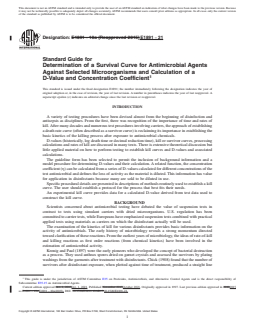
(Guide)Standard Guide for Determination of a Survival Curve for Antimicrobial Agents Against Selected Microorganisms and Calculation of a D-Value and Concentration Coefficient
General Information
- Abstract
SIGNIFICANCE AND USE
5.1 The different procedures and methods are designed to be used to produce survival data after microorganisms are exposed to antimicrobial agents in order to calculate values that can be used to analyze and rationalize the effectiveness of antimicrobial agents when tested using other, often applied test methods.
5.2 The data from these test procedures may be used in the selection and design of other tests of effectiveness of antimicrobial agents, some of which may be required by regulatory agencies to establish specific claims. Basic kinetic information about killing rate often serves as the initial information on which a testing program can be built.
SCOPE
1.1 This guide covers the methods for determining the death rate kinetics expressed as D-values. These values can be derived from the construction of a kill curve (or survivor curve) or by using other procedures for determining the number of survivors after exposure to antimicrobial chemicals or formulations. Options for calculations will be presented as well as the method for calculation of a concentration coefficient.
1.1.1 The test methods are designed to evaluate antimicrobial agents in formulations to define a survivor curve and to subsequently calculate a D-value. The tests are designed to produce data and calculate values that provide basic information of the rate-of-kill of antimicrobial formulations tested against single, selected microorganisms. In addition, calculated D-values from survivor curves from exposure at different dilutions of antimicrobial can be used to show the effect of dilution by calculation of the concentration exponent, η (2). D-value determination assumes the ideal of first-order killing reactions that are reflected in a straight-line reduction in count where a count-versus-time plot is done. The goal here is not to determine the time at which no survivors are found, but to determine a standard value that can be used in processing and exposure determinations or used to estimate dilutions.
1.1.2 As an example of potential use of kill curve data, the published FDA, OTC Tentative Final Monograph for Health-Care Antiseptic Drug Products, Proposed Rule, June 17, 1994 has suggested the testing of topically applied antimicrobial products using survival curve (or kill curve) calculations. The methods described in this guide are applicable to these products, but adjustments such as the use of antifoaming agents when the reaction mixture is stirred may be necessary to counteract the presence of detergents in many formulations. Frequently the sampling for these tests is done after very short intervals of exposure to the formulation, such as 30 and 60 s. This methodology also has been applied to preservative testing of antimicrobial ingredients in more complex cosmetic formulations (5).
1.2 The test methods discussed should be performed only by those trained in microbiological techniques.
1.3 The values stated in SI units are to be regarded as standard. No other units of measurement are included in this standard.
1.4 This standard does not purport to address all of the safety concerns, if any, associated with its use. It is the responsibility of the user of this standard to establish appropriate safety, health, and environmental practices and determine the applicability of regulatory limitations prior to use.
1.5 This international standard was developed in accordance with internationally recognized principles on standardization established in the Decision on Principles for the Development of International Standards, Guides and Recommendations issued by the World Trade Organization Technical Barriers to Trade (TBT) Committee.
- Status
- Published
- Publication Date
- 30-Sep-2021
- Technical Committee
- E35 - Pesticides, Antimicrobials, and Alternative Control Agents
- Drafting Committee
- E35.15 - Antimicrobial Agents
Buy Documents
ASTM E1891-21 - Standard Guide for Determination of a Survival Curve for Antimicrobial Agents Against Selected Microorganisms and Calculation of a D-Value and Concentration Coefficient
REDLINE ASTM E1891-21 - Standard Guide for Determination of a Survival Curve for Antimicrobial Agents Against Selected Microorganisms and Calculation of a D-Value and Concentration Coefficient
Overview
ASTM E1891-21: Standard Guide for Determination of a Survival Curve for Antimicrobial Agents Against Selected Microorganisms and Calculation of a D-Value and Concentration Coefficient provides comprehensive guidance on evaluating the effectiveness of antimicrobial agents. This standard establishes methods to determine death rate kinetics, construct survival (kill) curves, and calculate D-values and concentration coefficients for antimicrobials when tested against targeted microorganisms.
These procedures are essential for analyzing the rate at which microorganisms are killed by antimicrobial chemicals or formulations, offering fundamental data that supports regulatory claims, product development, and process validation in sectors including healthcare, cosmetics, and industrial hygiene.
Key Topics
Survival (Kill) Curve Construction:
The standard outlines methods to expose high-concentration microbial suspensions to antimicrobial agents and track the reduction in viable organisms over time. The resulting data are plotted to generate a survival (kill) curve, which visually represents the rate-of-kill.D-Value Calculation (Decimal Reduction Time):
The D-value represents the time required under specified conditions to achieve a one-log (90%) reduction in the microbial population. This value is key to quantifying antimicrobial efficacy and for comparing different agents or formulations.Concentration Coefficient (η):
When survival curve testing is conducted at multiple antimicrobial concentrations, the concentration coefficient is calculated to assess how dilution affects antimicrobial performance. This allows users to predict loss of activity upon dilution, which is critical for products that are diluted before use.Test Methods and Statistical Analysis:
The guide recommends protocols such as standard plate counts, membrane filtration, and the Most Probable Number (MPN) method for enumerating survivors, especially at low levels. It also describes the importance of replicating tests and applying statistical analysis, such as regression and standard error calculation, for robust data interpretation.Applicability and Limitations:
The standard advises that all test methods should be performed by personnel trained in microbiological techniques and that all results must be interpreted considering proper health, safety, and regulatory practices.
Applications
ASTM E1891-21 has broad practical value across diverse fields involving antimicrobial efficacy:
Product Development and Quality Assurance:
Manufacturers use these methods to objectively compare antimicrobial agents or formulations, optimize product concentrations, and support claims for efficacy on labels or in regulatory submissions.Regulatory Compliance:
Regulatory authorities often require D-values and survival curve data to substantiate antimicrobial effectiveness for healthcare antiseptics, disinfectants, preservatives in cosmetics, and other related products.Formulation Optimization:
The guidance on concentration coefficients facilitates formulation adjustments by predicting how changes in dilution impact antimicrobial activity, crucial for both concentrated products and ready-to-use solutions.Process Validation:
Industries such as food processing or pharmaceutical manufacturing rely on D-value determinations to validate sterilization and disinfection procedures, ensuring consistent microbial inactivation.
Related Standards
ASTM E1891-21 references and complements several other standards relevant to antimicrobial agent testing:
- ASTM D5259: Test Method for Isolation and Enumeration of Enterococci from Water by the Membrane Filter Procedure
- ASTM D5465: Practices for Determining Microbial Colony Counts from Waters Analyzed by Plating Methods
- ASTM E2756: Terminology Relating to Antimicrobial and Antiviral Agents
- Standard Methods for the Examination of Water and Wastewater (APHA 9215, 9221): Procedures for heterotrophic plate count and multiple-tube fermentation technique.
By aligning with international standards and regulatory guidelines, ASTM E1891-21 helps ensure consistency, accuracy, and reliability in antimicrobial efficacy testing. This standard is a vital resource for laboratories, manufacturers, and regulators committed to advancing public health and product safety through evidence-based antimicrobial evaluation.
Relations
- Effective Date
- 01-Apr-2024
- Effective Date
- 01-Jul-2020
- Effective Date
- 01-Nov-2019
- Effective Date
- 01-Apr-2019
- Effective Date
- 01-Apr-2018
- Effective Date
- 01-Jun-2016
- Effective Date
- 01-Aug-2014
- Effective Date
- 01-Jun-2012
- Effective Date
- 01-Jun-2012
- Effective Date
- 01-May-2010
- Effective Date
- 01-Jul-2006
- Effective Date
- 01-Jun-2004
- Effective Date
- 01-Jan-2000
- Effective Date
- 10-Dec-1998
Buy Documents
ASTM E1891-21 - Standard Guide for Determination of a Survival Curve for Antimicrobial Agents Against Selected Microorganisms and Calculation of a D-Value and Concentration Coefficient
REDLINE ASTM E1891-21 - Standard Guide for Determination of a Survival Curve for Antimicrobial Agents Against Selected Microorganisms and Calculation of a D-Value and Concentration Coefficient
Get Certified
Connect with accredited certification bodies for this standard

BSI Group
BSI (British Standards Institution) is the business standards company that helps organizations make excellence a habit.

TÜV Rheinland
TÜV Rheinland is a leading international provider of technical services.

TÜV SÜD
TÜV SÜD is a trusted partner of choice for safety, security and sustainability solutions.
Sponsored listings
Frequently Asked Questions
ASTM E1891-21 is a guide published by ASTM International. Its full title is "Standard Guide for Determination of a Survival Curve for Antimicrobial Agents Against Selected Microorganisms and Calculation of a D-Value and Concentration Coefficient". This standard covers: SIGNIFICANCE AND USE 5.1 The different procedures and methods are designed to be used to produce survival data after microorganisms are exposed to antimicrobial agents in order to calculate values that can be used to analyze and rationalize the effectiveness of antimicrobial agents when tested using other, often applied test methods. 5.2 The data from these test procedures may be used in the selection and design of other tests of effectiveness of antimicrobial agents, some of which may be required by regulatory agencies to establish specific claims. Basic kinetic information about killing rate often serves as the initial information on which a testing program can be built. SCOPE 1.1 This guide covers the methods for determining the death rate kinetics expressed as D-values. These values can be derived from the construction of a kill curve (or survivor curve) or by using other procedures for determining the number of survivors after exposure to antimicrobial chemicals or formulations. Options for calculations will be presented as well as the method for calculation of a concentration coefficient. 1.1.1 The test methods are designed to evaluate antimicrobial agents in formulations to define a survivor curve and to subsequently calculate a D-value. The tests are designed to produce data and calculate values that provide basic information of the rate-of-kill of antimicrobial formulations tested against single, selected microorganisms. In addition, calculated D-values from survivor curves from exposure at different dilutions of antimicrobial can be used to show the effect of dilution by calculation of the concentration exponent, η (2). D-value determination assumes the ideal of first-order killing reactions that are reflected in a straight-line reduction in count where a count-versus-time plot is done. The goal here is not to determine the time at which no survivors are found, but to determine a standard value that can be used in processing and exposure determinations or used to estimate dilutions. 1.1.2 As an example of potential use of kill curve data, the published FDA, OTC Tentative Final Monograph for Health-Care Antiseptic Drug Products, Proposed Rule, June 17, 1994 has suggested the testing of topically applied antimicrobial products using survival curve (or kill curve) calculations. The methods described in this guide are applicable to these products, but adjustments such as the use of antifoaming agents when the reaction mixture is stirred may be necessary to counteract the presence of detergents in many formulations. Frequently the sampling for these tests is done after very short intervals of exposure to the formulation, such as 30 and 60 s. This methodology also has been applied to preservative testing of antimicrobial ingredients in more complex cosmetic formulations (5). 1.2 The test methods discussed should be performed only by those trained in microbiological techniques. 1.3 The values stated in SI units are to be regarded as standard. No other units of measurement are included in this standard. 1.4 This standard does not purport to address all of the safety concerns, if any, associated with its use. It is the responsibility of the user of this standard to establish appropriate safety, health, and environmental practices and determine the applicability of regulatory limitations prior to use. 1.5 This international standard was developed in accordance with internationally recognized principles on standardization established in the Decision on Principles for the Development of International Standards, Guides and Recommendations issued by the World Trade Organization Technical Barriers to Trade (TBT) Committee.
SIGNIFICANCE AND USE 5.1 The different procedures and methods are designed to be used to produce survival data after microorganisms are exposed to antimicrobial agents in order to calculate values that can be used to analyze and rationalize the effectiveness of antimicrobial agents when tested using other, often applied test methods. 5.2 The data from these test procedures may be used in the selection and design of other tests of effectiveness of antimicrobial agents, some of which may be required by regulatory agencies to establish specific claims. Basic kinetic information about killing rate often serves as the initial information on which a testing program can be built. SCOPE 1.1 This guide covers the methods for determining the death rate kinetics expressed as D-values. These values can be derived from the construction of a kill curve (or survivor curve) or by using other procedures for determining the number of survivors after exposure to antimicrobial chemicals or formulations. Options for calculations will be presented as well as the method for calculation of a concentration coefficient. 1.1.1 The test methods are designed to evaluate antimicrobial agents in formulations to define a survivor curve and to subsequently calculate a D-value. The tests are designed to produce data and calculate values that provide basic information of the rate-of-kill of antimicrobial formulations tested against single, selected microorganisms. In addition, calculated D-values from survivor curves from exposure at different dilutions of antimicrobial can be used to show the effect of dilution by calculation of the concentration exponent, η (2). D-value determination assumes the ideal of first-order killing reactions that are reflected in a straight-line reduction in count where a count-versus-time plot is done. The goal here is not to determine the time at which no survivors are found, but to determine a standard value that can be used in processing and exposure determinations or used to estimate dilutions. 1.1.2 As an example of potential use of kill curve data, the published FDA, OTC Tentative Final Monograph for Health-Care Antiseptic Drug Products, Proposed Rule, June 17, 1994 has suggested the testing of topically applied antimicrobial products using survival curve (or kill curve) calculations. The methods described in this guide are applicable to these products, but adjustments such as the use of antifoaming agents when the reaction mixture is stirred may be necessary to counteract the presence of detergents in many formulations. Frequently the sampling for these tests is done after very short intervals of exposure to the formulation, such as 30 and 60 s. This methodology also has been applied to preservative testing of antimicrobial ingredients in more complex cosmetic formulations (5). 1.2 The test methods discussed should be performed only by those trained in microbiological techniques. 1.3 The values stated in SI units are to be regarded as standard. No other units of measurement are included in this standard. 1.4 This standard does not purport to address all of the safety concerns, if any, associated with its use. It is the responsibility of the user of this standard to establish appropriate safety, health, and environmental practices and determine the applicability of regulatory limitations prior to use. 1.5 This international standard was developed in accordance with internationally recognized principles on standardization established in the Decision on Principles for the Development of International Standards, Guides and Recommendations issued by the World Trade Organization Technical Barriers to Trade (TBT) Committee.
ASTM E1891-21 is classified under the following ICS (International Classification for Standards) categories: 11.080.20 - Disinfectants and antiseptics. The ICS classification helps identify the subject area and facilitates finding related standards.
ASTM E1891-21 has the following relationships with other standards: It is inter standard links to ASTM D5259-24, ASTM D5465-16(2020), ASTM E2756-19, ASTM D5259-19, ASTM E2756-18, ASTM D5465-16, ASTM D5259-14, ASTM D5259-92(2012), ASTM D5465-93(2012), ASTM E2756-10, ASTM D5259-92(2006), ASTM D5465-93(2004), ASTM D5259-92(2000), ASTM D5465-93(1998). Understanding these relationships helps ensure you are using the most current and applicable version of the standard.
ASTM E1891-21 is available in PDF format for immediate download after purchase. The document can be added to your cart and obtained through the secure checkout process. Digital delivery ensures instant access to the complete standard document.
Standards Content (Sample)
This international standard was developed in accordance with internationally recognized principles on standardization established in the Decision on Principles for the
Development of International Standards, Guides and Recommendations issued by the World Trade Organization Technical Barriers to Trade (TBT) Committee.
Designation: E1891 − 21
Standard Guide for
Determination of a Survival Curve for Antimicrobial Agents
Against Selected Microorganisms and Calculation of a
D-Value and Concentration Coefficient
This standard is issued under the fixed designation E1891; the number immediately following the designation indicates the year of
original adoption or, in the case of revision, the year of last revision. A number in parentheses indicates the year of last reapproval. A
superscript epsilon (´) indicates an editorial change since the last revision or reapproval.
INTRODUCTION
A variety of testing procedures have been devised almost from the beginning of disinfection and
antisepsis as disciplines. From the first, there was recognition of the importance of time and rates of
kill.Aftermanydecadesandnumeroustestproceduresinvolvingcarriers,theapproachofestablishing
a death rate curve (often described as a survivor curve) is reclaiming its importance in establishing the
basic kinetics of the killing process after exposure to antimicrobial chemicals.
D-values (historically, log death time or decimal reduction time), kill or survivor curves, processing
calculations and rates of kill are discussed in many texts. There is extensive theoretical discussion but
little applied material on how to perform testing to establish kill curves and D-values and associated
calculations.
The guideline form has been selected to permit the inclusion of background information and a
model procedure for determining D-values and their calculation.Arelated function, the concentration
coefficient(η)canbecalculatedfromaseriesofD-valuescalculatedfordifferentconcentrationsofthe
test antimicrobial and defines the loss of activity as the material is diluted. This information has value
for application in disinfectants because many are sold to be diluted in use.
Specificproceduraldetailsarepresentedindescriptionsofmethodsroutinelyusedtoestablishakill
curve. The user should establish a protocol for the process that best fits their needs.
An experimental kill curve provides data for a calculated D-value derived from test data used to
construct the kill curve.
BACKGROUND
Scientists concerned about antimicrobial testing have debated the value of suspension tests in
contrast to tests using simulant carriers with dried microorganisms. U.S. regulation has been
committedtocarriertests,whileEuropeanshaveemphasizedsuspensiontestscombinedwithpractical
applied tests using materials as carriers on which the disinfectant actually will be used.
The examination of the kinetics of kill for various disinfectants provides basic information on the
activity of antimicrobials. The early history of microbiology reveals a strong momentum directed
towardclarificationofthesereactions.Fromtheearliestyearsofmicrobiology,theideasofrate-of-kill
and killing reactions as first order reactions (from chemical kinetics) have been involved in the
estimation of antimicrobial activity.
Kronig and Paul (1897) were the early pioneers who developed the concept of bacterial destruction
as a process. They used anthrax spores dried on garnet crystals and assessed the survivors by plating
washings from the garments after treatment with disinfectants. Chick (1908) found that the number of
survivors after disinfectant exposure, when plotted against time of treatment, produced a straight line
that showed similarity to chemical, equimolecular reactions. Distortions in the expected straight-line
reactions were noted by Chick as well as in subsequent investigations. Over the years, the most
common type of deviation from the expected, straight-line survivor curve is a sigmodial one
displaying a shoulder, a lag or delay in logarithmic kill, and ending in distinct tailing, sometimes
indicating a resistant population.
There has been a variety of procedures advanced for accumulating data that can be used to calculate
D-values and construct survivor curves.
Esty and Meyer (1922) introduced the terminology we currently use in relation to bacterial kill
Copyright © ASTM International, 100 Barr Harbor Drive, PO Box C700, West Conshohocken, PA 19428-2959. United States
E1891 − 21
whether for spores or vegetative bacterial cells in devising thermal processing to eliminate Clostidium
botulinium in the canning industry. They also devised end-point analysis for interpretation of the
results of heat exposure and for processing calculations. Their procedure involved sampling multiple
tubes or other containers of product and analysis of the number remaining positive to determine the
number of survivors by Most Probable Number (MPN) analysis using the pattern of positive and
negative tubes. (1) This analysis is done after an exposure period when there are fewer bacterial cells
or spores in the container and positive and negative tubes can be expected on recovery.
Single-sample subculturing of aliquot samples from a reaction vessel containing the test organism
and the test antimicrobial has been the basic means for establishing survival curves. Usually a
suspension of target microorganisms is exposed to a disinfectant\sterilant and aliquots are withdrawn
at specific time intervals and assessed for survivors, usually with plate counts. Because of tailing
problems and difficulty in enumerating small numbers, when only a few survivors are left, MPN
methods of enumeration are recommended and often used (1, 2, 3).Acommon method derived from
thermal processing in the canning industry is the end-point method, described above, in which the
number of positive and negative tubes from replicate sampling (such as tubes or cans) is used alone
or in the combination with single sampling to construct a survivor curve and plotted to determine
D-values. (4)
Many antimicrobial formulations available for test are diluted in use. When D-values are
determined and calculated at more than one concentration (dilution) of an antimicrobial, the
concentration coefficient, designated as the Greek letter eta or η, denotes the effect of dilution on the
activity of a chemical or formulation.
This guide is under the jurisdiction of ASTM Committee E35 on Pesticides, Antimicrobials, and Alternative Control Agents and is the direct responsibility of
Subcommittee E35.15 on Antimicrobial Agents.
Current edition approved Oct. 1, 2021. Published October 2021. Originally approved in 1997. Last previous edition approved in 2015 as E1891 – 10a(2015). DOI:
10.1520/E1891-21.
The boldface numbers given in parentheses refer to a list of references at the end of the text.
1. Scope* products using survival curve (or kill curve) calculations. The
methods described in this guide are applicable to these
1.1 Thisguidecoversthemethodsfordeterminingthedeath
products,butadjustmentssuchastheuseofantifoamingagents
rate kinetics expressed as D-values. These values can be
when the reaction mixture is stirred may be necessary to
derivedfromtheconstructionofakillcurve(orsurvivorcurve)
counteract the presence of detergents in many formulations.
or by using other procedures for determining the number of
Frequently the sampling for these tests is done after very short
survivors after exposure to antimicrobial chemicals or formu-
intervals of exposure to the formulation, such as 30 and 60 s.
lations.Optionsforcalculationswillbepresentedaswellasthe
This methodology also has been applied to preservative testing
method for calculation of a concentration coefficient.
of antimicrobial ingredients in more complex cosmetic formu-
1.1.1 The test methods are designed to evaluate antimicro-
lations (5).
bial agents in formulations to define a survivor curve and to
subsequently calculate a D-value. The tests are designed to
1.2 Thetestmethodsdiscussedshouldbeperformedonlyby
produce data and calculate values that provide basic informa-
those trained in microbiological techniques.
tion of the rate-of-kill of antimicrobial formulations tested
1.3 The values stated in SI units are to be regarded as
againstsingle,selectedmicroorganisms.Inaddition,calculated
standard. No other units of measurement are included in this
D-values from survivor curves from exposure at different
standard.
dilutions of antimicrobial can be used to show the effect of
1.4 This standard does not purport to address all of the
dilution by calculation of the concentration exponent, η (2).
safety concerns, if any, associated with its use. It is the
D-value determination assumes the ideal of first-order killing
responsibility of the user of this standard to establish appro-
reactions that are reflected in a straight-line reduction in count
priate safety, health, and environmental practices and deter-
where a count-versus-time plot is done. The goal here is not to
mine the applicability of regulatory limitations prior to use.
determine the time at which no survivors are found, but to
determine a standard value that can be used in processing and 1.5 This international standard was developed in accor-
exposure determinations or used to estimate dilutions. dance with internationally recognized principles on standard-
1.1.2 As an example of potential use of kill curve data, the ization established in the Decision on Principles for the
published FDA, OTC Tentative Final Monograph for Health- Development of International Standards, Guides and Recom-
Care Antiseptic Drug Products, Proposed Rule, June 17, 1994 mendations issued by the World Trade Organization Technical
has suggested the testing of topically applied antimicrobial Barriers to Trade (TBT) Committee.
E1891 − 21
2. Referenced Documents 4.2 This test method involves testing a high count suspen-
3 sion of a microorganism as the initial challenge inoculum; at
2.1 ASTM Standards:
7 8 6
least 10 to 10 cfu/mL, to achieve a 10 cfu/mL when added
D5259 Test Method for Isolation and Enumeration of En-
to the reaction chamber and exposed to disinfectant and to
terococci from Water by the Membrane Filter Procedure
sporicidal chemicals.
D5465 Practices for Determining Microbial Colony Counts
from Waters Analyzed by Plating Methods 4.3 Agrowth medium for the inoculum must produce a high
E2756 Terminology Relating to Antimicrobial and Antiviral numbers of vegetative cells or spores within a reasonable time
Agents period with consistent resistance to chemical disinfectants.
2.2 APHA Standards:
4.4 Where possible agitation of the reaction chamber is
9215 Heterotrophic Plate Count
recommended.
9221 Multiple-Tube Fermentation Technique for Members
4.5 Currently a test temperature of 20 °C 6 1 °C is recom-
of the Coliform Group
mended. This temperature is lower than most environmental
temperatures in practice (room temperature). A more typical
3. Terminology
temperaturerangeissuggestedat22 °C 61 °C.Theactivityof
3.1 Definitions—For definitions of terms used in this guide,
many antimicrobials is increased with increasing temperature.
refer to Terminology E2756. An alternative temperature may be selected for testing, but
3.1.1 D-value or decimal reduction time, n—(often referred
must be controlled and constant.
to as log death time) relates reaction kinetics and inactivation
4.6 An alternative testing technique to single sequential
rate.
timed samples may be included in execution of this method
3.1.1.1 Discussion—It is defined as the time (usually in
because a major problem has occurred with many reported
minutes)toreducethemicrobiologicpopulationonelog orto
studies. Many kill or survival curves have shown a rapid kill of
reduce it to 90 % or reduce it to 10 % of the initial population.
several logs after an exposure period expected to eliminate
3.1.2 Fn = fraction negative (FN) data, n—(quantal data)
survivors, yet leaving a few survivors, usually ten or fewer
areexperimentalresultsintheformofadichotomousresponse:
ranging to 1000. This number fluctuates for an extended time
the unit tested is either positive (showing growth) or negative
with repeated sampling and has been termed, tailing.Achange
(showing no growth).
from single sampling to replicate - unit sampling is recom-
mended as a means to alleviate this problem.
3.1.3 concentration exponent, η:(dilution coeffıcient),
n—measurestheeffectofchangesinconcentration(ordilution)
4.7 Repetition of the estimation of a survival curve is
on cell death rate.
recommended. Recommendations for three to five replications
with sampling at five time points have been made.
3.1.3.1 Discussion—To measure η, the time necessary to
produce a comparable degree of death in a bacterial suspension
5. Significance and Use
for at least two different concentrations is measured (D-value)
(6).
5.1 Thedifferentproceduresandmethodsaredesignedtobe
3.1.4 most probable number (MPN), n—data in which a
used to produce survival data after microorganisms are ex-
fraction of the replicate units are negative and can be analyzed
posed to antimicrobial agents in order to calculate values that
statistically using the MPN technique to yield the probable
can be used to analyze and rationalize the effectiveness of
number of survivors at the respective exposure time.
antimicrobial agents when tested using other, often applied test
methods.
4. Summary of a Basic Test Method
5.2 The data from these test procedures may be used in the
4.1 This test method is conducted on selected microbial
selection and design of other tests of effectiveness of antimi-
species cultured to produce high-count suspensions that are
crobial agents, some of which may
...
This document is not an ASTM standard and is intended only to provide the user of an ASTM standard an indication of what changes have been made to the previous version. Because
it may not be technically possible to adequately depict all changes accurately, ASTM recommends that users consult prior editions as appropriate. In all cases only the current version
of the standard as published by ASTM is to be considered the official document.
Designation: E1891 − 10a (Reapproved 2015) E1891 − 21
Standard Guide for
Determination of a Survival Curve for Antimicrobial Agents
Against Selected Microorganisms and Calculation of a
D-Value and Concentration Coefficient
This standard is issued under the fixed designation E1891; the number immediately following the designation indicates the year of
original adoption or, in the case of revision, the year of last revision. A number in parentheses indicates the year of last reapproval. A
superscript epsilon (´) indicates an editorial change since the last revision or reapproval.
INTRODUCTION
A variety of testing procedures have been devised almost from the beginning of disinfection and
antisepsis as disciplines. From the first, there was recognition of the importance of time and rates of
kill. After many decades and numerous test procedures involving carriers, the approach of establishing
a death rate curve (often described as a survivor curve) is reclaiming its importance in establishing the
basic kinetics of the killing process after exposure to antimicrobial chemicals.
D-values (historically, log death time or decimal reduction time), kill or survivor curves, processing
calculations and rates of kill are discussed in many texts. There is extensive theoretical discussion but
little applied material on how to perform testing to establish kill curves and D-values and associated
calculations.
The guideline form has been selected to permit the inclusion of background information and a
model procedure for determining D-values and their calculation. A related function, the concentration
coefficient (η) can be calculated from a series of D-values calculated for different concentrations of the
test antimicrobial and defines the loss of activity as the material is diluted. This information has value
for application in disinfectants because many are sold to be diluted in use.
Specific procedural details are presented in descriptions of methods routinely used to establish a kill
curve. The user should establish a protocol for the process that best fits their needs.
An experimental kill curve provides data for a calculated D-value derived from test data used to
construct the kill curve.
BACKGROUND
Scientists concerned about antimicrobial testing have debated the value of suspension tests in
contrast to tests using simulant carriers with dried microorganisms. U.S. regulation has been
committed to carrier tests, while Europeans have emphasized suspension tests combined with practical
applied tests using materials as carriers on which the disinfectant actually will be used.
The examination of the kinetics of kill for various disinfectants provides basic information on the
activity of antimicrobials. The early history of microbiology reveals a strong momentum directed
toward clarification of these reactions. From the earliest years of microbiology, the ideas of rate-of-kill
and killing reactions as first order reactions (from chemical kinetics) have been involved in the
estimation of antimicrobial activity.
Kronig and Paul (1897) were the early pioneers who developed the concept of bacterial destruction
as a process. They used anthrax spores dried on garnet crystals and assessed the survivors by plating
washings from the garments after treatment with disinfectants. Chick (1908) found that the number of
survivors after disinfectant exposure, when plotted against time of treatment, produced a straight line
This guide is under the jurisdiction of ASTM Committee E35 on Pesticides, Antimicrobials, and Alternative Control Agents and is the direct responsibility of
Subcommittee E35.15 on Antimicrobial Agents.
Current edition approved Oct. 1, 2015Oct. 1, 2021. Published November 2015October 2021. Originally approved in 1997. Last previous edition approved in 20102015
as E1891 – 10a.E1891 – 10a(2015). DOI: 10.1520/E1891-10AR15.10.1520/E1891-21.
Copyright © ASTM International, 100 Barr Harbor Drive, PO Box C700, West Conshohocken, PA 19428-2959. United States
E1891 − 21
that showed similarity to chemical, equimolecular reactions. Distortions in the expected straight-line
reactions were noted by Chick as well as in subsequent investigations. Over the years, the most
common type of deviation from the expected, straight-line survivor curve is a sigmodial one
displaying a shoulder, a lag or delay in logarithmic kill, and ending in distinct tailing, sometimes
indicating a resistant population.
There has been a variety of procedures advanced for accumulating data that can be used to calculate
D-values and construct survivor curves.
Esty and Meyer (1922) introduced the terminology we currently use in relation to bacterial kill
whether for spores or vegetative bacterial cells in devising thermal processing to eliminate Clostidium
botulinium in the canning industry. They also devised end-point analysis for interpretation of the
results of heat exposure and for processing calculations. Their procedure involved sampling multiple
tubes or other containers of product and analysis of the number remaining positive to determine the
number of survivors by Most Probable Number (MPN) analysis using the pattern of positive and
negative tubes. (1) This analysis is done after an exposure period when there are fewer bacterial cells
or spores in the container and positive and negative tubes can be expected on recovery.
Single-sample subculturing of aliquot samples from a reaction vessel containing the test organism
and the test antimicrobial has been the basic means for establishing survival curves. Usually a
suspension of target microorganisms is exposed to a disinfectant\sterilant and aliquots are withdrawn
at specific time intervals and assessed for survivors, usually with plate counts. Because of tailing
problems and difficulty in enumerating small numbers, when only a few survivors are left, MPN
methods of enumeration are recommended and often used (1, 2, 3). A common method derived from
thermal processing in the canning industry is the end-point method, described above, in which the
number of positive and negative tubes from replicate sampling (such as tubes or cans) is used alone
or in the combination with single sampling to construct a survivor curve and plotted to determine
D-values. (4)
Many antimicrobial formulations available for test are diluted in use. When D-values are
determined and calculated at more than one concentration (dilution) of an antimicrobial, the
concentration coefficient, designated as the Greek letter eta or η, denotes the effect of dilution on the
activity of a chemical or formulation.
1. Scope Scope*
1.1 This guide covers the methods for determining the death rate kinetics expressed as D-values. These values can be derived from
the construction of a kill curve (or survivor curve) or by using other procedures for determining the number of survivors after
exposure to antimicrobial chemicals or formulations. Options for calculations will be presented as well as the method for
calculation of a concentration coefficient.
1.1.1 The test methods are designed to evaluate antimicrobial agents in formulations to define a survivor curve and to subsequently
calculate a D-value. The tests are designed to produce data and calculate values that provide basic information of the rate-of-kill
of antimicrobial formulations tested against single, selected microorganisms. In addition, calculated D-values from survivor curves
from exposure at different dilutions of antimicrobial can be used to show the effect of dilution by calculation of the concentration
exponent, η (2). D-value determination assumes the ideal of first-order killing reactions that are reflected in a straight-line reduction
in count where a count-versus-time plot is done. The goal here is not to determine the time at which no survivors are found, but
to determine a standard value that can be used in processing and exposure determinations or used to estimate dilutions.
1.1.2 As an example of potential use of kill curve data, the published FDA, OTC Tentative Final Monograph for Health-Care
Antiseptic Drug Products, Proposed Rule, June 17, 1994 has suggested the testing of topically applied antimicrobial products using
survival curve (or kill curve) calculations. The methods described in this guide are applicable to these products, but adjustments
such as the use of antifoaming agents when the reaction mixture is stirred may be necessary to counteract the presence of detergents
in many formulations. Frequently the sampling for these tests is done after very short intervals of exposure to the formulation, such
as 30 and 60 s. This methodology also has been applied to preservative testing of antimicrobial ingredients in more complex
cosmetic formulations (5).
1.2 The test methods discussed should be performed only by those trained in microbiological techniques.
The boldface numbers given in parentheses refer to a list of references at the end of the text.
E1891 − 21
1.3 The values stated in SI units are to be regarded as standard. No other units of measurement are included in this standard.
1.4 This standard does not purport to address all of the safety concerns, if any, associated with its use. It is the responsibility
of the user of this standard to establish appropriate safety safety, health, and healthenvironmental practices and determine the
applicability of regulatory limitations prior to use.
1.5 This international standard was developed in accordance with internationally recognized principles on standardization
established in the Decision on Principles for the Development of International Standards, Guides and Recommendations issued
by the World Trade Organization Technical Barriers to Trade (TBT) Committee.
2. Referenced Documents
2.1 ASTM Standards:
D5259 Test Method for Isolation and Enumeration of Enterococci from Water by the Membrane Filter Procedure
D5465 Practices for Determining Microbial Colony Counts from Waters Analyzed by Plating Methods
E2756 Terminology Relating to Antimicrobial and Antiviral Agents
2.2 APHA Standards:
9215 Heterotrophic Plate Count
9221 Multiple-Tube Fermentation Technique for Members of the Coliform Group
3. Terminology
3.1 Definitions:Definitions—For definitions of terms used in this guide, refer to Terminology E2756.
3.1.1 D-value or decimal reduction time—time, n—(often referred to as log death time) relates reaction kinetics and inactivation
rate. It is defined as the time (usually in minutes) to reduce the microbiologic population one log or to reduce it to 90 % or reduce
it to 10 % of the initial population.
3.1.1.1 Discussion—
It is defined as the time (usually in minutes) to reduce the microbiologic population one log or to reduce it to 90 % or reduce
it to 10 % of the initial population.
3.1.2 Fn = fraction negative (FN) data—data, n—(quantal data) are experimental results in the form of a dichotomous response:
the unit tested is either positive (showing growth) or negative (showing no growth).
3.1.3 concentration exponent, η: (dilutionη:(dilution coeffıcient), coeffıcient)—n—measures the effect of changes in concentration
(or dilution) on cell death rate. To measure η, the time necessary to produce a comparable degree of death in a bacterial suspension
for at least two different concentrations is measured (D-value) (6).
3.1.3.1 Discussion—
To measure η, the time necessary to produce a comparable degree of death in a bacterial suspension for at least two different
concentrations is measured (D-value) (6).
3.1.4 most probable number (MPN)—(MPN), n—data in which a fraction of the replicate units are negative and can be analyzed
statistically using the MPN technique to yield the probable number of survivors at the respective exposure time.
4. Summary of a Basic Test Method
4.1 This test method is conducted on selected microbial species cultured to produce high-count suspensions that are exposed to
the test antimicrobial agent or formulation(s) under standardized conditions of temperature and agitation. Samples from this
reaction mixture are withdrawn at pre-set times, neutralized and cultured to determine survivors, using standard procedures. A
D-value is calculated from the post exposure survivor data utilizing published and accepted methods.
4.2 This test method involves testing a high count suspension of a microorganism as the initial challenge inoculum; at least 10
8 6
to 10 cfu/mL, to achieve a 10 cfu/mL when added to the reaction chamber and exposed to disinfectant and to sporicidal
chemicals.
For referenced ASTM standards, visit the ASTM website, www.astm.org, or contact ASTM Customer Service at service@astm.org. For Annual Book of ASTM Standards
volume information, refer to the standard’s Document Summary page on the ASTM website.
Available online from:
http://standardmethods.org/store/ProductView.cfm?ProductID=102, or from American Public Health Association (APHA), Standard Methods for the Examination of Water
and Wastewater, 800 I Street, NW Washington, DC 20001, http://www.apha.org.
E1891 − 21
4.3 A growth medium for the inoculum must produce a high numbers of vegetative cells or spores within a reasonable time period
with consistent resistance to chemical disinfectants.
4.4 Where possible agitation of the reaction chamber is recommended.
4.5 Currently a test temperature of 2020 °C 6 1°C1 °C is recommended. This temperature is lower than most environmental
temperatures in practice (room temperature). A more typical temperature range is suggested at 2222 °C 6 1°C.1 °C. The activity
of many antimicrobials is increased with increasing temperature. An alternative temperature may be selected for testing, but must
be controlled and constant.
4.6 An alternative testing technique to single sequential timed samples may be included in execution of this method because a
major proble
...