

ASTM E3058-16
(Test Method)Standard Test Method for Determining the Residual Kill Activity of Hand Antiseptic Formulations
General Information
- Abstract
SIGNIFICANCE AND USE
5.1 Many marketed hand antiseptics make claims of "long-lasting protection” or “extended kill” (for example 6 hours), which are typically based on results of testing as described in Test Method E1882 or Guide E2752, or both. At this time there are no standard methods for evaluating a hand antiseptic formulation for its ability to kill microorganisms on hands when a “dry” contamination event occurs at some time after product use. This test method provides a method to substantiate residual kill claims for hand antiseptics.
SCOPE
1.1 This test method is designed to determine the residual killing activity of skin antiseptics against transient microbial skin flora on the hands .2 It may be used to evaluate products that are used with the aid of water and rinsed off and those that are used without the aid of water and not rinsed off.
1.2 Performance of this procedure requires the knowledge of regulations pertaining to the protection of human subjects (see 21 CFR Parts 50 and 56).
1.3 This test method should be performed by persons with training in microbiology, in facilities designed and equipped for work with potentially infectious agents at biosafety level 2.
1.4 Units—The values stated in SI units are to be regarded as standard. No other units of measurement are included in this standard.
1.5 This standard does not purport to address all of the safety concerns, if any, associated with its use. It is the responsibility of the user of this standard to establish appropriate safety and health practices and determine the applicability of regulatory limitations prior to use. For more specific precautionary statements see 8.1.
- Status
- Published
- Publication Date
- 14-Nov-2016
- Technical Committee
- E35 - Pesticides, Antimicrobials, and Alternative Control Agents
- Drafting Committee
- E35.15 - Antimicrobial Agents
Overview
ASTM E3058-16: Standard Test Method for Determining the Residual Kill Activity of Hand Antiseptic Formulations provides a comprehensive protocol for evaluating how long hand antiseptic products continue to kill transient skin microorganisms after application. As claims of "long-lasting protection" or "extended kill" become common in the hand hygiene industry, there is a critical need for a standardized technique to substantiate these claims under reproducible laboratory conditions.
This test method applies to both rinse-off and leave-on hand antiseptics and is designed to measure microbial reduction following a simulated "dry" contamination event, some time after the product has been used. The procedure uses healthy adult volunteers and controlled exposure to a bacterial test organism, making it relevant for manufacturers, regulatory submissions, and quality assurance in the development of effective hand hygiene products.
Key Topics
- Residual Kill Activity: Evaluates how effectively hand antiseptics reduce transient bacterial contamination over time, following initial application.
- Test Organism: Uses Staphylococcus aureus (ATCC 6538) as the challenge microorganism, which is significant due to its relevance in healthcare-associated infections.
- Types of Products Evaluated:
- Hand rubs (gels, foams, liquids, sprays, wipes) that do not require rinsing
- Hand washes requiring rinse-off
- Human Subject Protocols: Involves healthy adult volunteers, ensuring informed consent and adherence to ethics regulations, specifically referencing US FDA 21 CFR Parts 50 and 56.
- Microbiological Techniques: Utilizes controlled contamination of the skin, precise application of test formulations, and standardized recovery and enumeration of surviving microorganisms.
- Safety and Compliance: Requires work in biosafety level 2 laboratories with trained personnel, adherence to all regulatory and ethical guidelines, and post-test decontamination protocols for subjects.
Applications
ASTM E3058-16 is applicable in:
- Product Development and Validation: Enables manufacturers of hand sanitizers, hand rubs, and hand washes to scientifically demonstrate extended antimicrobial efficacy.
- Regulatory Submissions: Provides data useful for substantiating "long-lasting protection" or "residual kill" claims required by national and international regulatory agencies.
- Quality Assurance: Serves as a benchmark in ongoing product quality checks and comparative assessments with reference or competitive products.
- Healthcare Settings: Helps ensure that hand hygiene products used by healthcare personnel deliver effective, lasting reduction of pathogenic microorganisms.
- Laboratory Research: Supports reproducible research and product comparisons using a harmonized methodology for assessing residual antimicrobial properties.
By following this standard, stakeholders-including manufacturers, regulatory authorities, and healthcare institutions-can ensure that marketing claims about extended efficacy are supported by robust and reproducible scientific evidence, enhancing trust in infection prevention products.
Related Standards
For a holistic approach to the evaluation and terminology of hand antiseptics, ASTM E3058-16 references and aligns with several other internationally recognized standards, including:
- ASTM E1882: Evaluation of Antimicrobial Formulations by the Agar Patch Technique
- ASTM E2752: Guide for Evaluation of Residual Effectiveness of Antibacterial Personal Cleansing Products
- ASTM E2197: Quantitative Disk Carrier Test Method for Bactericidal, Virucidal, Fungicidal, Mycobactericidal, and Sporicidal Activities of Chemicals
- ASTM E1054: Evaluation of Inactivators of Antimicrobial Agents
- ASTM E2756: Terminology Relating to Antimicrobial and Antiviral Agents
- US FDA 21 CFR Parts 50 and 56: Human subject protection and Institutional Review Boards
Keywords: ASTM E3058, hand antiseptic, residual kill activity, antimicrobial efficacy, hand sanitizer, hand hygiene, extended protection, Staphylococcus aureus, healthcare infection control, long-lasting disinfectant.
Relations
- Effective Date
- 01-Nov-2019
- Effective Date
- 01-Apr-2018
- Effective Date
- 01-Dec-2017
- Effective Date
- 01-Dec-2017
- Effective Date
- 01-Oct-2015
- Effective Date
- 01-Jan-2011
- Effective Date
- 01-May-2010
- Effective Date
- 01-Apr-2010
- Effective Date
- 01-Apr-2010
- Effective Date
- 01-Apr-2008
- Effective Date
- 01-Nov-2005
- Effective Date
- 10-May-2002
- Effective Date
- 10-Apr-2002
- Effective Date
- 10-May-2000
Get Certified
Connect with accredited certification bodies for this standard

BSI Group
BSI (British Standards Institution) is the business standards company that helps organizations make excellence a habit.

TÜV Rheinland
TÜV Rheinland is a leading international provider of technical services.

TÜV SÜD
TÜV SÜD is a trusted partner of choice for safety, security and sustainability solutions.
Sponsored listings
Frequently Asked Questions
ASTM E3058-16 is a standard published by ASTM International. Its full title is "Standard Test Method for Determining the Residual Kill Activity of Hand Antiseptic Formulations". This standard covers: SIGNIFICANCE AND USE 5.1 Many marketed hand antiseptics make claims of "long-lasting protection” or “extended kill” (for example 6 hours), which are typically based on results of testing as described in Test Method E1882 or Guide E2752, or both. At this time there are no standard methods for evaluating a hand antiseptic formulation for its ability to kill microorganisms on hands when a “dry” contamination event occurs at some time after product use. This test method provides a method to substantiate residual kill claims for hand antiseptics. SCOPE 1.1 This test method is designed to determine the residual killing activity of skin antiseptics against transient microbial skin flora on the hands .2 It may be used to evaluate products that are used with the aid of water and rinsed off and those that are used without the aid of water and not rinsed off. 1.2 Performance of this procedure requires the knowledge of regulations pertaining to the protection of human subjects (see 21 CFR Parts 50 and 56). 1.3 This test method should be performed by persons with training in microbiology, in facilities designed and equipped for work with potentially infectious agents at biosafety level 2. 1.4 Units—The values stated in SI units are to be regarded as standard. No other units of measurement are included in this standard. 1.5 This standard does not purport to address all of the safety concerns, if any, associated with its use. It is the responsibility of the user of this standard to establish appropriate safety and health practices and determine the applicability of regulatory limitations prior to use. For more specific precautionary statements see 8.1.
SIGNIFICANCE AND USE 5.1 Many marketed hand antiseptics make claims of "long-lasting protection” or “extended kill” (for example 6 hours), which are typically based on results of testing as described in Test Method E1882 or Guide E2752, or both. At this time there are no standard methods for evaluating a hand antiseptic formulation for its ability to kill microorganisms on hands when a “dry” contamination event occurs at some time after product use. This test method provides a method to substantiate residual kill claims for hand antiseptics. SCOPE 1.1 This test method is designed to determine the residual killing activity of skin antiseptics against transient microbial skin flora on the hands .2 It may be used to evaluate products that are used with the aid of water and rinsed off and those that are used without the aid of water and not rinsed off. 1.2 Performance of this procedure requires the knowledge of regulations pertaining to the protection of human subjects (see 21 CFR Parts 50 and 56). 1.3 This test method should be performed by persons with training in microbiology, in facilities designed and equipped for work with potentially infectious agents at biosafety level 2. 1.4 Units—The values stated in SI units are to be regarded as standard. No other units of measurement are included in this standard. 1.5 This standard does not purport to address all of the safety concerns, if any, associated with its use. It is the responsibility of the user of this standard to establish appropriate safety and health practices and determine the applicability of regulatory limitations prior to use. For more specific precautionary statements see 8.1.
ASTM E3058-16 is classified under the following ICS (International Classification for Standards) categories: 11.080.20 - Disinfectants and antiseptics. The ICS classification helps identify the subject area and facilitates finding related standards.
ASTM E3058-16 has the following relationships with other standards: It is inter standard links to ASTM E2756-19, ASTM E2756-18, ASTM E2197-17, ASTM E2197-17e1, ASTM E2752-10(2015), ASTM E2197-11, ASTM E2756-10, ASTM E2752-10, ASTM E1882-10, ASTM E1054-08, ASTM E1882-05, ASTM E1054-02, ASTM E2197-02, ASTM E1882-00. Understanding these relationships helps ensure you are using the most current and applicable version of the standard.
ASTM E3058-16 is available in PDF format for immediate download after purchase. The document can be added to your cart and obtained through the secure checkout process. Digital delivery ensures instant access to the complete standard document.
Standards Content (Sample)
This international standard was developed in accordance with internationally recognized principles on standardization established in the Decision on Principles for the
Development of International Standards, Guides and Recommendations issued by the World Trade Organization Technical Barriers to Trade (TBT) Committee.
Designation: E3058 − 16
Standard Test Method for
Determining the Residual Kill Activity of Hand Antiseptic
Formulations
This standard is issued under the fixed designation E3058; the number immediately following the designation indicates the year of
original adoption or, in the case of revision, the year of last revision.Anumber in parentheses indicates the year of last reapproval.A
superscript epsilon (´) indicates an editorial change since the last revision or reapproval.
1. Scope E2197Quantitative Disk Carrier Test Method for Determin-
ing Bactericidal, Virucidal, Fungicidal, Mycobactericidal,
1.1 This test method is designed to determine the residual
and Sporicidal Activities of Chemicals
killing activity of skin antiseptics against transient microbial
2 E2756Terminology Relating toAntimicrobial andAntiviral
skin flora on the hands . It may be used to evaluate products
Agents
thatareusedwiththeaidofwaterandrinsedoffandthosethat
2.2 Federal Standards:
are used without the aid of water and not rinsed off.
21 CFR Part 50Protection of Human Subjects
1.2 Performance of this procedure requires the knowledge
21 CFR Part 56Institutional Review Boards
of regulations pertaining to the protection of human subjects
(see 21 CFR Parts 50 and 56).
3. Terminology
1.3 This test method should be performed by persons with
3.1 Definitions—For definitions of terms used in this
training in microbiology, in facilities designed and equipped
document, see Terminology E2756.
for work with potentially infectious agents at biosafety level 2.
3.2 Definitions of Terms Specific to This Standard:
1.4 Units—The values stated in SI units are to be regarded
3.2.1 healthcare personnel hand rub, n—an antimicrobial
asstandard.Nootherunitsofmeasurementareincludedinthis
gel, foam, liquid, spray, or wipe, applied by rubbing to reduce
standard.
the transient microbial skin flora on hands that are not visibly
soiled,andwhichdoesnotrequireapost-treatmentwaterrinse.
1.5 This standard does not purport to address all of the
Such agents may also be referred to as hand rubs, hygienic
safety concerns, if any, associated with its use. It is the
hand rubs, hand sanitizers, or hand antiseptics.
responsibility of the user of this standard to establish appro-
priate safety and health practices and determine the applica-
3.2.2 healthcare personnel hand wash, n—acleanserrequir-
bility of regulatory limitations prior to use. For more specific
ing rinsing or a non-rinse agent intended to reduce transient
precautionary statements see 8.1.
microbial skin flora on the hands.
3.2.3 room temperature, n—temperature in the range of 20
2. Referenced Documents
to 25°C (68 to 77°F).
2.1 ASTM Standards:
3.2.4 test bacteria, n—an applied suspension of bacteria
E1054Test Methods for Evaluation of Inactivators of Anti-
having characteristics that permit ready identification of colo-
microbial Agents
nies. Test bacteria are used to simulate a transient topical
E2752Guide for Evaluation of Residual Effectiveness of
microbial contaminant. These may also be referred to as test
Antibacterial Personal Cleansing Products
organisms, marker organisms, simulants, or contaminants.
E1882Test Method for Evaluation ofAntimicrobial Formu-
3.2.5 test material, n—a product or formulation that incor-
lations by the Agar Patch Technique
porates an antimicrobial ingredient(s).
This test method is under the jurisdiction of ASTM Committee E35 on
4. Summary of Test Method
Pesticides, Antimicrobials, and Alternative Control Agents and is the direct
4.1 This test method uses adult subjects who have provided
responsibility of Subcommittee E35.15 on Antimicrobial Agents.
Current edition approved Nov. 15, 2016. Published December 2016. DOI:
a written informed consent and whose hands have been
10.1520/E3058–16
determined to be free from any clinical evidence of skin
Rutter J.D., Angiulo K., Macinga D.R., Measuring residual activity of topical
disorders, dermatosis, cuts, lesions, or hangnails at the time of
antimicrobials: is the residual activity of chlorhexidine an artefact of laboratory
methods?J. Hosp. Infect. 88:113-115, 2014
For referenced ASTM standards, visit the ASTM website, www.astm.org, or
contact ASTM Customer Service at service@astm.org. For Annual Book of ASTM Available from U.S. Government Printing Office, Superintendent of
Standards volume information, refer to the standard’s Document Summary page on Documents, 732 N. Capitol St., NW, Washington, DC 20401-0001, http://
the ASTM website. www.access.gpo.gov.
Copyright © ASTM International, 100 Barr Harbor Drive, PO Box C700, West Conshohocken, PA 19428-2959. United States
E3058 − 16
participation in the study. Subjects are to refrain from use of forexample,multipurpose6061aluminumrectangular, ⁄8in.×
any antimicrobials for at least 7 days prior to the initiation of ⁄2 in. × 6 in. .
the test procedure (see 12.3).
6.2 Colony Counter—Anyofseveraltypesmaybeused;for
example, Quebec darkfield colony counters and similar de-
4.2 Subjects’hands are pre-treated with the test material to
vices. Automated, computerized plater/counter systems may
load the antimicrobial onto the skin. Test material remains on
also be used.
the hands for a pre-determined time (the time selected to
6.3 Discs—1 cm diam. and 0.7 mm thick made from sheets
demonstrate the test product’s residual kill activity) prior to
of brushed stainless steel, AISI Type 430 (E2197).
contamination.
6.4 Handwashing Sink—Sufficient in size to permit hand-
4.3 Subjects press each fingerpad onto a stainless steel disc
washing without the touching of hands to sink surface or other
contaminatedwithapproximately7log CFUoftestorganism
subjects.
(usingonediscperfingerpad),whichtransfersapproximately6
6.5 Humidity Chamber—Capable of maintaining 50-60%
log CFU of test organism to each fingerpad (that is, approxi-
relative humidity in the chamber for 24 h at room temperature.
mately 10% transfer). The test organism, Staphylococcus
aureus (ATCC 6538), remains viable upon drying and is stable 6.6 Humidity Monitor (Hygrometer)—Calibrated and ca-
on both the stainless steel discs and on the fingerpads over the pable of displaying relative humidity in 1% increments
course of the experiment. The fingerpads are exposed to the
6.7 Water Faucet(s)—Located above the sink at a height to
challenge organism for pre-determined times.
permit hands to be held higher than the elbow during the
washing procedure.
4.4 Thetestbacteriumisthenrecoveredfromthefingerpads
6.8 Tap Water Temperature Regulator and Temperature
byrubbingeachfingerpadfor30sinaPetridishcontaining10
Monitor—To set and maintain the tap water temperature at
ml neutralizer (one Petri dish per fingerpad).
40 62°C
4.5 Residual killing by the test material is measured by
6.9 Incubator—Capable of maintaining a temperature of
comparingthenumberoftestbacteriarecoveredfromcontami-
35 62°C.
nated fingerpads at specific time intervals after contamination
6.10 Biological Safety Cabinet.
to the number recovered at time zero (treated fingerpad with
zero time to allow for reduction in microorganism after
6.11 Miscellaneous Labware—Continuously adjustable pi-
application).
petters (1-mL and 0.2-mL capacity) and sterile pipette tips,
sterile serological pipettes (5.0-mL capacity), sterile culture
5. Significance and Use tubes, sterile disposable Petri dishes, sterile syringes, Erlen-
meyer flasks, sterile loops and beakers.
5.1 Many marketed hand antiseptics make claims of "long-
6.12 Sampling Petri dishes—Sterile dishes measuring 100
lasting protection” or “extended kill” (for example 6 hours),
mm × 15 mm, and able to hold 10 mL sampling solution (see
which are typically based on results of testing as described in
7.7).
TestMethodE1882orGuideE2752,orboth.Atthistimethere
6.13 Absorbance Meter—Capableofreadingat625nmwith
are no standard methods for evaluating a hand antiseptic
a 1 cm path length.
formulation for its ability to kill microorganisms on hands
when a “dry” contamination event occurs at some time after
6.14 Sterilizer—Any steam sterilizer capable of processing
productuse.Thistestmethodprovidesamethodtosubstantiate
culture media and reagents.
residual kill claims for hand antiseptics.
The sole source of supply of the apparatus known to the committee at this time
6. Apparatus
is available from McMaster Carr, part number 8975K614. http://
www.mcmaster.com/#. If you are aware of alternative suppliers, please provide this
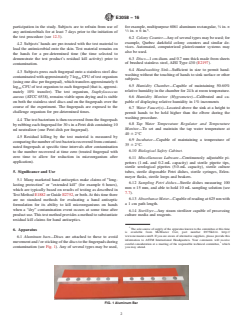
6.1 Aluminum bars—Discs are attached to these to avoid
information to ASTM International Headquarters. Your comments will receive
movementand/orstickingofthediscstothefingerpadsduring 1
careful consideration at a meeting of the responsible technical committee, which
contamination (see Fig. 1).Any of several types may be used, you may attend.
FIG. 1 Aluminum Bar
E3058 − 16
achieved by dilution alone, therefore, inclusion of an inactivator is only
6.15 Timer (Stop-Clock)—Typethatcanbereadforminutes
required if neutralization of the test material cannot be achieved upon
and seconds.
dilution (see 7.5).
6.16 Vortex Mixer—Any vortex that will ensure proper
7.6 Ethanol Solution—70% ethanol in water (v/v) for hand
mixing of culture.
decontamination.
7. Reagents and Materials 7.7 Test Material—Use directions provided with the test
material.Ifdirectionsarenotprovided,usethedirectionsgiven
7.1 Antibiotic Ointment—A topical, triple-antibiotic oint-
in this method.
ment for application to the hands after the final decontamina-
tion. 7.8 Negative Control—70% ethanol in water (v/v).
7.2 Cleansing Wash—Amild, proven non-antimicrobial liq-
8. Hazards
uid soap. May be purchased commercially or prepared accord-
8.1 Application of microorganisms to the skin may involve
ingtotheinstructions:SoftSoap,200g/L:Linseedoil50parts
a health risk. Determine the antibiotic sensitivity profile of the
by weight Potassium hydroxide 9.5 parts Ethanol 7 parts
test bacteria prior to applying to the skin. After the test has
Distilled or high purity water as needed Add linseed oil to a
been completed, decontaminate the subject’s hands and follow
solution of potassium hydroxide in 15 parts water and heat up
proper procedures to reduce infection risk (13.11). If an
to approximately 70°C while constantly stirring. Add the
infection occurs, provide the antibiotic susceptibility profile to
ethanol and continue heating while stirring until the saponifi-
the attending clinician.
cation process is completed and a sample dissolves clearly in
waterandalmostclearlyinalcohol.Theweightofthesoftsoap
9. Test Bacteria
is then brought up to 100 parts by addition of hot water. Take
200 g of the soft soap in 1 L of water. Dispense in to
9.1 Staphylococcus aureus ATCC 6538 (methicillin-
appropriate containers and sterilize in an autoclave.
sensitive) is the recommended test bacterial species. S. aureus
is differentiated from resident microbial skin flora (including
7.3 Chlorhexidine Skin Cleanser—Antiseptic skin cleanser
Staphylococcus epidermidis) colonies by colony morphology
containing 4% chlorhexidine gluconate (w/v) for hand decon-
and pigmentation on standard plating media (see 7.4.2.1)or
tamination.
with chromogenic indicator medium (see 7.4.2.2).
7.4 Culture Media:
7.4.1 Broth—Soybean-casein digest broth (tryptic soy
10. Preparation of Test Bacteria Suspension
broth) is recommended.
10.1 Preparation of S. aureus:
7.4.2 Agar Plating Media:
10.1.1 Prepare a stock culture of S. aureusATCC 6538 (no
7.4.2.1 Plating Medium—Soybean-casein digest agar (tryp-
more than 5 transfers from originalATCC vial) by inoculating
tic soy agar [TSA]) containing an effective inactivator for the
approximately 5 mLof soybean-casein digest broth (see 7.4.1)
test material, if necessary is recommended.
from a frozen stock or lyophilized vial and incubate for 18-24
NOTE 1—Ensure that stock culture of S. aureus and any subsequent
hat35 6 2°C.
subculture used produces golden-colored colonies on soybean-casein
10.1.2 Using a sterile bacteriological loop inoculate a suf-
digest agar.
ficient number of soybean-casein digest agar plates (see
7.4.2.2 S. aureus Plating Medium—HardyCHROM , con-
7.4.2.1) from the overnight culture for colony isolation and
taining an effective inactivator for the test material, if
incubate for 18-24 h at 35 6 2°C.
necessary,maybeusedasanalternativetothestandardplating
10.1.3 Using a sterile bacteriological loop, gently scrape or
media. Other indicator media for S. aureus may be appropriate
rub surface of agar to remove golden-colored colonies and
but should be validated prior to use.
suspend in fresh soybean-casein digest broth to an absorbance
of 0.2-0.25 at 625 nm at a path length of 1 cm (or other
NOTE2—S. aureusformssmooth,deeppinktofuchsia-coloredcolonies
when grown on HardyCHROM. The growth of most other organisms,
appropriate measurement based on your absorbance meter
including Staphylococcus epidermidis are partially to completely inhib-
specifications) to approximate a titer of 8.5-9.0 log CFU/ml.
ited.
Remove an aliquot from the suspension, dilute and plate for
7.5 Dilution and Sampling Fluid—Dissolve 0.4 g KH2PO4,
counting. An isolation streak plate should be made to confirm
10.1 g Na2HPO4, 1.0 g isooctylphenoxypolyethoxyethanol
purity.
(for example, Triton X-100), and appropriately validated
neutralizers,ifnecessary(seeNote3),indistilledwater.Adjust 11. Inoculation of Stainless Steel Discs
pH to 7.8 6 0.1 with 0.1 N HCl or 0.1 N NaOH and bring
11.1 Mix the test bacterial suspension using a vortex for 30
volume to 1 L with distilled water.
s to homogenize it.
NOTE3—AneutralizervalidationshouldbeconductedaccordingtoTest
11.2 Use a cali
...