

ASTM C1435/C1435M-20
(Practice)Standard Practice for Molding Roller-Compacted Concrete in Cylinder Molds Using a Vibrating Hammer
General Information
- Abstract
SIGNIFICANCE AND USE
4.1 This practice, intended for use in testing roller-compacted concrete, may be applicable to testing other types of cementitious material such as coarse-grained, soil-cement. This practice provides standardized requirements for molding stiff to very dry consistency concrete mixtures commonly used in roller compacted concrete construction. This practice is used instead of rodding or internal vibration, which cannot properly consolidate concrete of this consistency.
Note 1: Further description of roller compacted concrete consistency is given in ACI 207.5R and ACI 211.3. The consistency of concrete using a vibrating table may be determined in accordance with Test Methods C1170/C1170M.
4.2 This practice is used to mold cylindrical test specimens commonly used for testing compressive or tensile strength of concrete. Specimens tested for compressive strength and splitting tensile strength shall be in accordance with Test Methods C39/C39M and C496/C496M, respectively. Test specimens also may be used to determine density of fresh concrete.
Note 2: For some extremely dry mixtures; (those with a consistency greater than 45 s when tested in accordance with Test Methods C1170/C1170M)5 the density of specimens made in accordance with this practice may be greater than the in-place density of roller-compacted concrete due to the greater potential for voids at the bottom of the lifts in the field.
Note 3: The mass of the apparatus and amount of force applied by the operator may significantly affect the density of specimens made from these mixtures; thus, discretion is advised when interpreting test results on specimens made according to this practice.
SCOPE
1.1 This practice2 covers molding cylindrical test specimens from concrete when the standard procedures of rodding and internal vibration, as described in Practice C31/C31M and Practice C1176/C1176M, are not practicable. This practice is applicable to freshly-mixed concrete, prepared in the laboratory and the field.
1.2 Freshly-mixed concrete is molded in cylindrical molds using an electric vibrating hammer equipped with a shaft and circular plate.
1.3 The values stated in either SI units or inch-pound units are to be regarded separately as standard. Within the text, the inch-pound units are shown in brackets. The values stated in each system may not be exact equivalents; therefore, each system shall be used independently of the other. Combining values from the two systems may result in non-conformance with the standard.
1.4 The text of this practice references notes and footnotes, which provide explanatory material. These notes and footnotes (excluding those in tables and figures) shall not be considered as requirements of this practice.
1.5 This standard does not purport to address all of the safety concerns, if any, associated with its use. It is the responsibility of the user of this standard to establish appropriate safety, health, and environmental practices and determine the applicability of regulatory limitations prior to use.
1.6 This international standard was developed in accordance with internationally recognized principles on standardization established in the Decision on Principles for the Development of International Standards, Guides and Recommendations issued by the World Trade Organization Technical Barriers to Trade (TBT) Committee.
- Status
- Published
- Publication Date
- 31-Mar-2020
- Technical Committee
- C09 - Concrete and Concrete Aggregates
- Drafting Committee
- C09.45 - Roller-Compacted Concrete
Buy Documents
ASTM C1435/C1435M-20 - Standard Practice for Molding Roller-Compacted Concrete in Cylinder Molds Using a Vibrating Hammer
REDLINE ASTM C1435/C1435M-20 - Standard Practice for Molding Roller-Compacted Concrete in Cylinder Molds Using a Vibrating Hammer
Overview
ASTM C1435/C1435M-20: Standard Practice for Molding Roller-Compacted Concrete in Cylinder Molds Using a Vibrating Hammer establishes a standardized method for preparing cylindrical test specimens from roller-compacted concrete (RCC) and similar stiff or very dry concrete mixes. The standard is vital for ensuring reliable, consistent results when evaluating the mechanical properties-such as compressive and splitting tensile strength-of RCC, soil-cement, and other cementitious materials where traditional consolidation methods like rodding or internal vibration do not suffice.
By focusing on the correct equipment and procedures for molding these challenging concrete types, ASTM C1435/C1435M-20 supports quality assurance in both laboratory and field environments, fostering accurate and comparable testing results across projects.
Key Topics
- Applicability: Covers procedures for molding cylindrical specimens from freshly-mixed concrete, specifically stiff or very dry mixes common in RCC and coarse-grained soil-cement.
- Molding Process: Specifies using an electric vibrating hammer fitted with a shaft and circular tamping plate, advancing the concrete in four lifts to ensure adequate consolidation.
- Apparatus: Details requirements for mold types (reusable and single-use), mold sleeves, vibrating hammers (including weight and vibration frequency), tamping plates, and small hand tools.
- Sampling and Handling: Stresses the importance of representative sampling and careful sample handling to prevent segregation, which can influence test outcomes.
- Calibration: Highlights the need to regularly verify the vibrating hammer’s mass and operational frequency to maintain consistency in specimen preparation.
- Units of Measurement: Allows use of either SI or inch-pound units, but requires consistency within a given set of test results.
Applications
The procedures detailed in ASTM C1435/C1435M-20 are essential for:
- Testing Strength Properties: Creating specimens for compressive and splitting tensile strength tests, including those performed according to ASTM C39/C39M and ASTM C496/C496M standards.
- Field and Laboratory Use: Applicable to both laboratory-prepared and field-sampled concrete, facilitating standardized specimen preparation across different environments.
- Quality Control in RCC Construction: Widely used in dam, pavement, and large infrastructure projects where roller-compacted concrete is favored for its durability and rapid placement. Ensures that the specimens represent the actual material placed.
- Research and Mix Design: Useful in laboratories for testing new mix designs, evaluating substitutions in cementitious materials, or determining the effects of admixtures on stiff/dry concrete.
Correct specimen preparation per ASTM C1435/C1435M-20 helps produce reliable data for acceptance testing, performance predictions, and troubleshooting on-site issues related to mix consistency or compaction.
Related Standards
Understanding and implementing ASTM C1435/C1435M-20 is enhanced by familiarity with these related standards:
- ASTM C31/C31M: Standard Practice for Making and Curing Concrete Test Specimens in the Field.
- ASTM C39/C39M: Test Method for Compressive Strength of Cylindrical Concrete Specimens.
- ASTM C496/C496M: Test Method for Splitting Tensile Strength of Cylindrical Concrete Specimens.
- ASTM C1170/C1170M: Test Method for Determining Consistency and Density of Roller-Compacted Concrete Using a Vibrating Table.
- ASTM C1176/C1176M: Practice for Making Roller-Compacted Concrete in Cylinder Molds Using a Vibrating Table.
- ACI 207.5R: Report on Roller-Compacted Concrete.
- ACI 211.3: Practice for Selecting Proportions for No-Slump Concrete.
These standards collectively guide the process from material sampling and specimen fabrication to testing and interpretation, enabling robust quality management for roller-compacted and similar concretes.
Keywords: roller-compacted concrete, RCC, molding concrete specimens, vibrating hammer, cylinder molds, compressive strength, splitting tensile strength, ASTM concrete standards, cementitious materials testing, laboratory concrete procedures, field concrete testing.
Relations
- Effective Date
- 01-Apr-2020
- Refers
ASTM C31/C31M-24a - Standard Practice for Making and Curing Concrete Test Specimens in the Field - Effective Date
- 01-Apr-2024
- Refers
ASTM C31/C31M-24 - Standard Practice for Making and Curing Concrete Test Specimens in the Field - Effective Date
- 01-Jan-2024
- Refers
ASTM C39/C39M-23 - Standard Test Method for Compressive Strength of Cylindrical Concrete Specimens - Effective Date
- 01-Dec-2023
- Effective Date
- 01-Apr-2020
- Refers
ASTM C31/C31M-18 - Standard Practice for Making and Curing Concrete Test Specimens in the Field - Effective Date
- 01-Jan-2018
- Refers
ASTM C39/C39M-17b - Standard Test Method for Compressive Strength of Cylindrical Concrete Specimens - Effective Date
- 01-Aug-2017
- Refers
ASTM C39/C39M-16b - Standard Test Method for Compressive Strength of Cylindrical Concrete Specimens - Effective Date
- 01-Aug-2016
- Refers
ASTM C39/C39M-16a - Standard Test Method for Compressive Strength of Cylindrical Concrete Specimens - Effective Date
- 01-Jul-2016
- Refers
ASTM C31/C31M-15ae1 - Standard Practice for Making and Curing Concrete Test Specimens in the Field - Effective Date
- 15-Nov-2015
- Refers
ASTM C39/C39M-14a - Standard Test Method for Compressive Strength of Cylindrical Concrete Specimens - Effective Date
- 01-Jun-2014
- Effective Date
- 01-Apr-2014
- Refers
ASTM C39/C39M-14 - Standard Test Method for Compressive Strength of Cylindrical Concrete Specimens - Effective Date
- 01-Feb-2014
- Effective Date
- 01-Feb-2014
- Refers
ASTM C39/C39M-12a - Standard Test Method for Compressive Strength of Cylindrical Concrete Specimens - Effective Date
- 01-Sep-2012
Buy Documents
ASTM C1435/C1435M-20 - Standard Practice for Molding Roller-Compacted Concrete in Cylinder Molds Using a Vibrating Hammer
REDLINE ASTM C1435/C1435M-20 - Standard Practice for Molding Roller-Compacted Concrete in Cylinder Molds Using a Vibrating Hammer
Get Certified
Connect with accredited certification bodies for this standard

DIBt (Deutsches Institut für Bautechnik)
German Institute for Building Technology.
DIN CERTCO
DIN Group product certification.

Aboma Certification B.V.
Specialized in construction, metal, and transport sectors.
Sponsored listings
Frequently Asked Questions
ASTM C1435/C1435M-20 is a standard published by ASTM International. Its full title is "Standard Practice for Molding Roller-Compacted Concrete in Cylinder Molds Using a Vibrating Hammer". This standard covers: SIGNIFICANCE AND USE 4.1 This practice, intended for use in testing roller-compacted concrete, may be applicable to testing other types of cementitious material such as coarse-grained, soil-cement. This practice provides standardized requirements for molding stiff to very dry consistency concrete mixtures commonly used in roller compacted concrete construction. This practice is used instead of rodding or internal vibration, which cannot properly consolidate concrete of this consistency. Note 1: Further description of roller compacted concrete consistency is given in ACI 207.5R and ACI 211.3. The consistency of concrete using a vibrating table may be determined in accordance with Test Methods C1170/C1170M. 4.2 This practice is used to mold cylindrical test specimens commonly used for testing compressive or tensile strength of concrete. Specimens tested for compressive strength and splitting tensile strength shall be in accordance with Test Methods C39/C39M and C496/C496M, respectively. Test specimens also may be used to determine density of fresh concrete. Note 2: For some extremely dry mixtures; (those with a consistency greater than 45 s when tested in accordance with Test Methods C1170/C1170M)5 the density of specimens made in accordance with this practice may be greater than the in-place density of roller-compacted concrete due to the greater potential for voids at the bottom of the lifts in the field. Note 3: The mass of the apparatus and amount of force applied by the operator may significantly affect the density of specimens made from these mixtures; thus, discretion is advised when interpreting test results on specimens made according to this practice. SCOPE 1.1 This practice2 covers molding cylindrical test specimens from concrete when the standard procedures of rodding and internal vibration, as described in Practice C31/C31M and Practice C1176/C1176M, are not practicable. This practice is applicable to freshly-mixed concrete, prepared in the laboratory and the field. 1.2 Freshly-mixed concrete is molded in cylindrical molds using an electric vibrating hammer equipped with a shaft and circular plate. 1.3 The values stated in either SI units or inch-pound units are to be regarded separately as standard. Within the text, the inch-pound units are shown in brackets. The values stated in each system may not be exact equivalents; therefore, each system shall be used independently of the other. Combining values from the two systems may result in non-conformance with the standard. 1.4 The text of this practice references notes and footnotes, which provide explanatory material. These notes and footnotes (excluding those in tables and figures) shall not be considered as requirements of this practice. 1.5 This standard does not purport to address all of the safety concerns, if any, associated with its use. It is the responsibility of the user of this standard to establish appropriate safety, health, and environmental practices and determine the applicability of regulatory limitations prior to use. 1.6 This international standard was developed in accordance with internationally recognized principles on standardization established in the Decision on Principles for the Development of International Standards, Guides and Recommendations issued by the World Trade Organization Technical Barriers to Trade (TBT) Committee.
SIGNIFICANCE AND USE 4.1 This practice, intended for use in testing roller-compacted concrete, may be applicable to testing other types of cementitious material such as coarse-grained, soil-cement. This practice provides standardized requirements for molding stiff to very dry consistency concrete mixtures commonly used in roller compacted concrete construction. This practice is used instead of rodding or internal vibration, which cannot properly consolidate concrete of this consistency. Note 1: Further description of roller compacted concrete consistency is given in ACI 207.5R and ACI 211.3. The consistency of concrete using a vibrating table may be determined in accordance with Test Methods C1170/C1170M. 4.2 This practice is used to mold cylindrical test specimens commonly used for testing compressive or tensile strength of concrete. Specimens tested for compressive strength and splitting tensile strength shall be in accordance with Test Methods C39/C39M and C496/C496M, respectively. Test specimens also may be used to determine density of fresh concrete. Note 2: For some extremely dry mixtures; (those with a consistency greater than 45 s when tested in accordance with Test Methods C1170/C1170M)5 the density of specimens made in accordance with this practice may be greater than the in-place density of roller-compacted concrete due to the greater potential for voids at the bottom of the lifts in the field. Note 3: The mass of the apparatus and amount of force applied by the operator may significantly affect the density of specimens made from these mixtures; thus, discretion is advised when interpreting test results on specimens made according to this practice. SCOPE 1.1 This practice2 covers molding cylindrical test specimens from concrete when the standard procedures of rodding and internal vibration, as described in Practice C31/C31M and Practice C1176/C1176M, are not practicable. This practice is applicable to freshly-mixed concrete, prepared in the laboratory and the field. 1.2 Freshly-mixed concrete is molded in cylindrical molds using an electric vibrating hammer equipped with a shaft and circular plate. 1.3 The values stated in either SI units or inch-pound units are to be regarded separately as standard. Within the text, the inch-pound units are shown in brackets. The values stated in each system may not be exact equivalents; therefore, each system shall be used independently of the other. Combining values from the two systems may result in non-conformance with the standard. 1.4 The text of this practice references notes and footnotes, which provide explanatory material. These notes and footnotes (excluding those in tables and figures) shall not be considered as requirements of this practice. 1.5 This standard does not purport to address all of the safety concerns, if any, associated with its use. It is the responsibility of the user of this standard to establish appropriate safety, health, and environmental practices and determine the applicability of regulatory limitations prior to use. 1.6 This international standard was developed in accordance with internationally recognized principles on standardization established in the Decision on Principles for the Development of International Standards, Guides and Recommendations issued by the World Trade Organization Technical Barriers to Trade (TBT) Committee.
ASTM C1435/C1435M-20 is classified under the following ICS (International Classification for Standards) categories: 91.100.30 - Concrete and concrete products. The ICS classification helps identify the subject area and facilitates finding related standards.
ASTM C1435/C1435M-20 has the following relationships with other standards: It is inter standard links to ASTM C1435/C1435M-14, ASTM C31/C31M-24a, ASTM C31/C31M-24, ASTM C39/C39M-23, ASTM C1170/C1170M-20, ASTM C31/C31M-18, ASTM C39/C39M-17b, ASTM C39/C39M-16b, ASTM C39/C39M-16a, ASTM C31/C31M-15ae1, ASTM C39/C39M-14a, ASTM C1170/C1170M-14, ASTM C39/C39M-14, ASTM C172/C172M-14, ASTM C39/C39M-12a. Understanding these relationships helps ensure you are using the most current and applicable version of the standard.
ASTM C1435/C1435M-20 is available in PDF format for immediate download after purchase. The document can be added to your cart and obtained through the secure checkout process. Digital delivery ensures instant access to the complete standard document.
Standards Content (Sample)
This international standard was developed in accordance with internationally recognized principles on standardization established in the Decision on Principles for the
Development of International Standards, Guides and Recommendations issued by the World Trade Organization Technical Barriers to Trade (TBT) Committee.
Designation: C1435/C1435M − 20
Standard Practice for
Molding Roller-Compacted Concrete in Cylinder Molds
Using a Vibrating Hammer
This standard is issued under the fixed designation C1435/C1435M; the number immediately following the designation indicates the
year of original adoption or, in the case of revision, the year of last revision. A number in parentheses indicates the year of last
reapproval. A superscript epsilon (´) indicates an editorial change since the last revision or reapproval.
1. Scope* 2. Referenced Documents
2 3
1.1 This practice covers molding cylindrical test specimens 2.1 ASTM Standards:
from concrete when the standard procedures of rodding and C31/C31M Practice for Making and Curing Concrete Test
internal vibration, as described in Practice C31/C31M and Specimens in the Field
Practice C1176/C1176M, are not practicable. This practice is C39/C39M Test Method for Compressive Strength of Cylin-
applicable to freshly-mixed concrete, prepared in the labora- drical Concrete Specimens
tory and the field. C172/C172M Practice for Sampling Freshly Mixed Con-
crete
1.2 Freshly-mixed concrete is molded in cylindrical molds
C470/C470M Specification for Molds for Forming Concrete
using an electric vibrating hammer equipped with a shaft and
Test Cylinders Vertically
circular plate.
C496/C496M Test Method for Splitting Tensile Strength of
1.3 The values stated in either SI units or inch-pound units
Cylindrical Concrete Specimens
are to be regarded separately as standard. Within the text, the
C1170/C1170M Test Method for Determining Consistency
inch-pound units are shown in brackets. The values stated in
and Density of Roller-Compacted Concrete Using a Vi-
each system may not be exact equivalents; therefore, each
brating Table
system shall be used independently of the other. Combining
C1176/C1176M Practice for Making Roller-Compacted
values from the two systems may result in non-conformance
Concrete in Cylinder Molds Using a Vibrating Table
with the standard.
2.2 ACI Documents:
1.4 The text of this practice references notes and footnotes, ACI 207.5R Report on Roller-Compacted Concrete
ACI 211.3 Practice for Selecting Proportions for No-Slump
which provide explanatory material. These notes and footnotes
(excluding those in tables and figures) shall not be considered Concrete
as requirements of this practice.
3. Summary of Practice
1.5 This standard does not purport to address all of the
3.1 This practice describes molding cylindrical concrete test
safety concerns, if any, associated with its use. It is the
specimens using a vibrating hammer. Test specimens are
responsibility of the user of this standard to establish appro-
molded vertically in cylindrical molds by compacting the stiff
priate safety, health, and environmental practices and deter-
to very dry concrete mixture in four lifts using a vibrating
mine the applicability of regulatory limitations prior to use.
hammer.
1.6 This international standard was developed in accor-
dance with internationally recognized principles on standard-
4. Significance and Use
ization established in the Decision on Principles for the
4.1 This practice, intended for use in testing roller-
Development of International Standards, Guides and Recom-
compactedconcrete,maybeapplicabletotestingothertypesof
mendations issued by the World Trade Organization Technical
cementitiousmaterialsuchascoarse-grained,soil-cement.This
Barriers to Trade (TBT) Committee.
practice provides standardized requirements for molding stiff
to very dry consistency concrete mixtures commonly used in
roller compacted concrete construction. This practice is used
This practice is under the jurisdiction of Committee C09 on Concrete and
Concrete Aggregates and are the direct responsibility of Subcommittee C09.45 on
Roller-Compacted Concrete.
Current edition approved April 1, 2020. Published May 2020. Originally For referenced ASTM standards, visit the ASTM website, www.astm.org, or
approved in 1999. Last previous edition approved in 2014 as C1435/C1435M – 14. contact ASTM Customer Service at service@astm.org. For Annual Book of ASTM
DOI: 10.1520/C1435_C1435M-20. Standards volume information, refer to the standard’s Document Summary page on
Supporting data have been filed at ASTM International Headquarters and may the ASTM website.
beobtainedbyrequestingResearchReportRR:C09-1045.ContactASTMCustomer ACI Manual of Concrete Practice, Part 1, Materials and General Properties of
Service at service@astm.org. Concrete, American Concrete Institute, Farmington Hills, MI.
*A Summary of Changes section appears at the end of this standard
Copyright © ASTM International, 100 Barr Harbor Drive, PO Box C700, West Conshohocken, PA 19428-2959. United States
C1435/C1435M − 20
instead of rodding or internal vibration, which cannot properly 5.3 Tamping Plate—Acircular steel plate attached to a steel
consolidate concrete of this consistency. shaft, which is inserted into the vibrating hammer chuck. The
3 1
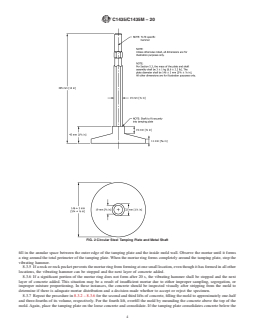
plate diameter shall be 146 63mm[5 ⁄4 6 ⁄8 in.] and the
NOTE 1—Further description of roller compacted concrete consistency
mass of the plate and shaft assembly shall be 3 6 1 kg [6.6 6
is given inACI 207.5R andACI 211.3. The consistency of concrete using
2.2 lb] (See Fig. 2).
a vibrating table may be determined in accordance with Test Methods
C1170/C1170M.
5.4 Small Tools—A square-ended shovel, a hand scoop, a
4.2 This practice is used to mold cylindrical test specimens
tamping rod, and a stopwatch.
commonly used for testing compressive or tensile strength of
concrete. Specimens tested for compressive strength and split-
6. Sampling
ting tensile strength shall be in accordance with Test Methods
6.1 Samples of freshly-mixed concrete shall be obtained in
C39/C39M and C496/C496M, respectively. Test specimens
accordance with Practice C172/C172M.
also may be used to determine density of fresh concrete.
6.2 Concrete samples shall have a maximum size aggregate
NOTE 2—For some extremely dry mixtures; (those with a consistency
of 50 mm [2 in.] or less. If the concrete has aggregate larger
greater than 45 s when tested in accordance with Test Methods C1170/
than 50 mm [2 in.] samples shall be obtained by wet sieving
C1170M) the density of specimens made in accordance with this practice
may be greater than the in-place density of roller-compacted concrete due
over a 50-mm [2-in.] sieve in accordance with Practice
to the greater potential for voids at the bottom of the lifts in the field.
C172/C172M.
NOTE 3—The mass of the apparatus and amount of force applied by the
operator may significantly affect the density of specimens made from 6.3 Concrete test specimens shall be molded within 45 min
these mixtures; thus, discretion is advised when interpreting test results on
after the completion of mixing unless otherwise specified.
specimens made according to this practice.
6.4 Technical Precautions:
5. Apparatus
6.4.1 When obtaining samples, ensure that the samples are
representative of the bulk production.
5.1 Molds:
6.4.2 Concrete with stiff to very dry consistency is highly
5.1.1 Type A Reusable Mold—A cylindrical mold conform-
susceptible to segregation during handling. To minimize
ing to the requirements of Specification C470/C470M for
segregation, use care in obtaining samples and during
150-mm [6-in.] diameter by 300-mm [12-in.] high reusable
transporting, remixing, and preparation of the specimens.
molds.
5.1
...
This document is not an ASTM standard and is intended only to provide the user of an ASTM standard an indication of what changes have been made to the previous version. Because
it may not be technically possible to adequately depict all changes accurately, ASTM recommends that users consult prior editions as appropriate. In all cases only the current version
of the standard as published by ASTM is to be considered the official document.
Designation: C1435/C1435M − 14 C1435/C1435M − 20
Standard Practice for
Molding Roller-Compacted Concrete in Cylinder Molds
Using a Vibrating Hammer
This standard is issued under the fixed designation C1435/C1435M; the number immediately following the designation indicates the
year of original adoption or, in the case of revision, the year of last revision. A number in parentheses indicates the year of last
reapproval. A superscript epsilon (´) indicates an editorial change since the last revision or reapproval.
1. Scope*
1.1 This practice covers molding cylindrical test specimens from concrete when the standard procedures of rodding and
internal vibration, as described in Practice C31/C31M and Practice C1176/C1176M, are not practicable. This practice is applicable
to freshly-mixed concrete, prepared in the laboratory and the field.
1.2 Freshly-mixed concrete is molded in cylindrical molds using an electric vibrating hammer equipped with a shaft and circular
plate.
1.3 The values stated in either SI units or inch-pound units are to be regarded separately as standard. Within the text, the
inch-pound units are shown in brackets. The values stated in each system may not be exact equivalents; therefore, each system shall
be used independently of the other. Combining values from the two systems may result in non-conformance with the standard.
1.4 The text of this practice references notes and footnotes, which provide explanatory material. These notes and footnotes
(excluding those in tables and figures) shall not be considered as requirements of this practice.
1.5 This standard does not purport to address all of the safety concerns, if any, associated with its use. It is the responsibility
of the user of this standard to establish appropriate safety safety, health, and healthenvironmental practices and determine the
applicability of regulatory limitations prior to use.
1.6 This international standard was developed in accordance with internationally recognized principles on standardization
established in the Decision on Principles for the Development of International Standards, Guides and Recommendations issued
by the World Trade Organization Technical Barriers to Trade (TBT) Committee.
2. Referenced Documents
2.1 ASTM Standards:
C31/C31M Practice for Making and Curing Concrete Test Specimens in the Field
C39/C39M Test Method for Compressive Strength of Cylindrical Concrete Specimens
C172/C172M Practice for Sampling Freshly Mixed Concrete
C470/C470M Specification for Molds for Forming Concrete Test Cylinders Vertically
C496/C496M Test Method for Splitting Tensile Strength of Cylindrical Concrete Specimens
C1170/C1170M Test Method for Determining Consistency and Density of Roller-Compacted Concrete Using a Vibrating Table
C1176/C1176M Practice for Making Roller-Compacted Concrete in Cylinder Molds Using a Vibrating Table
2.2 ACI Documents:
ACI 207.5R Report on Roller-Compacted Concrete
ACI 211.3 Practice for Selecting Proportions for No-Slump Concrete
3. Summary of Practice
3.1 This practice describes molding cylindrical concrete test specimens using a vibrating hammer. Test specimens are molded
vertically in cylindrical molds by compacting the stiff to very dry concrete mixture in four lifts using a vibrating hammer.
This practice is under the jurisdiction of Committee C09 on Concrete and Concrete Aggregates and are the direct responsibility of Subcommittee C09.45 on
Roller-Compacted Concrete.
Current edition approved Oct. 1, 2014April 1, 2020. Published November 2014May 2020. Originally approved in 1999. Last previous edition approved in 20082014 as
C1435/C1435M – 08.C1435/C1435M – 14. DOI: 10.1520/C1435_C1435M-14.10.1520/C1435_C1435M-20.
Supporting data have been filed at ASTM International Headquarters and may be obtained by requesting Research Report RR:C09-1045. Contact ASTM Customer
Service at service@astm.org.
For referenced ASTM standards, visit the ASTM website, www.astm.org, or contact ASTM Customer Service at service@astm.org. For Annual Book of ASTM Standards
volume information, refer to the standard’s Document Summary page on the ASTM website.
ACI Manual of Concrete Practice, Part 1, Materials and General Properties of Concrete, American Concrete Institute, Farmington Hills, MI.
*A Summary of Changes section appears at the end of this standard
Copyright © ASTM International, 100 Barr Harbor Drive, PO Box C700, West Conshohocken, PA 19428-2959. United States
C1435/C1435M − 20
4. Significance and Use
4.1 This practice, intended for use in testing roller-compacted concrete, may be applicable to testing other types of cementitious
material such as coarse-grained, soil-cement. This practice provides standardized requirements for molding stiff to very dry
consistency concrete mixtures commonly used in roller compacted concrete construction. This practice is used instead of rodding
or internal vibration, which cannot properly consolidate concrete of this consistency.
NOTE 1—Further description of roller compacted concrete consistency is given in ACI 207.5R and ACI 211.3. The consistency of concrete using a
vibrating table may be determined in accordance with Test Methods C1170/C1170M.
4.2 This practice is used to mold cylindrical test specimens commonly used for testing compressive or tensile strength of
concrete. Specimens tested for compressive strength and splitting tensile strength shall be in accordance with Test Methods
C39/C39M and C496/C496M, respectively. Test specimens also may be used to determine density of fresh concrete.
NOTE 2—For some extremely dry mixtures; (those with a consistency greater than 45 s when tested in accordance with Test Methods C1170/C1170M)
the density of specimens made in accordance with this practice may be greater than the in-place density of roller-compacted concrete due to the greater
potential for voids at the bottom of the lifts in the field.
NOTE 3—The mass of the apparatus and amount of force applied by the operator may significantly affect the density of specimens made from these
mixtures; thus, discretion is advised when interpreting test results on specimens made according to this practice.
5. Apparatus
5.1 Molds:
5.1.1 Type A Reusable Mold—A cylindrical mold conforming to the requirements of Specification C470/C470M for 150-mm
[6-in.] diameter by 300-mm [12-in.] high reusable molds.
5.1.2 Type B Single-Use Mold—A single-use plastic, cylindrical mold 150-mm [6-in.] diameter and 300-mm [12-in.] in height.
The mold specifications shall conform to Specification C470/C470M for single-use, plastic molds.
5.1.2.1 Mold Sleeve—A Type B cylindrical mold shall be inserted into a rigid cylindrical sleeve. The cylindrical sleeve shall be
made of steel or other hard metal resistant to cement paste corrosion. The sleeve shall be capable of firmly holding the plastic mold
upright without deformation of the mold. The sleeve shall be split and hinged on one side so that it can be opened to remove the
plastic mold; adjustable clamps shall be provided on the other side for tightening the sleeve around the mold. A metal base plate
with brackets shall be provided in which to insert the bottom portion of the sleeve to hold the sleeve during compaction. The sleeve
1 1
shall have a minimum wall thickness of 3 mm [ ⁄8 in.], and a minimum base plate thickness of 6 mm [ ⁄4 in.]. The inside diameter
1 1
of the mold sleeve shall be 3 6 1 mm [ ⁄8 6 ⁄16 in.] larger than the outside diameter of the Type B mold and have a height 13
1 1
6 6 mm [ ⁄2 6 ⁄4 in.] less than the height of the Type B mold.
5.2 Vibrating Hammer—A vibrating compaction hammer havi
...