

ASTM C1170/C1170M-20
(Test Method)Standard Test Method for Determining Consistency and Density of Roller-Compacted Concrete Using a Vibrating Table
General Information
- Abstract
SIGNIFICANCE AND USE
5.1 This test method is intended to be used for determining the consistency and density of stiff to extremely dry concrete mixtures common in roller-compacted concrete construction.
5.1.1 Because of the stiff to extremely dry consistency of some roller-compacted concrete mixtures, the standard Vebe test method of rodding the specimen in a slump cone is substituted by Procedures A and B.8
5.2 Procedure A uses a 22.7 kg [50 lb] surcharge and is used for concrete consolidated by roller-compaction methods when the consistency of the concrete is very stiff to extremely dry.
5.3 Procedure B uses a 12.5 kg [27.5 lb] surcharge and is used for concrete consolidated by roller-compaction methods when the consistency of the concrete is stiff to very stiff consistency, but not extremely dry.
SCOPE
1.1 This test method is used to determine the consistency of concrete using a vibrating table and a surcharge and to determine the density of the consolidated concrete specimen. This test method is applicable to freshly mixed concrete, prepared in both the laboratory and the field, having a nominal maximum size aggregate of 50 mm [2 in.] or less. If the nominal maximum size of aggregate is larger than 50 mm [2 in.], the test method is applicable only when performed on the fraction passing the 50-mm [2-in.] sieve with the larger aggregate being removed in accordance with Practice C172.
1.2 This test method, intended for use in testing roller-compacted concrete, may be applicable to testing other types of concrete such as cement-treated aggregate and mixtures similar to soil-cement.
1.3 The values stated in either SI units or inch-pound units are to be regarded separately as standard. The values stated in each system may not be exact equivalents; therefore, each system shall be used independently of the other. Combining values from the two systems may result in non-conformance with the standard.
1.4 The text of this standard refers to notes and footnotes that provide explanatory material. These notes and footnotes (excluding those in tables and figures) shall not be considered as requirements of this standard.
1.5 This standard does not purport to address all of the safety concerns, if any, associated with its use. It is the responsibility of the user of this standard to establish appropriate safety, health, and environmental practices and determine the applicability of regulatory limitations prior to use. (Warning—Fresh hydraulic cementitious mixtures are caustic and may cause chemical burns to skin and tissue upon prolonged exposure.2)
1.6 This international standard was developed in accordance with internationally recognized principles on standardization established in the Decision on Principles for the Development of International Standards, Guides and Recommendations issued by the World Trade Organization Technical Barriers to Trade (TBT) Committee.
- Status
- Published
- Publication Date
- 31-Mar-2020
- Technical Committee
- C09 - Concrete and Concrete Aggregates
- Drafting Committee
- C09.45 - Roller-Compacted Concrete
Buy Documents
ASTM C1170/C1170M-20 - Standard Test Method for Determining Consistency and Density of Roller-Compacted Concrete Using a Vibrating Table
REDLINE ASTM C1170/C1170M-20 - Standard Test Method for Determining Consistency and Density of Roller-Compacted Concrete Using a Vibrating Table
Overview
ASTM C1170/C1170M-20 is the internationally recognized standard test method for determining the consistency and density of roller-compacted concrete (RCC) using a vibrating table. Issued by ASTM International, this standard provides practical procedures for evaluating freshly mixed concrete, especially the stiff to extremely dry concretes commonly used in roller-compacted concrete construction. Accurate measurement of consistency and density helps ensure quality control in RCC projects and supports the reliable design and placement of large concrete structures such as dams, pavements, and industrial floors.
Key Topics
- Consistency Measurement: The test method uses a vibrating table and surcharge mass to evaluate the Vebe consistency time of RCC mixtures, indicating how easily the concrete can be compacted.
- Density Determination: Density is calculated by weighing the compacted specimen and dividing by its volume, providing essential data for mix design and performance assessment.
- Specimen Handling: Procedures outline careful sampling and handling techniques to minimize segregation and achieve representative results.
- Procedure Options: Two procedures are defined based on concrete consistency:
- Procedure A: Utilizes a 22.7 kg (50 lb) surcharge for extremely dry to very stiff concrete.
- Procedure B: Utilizes a 12.5 kg (27.5 lb) surcharge for stiff to very stiff, but not extremely dry, concrete.
- Applicability: The standard is primarily intended for RCC but may also be applied to cement-treated aggregates and soil-cement mixtures with a maximum aggregate size of 50 mm (2 in.) or less.
Applications
- Roller-Compacted Concrete Dams and Pavements: ASTM C1170/C1170M-20 is widely used for quality assurance on large-scale civil engineering projects, ensuring RCC mixtures meet stringent performance specifications.
- Design Verification: Mix designs can be validated both in the laboratory and field by assessing workability and density, supporting optimized construction processes.
- Material Acceptance and Performance: Measurements of consistency and density are essential for verifying that delivered concrete meets project requirements, directly impacting durability and strength.
- Research and Development: The standard provides a consistent basis for evaluating new mix designs, optimized materials, and construction techniques.
Related Standards
Several related ASTM and industry standards provide complementary methods and definitions relevant to the use and testing of roller-compacted concrete:
- ASTM C29/C29M - Test Method for Bulk Density ("Unit Weight") and Voids in Aggregate
- ASTM C125 - Terminology Relating to Concrete and Concrete Aggregates
- ASTM C172 - Practice for Sampling Freshly Mixed Concrete
- ASTM C670 - Practice for Preparing Precision and Bias Statements for Test Methods for Construction Materials
- ASTM C1067 - Practice for Conducting a Ruggedness Evaluation or Screening Program for Test Methods
- ASTM D1557 - Laboratory Compaction Characteristics of Soil Using Modified Effort
- ASTM E11 - Specification for Woven Wire Test Sieve Cloth and Test Sieves
By adhering to ASTM C1170/C1170M-20 and its referenced standards, construction professionals, engineers, and quality control technicians can ensure reliable, consistent, and reproducible testing of roller-compacted concrete consistency and density. This fosters higher quality concrete construction, improved infrastructure performance, and compliance with international best practices in concrete technology.
Keywords: ASTM C1170/C1170M-20, roller-compacted concrete, consistency test, density test, vibrating table, Vebe consistency, RCC, fresh concrete properties.
Relations
- Effective Date
- 01-Apr-2020
- Effective Date
- 01-Feb-2024
- Effective Date
- 01-Jan-2024
- Refers
ASTM C29/C29M-23 - Standard Test Method for Bulk Density (“Unit Weight”) and Voids in Aggregate - Effective Date
- 01-Oct-2023
- Effective Date
- 15-Apr-2020
- Effective Date
- 15-Dec-2019
- Effective Date
- 01-Jan-2019
- Effective Date
- 01-Oct-2018
- Effective Date
- 01-Jul-2018
- Effective Date
- 01-Jan-2018
- Effective Date
- 01-Jan-2017
- Effective Date
- 15-Dec-2016
- Effective Date
- 01-Feb-2016
- Effective Date
- 15-Dec-2015
- Effective Date
- 01-Jul-2015
Buy Documents
ASTM C1170/C1170M-20 - Standard Test Method for Determining Consistency and Density of Roller-Compacted Concrete Using a Vibrating Table
REDLINE ASTM C1170/C1170M-20 - Standard Test Method for Determining Consistency and Density of Roller-Compacted Concrete Using a Vibrating Table
Get Certified
Connect with accredited certification bodies for this standard

DIBt (Deutsches Institut für Bautechnik)
German Institute for Building Technology.
DIN CERTCO
DIN Group product certification.

Aboma Certification B.V.
Specialized in construction, metal, and transport sectors.
Sponsored listings
Frequently Asked Questions
ASTM C1170/C1170M-20 is a standard published by ASTM International. Its full title is "Standard Test Method for Determining Consistency and Density of Roller-Compacted Concrete Using a Vibrating Table". This standard covers: SIGNIFICANCE AND USE 5.1 This test method is intended to be used for determining the consistency and density of stiff to extremely dry concrete mixtures common in roller-compacted concrete construction. 5.1.1 Because of the stiff to extremely dry consistency of some roller-compacted concrete mixtures, the standard Vebe test method of rodding the specimen in a slump cone is substituted by Procedures A and B.8 5.2 Procedure A uses a 22.7 kg [50 lb] surcharge and is used for concrete consolidated by roller-compaction methods when the consistency of the concrete is very stiff to extremely dry. 5.3 Procedure B uses a 12.5 kg [27.5 lb] surcharge and is used for concrete consolidated by roller-compaction methods when the consistency of the concrete is stiff to very stiff consistency, but not extremely dry. SCOPE 1.1 This test method is used to determine the consistency of concrete using a vibrating table and a surcharge and to determine the density of the consolidated concrete specimen. This test method is applicable to freshly mixed concrete, prepared in both the laboratory and the field, having a nominal maximum size aggregate of 50 mm [2 in.] or less. If the nominal maximum size of aggregate is larger than 50 mm [2 in.], the test method is applicable only when performed on the fraction passing the 50-mm [2-in.] sieve with the larger aggregate being removed in accordance with Practice C172. 1.2 This test method, intended for use in testing roller-compacted concrete, may be applicable to testing other types of concrete such as cement-treated aggregate and mixtures similar to soil-cement. 1.3 The values stated in either SI units or inch-pound units are to be regarded separately as standard. The values stated in each system may not be exact equivalents; therefore, each system shall be used independently of the other. Combining values from the two systems may result in non-conformance with the standard. 1.4 The text of this standard refers to notes and footnotes that provide explanatory material. These notes and footnotes (excluding those in tables and figures) shall not be considered as requirements of this standard. 1.5 This standard does not purport to address all of the safety concerns, if any, associated with its use. It is the responsibility of the user of this standard to establish appropriate safety, health, and environmental practices and determine the applicability of regulatory limitations prior to use. (Warning—Fresh hydraulic cementitious mixtures are caustic and may cause chemical burns to skin and tissue upon prolonged exposure.2) 1.6 This international standard was developed in accordance with internationally recognized principles on standardization established in the Decision on Principles for the Development of International Standards, Guides and Recommendations issued by the World Trade Organization Technical Barriers to Trade (TBT) Committee.
SIGNIFICANCE AND USE 5.1 This test method is intended to be used for determining the consistency and density of stiff to extremely dry concrete mixtures common in roller-compacted concrete construction. 5.1.1 Because of the stiff to extremely dry consistency of some roller-compacted concrete mixtures, the standard Vebe test method of rodding the specimen in a slump cone is substituted by Procedures A and B.8 5.2 Procedure A uses a 22.7 kg [50 lb] surcharge and is used for concrete consolidated by roller-compaction methods when the consistency of the concrete is very stiff to extremely dry. 5.3 Procedure B uses a 12.5 kg [27.5 lb] surcharge and is used for concrete consolidated by roller-compaction methods when the consistency of the concrete is stiff to very stiff consistency, but not extremely dry. SCOPE 1.1 This test method is used to determine the consistency of concrete using a vibrating table and a surcharge and to determine the density of the consolidated concrete specimen. This test method is applicable to freshly mixed concrete, prepared in both the laboratory and the field, having a nominal maximum size aggregate of 50 mm [2 in.] or less. If the nominal maximum size of aggregate is larger than 50 mm [2 in.], the test method is applicable only when performed on the fraction passing the 50-mm [2-in.] sieve with the larger aggregate being removed in accordance with Practice C172. 1.2 This test method, intended for use in testing roller-compacted concrete, may be applicable to testing other types of concrete such as cement-treated aggregate and mixtures similar to soil-cement. 1.3 The values stated in either SI units or inch-pound units are to be regarded separately as standard. The values stated in each system may not be exact equivalents; therefore, each system shall be used independently of the other. Combining values from the two systems may result in non-conformance with the standard. 1.4 The text of this standard refers to notes and footnotes that provide explanatory material. These notes and footnotes (excluding those in tables and figures) shall not be considered as requirements of this standard. 1.5 This standard does not purport to address all of the safety concerns, if any, associated with its use. It is the responsibility of the user of this standard to establish appropriate safety, health, and environmental practices and determine the applicability of regulatory limitations prior to use. (Warning—Fresh hydraulic cementitious mixtures are caustic and may cause chemical burns to skin and tissue upon prolonged exposure.2) 1.6 This international standard was developed in accordance with internationally recognized principles on standardization established in the Decision on Principles for the Development of International Standards, Guides and Recommendations issued by the World Trade Organization Technical Barriers to Trade (TBT) Committee.
ASTM C1170/C1170M-20 is classified under the following ICS (International Classification for Standards) categories: 91.100.30 - Concrete and concrete products. The ICS classification helps identify the subject area and facilitates finding related standards.
ASTM C1170/C1170M-20 has the following relationships with other standards: It is inter standard links to ASTM C1170/C1170M-14e1, ASTM C670-24a, ASTM C670-24, ASTM C29/C29M-23, ASTM C1067-20, ASTM C125-19a, ASTM C125-19, ASTM C125-18b, ASTM C125-18a, ASTM C125-18, ASTM C29/C29M-17, ASTM C125-16, ASTM C29/C29M-16, ASTM C125-15b, ASTM C125-15a. Understanding these relationships helps ensure you are using the most current and applicable version of the standard.
ASTM C1170/C1170M-20 is available in PDF format for immediate download after purchase. The document can be added to your cart and obtained through the secure checkout process. Digital delivery ensures instant access to the complete standard document.
Standards Content (Sample)
This international standard was developed in accordance with internationally recognized principles on standardization established in the Decision on Principles for the
Development of International Standards, Guides and Recommendations issued by the World Trade Organization Technical Barriers to Trade (TBT) Committee.
Designation: C1170/C1170M − 20
Standard Test Method for
Determining Consistency and Density of Roller-Compacted
Concrete Using a Vibrating Table
ThisstandardisissuedunderthefixeddesignationC1170/C1170M;thenumberimmediatelyfollowingthedesignationindicatestheyear
of original adoption or, in the case of revision, the year of last revision. A number in parentheses indicates the year of last reapproval.
A superscript epsilon (´) indicates an editorial change since the last revision or reapproval.
1. Scope* 1.6 This international standard was developed in accor-
dance with internationally recognized principles on standard-
1.1 This test method is used to determine the consistency of
ization established in the Decision on Principles for the
concrete using a vibrating table and a surcharge and to
Development of International Standards, Guides and Recom-
determine the density of the consolidated concrete specimen.
mendations issued by the World Trade Organization Technical
This test method is applicable to freshly mixed concrete,
Barriers to Trade (TBT) Committee.
prepared in both the laboratory and the field, having a nominal
maximum size aggregate of 50 mm [2 in.] or less. If the
2. Referenced Documents
nominal maximum size of aggregate is larger than 50 mm [2
in.], the test method is applicable only when performed on the 2.1 ASTM Standards:
fraction passing the 50-mm [2-in.] sieve with the larger
C29/C29M Test Method for Bulk Density (“Unit Weight”)
aggregate being removed in accordance with Practice C172. and Voids in Aggregate
C125 Terminology Relating to Concrete and Concrete Ag-
1.2 This test method, intended for use in testing roller-
gregates
compactedconcrete,maybeapplicabletotestingothertypesof
C172 Practice for Sampling Freshly Mixed Concrete
concretesuchascement-treatedaggregateandmixturessimilar
C670 Practice for Preparing Precision and Bias Statements
to soil-cement.
for Test Methods for Construction Materials
1.3 The values stated in either SI units or inch-pound units
C1067 Practice for Conducting a Ruggedness Evaluation or
are to be regarded separately as standard. The values stated in
Screening Program for Test Methods for Construction
each system may not be exact equivalents; therefore, each
Materials
system shall be used independently of the other. Combining
D1557 Test Methods for Laboratory Compaction Character-
values from the two systems may result in non-conformance 3
istics of Soil Using Modified Effort (56,000 ft-lbf/ft
with the standard. 3
(2,700 kN-m/m ))
1.4 The text of this standard refers to notes and footnotes E11 Specification for Woven Wire Test Sieve Cloth and Test
that provide explanatory material. These notes and footnotes
Sieves
(excluding those in tables and figures) shall not be considered E177 Practice for Use of the Terms Precision and Bias in
as requirements of this standard.
ASTM Test Methods
1.5 This standard does not purport to address all of the
3. Terminology
safety concerns, if any, associated with its use. It is the
responsibility of the user of this standard to establish appro-
3.1 Definitions:
priate safety, health, and environmental practices and deter-
3.1.1 For definitions of terms used in this test method, refer
mine the applicability of regulatory limitations prior to use.
to Terminology C125.
(Warning—Fresh hydraulic cementitious mixtures are caustic
3.2 Definitions of Terms Specific to This Standard:
and may cause chemical burns to skin and tissue upon
3.2.1 extremely dry consistency, n—for the purpose of this
prolonged exposure. )
standard, the consistency of concrete having no slump and a
Vebe consistency greater than 30 s when measured with
Procedure A.
This test method is under the jurisdiction of ASTM Committee C09 on
Concrete and ConcreteAggregates and is the direct responsibility of Subcommittee
C09.45 on Roller-Compacted Concrete.
Current edition approved April 1, 2020. Published May 2020. Originally
ɛ1
approved in 1991. Last previous edition approved in 2014 as C1170 – 14 . DOI: For referenced ASTM standards, visit the ASTM website, www.astm.org, or
10.1520/C1170_C1170M-20. contact ASTM Customer Service at service@astm.org. For Annual Book of ASTM
Section on Safety Precautions, Manual of Aggregate and Concrete Testing, Standards volume information, refer to the standard’s Document Summary page on
Annual Book of ASTM Standards, Vol 04.02. the ASTM website.
*A Summary of Changes section appears at the end of this standard
Copyright © ASTM International, 100 Barr Harbor Drive, PO Box C700, West Conshohocken, PA 19428-2959. United States
C1170/C1170M − 20
3.2.2 stiff consistency, n—for the purpose of this standard, test method of rodding the specimen in a slump cone is
the consistency of concrete having no slump and a Vebe substituted by Procedures A and B.
consistency ranging from 5 to 20 s when measured with
5.2 ProcedureAuses a 22.7 kg [50 lb] surcharge and is used
Procedure B.
for concrete consolidated by roller-compaction methods when
3.2.3 Vebe consistency, n—the time required for a given
the consistency of the concrete is very stiff to extremely dry.
mass of concrete to be consolidated by vibration in a cylindri-
5.3 Procedure B uses a 12.5 kg [27.5 lb] surcharge and is
cally shaped mold under a surcharge mass.
used for concrete consolidated by roller-compaction methods
3.2.4 very stiff consistency, n—for the purpose of this
when the consistency of the concrete is stiff to very stiff
standard, the consistency of concrete having no slump and a
consistency, but not extremely dry.
Vebe consistency ranging from 20 to 30 s when measured with
6. Apparatus
Procedure A or B.
6.1 Vibrating Table—A vibrating table with a steel deck
4. Summary of Test Method
approximately 20-mm [ ⁄4-in.] thick with dimensions of ap-
proximately 380 mm [15 in.] in length, 250 mm [10 in.] in
4.1 A vibrating table is used to measure the consistency of
width, and 300 mm [12 in.] in height. The vibrating table shall
stiff to extremely dry concrete mixtures (see Note 1). Density
be constructed in such a manner as to prevent flexing of the
of the compacted specimen is measured by determining the
table during operation. The table deck shall be activated by an
mass of the consolidated specimen and dividing by its volume.
electromechanical vibrator. The table shall produce a sinusoi-
NOTE 1—Further description of concrete of this consistency is given in
dal vibratory motion with a frequency of at least 60 62Hz
4 5
ACI 207.5R and ACI 211.3R.
[3600 6 100 vibrations per min] and a double amplitude of
4.2 Two procedures are provided:
vibration of 0.43 6 0.08 mm [0.0170 6 0.0030 in.] when a 27
4.2.1 Procedure A uses a 22.7 kg [50 lb] surcharge mass
6 2-kg [60.0 6 2.5-lb] surcharge is bolted to the center of the
placed on top of the test specimen. Procedure A shall be used
table. The vibrator and table shall have a total mass of at least
for testing concrete of extremely dry consistency or when the
90kg[200lb].Thetableshallbelevelandhavesufficientmass
Vebe consistency by Procedure B is 30 s or greater (see Note
or be secured to prevent displacement of the apparatus during
2).
performance of the test.
NOTE 2—Further description of the test procedure using a 22.7 kg [50
6.2 Cylindrical Mold—The cylindrical mold shall be made
lb] surcharge can be found in the U.S. Bureau of Reclamation’s Technical
of steel or other hard metal resistant to corrosion by cement
Memorandum No. 8.
paste and shall have an inside diameter of 240 62mm[9
4.2.2 Procedure B uses a 12.5 kg [27.5 lb] surcharge mass 1 1 3 1
⁄2 6 ⁄16 in.], a depth of 200 62mm[7 ⁄4 6 ⁄16 in.], and a
placed on top of the test specimen. Procedure B shall be used
1 1
wall thickness of 6 62mm[ ⁄4 6 ⁄16 in.]. The mold shall be
for testing concrete of stiff consistency or when the Vebe
equipped with permanently affixed slotted metal brackets so it
consistency by Procedure B is less than 20 s (see Note 3).
canberigidlyclampedtothevibratingtable.Thetoprimofthe
mold shall be smooth, plane, and parallel to the bottom of the
NOTE 3—Further description of the test procedure using a 12.5 kg [27.5
lb] surcharge can be found in the U. S. Army Corps of Engineer’s test mold and shall be capable of providing an air and watertight
procedure CRD-C-53-01.
seal when a glass or plastic plate is placed on the top rim.
4.2.3 Either Procedure A or B can be used for testing
6.3 Swivel Arm and Guide Sleeve—A metal guide sleeve
concrete with a very stiff consistency or when the Vebe
with a clamp assembly or other suitable holding device
consistency by Procedure A or B ranges from 20 to 30 s.
mounted on a swivel arm (see Fig. 1). The swivel arm and
guide sleeve must be capable of holding the metal shaft with
5. Significance and Use
the attached 22.7 kg [50 lb] or 12.5 kg [27.5 lb] cylindrical
mass in a position perpendicular to the vibrating surface and
5.1 This test method is intended to be used for determining
allowing the shaft to slide freely when the clamp is released.
the consistency and density of stiff to extremely dry concrete
The inside diameter of the guide sleeve shall be 3 62mm
mixtures common in roller-compacted concrete construction.
1 1
[ ⁄8 6 ⁄16 in.] larger than the diameter of the metal shaft of the
5.1.1 Because of the stiff to extremely dry consistency of
surcharge. The swivel arm must be capable of maintaining the
some roller-compacted concrete mixtures, the standard Vebe
guide sleeve in a locked position directly over the center of the
vibrating surface. The swivel arm shall be capable of being
rotated away from the center of the table.
ACI 207.5R, Report on Roller-Compacted Concrete, 1999. Available from
American Concrete Institute (ACI), P.O. Box 9094, Farmington Hills, MI 48333, 6.4 Surcharge Assembly—A cylindrical steel mass with a
http://www.concrete.org.
circular plastic plate attached to its base and a metal shaft at
ACI 211.3R, Guide for Selecting Proportions for No-Slump Concrete, 2002.
5 1
least 450 mm [18 in.] in length and 16 62mm[ ⁄8 6 ⁄16 in.]
Available from American Concrete Institute (ACI), P.O. Box 9094, Farmington
indiameterattachedperpendicularlytotheplateandembedded
Hills, MI 48333, http://www.concrete.org.
Guidelines for Designing and Constructing Roller-Compacted Concrete Dams,
ACER Technical Memorandum No. 8, Bureau of Reclamation, Denver, CO,
Appendix A, 1987. ACI Manual of Concrete Practice, Part 1, 2005. Available from American
Test Method for Consistency of No-Slump Concrete Using the Modified Vebe Concrete Institute (ACI), P.O. Box 9094, Farmington Hills, MI 48333, http://
Apparatus, CRD-C-53-01, U. S. Army Corps of Engineers, Vicksburg, MS, 2001. www.concrete.org.
C1170/C1170M − 20
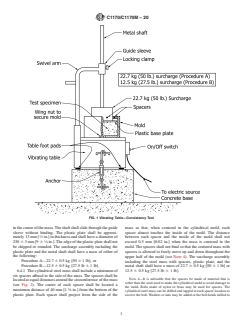
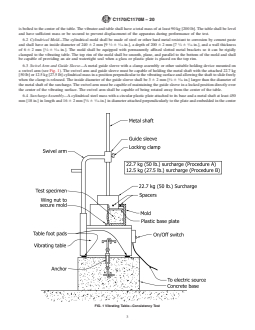
FIG. 1 Vibrating Table—Consistency Test
inthecenterofthemass.Theshaftshallslidethroughtheguide mass so that, when centered in the cylindrical mold, each
sleeve without binding. The plastic plate shall be approxi- spacer almost touches the inside of the mold. The distance
mately 13 mm [ ⁄2 in.] in thickness and shall have a diameter of between each spacer and the inside of the mold shall not
230 63mm[9 6 ⁄8in.].Theedgeoftheplasticplateshallnot
exceed 0.5 mm [0.02 in.] when the mass is centered in the
be chipped or rounded. The surcharge assembly including the mold.The spacers shall not bind so that the centered mass with
plastic plate and the metal shaft shall have a mass of either of
spacers is allowed to freely move up and down throughout the
the following: upper half of the mold (see Note 4). The surcharge assembly
Procedure A—22.7 6 0.5 kg [50 6 1 lb], or
including the steel mass with spacers, plastic plate, and the
Procedure B—12.5 6 0.5 kg [27.5 lb 6 1 lb]. metal shaft shall have a mass of 22.7 6 0.5 kg [50 6 1 lb] or
6.4.1 The cylindrical steel mass shall include a minimum of
12.5 6 0.5 kg [27.5 lb 6 1 lb].
six spacers affixed to the side of the mass. The spacers shall be
NOTE 4—It is advisable that the spacers be made of material that is
locatedatequaldistancesaroundthecircumferenceofthemass
softer than the steel used to make the cylindrical mold to avoid damage to
(see Fig. 2). The center of each spacer shall be located a
the mold. Bolts made of nylon or brass may be used for spacers. The
maximum distance of 40 mm [1 ⁄8 in.] from the bottom of the
cylindrical steel mass can be drilled and tapped at each spacer location to
plastic plate. Each spacer shall project from the side of the receive the bolt. Washers or nuts may be added or the bolt heads milled to
C1170/C1170M − 20
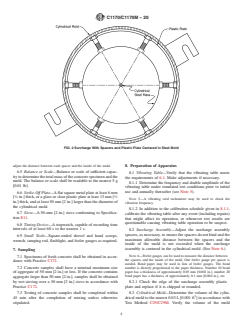
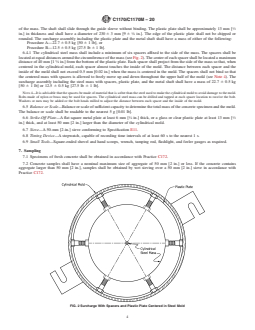
FIG. 2 Surcharge With Spacers and Plastic Plate Centered in Steel Mold
adjust the distance between each spacer and the inside of the mold.
8. Preparation of Apparatus
6.5 Balance or Scale—Balance or scale of sufficient capac-
8.1 Vibrating Table—Verify that the vibrating table meets
itytodeterminethetotalmassoftheconcretespecimenandthe
the requirements of 6.1. Make adjustments if necessary.
mold. The balance or scale shall be readable to the nearest 5 g
8.1.1 Determine the frequency and double amplitude of the
[0.01 lb].
vibrating table under simulated test conditions prior to initial
use and annually thereafter (see Note 5).
6.6 Strike-Off Plate—Aflat square metal plate at least 6 mm
1 1
[ ⁄4 in.] thick, or a glass or clear plastic plate at least 13 mm [ ⁄2
NOTE 5—A vibrating reed tachometer may be used to check the
in.] thick, and at least 50 mm [2 in.] larger than the diameter of
vibration frequency.
the cylindrical mold.
8.1.2 In addition to the calibration schedule given in 8.1.1,
6.7 Sieve—A 50-mm [2-in.] sieve conforming to Specifica-
calibrate the vibrating table after any event (including repairs)
tion E11.
that might affect its operation, or whenever test results are
questionable causing vibrating table operation to be suspect.
6.8 Timing Device—Astopwatch, capable of recording time
intervals of at least 60 s to the nearest 1 s.
8.2 Surcharge Assembly—Adjust the surcharge assembly
spacers, as necessary, to ensure the s
...
This document is not an ASTM standard and is intended only to provide the user of an ASTM standard an indication of what changes have been made to the previous version. Because
it may not be technically possible to adequately depict all changes accurately, ASTM recommends that users consult prior editions as appropriate. In all cases only the current version
of the standard as published by ASTM is to be considered the official document.
´1
Designation: C1170/C1170M − 14 C1170/C1170M − 20
Standard Test Method for
Determining Consistency and Density of Roller-Compacted
Concrete Using a Vibrating Table
This standard is issued under the fixed designation C1170/C1170M; the number immediately following the designation indicates the year
of original adoption or, in the case of revision, the year of last revision. A number in parentheses indicates the year of last reapproval.
A superscript epsilon (´) indicates an editorial change since the last revision or reapproval.
ε NOTE—Editorial corrections were made to 10.2.6 in June 2014.
1. Scope*
1.1 This test method is used to determine the consistency of concrete using a vibrating table and a surcharge and to determine
the density of the consolidated concrete specimen. This test method is applicable to freshly mixed concrete, prepared in both the
laboratory and the field, having a nominal maximum size aggregate of 50 mm [2 in.] or less. If the nominal maximum size of
aggregate is larger than 50 mm [2 in.], the test method is applicable only when performed on the fraction passing the 50-mm [2-in.]
sieve with the larger aggregate being removed in accordance with Practice C172.
1.2 This test method, intended for use in testing roller-compacted concrete, may be applicable to testing other types of concrete
such as cement-treated aggregate and mixtures similar to soil-cement.
1.3 The values stated in either SI units or inch-pound units are to be regarded separately as standard. The values stated in each
system may not be exact equivalents; therefore, each system shall be used independently of the other. Combining values from the
two systems may result in non-conformance with the standard.
1.4 The text of this standard refers to notes and footnotes that provide explanatory material. These notes and footnotes
(excluding those in tables and figures) shall not be considered as requirements of this standard.
1.5 This standard does not purport to address all of the safety concerns, if any, associated with its use. It is the responsibility
of the user of this standard to establish appropriate safety safety, health, and healthenvironmental practices and determine the
applicability of regulatory limitations prior to use. (Warning—Fresh hydraulic cementitious mixtures are caustic and may cause
chemical burns to skin and tissue upon prolonged exposure. )
1.6 This international standard was developed in accordance with internationally recognized principles on standardization
established in the Decision on Principles for the Development of International Standards, Guides and Recommendations issued
by the World Trade Organization Technical Barriers to Trade (TBT) Committee.
2. Referenced Documents
2.1 ASTM Standards:
C29/C29M Test Method for Bulk Density (“Unit Weight”) and Voids in Aggregate
C125 Terminology Relating to Concrete and Concrete Aggregates
C172 Practice for Sampling Freshly Mixed Concrete
C670 Practice for Preparing Precision and Bias Statements for Test Methods for Construction Materials
C1067 Practice for Conducting a Ruggedness Evaluation or Screening Program for Test Methods for Construction Materials
D1557 Test Methods for Laboratory Compaction Characteristics of Soil Using Modified Effort (56,000 ft-lbf/ft (2,700
kN-m/m ))
E11 Specification for Woven Wire Test Sieve Cloth and Test Sieves
E177 Practice for Use of the Terms Precision and Bias in ASTM Test Methods
This test method is under the jurisdiction of ASTM Committee C09 on Concrete and Concrete Aggregates and is the direct responsibility of Subcommittee C09.45 on
Roller-Compacted Concrete.
Current edition approved April 1, 2014April 1, 2020. Published May 2014May 2020. Originally approved in 1991. Last previous edition approved in 20082014 as
ɛ1
C1170 – 08.C1170 – 14 . DOI: 10.1520/C1170_C1170M-14E01.10.1520/C1170_C1170M-20.
Section on Safety Precautions, Manual of Aggregate and Concrete Testing, Annual Book of ASTM Standards, Vol 04.02.
For referenced ASTM standards, visit the ASTM website, www.astm.org, or contact ASTM Customer Service at service@astm.org. For Annual Book of ASTM Standards
volume information, refer to the standard’s Document Summary page on the ASTM website.
*A Summary of Changes section appears at the end of this standard
Copyright © ASTM International, 100 Barr Harbor Drive, PO Box C700, West Conshohocken, PA 19428-2959. United States
C1170/C1170M − 20
3. Terminology
3.1 Definitions:
3.1.1 For definitions of terms used in this test method, refer to Terminology C125.
3.2 Definitions of Terms Specific to This Standard:
3.2.1 extremely dry consistency, n—for the purpose of this standard, the consistency of concrete having no slump and a Vebe
consistency greater than 30 s when measured with Procedure A.
3.2.2 stiff consistency, n—for the purpose of this standard, the consistency of concrete having no slump and a Vebe consistency
ranging from 5 to 20 s when measured with Procedure B.
3.2.3 Vebe consistency, n—the time required for a given mass of concrete to be consolidated by vibration in a cylindrically
shaped mold under a surcharge mass.
3.2.4 very stiff consistency, n—for the purpose of this standard, the consistency of concrete having no slump and a Vebe
consistency ranging from 20 to 30 s when measured with Procedure A or B.
4. Summary of Test Method
4.1 A vibrating table is used to measure the consistency of stiff to extremely dry concrete mixtures (see Note 1). Density of the
compacted specimen is measured by determining the mass of the consolidated specimen and dividing by its volume.
4 5
NOTE 1—Further description of concrete of this consistency is given in ACI 207.5R and ACI 211.3R.
4.2 Two procedures are provided:
4.2.1 Procedure A uses a 22.7 kg [50 lb] surcharge mass placed on top of the test specimen. Procedure A shall be used for testing
concrete of extremely dry consistency or when the Vebe consistency by Procedure B is 30 s or greater (see Note 2).
NOTE 2—Further description of the test procedure using a 22.7 kg [50 lb] surcharge can be found in the U.S. Bureau of Reclamation’s Technical
Memorandum No. 8.
4.2.2 Procedure B uses a 12.5 kg [27.5 lb] surcharge mass placed on top of the test specimen. Procedure B shall be used for
testing concrete of stiff consistency or when the Vebe consistency by Procedure B is less than 20 s (see Note 3).
NOTE 3—Further description of the test procedure using a 12.5 kg [27.5 lb] surcharge can be found in the U. S. Army Corps of Engineer’s test procedure
CRD-C-53-01.
4.2.3 Either Procedure A or B can be used for testing concrete with a very stiff consistency or when the Vebe consistency by
Procedure A or B ranges from 20 to 30 s.
5. Significance and Use
5.1 This test method is intended to be used for determining the consistency and density of stiff to extremely dry concrete
mixtures common in roller-compacted concrete construction.
5.1.1 Because of the stiff to extremely dry consistency of some roller-compacted concrete mixtures, the standard Vebe test
method of rodding the specimen in a slump cone is substituted by Procedures A and B.
5.2 Procedure A uses a 22.7 kg [50 lb] surcharge and is used for concrete consolidated by roller-compaction methods when the
consistency of the concrete is very stiff to extremely dry.
5.3 Procedure B uses a 12.5 kg [27.5 lb] surcharge and is used for concrete consolidated by roller-compaction methods when
the consistency of the concrete is stiff to very stiff consistency, but not extremely dry.
6. Apparatus
6.1 Vibrating Table—A vibrating table with a steel deck approximately 20-mm [ ⁄4-in.] thick with dimensions of approximately
380 mm [15 in.] in length, 250 mm [10 in.] in width, and 300 mm [12 in.] in height. The vibrating table shall be constructed in
such a manner as to prevent flexing of the table during operation. The table deck shall be activated by an electromechanical
vibrator. The table shall produce a sinusoidal vibratory motion with a frequency of at least 60 6 2 Hz [3600 6 100 vibrations per
min] and a double amplitude of vibration of 0.43 6 0.08 mm [0.0170 6 0.0030 in.] when a 27 6 2-kg [60.0 6 2.5-lb] surcharge
ACI 207.5R, Report on Roller-Compacted Concrete, 1999. Available from American Concrete Institute (ACI), P.O. Box 9094, Farmington Hills, MI 48333,
http://www.concrete.org.
ACI 211.3R, Guide for Selecting Proportions for No-Slump Concrete, 2002. Available from American Concrete Institute (ACI), P.O. Box 9094, Farmington Hills, MI
48333, http://www.concrete.org.
Guidelines for Designing and Constructing Roller-Compacted Concrete Dams, ACER Technical Memorandum No. 8, Bureau of Reclamation, Denver, CO, Appendix
A, 1987.
Test Method for Consistency of No-Slump Concrete Using the Modified Vebe Apparatus, CRD-C-53-01, U. S. Army Corps of Engineers, Vicksburg, MS, 2001.
ACI Manual of Concrete Practice, Part 1, 2005. Available from American Concrete Institute (ACI), P.O. Box 9094, Farmington Hills, MI 48333, http://www.concrete.org.
C1170/C1170M − 20
is bolted to the center of the table. The vibrator and table shall have a total mass of at least 90 kg [200 lb]. The table shall be level
and have sufficient mass or be secured to prevent displacement of the apparatus during performance of the test.
6.2 Cylindrical Mold—The cylindrical mold shall be made of steel or other hard metal resistant to corrosion by cement paste
1 1 3 1
and shall have an inside diameter of 240 6 2 mm [9 ⁄2 6 ⁄16 in.], a depth of 200 6 2 mm [7 ⁄4 6 ⁄16 in.], and a wall thickness
1 1
of 6 6 2 mm [ ⁄4 6 ⁄16 in.]. The mold shall be equipped with permanently affixed slotted metal brackets so it can be rigidly
clamped to the vibrating table. The top rim of the mold shall be smooth, plane, and parallel to the bottom of the mold and shall
be capable of providing an air and watertight seal when a glass or plastic plate is placed on the top rim.
6.3 Swivel Arm and Guide Sleeve—A metal guide sleeve with a clamp assembly or other suitable holding device mounted on
a swivel arm (see Fig. 1). The swivel arm and guide sleeve must be capable of holding the metal shaft with the attached 22.7 kg
[50 lb] or 12.5 kg [27.5 lb] cylindrical mass in a position perpendicular to the vibrating surface and allowing the shaft to slide freely
1 1
when the clamp is released. The inside diameter of the guide sleeve shall be 3 6 2 mm [ ⁄8 6 ⁄16 in.] larger than the diameter of
the metal shaft of the surcharge. The swivel arm must be capable of maintaining the guide sleeve in a locked position directly over
the center of the vibrating surface. The swivel arm shall be capable of being rotated away from the center of the table.
6.4 Surcharge Assembly—A cylindrical steel mass with a circular plastic plate attached to its base and a metal shaft at least 450
5 1
mm [18 in.] in length and 16 6 2 mm [ ⁄8 6 ⁄16 in.] in diameter attached perpendicularly to the plate and embedded in the center
FIG. 1 Vibrating Table—Consistency Test
C1170/C1170M − 20
of the mass. The shaft shall slide through the guide sleeve without binding. The plastic plate shall be approximately 13 mm [ ⁄2
in.] in thickness and shall have a diameter of 230 6 3 mm [9 6 ⁄8 in.]. The edge of the plastic plate shall not be chipped or
rounded. The surcharge assembly including the plastic plate and the metal shaft shall have a mass of either of the following:
Procedure A—22.7 6 0.5 kg [50 6 1 lb], or
Procedure B—12.5 6 0.5 kg [27.5 lb 6 1 lb].
6.4.1 The cylindrical steel mass shall include a minimum of six spacers affixed to the side of the mass. The spacers shall be
located at equal distances around the circumference of the mass (see Fig. 2). The center of each spacer shall be located a maximum
distance of 40 mm [1 ⁄8 in.] from the bottom of the plastic plate. Each spacer shall project from the side of the mass so that, when
centered in the cylindrical mold, each spacer almost touches the inside of the mold. The distance between each spacer and the
inside of the mold shall not exceed 0.5 mm [0.02 in.] when the mass is centered in the mold. The spacers shall not bind so that
the centered mass with spacers is allowed to freely move up and down throughout the upper half of the mold (see Note 4). The
surcharge assembly including the steel mass with spacers, plastic plate, and the metal shaft shall have a mass of 22.7 6 0.5 kg
[50 6 1 lb] or 12.5 6 0.5 kg [27.5 lb 6 1 lb].
NOTE 4—It is advisable that the spacers be made of material that is softer than the steel used to make the cylindrical mold to avoid damage to the mold.
Bolts made of nylon or brass may be used for spacers. The cylindrical steel mass can be drilled and tapped at each spacer location to receive the bolt.
Washers or nuts may be added or the bolt heads milled to adjust the distance between each spacer and the inside of the mold.
6.5 Balance or Scale—Balance or scale of sufficient capacity to determine the total mass of the concrete specimen and the mold.
The balance or scale shall be readable to the nearest 5 g [0.01 lb].
1 1
6.6 Strike-Off Plate—A flat square metal plate at least 6 mm [ ⁄4 in.] thick, or a glass or clear plastic plate at least 13 mm [ ⁄2
in.] thick, and at least 50 mm [2 in.] larger than the diameter of the cylindrical mold.
6.7 Sieve—A 50-mm [2-in.] sieve conforming to Specification E11.
6.8 Timing Device—A stopwatch, capable of recording time intervals of at least 60 s to the nearest 1 s.
6.9 Small Tools—Square-ended shovel and hand scoops, wrench, tamping rod, flashlight, and feeler gauges as required.
7. Sampling
7.1 Specimens of fresh concrete shall be obtained in accordance with Practice C172.
7.2 Concrete samples shall have a nominal maximum size of aggregate of 50 mm [2 in.] or less. If the concrete contains
aggregate larger than 50 mm [2 in.], samples shall be obtained by wet sieving over a 50 mm [2 in.] sieve in accordance with
Practice C172.
FIG. 2 Surcharge With Spacers and Plastic Plate Centered in Steel Mold
C1170/C1170M − 20
7.3 Testing of concrete samples shall be completed within 45 min after the completion of mixing unless otherwise stipulated.
8. Preparation of
...