

ASTM E608/E608M-13(2019)
(Specification)Standard Specification for Mineral-Insulated, Metal-Sheathed Base Metal Thermocouples
General Information
- Abstract
ABSTRACT
This specification covers the requirements for mineral-insulated, metal-sheathed base metal thermocouples for industrial or high-reliability applications. Provisions are made herein for selecting thermoelements, and insulation and sheath materials, and measuring junction configuration, thermocouple assembly length, and the type of transition or termination. This specification also includes provisions for quality assurance or verification program requirements, or both, as the purchaser's option.
SIGNIFICANCE AND USE
4.1 This specification describes the physical requirements of mineral-insulated, metal-sheathed base metal thermocouples and establishes suitable test criteria for their evaluation.
4.2 Standardized dimensional requirements and acceptable allowances for manufacturing variations, are given.
4.3 A set of standard tests to be applied to all thermocouples covered by this specification are described, in addition to optional tests from which applicable additional requirements may be selected.
4.4 Warning—Users should be aware that certain characteristics of thermocouples might change with time and use.
4.4.1 If a thermocouple's designed shipping, storage, installation, or operating temperature has been exceeded, the thermocouple’s moisture seal may have been compromised and may no longer prevent the deleterious intrusion of water vapor. Consequently, the thermocouple's condition established by test at the time of manufacture may not apply later after an extended period of use, and retesting may become necessary.
4.4.2 In addition, inhomogeneities can develop in thermoelements because of exposure to temperature, even in cases where the maximum exposure temperatures have been lower than the suggested upper temperature limits of Table 1. For this reason, calibration of thermocouples destined for delivery to a customer is not recommended (see S6.1).
4.4.3 Furthermore, because the EMF indication of any thermocouple depends upon the condition of the thermoelements along their entire length, as well as the temperature profile pattern in the region of any inhomogeneity, the EMF output of a used thermocouple will be unique to its installation. Because temperature profiles in calibration equipment are unlikely to duplicate those of the installation, removal of a used thermocouple to a separate apparatus for calibration is not recommended. Instead, in-situ calibration by comparison to a similar thermocouple of known accuracy is recommended.
SCOPE
1.1 This specification covers the requirements for mineral-insulated, metal-sheathed base metal thermocouples for industrial or high-reliability applications. It applies specifically to thermocouples fabricated from sheathed thermocouple material in accordance with Specification E585/E585M. The specification provides for the selection of thermoelements, insulation, sheath material, measuring junction configuration, thermocouple assembly length, and the type of transition or termination.
1.2 This specification also includes provisions for either quality assurance or verification program requirements, or both, as a purchaser’s option.
1.3 The values stated in either SI units or inch-pound units are to be regarded separately as standard. The values stated in each system may not be exact equivalents; therefore, each system shall be used independently of the other. Combining values from the two systems may result in non-conformance with the standard.
1.4 This standard does not purport to address all of the safety concerns, if any, associated with its use. It is the responsibility of the user of this standard to establish appropriate safety, health, and environmental practices and determine the applicability of regulatory limitations prior to use.
1.5 This international standard was developed in accordance with internationally recognized principles on standardization established in the Decision on Principles for the Development of Inter...
- Status
- Published
- Publication Date
- 30-Apr-2019
- Technical Committee
- E20 - Temperature Measurement
- Drafting Committee
- E20.12 - Thermocouples - Specifications
Overview
ASTM E608/E608M-13(2019): Standard Specification for Mineral-Insulated, Metal-Sheathed Base Metal Thermocouples establishes requirements for mineral-insulated, metal-sheathed thermocouples made from base metals. These thermocouples are widely used in industrial and high-reliability environments for precise temperature measurement due to their durability, insulation, and resistance to environmental influences. The standard outlines specifications for thermoelement selection, insulation and sheath materials, measuring junction configurations, assembly length, and termination types. It also addresses quality assurance and verification program requirements to ensure consistent product performance.
Key Topics
- Material Selection: Specifies criteria for thermoelements, insulation (typically magnesium oxide or aluminum oxide), and sheath materials to optimize performance across varied industrial conditions.
- Junction Configurations: Details both grounded and ungrounded (including isolated ungrounded and common ungrounded) measuring junctions, each offering distinct electrical characteristics for different application needs.
- Manufacturing Tolerances: Defines dimensional and electrical property tolerances for consistent manufacturing quality, including initial EMF tolerances and insulation resistance.
- Testing and Inspection:
- Standardized tests: visual inspection, dimensional checks, insulation resistance (particularly for ungrounded junctions), polarity, and electrical continuity.
- Optional supplementary tests: radiography, dye penetrant inspection, helium mass spectrometer and water testing for weld and sheath integrity, and elevated temperature insulation resistance.
- Traceability and Documentation: Requires tagging and traceability of individual thermocouples, with supporting documentation for tests and materials to ensure quality assurance.
- Safety and Compliance: Stresses that users are responsible for proper safety, health, and environmental practices when applying the standard.
Applications
Mineral-insulated, metal-sheathed base metal thermocouples according to ASTM E608/E608M are widely used in:
- Industrial Process Control: High-accuracy temperature monitoring in chemical, petrochemical, power generation, and metal-processing industries.
- Harsh and High-Reliability Environments: Applications requiring robustness against vibration, corrosion, and moisture ingress, such as aerospace, nuclear, and critical manufacturing processes.
- Quality Assurance Programs: Facilities implementing stringent verification protocols can specify optional supplementary tests and documentation to meet regulatory or client requirements.
- Custom Installations: The specification accommodates custom lengths, configurations, and termination types for complex system integration.
- Ongoing Maintenance: Provisions for in-situ calibration and re-testing as thermocouple properties can change with time, use, and environmental exposure.
Related Standards
- ASTM E585/E585M: Specification for Compacted Mineral-Insulated, Metal-Sheathed, Base Metal Thermocouple Cable.
- ASTM E220: Test Method for Calibration of Thermocouples by Comparison Techniques.
- ASTM E230/E230M: Temperature-Electromotive Force (EMF) Tables for Standardized Thermocouples.
- ASTM E780: Test Method for Measuring the Insulation Resistance of Mineral-Insulated, Metal-Sheathed Thermocouples and Cable.
- ASTM E839: Test Methods for Sheathed Thermocouples and Sheathed Thermocouple Cable.
- AWS A5.9 & A5.14: Specifications for welding rods and electrodes used in thermocouple fabrication.
- ASTM E165/E165M: Liquid Penetrant Testing for General Industry.
- ASTM E344: Terminology related to thermometry and hydrometry.
Practical Value
Following ASTM E608/E608M ensures:
- Consistency and Reliability: Uniformity in manufacturing and performance characteristics vital for process control and repeatable results.
- Safety Assurance: Clear delineation of responsibility for safety and regulatory compliance.
- Enhanced Product Life: Detailed requirements for moisture sealing, robust terminations, and in-use calibration recommendations prolong useful thermocouple lifespan.
- International Recognition: The standard aligns with globally recognized principles, supporting acceptance in international trade and multi-national operations.
Keywords: ASTM E608/E608M, mineral-insulated thermocouples, metal-sheathed, base metal thermocouples, temperature measurement, process control, industrial thermocouple, quality assurance, junction configuration, insulation resistance.
Relations
- Effective Date
- 01-Dec-2023
- Effective Date
- 01-Nov-2023
- Refers
ASTM E839-23 - Standard Test Methods for Sheathed Thermocouples and Sheathed Thermocouple Cable - Effective Date
- 01-Nov-2023
- Effective Date
- 01-May-2023
- Effective Date
- 01-Sep-2019
- Effective Date
- 01-Apr-2018
- Effective Date
- 01-Nov-2016
- Effective Date
- 01-Nov-2016
- Effective Date
- 01-Nov-2013
- Effective Date
- 01-May-2013
- Effective Date
- 01-May-2012
- Effective Date
- 01-May-2012
- Refers
ASTM E839-11 - Standard Test Methods for Sheathed Thermocouples and Sheathed Thermocouple Cable - Effective Date
- 01-Nov-2011
- Effective Date
- 15-May-2011
- Effective Date
- 15-May-2011
Get Certified
Connect with accredited certification bodies for this standard

BSMI (Bureau of Standards, Metrology and Inspection)
Taiwan's standards and inspection authority.
Sponsored listings
Frequently Asked Questions
ASTM E608/E608M-13(2019) is a technical specification published by ASTM International. Its full title is "Standard Specification for Mineral-Insulated, Metal-Sheathed Base Metal Thermocouples". This standard covers: ABSTRACT This specification covers the requirements for mineral-insulated, metal-sheathed base metal thermocouples for industrial or high-reliability applications. Provisions are made herein for selecting thermoelements, and insulation and sheath materials, and measuring junction configuration, thermocouple assembly length, and the type of transition or termination. This specification also includes provisions for quality assurance or verification program requirements, or both, as the purchaser's option. SIGNIFICANCE AND USE 4.1 This specification describes the physical requirements of mineral-insulated, metal-sheathed base metal thermocouples and establishes suitable test criteria for their evaluation. 4.2 Standardized dimensional requirements and acceptable allowances for manufacturing variations, are given. 4.3 A set of standard tests to be applied to all thermocouples covered by this specification are described, in addition to optional tests from which applicable additional requirements may be selected. 4.4 Warning—Users should be aware that certain characteristics of thermocouples might change with time and use. 4.4.1 If a thermocouple's designed shipping, storage, installation, or operating temperature has been exceeded, the thermocouple’s moisture seal may have been compromised and may no longer prevent the deleterious intrusion of water vapor. Consequently, the thermocouple's condition established by test at the time of manufacture may not apply later after an extended period of use, and retesting may become necessary. 4.4.2 In addition, inhomogeneities can develop in thermoelements because of exposure to temperature, even in cases where the maximum exposure temperatures have been lower than the suggested upper temperature limits of Table 1. For this reason, calibration of thermocouples destined for delivery to a customer is not recommended (see S6.1). 4.4.3 Furthermore, because the EMF indication of any thermocouple depends upon the condition of the thermoelements along their entire length, as well as the temperature profile pattern in the region of any inhomogeneity, the EMF output of a used thermocouple will be unique to its installation. Because temperature profiles in calibration equipment are unlikely to duplicate those of the installation, removal of a used thermocouple to a separate apparatus for calibration is not recommended. Instead, in-situ calibration by comparison to a similar thermocouple of known accuracy is recommended. SCOPE 1.1 This specification covers the requirements for mineral-insulated, metal-sheathed base metal thermocouples for industrial or high-reliability applications. It applies specifically to thermocouples fabricated from sheathed thermocouple material in accordance with Specification E585/E585M. The specification provides for the selection of thermoelements, insulation, sheath material, measuring junction configuration, thermocouple assembly length, and the type of transition or termination. 1.2 This specification also includes provisions for either quality assurance or verification program requirements, or both, as a purchaser’s option. 1.3 The values stated in either SI units or inch-pound units are to be regarded separately as standard. The values stated in each system may not be exact equivalents; therefore, each system shall be used independently of the other. Combining values from the two systems may result in non-conformance with the standard. 1.4 This standard does not purport to address all of the safety concerns, if any, associated with its use. It is the responsibility of the user of this standard to establish appropriate safety, health, and environmental practices and determine the applicability of regulatory limitations prior to use. 1.5 This international standard was developed in accordance with internationally recognized principles on standardization established in the Decision on Principles for the Development of Inter...
ABSTRACT This specification covers the requirements for mineral-insulated, metal-sheathed base metal thermocouples for industrial or high-reliability applications. Provisions are made herein for selecting thermoelements, and insulation and sheath materials, and measuring junction configuration, thermocouple assembly length, and the type of transition or termination. This specification also includes provisions for quality assurance or verification program requirements, or both, as the purchaser's option. SIGNIFICANCE AND USE 4.1 This specification describes the physical requirements of mineral-insulated, metal-sheathed base metal thermocouples and establishes suitable test criteria for their evaluation. 4.2 Standardized dimensional requirements and acceptable allowances for manufacturing variations, are given. 4.3 A set of standard tests to be applied to all thermocouples covered by this specification are described, in addition to optional tests from which applicable additional requirements may be selected. 4.4 Warning—Users should be aware that certain characteristics of thermocouples might change with time and use. 4.4.1 If a thermocouple's designed shipping, storage, installation, or operating temperature has been exceeded, the thermocouple’s moisture seal may have been compromised and may no longer prevent the deleterious intrusion of water vapor. Consequently, the thermocouple's condition established by test at the time of manufacture may not apply later after an extended period of use, and retesting may become necessary. 4.4.2 In addition, inhomogeneities can develop in thermoelements because of exposure to temperature, even in cases where the maximum exposure temperatures have been lower than the suggested upper temperature limits of Table 1. For this reason, calibration of thermocouples destined for delivery to a customer is not recommended (see S6.1). 4.4.3 Furthermore, because the EMF indication of any thermocouple depends upon the condition of the thermoelements along their entire length, as well as the temperature profile pattern in the region of any inhomogeneity, the EMF output of a used thermocouple will be unique to its installation. Because temperature profiles in calibration equipment are unlikely to duplicate those of the installation, removal of a used thermocouple to a separate apparatus for calibration is not recommended. Instead, in-situ calibration by comparison to a similar thermocouple of known accuracy is recommended. SCOPE 1.1 This specification covers the requirements for mineral-insulated, metal-sheathed base metal thermocouples for industrial or high-reliability applications. It applies specifically to thermocouples fabricated from sheathed thermocouple material in accordance with Specification E585/E585M. The specification provides for the selection of thermoelements, insulation, sheath material, measuring junction configuration, thermocouple assembly length, and the type of transition or termination. 1.2 This specification also includes provisions for either quality assurance or verification program requirements, or both, as a purchaser’s option. 1.3 The values stated in either SI units or inch-pound units are to be regarded separately as standard. The values stated in each system may not be exact equivalents; therefore, each system shall be used independently of the other. Combining values from the two systems may result in non-conformance with the standard. 1.4 This standard does not purport to address all of the safety concerns, if any, associated with its use. It is the responsibility of the user of this standard to establish appropriate safety, health, and environmental practices and determine the applicability of regulatory limitations prior to use. 1.5 This international standard was developed in accordance with internationally recognized principles on standardization established in the Decision on Principles for the Development of Inter...
ASTM E608/E608M-13(2019) is classified under the following ICS (International Classification for Standards) categories: 17.200.20 - Temperature-measuring instruments. The ICS classification helps identify the subject area and facilitates finding related standards.
ASTM E608/E608M-13(2019) has the following relationships with other standards: It is inter standard links to ASTM E344-23, ASTM E230/E230M-23a, ASTM E839-23, ASTM E230/E230M-23, ASTM E344-19, ASTM E344-18, ASTM E839-11(2016), ASTM E344-16, ASTM E220-13, ASTM E344-13, ASTM E585/E585M-12, ASTM E344-12, ASTM E839-11, ASTM E230/E230M-11, ASTM E230/E230M-11e1. Understanding these relationships helps ensure you are using the most current and applicable version of the standard.
ASTM E608/E608M-13(2019) is available in PDF format for immediate download after purchase. The document can be added to your cart and obtained through the secure checkout process. Digital delivery ensures instant access to the complete standard document.
Standards Content (Sample)
This international standard was developed in accordance with internationally recognized principles on standardization established in the Decision on Principles for the
Development of International Standards, Guides and Recommendations issued by the World Trade Organization Technical Barriers to Trade (TBT) Committee.
Designation:E608/E608M −13 (Reapproved 2019) An American National Standard
Standard Specification for
Mineral-Insulated, Metal-Sheathed Base Metal
Thermocouples
This standard is issued under the fixed designation E608/E608M; the number immediately following the designation indicates the year
of original adoption or, in the case of revision, the year of last revision. A number in parentheses indicates the year of last reapproval.
A superscript epsilon (´) indicates an editorial change since the last revision or reapproval.
1. Scope 2. Referenced Documents
1.1 This specification covers the requirements for mineral- 2.1 ASTM Standards:
insulated, metal-sheathed base metal thermocouples for indus- E165/E165M Practice for Liquid Penetrant Testing for Gen-
trial or high-reliability applications. It applies specifically to eral Industry
thermocouples fabricated from sheathed thermocouple mate- E220 Test Method for Calibration of Thermocouples By
rial in accordance with Specification E585/E585M. The speci- Comparison Techniques
fication provides for the selection of thermoelements, E230/E230M Specification for Temperature-Electromotive
insulation, sheath material, measuring junction configuration, Force (emf) Tables for Standardized Thermocouples
thermocouple assembly length, and the type of transition or E344 Terminology Relating to Thermometry and Hydrom-
termination. etry
E585/E585M Specification for Compacted Mineral-
1.2 This specification also includes provisions for either
Insulated, Metal-Sheathed, Base Metal Thermocouple
quality assurance or verification program requirements, or
Cable
both, as a purchaser’s option.
E780 Test Method for Measuring the Insulation Resistance
1.3 The values stated in either SI units or inch-pound units
of Mineral-Insulated, Metal-Sheathed Thermocouples and
are to be regarded separately as standard. The values stated in
Mineral-Insulated, Metal-Sheathed Cable at Room Tem-
each system are not necessarily exact equivalents; therefore, to
perature
ensure conformance with the standard, each system shall be
E839 Test Methods for Sheathed Thermocouples and
used independently of the other, and values from the two
Sheathed Thermocouple Cable
systems shall not be combined.
2.2 AWS Standards:
1.4 This standard does not purport to address all of the
A5.9 Specification for Corrosion-Resisting Chromium and
safety concerns, if any, associated with its use. It is the
Chromium-Nickel Steel Welding Rods and Bare Elec-
responsibility of the user of this standard to establish appro-
trodes
priate safety, health, and environmental practices and deter-
A5.14 Specification for Nickel and Nickel-Alloy BareWeld-
mine the applicability of regulatory limitations prior to use.
ing Rods and Electrodes
1.5 This international standard was developed in accor-
3. Terminology
dance with internationally recognized principles on standard-
ization established in the Decision on Principles for the
3.1 Definitions—ThedefinitionsgiveninTerminologyE344
Development of International Standards, Guides and Recom-
shall apply to this specification.
mendations issued by the World Trade Organization Technical
3.2 Definitions of Terms Specific to This Standard:
Barriers to Trade (TBT) Committee.
1 2
This specification is under the jurisdiction of ASTM Committee E20 on For referenced ASTM standards, visit the ASTM website, www.astm.org, or
Temperature Measurement and is the direct responsibility of Subcommittee E20.12 contact ASTM Customer Service at service@astm.org. For Annual Book of ASTM
on Thermocouples - Specifications. Standards volume information, refer to the standard’s Document Summary page on
CurrenteditionapprovedMay1,2019.PublishedJuly2019.Originallyapproved the ASTM website.
in 1977. Last previous edition approved in 2013 as E608/E608M – 13. DOI: Available from American Welding Society (AWS), 550 NW LeJeune Rd.,
10.1520/E0608_E0608M-13R19. Miami, FL 33126, http://www.aws.org.
Copyright © ASTM International, 100 Barr Harbor Drive, PO Box C700, West Conshohocken, PA 19428-2959. United States
E608/E608M−13 (2019)
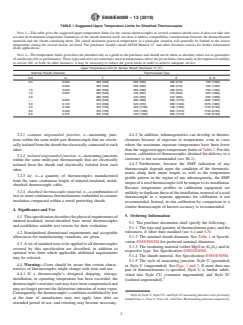
TABLE 1 Suggested Upper Temperature Limits for Sheathed Thermocouples
NOTE 1—This table gives the suggested upper temperature limits for the various thermocouples in several common sheath sizes. It does not take into
account environmental temperature limitations of the sheath material itself, nor does it address compatibility considerations between the thermoelement
materials and the sheath containing them. The actual maximum practical temperature in a particular situation will generally be limited to the lowest
temperature among the several factors involved. The purchaser should consult ASTM Manual 12 and other literature sources for further information
about applications.
NOTE 2—The temperature limits given here are intended only as a guide to the purchaser and should not be taken as absolute values nor as guarantees
ofsatisfactorylifeorperformance.Thesetypesandsizesaresometimesusedattemperaturesabovethegivenlimits,butusuallyattheexpenseofstability
or service life, or both. In other instances, it may be necessary to reduce the given limits in order to achieve adequate service.
Upper Temperature Limit for Various Sheath Diameters °C [°F]
Nominal Sheath Diameter Thermocouple Type
mm in. T J E K, N
0.5 0.020 260 (500) 260 (500) 300 (570) 700 (1290)
. . . 0.032 260 (500) 260 (500) 300 (570) 700 (1290)
1.0 0.040 260 (500) 260 (500) 300 (570) 700 (1290)
1.5 0.062 260 (500) 440 (825) 510 (950) 920 (1690)
2.0 . . . 260 (500) 440 (825) 510 (950) 920 (1690)
. . . 0.093 260 (500) 480 (900) 580 (1075) 1000 (1830)
3.0 0.125 315 (600) 520 (970) 650 (1200) 1070 (1960)
4.5 0.188 370 (700) 620 (1150) 730 (1350) 1150 (2100)
6.0 0.250 370 (700) 720 (1330) 820 (1510) 1150 (2100)
8.0 0.375 370 (700) 720 (1330) 820 (1510) 1150 (2100)
3.2.1 common ungrounded junction, n—measuring junc- 4.4.2 In addition, inhomogeneities can develop in thermo-
tions within the same multi-pair thermocouple that are electri- elements because of exposure to temperature, even in cases
callyisolatedfromthesheathbutelectricallyconnectedtoeach where the maximum exposure temperatures have been lower
other. thanthesuggesteduppertemperaturelimitsofTable1.Forthis
reason, calibration of thermocouples destined for delivery to a
3.2.2 isolated ungrounded junction, n—measuring junctions
customer is not recommended (see S6.1).
within the same multi-pair thermocouple that are electrically
4.4.3 Furthermore, because the EMF indication of any
isolated from the sheath and electrically isolated from each
thermocouple depends upon the condition of the thermoele-
other.
ments along their entire length, as well as the temperature
3.2.3 lot, n—a quantity of thermocouples manufactured
profile pattern in the region of any inhomogeneity, the EMF
from the same continuous length of mineral-insulated, metal-
outputofausedthermocouplewillbeuniquetoitsinstallation.
sheathed thermocouple cable.
Because temperature profiles in calibration equipment are
3.2.4 sheathed thermocouple material, n—a combination of
unlikelytoduplicatethoseoftheinstallation,removalofaused
two or more continuous thermoelements embedded in ceramic
thermocouple to a separate apparatus for calibration is not
insulation compacted within a metal protecting sheath.
recommended. Instead, in-situ calibration by comparison to a
similar thermocouple of known accuracy is recommended.
4. Significance and Use
5. Ordering Information
4.1 Thisspecificationdescribesthephysicalrequirementsof
mineral-insulated, metal-sheathed base metal thermocouples
5.1 The purchase documents shall specify the following:
and establishes suitable test criteria for their evaluation.
5.1.1 The type and quantity of thermoelement pairs, and the
4.2 Standardized dimensional requirements and acceptable tolerances, if other than standard (see 6.4 and 6.5).
5.1.2 The nominal sheath diameter. See Table 1 or Specifi-
allowances for manufacturing variations, are given.
cation E585/E585M for preferred nominal diameters.
4.3 Asetofstandardteststobeappliedtoallthermocouples
5.1.3 The insulating material (either MgO orAl O ) and its
2 3
covered by this specification are described, in addition to
respective type. See Specification E585/E585M.
optional tests from which applicable additional requirements
5.1.4 The sheath material. See Specification E585/E585M.
may be selected.
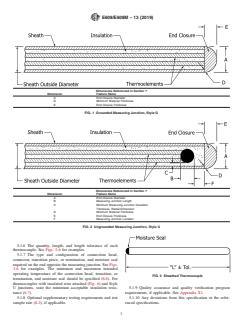
5.1.5 The style of measuring junction: Style G (grounded)
4.4 Warning—Users should be aware that certain charac-
or Style U (ungrounded). See Figs. 1 and 2. If more than one
teristics of thermocouples might change with time and use.
pair of thermoelements is specified, Style U is further subdi-
4.4.1 If a thermocouple’s designed shipping, storage,
vided into Style CU (common ungrounded) and Style IU
installation, or operating temperature has been exceeded, the
(isolated ungrounded).
thermocouple’smoisturesealmayhavebeencompromisedand
may no longer prevent the deleterious intrusion of water vapor.
Consequently, the thermocouple’s condition established by test
Style G, Style U, Style CU, and Style IU measuring junctions were previously
at the time of manufacture may not apply later after an
termed Class 1, Class 2, Class 2A, and Class 2B measuring junctions respectively.
extended period of use, and retesting may become necessary.
E608/E608M−13 (2019)
Dimensions Referenced in Section 7
Dimension Feature Name
A End Closure Diameter
D Minimum Material Thickness
E End Closure Thickness
FIG. 1 Grounded Measuring Junction, Style G
Dimensions Referenced in Section 7
Dimension Feature Name
A End Closure Diameter
B Measuring Junction Length
C Minimum Measuring Junction Insulation
Thickness, Radial Dimension
D Minimum Material Thickness
E End Closure Thickness
F Measuring Junction Location
FIG. 2 Ungrounded Measuring Junction, Style U
5.1.6 The quantity, length, and length tolerance of each
thermocouple. See Figs. 3-6 for examples.
5.1.7 The type and configuration of connection head,
connector, transition piece, or termination, and moisture seal
required on the end opposite the measuring junction. See Figs.
3-6 for examples. The minimum and maximum intended
operating temperature of the connection head, transition, or
FIG. 3 Sheathed Thermocouple
termination, and moisture seal should be specified (6.6). For
thermocouples with insulated wire attached (Fig. 6) and Style
U junctions, state the minimum acceptable insulation resis- 5.1.9 Quality assurance and quality verification program
tance (6.7). requirements, if applicable. See Appendix X1.
5.1.8 Optional supplementary testing requirements and test 5.1.10 Any deviations from this specification or the refer-
sample rate (8.2), if applicable. enced specifications.
E608/E608M−13 (2019)
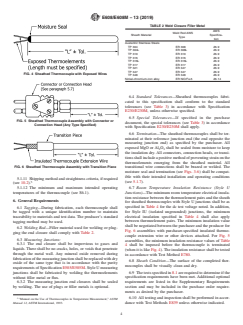
TABLE 2 Weld Closure Filler Metal
AWS
Weld Rod AWS
Sheath Material Specifica-
Type
tion
Austenitic Stainless Steels
TP 304 ER 308 A5.9
TP 304L ER 308L A5.9
TP 310 ER 310 A5.9
TP 316 ER 316 A5.9
TP 316L ER 316L A5.9
TP 317 ER 317 A5.9
TP 321 ER 347 A5.9
TP 347 ER 347 A5.9
FIG. 4 Sheathed Thermocouple with Exposed Wires
TP 348 ER 348 A5.9
Nickel-chromium-iron alloy ER NiCrFe-5 A5.14
6.4 Standard Tolerances—Sheathed thermocouples fabri-
cated to this specification shall conform to the standard
tolerances (see Table 3) in accordance with Specification
E230/E230M, unless otherwise specified.
6.5 Special Tolerances—If specified in the purchase
FIG. 5 Sheathed Thermocouple Assembly with Connector or
document, the special tolerances (see Table 3) in accordance
Connection Head (Any Type Specified)
with Specification E230/E230M shall apply.
6.6 Termination—The sheathed thermocouples shall be ter-
minated at their reference junction end (the end opposite the
measuring junction end) as specified by the purchaser. All
exposed MgO or Al O shall be sealed from moisture to keep
2 3
the insulation dry. All connectors, connection heads, or transi-
tionsshallincludeapositivemethodofpreventingstrainonthe
thermoelements emerging from the sheathed material. All
FIG. 6 Sheathed Thermocouple Assembly with Transition Piece transitional wire connections shall be brazed or welded. The
moisture seal and termination (see Figs. 3-6) shall be compat-
ible with their intended installation and operating conditions
5.1.11 Shipping method and straightness criteria, if required
5 (see 5.1.7).
(see 10.2).
5.1.12 The minimum and maximum intended operating 6.7 Room Temperature Insulation Resistance (Style U
temperatures of the thermocouple (see S6.1). Junctions)—The minimum room temperature electrical insula-
tion resistance between the thermoelement pairs and the sheath
6. General Requirements
for sheathed thermocouples with Style U junctions shall be as
specified in Table 4 for the dc test voltage noted. In addition,
6.1 Tagging—During fabrication, each thermocouple shall
for Style IU (isolated ungrounded) junctions, the minimum
be tagged with a unique identification number to maintain
electrical insulation specified in Table 4 shall also apply
traceability to materials and test data. The producer’s standard
between thermoelement pairs. The minimum insulation value
tagging method may be used.
shall be negotiated between the purchaser and the producer for
6.2 Welding Rod—Filler material used for welding or plug-
Fig. 6 assemblies with purchaser-specified insulated thermo-
ging the end closure shall comply with Table 2.
couple extension wire or other devices attached. For Fig. 5
6.3 Measuring Junctions:
assemblies, the minimum insulation resistance values of Table
6.3.1 The end closure shall be impervious to gases and
4 shall be imposed before the thermocouple is terminated
liquids. There shall be no cracks, holes, or voids that penetrate
(when it is like Fig. 4).The insulation resistance shall be tested
through the metal wall. Any mineral oxide removed during
in accordance with Test Method E780.
fabricationofthemeasuringjunctionshallbereplacedwithdry
6.8 Sheath Condition—The surface of the completed ther-
oxide of the same type that is in accordance with the purity
mocouples shall be visually clean and dry.
requirementsofSpecificationE585/E585M.StyleUmeasuring
6.9 The tests specified in 8.1 are required to determine if the
junctions shall be fabricated by welding the thermoelements
specification requirements have been met. Additional optional
without filler metal or flux.
requirements are listed in the Supplementary Requirements
6.3.2 The measuring junction end closures shall be sealed
section and may be included in the purchase order require-
by welding. The use of plugs or filler metals is optional.
ments as desired by the purchaser.
6.10 All testing and inspection shall be performed in accor-
“Manual on the Use of Thermocouples in Temperature Measurement,” ASTM
Manual 12, ASTM International, 1993. dance with Test Methods E839 unless otherwise indicated.
E608/E608M−13 (2019)
TABLE 3 Tolerances on Initial Values of EMF versus Temperature for Sheathed Thermocouples
NOTE 1—Tolerances in this table apply to new sheathed thermocouple material when used at temperatures not exceeding the recommended limits of
Table 1. If used at higher temperatures, these tolerances may not apply.
NOTE 2—Tolerances apply to new material as produced and do not allow for changes in thermoelectric characteristics of the materials during use. The
magnitude of such changes depends upon such factors as sheath and thermoelement size, temperature, time of exposure, and environment.
NOTE 3—Where tolerances are given in percent, the percentage applies to the temperature being measured when expressed in degrees Celsius.
NOTE 4—To determine the tolerance in degrees Fahrenheit, multiply the tolerance in degrees Celsius by 1.8.
Temperature Range Tolerances—with Reference Junction @ 0°C [32°F]
Thermo-
Standard Special
couple
Tolerances Tolerances
°C °F
Type
°C °F °C °F
T 0 to 350 32 to 700 The greater of ±1 or Note 3 The greater of ±0.5 or Note 4
0.75 % 0.4 %
J 0 to 750 32 to 1400 The greater of ±2.2 or The greater of ±1.1 or
0.75 % 0.4 %
E 0 to 900 32 to 1600 The greater of ±1.7 or The greater of ±1 or
0.5 % 0.4 %
K or N 0 to 1250 32 to 2300 The greater of ±2.2 or The greater of ±1.1 or
0.75 % 0.4 %
A B
T −200 to 0 −328 to 32 The greater of ±1 or
1.5 %
A B
E −200 to 0 −328 to 32 The greater of ±1.7 or
1%
A B
K −200 to 0 −328 to 32 The greater of ±2.2 or
2%
A
Sheathed thermocouples and thermocouple material are normally supplied to meet the tolerances specified in the table for temperatures above 0°C. The same materials,
however, may not fall within the sub-zero tolerances given in the second section of the table. If materials are required to meet the sub-zero limits, the purchase order shall
so state. Selection of materials shall be required.
B
Little information is available to justify establishing special tolerances for sub-zero temperatures. Such special sub-zero tolerances, if required, shall be agreed upon
between the purchaser and the producer.
TABLE 4 Room Temperature Insulation R
...