

ASTM D3983-98(2019)
(Test Method)Standard Test Method for Measuring Strength and Shear Modulus of Nonrigid Adhesives by the Thick-Adherend Tensile-Lap Specimen
General Information
- Abstract
SIGNIFICANCE AND USE
5.1 This test method is capable of providing shear modulus and shear strength values for adhesives with accuracy suitable for use by design engineers in predicting the characteristics of building assemblies bonded with nonrigid adhesives. Adhesive formulators will also find the method useful during the development of new adhesive systems. In general, the thick adherend lap-shear test is a useful tool in research during studies of both short- and long-term load-deformation properties of adhesives. This thick adherend lap-shear test yields a uniformity of stress distribution approaching that obtained in thin tubular butt joints subjected to torsion, which is considered to be a condition of pure shear.
5.2 The user is cautioned that pure shear strength cannot be obtained by this test method, because some tensile and compression stresses and stress concentrations are present in the joint. The estimate of shear strength by this test method will be conservative. If pure shear strength is demanded, then Test Method E229 should be used.
SCOPE
1.1 This test method describes a method of measuring the shear modulus and rupture stress in shear of adhesives in bonded joints. The method employs lap-shear specimens with wood, metal, or composite adherends, with adhesives having shear moduli ranging up to 700 MPa (100 000 psi). This test method is suitable generally for joints in which the ratio of adherend tensile modulus to adhesive shear modulus is greater than 300 to 1. It is not suitable for adhesives that have a high shear modulus in the cured state and that also require elimination of volatile constituents during cure.
1.2 The values stated in SI units are to be regarded as standard. The values given in parentheses after SI units are provided for information only and are not considered standard.
1.3 This standard does not purport to address all of the safety concerns, if any, associated with its use. It is the responsibility of the user of this standard to establish appropriate safety, health, and environmental practices and determine the applicability of regulatory limitations prior to use.
1.4 This international standard was developed in accordance with internationally recognized principles on standardization established in the Decision on Principles for the Development of International Standards, Guides and Recommendations issued by the World Trade Organization Technical Barriers to Trade (TBT) Committee.
- Status
- Published
- Publication Date
- 28-Feb-2019
- Technical Committee
- D14 - Adhesives
- Drafting Committee
- D14.70 - Construction Adhesives
Overview
ASTM D3983-98(2019), Standard Test Method for Measuring Strength and Shear Modulus of Nonrigid Adhesives by the Thick-Adherend Tensile-Lap Specimen, outlines a reliable and accurate procedure for determining the shear strength and shear modulus of nonrigid adhesives used in bonded joints. Developed by ASTM International, this standard uses lap-shear specimens with wood, metal, or composite adherends and is suitable for adhesives with shear moduli up to 700 MPa (100,000 psi). The test method is significant for design engineers and adhesive formulators because it allows the prediction and analysis of load-deformation properties in building assemblies and aids in the development and research of adhesive systems.
Key Topics
- Shear Strength and Shear Modulus Measurement: The standard provides a method to evaluate rupture stress in shear and the elastic properties of adhesive bonds.
- Specimen Design and Test Accuracy: Through the use of thick-adherend lap-shear specimens, the method minimizes stress concentrations and promotes more uniform stress distribution as compared to conventional test setups.
- Material Suitability: Intended for joints where the adherend tensile modulus to adhesive shear modulus ratio is greater than 300:1. Applicable for wood, metal, and composite adherends.
- Limitations: Not suitable for high shear modulus adhesives needing volatile elimination during cure. The test does not yield pure shear measurements; instead, it offers conservative estimates due to inevitable tensile, compressive, and concentrated stresses in the joint.
- Data Reporting: Results include adhesive and adherend types, bondline thickness, joint overlap, environmental test conditions, and measured shear modulus and shear strength.
Applications
ASTM D3983-98(2019) is widely used in:
- Building and Construction Engineering: Provides critical material property data needed for the design and safety analysis of adhesive-bonded assemblies, ensuring that structural joints perform reliably under expected loads.
- Adhesive Development: Essential for adhesive formulators to evaluate comparative performance among new and existing products, especially during research and quality control activities.
- Materials Testing Laboratories: Serves as a benchmark test for characterizing adhesive systems, particularly in research settings involving short- and long-term performance studies under varied environmental conditions.
- Product Certification and Specification Compliance: Frequently referenced in industry standards and specifications to verify adhesive performance in demanding applications, increasing customer and end-user confidence.
- Environmental Performance Evaluation: Allows for precise measurement under controlled temperature and humidity, assessing the influence of external factors on adhesive properties.
Related Standards
For a comprehensive approach to adhesive performance and testing, the following related ASTM standards are often referenced in conjunction with ASTM D3983:
- ASTM D143 - Test Methods for Small Clear Specimens of Timber
- ASTM D905 - Test Method for Strength Properties of Adhesive Bonds in Shear by Compression Loading
- ASTM D907 - Terminology of Adhesives
- ASTM D1151 - Practice for Effect of Moisture and Temperature on Adhesive Bonds
- ASTM D2651 - Guide for Preparation of Metal Surfaces for Adhesive Bonding
- ASTM E6 - Terminology Relating to Methods of Mechanical Testing
- ASTM E83 - Practice for Verification and Classification of Extensometer Systems
- ASTM E104 - Practice for Maintaining Constant Relative Humidity by Means of Aqueous Solutions
- ASTM E229 - Test Method for Shear Strength and Shear Modulus of Structural Adhesives (Withdrawn)
Conclusion
ASTM D3983-98(2019) is a foundational standard for the measurement of strength and shear modulus in nonrigid adhesives using thick-adherend tensile-lap specimens. Its methodology offers valuable, conservative insights for engineers, product developers, and researchers, supporting the reliable design and evaluation of adhesive-bonded structures across industries. Regular reference to this standard and related documents ensures best practices in material testing and adhesive performance assurance.
Relations
- Effective Date
- 01-Mar-2019
- Effective Date
- 15-Nov-2023
- Effective Date
- 01-May-2016
- Effective Date
- 01-Jul-2012
- Effective Date
- 01-May-2012
- Effective Date
- 01-Apr-2012
- Effective Date
- 01-Dec-2011
- Effective Date
- 01-Jan-2011
- Effective Date
- 01-Jun-2010
- Effective Date
- 01-Jan-2010
- Effective Date
- 01-Sep-2009
- Effective Date
- 15-May-2009
- Effective Date
- 15-May-2009
- Effective Date
- 01-Apr-2009
- Effective Date
- 01-Jan-2009
Get Certified
Connect with accredited certification bodies for this standard

DIN CERTCO
DIN Group product certification.

Smithers Quality Assessments
US management systems and product certification.
Sponsored listings
Frequently Asked Questions
ASTM D3983-98(2019) is a standard published by ASTM International. Its full title is "Standard Test Method for Measuring Strength and Shear Modulus of Nonrigid Adhesives by the Thick-Adherend Tensile-Lap Specimen". This standard covers: SIGNIFICANCE AND USE 5.1 This test method is capable of providing shear modulus and shear strength values for adhesives with accuracy suitable for use by design engineers in predicting the characteristics of building assemblies bonded with nonrigid adhesives. Adhesive formulators will also find the method useful during the development of new adhesive systems. In general, the thick adherend lap-shear test is a useful tool in research during studies of both short- and long-term load-deformation properties of adhesives. This thick adherend lap-shear test yields a uniformity of stress distribution approaching that obtained in thin tubular butt joints subjected to torsion, which is considered to be a condition of pure shear. 5.2 The user is cautioned that pure shear strength cannot be obtained by this test method, because some tensile and compression stresses and stress concentrations are present in the joint. The estimate of shear strength by this test method will be conservative. If pure shear strength is demanded, then Test Method E229 should be used. SCOPE 1.1 This test method describes a method of measuring the shear modulus and rupture stress in shear of adhesives in bonded joints. The method employs lap-shear specimens with wood, metal, or composite adherends, with adhesives having shear moduli ranging up to 700 MPa (100 000 psi). This test method is suitable generally for joints in which the ratio of adherend tensile modulus to adhesive shear modulus is greater than 300 to 1. It is not suitable for adhesives that have a high shear modulus in the cured state and that also require elimination of volatile constituents during cure. 1.2 The values stated in SI units are to be regarded as standard. The values given in parentheses after SI units are provided for information only and are not considered standard. 1.3 This standard does not purport to address all of the safety concerns, if any, associated with its use. It is the responsibility of the user of this standard to establish appropriate safety, health, and environmental practices and determine the applicability of regulatory limitations prior to use. 1.4 This international standard was developed in accordance with internationally recognized principles on standardization established in the Decision on Principles for the Development of International Standards, Guides and Recommendations issued by the World Trade Organization Technical Barriers to Trade (TBT) Committee.
SIGNIFICANCE AND USE 5.1 This test method is capable of providing shear modulus and shear strength values for adhesives with accuracy suitable for use by design engineers in predicting the characteristics of building assemblies bonded with nonrigid adhesives. Adhesive formulators will also find the method useful during the development of new adhesive systems. In general, the thick adherend lap-shear test is a useful tool in research during studies of both short- and long-term load-deformation properties of adhesives. This thick adherend lap-shear test yields a uniformity of stress distribution approaching that obtained in thin tubular butt joints subjected to torsion, which is considered to be a condition of pure shear. 5.2 The user is cautioned that pure shear strength cannot be obtained by this test method, because some tensile and compression stresses and stress concentrations are present in the joint. The estimate of shear strength by this test method will be conservative. If pure shear strength is demanded, then Test Method E229 should be used. SCOPE 1.1 This test method describes a method of measuring the shear modulus and rupture stress in shear of adhesives in bonded joints. The method employs lap-shear specimens with wood, metal, or composite adherends, with adhesives having shear moduli ranging up to 700 MPa (100 000 psi). This test method is suitable generally for joints in which the ratio of adherend tensile modulus to adhesive shear modulus is greater than 300 to 1. It is not suitable for adhesives that have a high shear modulus in the cured state and that also require elimination of volatile constituents during cure. 1.2 The values stated in SI units are to be regarded as standard. The values given in parentheses after SI units are provided for information only and are not considered standard. 1.3 This standard does not purport to address all of the safety concerns, if any, associated with its use. It is the responsibility of the user of this standard to establish appropriate safety, health, and environmental practices and determine the applicability of regulatory limitations prior to use. 1.4 This international standard was developed in accordance with internationally recognized principles on standardization established in the Decision on Principles for the Development of International Standards, Guides and Recommendations issued by the World Trade Organization Technical Barriers to Trade (TBT) Committee.
ASTM D3983-98(2019) is classified under the following ICS (International Classification for Standards) categories: 83.180 - Adhesives. The ICS classification helps identify the subject area and facilitates finding related standards.
ASTM D3983-98(2019) has the following relationships with other standards: It is inter standard links to ASTM D3983-98(2011), ASTM D143-23, ASTM D2651-01(2016), ASTM D907-12a, ASTM D907-12, ASTM E104-02(2012), ASTM D907-11a, ASTM D907-11, ASTM E83-10a, ASTM E83-10, ASTM D143-09, ASTM E6-09b, ASTM E6-09be1, ASTM E6-09a, ASTM E6-09. Understanding these relationships helps ensure you are using the most current and applicable version of the standard.
ASTM D3983-98(2019) is available in PDF format for immediate download after purchase. The document can be added to your cart and obtained through the secure checkout process. Digital delivery ensures instant access to the complete standard document.
Standards Content (Sample)
This international standard was developed in accordance with internationally recognized principles on standardization established in the Decision on Principles for the
Development of International Standards, Guides and Recommendations issued by the World Trade Organization Technical Barriers to Trade (TBT) Committee.
Designation: D3983 − 98 (Reapproved 2019)
Standard Test Method for
Measuring Strength and Shear Modulus of Nonrigid
Adhesives by the Thick-Adherend Tensile-Lap Specimen
This standard is issued under the fixed designation D3983; the number immediately following the designation indicates the year of
original adoption or, in the case of revision, the year of last revision.Anumber in parentheses indicates the year of last reapproval.A
superscript epsilon (´) indicates an editorial change since the last revision or reapproval.
1. Scope D1151Practice for Effect of Moisture and Temperature on
Adhesive Bonds
1.1 This test method describes a method of measuring the
D2651GuideforPreparationofMetalSurfacesforAdhesive
shear modulus and rupture stress in shear of adhesives in
Bonding
bonded joints. The method employs lap-shear specimens with
E6Terminology Relating to Methods of Mechanical Testing
wood, metal, or composite adherends, with adhesives having
E83Practice for Verification and Classification of Exten-
shear moduli ranging up to 700 MPa (100000 psi). This test
someter Systems
method is suitable generally for joints in which the ratio of
E104Practice for Maintaining Constant Relative Humidity
adherend tensile modulus to adhesive shear modulus is greater
by Means of Aqueous Solutions
than 300 to 1. It is not suitable for adhesives that have a high
E229Test Method for Shear Strength and Shear Modulus of
shear modulus in the cured state and that also require elimina-
Structural Adhesives (Withdrawn 2003)
tion of volatile constituents during cure.
1.2 The values stated in SI units are to be regarded as
3. Terminology
standard. The values given in parentheses after SI units are
3.1 Definitions:
provided for information only and are not considered standard.
3.1.1 For definitions of terms used in this test method, refer
1.3 This standard does not purport to address all of the
to Terminologies E6 and D907.
safety concerns, if any, associated with its use. It is the
3.1.2 initial tangent modulus, n—the slope of the stress-
responsibility of the user of this standard to establish appro-
strain curve at the origin.
priate safety, health, and environmental practices and deter-
3.1.3 nominal stress, n—the stress at a point calculated on
mine the applicability of regulatory limitations prior to use.
the net cross section by simple elastic theory without taking
1.4 This international standard was developed in accor-
intoaccounttheeffectonthestressproducedbydiscontinuities
dance with internationally recognized principles on standard-
such as holes, grooves, fillets, etc.
ization established in the Decision on Principles for the
3.1.4 normal stress, n—the stress component perpendicular
Development of International Standards, Guides and Recom-
to a plane on which the forces act, that is, the plane of the
mendations issued by the World Trade Organization Technical
bondline.
Barriers to Trade (TBT) Committee.
3.1.5 proportional limit, n—the maximum stress that a
2. Referenced Documents
material is capable of sustaining without significant deviation
from proportionality of stress to strain.
2.1 ASTM Standards:
D143Test Methods for Small Clear Specimens of Timber
3.1.6 secant modulus, n—theslopeofthesecantdrawnfrom
D905Test Method for Strength Properties of Adhesive
the origin to any specified point on the stress-strain curve.
Bonds in Shear by Compression Loading
3.1.6.1 Discussion—Modulus is expressed in force per unit
D907Terminology of Adhesives area (MPa, lb/in. , etc.).
3.1.7 shear modulus, n—the ratio of shear stress to corre-
sponding shear strain below the proportional limit. (Compare
This test method is under the jurisdiction of ASTM Committee D14 on
secant modulus.)
Adhesives and is the direct responsibility of Subcommittee D14.70 on Construction
Adhesives. 3.1.7.1 Discussion—The term shear modulus is generally
Current edition approved March 1, 2019. Published March 2019. Originally
reserved for materials that exhibit linear elastic behavior over
approved in 1981. Last previous edition approved in 2011 as D3983–98(2011).
most of their stress-strain diagram. Many adhesives exhibit
DOI: 10.1520/D3983-98R19.
For referenced ASTM standards, visit the ASTM website, www.astm.org, or
contact ASTM Customer Service at service@astm.org. For Annual Book of ASTM
Standards volume information, refer to the standard’s Document Summary page on The last approved version of this historical standard is referenced on
the ASTM website. www.astm.org.
Copyright © ASTM International, 100 Barr Harbor Drive, PO Box C700, West Conshohocken, PA 19428-2959. United States
D3983 − 98 (2019)
curvilinear or nonelastic behavior, or both, in which case some
other term, such as secant modulus, may be substituted.
3.1.8 shear strain, n—thetangentoftheangularchange,due
to force, between two lines originally perpendicular to each
other through a point in the body.
3.1.8.1 Discussion—Shear strain equals adherend slip/
adhesive layer thickness.
3.1.9 shear strength, n—in an adhesive joint, the maximum
average stress when a force is applied parallel to the joint.
3.1.9.1 Discussion—In most adhesive test methods, the
shearstrengthisactuallythemaximumaveragestressatfailure
ofthespecimen,notnecessarilythetruemaximumstressinthe
material.
3.1.10 shear stress, n—the stress component tangential to
the plane of which the forces act, that is, the plane of the
bondline.
3.1.10.1 Discussion—Nominal shear stress equals load/
bond area.
3.1.11 strain, n—the unit change due to force, in the size or
shape of a body referred to its original size or shape.
NOTE 1—Case load and unload diagrams and modulus line are
3.1.12 stress, n—the intensity at a point in a body of the
congruent.
internalforcesorcomponentsofforcethatactonagivenplane
FIG. 1 Load-Slip Diagram of Linear Elastic Adhesive Under Cyclic
through the point. Low-Level Loading
3.1.13 stress-strain diagram, n—a diagram in which corre-
sponding values of stress and strain are plotted against each
other. Values of stress are usually plotted as ordinates (verti-
cally) and values of strain as abscissas (horizontally).
3.2 Definitions of Terms Specific to This Standard:
3.2.1 load, n—the force applied to the specimen at any
given time.
3.2.2 load-slip diagram, n—adiagraminwhichcorrespond-
ing values of load and slip are plotted against each other.
Values of load are usually plotted as ordinates (vertically) and
values of slip as abscissas (horizontally).
3.2.2.1 Discussion—Stress-strain behavior is commonly re-
corded in the form of a load-slip diagram. The difference
between the two is simply one of scale. Load is divided by
bond area to obtain stress and slip is divided by adhesive layer
thickness to obtain strain. Examples of various types of
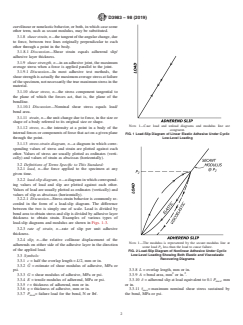
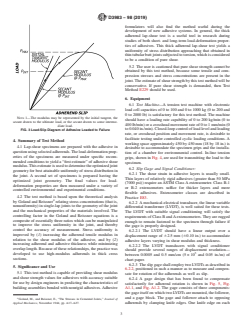
load-slip diagrams and modulus are shown in Figs. 1-3.
3.2.3 rate of strain, n—rate of slip per unit adhesive
thickness.
3.2.4 slip, n—the relative collinear displacement of the
NOTE 1—The modulus is represented by the secant modulus line at
adherends on either side of the adhesive layer in the direction
some load P less than the load to cause failure.
of the applied load.
FIG. 2 Load-Slip Diagram of Nonlinear Adhesive Under Cyclic
Low-Level Loading Showing Both Elastic and Viscoelastic
3.3 Symbols:
Recovering Diagrams
3.3.1 c =half the overlap length= L/2, mm or in.
3.3.2 Ĝ =estimate of shear modulus of adhesive, MPa or
psi. 3.3.8 L =overlap length, mm or in.
2 2
3.3.3 G =shear modulus of adhesive, MPa or psi. 3.3.9 A =bond area, mm or in. .
3.3.4 E =tensile modulus of adherend, MPa or psi. 3.3.10 δ =adherend slip at load equivalent to 0.1 P ,mm
max
3.3.5 t =thickness of adherend, mm or in. or in.
3.3.6 η =thickness of adhesive, mm or in. 3.3.11 τ¯ =maximum nominal shear stress sustained by
max
3.3.7 P =failure load for the bond, N or lbf. the bond, MPa or psi.
max
D3983 − 98 (2019)
formulators will also find the method useful during the
development of new adhesive systems. In general, the thick
adherend lap-shear test is a useful tool in research during
studies of both short- and long-term load-deformation proper-
ties of adhesives. This thick adherend lap-shear test yields a
uniformity of stress distribution approaching that obtained in
thintubularbuttjointssubjectedtotorsion,whichisconsidered
to be a condition of pure shear.
5.2 The user is cautioned that pure shear strength cannot be
obtained by this test method, because some tensile and com-
pression stresses and stress concentrations are present in the
joint.Theestimateofshearstrengthbythistestmethodwillbe
conservative. If pure shear strength is demanded, then Test
Method
E229 should be used.
6. Equipment
6.1 Test Machine—A tension test machine with electronic
load cell capacities of 0 to 100 and 0 to 1000 kg (0 to 200 and
0 to 2000 lb) is satisfactory for this test method. The machine
NOTE 1—The modulus may be represented by the initial tangent, the
should have a loading rate capability of 0 to 200 kg/min (0 to
secant drawn to the ultimate load, or the secant drawn to some interme-
400lb/min)oracrossheadmovementrateof0to1mm/min(0
diate load.
to0.040in./min).Closed-loopcontrolofloadlevelandloading
FIG. 3 Load-Slip Diagram of Adhesive Loaded to Failure
rate, or crosshead position and movement rate, is desirable to
facilitate testing under controlled cyclic loading conditions. A
4. Summary of Test Method
working space approximately 450 by 450 mm (18 by 18 in.) is
4.1 Lap-shear specimens are prepared with the adhesive in
desirable to accommodate the specimen grips and the installa-
questionusingselectedadherends.Theload-deformationprop-
tion of a chamber for environmental control. In-line tension
erties of the specimens are measured under specific recom-
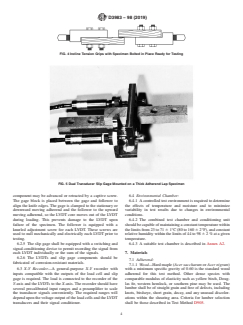
grips, shown in Fig. 4, are used for transmitting the load to the
mended conditions to yield a “first estimate” of adhesive shear
specimen.
modulus.Thisestimateisusedtodeterminetheoptimizedjoint
6.2 Slip Gage and Signal Conditioner:
geometry for best attainable uniformity of stress distribution in
6.2.1 The shear strain in adhesive layers is usually small.
the joint. A second set of specimens is prepared having the
Thin layers of relatively rigid adhesives (greater than 50 MPa
optimized joint geometry. The final values for load-
(7000 psi)) require anASTM ClassAextensometer. Class B-1
deformation properties are then measured under a variety of
or B-2 extensometers suffice for thicker layers and more
controlled environmental and experimental conditions.
flexible adhesives. Extensometer classes are described in
4.2 The test method is based upon the theoretical analysis
Practice E83.
by Goland and Reissner relating stress concentrations (that is,
6.2.2 Amechanical-electrical transducer, the linear variable
nonuniformity) in single-lap joints to the geometry of the joint
differential transformer (LVDT), is well suited for these tests.
and the mechanical properties of the materials involved. The
The LVDT with suitable signal conditioning will satisfy the
controlling factor in the Goland and Reissner equations is a
requirementsofClassBandAextensometers.Theyarerugged
composite of essentially three ratios which can be manipulated
enough to remain fastened to the specimen through failure if
to improve the stress uniformity in the joint, and thereby
the gage is properly designed.
control the accuracy of measurement. Stress uniformity is
6.2.2.1 The LVDT should have a linear output over a
improved by (1) increasing the adherend tensile modulus in
displacement range of 62.5 mm (60.10 in.) to accommodate
relation to the shear modulus of the adhesive, and by (2)
adhesive layers varying in shear modulus and thickness.
increasing adherend and adhesive thickness while minimizing
6.2.2.2 The LVDT transducers with signal conditioner
overlaplength.Becauseoftheserelationships,thepracticewas
should provide several ranges of displacement resolution—
developed to use high-modulus adherends in thick cross
between 0.0005 and 0.5 mm/cm (5×10 and 0.05 in./m) of
sections.
chart paper.
6.2.3 TheslipgageshallemploytwoLVDTsasdescribedin
5. Significance and Use
6.2.2, positioned in such a manner as to measure and compen-
5.1 This test method is capable of providing shear modulus
sate for rotation of the adherends as well as slip.
and shear strength values for adhesives with accuracy suitable
6.2.4 A gage design that has been found to compensate
for use by design engineers in predicting the characteristics of
satisfactorily for adherend rotation is shown in Fig. 5, Fig.
building assemblies bonded with nonrigid adhesives.Adhesive
A1.1, and Fig. A1.2. The gage consists of three components:
thegageitselfonwhichtwoLVDTsaremounted,thefollower,
and a gage block. The gage and follower attach to opposing
Goland, M., and Reissner, E., “The Stresses in Cemented Joints,” Journal of
Applied Mechanics, November 1944, pp. A17–A27. adherends by clamping knife edges. One knife edge on each
D3983 − 98 (2019)
FIG. 4 Incline Tension Grips with Specimen Bolted in Place Ready for Testing
FIG. 5 Dual Transducer Slip Gage Mounted on a Thick Adherend Lap Specimen
component may be advanced or retracted by a captive screw. 6.4 Environmental Chamber:
The gage block is placed between the gage and follower to 6.4.1 Acontrolled test environment is required to determine
align the knife edges. The gage is clamped to the stationary or the effects of temperature and moisture and to minimize
downward moving adherend and the follower to the upward variability in test results due to changes in environmental
moving adherend, so the LVDT core moves out of the LVDT conditions.
during loading. This prevents damage to the LVDT upon 6.4.2 The combined test chamber and conditioning unit
failure of the specimen. The follower is equipped with a shouldbecapableofmaintainingaconstanttemperaturewithin
knurled adjustment screw for each LVDT. These screws are thelimitsfrom23to71 61°C(80to160 62°F),andconstant
used to null mechanically and electrically each LVDT prior to relativehumiditywithinthelimitsof44to98 62%atagiven
testing. temperature.
6.2.5 The slip gage shall be equipped with a switching and 6.4.3 A suitable test chamber is described in Annex A2.
signal-conditioning device to permit recording the signal from
each LVDT individually or the sum of the signals. 7. Materials
6.2.6 The LVDTs and slip gage components should be
7.1 Adherend:
fabricated of corrosion-resistant materials.
7.1.1 Wood—Hard maple (Acer saccharum or Acer nigrum)
6.3 X-Y Recorder—A general-purpose X-Y recorder with with a minimum specific gravity of 0.60 is the standard wood
inputs compatible with the outputs of the load cell and slip adherend for this test method. Other dense species with
gage is required. The load is connected to the recorder of the comparable modulus of elasticity such as yellow birch, Doug-
Y-axis and the LVDTs to the X-axis. The recorder should have las fir, western hemlock, or southern pine may be used. The
several precalibrated input ranges and a preamplifier to scale lumber shall be of straight grain and free of defects, including
the transducer signals conveniently. The required ranges will knots, birdseye, short grain, decay, and any unusual discolor-
dependuponthevoltageoutputoftheloadcellsandtheLVDT ations within the shearing area. Criteria for lumber selection
transducers and their signal conditioner. shall be those described in Test Method D905.
D3983 − 98 (2019)
7.2 Metal—Use cold-rolled steel or aluminum-alloy bar 8.3.1.2 After surfacing, cut each board into two blocks 90
stock, machined to a surface finish of 16 µin. or better in the by 150 mm (3.54 by 5.91 in.), mark them as a pair, and return
bond area, for adhesives that contain no volatile constituents, them to the conditioning atmosphere. Bond the blocks within
and have a shear modulus in the range from 50 to 700 MPa 24 h of the time the boards were surfaced.
(7000 to 100000 psi).
8.3.1.3 Shims placed between the adherends or used in
combination with a gluing jig are required to control bondline
7.3 Adhesives—Any adhesive with a shear modulus not
thickness. A suitable jig is shown in Fig. 6. Shims are placed
exceeding 50 MPa (7000 psi) can be tested using hard maple
between the jig base and the top block (which is clamped in
adherends. More rigid adhesives can be tested using stiffer
place) to squeeze out excess adhesive, and leave the desired
although nonpermeable adherends if the adhesive does not
volume of adhesive between the two adherends. The bottom
require the elimination of volatile solvents during cure. In this
block is free to move upward to allow for bondline shrinkage
case,adhesiveswithshearmodulusintherangefrom50to250
as volatiles are lost during cure.Adhesive systems with 100%
MPa (7000 to 36000 psi) may be tested with aluminum
total solids will require shims equal in thickness to that of the
adherends.Adhesives having shear modulus in the range from
desired bondline. Bonded blocks should remain in the jig for
250 to 700 MPa (36000 to 100000 psi) shall be tested with
24hfollowedbyadditionaltimeintheconditionedatmosphere
steel adherends.
as required to assure full strength development.
8. Test Specimen
8.3.1.4 Different overlap lengths can be produced by saw
kerfs through an adherend to the bondline. The method for
8.1 The standard adherend for the tension lap-shear speci-
determining allowable overlap length is described in 11.4.
men shall be a block 150 by 16 by 20 mm (5.9 by 0.63 by 0.79
8.3.1.5 After adjustment of overlap length, the bonded
in.) which can be bonded on the 20-mm face in overlaps
blocks can be cut into specimens 20 mm (0.79 in.) wide to
ranging from 4 to 50 mm (0.16 to 1.97 in.).
yield four specimens each. Cut specimen ends to length and
8.2 Drill holes in the lap-shear specimen in order to bolt the
drillholesforboltattachmenttothetestapparatus,asshownin
specimenfirmlytothefixturesofthecrossheadandloadcellof
Fig. 7.
the test machine.
NOTE 3—Care must be taken to drill the holes exactly on the central
8.3 Specimen Preparation:
longitudinal axis of each adherend to minimize adherend rotation for this
8.3.1 Wood Specimens:
source. The use of a marked jig, centering punch and spur, or doweling
8.3.1.1 Cut lumber into boards 19 by 95 by 350 mm (0.75 drill bit are recommended.
by3.75by13.8in.)withthe350-mmdimensionparalleltothe
8.3.2 Metal Specimens:
grain direction. Condition the boards to an equilibrium mois-
8.3.2.1 Metal specimens shall be bonded from individual
turecontentof7to10%,onanovendryweightbasis,ortothe
adherends rather than being cut from a bonded block as
moisture content recommended by the manufacturer of the
described for wood. Machine single adherends that can be
adhesive being tested (Note 1). Lightly surface the side of the
reused from bar stock to the dimensions 20 by 20 by 150 mm
board to be bonded using a hand-fed jointer having well-
(0.79 by 0.79 by 5.91 in.) and grind to a final thickness of 16
sharpened and aligned knives. Surface the opposite face of the
6 0.025 mm (0.63 6 0.001 in.). Drill holes
...