

ASTM C195-07(2019)
(Specification)Standard Specification for Mineral Fiber Thermal Insulating Cement
General Information
- Abstract
ABSTRACT
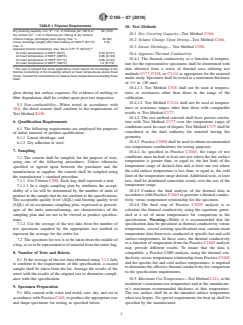
This specification covers mineral fiber thermal insulating materials in the form of dry cement, which, when mixed with a suitable proportion of water, applied as a plastic mass, and dried in place, affords resistance to heat transmission on surfaces operating at a certain range of temperature. Mineral fiber thermal insulating cement shall be composed of mineral fiber and inorganic fillers, with a suitable proportion of heat-resistant binder. The mineral fiber shall consist of rock, slag, or glass processed from a molten state into fibrous form. Asbestos shall not be used as an ingredient or component part of the product. Different test methods shall be performed in order to determine the following properties of the cement: dry covering capacity, volume change upon drying, linear shrinkage, and apparent thermal conductivity.
SCOPE
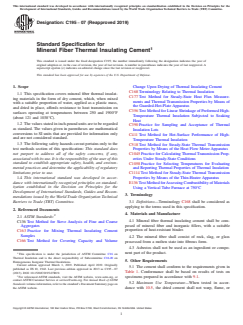
1.1 This specification covers mineral fiber thermal insulating materials in the form of dry cement, which, when mixed with a suitable proportion of water, applied as a plastic mass, and dried in place, affords resistance to heat transmission on surfaces operating at temperatures between 250 and 1900°F (about 121 and 1038°C).
1.2 The values stated in inch-pound units are to be regarded as standard. The values given in parentheses are mathematical conversions to SI units that are provided for information only and are not considered standard.
1.3 The following safety hazards caveat pertains only to the test methods section of this specification: This standard does not purport to address all of the safety concerns, if any, associated with its use. It is the responsibility of the user of this standard to establish appropriate safety, health, and environmental practices and determine the applicability of regulatory limitations prior to use.
1.4 This international standard was developed in accordance with internationally recognized principles on standardization established in the Decision on Principles for the Development of International Standards, Guides and Recommendations issued by the World Trade Organization Technical Barriers to Trade (TBT) Committee.
- Status
- Published
- Publication Date
- 28-Feb-2019
- Technical Committee
- C16 - Thermal Insulation
- Drafting Committee
- C16.20 - Homogeneous Inorganic Thermal Insulations


Overview
ASTM C195-07(2019): Standard Specification for Mineral Fiber Thermal Insulating Cement establishes criteria for dry cementitious mineral fiber thermal insulation used to inhibit heat transmission on surfaces operating within the temperature range of 250°F to 1900°F (about 121°C to 1038°C). The standard focuses on materials composed of mineral fibers - such as rock, slag, or glass - processed from a molten state, combined with inorganic fillers and heat-resistant binders. Asbestos is explicitly excluded from all formulations. This specification ensures performance through defined testing and manufacturing requirements, supporting consistent quality and safety in industrial and commercial thermal insulation applications.
Key Topics
Material Composition: Specifies that mineral fiber thermal insulating cement must consist of fibrous rock, slag, or glass, along with inorganic fillers and appropriate heat-resistant binders. Asbestos is not permitted.
Thermal Performance: Outlines test methods to evaluate critical performance characteristics, including:
- Dry covering capacity
- Volume change upon drying (shrinkage)
- Linear shrinkage at high temperatures
- Apparent thermal conductivity at various temperatures
Physical and Safety Requirements:
- The cement must display non-combustibility and withstand thermal cycling without significant deformation or degradation.
- Provides guidance on safety, health, and environmental practices during handling and testing.
Sampling and Testing Procedures:
- Offers instructions for representative sampling, preparation, and testing of the insulating cement.
- Includes processes for acceptance, rejection, and retesting of material lots based on compliance with the standard’s requirements.
Applications
ASTM C195 mineral fiber thermal insulating cement is widely used across industries requiring reliable and high-temperature insulation. Typical applications include:
- Industrial Thermal Insulation: Protects piping, tanks, boilers, and equipment operating at elevated temperatures, helping to prevent heat loss and ensure energy efficiency.
- Commercial HVAC Systems: Utilized in ductwork and mechanical systems to maintain temperature stability and reduce energy consumption.
- Steam and Power Generation Facilities: Essential for the insulation of surfaces exposed to high operating temperatures to enhance safety and operational efficiency.
- Petrochemical and Chemical Processing Plants: Applied to process equipment and piping to maintain process temperatures and provide personnel protection.
The material can be mixed with water, applied as a plastic mass, and dried in place, creating a durable thermal barrier tailored to specific shapes and surfaces.
Related Standards
Several ASTM standards support or are referenced within ASTM C195 for testing and terminology consistency, including:
- ASTM C168: Terminology Relating to Thermal Insulation
- ASTM C166 & C356: Test Methods for Covering Capacity, Volume Change, and Linear Shrinkage
- ASTM C177, C518, C1114: Test Methods for Steady-State Heat Flow and Thermal Conductivity
- ASTM E136: Test Method for Assessing Combustibility of Materials
- ASTM C163, C390, C411, C1045, C1058: Practices for mixing, sampling, selecting test conditions, and reporting thermal properties
These linked standards ensure a comprehensive, harmonized approach to determining thermal insulating cement’s quality, safety, and suitability for demanding applications.
Keywords: ASTM C195, mineral fiber insulating cement, thermal insulation, high-temperature insulation, non-combustible insulation, industrial insulation standards, thermal conductivity, energy efficiency.
Relations
- Effective Date
- 01-Mar-2019
- Effective Date
- 15-Apr-2024
- Effective Date
- 01-Mar-2024
- Effective Date
- 01-Mar-2024
- Effective Date
- 01-Feb-2024
- Effective Date
- 01-Sep-2019
- Effective Date
- 01-Apr-2019
- Effective Date
- 01-Mar-2019
- Effective Date
- 01-Mar-2019
- Effective Date
- 01-Feb-2019
- Effective Date
- 15-Apr-2018
- Effective Date
- 01-Oct-2017
- Effective Date
- 01-Jun-2017
- Effective Date
- 01-Nov-2016
- Effective Date
- 01-Jan-2016
Get Certified
Connect with accredited certification bodies for this standard

DIBt (Deutsches Institut für Bautechnik)
German Institute for Building Technology.
DIN CERTCO
DIN Group product certification.

Aboma Certification B.V.
Specialized in construction, metal, and transport sectors.
Sponsored listings
Frequently Asked Questions
ASTM C195-07(2019) is a technical specification published by ASTM International. Its full title is "Standard Specification for Mineral Fiber Thermal Insulating Cement". This standard covers: ABSTRACT This specification covers mineral fiber thermal insulating materials in the form of dry cement, which, when mixed with a suitable proportion of water, applied as a plastic mass, and dried in place, affords resistance to heat transmission on surfaces operating at a certain range of temperature. Mineral fiber thermal insulating cement shall be composed of mineral fiber and inorganic fillers, with a suitable proportion of heat-resistant binder. The mineral fiber shall consist of rock, slag, or glass processed from a molten state into fibrous form. Asbestos shall not be used as an ingredient or component part of the product. Different test methods shall be performed in order to determine the following properties of the cement: dry covering capacity, volume change upon drying, linear shrinkage, and apparent thermal conductivity. SCOPE 1.1 This specification covers mineral fiber thermal insulating materials in the form of dry cement, which, when mixed with a suitable proportion of water, applied as a plastic mass, and dried in place, affords resistance to heat transmission on surfaces operating at temperatures between 250 and 1900°F (about 121 and 1038°C). 1.2 The values stated in inch-pound units are to be regarded as standard. The values given in parentheses are mathematical conversions to SI units that are provided for information only and are not considered standard. 1.3 The following safety hazards caveat pertains only to the test methods section of this specification: This standard does not purport to address all of the safety concerns, if any, associated with its use. It is the responsibility of the user of this standard to establish appropriate safety, health, and environmental practices and determine the applicability of regulatory limitations prior to use. 1.4 This international standard was developed in accordance with internationally recognized principles on standardization established in the Decision on Principles for the Development of International Standards, Guides and Recommendations issued by the World Trade Organization Technical Barriers to Trade (TBT) Committee.
ABSTRACT This specification covers mineral fiber thermal insulating materials in the form of dry cement, which, when mixed with a suitable proportion of water, applied as a plastic mass, and dried in place, affords resistance to heat transmission on surfaces operating at a certain range of temperature. Mineral fiber thermal insulating cement shall be composed of mineral fiber and inorganic fillers, with a suitable proportion of heat-resistant binder. The mineral fiber shall consist of rock, slag, or glass processed from a molten state into fibrous form. Asbestos shall not be used as an ingredient or component part of the product. Different test methods shall be performed in order to determine the following properties of the cement: dry covering capacity, volume change upon drying, linear shrinkage, and apparent thermal conductivity. SCOPE 1.1 This specification covers mineral fiber thermal insulating materials in the form of dry cement, which, when mixed with a suitable proportion of water, applied as a plastic mass, and dried in place, affords resistance to heat transmission on surfaces operating at temperatures between 250 and 1900°F (about 121 and 1038°C). 1.2 The values stated in inch-pound units are to be regarded as standard. The values given in parentheses are mathematical conversions to SI units that are provided for information only and are not considered standard. 1.3 The following safety hazards caveat pertains only to the test methods section of this specification: This standard does not purport to address all of the safety concerns, if any, associated with its use. It is the responsibility of the user of this standard to establish appropriate safety, health, and environmental practices and determine the applicability of regulatory limitations prior to use. 1.4 This international standard was developed in accordance with internationally recognized principles on standardization established in the Decision on Principles for the Development of International Standards, Guides and Recommendations issued by the World Trade Organization Technical Barriers to Trade (TBT) Committee.
ASTM C195-07(2019) is classified under the following ICS (International Classification for Standards) categories: 91.100.10 - Cement. Gypsum. Lime. Mortar. The ICS classification helps identify the subject area and facilitates finding related standards.
ASTM C195-07(2019) has the following relationships with other standards: It is inter standard links to ASTM C195-07(2013), ASTM C168-24, ASTM C390-08(2024), ASTM E136-24a, ASTM E136-24, ASTM C390-08(2019), ASTM C1045-19, ASTM C1114-06(2019), ASTM C411-19, ASTM E136-19, ASTM C168-18, ASTM C411-17, ASTM C168-17, ASTM E136-16a, ASTM E136-16. Understanding these relationships helps ensure you are using the most current and applicable version of the standard.
ASTM C195-07(2019) is available in PDF format for immediate download after purchase. The document can be added to your cart and obtained through the secure checkout process. Digital delivery ensures instant access to the complete standard document.
Standards Content (Sample)
This international standard was developed in accordance with internationally recognized principles on standardization established in the Decision on Principles for the
Development of International Standards, Guides and Recommendations issued by the World Trade Organization Technical Barriers to Trade (TBT) Committee.
Designation:C195 −07 (Reapproved 2019)
Standard Specification for
Mineral Fiber Thermal Insulating Cement
This standard is issued under the fixed designation C195; the number immediately following the designation indicates the year of
original adoption or, in the case of revision, the year of last revision. A number in parentheses indicates the year of last reapproval. A
superscript epsilon (´) indicates an editorial change since the last revision or reapproval.
This standard has been approved for use by agencies of the U.S. Department of Defense.
1. Scope Change Upon Drying of Thermal Insulating Cement
C168 Terminology Relating to Thermal Insulation
1.1 This specification covers mineral fiber thermal insulat-
C177 Test Method for Steady-State Heat Flux Measure-
ing materials in the form of dry cement, which, when mixed
ments and Thermal Transmission Properties by Means of
with a suitable proportion of water, applied as a plastic mass,
the Guarded-Hot-Plate Apparatus
and dried in place, affords resistance to heat transmission on
C356 Test Method for Linear Shrinkage of Preformed High-
surfaces operating at temperatures between 250 and 1900°F
Temperature Thermal Insulation Subjected to Soaking
(about 121 and 1038°C).
Heat
1.2 The values stated in inch-pound units are to be regarded
C390 Practice for Sampling and Acceptance of Thermal
as standard. The values given in parentheses are mathematical
Insulation Lots
conversions to SI units that are provided for information only
C411 Test Method for Hot-Surface Performance of High-
and are not considered standard.
Temperature Thermal Insulation
1.3 The following safety hazards caveat pertains only to the
C518 Test Method for Steady-State Thermal Transmission
test methods section of this specification: This standard does Properties by Means of the Heat Flow Meter Apparatus
not purport to address all of the safety concerns, if any,
C1045 Practice for Calculating Thermal Transmission Prop-
associated with its use. It is the responsibility of the user of this erties Under Steady-State Conditions
standard to establish appropriate safety, health, and environ-
C1058 Practice for Selecting Temperatures for Evaluating
mental practices and determine the applicability of regulatory and Reporting Thermal Properties of Thermal Insulation
limitations prior to use.
C1114 Test Method for Steady-State Thermal Transmission
1.4 This international standard was developed in accor- Properties by Means of the Thin-Heater Apparatus
dance with internationally recognized principles on standard-
E136 Test Method forAssessing Combustibility of Materials
ization established in the Decision on Principles for the
Using a Vertical Tube Furnace at 750°C
Development of International Standards, Guides and Recom-
3. Terminology
mendations issued by the World Trade Organization Technical
Barriers to Trade (TBT) Committee. 3.1 Definitions—Terminology C168 shall be considered as
applying to the terms used in this specification.
2. Referenced Documents
4. Materials and Manufacture
2.1 ASTM Standards:
4.1 Mineral fiber thermal insulating cement shall be com-
C136 Test Method for Sieve Analysis of Fine and Coarse
posed of mineral fiber and inorganic fillers, with a suitable
Aggregates
proportion of heat-resistant binder.
C163 Practice for Mixing Thermal Insulating Cement
Samples
4.2 The mineral fiber shall consist of rock, slag, or glass
C166 Test Method for Covering Capacity and Volume
processed from a molten state into fibrous form.
4.3 Asbestos shall not be used as an ingredient or compo-
nent part of the product.
This specification is under the jurisdiction of ASTM Committee C16 on
Thermal Insulation and is the direct responsibility of Subcommittee C16.20 on
5. Other Requirements
Homogeneous Inorganic Thermal Insulations.
Current edition approved March 1, 2019. Published April 2019. Originally
5.1 The cement shall conform to the requirements given in
published as ES 10, 1942. Last previous edition approved in 2013 as C195 – 07
Table 1. Conformance shall be based on results of tests on
(2013). DOI: 10.1520/C0195-07R19.
For referenced ASTM standards, visit the ASTM website, www.astm.org, or specimens prepared in accordance with 9.1.
contact ASTM Customer Service at service@astm.org. For Annual Book of ASTM
5.2 Maximum Use Temperature—When tested in accor-
Standards volume information, refer to the standard’s Document Summary page on
the ASTM website. dance with 10.5, the dried cement shall not warp, flame, or
Copyright © ASTM International, 100 Barr Harbor Drive, PO Box C700, West Conshohocken, PA 19428-2959. United States
C195−07 (2019)
TABLE 1 Physical Requirements
10. Test Methods
Dry covering capacity, min, ft , 1 in. in thickness per 100 lb of 30 (15.6)
10.1 Dry Covering Capacity—Test Method C166.
dry cement (m , 1 cm in thickness per 100 kg of dry cement)
Volume change (shrinkage) upon drying, max, % 35 (35)
10.2 Volume Change Upon Drying—Test Method C166.
Linear shrinkage (length) after heat soaking at 1600°F (871°C) 5(5)
max, %
10.3 Linear Shrinkage— Test Method C356.
2 A
Apparent thermal conductivity, max, Btu·in./h·ft ·°F (W/m·K):
At mean temperature of 200°F (93°C) 0.70 (0.101)
10.4 Apparent Thermal Conductivity
At mean temperature of 500°F (260°C) 0.85 (0.123)
10.4.1 The thermal conductivity as a function of tempera-
At mean temperature of 700°F (371°C) 0.95 (0.137)
At mean temperature of 900°F (482°C) 1.2 (0.173)
ture for the representative specimens shall be determined with
A
The user is advised that some applications could require the knowledge of the data obtained from a series of thermal tests utilizing test
thermal conductivity of the insulating cement at mean temperatures above those
methods C177, C518,or C1114 as appropriate for the material
shown. Consult the manufacturer for data at mean temperatures exceeding those
under study. Specimen shall be tested at a maximum thickness
listed.
of 1 ⁄2 in. (38 mm).
10.4.1.1 Test Method C518 shall not be used at tempera-
tures or resistances other than those in the range of the
glow during hot surface exposure. No evidence of melting or
calibration.
fiber degradation shall be evident upon post-test inspection.
10.4.1.2 Test Method C1114 shall not be used at tempera-
5.3 Non-combustibility—When tested in accordance with
tures or resistance ranges other than those with comparable
10.6, the dried cement shall conform to the requirements of
results to Test Method C177.
Test Method E136.
...