

ASTM D8505/D8505M-23
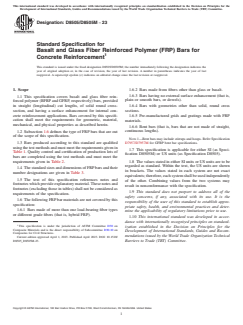
(Specification)Standard Specification for Basalt and Glass Fiber Reinforced Polymer (FRP) Bars for Concrete Reinforcement
General Information
- Abstract
SCOPE
1.1 This specification covers basalt and glass fiber reinforced polymer (BFRP and GFRP, respectively) bars, provided in straight (longitudinal) cut lengths, of solid round cross-section, and having a surface enhancement for internal concrete reinforcement applications. Bars covered by this specification shall meet the requirements for geometric, material, mechanical, and physical properties as described herein.
1.2 Subsection 1.6 defines the type of FRP bars that are out of the scope of this specification.
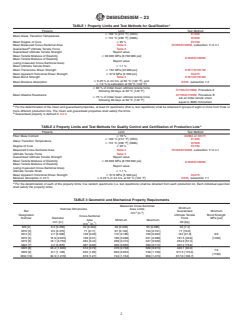
1.3 Bars produced according to this standard are qualified using the test methods and must meet the requirements given in Table 1. Quality control and certification of production lots of bars are completed using the test methods and must meet the requirements given in Table 2.
1.4 The standard sizes and dimensions of FRP bars and their number designations are given in Table 3.
1.5 The text of this specification references notes and footnotes which provide explanatory material. These notes and footnotes (excluding those in tables) shall not be considered as requirements of the specification.
1.6 The following FRP bar materials are not covered by this specification:
1.6.1 Bars made of more than one load-bearing fiber types or different grade fibers (that is, hybrid FRP).
1.6.2 Bars made from fibers other than glass or basalt.
1.6.3 Bars having no external surface enhancement (that is, plain or smooth bars, or dowels).
1.6.4 Bars with geometries other than solid, round cross sections.
1.6.5 Pre-manufactured grids and gratings made with FRP materials.
1.6.6 Bent bars (that is, bars that are not made of straight, continuous lengths).
Note 1: Bent bars may include stirrups and hoops. Refer Specification D7957/D7957M for GFRP bent bar specifications.
1.7 This specification is applicable for either SI (as Specification D8505M) or US units (as Specification D8505).
1.8 The values stated in either SI units or US units are to be regarded as standard. Within the text, the US units are shown in brackets. The values stated in each system are not exact equivalents; therefore, each system shall be used independently of the other. Combining values from the two systems may result in nonconformance with the specification.
1.9 This standard does not purport to address all of the safety concerns, if any, associated with its use. It is the responsibility of the user of this standard to establish appropriate safety, health, and environmental practices and determine the applicability of regulatory limitations prior to use.
1.10 This international standard was developed in accordance with internationally recognized principles on standardization established in the Decision on Principles for the Development of International Standards, Guides and Recommendations issued by the World Trade Organization Technical Barriers to Trade (TBT) Committee.
- Status
- Published
- Publication Date
- 31-Mar-2023
- Technical Committee
- D30 - Composite Materials
- Drafting Committee
- D30.10 - Composites for Civil Structures
Overview
ASTM D8505/D8505M-23, developed by ASTM International, specifies the minimum requirements for basalt and glass fiber reinforced polymer (BFRP and GFRP) bars intended for use as internal concrete reinforcement. This standard improves consistency and quality across BFRP and GFRP bar manufacturing, ensuring these nonmetallic reinforcement products meet specified geometric, material, mechanical, and physical property criteria. It covers bars provided in straight, solid, round cross-sections with surface enhancements that facilitate mechanical bonding to concrete. The standard is applicable to reinforced concrete projects using either SI or US customary units.
Key Topics
- Scope and Material Coverage: The standard applies to straight bars with round, solid cross-sections, made exclusively from continuous basalt or glass fibers. Bars must feature surface enhancements (such as lugs or sand coating) for concrete bonding.
- Exclusions: Bars made from hybrid fibers, other fiber types, plain or smooth bars, non-round shapes, grids, gratings, or bent bars (including stirrups and hoops) are outside the scope.
- Properties and Testing: Specifies required properties like tensile strength, modulus of elasticity, bond strength, shear strength, degree of cure, and moisture absorption. Test methods and sample requirements are referenced for qualification, quality control, and certification.
- Geometric Specifications: Details size designations, diameters, and cross-sectional area limits to align with common practices in the concrete reinforcement industry.
- Quality Control: Outlines procedures for sampling, reporting, marking, and traceability of production lots.
- Durability Criteria: Includes requirements for moisture absorption and resistance to alkaline environments, ensuring long-term performance in harsh conditions.
- Marking and Traceability: Details mandatory product markings and documentation to support quality assurance and regulatory compliance.
Applications
ASTM D8505/D8505M-23 is essential for:
- Civil Infrastructure Projects: Bridges, highways, parking structures, and marine or coastal facilities where corrosion-resistant reinforcement is critical.
- Buildings: Commercial, industrial, transportation, and institutional structures requiring enhanced durability and reduced maintenance compared to steel rebar.
- Specialty Construction: Tunnels, water treatment, or environments with electromagnetic considerations, where nonmetallic FRP bars offer advantages over traditional steel reinforcement.
- Quality Assurance: Used by designers, structural engineers, precast concrete manufacturers, construction teams, and project owners to specify, procure, or inspect compliant BFRP and GFRP products.
- Procurement and Traceability: Provides manufacturers and purchasers with clear guidelines for ordering, marking, quality control documentation, and reporting, thus streamlining the supply chain.
Related Standards
To support its requirements and testing protocols, ASTM D8505/D8505M-23 references several related standards:
- ASTM D7957/D7957M - Specification for solid round GFRP bars (including bent bars)
- ASTM D7205/D7205M - Tensile property testing for FRP composite bars
- ASTM D7913/D7913M - Bond strength test methods for FRP bars to concrete
- ASTM D7617/D7617M - Transverse shear testing for FRP composite bars
- ASTM D570 - Test method for water absorption of plastics
- ASTM A615/A615M - Steel bar sizes used for reinforcement, aiding in bar designation consistency
For seamless project execution and optimal performance, construction professionals, structural engineers, and suppliers should adhere to ASTM D8505/D8505M-23 when selecting basalt or glass FRP bars for concrete reinforcement. This enables enhanced durability, cost-effectiveness, and quality assurance in reinforced concrete structures.
Relations
- Effective Date
- 01-Jan-2024
- Effective Date
- 01-Nov-2023
- Effective Date
- 01-Jul-2023
- Effective Date
- 01-Feb-2020
- Effective Date
- 15-Oct-2019
- Effective Date
- 15-Apr-2019
- Effective Date
- 01-Feb-2019
- Refers
ASTM C904-01(2018) - Standard Terminology Relating to Chemical-Resistant Nonmetallic Materials - Effective Date
- 01-Nov-2018
- Effective Date
- 15-Sep-2018
- Effective Date
- 01-Apr-2018
- Effective Date
- 01-Apr-2018
- Effective Date
- 01-Sep-2017
- Effective Date
- 01-Aug-2017
- Effective Date
- 01-Aug-2016
- Effective Date
- 15-Mar-2016
Get Certified
Connect with accredited certification bodies for this standard

DIBt (Deutsches Institut für Bautechnik)
German Institute for Building Technology.
DIN CERTCO
DIN Group product certification.

Aboma Certification B.V.
Specialized in construction, metal, and transport sectors.
Sponsored listings
Frequently Asked Questions
ASTM D8505/D8505M-23 is a technical specification published by ASTM International. Its full title is "Standard Specification for Basalt and Glass Fiber Reinforced Polymer (FRP) Bars for Concrete Reinforcement". This standard covers: SCOPE 1.1 This specification covers basalt and glass fiber reinforced polymer (BFRP and GFRP, respectively) bars, provided in straight (longitudinal) cut lengths, of solid round cross-section, and having a surface enhancement for internal concrete reinforcement applications. Bars covered by this specification shall meet the requirements for geometric, material, mechanical, and physical properties as described herein. 1.2 Subsection 1.6 defines the type of FRP bars that are out of the scope of this specification. 1.3 Bars produced according to this standard are qualified using the test methods and must meet the requirements given in Table 1. Quality control and certification of production lots of bars are completed using the test methods and must meet the requirements given in Table 2. 1.4 The standard sizes and dimensions of FRP bars and their number designations are given in Table 3. 1.5 The text of this specification references notes and footnotes which provide explanatory material. These notes and footnotes (excluding those in tables) shall not be considered as requirements of the specification. 1.6 The following FRP bar materials are not covered by this specification: 1.6.1 Bars made of more than one load-bearing fiber types or different grade fibers (that is, hybrid FRP). 1.6.2 Bars made from fibers other than glass or basalt. 1.6.3 Bars having no external surface enhancement (that is, plain or smooth bars, or dowels). 1.6.4 Bars with geometries other than solid, round cross sections. 1.6.5 Pre-manufactured grids and gratings made with FRP materials. 1.6.6 Bent bars (that is, bars that are not made of straight, continuous lengths). Note 1: Bent bars may include stirrups and hoops. Refer Specification D7957/D7957M for GFRP bent bar specifications. 1.7 This specification is applicable for either SI (as Specification D8505M) or US units (as Specification D8505). 1.8 The values stated in either SI units or US units are to be regarded as standard. Within the text, the US units are shown in brackets. The values stated in each system are not exact equivalents; therefore, each system shall be used independently of the other. Combining values from the two systems may result in nonconformance with the specification. 1.9 This standard does not purport to address all of the safety concerns, if any, associated with its use. It is the responsibility of the user of this standard to establish appropriate safety, health, and environmental practices and determine the applicability of regulatory limitations prior to use. 1.10 This international standard was developed in accordance with internationally recognized principles on standardization established in the Decision on Principles for the Development of International Standards, Guides and Recommendations issued by the World Trade Organization Technical Barriers to Trade (TBT) Committee.
SCOPE 1.1 This specification covers basalt and glass fiber reinforced polymer (BFRP and GFRP, respectively) bars, provided in straight (longitudinal) cut lengths, of solid round cross-section, and having a surface enhancement for internal concrete reinforcement applications. Bars covered by this specification shall meet the requirements for geometric, material, mechanical, and physical properties as described herein. 1.2 Subsection 1.6 defines the type of FRP bars that are out of the scope of this specification. 1.3 Bars produced according to this standard are qualified using the test methods and must meet the requirements given in Table 1. Quality control and certification of production lots of bars are completed using the test methods and must meet the requirements given in Table 2. 1.4 The standard sizes and dimensions of FRP bars and their number designations are given in Table 3. 1.5 The text of this specification references notes and footnotes which provide explanatory material. These notes and footnotes (excluding those in tables) shall not be considered as requirements of the specification. 1.6 The following FRP bar materials are not covered by this specification: 1.6.1 Bars made of more than one load-bearing fiber types or different grade fibers (that is, hybrid FRP). 1.6.2 Bars made from fibers other than glass or basalt. 1.6.3 Bars having no external surface enhancement (that is, plain or smooth bars, or dowels). 1.6.4 Bars with geometries other than solid, round cross sections. 1.6.5 Pre-manufactured grids and gratings made with FRP materials. 1.6.6 Bent bars (that is, bars that are not made of straight, continuous lengths). Note 1: Bent bars may include stirrups and hoops. Refer Specification D7957/D7957M for GFRP bent bar specifications. 1.7 This specification is applicable for either SI (as Specification D8505M) or US units (as Specification D8505). 1.8 The values stated in either SI units or US units are to be regarded as standard. Within the text, the US units are shown in brackets. The values stated in each system are not exact equivalents; therefore, each system shall be used independently of the other. Combining values from the two systems may result in nonconformance with the specification. 1.9 This standard does not purport to address all of the safety concerns, if any, associated with its use. It is the responsibility of the user of this standard to establish appropriate safety, health, and environmental practices and determine the applicability of regulatory limitations prior to use. 1.10 This international standard was developed in accordance with internationally recognized principles on standardization established in the Decision on Principles for the Development of International Standards, Guides and Recommendations issued by the World Trade Organization Technical Barriers to Trade (TBT) Committee.
ASTM D8505/D8505M-23 is classified under the following ICS (International Classification for Standards) categories: 91.100.50 - Binders. Sealing materials. The ICS classification helps identify the subject area and facilitates finding related standards.
ASTM D8505/D8505M-23 has the following relationships with other standards: It is inter standard links to ASTM D7028-07(2024), ASTM E2160-23, ASTM D3950-23, ASTM D7913/D7913M-14(2020), ASTM D3878-19a, ASTM D3878-19, ASTM D7705/D7705M-12(2019), ASTM C904-01(2018), ASTM D2584-18, ASTM E2160-04(2018), ASTM D3878-18, ASTM D3950-17, ASTM D7617/D7617M-11(2017), ASTM D3878-16, ASTM D3950-16. Understanding these relationships helps ensure you are using the most current and applicable version of the standard.
ASTM D8505/D8505M-23 is available in PDF format for immediate download after purchase. The document can be added to your cart and obtained through the secure checkout process. Digital delivery ensures instant access to the complete standard document.
Standards Content (Sample)
This international standard was developed in accordance with internationally recognized principles on standardization established in the Decision on Principles for the
Development of International Standards, Guides and Recommendations issued by the World Trade Organization Technical Barriers to Trade (TBT) Committee.
Designation: D8505/D8505M − 23
Standard Specification for
Basalt and Glass Fiber Reinforced Polymer (FRP) Bars for
Concrete Reinforcement
This standard is issued under the fixed designation D8505/D8505M; the number immediately following the designation indicates the
year of original adoption or, in the case of revision, the year of last revision. A number in parentheses indicates the year of last
reapproval. A superscript epsilon (´) indicates an editorial change since the last revision or reapproval.
1. Scope 1.6.2 Bars made from fibers other than glass or basalt.
1.6.3 Bars having no external surface enhancement (that is,
1.1 This specification covers basalt and glass fiber rein-
plain or smooth bars, or dowels).
forced polymer (BFRP and GFRP, respectively) bars, provided
in straight (longitudinal) cut lengths, of solid round cross- 1.6.4 Bars with geometries other than solid, round cross
sections.
section, and having a surface enhancement for internal con-
crete reinforcement applications. Bars covered by this specifi-
1.6.5 Pre-manufactured grids and gratings made with FRP
cation shall meet the requirements for geometric, material,
materials.
mechanical, and physical properties as described herein.
1.6.6 Bent bars (that is, bars that are not made of straight,
continuous lengths).
1.2 Subsection 1.6 defines the type of FRP bars that are out
of the scope of this specification.
NOTE 1—Bent bars may include stirrups and hoops. Refer Specification
1.3 Bars produced according to this standard are qualified D7957/D7957M for GFRP bent bar specifications.
using the test methods and must meet the requirements given in
1.7 This specification is applicable for either SI (as Speci-
Table 1. Quality control and certification of production lots of
fication D8505M) or US units (as Specification D8505).
bars are completed using the test methods and must meet the
1.8 The values stated in either SI units or US units are to be
requirements given in Table 2.
regarded as standard. Within the text, the US units are shown
1.4 The standard sizes and dimensions of FRP bars and their
in brackets. The values stated in each system are not exact
number designations are given in Table 3.
equivalents; therefore, each system shall be used independently
1.5 The text of this specification references notes and
of the other. Combining values from the two systems may
footnotes which provide explanatory material. These notes and
result in nonconformance with the specification.
footnotes (excluding those in tables) shall not be considered as
1.9 This standard does not purport to address all of the
requirements of the specification.
safety concerns, if any, associated with its use. It is the
1.6 The following FRP bar materials are not covered by this
responsibility of the user of this standard to establish appro-
specification:
priate safety, health, and environmental practices and deter-
1.6.1 Bars made of more than one load-bearing fiber types
mine the applicability of regulatory limitations prior to use.
or different grade fibers (that is, hybrid FRP).
1.10 This international standard was developed in accor-
dance with internationally recognized principles on standard-
This specification is under the jurisdiction of ASTM Committee D30 on
ization established in the Decision on Principles for the
Composite Materials and is the direct responsibility of Subcommittee D30.10 on
Development of International Standards, Guides and Recom-
Composites for Civil Structures.
mendations issued by the World Trade Organization Technical
Current edition approved April 1, 2023. Published April 2023. DOI: 10.1520/
D8505_D8505M-23. Barriers to Trade (TBT) Committee.
Copyright © ASTM International, 100 Barr Harbor Drive, PO Box C700, West Conshohocken, PA 19428-2959. United States
D8505/D8505M − 23
A
TABLE 1 Property Limits and Test Methods for Qualification
Property Limit Test Method
$ 100 °C [212 °F] (DSC) E1356
Mean Glass Transition Temperature
$ 110 °C [230 °F] (DMA) D7028
Mean Degree of Cure $ 95 % E2160
Mean Measured Cross-Sectional Area Table 3 D7205/D7205M, subsection 11.2.4.1
B
Guaranteed Ultimate Tensile Force Table 3
Guaranteed Ultimate Tensile Strength Report value
Mean Tensile Modulus of Elasticity $ 60 000 MPa [8 700 000 psi]
D7205/D7205M
Mean Tensile Modulus of Elasticity
Report value
(using measured Cross-Sectional Area)
Mean Ultimate Tensile Strain $ 1.1 %
Mean Transverse Shear Strength $ 152 MPa [22 000 psi] D7617/D7617M
Mean Apparent Horizontal Shear Strength $ 37.9 MPa [5 500 psi] D4475
Mean Bond Strength Table 3 D7913/D7913M
# 0.25 % in 24 hrs. at 50 °C [122 °F], and
Mean Moisture Absorption D570, subsection 7.4
# 1.0 % to saturation at 50 °C [122 °F]
$ 80 % of initial mean ultimate tensile force
D7705/D7705M, Procedure A
following 90 days at 60 °C [140 °F]
Mean Alkaline Resistance D7705/D7705M, Procedure B
$ 75 % of initial mean ultimate tensile force
set an initial tensile strain
following 90 days at 60 °C [140 °F]
equal to 3000 microstrain
A
For the determination of the mean and guaranteed properties, at least 24 specimens (that is, test repetitions) shall be obtained in groups of eight or more from three or
more different production lots. The mean and guaranteed properties shall satisfy the limits.
B
Guaranteed property is defined in 3.2.2.
A
TABLE 2 Property Limits and Test Methods for Quality Control and Certification of Production Lots
Property Limit Test Method
Fiber Mass Content $ 70 % D2584 or D3171
$ 100 °C [212 °F] (DSC) E1356
Glass Transition Temperature
$ 110 °C [230 °F] (DMA) D7028
Degree of Cure $ 95 % E2160
Measured Cross-Sectional Area Table 3 D7205/D7205M, subsection 11.2.4.1
Ultimate Tensile Force Table 3
Guaranteed Ultimate Tensile Strength Report value
Mean Tensile Modulus of Elasticity $ 60 000 MPa [8 700 000 psi]
D7205/D7205M
Mean Tensile Modulus of Elasticity
Report value
(using measured Cross-Sectional Area)
Ultimate Tensile Strain $ 1.1 %
Mean Apparent Horizontal Shear Strength $ 37.9 MPa [5 500 psi] D4475
Moisture Absorption in 24 h # 0.25 % in 24 hrs. at 50 °C [122 °F] D570, subsection 7.1
A
For the determination of each of the property limits, five random specimens (i.e. test repetitions) shall be obtained from each production lot. Each individual specimen
shall satisfy the property limits.
TABLE 3 Geometric and Mechanical Property Requirements
Measured Cross-Sectional
Minimum
Nominal Dimensions Area Limits
Bar Guaranteed Minimum
2 2
mm [in. ]
Designation Ultimate Tensile Bond Strength
Cross-Sectional
Number Diameter Force MPa [psi]
Area Minimum Maximum
mm [in.] kN [kip]
2 2
mm [in. ]
M6 [2] 6.3 [0.250] 32 [0.049] 30 [0.046] 55 [0.085] 33 [7.4]
M10 [3] 9.5 [0.375] 71 [0.11] 67 [0.104] 104 [0.161] 71 [16.0]
M13 [4] 2.7 [0.500] 129 [0.20] 119 [0.185] 169 [0.263] 124 [27.9] 9.6
M16 [5] 15.9 [0.625] 199 [0.31] 186 [0.288] 251 [0.388] 181.5 [40.8] [1400]
M19 [6] 19.1 [0.750] 284 [0.44] 268 [0.415] 347 [0.539] 254.9 [57.3]
M22 [7] 2.2 [0.875] 387 [0.60] 365 [0.565] 460 [0.713] 337.2 [75.8]
M25 [8] 25.4 [1.000] 510 [0.79] 476 [0.738] 589 [0.913] 422.1 [94.9]
7.6
M29 [9] 8.7 [1.128] 645 [1.00] 603 [0.934] 748 [1.159] 511.5 [115.0]
[1100]
M32 [10] 32.3 [1.270] 819 [1.27] 744 [1.154] 950 [1.473] 617.0 [138.7]
D8505/D8505M − 23
2. Referenced Documents 3.1.1 Terminology C904 defines terms relating to chemical-
2 resistant nonmetallic materials. Terminology D3878 defines
2.1 ASTM Standards:
terms relating to composites materials.
A615/A615M Specification for Deformed and Plain Carbon-
3.2 Definitions of Terms Specific to This Standard:
Steel Bars for Concrete Reinforcement
3.2.1 bar, n—a straight element with a solid, round cross
C904 Terminology Relating to Chemical-Resistant Nonme-
section, having surface enhancement.
tallic Materials
D570 Test Method for Water Absorption of Plastics 3.2.2 bar designation, n—an alphanumeric identifier corre-
sponding to the standard size of the bar, as given in Table 3.
D578/D578M Specification for Glass Fiber Strands
D792 Test Methods for Density and Specific Gravity (Rela-
3.2.3 guaranteed property, n—a characteristic value pro-
tive Density) of Plastics by Displacement
vided by the manufacturer more than or equal to the mean
D2584 Test Method for Ignition Loss of Cured Reinforced
minus three standard deviations, where the mean is obtained
Resins
from at least 24 specimens (that is, test repetitions) in groups of
D3171 Test Methods for Constituent Content of Composite
eight or more from three or more different production lots.
Materials
3.2.4 mean property, n—a value provided by the manufac-
D3878 Terminology for Composite Materials
turer equal to the average of a defined set of tested specimens
D3950 Specification for Strapping, Nonmetallic (and Join-
(that is, test repetitions) according to a specified standard test
ing Methods)
method.
D3953 Specification for Strapping, Flat Steel and Seals
3.2.5 measured cross-sectional area, n—the cross-sectional
D4475 Test Method for Apparent Horizontal Shear Strength
area of the finished manufactured bar, including deformations,
of Pultruded Reinforced Plastic Rods By the Short-Beam
lugs, sand coating or any bond-enhancing surface treatment,
Method
measured according to Test Method D7205/D7205M, subsec-
D4649 Guide for Use of Stretch Films and Wrapping Appli-
tion 11.2.4.1.
cation
D4675 Guide for Selection and Use of Flat Strapping Ma-
3.2.6 nominal bar diameter, n—a standard diameter of a bar,
terials
as given in Table 3.
D5728 Practices for Securement of Cargo in Intermodal and
3.2.7 nominal cross-sectional area, n—a standard cross-
Unimodal Surface Transport
sectional area of a bar, as given in Table 3.
D7028 Test Method for Glass Transition Temperature (DMA
3.2.8 production lot, n—any batch of bar produced from
Tg) of Polymer Matrix Composites by Dynamic Mechani-
start to finish with the same constituent materials used in the
cal Analysis (DMA)
same proportions without changing any production parameter
D7205/D7205M Test Method for Tensile Properties of Fiber
(for example, cure temperature or speed of production).
Reinforced Polymer Matrix Composite Bars
D7617/D7617M Test Method for Transverse Shear Strength 3.2.9 production lot number, n—a unique identification
of Fiber-reinforced Polymer Matrix Composite Bars (number, alphanumerical, and/or symbols) assigned by the
D7705/D7705M Test Method for Alkali Resistance of Fiber
manufacture to each bar production lot whereby it provides
Reinforced Polymer (FRP) Matrix Composite Bars used traceability to the raw materials and manufacturing informa-
in Concrete Construction
tion.
D7913/D7913M Test Method for Bond Strength of Fiber-
3.2.10 standard deviation, n—a value that indicate the
Reinforced Polymer Matrix Composite Bars to Concrete
extent of deviation of a defined set of tested specimens (that is,
by Pullout Testing
test repetitions) according to a specified standard test method.
D7957/D7957M Specification for Solid Round Glass Fiber
3.2.11 surface enhancement, n—any surface treatment, part
Reinforced Polymer Bars for Concrete Reinforcement
of the manufacturing process, that provides means of mechani-
D8448/D8448M Specification for Basalt Fiber Strands
cally transmitting force between the bar and the concrete
E1356 Test Method for Assignment of the Glass Transition
surrounding the bar, which may include for example
Temperatures by Differential Scanning Calorimetry
3 protrusions, lugs, sand coating, and/or deformations.
(Withdrawn 2023)
3.2.12 test, certification, n—an optional test, specified by
E2160 Test Method for Heat of Reaction of Thermally
and completed under the supervision of the purchaser, to
Reactive Materials by Differential Scanning Calorimetry
certify that the bar or material provided for a given project or
production lot meets the requirements of the specification.
3. Terminology
3.2.13 test, qualification, n—a test completed under the
3.1 Definitions:
supervision of the manufacturer to ensure conformance of the
bar or material to the requirements of a specification.
3.2.14 test, quality control, n—a test completed on each
For referenced ASTM standards, visit the ASTM website, www.astm.org, or
contact ASTM Customer Service at service@astm.org. For Annual Book of ASTM
production lot of a bar or material, under the supervision of the
Standards volume information, refer to the standard’s Document Summary page on
manufacturer, to ensure that the process of manufacturing the
the ASTM website.
bar remains under control and that the bar is within specifica-
The last approved version of this historical standard is referenced on
www.astm.org. tion.
D8505/D8505M − 23
4. Ordering Information 6. Physical Properties
4.1 The purchaser is responsible to specify all requirements
6.1 Fiber Mass Content—The fiber mass content shall be
that are necessary for material ordered to this specification.
determined by Test Method D2584 or Test Methods D3171, at
a frequency and number of specimens as indicated in Section
4.2 Orders for FRP bars for concrete reinforcement under
9. The fiber mass content is calculated as the mass of the
this specification shall contain at minimum the following
longitudinal fibers divided by the mass of the longitudinal
information:
fibers plus resin. Excluded from this calculation are all mate-
4.2.1 Name of the FRP material (as identified by the
rials added to the bar for bond enhancement purposes only.
manufacturer’s description),
Any excluded materials as part of this property shall be
4.2.2 Bar standard designation number (standard size), as
described and reported. The fiber mass content shall be in
given in Table 3,
accordance with the mean given in Table 2.
4.2.3 Quantity (number of bar pieces),
4.2.4 Cut length of each individual straight bar, and
NOTE 3—Materials added to the bar for bond enhancement purposes
may include for example sand granules, exterior non-longitudinal fibers
4.2.5 ASTM specification number and year of issue.
such as a helically wrapped fibers. All matrix resin components (such as
4.3 The purchaser shall have the option to specify additional
fillers and other additives) shall be part of the calculation.
requirements as necessary, including but not limited to, the
6.2 Glass Transition Temperature—The glass transition
following:
temperature (T ) shall be determined using specimens cut from
g
4.3.1 Copy of the report of the quality control tests, as given
the as-produced bar, by Test Method E1356 or Test Method
in Table 2,
D7028, at a frequency and number of specimens as indicated in
4.3.2 Requirements for inspection as indicated in Section
Section 9. The mean glass transition temperature shall be in
12,
accordance with the limits given in Table 1 and Table 2.
4.3.3 Special packaging requirements, and
6.2.1 The T shall be determined from the midpoint of the
g
4.3.4 Other requirements, if any.
first temperature scan when using Differential Scanning Calo-
NOTE 2—Descriptive bar list part numbering can be helpful in commu-
rimetry (DSC) per Test Method E1356.
nicating the designer’s intent to the fabricator, supplier, placement of the
6.2.2 The T shall be determined from the loss modulus
g
reinforcing, procurement, and job site inspection. An example of descrip-
when using Dynamic Mechanical Analysis (DMA) per Test
tive part numbering for FRP bars is shown in Appendix X1.
Method D7028.
6.2.3 For qualification testing, if a range of otherwise
5. Constituent Materials and Manufacture
identically produced bar sizes is offered, the T on either odd or
g
5.1 Reinforcing Fibers:
even bar size designations covering the full range of produced
5.1.1 Basalt fibers shall be in the form of continuous
bar sizes may be used.
unidirectional rovings, conforming to Specification D8448/
D8448M. 6.3 Degree of Cure:
5.1.2 Glass fibers shall be in the form of continuous
6.3.1 Degree of Cure—The degree of cure shall be deter-
unidirectional rovings conforming to Specification D578/ mined from the as-produced bar, by Test Method E2160, at a
D578M (that is, boron free glass fibers).
frequency and number of specimens as indicated in Section 9.
The mean degree of cure shall be in accordance with the limits
5.2 Matrix Resins—Vinyl ester and epoxy thermoset poly-
given in Table 1 and Table 2.
mer resins are permitted, provided that the physical and
6.3.2 For qualification testing, if a range of otherwise
durability properties of bars as listed in this specification are
identically produced bar sizes is offered, the degree of cure on
met.
either odd or even bar size designations covering the full range
5.3 Manufacturing Process:
of produced bar sizes may be used.
5.3.1 Process or material modifications are not permitted
6.4 Bar Sizes:
during the production of a single production lot.
6.4.1 The standard size designation of bars meeting this
5.3.2 The manufacturer shall document the process used
and report the date(s) of production and quantity of material specification shall be in bar number designations or metric
equivalents consistent with the practice for steel bars as
produced in the production lot and assign a unique production
lot number. described in Specification A615/A615M, as given in Table 3.
5.3.3 The manufacturer shall maintain a documented quality
6.4.2 Measured Cross-Sectional Area—The measured cross-
control plan that details the activities of the proce
...