

ASTM E698-23
(Test Method)Standard Test Method for Kinetic Parameters for Thermally Unstable Materials Using Differential Scanning Calorimetry and the Flynn/Wall/Ozawa Method
General Information
- Abstract
SIGNIFICANCE AND USE
5.1 The kinetic parameters combined with the general rate law and the reaction enthalpy can be used for the determination of thermal hazard using Practice E1231 (1).4
SCOPE
1.1 This test method covers the determination of the overall kinetic parameters for exothermic reactions using the Flynn/Wall/Ozawa method and differential scanning calorimetry.
1.2 This technique is applicable to reactions whose behavior can be described by the Arrhenius equation and the general rate law.
1.3 Limitations—There are cases where this technique is not applicable. Limitations may be indicated by curves departing from a straight line (see 11.2) or the isothermal aging test not closely agreeing with the results predicted by the calculated kinetic values. In particular, this test method is not applicable to reactions that are partially inhibited. The technique may not work with reactions that include simultaneous or consecutive reaction steps. This test method may not apply to materials that undergo phase transitions if the reaction rate is significant at the transition temperature.
1.4 The values stated in SI units are to be regarded as standard. No other units of measurement are included in this standard.
1.5 This standard does not purport to address all of the safety concerns, if any, associated with its use. It is the responsibility of the user of this standard to establish appropriate safety, health, and environmental practices and determine the applicability of regulatory limitations prior to use.
1.6 This international standard was developed in accordance with internationally recognized principles on standardization established in the Decision on Principles for the Development of International Standards, Guides and Recommendations issued by the World Trade Organization Technical Barriers to Trade (TBT) Committee.
- Status
- Published
- Publication Date
- 31-Jul-2023
- Technical Committee
- E37 - Thermal Measurements
- Drafting Committee
- E37.01 - Calorimetry and Mass Loss
Buy Documents
ASTM E698-23 - Standard Test Method for Kinetic Parameters for Thermally Unstable Materials Using Differential Scanning Calorimetry and the Flynn/Wall/Ozawa Method
REDLINE ASTM E698-23 - Standard Test Method for Kinetic Parameters for Thermally Unstable Materials Using Differential Scanning Calorimetry and the Flynn/Wall/Ozawa Method
Overview
ASTM E698-23 is the internationally recognized standard test method for determining kinetic parameters of thermally unstable materials using Differential Scanning Calorimetry (DSC) and the Flynn/Wall/Ozawa method. Developed by ASTM Committee E37 on Thermal Measurements, this standard provides essential procedures for characterizing exothermic reaction kinetics, particularly focusing on materials with potential thermal hazards. By combining kinetic analysis with the general rate law and reaction enthalpy, this method is instrumental in evaluating the thermal stability and hazard potential of chemicals, supporting safe material handling and regulatory compliance across diverse industries.
Key Topics
- Differential Scanning Calorimetry (DSC): Utilizes a programmable heating method to detect and measure exothermic events in small sample sizes with precision.
- Flynn/Wall/Ozawa Method: Applies multiple heating rates and peak temperature analysis to derive Arrhenius activation energy and pre-exponential factors without assuming a specific reaction mechanism.
- Kinetic Parameter Determination: Provides procedures to calculate activation energy and reaction rates, allowing for accurate prediction of material behavior under thermal stress.
- Limitations: Not applicable to reactions with simultaneous or consecutive steps, materials undergoing significant phase transitions at reaction temperatures, or partially inhibited reactions.
- Calibration and Accuracy: Requires rigorous calibration procedures for temperature, heat flow, and elapsed time signals to ensure precise and repeatable results.
- Safety Considerations: Addresses sample size, environmental controls, and the removal of toxic or corrosive effluents, emphasizing safe laboratory practices for potentially hazardous materials.
Applications
ASTM E698-23 is utilized in several practical and regulatory contexts:
- Chemical Safety and Hazard Assessment: Supports the evaluation of thermal hazards for unstable chemicals, aiding in risk mitigation for manufacturing, storage, and transportation.
- Product Development: Assists researchers and manufacturers in determining the safe temperature limits and shelf life of reactive materials or formulations.
- Regulatory Compliance: Provides a standardized approach aligned with international principles for documenting material stability, supporting submissions to regulatory agencies.
- Process Safety Management: Integrates with thermal hazard evaluation practices, such as those detailed in ASTM E1231, to inform process design and accident prevention measures.
- Interlaboratory Studies: Ensures method precision and reproducibility, facilitating reliable data comparison between different laboratories and industries.
Related Standards
For comprehensive thermal analysis and hazard assessment, ASTM E698-23 is commonly used alongside related ASTM standards:
- ASTM E1231: Practice for Calculation of Hazard Potential Figures of Merit for Thermally Unstable Materials.
- ASTM E473 / E1142 / E1445: Terminology for thermal analysis, rheology, and chemical hazard potential, respectively.
- ASTM E967: Test Method for Temperature Calibration of DSC and Differential Thermal Analyzers.
- ASTM E691 / E1970: Guidance for interlaboratory study and statistical treatment of thermoanalytical data.
- ASTM E2890 / E2781 / E3142: Alternative methods for determining kinetic parameters and evaluating the performance of thermal analysis equipment.
Practical Value
Adopting ASTM E698-23 allows organizations to:
- Accurately assess the thermal stability and exothermic behavior of materials using DSC.
- Predict reaction behavior and determine safe handling and storage conditions for unstable compounds.
- Support compliance with international safety and hazard assessment requirements.
- Optimize product safety and lifecycle management through reliable kinetic parameter determination.
By offering a transparent and repeatable method, ASTM E698-23 is essential for chemical safety, regulatory documentation, and material innovation where thermal instability must be managed.
Relations
- Effective Date
- 15-Mar-2024
- Effective Date
- 15-Nov-2023
- Effective Date
- 01-Oct-2023
- Effective Date
- 01-Oct-2023
- Effective Date
- 01-Sep-2019
- Effective Date
- 15-Jan-2018
- Effective Date
- 01-Nov-2016
- Effective Date
- 01-Nov-2015
- Effective Date
- 01-May-2015
- Effective Date
- 01-Feb-2015
- Effective Date
- 15-Aug-2014
- Effective Date
- 15-Aug-2014
- Effective Date
- 01-Apr-2014
- Effective Date
- 15-Feb-2014
- Effective Date
- 15-Sep-2013
Buy Documents
ASTM E698-23 - Standard Test Method for Kinetic Parameters for Thermally Unstable Materials Using Differential Scanning Calorimetry and the Flynn/Wall/Ozawa Method
REDLINE ASTM E698-23 - Standard Test Method for Kinetic Parameters for Thermally Unstable Materials Using Differential Scanning Calorimetry and the Flynn/Wall/Ozawa Method
Get Certified
Connect with accredited certification bodies for this standard

IMP NDT d.o.o.
Non-destructive testing services. Radiography, ultrasonic, magnetic particle, penetrant, visual inspection.
Inštitut za kovinske materiale in tehnologije
Institute of Metals and Technology. Materials testing, metallurgical analysis, NDT.
Q Techna d.o.o.
NDT and quality assurance specialist. 30+ years experience. NDT personnel certification per ISO 9712, nuclear and thermal power plant inspections, QA/
Sponsored listings
Frequently Asked Questions
ASTM E698-23 is a standard published by ASTM International. Its full title is "Standard Test Method for Kinetic Parameters for Thermally Unstable Materials Using Differential Scanning Calorimetry and the Flynn/Wall/Ozawa Method". This standard covers: SIGNIFICANCE AND USE 5.1 The kinetic parameters combined with the general rate law and the reaction enthalpy can be used for the determination of thermal hazard using Practice E1231 (1).4 SCOPE 1.1 This test method covers the determination of the overall kinetic parameters for exothermic reactions using the Flynn/Wall/Ozawa method and differential scanning calorimetry. 1.2 This technique is applicable to reactions whose behavior can be described by the Arrhenius equation and the general rate law. 1.3 Limitations—There are cases where this technique is not applicable. Limitations may be indicated by curves departing from a straight line (see 11.2) or the isothermal aging test not closely agreeing with the results predicted by the calculated kinetic values. In particular, this test method is not applicable to reactions that are partially inhibited. The technique may not work with reactions that include simultaneous or consecutive reaction steps. This test method may not apply to materials that undergo phase transitions if the reaction rate is significant at the transition temperature. 1.4 The values stated in SI units are to be regarded as standard. No other units of measurement are included in this standard. 1.5 This standard does not purport to address all of the safety concerns, if any, associated with its use. It is the responsibility of the user of this standard to establish appropriate safety, health, and environmental practices and determine the applicability of regulatory limitations prior to use. 1.6 This international standard was developed in accordance with internationally recognized principles on standardization established in the Decision on Principles for the Development of International Standards, Guides and Recommendations issued by the World Trade Organization Technical Barriers to Trade (TBT) Committee.
SIGNIFICANCE AND USE 5.1 The kinetic parameters combined with the general rate law and the reaction enthalpy can be used for the determination of thermal hazard using Practice E1231 (1).4 SCOPE 1.1 This test method covers the determination of the overall kinetic parameters for exothermic reactions using the Flynn/Wall/Ozawa method and differential scanning calorimetry. 1.2 This technique is applicable to reactions whose behavior can be described by the Arrhenius equation and the general rate law. 1.3 Limitations—There are cases where this technique is not applicable. Limitations may be indicated by curves departing from a straight line (see 11.2) or the isothermal aging test not closely agreeing with the results predicted by the calculated kinetic values. In particular, this test method is not applicable to reactions that are partially inhibited. The technique may not work with reactions that include simultaneous or consecutive reaction steps. This test method may not apply to materials that undergo phase transitions if the reaction rate is significant at the transition temperature. 1.4 The values stated in SI units are to be regarded as standard. No other units of measurement are included in this standard. 1.5 This standard does not purport to address all of the safety concerns, if any, associated with its use. It is the responsibility of the user of this standard to establish appropriate safety, health, and environmental practices and determine the applicability of regulatory limitations prior to use. 1.6 This international standard was developed in accordance with internationally recognized principles on standardization established in the Decision on Principles for the Development of International Standards, Guides and Recommendations issued by the World Trade Organization Technical Barriers to Trade (TBT) Committee.
ASTM E698-23 is classified under the following ICS (International Classification for Standards) categories: 19.040 - Environmental testing. The ICS classification helps identify the subject area and facilitates finding related standards.
ASTM E698-23 has the following relationships with other standards: It is inter standard links to ASTM E2781-24, ASTM E1445-08(2023), ASTM E1142-23b, ASTM E473-23b, ASTM E1231-19, ASTM E3142-18, ASTM E2781-16, ASTM E1231-15, ASTM E1142-15, ASTM E1445-08(2015), ASTM E1142-14b, ASTM E473-14, ASTM E1142-14a, ASTM E1142-14, ASTM E1860-13. Understanding these relationships helps ensure you are using the most current and applicable version of the standard.
ASTM E698-23 is available in PDF format for immediate download after purchase. The document can be added to your cart and obtained through the secure checkout process. Digital delivery ensures instant access to the complete standard document.
Standards Content (Sample)
This international standard was developed in accordance with internationally recognized principles on standardization established in the Decision on Principles for the
Development of International Standards, Guides and Recommendations issued by the World Trade Organization Technical Barriers to Trade (TBT) Committee.
Designation: E698 − 23
Standard Test Method for
Kinetic Parameters for Thermally Unstable Materials Using
Differential Scanning Calorimetry and the Flynn/Wall/Ozawa
Method
This standard is issued under the fixed designation E698; the number immediately following the designation indicates the year of
original adoption or, in the case of revision, the year of last revision. A number in parentheses indicates the year of last reapproval. A
superscript epsilon (´) indicates an editorial change since the last revision or reapproval.
INTRODUCTION
The kinetics of exothermic reactions are important in assessing the potential of materials and
systems for thermal explosion. This test method provides a means for determining Arrhenius
activation energies and pre-exponential factors using differential thermal methods. This test method is
to be used in conjunction with other tests to characterize the hazard potential of chemicals.
1. Scope ization established in the Decision on Principles for the
Development of International Standards, Guides and Recom-
1.1 This test method covers the determination of the overall
mendations issued by the World Trade Organization Technical
kinetic parameters for exothermic reactions using the Flynn/
Barriers to Trade (TBT) Committee.
Wall/Ozawa method and differential scanning calorimetry.
1.2 This technique is applicable to reactions whose behavior
2. Referenced Documents
can be described by the Arrhenius equation and the general rate 2
2.1 ASTM Standards:
law.
E473 Terminology Relating to Thermal Analysis and Rhe-
1.3 Limitations—There are cases where this technique is not
ology
applicable. Limitations may be indicated by curves departing
E691 Practice for Conducting an Interlaboratory Study to
from a straight line (see 11.2) or the isothermal aging test not
Determine the Precision of a Test Method
closely agreeing with the results predicted by the calculated
E967 Test Method for Temperature Calibration of Differen-
kinetic values. In particular, this test method is not applicable
tial Scanning Calorimeters and Differential Thermal Ana-
to reactions that are partially inhibited. The technique may not
lyzers
work with reactions that include simultaneous or consecutive E968 Practice for Heat Flow Calibration of Differential
reaction steps. This test method may not apply to materials that
Scanning Calorimeters (Withdrawn 2023)
undergo phase transitions if the reaction rate is significant at E1142 Terminology Relating to Thermophysical Properties
the transition temperature.
E1231 Practice for Calculation of Hazard Potential Figures
of Merit for Thermally Unstable Materials
1.4 The values stated in SI units are to be regarded as
E1445 Terminology Relating to Hazard Potential of Chemi-
standard. No other units of measurement are included in this
cals
standard.
E1860 Test Method for Elapsed Time Calibration of Ther-
1.5 This standard does not purport to address all of the
mal Analyzers
safety concerns, if any, associated with its use. It is the
E1970 Practice for Statistical Treatment of Thermoanalytical
responsibility of the user of this standard to establish appro-
Data
priate safety, health, and environmental practices and deter-
E2781 Practice for Evaluation of Methods for Determination
mine the applicability of regulatory limitations prior to use.
of Kinetic Parameters by Calorimetry and Differential
1.6 This international standard was developed in accor-
Scanning Calorimetry
dance with internationally recognized principles on standard-
1 2
This test method is under the jurisdiction of ASTM Committee E37 on Thermal For referenced ASTM standards, visit the ASTM website, www.astm.org, or
Measurements and is the direct responsibility of Subcommittee E37.01 on Calo- contact ASTM Customer Service at service@astm.org. For Annual Book of ASTM
rimetry and Mass Loss. Standards volume information, refer to the standard’s Document Summary page on
Current edition approved Aug. 1, 2023. Published August 2023. Originally the ASTM website.
approved in 1979. Last previous edition approved in 2018 as E698 – 18. DOI: The last approved version of this historical standard is referenced on
10.1520/E0698-23. www.astm.org.
Copyright © ASTM International, 100 Barr Harbor Drive, PO Box C700, West Conshohocken, PA 19428-2959. United States
E698 − 23
E2890 Test Method for Determination of Kinetic Parameters 6.2.1.1 A furnace, to provide uniform controlled heating
and Reaction Order for Thermally Unstable Materials by (cooling) of a specimen and reference to a constant temperature
Differential Scanning Calorimetry Using the Kissinger or at a constant rate within the applicable temperature range of
and Farjas Methods this test method.
E3142 Test Method for Thermal Lag of Thermal Analysis 6.2.1.2 A temperature sensor, to provide an indication of the
Apparatus specimen/furnace temperature readable to 60.1 K.
6.2.1.3 A differential sensor, to detect a difference in heat
3. Terminology
flow between the specimen and reference equivalent to 10 μW.
6.2.1.4 A means of sustaining a test chamber environment,
3.1 Technical terms used in this test method are defined in
of an inert purge gas at a rate of 10 mL ⁄min to 50 mL ⁄min.
Terminologies E473, E1142, and E1445 including activation
energy, Arrhenius equation, Celsius, differential scanning
NOTE 1—Typically, 99+ % pure nitrogen, argon, or helium are em-
ployed when oxidation in air is a concern. Unless effects of moisture are
calorimetry, enthalpy, general rate law, Kelvin, kinetics, peak
to be studied, use of dry purge gas is recommended; especially for
value, pre-exponential factor, reaction, reaction order, and
operation at subambient temperature.
temperature.
6.2.2 A temperature controller, capable of executing a
specific temperature program by operating the furnace(s)
4. Summary of Test Method
between selected temperature limits at a rate of temperature
4.1 A specimen is placed in a suitable container and
change between 0.5 K/min and 10 K ⁄min constant to
positioned in a differential scanning calorimeter (DSC).
60.1 K ⁄min or at an isothermal temperature constant to
4.2 The temperature surrounding the specimen is increased 60.1 K.
at a linear rate and any exothermic reaction peaks recorded.
6.2.3 A data collection device, to provide a means of
acquiring, storing, and displaying measured or calculated
4.3 Steps 4.1 and 4.2 are repeated for several heating rates
–1 –1 signals, or both. The minimum output signals required for
in the range from 1 K min to 10 K min .
differential scanning calorimetry are heat flow, temperature,
4.4 Temperatures at which the reaction peak maxima occur
and time.
are plotted as a function of their respective heating rates.
6.3 Containers (pans, crucibles, vials, etc.), which are inert
4.5 Kinetic values calculated from the peak temperature-
to the specimen and reference materials and which are suitable
heating rate relationship are used to predict a reaction half-life
structural shape and integrity to contain the specimen and
at a selected temperature.
reference in accordance with the specific requirements of this
test method.
4.6 A specimen is aged at the selected temperature for the
predicted half-life time.
6.4 A balance, with a capacity of at least 100 mg, to weigh
specimens or containers (pans, crucibles, vials, etc.) to within
4.7 The aged specimen is temperature programmed in a
10 μg.
differential scanning calorimeter and its reaction peak area
compared with that for an unaged sample run under the same
6.5 Auxiliary equipment useful for conducting this test
conditions.
method below ambient temperature.
6.5.1 A coolant system, which can be directly coupled with
4.8 If the normalized area for the aged specimen is approxi-
the controller to the furnace to hasten its recovery from
mately half that for the unaged sample, the kinetic values are
elevated temperatures, to provide constant cooling rates, or to
confirmed for the temperature selected.
sustain an isothermal subambient temperature, or a combina-
tion thereof.
5. Significance and Use
5.1 The kinetic parameters combined with the general rate 7. Safety Precautions
law and the reaction enthalpy can be used for the determination
7.1 The use of this test method on materials whose potential
of thermal hazard using Practice E1231 (1).
hazards are unknown requires that precaution be taken during
sample preparation and testing.
6. Apparatus
7.2 Where particle size reduction by grinding is necessary,
6.1 General—The equipment used in this test method
the user of this test method should presume that the material is
should be capable of displaying quantitative changes of en-
dangerous.
thalpy as a function of time (t) or temperature (T), should be
7.3 Toxic or corrosive effluents, or both, may be released
linearly programmable and have the capabilities of subjecting
when heating the material and could be harmful to the
the sample cell to different atmospheres. The heat sensing
personnel or the apparatus. Use of an exhaust system to remove
element should be external to the sample.
such effluents is recommended.
6.2 Differential Scanning Calorimeter (DSC):
8. Sampling
6.2.1 A test chamber composed of:
8.1 Specimen size is kept small to minimize temperature
gradients within the sample. In general, a sample mass result-
ing in a maximum heat generation of less than 8 mJ ⁄s (8 mW)
The boldface numbers in parentheses refer to the list of references at the end of
this standard. is satisfactory.
E698 − 23
NOTE 2—The 8 mW maximum heat flow will ensure that the adiabatic NOTE 4—Committee E37 recommends calibration, or calibration
temperature rise in the specimen is less than 0.1 °C. verification, of all signals at least annually.
8.2 Specimens shall be representative of the material being 9.4 Determine the temperature calibration corrections for
studied and should be prepared to achieve good thermal contact other heating rates by programming a sharply melting standard
between sample and container (see Figs. 1 and 2). (for example, pure indium metal) at these heating rates and
observing the deviation of the known melt temperature as a
8.3 The specimen container should be nonreactive with the
function of the rate.
sample or reaction products.
NOTE 5—This table of temperature calibration correction values, once
8.4 The reference for the sample is normally an empty determined for a particular apparatus and specimen container, may be used
for subsequent experiments following temperature calibration at 10 K ⁄min
container or one filled with inert material.
heating rate in 9.3.
8.5 Specimens which have appreciable volatility over the
9.5 The thermal resistance of the instrument sample cell is
temperature range of interest may require sealing in hermetic
determined by measuring the temperature lag observed for the
containers or a high-pressure cell, or both, to prevent vapor-
melting of a pure metal standard. See Fig. X1.2 in Appendix
ization interference and weight loss of unreacted material.
X1 (see also E3142).
NOTE 3— Should deformation of the container be observed following
the test, repeat the experiment with a smaller specimen size.
10. Procedure
8.6 The specimen atmosphere should closely represent the
10.1 Perform an initial experiment using a specimen of
conditions of usage.
5 mg or less to determine proper specimen sizes and starting
temperatures.
9. Calibration
10.2 Place the specimen and reference materials in the
9.1 Perform any calibration procedures recommended by
instrument heating unit. Use a specimen size as recommended
the manufacturer as described in the operator’s manual.
in 8.1.
9.2 Calibrate the heat flow and elapsed time signals using
10.3 Heat the specimen at 10 K ⁄min from a point starting at
Practice E968 and Test Method E1860, respectively, using the
least 50 K below the first observed exothermic peak deflection.
same type of specimen container to be used in the subsequent
kinetic tests. 10.4 Record the differential heat flow signal as a function of
temperature. Continue heating until the peak maximum of
9.3 Calibrate the temperature signal at 10 K ⁄min using Test
interest is recorded.
Method E967 and Test Method E1860, respectively, using the
same type of specimen container to be used in the subsequent 10.5 Repeat 10.2 – 10.4 for various heating rates between
kinetic tests. about 1 K/min and 10 K ⁄min.
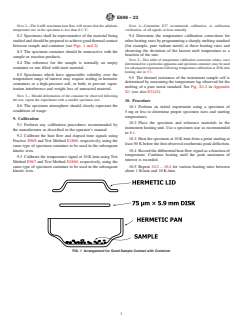
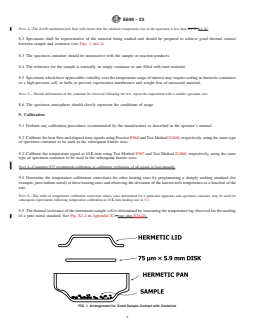
FIG. 1 Arrangement for Good Sample Contact with Container
E698 − 23
FIG. 2 Specimen Pan Collapsed and Collected
NOTE 6—A minimum of four determinations at heating rates between
the aging temperature so that no significant reaction occurs
1 K ⁄min and 10 K ⁄min are recommended.
during subsequent holding time.
NOTE 7—Reaction curve baselines should be level to minimize slope
error in peak maxima measurements. 11.9 Heat the aged specimen in a thermal instrument and
record its reaction peak and determine temperature.
11. Calculation
11.10 Heat a similar but unaged specimen in the same way
11.1 Temperatures of reaction peak maxima are corrected
and record its reaction peak and determine temperature.
for temperature scale nonlinearity, heating rate changes, and
11.11 On an equal mass basis, the peak area or displacement
thermal lag as in the example in Appendix X1 (see also Test
from baseline of the aged specimen shall be approximately one
Method E3142).
half that of the unaged sample. If so, the reaction kinetics are
–1
11.2 Plot log β (heating rate, K min ) versus 1/T, where T
confirmed for the temperature range explored.
is the corrected peak maximum temperature in Kelvin. Calcu-
late and construct a least squares “best
...
This document is not an ASTM standard and is intended only to provide the user of an ASTM standard an indication of what changes have been made to the previous version. Because
it may not be technically possible to adequately depict all changes accurately, ASTM recommends that users consult prior editions as appropriate. In all cases only the current version
of the standard as published by ASTM is to be considered the official document.
Designation: E698 − 18 E698 − 23
Standard Test Method for
Kinetic Parameters for Thermally Unstable Materials Using
Differential Scanning Calorimetry and the Flynn/Wall/Ozawa
Method
This standard is issued under the fixed designation E698; the number immediately following the designation indicates the year of
original adoption or, in the case of revision, the year of last revision. A number in parentheses indicates the year of last reapproval. A
superscript epsilon (´) indicates an editorial change since the last revision or reapproval.
INTRODUCTION
The kinetics of exothermic reactions are important in assessing the potential of materials and
systems for thermal explosion. This test method provides a means for determining Arrhenius
activation energies and pre-exponential factors using differential thermal methods. This test method is
to be used in conjunction with other tests to characterize the hazard potential of chemicals.
1. Scope
1.1 This test method covers the determination of the overall kinetic parameters for exothermic reactions using the Flynn/Wall/
Ozawa method and differential scanning calorimetry.
1.2 This technique is applicable to reactions whose behavior can be described by the Arrhenius equation and the general rate law.
1.3 Limitations—There are cases where this technique is not applicable. Limitations may be indicated by curves departing from
a straight line (see 11.2) or the isothermal aging test not closely agreeing with the results predicted by the calculated kinetic values.
In particular, this test method is not applicable to reactions that are partially inhibited. The technique may not work with reactions
that include simultaneous or consecutive reaction steps. This test method may not apply to materials that undergo phase transitions
if the reaction rate is significant at the transition temperature.
1.4 The values stated in SI units are to be regarded as standard. No other units of measurement are included in this standard.
1.5 This standard does not purport to address all of the safety concerns, if any, associated with its use. It is the responsibility
of the user of this standard to establish appropriate safety, health, and environmental practices and determine the applicability of
regulatory limitations prior to use.
1.6 This international standard was developed in accordance with internationally recognized principles on standardization
established in the Decision on Principles for the Development of International Standards, Guides and Recommendations issued
by the World Trade Organization Technical Barriers to Trade (TBT) Committee.
This test method is under the jurisdiction of ASTM Committee E37 on Thermal Measurements and is the direct responsibility of Subcommittee E37.01 on Calorimetry
and Mass Loss.
Current edition approved June 1, 2018Aug. 1, 2023. Published June 2018August 2023. Originally approved in 1979. Last previous edition approved in 20162018 as
E698 – 16.E698 – 18. DOI: 10.1520/E0698-18.10.1520/E0698-23.
Copyright © ASTM International, 100 Barr Harbor Drive, PO Box C700, West Conshohocken, PA 19428-2959. United States
E698 − 23
2. Referenced Documents
2.1 ASTM Standards:
E473 Terminology Relating to Thermal Analysis and Rheology
E691 Practice for Conducting an Interlaboratory Study to Determine the Precision of a Test Method
E967 Test Method for Temperature Calibration of Differential Scanning Calorimeters and Differential Thermal Analyzers
E968 Practice for Heat Flow Calibration of Differential Scanning Calorimeters (Withdrawn 2023)
E1142 Terminology Relating to Thermophysical Properties
E1231 Practice for Calculation of Hazard Potential Figures of Merit for Thermally Unstable Materials
E1445 Terminology Relating to Hazard Potential of Chemicals
E1860 Test Method for Elapsed Time Calibration of Thermal Analyzers
E1970 Practice for Statistical Treatment of Thermoanalytical Data
E2781 Practice for Evaluation of Methods for Determination of Kinetic Parameters by Calorimetry and Differential Scanning
Calorimetry
E2890 Test Method for Determination of Kinetic Parameters and Reaction Order for Thermally Unstable Materials by
Differential Scanning Calorimetry Using the Kissinger and Farjas Methods
E3142 Test Method for Thermal Lag of Thermal Analysis Apparatus
3. Terminology
3.1 Technical terms used in this test method are defined in Terminologies E473, E1142, and E1445 including activation energy,
Arrhenius equation, Celsius, differential scanning calorimetry, enthalpy, general rate law, Kelvin, kinetics, peak value,
pre-exponential factor, reaction, reaction order, and temperature.
4. Summary of Test Method
4.1 A specimen is placed in a suitable container and positioned in a differential scanning calorimeter (DSC).(DSC).
4.2 The temperature surrounding the specimen is increased at a linear rate and any exothermic reaction peaks recorded.
–1 –1
4.3 Steps 4.1 and 4.2 are repeated for several heating rates in the range from 1 K min to 10 K min .
4.4 Temperatures at which the reaction peak maxima occur are plotted as a function of their respective heating rates.
4.5 Kinetic values calculated from the peak temperature-heating rate relationship are used to predict a reaction half-life at a
selected temperature.
4.6 A specimen is aged at the selected temperature for the predicted half-life time.
4.7 The aged specimen is temperature programmed in a differential scanning calorimeter and its reaction peak area compared with
that for an unaged sample run under the same conditions.
4.8 If the normalized area for the aged specimen is approximately half that for the unaged sample, the kinetic values are confirmed
for the temperature selected.
5. Significance and Use
5.1 The kinetic parameters combined with the general rate law and the reaction enthalpy can be used for the determination of
thermal hazard using Practice E1231 (1).
For referenced ASTM standards, visit the ASTM website, www.astm.org, or contact ASTM Customer Service at service@astm.org. For Annual Book of ASTM Standards
volume information, refer to the standard’s Document Summary page on the ASTM website.
The last approved version of this historical standard is referenced on www.astm.org.
The boldface numbers in parentheses refer to the list of references at the end of this standard.
E698 − 23
6. Apparatus
6.1 General—The equipment used in this test method should be capable of displaying quantitative changes of enthalpy as a
function of time (t) or temperature (T), should be linearly programmable and have the capabilities of subjecting the sample cell
to different atmospheres. The heat sensing element should be external to the sample.
6.2 Differential Scanning Calorimeter (DSC):
6.2.1 A test chamber composed of:
6.2.1.1 A furnace, to provide uniform controlled heating (cooling) of a specimen and reference to a constant temperature or at a
constant rate within the applicable temperature range of this test method.
6.2.1.2 A temperature sensor, to provide an indication of the specimen/furnace temperature readable to 60.1 K.
6.2.1.3 A differential sensor, to detect a difference in heat flow between the specimen and reference equivalent to 10 μW.
6.2.1.4 A means of sustaining a test chamber environment, of an inert purge gas at a rate of 10 mL ⁄min to 50 mL ⁄min.
NOTE 1—Typically, 99+ % pure nitrogen, argon, or helium are employed when oxidation in air is a concern. Unless effects of moisture are to be studied,
use of dry purge gas is recommended; especially for operation at subambient temperature.
6.2.2 A temperature controller, capable of executing a specific temperature program by operating the furnace(s) between selected
temperature limits at a rate of temperature change between 0.5 K/min and 10 K ⁄min constant to 60.1 K ⁄min or at an isothermal
temperature constant to 60.1 K.
6.2.3 A data collection device, to provide a means of acquiring, storing, and displaying measured or calculated signals, or both.
The minimum output signals required for differential scanning calorimetry are heat flow, temperature, and time.
6.3 Containers (pans, crucibles, vials, etc.), which are inert to the specimen and reference materials and which are suitable
structural shape and integrity to contain the specimen and reference in accordance with the specific requirements of this test
method.
6.4 A balance, with a capacity of at least 100 mg, to weigh specimens or containers (pans, crucibles, vials, etc.) to within 10 μg.
6.5 Auxiliary equipment useful for conducting this test method below ambient temperature.
6.5.1 A coolant system, which can be directly coupled with the controller to the furnace to hasten its recovery from elevated
temperatures, to provide constant cooling rates, or to sustain an isothermal subambient temperature, or a combination thereof.
7. Safety Precautions
7.1 The use of this test method on materials whose potential hazards are unknown requires that precaution be taken during sample
preparation and testing.
7.2 Where particle size reduction by grinding is necessary, the user of this test method should presume that the material is
dangerous.
7.3 Toxic or corrosive effluents, or both, may be released when heating the material and could be harmful to the personnel or the
apparatus. Use of an exhaust system to remove such effluents is recommended.
8. Sampling
8.1 Specimen size is kept small to minimize temperature gradients within the sample. In general, a sample mass resulting in a
maximum heat generation of less than 8 mJ ⁄s (8 mW) is satisfactory.
E698 − 23
NOTE 2—The 8 mW maximum heat flow will ensure that the adiabatic temperature rise in the specimen is less than 0.1°C .0.1 °C.
8.2 Specimens shall be representative of the material being studied and should be prepared to achieve good thermal contact
between sample and container (see Figs. 1 and 2).
8.3 The specimen container should be nonreactive with the sample or reaction products.
8.4 The reference for the sample is normally an empty container or one filled with inert material.
8.5 Specimens which have appreciable volatility over the temperature range of interest may require sealing in hermetic containers
or a high-pressure cell, or both, to prevent vaporization interference and weight loss of unreacted material.
NOTE 3— Should deformation of the container be observed following the test, repeat the experiment with a smaller specimen size.
8.6 The specimen atmosphere should closely represent the conditions of usage.
9. Calibration
9.1 Perform any calibration procedures recommended by the manufacturer as described in the operator’s manual.
9.2 Calibrate the heat flow and elapsed time signals using Practice E968 and Test Method E1860, respectively, using the same type
of specimen container to be used in the subsequent kinetic tests.
9.3 Calibrate the temperature signal at 10 K ⁄min using Test Method E967 and Test Method E1860, respectively, using the same
type of specimen container to be used in the subsequent kinetic tests.
NOTE 4—Committee E37 recommends calibration, or calibration verification, of all signals at least annually.
9.4 Determine the temperature calibration corrections for other heating rates by programming a sharply melting standard (for
example, pure indium metal) at these heating rates and observing the deviation of the known melt temperature as a function of the
rate.
NOTE 5—This table of temperature calibration correction values, once determined for a particular apparatus and specimen container, may be used for
subsequent experiments following temperature calibration at 10 K ⁄min heating rate in 9.3.
9.5 The thermal resistance of the instrument sample cell is determined by measuring the temperature lag observed for the melting
of a pure metal standard. See Fig. X1.2 in Appendix X1. (see also E3142).
FIG. 1 Arrangement for Good Sample Contact with Container
E698 − 23
FIG. 2 Specimen Pan Collapsed and Collected
10. Procedure
10.1 Perform an initial experiment using a specimen of 5 mg or less to determine proper specimen sizes and starting temperatures.
10.2 Place the specimen and reference materials in the instrument heating unit. Use a specimen size as recommended in 8.1.
10.3 Heat the specimen at 10 K ⁄min from a point starting at least 50 K below the first observed exothermic peak deflection.
10.4 Record the differential heat flow signal as a function of temperature. Continue heating until the peak maximum of interest
is recorded.
10.5 Repeat 10.2 – 10.4 for various heating rates between about 1 K/min and 10 K ⁄min.
E698 − 23
NOTE 6—A minimum of four determinations at heating rates between 11 K K/min ⁄min and 10 K ⁄min are recommended.
NOTE 7—Reaction curve baselines should be level to minimize slope error in peak maxima measurements.
11. Calculation
11.1 Temperatures of reaction peak maxima are corrected for temperature scale nonlinearity, heating rate changes, and thermal lag
as in the example in Appendix X1. (see also Test Method E3142).
–1
11.2 Plot log β (heating rate, K min ) versus 1/T, where T is the corrected peak maximum temperature in Kelvin. Calculate and
construct a least squares “best fit” line through these points (see Practice E1970). The slope of this “best fit” line is taken as the
value for d log β ⁄d (1/T).
11.3 Calculate an approximate value for E (activation energy) as follows (2):
E>22.19R d log β/d 1/T (1)
@ ~ !#
–1 –1
where R = gas constant (=8.314 J mol K ).
11.4 Refine value of E by:
11.4.1 Calculate E/RT approximately.
11.4.2 Find corresponding value of D from Table X2.1.
11.4.3 Calculate new value for E as follows:
E 5 ~22.303R/D!@dlog β/d~1/T!# (2)
Refining the value of E a second time usually re
...