

ASTM E872-82(2019)
(Test Method)Standard Test Method for Volatile Matter in the Analysis of Particulate Wood Fuels
General Information
- Abstract
SIGNIFICANCE AND USE
4.1 The test procedures described in this test method can be used to determine the percentage of gaseous products, exclusive of moisture vapor, of any particulate wood fuel meeting the requirements specified in this test method.
SCOPE
1.1 This test method determines the percentage of gaseous products, exclusive of moisture vapor, in the analysis sample of particulate wood fuel that is released under the specific conditions of the test. The particulate wood fuel may be sanderdust, sawdust, pellets, green tree chips, hogged fuel, or other type particulate wood fuel having a maximum particle volume of 16.39 cm3 (1 in.3). Volatile matter, when determined as herein described, may be used to indicate yields on processes to provide the basis for purchasing and selling or to establish burning characteristics.
1.2 The values stated in SI units are to be regarded as the standard. The values given in parentheses are for information only.
1.3 This standard does not purport to address all of the safety concerns, if any, associated with its use. It is the responsibility of the user of this standard to establish appropriate safety, health, and environmental practices and determine the applicability of regulatory limitations prior to use.
1.4 This international standard was developed in accordance with internationally recognized principles on standardization established in the Decision on Principles for the Development of International Standards, Guides and Recommendations issued by the World Trade Organization Technical Barriers to Trade (TBT) Committee.
- Status
- Published
- Publication Date
- 31-Mar-2019
- Technical Committee
- E48 - Bioenergy and Industrial Chemicals from Biomass
- Drafting Committee
- E48.05 - Biomass Conversion


Overview
ASTM E872-82(2019), titled Standard Test Method for Volatile Matter in the Analysis of Particulate Wood Fuels, establishes a unified method for determining the percentage of volatile matter-gaseous products exclusive of moisture vapor-in various particulate wood fuels. This standard test method is fundamental in the analysis and characterization of wood-based biomass fuels such as sawdust, pellets, green tree chips, sanderdust, and hogged fuel, where the maximum particle volume does not exceed 16.39 cm³ (1 in³).
The standard is developed according to international principles outlined by the World Trade Organization (WTO) Technical Barriers to Trade (TBT) Committee and supports trade, regulatory compliance, and the energy industry by providing consistent and reliable results.
Key Topics
- Purpose: Defines procedures to determine the percentage of volatile matter (exclusive of moisture) in particulate wood fuels under strictly controlled conditions.
- Importance: The volatile matter content is a critical parameter in fuel analysis, influencing combustion properties, purchasing and selling terms, and process yields.
- Applicable Materials: Includes all particulate wood fuels with particle volume up to 16.39 cm³, such as:
- Sawdust
- Pellets
- Sanderdust
- Green tree chips
- Hogged fuel
- Sample Collection: Emphasizes systematic sampling from fresh stock to ensure representativeness; samples must be stored in airtight containers to preserve composition.
- Test Method: Relies on precise weighing, use of controlled electric furnaces, and correction for moisture determined by ASTM E871 to achieve accurate volatile matter readings.
- Units: SI units are standard; any alternate units (such as inches or pounds) are for information only.
Applications
Fuel Quality Assessment
- Burning Characteristics: Determines the fuel’s combustion behavior, such as ignition and volatilization rates, which are key parameters for furnace and boiler design.
- Trade and Commerce: Provides an objective basis for pricing, purchasing, and selling particulate wood fuels in domestic and international markets.
- Process Yield Prediction: Supports biomass conversion and energy generation operations by providing input data for process modeling and yield calculations.
Regulatory and Environmental Compliance
- International Consistency: Ensures compatibility with global trade and regulatory frameworks, supporting cross-border commerce.
- Health, Safety & Environmental Considerations: Assists in establishing standards for safe handling, storage, and conversion of bioenergy materials.
Laboratory and Industrial Use
- Quality Control: Enables fuel producers and users to monitor batch-to-batch consistency and adherence to contractual specifications.
- Research & Development: Facilitates innovation in biomass energy and materials science by providing standardized testing methodologies.
Related Standards
Implementing ASTM E872-82(2019) often involves reference to, or use in combination with, the following standards:
- ASTM E871 – Standard Test Method for Moisture Analysis of Particulate Wood Fuels
- ASTM D346 – Practice for Collection and Preparation of Coke Samples for Laboratory Analysis
- ASTM D2013 – Practice for Preparing Coal Samples for Analysis
These standards complement the volatile matter analysis by addressing sampling, preparation, and moisture determination-providing an integrated approach to wood fuel characterization within the bioenergy sector.
By following ASTM E872-82(2019), laboratories, fuel producers, and energy operators can ensure accurate, repeatable, and internationally-accepted volatile matter determinations in particulate wood fuels, supporting both operational efficiency and market transparency.
Relations
- Effective Date
- 01-Apr-2019
- Effective Date
- 01-Apr-2019
- Effective Date
- 15-Aug-2013
- Effective Date
- 01-May-2010
- Effective Date
- 01-Jun-2007
- Effective Date
- 01-Nov-2006
- Effective Date
- 01-Nov-2004
- Effective Date
- 01-Apr-2004
- Effective Date
- 01-Apr-2004
- Effective Date
- 01-Dec-2003
- Effective Date
- 10-Nov-2001
- Effective Date
- 10-Sep-1998
- Effective Date
- 01-Jan-1987
- Effective Date
- 01-Apr-2019
Get Certified
Connect with accredited certification bodies for this standard

Element Materials Technology
Materials testing and product certification.

ABS Group Brazil
ABS Group certification services in Brazil.

ABS Quality Evaluations Inc.
American Bureau of Shipping quality certification.
Sponsored listings
Frequently Asked Questions
ASTM E872-82(2019) is a standard published by ASTM International. Its full title is "Standard Test Method for Volatile Matter in the Analysis of Particulate Wood Fuels". This standard covers: SIGNIFICANCE AND USE 4.1 The test procedures described in this test method can be used to determine the percentage of gaseous products, exclusive of moisture vapor, of any particulate wood fuel meeting the requirements specified in this test method. SCOPE 1.1 This test method determines the percentage of gaseous products, exclusive of moisture vapor, in the analysis sample of particulate wood fuel that is released under the specific conditions of the test. The particulate wood fuel may be sanderdust, sawdust, pellets, green tree chips, hogged fuel, or other type particulate wood fuel having a maximum particle volume of 16.39 cm3 (1 in.3). Volatile matter, when determined as herein described, may be used to indicate yields on processes to provide the basis for purchasing and selling or to establish burning characteristics. 1.2 The values stated in SI units are to be regarded as the standard. The values given in parentheses are for information only. 1.3 This standard does not purport to address all of the safety concerns, if any, associated with its use. It is the responsibility of the user of this standard to establish appropriate safety, health, and environmental practices and determine the applicability of regulatory limitations prior to use. 1.4 This international standard was developed in accordance with internationally recognized principles on standardization established in the Decision on Principles for the Development of International Standards, Guides and Recommendations issued by the World Trade Organization Technical Barriers to Trade (TBT) Committee.
SIGNIFICANCE AND USE 4.1 The test procedures described in this test method can be used to determine the percentage of gaseous products, exclusive of moisture vapor, of any particulate wood fuel meeting the requirements specified in this test method. SCOPE 1.1 This test method determines the percentage of gaseous products, exclusive of moisture vapor, in the analysis sample of particulate wood fuel that is released under the specific conditions of the test. The particulate wood fuel may be sanderdust, sawdust, pellets, green tree chips, hogged fuel, or other type particulate wood fuel having a maximum particle volume of 16.39 cm3 (1 in.3). Volatile matter, when determined as herein described, may be used to indicate yields on processes to provide the basis for purchasing and selling or to establish burning characteristics. 1.2 The values stated in SI units are to be regarded as the standard. The values given in parentheses are for information only. 1.3 This standard does not purport to address all of the safety concerns, if any, associated with its use. It is the responsibility of the user of this standard to establish appropriate safety, health, and environmental practices and determine the applicability of regulatory limitations prior to use. 1.4 This international standard was developed in accordance with internationally recognized principles on standardization established in the Decision on Principles for the Development of International Standards, Guides and Recommendations issued by the World Trade Organization Technical Barriers to Trade (TBT) Committee.
ASTM E872-82(2019) is classified under the following ICS (International Classification for Standards) categories: 75.160.10 - Solid fuels. The ICS classification helps identify the subject area and facilitates finding related standards.
ASTM E872-82(2019) has the following relationships with other standards: It is inter standard links to ASTM E872-82(2013), ASTM E871-82(2019), ASTM E871-82(2013), ASTM D346-04(2010), ASTM D2013-07, ASTM E871-82(2006), ASTM D2013-04, ASTM D346-04, ASTM D346-04e1, ASTM D2013-03, ASTM D2013-01, ASTM D346-90(1998), ASTM E871-82(1998), ASTM E870-82(2019). Understanding these relationships helps ensure you are using the most current and applicable version of the standard.
ASTM E872-82(2019) is available in PDF format for immediate download after purchase. The document can be added to your cart and obtained through the secure checkout process. Digital delivery ensures instant access to the complete standard document.
Standards Content (Sample)
This international standard was developed in accordance with internationally recognized principles on standardization established in the Decision on Principles for the
Development of International Standards, Guides and Recommendations issued by the World Trade Organization Technical Barriers to Trade (TBT) Committee.
Designation: E872 − 82 (Reapproved 2019)
Standard Test Method for
Volatile Matter in the Analysis of Particulate Wood Fuels
This standard is issued under the fixed designation E872; the number immediately following the designation indicates the year of
original adoption or, in the case of revision, the year of last revision. A number in parentheses indicates the year of last reapproval. A
superscript epsilon (´) indicates an editorial change since the last revision or reapproval.
1. Scope 3. Summary of Test Method
3.1 Volatile matter is determined by establishing the loss in
1.1 This test method determines the percentage of gaseous
products,exclusiveofmoisturevapor,intheanalysissampleof weight resulting from heating wood under rigidly controlled
particulate wood fuel that is released under the specific conditions. The measured weight loss, corrected for moisture
conditions of the test. The particulate wood fuel may be as determined in Test Method E871, establishes the volatile
sanderdust, sawdust, pellets, green tree chips, hogged fuel, or matter content.
other type particulate wood fuel having a maximum particle
4. Significance and Use
3 3
volume of 16.39 cm (1 in. ).Volatile matter, when determined
4.1 The test procedures described in this test method can be
as herein described, may be used to indicate yields on
used to determine the percentage of gaseous products, exclu-
processes to provide the basis for purchasing and selling or to
sive of moisture vapor, of any particulate wood fuel meeting
establish burning characteristics.
the requirements specified in this test method.
1.2 The values stated in SI units are to be regarded as the
standard. The values given in parentheses are for information 5. Apparatus
only.
5.1 Platinum Crucible, with closely fitting cover, or a
1.3 This standard does not purport to address all of the
nickel-chromium crucible, with closely fitting cover, pre-fired
safety concerns, if any, associated with its use. It is the
to oxidize and stabilize the weight. The crucible shall be of not
responsibility of the user of this standard to establish appro-
less than 10 or more than 20 mL capacity, not less than 25 or
priate safety, health, and environmental practices and deter-
more than 35 mm in diameter, and not less than 30 or more
mine the applicability of regulatory limitations prior to use. than 35 mm in height.
1.4 This international standard was developed in accor-
5.2 Vertical Electric Tube Furnace—The furnace may be of
dance with internationally recognized principles on standard-
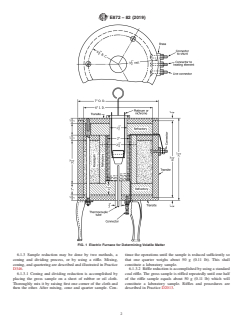
the form shown in Fig. 1. It shall be regulated to maintain a
ization established in the Decision on Principles for the
temperature of 950 6 20 °C in the crucible, as measured by a
Development of International Standards, Guides and Recom-
thermocouple positioned in the furnace.
mendations issued by the World Trade Organization Technical
Barriers to Trade (TBT) Committee. 6. Procedure
6.1 Sampling:
2. Referenced Documents
6.1.1 PlaceofSampling—Take sample where wood is being
2.1 ASTM Standards: loaded into or unloaded from means of transportation or when
D346 Practice for Collection and Preparation of Coke discharged from storage bins or conveyors.
Samples for Laboratory Analysis
NOTE 1—Samples collected from the surface of piles are, in general,
D2013 Practice for Preparing Coal Samples for Analysis
unreliable because of the exposure to the environment. If necessary,
E871 Test Method for Moisture Analysis of Particulate collect nine increments from a foot or more below the surface at nine
points covering the pile.
Wood Fuels
6.1.2 Collection of Gross Sample:
6.1.2.1 Collect increments regularly, systematically, and
This test method is under the jurisdiction of ASTM Committee E48 on
with such frequency that the entire quantity of wood sampled
Bioenergy and Industrial Chemicals from Biomass and is the direct responsibility of
will be represented proportionally in the gross sample.
Subcommittee E48.05 on Biomass Conversion.
6.1.2.2 The quantity of the sample shall be large enough to
Current edition approved April 1, 2019. Published April 2019. Originally
be representative but not less than 10 kg (22 lb).
approvedin1982.Lastpreviouseditionapprovedin2013asE872 – 82(2013).DOI:
10.1520/E0872-82R19.
6.1.2.3 Place samples in an airtight container immediately
For referenced ASTM standards, visit the ASTM website, www.astm.org, or
after collection. Maintain samples in the airtight container
contact ASTM Customer Service at service@astm.org. For Annual Book of ASTM
whenever possible to prevent gains or losses in moisture from
Standards volume information, refer to the standard’s Document Summary page on
the ASTM website. the atmosphere.
Copyright © ASTM International, 100 Barr Harbor Drive, PO Box C700, West Conshohocken, PA 19428-2959. United States
E872 − 82 (2019)
FIG. 1 Electric Furnace for Determini
...