

ASTM E695-22
(Test Method)Standard Test Method of Measuring Relative Resistance of Wall, Floor, and Roof Construction to Impact Loading
General Information
- Abstract
SIGNIFICANCE AND USE
4.1 The procedures outlined will provide data that can be used to evaluate the relative performance of wall, floor, and roof constructions under conditions representative of those sustained in actual service when subjected to impact by a heavy blunt object. See Test Method E661 for evaluation of floor and roof sheathing and Practice E73 for evaluation of roof trusses.
4.2 The method is intended to be applied to relatively light construction, including, but not limited to, wood floor and roof systems, partitions framed with wood or steel studs, steel floor or roof decking systems, steel siding and wall panels, or thin concrete and masonry walls or slabs and similar assemblies.
SCOPE
1.1 This test method covers the measurement of the relative resistance of wall, floor, and roof construction to impact loading. The test is not applicable to doors.
1.2 The values stated in inch-pound units are to be regarded as standard. The values given in parentheses are mathematical conversions to SI units that are provided for information only and are not considered standard.
1.3 This standard does not purport to address all of the safety concerns, if any, associated with its use. It is the responsibility of the user of this standard to establish appropriate safety, health, and environmental practices and determine the applicability of regulatory limitations prior to use.
1.4 This international standard was developed in accordance with internationally recognized principles on standardization established in the Decision on Principles for the Development of International Standards, Guides and Recommendations issued by the World Trade Organization Technical Barriers to Trade (TBT) Committee.
- Status
- Published
- Publication Date
- 30-Sep-2022
- Technical Committee
- E06 - Performance of Buildings
Buy Documents
ASTM E695-22 - Standard Test Method of Measuring Relative Resistance of Wall, Floor, and Roof Construction to Impact Loading
REDLINE ASTM E695-22 - Standard Test Method of Measuring Relative Resistance of Wall, Floor, and Roof Construction to Impact Loading
Overview
ASTM E695-22: Standard Test Method of Measuring Relative Resistance of Wall, Floor, and Roof Construction to Impact Loading is a critical method developed by ASTM International. This standard specifies procedures for evaluating the performance of wall, floor, and roof assemblies subjected to impact loading by heavy blunt objects under simulated service conditions. Applicable primarily to relatively light construction such as wood, steel, thin concrete, masonry assemblies, and steel siding or panels, this test method provides valuable data for understanding a structure's resistance to impact events.
This method is not designed for doors and focuses on wall, floor, and roof systems installed in actual buildings, ensuring that its application mirrors realistic service environments. ASTM E695-22 supports the design, evaluation, and specification of building components where impact resistance is a crucial parameter.
Key Topics
- Impact Resistance Measurement
Assesses the structural integrity of wall, floor, and roof constructions when exposed to heavy, blunt impacts, simulating potential real-life service conditions. - Test Apparatus and Procedure
Specifies the use of a shot-filled leather impact bag and detailed guidelines for mounting specimens either horizontally (for floors and roofs) or vertically (for walls). - Specimen Preparation
Ensures samples reflect actual construction, including materials, assembly, and dimensions. - Testing Parameters
Outlines measurement strategies for instantaneous deflection and set, specifying the number and placement of test drops to evaluate specimen performance. - Reporting Requirements
Standardizes result documentation, mandating comprehensive descriptions and illustrations to ensure transparency and repeatability. - Applicability and Limitations
Stresses the importance of safety, health, and regulatory compliance, and clarifies that the test is not meant for routine quality control but for prototype evaluation.
Applications
ASTM E695-22 finds broad practical application across the construction, architectural, and structural engineering sectors. Key uses include:
- Design Validation
Assists engineers and architects in confirming the impact resistance of building elements during the design and product development stages. - Material Selection
Provides comparative data to aid the selection of suitable materials or assemblies for specific environments prone to dynamic impact. - Product Certification
Used by manufacturers to demonstrate compliance with industry standards for impact resistance, facilitating product certification and market acceptance. - Building Code Compliance
Supports meeting regulatory requirements in areas where resistance to accidental or intentional impact is mandated for occupancy safety. - Performance Benchmarking
Enables comparative assessments between different wall, floor, and roof system designs, supporting informed decision-making in material procurement and structural specification.
Related Standards
Several ASTM and associated standards complement or reference ASTM E695-22:
- ASTM E661 - Test Method for Performance of Wood and Wood-Based Floor and Roof Sheathing Under Concentrated Static and Impact Loads.
- ASTM E73 - Practice for Static Load Testing of Truss Assemblies, relevant for roof truss evaluation.
- ASTM E575 - Practice for Reporting Data from Structural Tests of Building Constructions.
- ASTM E631 - Terminology of Building Constructions, offers definitions for terms used in E695.
- ASTM D1517 - Terminology Relating to Leather, referenced for details about required test materials.
These standards collectively provide a comprehensive framework for the testing, evaluation, and reporting of building system performance under impact loading conditions.
Keywords: ASTM E695-22, impact resistance, wall construction testing, floor impact loading, roof system testing, building performance, structural impact test, ASTM standards for buildings, light construction impact test, wall and roof impact performance.
Relations
- Effective Date
- 01-Jul-2018
- Effective Date
- 01-Dec-2015
- Effective Date
- 01-Mar-2015
- Effective Date
- 01-Nov-2014
- Effective Date
- 01-Apr-2011
- Effective Date
- 01-Oct-2010
- Effective Date
- 01-Apr-2007
- Effective Date
- 01-Oct-2006
- Effective Date
- 01-Jun-2006
- Effective Date
- 01-Oct-2005
- Effective Date
- 01-Sep-2004
- Effective Date
- 01-Sep-2004
- Effective Date
- 01-Apr-2004
- Effective Date
- 01-Oct-2003
- Effective Date
- 01-Oct-2003
Buy Documents
ASTM E695-22 - Standard Test Method of Measuring Relative Resistance of Wall, Floor, and Roof Construction to Impact Loading
REDLINE ASTM E695-22 - Standard Test Method of Measuring Relative Resistance of Wall, Floor, and Roof Construction to Impact Loading
Get Certified
Connect with accredited certification bodies for this standard

DIBt (Deutsches Institut für Bautechnik)
German Institute for Building Technology.
DIN CERTCO
DIN Group product certification.

Aboma Certification B.V.
Specialized in construction, metal, and transport sectors.
Sponsored listings
Frequently Asked Questions
ASTM E695-22 is a standard published by ASTM International. Its full title is "Standard Test Method of Measuring Relative Resistance of Wall, Floor, and Roof Construction to Impact Loading". This standard covers: SIGNIFICANCE AND USE 4.1 The procedures outlined will provide data that can be used to evaluate the relative performance of wall, floor, and roof constructions under conditions representative of those sustained in actual service when subjected to impact by a heavy blunt object. See Test Method E661 for evaluation of floor and roof sheathing and Practice E73 for evaluation of roof trusses. 4.2 The method is intended to be applied to relatively light construction, including, but not limited to, wood floor and roof systems, partitions framed with wood or steel studs, steel floor or roof decking systems, steel siding and wall panels, or thin concrete and masonry walls or slabs and similar assemblies. SCOPE 1.1 This test method covers the measurement of the relative resistance of wall, floor, and roof construction to impact loading. The test is not applicable to doors. 1.2 The values stated in inch-pound units are to be regarded as standard. The values given in parentheses are mathematical conversions to SI units that are provided for information only and are not considered standard. 1.3 This standard does not purport to address all of the safety concerns, if any, associated with its use. It is the responsibility of the user of this standard to establish appropriate safety, health, and environmental practices and determine the applicability of regulatory limitations prior to use. 1.4 This international standard was developed in accordance with internationally recognized principles on standardization established in the Decision on Principles for the Development of International Standards, Guides and Recommendations issued by the World Trade Organization Technical Barriers to Trade (TBT) Committee.
SIGNIFICANCE AND USE 4.1 The procedures outlined will provide data that can be used to evaluate the relative performance of wall, floor, and roof constructions under conditions representative of those sustained in actual service when subjected to impact by a heavy blunt object. See Test Method E661 for evaluation of floor and roof sheathing and Practice E73 for evaluation of roof trusses. 4.2 The method is intended to be applied to relatively light construction, including, but not limited to, wood floor and roof systems, partitions framed with wood or steel studs, steel floor or roof decking systems, steel siding and wall panels, or thin concrete and masonry walls or slabs and similar assemblies. SCOPE 1.1 This test method covers the measurement of the relative resistance of wall, floor, and roof construction to impact loading. The test is not applicable to doors. 1.2 The values stated in inch-pound units are to be regarded as standard. The values given in parentheses are mathematical conversions to SI units that are provided for information only and are not considered standard. 1.3 This standard does not purport to address all of the safety concerns, if any, associated with its use. It is the responsibility of the user of this standard to establish appropriate safety, health, and environmental practices and determine the applicability of regulatory limitations prior to use. 1.4 This international standard was developed in accordance with internationally recognized principles on standardization established in the Decision on Principles for the Development of International Standards, Guides and Recommendations issued by the World Trade Organization Technical Barriers to Trade (TBT) Committee.
ASTM E695-22 is classified under the following ICS (International Classification for Standards) categories: 91.060.01 - Elements of buildings in general. The ICS classification helps identify the subject area and facilitates finding related standards.
ASTM E695-22 has the following relationships with other standards: It is inter standard links to ASTM E575-05(2018), ASTM D1517-15, ASTM E631-15, ASTM E631-14, ASTM E575-05(2011), ASTM D1517-10, ASTM E73-83(2007), ASTM D1517-06, ASTM E631-06, ASTM E575-05, ASTM D1517-04, ASTM D1517-04e1, ASTM D1517-99(2004), ASTM E661-03, ASTM E661-03(2009). Understanding these relationships helps ensure you are using the most current and applicable version of the standard.
ASTM E695-22 is available in PDF format for immediate download after purchase. The document can be added to your cart and obtained through the secure checkout process. Digital delivery ensures instant access to the complete standard document.
Standards Content (Sample)
This international standard was developed in accordance with internationally recognized principles on standardization established in the Decision on Principles for the
Development of International Standards, Guides and Recommendations issued by the World Trade Organization Technical Barriers to Trade (TBT) Committee.
Designation: E695 − 22
Standard Test Method of
Measuring Relative Resistance of Wall, Floor, and Roof
Construction to Impact Loading
This standard is issued under the fixed designation E695; the number immediately following the designation indicates the year of
original adoption or, in the case of revision, the year of last revision. A number in parentheses indicates the year of last reapproval. A
superscript epsilon (´) indicates an editorial change since the last revision or reapproval.
1. Scope Based Floor and Roof Sheathing Under Concentrated
Static and Impact Loads
1.1 This test method covers the measurement of the relative
2.2 Other Standard:
resistance of wall, floor, and roof construction to impact
Fed. Spec. A-A-50197A Linen, Thread
loading. The test is not applicable to doors.
3. Terminology
1.2 The values stated in inch-pound units are to be regarded
as standard. The values given in parentheses are mathematical
3.1 Definitions—For definitions of terms related to this
conversions to SI units that are provided for information only
standard, see Terminology E631.
and are not considered standard.
4. Significance and Use
1.3 This standard does not purport to address all of the
safety concerns, if any, associated with its use. It is the 4.1 The procedures outlined will provide data that can be
responsibility of the user of this standard to establish appro- used to evaluate the relative performance of wall, floor, and
priate safety, health, and environmental practices and deter- roof constructions under conditions representative of those
mine the applicability of regulatory limitations prior to use. sustainedinactualservicewhensubjectedtoimpactbyaheavy
1.4 This international standard was developed in accor- blunt object. See Test Method E661 for evaluation of floor and
dance with internationally recognized principles on standard- roof sheathing and Practice E73 for evaluation of roof trusses.
ization established in the Decision on Principles for the
4.2 The method is intended to be applied to relatively light
Development of International Standards, Guides and Recom-
construction, including, but not limited to, wood floor and roof
mendations issued by the World Trade Organization Technical
systems, partitions framed with wood or steel studs, steel floor
Barriers to Trade (TBT) Committee.
or roof decking systems, steel siding and wall panels, or thin
concrete and masonry walls or slabs and similar assemblies.
2. Referenced Documents
5. Summary of Method
2.1 ASTM Standards:
D1517 Terminology Relating to Leather
5.1 Specimens of wall, floor, and roof construction are
E73 Practice for Static Load Testing of Truss Assemblies
subjected to the impact force of a standard impact instrument.
E575 Practice for Reporting Data from Structural Tests of
Wall sections are tested in the vertical position. Floor and roof
Building Constructions, Elements, Connections, and As-
sections are tested only in the horizontal position. Because of
semblies
the inherent differences in the method of applying load,
E631 Terminology of Building Constructions
measurements obtained from tests in a horizontal mode are not
E661 Test Method for Performance of Wood and Wood-
comparabletomeasurementsobtainedfromtestsinthevertical
mode.
This test method is under the jurisdiction of ASTM Committee E06 on
6. Apparatus for Floor and Roof Systems, Specimen
Performance of Buildings and is the direct responsibility of Subcommittee E06.11
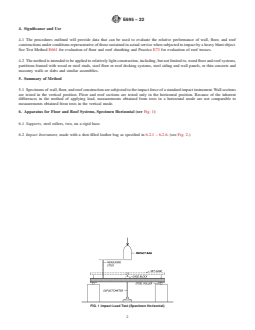
Horizontal (see Fig. 1)
on Horizontal and Vertical Structures/Structural Performance of Completed Struc-
tures.
6.1 Supports, steel rollers, two, on a rigid base.
Current edition approved Oct. 1, 2022. Published October 2022. Originally
ɛ1
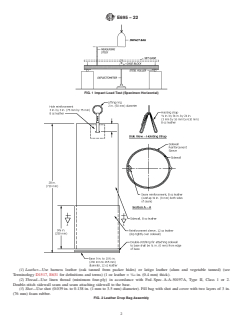
6.2 Impact Instrument, made with a shot-filled leather bag
approved in 1979. Last previous edition approved in 2015 as E695 – 03 (2015) .
DOI: 10.1520/E0695-22.
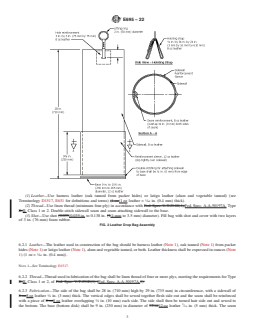
as specified in 6.2.1 – 6.2.6. (see Fig. 2.)
For referenced ASTM standards, visit the ASTM website, www.astm.org, or
contact ASTM Customer Service at service@astm.org. For Annual Book of ASTM
Standards volume information, refer to the standard’s Document Summary page on Available from U.S. General Services Administration, 1800 F Street, NW
the ASTM website. Washington, DC 20405, https://fedspecs.gsa.gov.
Copyright © ASTM International, 100 Barr Harbor Drive, PO Box C700, West Conshohocken, PA 19428-2959. United States
E695 − 22
FIG. 1 Impact Load Test (Specimen Horizontal)
(1) Leather—Use harness leather (oak tanned from packer hides) or latigo leather (alum and vegetable tanned) (see
Terminology D1517, E631 for definitions and terms) (1 oz leather = ⁄64 in. (0.4 mm) thick).
(2) Thread—Use linen thread (minimum four-ply) in accordance with Fed. Spec. A-A-50197A, Type II, Class 1 or 2.
Double-stitch sidewall seam and seam attaching sidewall to the base.
(3) Shot—Use shot (0.039 in. to 0.138 in. (1 mm to 3.5 mm) diameter). Fill bag with shot and cover with two layers of 3 in.
(76 mm) foam rubber.
FIG. 2 Leather Drop Bag Assembly
E695 − 22
6.2.1 Leather—The leather used in construction of the bag micrometer graduated to 0.001 in. (0.025 mm) divisions shall
should be harness leather (Note 1), oak tanned (Note 1) from be attached to the frame at midlength.
packer hides (Note 1) or latigo leather (Note 1), alum and
6.6 Gage Blocks, 12 in. by 12 in. (300 mm by 300 mm) in
vegetable tanned, or both. Leather thickness shall be expressed
area, and constructed of metal or other hard surface material.
in ounces (Note 1)(1oz= ⁄64 in. (0.4 mm)).
6.7 Hold-Downs—Clampsorotherrestrainingdevicesatthe
NOTE 1—See Terminology D1517.
specimen ends to minimize translation.
6.2.2 Thread—Thread used in fabrication of the bag shall be
7. Apparatus for Wall Systems, Specimen Vertical (see
linen thread of four or more plys, meeting the requirements for
Fig. 3)
Type II, Class 1 or 2, of Fed. Spec. A-A-50197A.
7.1 Steel Channels, for support of the specimen at top and
6.2.3 Fabrication—The side of the bag shall be 28 in. (710
bottom.
mm)highby29in.(735mm)incircumference,withasidewall
of 8 oz leather ⁄8 in. (3 mm) thick. The vertical edges shall be
7.2 Rollers, cylindrical rollers and two supporting rollers.
sewed together flesh side out and the seam shall be reinforced
7.3 Impact bag, measuring sticks, deflectometer, set gage,
with a piece of 8 oz leather overlapping ⁄8 in. (10 mm) each
and gage blocks conforming to the requirements specified in
side. The side shall then be turned hair side out and sewed to
6.2 – 6.7.
the bottom. The base (bottom disk) shall be 9 in. (230 mm) in
7.4 Rigid Supporting Frame, to which the supporting chan-
diameter of 12 oz leather ⁄16 in. (5 mm) thick. The seam
nels and deflection gage are attached.
attaching the wall to the base shall be ⁄4 in. (6 mm) from the
edge of the base. Two rows of stitching shall be used for the
8. Test Specimen
vertical wall seam and the seam attaching the wall to the base.
6.2.4 Hoisting Strap—The strap to hoist the bag shall be
8.1 Size—The specimens shall be representative of the
1 5
made from 8 oz leather ⁄8 in. (3 mm) thick by ⁄8 in. (16 mm) actual construction as to material, method of assembly, and
wide by 24 in. (610 mm) long. The strap shall be passed
workmanship.
through holes, diametrically opposite, in the side walls 1 ⁄2 in.
8.2 Length or Height—The length or height of specimen for
(40 mm) from the top of the wall. These holes shall be
each element shall be chosen to conform approximately to the
reinforcedwithpiecesof8 ozleatherand3in.(76mm)square.
length or height of that element in actual size.
The leather strap shall be passed twice through a 2 in. (50 mm)
8.3 Width—The width of specimen shall be chosen, insofar
diameter lifting ring and the ends fastened by sewing, riveting,
as feasible, to include several of the principal load-carrying
or by use of a buckle. To avoid excessive stretching of the
members to ensure that the behavior under load will simulate
leather wall or failure of the vertical seam, a sleeve, made from
that anticipated under service conditions. The actual width of
12 oz leather, of the same type as the base of the bag, shall be
specimens shall be a whole number multiplied by the spacing
fitted to slip tightly around the lower portion of the bag. This
5 of the principal load-carrying members, except for prefabri-
sleeve should be 9 ⁄8 in. (250 mm) high.
cated panels for which the actual width shall be the width of
6.2.5 Shot—The bag shall be loosely filled with metal shot
panel used. If the structural properties of a particular construc-
or pellets with diameters of 0.039 in. to 0.138 in. (1 mm to 3.5
tionaretobecomparedwithanotherconstruction,thereshould
mm). Two layers of 3 in. (75 mm) thick foam rubber or similar
not be a great difference in the actual widths of the specimens.
padding shall be placed over the lead shot to prevent spillage
8.4 Age—Constructions such as con
...
This document is not an ASTM standard and is intended only to provide the user of an ASTM standard an indication of what changes have been made to the previous version. Because
it may not be technically possible to adequately depict all changes accurately, ASTM recommends that users consult prior editions as appropriate. In all cases only the current version
of the standard as published by ASTM is to be considered the official document.
´1
Designation: E695 − 03 (Reapproved 2015) E695 − 22
Standard Test Method of
Measuring Relative Resistance of Wall, Floor, and Roof
Construction to Impact Loading
This standard is issued under the fixed designation E695; the number immediately following the designation indicates the year of
original adoption or, in the case of revision, the year of last revision. A number in parentheses indicates the year of last reapproval. A
superscript epsilon (´) indicates an editorial change since the last revision or reapproval.
ε NOTE—Units information was editorially corrected in March 2015.
1. Scope
1.1 This test method covers the measurement of the relative resistance of wall, floor, and roof construction to impact loading. The
test is not applicable to doors.
1.2 The values stated in inch-pound units are to be regarded as standard. The values given in parentheses are mathematical
conversions to SI units that are provided for information only and are not considered standard.
1.3 This standard does not purport to address all of the safety concerns, if any, associated with its use. It is the responsibility
of the user of this standard to establish appropriate safety safety, health, and healthenvironmental practices and determine the
applicability of regulatory limitations prior to use.
1.4 This international standard was developed in accordance with internationally recognized principles on standardization
established in the Decision on Principles for the Development of International Standards, Guides and Recommendations issued
by the World Trade Organization Technical Barriers to Trade (TBT) Committee.
2. Referenced Documents
2.1 ASTM Standards:
D1517 Terminology Relating to Leather
E73 Practice for Static Load Testing of Truss Assemblies
E575 Practice for Reporting Data from Structural Tests of Building Constructions, Elements, Connections, and Assemblies
E631 Terminology of Building Constructions
E661 Test Method for Performance of Wood and Wood-Based Floor and Roof Sheathing Under Concentrated Static and Impact
Loads
2.2 Other Standards:Standard:
Fed. Spec. V-T-291E(1) Fed. Spec. A-A-50197A Linen, Thread
3. Terminology
3.1 Definitions—For definitions of terms related to this standard, see Terminology E631.
This test method is under the jurisdiction of ASTM Committee E06 on Performance of Buildings and is the direct responsibility of Subcommittee E06.11 on Horizontal
and Vertical Structures/Structural Performance of Completed Structures.
Current edition approved March 1, 2015Oct. 1, 2022. Published March 2015October 2022. Originally approved in 1979. Last previous edition approved in 20092015 as
ɛ1
E695 – 03 (2009).(2015) . DOI: 10.1520/E0695-03R15E01.10.1520/E0695-22.
For referenced ASTM standards, visit the ASTM website, www.astm.org, or contact ASTM Customer Service at service@astm.org. For Annual Book of ASTM Standards
volume information, refer to the standard’sstandard’s Document Summary page on the ASTM website.
Available from DLA Documents Services, Building 4/D, 700 Robbins Ave., Philadelphia, PA 19111-5094, http://quicksearch.dla.mil.U.S. General Services
Administration, 1800 F Street, NW Washington, DC 20405, https://fedspecs.gsa.gov.
Copyright © ASTM International, 100 Barr Harbor Drive, PO Box C700, West Conshohocken, PA 19428-2959. United States
E695 − 22
4. Significance and Use
4.1 The procedures outlined will provide data that can be used to evaluate the relative performance of wall, floor, and roof
constructions under conditions representative of those sustained in actual service when subjected to impact by a heavy blunt object.
See Test Method E661 for evaluation of floor and roof sheathing and Practice E73 for evaluation of roof trusses.
4.2 The method is intended to be applied to relatively light construction, including, but not limited to, wood floor and roof systems,
partitions framed with wood or steel studs, steel floor or roof decking systems, steel siding and wall panels, or thin concrete and
masonry walls or slabs and similar assemblies.
5. Summary of Method
5.1 Specimens of wall, floor, and roof construction are subjected to the impact force of a standard impact instrument. Wall sections
are tested in the vertical position. Floor and roof sections are tested only in the horizontal position. Because of the inherent
differences in the method of applying load, measurements obtained from tests in a horizontal mode are not comparable to
measurements obtained from tests in the vertical mode.
6. Apparatus for Floor and Roof Systems, Specimen Horizontal (see Fig. 1)
6.1 Supports, steel rollers, two, on a rigid base.
6.2 Impact Instrument, made with a shot-filled leather bag as specified in 6.2.1 – 6.2.6. (see Fig. 2.)
FIG. 1 Impact Load Test (Specimen Horizontal)
E695 − 22
(1) Leather—Use harness leather (oak tanned from packer hides) or latigo leather (alum and vegetable tanned) (see
Terminology D1517, E631 for definitions and terms) (1-oz(1 oz leather = ⁄64 in. (0.4 mm) thick).
(2) Thread—Use linen thread (minimum four-ply) in accordance with Fed. Spec. V-T-291E(1),Fed. Spec. A-A-50197A, Type
B,II, Class 1 or 2. Double-stitch sidewall seam and seam attaching sidewall to the base.
(3) Shot—Use shot (0.039(0.039 in. to 0.138 in. (1(1 mm to 3.5 mm) diameter). Fill bag with shot and cover with two layers
of 3 in. (76 mm) foam rubber.
FIG. 2 Leather Drop Bag Assembly
6.2.1 Leather—The leather used in construction of the bag should be harness leather (Note 1), oak tanned (Note 1) from packer
hides (Note 1) or latigo leather (Note 1), alum and vegetable tanned, or both. Leather thickness shall be expressed in ounces (Note
1) (1 oz = ⁄64 in. (0.4 mm)).
NOTE 1—See Terminology D1517.
6.2.2 Thread—Thread used in fabrication of the bag shall be linen thread of four or more plys, meeting the requirements for Type
B,II, Class 1 or 2, of Fed. Spec. V-T-291E(1) (Fed. Spec. A-A-50197A.1).
6.2.3 Fabrication—The side of the bag shall be 28 in. (710 mm) high by 29 in. (735 mm) in circumference, with a sidewall of
8-oz8 oz leather ⁄8 in. (3 mm) thick. The vertical edges shall be sewed together flesh side out and the seam shall be reinforced
with a piece of 8-oz8 oz leather overlapping ⁄8 in. (10 mm) each side. The side shall then be turned hair side out and sewed to
the bottom. The base (bottom disk) shall be 9 in. (230 mm) in diameter of 12-oz12 oz leather ⁄16 in. (5 mm) thick. The seam
E695 − 22
attaching the wall to the base shall be ⁄4 in. (6 mm) from the edge of the base. Two rows of stitching shall be used for the vertical
wall seam and the seam attaching the wall to the base.
1 5
6.2.4 Hoisting Strap—The strap to hoist the bag shall be made from 8-oz8 oz leather ⁄8 in. (3 mm) thick by ⁄8 in. (16 mm) wide
by 24 in. (610 mm) long. The strap shall be passed through holes, diametrically opposite, in the side walls 1 ⁄2 in. (40 mm) from
the top of the wall. These holes shall be reinforced with pieces of 8-oz8 oz leather and 3 in. (76 mm) square. The leather strap shall
be passed twice through a 2-in. (50-mm)2 in. (50 mm) diameter lifting ring and the ends fastened by sewing, riveting, or by use
of a buckle. To avoid excessive stretching of the leather wall or failure of the vertical seam, a sleeve, made from 12-oz12 oz leather,
of the same type as the base of the bag, shall be fitted to slip tightly around the lower portion of the bag. This sleeve should be
9 ⁄8 in. (250 mm) high.
6.2.5 Shot—The bag shall be loosely filled with metal shot or pellets with diameters of 0.0390.039 in. to 0.138 in. (1(1 mm to 3.5
mm). Two layers of 3-in. (75-mm)3 in. (75 mm) thick foam rubber or similar padding shall be placed over the lead shot to prevent
spillage during testing.
6.2.6 The total mass of the bag, including shot, shall be adjusted to the desired level with an accuracy of 61 %. The mass of the
bag may be adjusted to any specified mass, depending upon the information desired.
6.3 Measuring Sticks—A stick, laid off in 6-in. (150-mm)6 in. (150 mm) increments, or a series of sticks the lengths of which are
multiples of 6 in. (152 mm), to measure the height of drop accurately. A graduated sliding pointer, a standard metal tape measure,
or any similar device that can accurately measure the height of drop may be substituted.
6.4 Deflectometer, or other suitable deflectometer equipment, consisting of a metal tube having a base at the lower end and a clamp
at the upper end which supports, by friction, a light metal rod. The rod shall be movable inside the tube and shall be graduated
to 0.01-in. (0.25-mm)0.01 in. (0.25 mm) divisions.
6.5 Set Gage, consisting of a light, rigid frame having two legs at one end and one leg at the other end, with the distance between
the legs equal to the span of the specimen. A dial micrometer graduated to 0.001-in. (0.025-mm)0.001 in. (0.025 mm) divisions
shall be attached to the frame at midlength.
6.6 Gage Blocks, 1212 in. by 12 in. (300(300 mm by 300 mm) in area, and constructed of metal or other hard surface material.
6.7 Hold-Downs—Clamps or other restraining devices at the specimen ends to minimize translation.
7. Apparatus for Wall Systems, Specimen Vertical (see Fig. 3)
7.1 Steel Channels, for su
...