

ASTM E2980-20
(Test Method)Standard Test Methods for Estimating Average Particle Size of Powders Using Air Permeability
General Information
- Abstract
SIGNIFICANCE AND USE
4.1 These test methods provide procedures for determining the envelope-specific surface area of powders, from which is calculated an “average” particle diameter, assuming the particles are monosize, smooth surface, nonporous, spherical particles. For this reason, values obtained by these test methods will be reported as an average particle size. The degree of correlation between the results of these test methods and the quality of powders in use will vary with each particular application and has not been fully determined.
4.2 These test methods are generally applicable to all powders, including metals (see Test Methods B330 for specific metal powder requirements), ceramics, and organic materials, for particles having diameters between 0.2 and 75 µm. They should not be used for powders composed of particles whose shape is too far from equiaxed – that is, flakes or fibers. In these cases, it is permissible to use the test methods described only by agreement between the parties concerned. These test methods shall not be used for mixtures of different powders, nor for powders containing binders or lubricants. When the powder contains agglomerates, the measured surface area may be affected by the degree of agglomeration. Methods of de-agglomeration such as that specified in Practice B859 may be used if agreed upon between the parties concerned.
4.3 When an “average” particle size of powders is determined by these methods, it should be clearly kept in mind that this average size is derived from the determination of the specific surface area of the powder using a relationship that is true only for powders of uniform size and spherical shape. Thus, the results of these methods are only estimates of average particle size.
4.4 Reported particle size measurement is a function of both the actual dimension and shape factor as well as the particular physical or chemical properties of the particle being measured. Caution is required when comparing data from instruments op...
SCOPE
1.1 These test methods use air permeability to determine an envelope-specific surface area and its associated average equivalent spherical diameter (from 0.2 to 75 µm) of powders. Two test methods are described: One test method for inorganic materials (Test Method 1), and another test method for organic materials (Test Method 2). The values obtained are not intended to be absolute but are generally useful on a relative basis for control purposes.
1.2 Units—With the exception of the values for density and the mass used to determine density, for which the use of the gram per cubic centimetre (g/cm3) and gram (g) units is the longstanding industry practice; and the units for pressure, cm H2O – also long-standing practice; the values in SI units are to be regarded as standard.
1.3 This standard does not purport to address all of the safety concerns, if any, associated with its use. It is the responsibility of the user of this standard to establish appropriate safety, health, and environmental practices and determine the applicability of regulatory limitations prior to use.
1.4 This international standard was developed in accordance with internationally recognized principles on standardization established in the Decision on Principles for the Development of International Standards, Guides and Recommendations issued by the World Trade Organization Technical Barriers to Trade (TBT) Committee.
- Status
- Published
- Publication Date
- 30-Sep-2020
- Technical Committee
- E29 - Particle and Spray Characterization
- Drafting Committee
- E29.02 - Non-Sieving Methods
Buy Documents
ASTM E2980-20 - Standard Test Methods for Estimating Average Particle Size of Powders Using Air Permeability
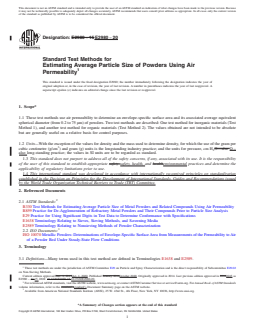
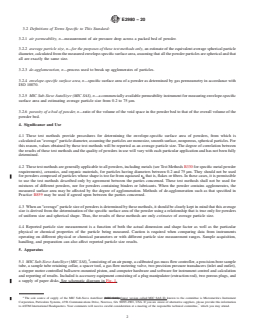
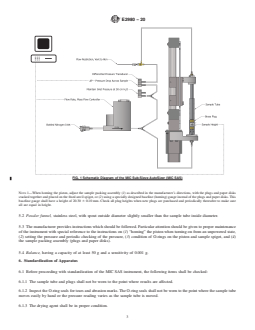
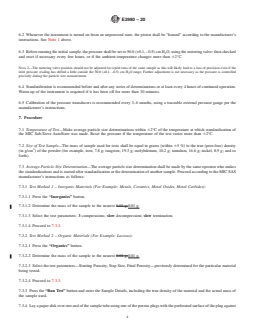
REDLINE ASTM E2980-20 - Standard Test Methods for Estimating Average Particle Size of Powders Using Air Permeability
Overview
ASTM E2980-20: Standard Test Methods for Estimating Average Particle Size of Powders Using Air Permeability, published by ASTM International, outlines reliable procedures for determining the envelope-specific surface area of powders. From this measurement, the method estimates the average equivalent spherical particle diameter, assuming that the powder consists of monosize, smooth, nonporous, spherical particles. These test methods utilize air permeability to calculate particle size in the range of 0.2 to 75 micrometers, making them suitable for a variety of powder types, including metals, ceramics, and organic materials.
The standard distinguishes between two test methods:
- Test Method 1: For inorganic materials (e.g., metals, ceramics)
- Test Method 2: For organic materials
ASTM E2980-20 is widely employed for quality control and comparative analysis of powder materials, although the results are considered estimates due to the assumptions about particle geometry.
Keywords: air permeability, average particle size, envelope-specific surface area, particle size analysis, powder characterization, porosity.
Key Topics
- Air Permeability Principle: Measurement of air flow and pressure drop across a bed of packed powder, used to derive the specific surface area.
- Estimation of Average Particle Size: Calculation assumes particles are uniform spheres. The result is an average estimate based on surface area measurements.
- Applicability and Scope:
- Particle diameter range: 0.2 to 75 μm
- Suitable for metals, ceramics, and organics
- Not recommended for powders with flake or fiber morphologies, mixtures, or powders containing binders/lubricants
- Results for agglomerated powders may require agreed-upon de-agglomeration procedures
- Instrumentation: Use of commercially available permeability instruments such as the MIC Sub-Sieve AutoSizer (MIC SAS) is described, with attention to standardization and calibration.
- Precision and Reporting:
- Repeatability data for typical particle sizes is provided
- Specific reporting protocols for both test methods
- Cautions on comparing results across different instruments or techniques
Applications
ASTM E2980-20 is essential in industries and research fields where understanding powder particle size distribution impacts product quality, process control, and material properties:
- Metallurgy and Metal Powders: Facilitates powder selection and process control for additive manufacturing, powder metallurgy, and sintering.
- Ceramic Manufacturing: Enables consistency in ceramic powder feedstocks, impacting final product strength and density.
- Pharmaceuticals and Organics: Ensures predictable dissolution and compaction behavior for powdered active ingredients and excipients.
- Quality Control: Provides a standardized method for the relative comparison of powder batches over time.
- Materials Characterization: Supports R&D and comparative studies by estimating average particle size in powders where full size distribution analysis is impractical.
Limitations: This method is most effective for equiaxed powders and is less reliable for mixtures or irregularly shaped particles. Average particle size results are estimates derived from surface area measurements and should be interpreted accordingly.
Related Standards
For users interested in deeper or related aspects of powder particle size determination by air permeability, these standards provide complementary procedures and terminology:
- ASTM B330: Test methods for metal powders and related compounds using air permeability
- ASTM B859: Practice for de-agglomeration of refractory metal powders before size analysis
- ASTM E29: Practice for using significant digits in test data
- ASTM E1638: Terminology relating to sieves and sieving methods
- ASTM E2589: Terminology relating to nonsieving methods for powder characterization
- ISO 10070: Methods for determining envelope-specific surface area of metallic powders by air permeability
Using these standardized approaches ensures consistency, reliability, and international comparability in powder particle size analysis.
Relations
- Refers
ASTM E2589-23a - Standard Terminology Relating to Nonsieving Methods of Powder Characterization - Effective Date
- 01-Sep-2023
- Effective Date
- 01-Oct-2013
- Effective Date
- 01-Jun-2013
- Effective Date
- 01-Nov-2012
- Effective Date
- 15-May-2012
- Refers
ASTM E1638-11a - Standard Terminology Relating to Sieves, Sieving Methods, and Screening Media - Effective Date
- 15-Nov-2011
- Effective Date
- 01-May-2011
- Refers
ASTM E2589-11 - Standard Terminology Relating to Nonsieving Methods of Powder Characterization - Effective Date
- 01-Apr-2011
- Effective Date
- 01-Dec-2010
- Refers
ASTM E2589-09a - Standard Terminology Relating to Nonsieving Methods of Powder Characterization - Effective Date
- 15-Dec-2009
- Effective Date
- 01-Mar-2009
- Refers
ASTM E2589-09 - Standard Terminology Relating to Nonsieving Methods of Powder Characterization - Effective Date
- 01-Jan-2009
- Effective Date
- 01-Oct-2008
- Refers
ASTM E2589-08b - Standard Terminology Relating to Nonsieving Methods of Powder Characterization - Effective Date
- 15-Jul-2008
- Refers
ASTM E2589-08a - Standard Terminology Relating to Nonsieving Methods of Powder Characterization - Effective Date
- 01-Jul-2008
Buy Documents
ASTM E2980-20 - Standard Test Methods for Estimating Average Particle Size of Powders Using Air Permeability
REDLINE ASTM E2980-20 - Standard Test Methods for Estimating Average Particle Size of Powders Using Air Permeability
Get Certified
Connect with accredited certification bodies for this standard

IMP NDT d.o.o.
Non-destructive testing services. Radiography, ultrasonic, magnetic particle, penetrant, visual inspection.
Inštitut za kovinske materiale in tehnologije
Institute of Metals and Technology. Materials testing, metallurgical analysis, NDT.
Q Techna d.o.o.
NDT and quality assurance specialist. 30+ years experience. NDT personnel certification per ISO 9712, nuclear and thermal power plant inspections, QA/
Sponsored listings
Frequently Asked Questions
ASTM E2980-20 is a standard published by ASTM International. Its full title is "Standard Test Methods for Estimating Average Particle Size of Powders Using Air Permeability". This standard covers: SIGNIFICANCE AND USE 4.1 These test methods provide procedures for determining the envelope-specific surface area of powders, from which is calculated an “average” particle diameter, assuming the particles are monosize, smooth surface, nonporous, spherical particles. For this reason, values obtained by these test methods will be reported as an average particle size. The degree of correlation between the results of these test methods and the quality of powders in use will vary with each particular application and has not been fully determined. 4.2 These test methods are generally applicable to all powders, including metals (see Test Methods B330 for specific metal powder requirements), ceramics, and organic materials, for particles having diameters between 0.2 and 75 µm. They should not be used for powders composed of particles whose shape is too far from equiaxed – that is, flakes or fibers. In these cases, it is permissible to use the test methods described only by agreement between the parties concerned. These test methods shall not be used for mixtures of different powders, nor for powders containing binders or lubricants. When the powder contains agglomerates, the measured surface area may be affected by the degree of agglomeration. Methods of de-agglomeration such as that specified in Practice B859 may be used if agreed upon between the parties concerned. 4.3 When an “average” particle size of powders is determined by these methods, it should be clearly kept in mind that this average size is derived from the determination of the specific surface area of the powder using a relationship that is true only for powders of uniform size and spherical shape. Thus, the results of these methods are only estimates of average particle size. 4.4 Reported particle size measurement is a function of both the actual dimension and shape factor as well as the particular physical or chemical properties of the particle being measured. Caution is required when comparing data from instruments op... SCOPE 1.1 These test methods use air permeability to determine an envelope-specific surface area and its associated average equivalent spherical diameter (from 0.2 to 75 µm) of powders. Two test methods are described: One test method for inorganic materials (Test Method 1), and another test method for organic materials (Test Method 2). The values obtained are not intended to be absolute but are generally useful on a relative basis for control purposes. 1.2 Units—With the exception of the values for density and the mass used to determine density, for which the use of the gram per cubic centimetre (g/cm3) and gram (g) units is the longstanding industry practice; and the units for pressure, cm H2O – also long-standing practice; the values in SI units are to be regarded as standard. 1.3 This standard does not purport to address all of the safety concerns, if any, associated with its use. It is the responsibility of the user of this standard to establish appropriate safety, health, and environmental practices and determine the applicability of regulatory limitations prior to use. 1.4 This international standard was developed in accordance with internationally recognized principles on standardization established in the Decision on Principles for the Development of International Standards, Guides and Recommendations issued by the World Trade Organization Technical Barriers to Trade (TBT) Committee.
SIGNIFICANCE AND USE 4.1 These test methods provide procedures for determining the envelope-specific surface area of powders, from which is calculated an “average” particle diameter, assuming the particles are monosize, smooth surface, nonporous, spherical particles. For this reason, values obtained by these test methods will be reported as an average particle size. The degree of correlation between the results of these test methods and the quality of powders in use will vary with each particular application and has not been fully determined. 4.2 These test methods are generally applicable to all powders, including metals (see Test Methods B330 for specific metal powder requirements), ceramics, and organic materials, for particles having diameters between 0.2 and 75 µm. They should not be used for powders composed of particles whose shape is too far from equiaxed – that is, flakes or fibers. In these cases, it is permissible to use the test methods described only by agreement between the parties concerned. These test methods shall not be used for mixtures of different powders, nor for powders containing binders or lubricants. When the powder contains agglomerates, the measured surface area may be affected by the degree of agglomeration. Methods of de-agglomeration such as that specified in Practice B859 may be used if agreed upon between the parties concerned. 4.3 When an “average” particle size of powders is determined by these methods, it should be clearly kept in mind that this average size is derived from the determination of the specific surface area of the powder using a relationship that is true only for powders of uniform size and spherical shape. Thus, the results of these methods are only estimates of average particle size. 4.4 Reported particle size measurement is a function of both the actual dimension and shape factor as well as the particular physical or chemical properties of the particle being measured. Caution is required when comparing data from instruments op... SCOPE 1.1 These test methods use air permeability to determine an envelope-specific surface area and its associated average equivalent spherical diameter (from 0.2 to 75 µm) of powders. Two test methods are described: One test method for inorganic materials (Test Method 1), and another test method for organic materials (Test Method 2). The values obtained are not intended to be absolute but are generally useful on a relative basis for control purposes. 1.2 Units—With the exception of the values for density and the mass used to determine density, for which the use of the gram per cubic centimetre (g/cm3) and gram (g) units is the longstanding industry practice; and the units for pressure, cm H2O – also long-standing practice; the values in SI units are to be regarded as standard. 1.3 This standard does not purport to address all of the safety concerns, if any, associated with its use. It is the responsibility of the user of this standard to establish appropriate safety, health, and environmental practices and determine the applicability of regulatory limitations prior to use. 1.4 This international standard was developed in accordance with internationally recognized principles on standardization established in the Decision on Principles for the Development of International Standards, Guides and Recommendations issued by the World Trade Organization Technical Barriers to Trade (TBT) Committee.
ASTM E2980-20 is classified under the following ICS (International Classification for Standards) categories: 19.120 - Particle size analysis. Sieving. The ICS classification helps identify the subject area and facilitates finding related standards.
ASTM E2980-20 has the following relationships with other standards: It is inter standard links to ASTM E2589-23a, ASTM B859-13, ASTM E1638-13, ASTM B330-12, ASTM E1638-12, ASTM E1638-11a, ASTM E1638-11, ASTM E2589-11, ASTM E1638-10, ASTM E2589-09a, ASTM E1638-09, ASTM E2589-09, ASTM E29-08, ASTM E2589-08b, ASTM E2589-08a. Understanding these relationships helps ensure you are using the most current and applicable version of the standard.
ASTM E2980-20 is available in PDF format for immediate download after purchase. The document can be added to your cart and obtained through the secure checkout process. Digital delivery ensures instant access to the complete standard document.
Standards Content (Sample)
This international standard was developed in accordance with internationally recognized principles on standardization established in the Decision on Principles for the
Development of International Standards, Guides and Recommendations issued by the World Trade Organization Technical Barriers to Trade (TBT) Committee.
Designation: E2980 − 20
Standard Test Methods for
Estimating Average Particle Size of Powders Using Air
Permeability
This standard is issued under the fixed designation E2980; the number immediately following the designation indicates the year of
original adoption or, in the case of revision, the year of last revision. A number in parentheses indicates the year of last reapproval. A
superscript epsilon (´) indicates an editorial change since the last revision or reapproval.
1. Scope* B859 Practice for De-Agglomeration of Refractory Metal
Powders and Their Compounds Prior to Particle Size
1.1 These test methods use air permeability to determine an
Analysis
envelope-specific surface area and its associated average
E29 Practice for Using Significant Digits in Test Data to
equivalent spherical diameter (from 0.2 to 75 µm) of powders.
Determine Conformance with Specifications
Two test methods are described: One test method for inorganic
E1638 Terminology Relating to Sieves, Sieving Methods,
materials (Test Method 1), and another test method for organic
and Screening Media
materials (Test Method 2). The values obtained are not
E2589 Terminology Relating to Nonsieving Methods of
intended to be absolute but are generally useful on a relative
Powder Characterization
basis for control purposes.
2.2 ISO Documents:
1.2 Units—With the exception of the values for density and
ISO 10070 Metallic Powders: Determinations of Envelope-
the mass used to determine density, for which the use of the
Specific Surface Area from Measurements of the Perme-
gram per cubic centimetre (g/cm ) and gram (g) units is the
ability to Air of a Powder Bed Under Steady-State Flow
longstanding industry practice; and the units for pressure, cm
Conditions
H O – also long-standing practice; the values in SI units are to
be regarded as standard. 3. Terminology
1.3 This standard does not purport to address all of the
3.1 Definitions—Many terms used in this test method are
safety concerns, if any, associated with its use. It is the
defined in Terminologies E1638 and E2589.
responsibility of the user of this standard to establish appro-
3.2 Definitions of Terms Specific to This Standard:
priate safety, health, and environmental practices and deter-
3.2.1 air permeability, n—measurement of air pressure drop
mine the applicability of regulatory limitations prior to use.
across a packed bed of powder.
1.4 This international standard was developed in accor-
3.2.2 average particle size, n—for the purposes of these test
dance with internationally recognized principles on standard-
methods only, an estimate of the equivalent average spherical
ization established in the Decision on Principles for the
particle diameter, calculated from the measured envelope-
Development of International Standards, Guides and Recom-
specific surface area, assuming that all the powder particles are
mendations issued by the World Trade Organization Technical
spherical and that all are exactly the same size.
Barriers to Trade (TBT) Committee.
3.2.3 de-agglomeration, n—process used to break up ag-
2. Referenced Documents
glomerates of particles.
2.1 ASTM Standards:
3.2.4 envelope-specific surface area, n—specific surface
B330 Test Methods for Estimating Average Particle Size of
area of a powder as determined by gas permeametry in
Metal Powders and Related Compounds Using Air Per-
accordance with ISO 10070.
meability
3.2.5 MIC Sub-Sieve AutoSizer (MIC SAS), n—a commer-
cially available permeability instrument for measuring
envelope-specific surface area and estimating average particle
These test methods are under the jurisdiction of ASTM Committee E29 on
size from 0.2 to 75 µm.
Particle and Spray Characterization and is the direct responsibility of Subcommittee
E29.02 on Non-Sieving Methods.
3.2.6 porosity of a bed of powder, n—ratio of the volume of
Current edition approved Oct. 1, 2020. Published October 2020. Originally
the void space in the powder bed to that of the overall volume
approved in 2014. Last previous edition approved in 2015 as E2980 – 15. DOI:
of the powder bed.
10.1520/E2980-20.
For referenced ASTM standards, visit the ASTM website, www.astm.org, or
contact ASTM Customer Service at service@astm.org. For Annual Book of ASTM
Standards volume information, refer to the standard’s Document Summary page on Available fromAmerican National Standards Institute (ANSI), 25 W. 43rd St.,
the ASTM website. 4th Floor, New York, NY 10036, http://www.ansi.org.
*A Summary of Changes section appears at the end of this standard
Copyright © ASTM International, 100 Barr Harbor Drive, PO Box C700, West Conshohocken, PA 19428-2959. United States
E2980 − 20
4. Significance and Use lator (extraction rod), two porous plugs, and a supply of paper
disks. See schematic diagram in Fig. 1.
4.1 These test methods provide procedures for determining
the envelope-specific surface area of powders, from which is
NOTE 1—When homing the piston, adjust the sample packing assembly
(1) as described in the manufacturer’s directions, with the plugs and paper
calculated an “average” particle diameter, assuming the par-
disks stacked together and placed on the fixed anvil spigot, or (2) using a
ticles are monosize, smooth surface, nonporous, spherical
specially designed baseline (homing) gauge instead of the plugs and paper
particles.Forthisreason,valuesobtainedbythesetestmethods
disks.This baseline gauge shall have a height of 20.30 6 0.10 mm. Check
will be reported as an average particle size. The degree of
all plug heights when new plugs are purchased and periodically thereafter
correlation between the results of these test methods and the to make sure all are equal in height.
quality of powders in use will vary with each particular
5.2 Powder funnel, stainless steel, with spout outside diam-
application and has not been fully determined.
eter slightly smaller than the sample tube inside diameter.
4.2 These test methods are generally applicable to all
5.3 The manufacturer provides instructions which should be
powders, including metals (seeTest Methods B330 for specific
followed. Particular attention should be given to proper main-
metal powder requirements), ceramics, and organic materials,
tenance of the instrument with special reference to the instruc-
for particles having diameters between 0.2 and 75 µm. They
tions on (1) “homing” the piston when turning on from an
should not be used for powders composed of particles whose
unpowered state, (2) setting the pressure and periodic checking
shapeistoofarfromequiaxed–thatis,flakesorfibers.Inthese
of the pressure, (3) condition of O-rings on the piston and
cases, it is permissible to use the test methods described only
sample spigot, and (4) the sample packing assembly (plugs and
by agreement between the parties concerned. These test meth-
paper disks).
ods shall not be used for mixtures of different powders, nor for
5.4 Balance, having a capacity of at least 50 g and a
powders containing binders or lubricants. When the powder
sensitivity of 0.001 g.
contains agglomerates, the measured surface area may be
affected by the degree of agglomeration. Methods of de-
6. Standardization of Apparatus
agglomeration such as that specified in Practice B859 may be
6.1 BeforeproceedingwithstandardizationoftheMICSAS
used if agreed upon between the parties concerned.
instrument, the following items shall be checked:
4.3 When an “average” particle size of powders is deter-
6.1.1 The sample tube and plugs shall not be worn to the
mined by these methods, it should be clearly kept in mind that
point where results are affected.
this average size is derived from the determination of the
6.1.2 Inspect the O-ring seals for tears and abrasion marks.
specific surface area of the powder using a relationship that is
The O-ring seals shall not be worn to the point where the
true only for powders of uniform size and spherical shape.
sample tube moves easily by hand or the pressure reading
Thus, the results of these methods are only estimates of
varies as the sample tube is moved.
average particle size.
6.1.3 The drying agent shall be in proper condition.
4.4 Reportedparticlesizemeasurementisafunctionofboth
6.2 Whenever the instrument is turned on from an unpow-
the actual dimension and shape factor as well as the particular
ered state, the piston shall be “homed” according to the
physical or chemical properties of the particle being measured.
manufacturer’s instructions. See Note 1 above.
Caution is required when comparing data from instruments
6.3 Before running the initial sample, the pressure shall be
operating on different physical or chemical parameters or with
set to 50.0 (+0.1, –0.5) cm H O, using the metering valve; then
different particle size measurement ranges. Sample acquisition,
checked and reset if necessary every few hours, or if the
handling, and preparation can also affect reported particle size
ambient temperature changes more than 62°C.
results.
NOTE 2—The metering valve position should not be adjusted for repeat
5. Apparatus
runs of the same sample as this will likely lead to a loss of precision even
iftheinletpressurereadinghasdriftedalittleoutsidethe50.0(+0.1,–0.5)
5.1 MIC Sub-Sieve AutoSizer (MIC SAS), consisting of an
cm H O range. Further adjustment is not necessary as the pressure is
air pump, a calibrated gas mass flow controller, a precision-
controlled precisely during the particle size measurement.
bore sample tube, a sample tube retaining collar, a spacer tool,
6.4 Standardization is recommended before and after any
a gas flow metering valve, two precision pressure transducers
series of determinations or at least every 4 hours of continued
(inlet and outlet), a stepper motor controlled ballscrew-
operation. Warm-up of the instrument is required if it has been
mounted piston, and computer hardware and software for
off for more than 30 minutes.
instrument con
...
This document is not an ASTM standard and is intended only to provide the user of an ASTM standard an indication of what changes have been made to the previous version. Because
it may not be technically possible to adequately depict all changes accurately, ASTM recommends that users consult prior editions as appropriate. In all cases only the current version
of the standard as published by ASTM is to be considered the official document.
Designation: E2980 − 15 E2980 − 20
Standard Test Methods for
Estimating Average Particle Size of Powders Using Air
Permeability
This standard is issued under the fixed designation E2980; the number immediately following the designation indicates the year of
original adoption or, in the case of revision, the year of last revision. A number in parentheses indicates the year of last reapproval. A
superscript epsilon (´) indicates an editorial change since the last revision or reapproval.
1. Scope*
1.1 These test methods use air permeability to determine an envelope-specific surface area and its associated average equivalent
spherical diameter (from 0.2 to 75 μm) of powders. Two test methods are described: One test method for inorganic materials (Test
Method 1), and another test method for organic materials (Test Method 2). The values obtained are not intended to be absolute
but are generally useful on a relative basis for control purposes.
1.2 Units—With the exception of the values for density and the mass used to determine density, for which the use of the gram per
cubic centimetre (g/cm ) and gram (g) units is the longstanding industry practice; and the units for pressure, cm H O—also O –
also long-standing practice; the values in SI units are to be regarded as standard.
1.3 This standard does not purport to address all of the safety concerns, if any, associated with its use. It is the responsibility
of the user of this standard to establish appropriate safety safety, health, and healthenvironmental practices and determine the
applicability of regulatory limitations prior to use.
1.4 This international standard was developed in accordance with internationally recognized principles on standardization
established in the Decision on Principles for the Development of International Standards, Guides and Recommendations issued
by the World Trade Organization Technical Barriers to Trade (TBT) Committee.
2. Referenced Documents
2.1 ASTM Standards:
B330 Test Methods for Estimating Average Particle Size of Metal Powders and Related Compounds Using Air Permeability
B859 Practice for De-Agglomeration of Refractory Metal Powders and Their Compounds Prior to Particle Size Analysis
E29 Practice for Using Significant Digits in Test Data to Determine Conformance with Specifications
E1638 Terminology Relating to Sieves, Sieving Methods, and Screening Media
E2589 Terminology Relating to Nonsieving Methods of Powder Characterization
2.2 ISO Documents:
ISO 10070 Metallic Powders: Determinations of Envelope-Specific Surface Area from Measurements of the Permeability to Air
of a Powder Bed Under Steady-State Flow Conditions
3. Terminology
3.1 Definitions—Many terms used in this test method are defined in Terminologies E1638 and E2589.
These test methods are under the jurisdiction of ASTM Committee E29 on Particle and Spray Characterization and is the direct responsibility of Subcommittee E29.02
on Non-Sieving Methods.
Current edition approved Dec. 1, 2015Oct. 1, 2020. Published January 2016October 2020. Originally approved in 2014. Last previous edition approved in 20142015 as
E2980 – 14.15. DOI: 10.1520/E2980-15.10.1520/E2980-20.
For referenced ASTM standards, visit the ASTM website, www.astm.org, or contact ASTM Customer Service at service@astm.org. For Annual Book of ASTM Standards
volume information, refer to the standard’sstandard’s Document Summary page on the ASTM website.
Available from American National Standards Institute (ANSI), 25 W. 43rd St., 4th Floor, New York, NY 10036, http://www.ansi.org.
*A Summary of Changes section appears at the end of this standard
Copyright © ASTM International, 100 Barr Harbor Drive, PO Box C700, West Conshohocken, PA 19428-2959. United States
E2980 − 20
3.2 Definitions of Terms Specific to This Standard:
3.2.1 air permeability, n—measurement of air pressure drop across a packed bed of powder.
3.2.2 average particle size, n—for the purposes of these test methods only, an estimate of the equivalent average spherical particle
diameter, calculated from the measured envelope-specific surface area, assuming that all the powder particles are spherical and that
all are exactly the same size.
3.2.3 de-agglomeration, n—process used to break up agglomerates of particles.
3.2.4 envelope-specific surface area, n—specific surface area of a powder as determined by gas permeametry in accordance with
ISO 10070.
3.2.5 MIC Sub-Sieve AutoSizer (MIC SAS), n—a commercially available permeability instrument for measuring envelope-specific
surface area and estimating average particle size from 0.2 to 75 μm.
3.2.6 porosity of a bed of powder, n—ratio of the volume of the void space in the powder bed to that of the overall volume of the
powder bed.
4. Significance and Use
4.1 These test methods provide procedures for determining the envelope-specific surface area of powders, from which is
calculated an “average” particle diameter, assuming the particles are monosize, smooth surface, nonporous, spherical particles. For
this reason, values obtained by these test methods will be reported as an average particle size. The degree of correlation between
the results of these test methods and the quality of powders in use will vary with each particular application and has not been fully
determined.
4.2 These test methods are generally applicable to all powders, including metals (see Test Methods B330 for specific metal powder
requirements), ceramics, and organic materials, for particles having diameters between 0.2 and 75 μm. They should not be used
for powders composed of particles whose shape is too far from equiaxed -– that is, flakes or fibers. In these cases, it is permissible
to use the test methods described only by agreement between the parties concerned. These test methods shall not be used for
mixtures of different powders, nor for powders containing binders or lubricants. When the powder contains agglomerates, the
measured surface area may be affected by the degree of agglomeration. Methods of de-agglomeration such as that specified in
Practice B859 may be used if agreed upon between the parties concerned.
4.3 When an “average” particle size of powders is determined by these methods, it should be clearly kept in mind that this average
size is derived from the determination of the specific surface area of the powder using a relationship that is true only for powders
of uniform size and spherical shape. Thus, the results of these methods are only estimates of average particle size.
4.4 Reported particle size measurement is a function of both the actual dimension and shape factor as well as the particular
physical or chemical properties of the particle being measured. Caution is required when comparing data from instruments
operating on different physical or chemical parameters or with different particle size measurement ranges. Sample acquisition,
handling, and preparation can also affect reported particle size results.
5. Apparatus
5.1 MIC Sub-Sieve AutoSizer (MIC SAS), consisting of an air pump, a calibrated gas mass flow controller, a precision-bore sample
tube, a sample tube retaining collar, a spacer tool, a gas flow metering valve, two precision pressure transducers (inlet and outlet),
a stepper motor controlled ballscrew-mounted piston, and computer hardware and software for instrument control and calculation
and reporting of results. Included is accessory equipment consisting of a plug manipulator (extraction rod), two porous plugs, and
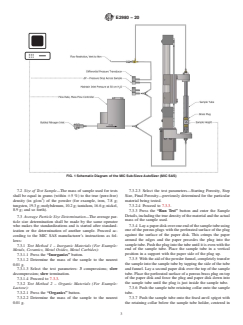
a supply of paper disks. See schematic diagram in Fig. 1.
The sole source of supply of the MIC Sub-Sieve AutoSizer (MIC SAS) (latest version called MIC SAS II) known to the committee is Micromeritics Instrument
Corporation, Particulate Systems, 4356 Communications Drive, Norcross, GA 30093-2901, USA. If you are aware of alternative suppliers, please provide this information
to ASTM International Headquarters. Your comments will receive careful consideration at a meeting of the responsible technical committee, which you may attend.
E2980 − 20
FIG. 1 Schematic Diagram of the MIC Sub-Sieve AutoSizer (MIC SAS)
NOTE 1—When homing the piston, adjust the sample packing assembly (1) as described in the manufacturer’s directions, with the plugs and paper disks
stacked together and placed on the fixed anvil spigot, or (2) using a specially designed baseline (homing) gauge instead of the plugs and paper disks. This
baseline gauge shall have a height of 20.30 6 0.10 mm. Check all plug heights when new plugs are purchased and periodically thereafter to make sure
all are equal in height.
5.2 Powder funnel, stainless steel, with spout outside diameter slightly smaller than the sample tube inside diameter.
5.3 The manufacturer provides instructions which should be followed. Particular attention should be given to proper maintenance
of the instrument with special reference to the instructions on (1) “homing” the piston when turning on from an unpowered state,
(2) setting the pressure and periodic checking of the pressure, (3) condition of O-rings on the piston and sample spigot, and (4)
the sample packing assembly (plugs and paper disks).
5.4 Balance, having a capacity of at least 50 g and a sensitivity of 0.001 g.
6. Standardization of Apparatus
6.1 Before proceeding with standardization of the MIC SAS instrument, the following items shall be checked:
6.1.1 The sample tube and plugs shall not be worn to the point where results are affected.
6.1.2 Inspect the O-ring seals for tears and abrasion marks. The O-ring seals shall not be worn to the point where the sample tube
moves easily by hand or the pressure reading varies as the sample tube is moved.
6.1.3 The drying agent shall be in proper condition.
E2980 − 20
6.2 Whenever the instrument is turned on from an unpowered state, the piston shall be “homed” according to the manufacturer’s
instructions. See Note 1 above.
6.3 Before running the initial sample, the pressure shall be set to 50.0 (+0.1, –0.5) cm H O,
...