

ASTM E11-22
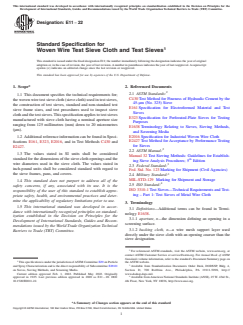
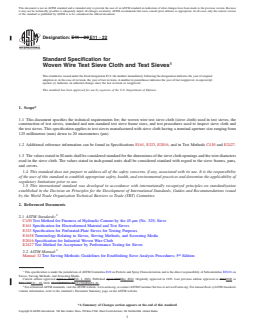
(Specification)Standard Specification for Woven Wire Test Sieve Cloth and Test Sieves
General Information
- Abstract
ABSTRACT
Standard ASTM E11 was completely revised with the -09 revision, and further in subsequent years to apply tolerances in conformance with truncated Gaussian normal distribution statistics. It covers the requirements for the sieve cloth itself, and for the design and construction of test sieves that use sieve cloth as a particle sizing medium to classify materials. This specification incorporates a maximum standard deviation value (where applicable) for the sieve cloth and for the Test Sieves. The maximum standard deviation values in Table 1 have been corrected by a K factor so as to increase the confidence level of the sieve cloth and the Test Sieve. Three (3) different inspection confidence levels are applied for Compliance, Inspection and Calibration Test Sieves; with Calibration Test Sieves having at least twice as many openings measured as Inspection Sieves. Similar to previous ASTM E11 revisions the specification covers the Test Sieve and its construction; standard frame sizes, non-standard frames, dimensional information, characteristics of the sieve frame, materials of construction for the sieve frame, attachment of the sieve cloth to the sieve frame, and specifies how test sieves should be labeled. Lastly, the specification Annex discusses in detail the proper procedure for inspection of the sieve cloth and the test sieve, to ensure that it complies with the requirements as shown in Table 1 of the specification.
SCOPE
1.1 This document specifies the technical requirements for; the woven wire test sieve cloth (sieve cloth) used in test sieves, the construction of test sieves, standard and non-standard test sieve frame sizes, and test procedures used to inspect sieve cloth and the test sieves. This specification applies to test sieves manufactured with sieve cloth having a nominal aperture size ranging from 125 millimetres (mm) down to 20 micrometres (μm).
1.2 Additional reference information can be found in Specifications E161, E323, E2016, and in Test Methods C430 and E2427.
1.3 The values stated in SI units shall be considered standard for the dimensions of the sieve cloth openings and the wire diameters used in the sieve cloth. The values stated in inch-pound units shall be considered standard with regard to the sieve frames, pans, and covers.
1.4 This standard does not purport to address all of the safety concerns, if any, associated with its use. It is the responsibility of the user of this standard to establish appropriate safety, health, and environmental practices and determine the applicability of regulatory limitations prior to use.
1.5 This international standard was developed in accordance with internationally recognized principles on standardization established in the Decision on Principles for the Development of International Standards, Guides and Recommendations issued by the World Trade Organization Technical Barriers to Trade (TBT) Committee.
- Status
- Published
- Publication Date
- 31-Jan-2022
- Technical Committee
- E29 - Particle and Spray Characterization
- Drafting Committee
- E29.01 - Sieves, Sieving Methods, and Screening Media
Buy Documents
ASTM E11-22 - Standard Specification for Woven Wire Test Sieve Cloth and Test Sieves
REDLINE ASTM E11-22 - Standard Specification for Woven Wire Test Sieve Cloth and Test Sieves
Overview
ASTM E11-22: Standard Specification for Woven Wire Test Sieve Cloth and Test Sieves establishes the technical requirements for woven wire sieve cloth and the construction of test sieves used for particle size analysis in a variety of industries. Developed and maintained by ASTM International, this standard applies to test sieves made using sieve cloth with nominal aperture sizes ranging from 125 millimetres (mm) down to 20 micrometres (μm). ASTM E11-22 is widely referenced for the reliable classification of materials by particle size using woven wire sieves, ensuring repeatable and consistent results in laboratory and industrial applications.
Key Topics
Sieve Cloth Requirements: Specifies material (stainless steel, brass, or bronze), weaving types (plain weave for ≥75 μm; twill weave permitted for ≤71 μm), dimensional tolerances, absence of coating, and defect criteria for sieve cloth used in test sieves.
Test Sieve Construction: Details standardized and non-standard frame sizes, allowed materials (typically brass or stainless steel for corrosion resistance), construction methods to maintain rigidity and avoid material catch points, and guidelines for attaching the sieve cloth.
Dimensional Tolerances and Measurement: Outlines permissible variations for average opening size, maximum opening, and wire diameter. Establishes the procedure for measuring sieve openings and wire diameters and defines quality levels (Compliance, Inspection, Calibration) based on confidence in measurement through truncated Gaussian distribution statistics.
Inspection and Certification:
- Compliance Sieves: Inspected before assembly; basic conformance.
- Inspection Sieves: Inspected after assembly with a required number of measured apertures; accompanied by a detailed certificate.
- Calibration Sieves: Most rigorous, with at least twice the number of apertures measured compared to inspection sieves; supplied with comprehensive certification.
Test Sieve Labeling: Specifies labeling requirements including reference to ASTM E11, manufacturer, sieve designation, and a unique serial number for traceability.
Applications
ASTM E11-22 is essential for industries involved in:
- Quality control laboratories conducting sieve analysis for particle size distribution
- Pharmaceutical manufacturing, where precise particle sizing impacts product quality
- Construction materials testing, such as determining aggregate gradation in concrete and asphalt
- Food and beverage industry analyzing powders and granular products
- Mining, metallurgy, and chemicals where raw material sizing is critical for processing
By providing clear requirements for the use, inspection, and documentation of woven wire test sieves, the standard ensures reliable, reproducible, and internationally recognized particle size analysis results. This enhances comparability across laboratories and compliance with regulatory or customer specifications.
Related Standards
ASTM E11-22 references and complements several other standards relevant to particle size analysis and test sieve specifications, including:
- ASTM E161: Specification for Electroformed Material and Test Sieves
- ASTM E323: Specification for Perforated-Plate Sieves for Testing Purposes
- ASTM E2016: Specification for Industrial Woven Wire Cloth
- ASTM C430: Test Method for Fineness of Hydraulic Cement by the 45-μm (No. 325) Sieve
- ASTM E2427: Test Method for Acceptance by Performance Testing for Sieves
- ISO 3310-1: Test Sieves-Technical Requirements and Testing – Part 1: Metal Wire Cloth Sieves
Practical Value
Adhering to ASTM E11-22 allows laboratories and manufacturers to:
- Ensure test sieves meet rigorous dimensional and performance specifications
- Achieve consistent and accurate particle size analysis
- Comply with international and industry-specific requirements
- Facilitate traceable and auditable test procedures
- Reduce material variability and improve product quality through standardized testing practices
Keywords: ASTM E11-22, woven wire test sieve cloth, test sieves, particle size analysis, sieve certification, inspection sieve, calibration sieve, quality assurance, laboratory standards, aperture size, sieve construction
Relations
- Effective Date
- 01-Dec-2017
- Effective Date
- 01-Nov-2015
- Effective Date
- 01-Oct-2015
- Effective Date
- 01-Nov-2013
- Effective Date
- 01-Jun-2013
- Effective Date
- 15-May-2012
- Effective Date
- 01-Apr-2012
- Refers
ASTM E1638-11a - Standard Terminology Relating to Sieves, Sieving Methods, and Screening Media - Effective Date
- 15-Nov-2011
- Effective Date
- 15-Nov-2011
- Effective Date
- 15-Nov-2011
- Effective Date
- 01-Oct-2011
- Effective Date
- 01-May-2011
- Effective Date
- 01-Dec-2010
- Effective Date
- 01-May-2010
- Effective Date
- 01-Nov-2009
Buy Documents
ASTM E11-22 - Standard Specification for Woven Wire Test Sieve Cloth and Test Sieves
REDLINE ASTM E11-22 - Standard Specification for Woven Wire Test Sieve Cloth and Test Sieves
Get Certified
Connect with accredited certification bodies for this standard

IMP NDT d.o.o.
Non-destructive testing services. Radiography, ultrasonic, magnetic particle, penetrant, visual inspection.
Inštitut za kovinske materiale in tehnologije
Institute of Metals and Technology. Materials testing, metallurgical analysis, NDT.
Q Techna d.o.o.
NDT and quality assurance specialist. 30+ years experience. NDT personnel certification per ISO 9712, nuclear and thermal power plant inspections, QA/
Sponsored listings
Frequently Asked Questions
ASTM E11-22 is a technical specification published by ASTM International. Its full title is "Standard Specification for Woven Wire Test Sieve Cloth and Test Sieves". This standard covers: ABSTRACT Standard ASTM E11 was completely revised with the -09 revision, and further in subsequent years to apply tolerances in conformance with truncated Gaussian normal distribution statistics. It covers the requirements for the sieve cloth itself, and for the design and construction of test sieves that use sieve cloth as a particle sizing medium to classify materials. This specification incorporates a maximum standard deviation value (where applicable) for the sieve cloth and for the Test Sieves. The maximum standard deviation values in Table 1 have been corrected by a K factor so as to increase the confidence level of the sieve cloth and the Test Sieve. Three (3) different inspection confidence levels are applied for Compliance, Inspection and Calibration Test Sieves; with Calibration Test Sieves having at least twice as many openings measured as Inspection Sieves. Similar to previous ASTM E11 revisions the specification covers the Test Sieve and its construction; standard frame sizes, non-standard frames, dimensional information, characteristics of the sieve frame, materials of construction for the sieve frame, attachment of the sieve cloth to the sieve frame, and specifies how test sieves should be labeled. Lastly, the specification Annex discusses in detail the proper procedure for inspection of the sieve cloth and the test sieve, to ensure that it complies with the requirements as shown in Table 1 of the specification. SCOPE 1.1 This document specifies the technical requirements for; the woven wire test sieve cloth (sieve cloth) used in test sieves, the construction of test sieves, standard and non-standard test sieve frame sizes, and test procedures used to inspect sieve cloth and the test sieves. This specification applies to test sieves manufactured with sieve cloth having a nominal aperture size ranging from 125 millimetres (mm) down to 20 micrometres (μm). 1.2 Additional reference information can be found in Specifications E161, E323, E2016, and in Test Methods C430 and E2427. 1.3 The values stated in SI units shall be considered standard for the dimensions of the sieve cloth openings and the wire diameters used in the sieve cloth. The values stated in inch-pound units shall be considered standard with regard to the sieve frames, pans, and covers. 1.4 This standard does not purport to address all of the safety concerns, if any, associated with its use. It is the responsibility of the user of this standard to establish appropriate safety, health, and environmental practices and determine the applicability of regulatory limitations prior to use. 1.5 This international standard was developed in accordance with internationally recognized principles on standardization established in the Decision on Principles for the Development of International Standards, Guides and Recommendations issued by the World Trade Organization Technical Barriers to Trade (TBT) Committee.
ABSTRACT Standard ASTM E11 was completely revised with the -09 revision, and further in subsequent years to apply tolerances in conformance with truncated Gaussian normal distribution statistics. It covers the requirements for the sieve cloth itself, and for the design and construction of test sieves that use sieve cloth as a particle sizing medium to classify materials. This specification incorporates a maximum standard deviation value (where applicable) for the sieve cloth and for the Test Sieves. The maximum standard deviation values in Table 1 have been corrected by a K factor so as to increase the confidence level of the sieve cloth and the Test Sieve. Three (3) different inspection confidence levels are applied for Compliance, Inspection and Calibration Test Sieves; with Calibration Test Sieves having at least twice as many openings measured as Inspection Sieves. Similar to previous ASTM E11 revisions the specification covers the Test Sieve and its construction; standard frame sizes, non-standard frames, dimensional information, characteristics of the sieve frame, materials of construction for the sieve frame, attachment of the sieve cloth to the sieve frame, and specifies how test sieves should be labeled. Lastly, the specification Annex discusses in detail the proper procedure for inspection of the sieve cloth and the test sieve, to ensure that it complies with the requirements as shown in Table 1 of the specification. SCOPE 1.1 This document specifies the technical requirements for; the woven wire test sieve cloth (sieve cloth) used in test sieves, the construction of test sieves, standard and non-standard test sieve frame sizes, and test procedures used to inspect sieve cloth and the test sieves. This specification applies to test sieves manufactured with sieve cloth having a nominal aperture size ranging from 125 millimetres (mm) down to 20 micrometres (μm). 1.2 Additional reference information can be found in Specifications E161, E323, E2016, and in Test Methods C430 and E2427. 1.3 The values stated in SI units shall be considered standard for the dimensions of the sieve cloth openings and the wire diameters used in the sieve cloth. The values stated in inch-pound units shall be considered standard with regard to the sieve frames, pans, and covers. 1.4 This standard does not purport to address all of the safety concerns, if any, associated with its use. It is the responsibility of the user of this standard to establish appropriate safety, health, and environmental practices and determine the applicability of regulatory limitations prior to use. 1.5 This international standard was developed in accordance with internationally recognized principles on standardization established in the Decision on Principles for the Development of International Standards, Guides and Recommendations issued by the World Trade Organization Technical Barriers to Trade (TBT) Committee.
ASTM E11-22 is classified under the following ICS (International Classification for Standards) categories: 19.120 - Particle size analysis. Sieving. The ICS classification helps identify the subject area and facilitates finding related standards.
ASTM E11-22 has the following relationships with other standards: It is inter standard links to ASTM C430-17, ASTM E2016-15, ASTM C430-08(2015), ASTM E2427-13, ASTM E1638-13, ASTM E1638-12, ASTM E161-12, ASTM E1638-11a, ASTM E323-11, ASTM E2016-11, ASTM E2427-11, ASTM E1638-11, ASTM E1638-10, ASTM E161-00(2010), ASTM E323-09. Understanding these relationships helps ensure you are using the most current and applicable version of the standard.
ASTM E11-22 is available in PDF format for immediate download after purchase. The document can be added to your cart and obtained through the secure checkout process. Digital delivery ensures instant access to the complete standard document.
Standards Content (Sample)
This international standard was developed in accordance with internationally recognized principles on standardization established in the Decision on Principles for the
Development of International Standards, Guides and Recommendations issued by the World Trade Organization Technical Barriers to Trade (TBT) Committee.
Designation:E11 −22
Standard Specification for
Woven Wire Test Sieve Cloth and Test Sieves
This standard is issued under the fixed designation E11; the number immediately following the designation indicates the year of original
adoption or, in the case of revision, the year of last revision.Anumber in parentheses indicates the year of last reapproval.Asuperscript
epsilon (´) indicates an editorial change since the last revision or reapproval.
This standard has been approved for use by agencies of the U.S. Department of Defense.
1. Scope* 2. Referenced Documents
2.1 ASTM Standards:
1.1 This document specifies the technical requirements for;
C430 Test Method for Fineness of Hydraulic Cement by the
the woven wire test sieve cloth (sieve cloth) used in test sieves,
45-µm (No. 325) Sieve
the construction of test sieves, standard and non-standard test
E161 Specification for Electroformed Material and Test
sieve frame sizes, and test procedures used to inspect sieve
Sieves
clothandthetestsieves.Thisspecificationappliestotestsieves
E323 Specification for Perforated-Plate Sieves for Testing
manufactured with sieve cloth having a nominal aperture size
Purposes
ranging from 125 millimetres (mm) down to 20 micrometres
E1638 Terminology Relating to Sieves, Sieving Methods,
(µm).
and Screening Media
E2016 Specification for Industrial Woven Wire Cloth
1.2 Additional reference information can be found in Speci-
E2427 Test Method for Acceptance by Performance Testing
fications E161, E323, E2016, and in Test Methods C430 and
for Sieves
E2427.
2.2 ASTM Manual:
1.3 The values stated in SI units shall be considered
Manual 32 Test Sieving Methods: Guidelines for Establish-
th
standard for the dimensions of the sieve cloth openings and the
ing Sieve Analysis Procedures; 5 Edition
wire diameters used in the sieve cloth. The values stated in
2.3 Federal Standard:
inch-pound units shall be considered standard with regard to
Fed. Std. No. 123 Marking for Shipment (Civil Agencies)
the sieve frames, pans, and covers.
2.4 Military Standard:
MIL-STD-129 Marking for Shipment and Storage
1.4 This standard does not purport to address all of the
2.5 ISO Standard:
safety concerns, if any, associated with its use. It is the
ISO 3310-1 Test Sieves—Technical Requirements and Test-
responsibility of the user of this standard to establish appro-
ing – Part 1: Test Sieves of Metal Wire Cloth
priate safety, health, and environmental practices and deter-
mine the applicability of regulatory limitations prior to use.
3. Terminology
1.5 This international standard was developed in accor-
3.1 Definitions—Additional terms can be found in Termi-
dance with internationally recognized principles on standard-
nology E1638.
ization established in the Decision on Principles for the
3.1.1 aperture, n—the dimension defining an opening in a
Development of International Standards, Guides and Recom-
screening surface.
mendations issued by the World Trade Organization Technical
3.1.2 backing cloth, n—a wire mesh support layer used
Barriers to Trade (TBT) Committee.
directly under the sieve cloth with an opening coarser than the
sieve designation.
For referenced ASTM standards, visit the ASTM website, www.astm.org, or
contact ASTM Customer Service at service@astm.org. For Annual Book of ASTM
Standards volume information, refer to the standard’s Document Summary page on
ThisspecificationisunderthejurisdictionofASTMCommitteeE29onParticle the ASTM website.
and Spray Characterization and is the direct responsibility of Subcommittee E29.01 Available from Standardization Documents Order Desk, DODSSP, Bldg. 4,
on Sieves, Sieving Methods, and Screening Media. Section D, 700 Robbins Ave., Philadelphia, PA 19111-5098, http://
Current edition approved Feb. 1, 2022. Published May 2022. Originally www.dodssp.daps.mil.
approved in 1925. Last previous edition approved in 2020 as E11 – 20. DOI: Available fromAmerican National Standards Institute (ANSI), 25 W. 43rd St.,
10.1520/E0011-22. 4th Floor, New York, NY 10036, http://www.ansi.org.
*A Summary of Changes section appears at the end of this standard
Copyright © ASTM International, 100 Barr Harbor Drive, PO Box C700, West Conshohocken, PA 19428-2959. United States
E11−22
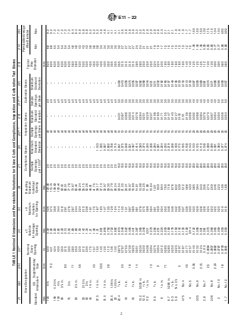
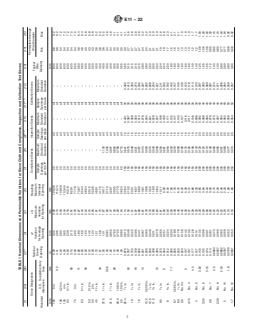
TABLE 1 Nominal Dimensions and Permissible Variations for Sieve Cloth and Compliance, Inspection and Calibration Test Sieves
A B, C B, C
(1) (2a) (2b) (3) (4) (5) (6) (7) (8) (9) (10) (11) (12) (13) (14) (15)
Permissible Average
Sieve Designation Compliance Sieves Inspection Sieves Calibration Sieves
±Y +X Resulting
Wire Diameter
Nominal Typical
Variation Maximum Maximum
Sieve Wire
Sample Maximum Sample Maximum Sample Maximum
for Average Variation Individual
U.S. Supplementary
Opening Diameter
Standard Openings Standard Openings Standard Openings Standard Min Max
Opening for Opening Opening
Alternative Size
per 100 ft Deviation per Sieve Deviation per Sieve Deviation
mm mm in. mm mm mm mm
125 5 in. 5.00 3.30 4.06 129.06 20 – all – all – 8.00 6.8 9.2
112 4.41 2.96 3.74 115.74 20 – all – all – 8.00 6.8 9.2
106 4.24 in. 4.24 2.80 3.59 109.59 20 – all – all – 6.30 5.4 7.2
100 4 in. 4.00 2.65 3.44 103.44 20 – all – all – 6.30 5.4 7.2
90 3 ⁄2 in. 3.50 2.39 3.18 93.18 20 – all – all – 6.30 5.4 7.2
80 3.15 2.13 2.91 82.91 20 – all – all – 6.30 5.4 7.2
75 3 in. 3.00 2.00 2.78 77.78 20 – all – all – 6.30 5.4 7.2
71 2.80 1.89 2.67 73.67 20 – all – all – 5.60 4.8 6.4
63 2 ⁄2 in. 2.50 1.69 2.44 65.44 20 – all – all – 5.60 4.8 6.4
56 2.20 1.50 2.24 58.24 20 – all – all – 5.00 4.3 5.8
53 2.12 in. 2.12 1.42 2.15 55.15 20 – all – all – 5.00 4.3 5.8
50 2 in. 2.00 1.34 2.06 52.06 20 – all – all – 5.00 4.3 5.8
45 1 ⁄4 in. 1.75 1.21 1.91 46.91 20 – all – all – 4.50 3.8 5.2
40 1.57 1.08 1.75 41.75 20 – all – all – 4.50 3.8 5.2
37.5 1 ⁄2 in. 1.50 1.01 1.67 39.17 20 1.103 all – all – 4.50 3.8 5.2
35.5 1.40 0.961 1.60 37.10 20 1.035 all – all – 4.00 3.4 4.6
31.5 1 ⁄4 in. 1.25 0.855 1.47 32.97 20 0.907 all – all – 4.00 3.4 4.6
28 1.10 0.762 1.35 29.35 20 0.802 all – all – 3.55 3.0 4.1
26.5 1.06 in. 1.06 0.722 1.29 27.79 20 0.758 all – all – 3.55 3.0 4.1
25 1.00 in. 1.00 0.682 1.24 26.24 20 0.715 all – all – 3.55 3.0 4.1
22.4 ⁄8 in. 0.875 0.613 1.14 23.54 150 0.641 15 0.431 30 0.460 3.55 3.0 4.1
20 0.787 0.548 1.05 21.05 150 0.575 15 0.387 30 0.413 3.15 2.7 3.6
19 ⁄4 in. 0.750 0.522 1.01 20.01 150 0.548 15 0.368 30 0.393 3.15 2.7 3.6
18 0.709 0.495 0.97 18.97 150 0.521 15 0.350 30 0.374 3.15 2.7 3.6
16 ⁄8 in. 0.625 0.441 0.89 16.89 150 0.467 15 0.314 30 0.335 3.15 2.7 3.6
14 0.551 0.387 0.81 14.81 150 0.414 15 0.278 30 0.297 2.80 2.4 3.2
13.2 0.530 in. 0.530 0.365 0.78 13.98 150 0.393 15 0.264 30 0.282 2.80 2.4 3.2
12.5 ⁄2 in. 0.500 0.346 0.75 13.25 150 0.374 15 0.251 30 0.268 2.50 2.1 2.9
11.2 ⁄16 in. 0.438 0.311 0.69 11.89 150 0.340 15 0.229 30 0.244 2.50 2.1 2.9
10 0.394 0.279 0.64 10.64 150 0.308 15 0.207 30 0.221 2.50 2.1 2.9
9.5 ⁄8 in. 0.375 0.265 0.61 10.11 150 0.294 15 0.198 30 0.211 2.24 1.9 2.6
9 0.354 0.251 0.59 9.59 150 0.281 15 0.189 30 0.202 2.24 1.9 2.6
8 ⁄16 in. 0.312 0.224 0.54 8.54 150 0.254 15 0.171 30 0.182 2.00 1.7 2.3
7.1 0.280 0.200 0.50 7.60 150 0.230 15 0.155 30 0.165 1.80 1.5 2.1
6.7 0.265 in. 0.265 0.189 0.48 7.18 150 0.219 15 0.147 30 0.157 1.80 1.5 2.1
6.3 ⁄4 in. 0.250 0.178 0.46 6.76 150 0.208 15 0.140 30 0.149 1.80 1.5 2.1
5.6 No. 3 ⁄2 0.223 0.159 0.42 6.02 150 0.189 15 0.127 30 0.136 1.60 1.3 1.9
5 0.197 0.142 0.39 5.39 150 0.172 15 0.116 30 0.123 1.60 1.3 1.9
4.75 No. 4 0.187 0.135 0.37 5.12 150 0.165 15 0.111 30 0.118 1.60 1.3 1.9
4.5 0.177 0.128 0.36 4.86 150 0.158 15 0.106 30 0.113 1.40 1.2 1.7
4 No. 5 0.157 0.114 0.33 4.33 150 0.143 15 0.096 30 0.103 1.40 1.2 1.7
3.55 0.140 0.102 0.30 3.85 200 0.130 20 0.092 40 0.097 1.25 1.06 1.50
3.35 No. 6 0.132 0.096 0.29 3.64 200 0.125 20 0.088 40 0.093 1.25 1.06 1.50
3.15 0.124 0.091 0.28 3.43 200 0.119 20 0.084 40 0.089 1.25 1.06 1.50
2.8 No. 7 0.110 0.081 0.26 3.06 200 0.108 20 0.076 40 0.081 1.12 0.95 1.30
2.5 0.0984 0.073 0.24 2.74 200 0.099 20 0.070 40 0.074 1.00 0.85 1.15
2.36 No. 8 0.0937 0.069 0.23 2.59 200 0.095 20 0.067 40 0.071 1.00 0.85 1.15
2.24 0.0882 0.065 0.22 2.46 200 0.091 20 0.064 40 0.068 0.90 0.77 1.04
2 No. 10 0.0787 0.059 0.20 2.20 250 0.083 25 0.060 50 0.064 0.90 0.77 1.04
1.8 0.0709 0.053 0.19 1.99 250 0.077 25 0.056 50 0.059 0.80 0.68 0.92
1.7 No. 12 0.0661 0.050 0.18 1.88 250 0.074 25 0.054 50 0.057 0.80 0.68 0.92
E11−22
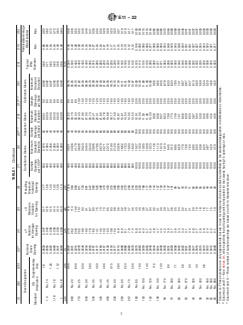
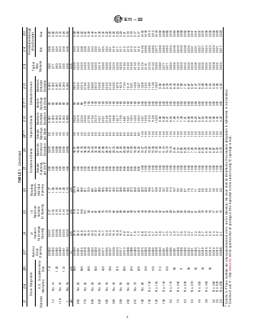
TABLE1 Continued
A B, C B, C
(1) (2a) (2b) (3) (4) (5) (6) (7) (8) (9) (10) (11) (12) (13) (14) (15)
Permissible Average
Sieve Designation Compliance Sieves Inspection Sieves Calibration Sieves
±Y +X Resulting
Wire Diameter
Nominal Typical
Variation Maximum Maximum
Sieve Wire
Sample Maximum Sample Maximum Sample Maximum
for Average Variation Individual
U.S. Supplementary
Opening Diameter
Standard Openings Standard Openings Standard Openings Standard Min Max
Opening for Opening Opening
Alternative Size
per 100 ft Deviation per Sieve Deviation per Sieve Deviation
1.6 0.0630 0.047 0.17 1.77 250 0.070 25 0.051 50 0.054 0.80 0.68 0.92
1.4 No. 14 0.0555 0.042 0.16 1.56 400 0.064 40 0.050 80 0.052 0.71 0.60 0.82
1.25 0.0492 0.038 0.15 1.40 400 0.058 40 0.045 80 0.047 0.63 0.54 0.72
1.18 No. 16 0.0469 0.036 0.14 1.32 400 0.056 40 0.043 80 0.045 0.63 0.54 0.72
1.12 0.0441 0.034 0.14 1.26 400 0.054 40 0.042 80 0.044 0.56 0.48 0.64
1 No. 18 0.0394 0.030 0.13 1.13 400 0.050 40 0.039 80 0.040 0.56 0.48 0.64
µm µm in. µm µm µm mm
900 0.0354 27.6 118 1018 400 45.51 40 35.22 80 36.74 0.500 0.43 0.58
850 No. 20 0.0331 26.2 114 964 400 43.66 40 33.79 80 35.25 0.500 0.43 0.58
800 0.0315 24.8 109 909 400 41.79 40 32.34 80 33.74 0.450 0.38 0.52
710 No. 25 0.0278 22.2 101 811 500 38.36 50 30.43 100 31.62 0.450 0.38 0.52
630 0.0248 19.9 93 723 500 35.23 50 27.95 100 29.04 0.400 0.34 0.46
600 No. 30 0.0234 19.0 91 691 500 34.04 50 27.00 100 28.06 0.400 0.34 0.46
560 0.0220 17.9 87 647 500 32.43 50 25.73 100 26.73 0.355 0.30 0.41
500 No. 35 0.0197 16.2 80 580 600 29.96 60 24.21 120 25.09 0.315 0.27 0.36
450 0.0177 14.7 75 525 600 27.86 60 22.51 120 23.32 0.280 0.24 0.32
425 No. 40 0.0165 14.0 73 498 600 26.79 60 21.65 120 22.43 0.280 0.24 0.32
400 0.0157 13.3 70 470 600 25.71 60 20.78 120 21.52 0.250 0.21 0.29
355 No. 45 0.0139 12.0 65 420 800 23.72 80 19.68 160 20.30 0.224 0.19 0.26
315 0.0124 10.8 60 375 800 21.90 80 18.17 160 18.75 0.200 0.17 0.23
300 No. 50 0.0117 10.4 58 358 800 21.20 80 17.59 160 18.15 0.200 0.17 0.23
280 0.0110 9.8 56 336 800 20.26 80 16.81 160 17.34 0.180 0.15 0.21
250 No. 60 0.0098 8.9 52 302 800 18.82 80 15.61 160 16.11 0.160 0.13 0.19
224 0.0088 8.1 49 273 800 17.53 80 14.54 160 15.01 0.160 0.13 0.19
212 No. 70 0.0083 7.8 47 259 800 16.93 80 14.05 160 14.49 0.140 0.12 0.17
200 0.0079 7.4 45 245 800 16.32 80 13.54 160 13.97 0.140 0.12 0.17
180 No. 80 0.0070 6.8 43 223 1000 15.27 100 12.91 200 13.28 0.125 0.106 0.150
160 0.0063 6.3 40 200 1000 14.20 100 12.00 200 12.34 0.112 0.095 0.130
150 No. 100 0.0059 6.0 38 188 1000 13.65 100 11.53 200 11.86 0.100 0.085 0.115
140 0.0055 5.7 37 177 1000 13.09 100 11.06 200 11.38 0.100 0.085 0.115
125 No. 120 0.0049 5.2 34 159 1000 12.23 100 10.33 200 10.63 0.090 0.077 0.104
112 0.0044 4.8 32 144 1000 11.46 100 9.68 200 9.96 0.080 0.068 0.092
106 No. 140 0.0041 4.7 31 137 1000 11.10 100 9.38 200 9.65 0.071 0.060 0.082
100 0.0039 4.5 30 130 1000 10.73 100 9.07 200 9.33 0.071 0.060 0.082
90 No. 170 0.0035 4.2 29 119 1000 10.10 100 8.53 200 8.78 0.063 0.054 0.072
80 0.0031 3.9 27 107 1000 9.45 100 7.99 250 8.33 0.056 0.048 0.064
75 No. 200 0.0029 3.7 26 101 1000 9.12 100 7.70 250 8.04 0.050 0.043 0.058
71 0.0028 3.6 25 96 1000 8.85 100 7.48 250 7.80 0.050 0.043 0.058
63 No. 230 0.0025 3.4 24 87 1000 8.29 100 7.01 250 7.31 0.045 0.038 0.052
56 0.0022 3.2 22 78 1000 7.79 100 6.58 250 6.87 0.040 0.034 0.046
53 No. 270 0.0021 3.1 21 74 1000 7.56 100 6.39 250 6.67 0.036 0.031 0.041
50 0.0020 3.0 21 71 1000 7.34 100 6.20 250 6.47 0.036 0.031 0.041
45 No. 325 0.0017 2.8 20 65 1000 6.95 100 5.87 250 6.13 0.032 0.027 0.037
40 0.0016 2.7 19 59 1000 6.55 100 5.54 300 5.83 0.032 0.027 0.037
38 No. 400 0.0015 2.6 18 56 1000 6.38 100 5.39 300 5.69 0.030 0.024 0.035
36 0.0014 2.6 18 54 1000 6.22 100 5.26 300 5.54 0.030 0.024 0.035
32 No. 450 0.0012 2.4 17 49 1000 5.87 100 4.96 300 5.23 0.028 0.023 0.033
25 No. 500 0.0010 2.2 15 40 1000 5.23 100 4.42 300 4.66 0.025 0.021 0.029
20 No. 635 0.0008 2.1 13 33 1000 4.73 100 4.00 300 4.22 0.020 0.017 0.023
A
Column 3—These numbers are only approximate but are in use for reference; the sieve shall be identified by the standard designation in millimetres or micrometres.
B
Columns 9 and 11—See Annex A1, which specifies that all openings will be inspected for test sieves having 15 openings or less.
C
Columns 9 and 11—These number of sample openings are based on an 8-in. diameter test sieve.
E11−22
3.1.3 crimp, n—the corrugation in the warp and shute wire, 3.1.11 twill weave, n—sieve cloth in which the warp wires
or both. The crimp in the wires is formed either during the and shute wires pass over two and under two wires in both
directions.
weavingprocess,orwithacrimpingmachinepriortoweaving.
If formed during the weaving process, the tension existing
3.1.12 warp wires, n—the wires running the long way of the
between the warp and shute wires fundamentally determines
cloth as woven.
the respective amount or depth of crimp, which locks the wires
in place, and in part establishes the firmness of the sieve cloth.
4. Ordering Information
3.1.4 firmness, n—a subjective term referring to the planar 4.1 Orders for items under this specification should include
rigidity of sieve cloth (as a roll good, not mounted in a test
the following information as required:
sieveframe),establishedbythetensilestrengthofthematerial, 4.1.1 Description of item(s) (Test Sieve or Sieve Cloth),
the relationship of the mesh to wire diameters, the type of 4.1.2 ASTM E11 designation and year of issue,
weave, and amount of crimp in the wires. The absence of 4.1.3 Quantity of each item, and
4.1.4 Sieve designation (
firmness in sieve cloth is termed sleaziness. Table 1, Standard Column 1, Al-
ternate Column 2).
3.1.5 matched test sieve, n—a test sieve that reproduces the
4.1.4.1 Test sieves can be supplied based on different levels
performance results of another test sieve within user defined
of confidence as Compliance Sieves, Inspection Sieves, and
limits for a designated material (for information only and may
Calibration Sieves.
not be in compliance with this specification).
4.2 Test sieves in standard circular or nonstandard frame:
3.1.6 mesh, n—the number of wires or openings per linear
4.2.1 Nominal sieve frame diameter (see Table 2) or dimen-
inch (25.4 mm) counted from the center of any wire to a point
sional description of nonstandard test sieve frame, and
exactly 1 in. (25.4 mm) distant, including the fractional
4.2.2 Nominal sieve frame height (see Table 2).
distance between either thereof.
5. Sieve Cloth Requirements
3.1.7 plain weave, n—sieve cloth in which the warp wires
andshutewirespassoveroneandunderoneinbothdirections.
5.1 The sieve cloth used in test sieves shall meet the
requirements of Table 1 and shall be designated Specification
3.1.8 shute wires, n—the wires running the short way of, or
E11 Sieve Cloth.The number of inspected apertures shall be in
across the cloth as woven (also referred to as the shoot, fill, or
accordance with Table 1 (Column 7). Sieve cloth conforming
weft wires).
to this specification shall be woven from stainless steel, brass,
3.1.9 sieve cloth, n—woven wire cloth conforming to this
orbronze.Sieveclothwithopeningsgreaterthanorequalto75
specification.
micrometres shall be woven using a plain weave. For sieve
cloth with openings equal to or less than 71 micrometres the
3.1.10 test sieve (sieve cloth), n—an apparatus manufac-
sieve cloth may be supplied using a twill weave. The sieve
tured by mounting E11 sieve cloth in a frame, designed for use
cloth shall not be coated or plated.
in particle size analysis by sieving.
5.2 All measurements of openings and wire diameters shall
3.1.10.1 compliance test sieve, n—a test sieve manufactured
be made along the midpoints of the openings as shown in Fig.
using sieve cloth which has been inspected prior to being
1.
mounted in the sieve frame; and that meets the requirements of
Table 1 in part based on the standard deviation of the required
number of sample openings per 100 square feet of sieve cloth
(Column 7) not exceeding the maximum allowable for a
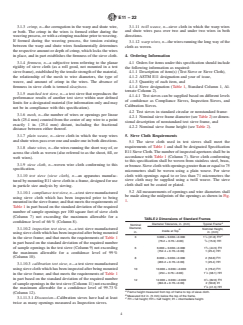
TABLE 2 Dimensions of Standard Frames
confidence level of 66 % (Column 8).
A
Diameter Tolerance, in. (mm) Typical Frame
Nominal
3.1.10.2 inspection test sieve, n—a test sieve manufactured Diameter,
Nominal Height,
B
Inside at Top
in.
in. (mm)
usingsieveclothwhichhasbeeninspectedafterbeingmounted
C
3 3.000 + 0.030 ⁄−0.000 1 ⁄4 (31.8) FH
in the sieve frame; and that meets the requirements of Table 1
(76.2 + 0.76 ⁄−0.00) ⁄8 (15.9) HH
in part based on the standard deviation of the required number
of sample openings in the test sieve (Column 9) not exceeding 6 6.000 + 0.030 ⁄−0.000 1 ⁄4 (44.5) FH
(152.4 + 0.76 ⁄−0.00) 1 (25.4) HH
the maximum allowable for a confidence level of 99 %
(Column 10).
8 8.000 + 0.030 ⁄−0.000 2 (50.8) FH
(203.2 + 0.76 ⁄−0.00) 1 (25.4) HH
3.1.10.3 calibration test sieve, n—a test sieve manufactured
usingsieveclothwhichhasbeeninspectedafterbeingmounted 10 10.000 + 0.030 ⁄−0.000 3 (76.2) FH
(254 + 0.76 ⁄−0.00) 1 ⁄2 (38.1) HH
in the sieve frame; and that meets the requirements of Table 1
in part based on the standard deviation of the required number
12 12.000 + 0.030 ⁄−0.000 3 ⁄4 (82.6) FH
(304.8 + 0.76 ⁄−0.00) 2 (50.8) IH
ofsampleopeningsinthetestsieve(Column11)notexceeding
1 ⁄8 (41.3) H
...
This document is not an ASTM standard and is intended only to provide the user of an ASTM standard an indication of what changes have been made to the previous version. Because
it may not be technically possible to adequately depict all changes accurately, ASTM recommends that users consult prior editions as appropriate. In all cases only the current version
of the standard as published by ASTM is to be considered the official document.
Designation: E11 − 20 E11 − 22
Standard Specification for
Woven Wire Test Sieve Cloth and Test Sieves
This standard is issued under the fixed designation E11; the number immediately following the designation indicates the year of original
adoption or, in the case of revision, the year of last revision. A number in parentheses indicates the year of last reapproval. A superscript
epsilon (´) indicates an editorial change since the last revision or reapproval.
This standard has been approved for use by agencies of the U.S. Department of Defense.
1. Scope*
1.1 This document specifies the technical requirements for; the woven wire test sieve cloth (sieve cloth) used in test sieves, the
construction of test sieves, standard and non-standard test sieve frame sizes, and test procedures used to inspect sieve cloth and
the test sieves. This specification applies to test sieves manufactured with sieve cloth having a nominal aperture size ranging from
125 millimetres (mm) down to 20 micrometres (μm).
1.2 Additional reference information can be found in Specifications E161, E323, E2016, and in Test Methods C430 and E2427.
1.3 The values stated in SI units shall be considered standard for the dimensions of the sieve cloth openings and the wire diameters
used in the sieve cloth. The values stated in inch-pound units shall be considered standard with regard to the sieve frames, pans,
and covers.
1.4 This standard does not purport to address all of the safety concerns, if any, associated with its use. It is the responsibility
of the user of this standard to establish appropriate safety, health, and environmental practices and determine the applicability of
regulatory limitations prior to use.
1.5 This international standard was developed in accordance with internationally recognized principles on standardization
established in the Decision on Principles for the Development of International Standards, Guides and Recommendations issued
by the World Trade Organization Technical Barriers to Trade (TBT) Committee.
2. Referenced Documents
2.1 ASTM Standards:
C430 Test Method for Fineness of Hydraulic Cement by the 45-μm (No. 325) Sieve
E161 Specification for Electroformed Material and Test Sieves
E323 Specification for Perforated-Plate Sieves for Testing Purposes
E1638 Terminology Relating to Sieves, Sieving Methods, and Screening Media
E2016 Specification for Industrial Woven Wire Cloth
E2427 Test Method for Acceptance by Performance Testing for Sieves
2.2 ASTM Manual:
th
Manual 32 Test Sieving Methods: Guidelines for Establishing Sieve Analysis Procedures; 5 Edition
This specification is under the jurisdiction of ASTM Committee E29 on Particle and Spray Characterization and is the direct responsibility of Subcommittee E29.01 on
Sieves, Sieving Methods, and Screening Media.
Current edition approved April 1, 2020Feb. 1, 2022. Published April 2020May 2022. Originally approved in 1925. Last previous edition approved in 20172020 as
E11 – 17.E11 – 20. DOI: 10.1520/E0011-20.10.1520/E0011-22.
For referenced ASTM standards, visit the ASTM website, www.astm.org, or contact ASTM Customer Service at service@astm.org. For Annual Book of ASTM Standards
volume information, refer to the standard’s Document Summary page on the ASTM website.
*A Summary of Changes section appears at the end of this standard
Copyright © ASTM International, 100 Barr Harbor Drive, PO Box C700, West Conshohocken, PA 19428-2959. United States
E11 − 22
2.3 Federal Standard:
Fed. Std. No. 123 Marking for Shipment (Civil Agencies)
2.4 Military Standard:
MIL-STD-129 Marking for Shipment and Storage
2.5 ISO Standard:
ISO 3310-1 Test Sieves—Technical Requirements and Testing – Part 1: Test Sieves of Metal Wire Cloth
3. Terminology
3.1 Definitions—Additional terms can be found in Terminology E1638.
3.1.1 aperture, n—the dimension defining an opening in a screening surface.
3.1.2 backing cloth, n—a wire mesh support layer used directly under the sieve cloth with an opening coarser than the sieve
designation.
Available from Standardization Documents Order Desk, DODSSP, Bldg. 4, Section D, 700 Robbins Ave., Philadelphia, PA 19111-5098, http://www.dodssp.daps.mil.
Available from American National Standards Institute (ANSI), 25 W. 43rd St., 4th Floor, New York, NY 10036, http://www.ansi.org.
E11 − 22
TABLE 1 Nominal Dimensions and Permissible Variations for Sieve Cloth and Compliance, Inspection and Calibration Test Sieves
A B, C B, C
(1) (2a) (2b) (3) (4) (5) (6) (7) (8) (9) (10) (11) (12) (13) (14) (15)
Permissible Average
Sieve Designation Compliance Sieves Inspection Sieves Calibration Sieves
±Y +X Resulting
Wire Diameter
Nominal Typical
Variation Maximum Maximum
Sieve Wire
Sample Maximum Sample Maximum Sample Maximum
for Average Variation Individual
U.S. Supplementary
Opening Diameter
Standard Openings Standard Openings Standard Openings Standard Min Max
Opening for Opening Opening
Alternative Size
per 100 ft Deviation per Sieve Deviation per Sieve Deviation
mm mm in. mm mm mm mm
125 5 in. 5.00 3.30 4.06 129.06 20 – all – all – 8.00 6.8 9.2
112 4.41 2.96 3.74 115.74 20 – all – all – 8.00 6.8 9.2
106 4.24 in. 4.24 2.80 3.59 109.59 20 – all – all – 6.30 5.4 7.2
100 4 in. 4.00 2.65 3.44 103.44 20 – all – all – 6.30 5.4 7.2
90 3 ⁄2 in. 3.50 2.39 3.18 93.18 20 – all – all – 6.30 5.4 7.2
80 3.15 2.13 2.91 82.91 20 – all – all – 6.30 5.4 7.2
75 3 in. 3.00 2.00 2.78 77.78 20 – all – all – 6.30 5.4 7.2
71 2.80 1.89 2.67 73.67 20 – all – all – 5.60 4.8 6.4
63 2 ⁄2 in. 2.50 1.69 2.44 65.44 20 – all – all – 5.60 4.8 6.4
56 2.20 1.50 2.24 58.24 20 – all – all – 5.00 4.3 5.8
53 2.12 in. 2.12 1.42 2.15 55.15 20 – all – all – 5.00 4.3 5.8
50 2 in. 2.00 1.34 2.06 52.06 20 – all – all – 5.00 4.3 5.8
45 1 ⁄4 in. 1.75 1.21 1.91 46.91 20 – all – all – 4.50 3.8 5.2
40 1.57 1.08 1.75 41.75 20 – all – all – 4.50 3.8 5.2
37.5 1 ⁄2 in. 1.50 1.01 1.67 39.17 20 1.103 all – all – 4.50 3.8 5.2
35.5 1.40 0.961 1.60 37.10 20 1.035 all – all – 4.00 3.4 4.6
31.5 1 ⁄4 in. 1.25 0.855 1.47 32.97 20 0.907 all – all – 4.00 3.4 4.6
28 1.10 0.762 1.35 29.35 20 0.802 all – all – 3.55 3.0 4.1
26.5 1.06 in. 1.06 0.722 1.29 27.79 20 0.758 all – all – 3.55 3.0 4.1
25 1.00 in. 1.00 0.682 1.24 26.24 20 0.715 all – all – 3.55 3.0 4.1
22.4 ⁄8 in. 0.875 0.613 1.14 23.54 150 0.641 15 0.431 30 0.460 3.55 3.0 4.1
20 0.787 0.548 1.05 21.05 150 0.575 15 0.387 30 0.413 3.15 2.7 3.6
19 ⁄4 in. 0.750 0.522 1.01 20.01 150 0.548 15 0.368 30 0.393 3.15 2.7 3.6
18 0.709 0.495 0.97 18.97 150 0.521 15 0.350 30 0.374 3.15 2.7 3.6
16 ⁄8 in. 0.625 0.441 0.89 16.89 150 0.467 15 0.314 30 0.335 3.15 2.7 3.6
14 0.551 0.387 0.81 14.81 150 0.414 15 0.278 30 0.297 2.80 2.4 3.2
13.2 0.530 in. 0.530 0.365 0.78 13.98 150 0.393 15 0.264 30 0.282 2.80 2.4 3.2
12.5 ⁄2 in. 0.500 0.346 0.75 13.25 150 0.374 15 0.251 30 0.268 2.50 2.1 2.9
11.2 ⁄16 in. 0.438 0.311 0.69 11.89 150 0.340 15 0.229 30 0.244 2.50 2.1 2.9
10 0.394 0.279 0.64 10.64 150 0.308 15 0.207 30 0.221 2.50 2.1 2.9
9.5 ⁄8 in. 0.375 0.265 0.61 10.11 150 0.294 15 0.198 30 0.211 2.24 1.9 2.6
9 0.354 0.251 0.59 9.59 150 0.281 15 0.189 30 0.202 2.24 1.9 2.6
8 ⁄16 in. 0.312 0.224 0.54 8.54 150 0.254 15 0.171 30 0.182 2.00 1.7 2.3
7.1 0.280 0.200 0.50 7.60 150 0.230 15 0.155 30 0.165 1.80 1.5 2.1
6.7 0.265 in. 0.265 0.189 0.48 7.18 150 0.219 15 0.147 30 0.157 1.80 1.5 2.1
6.3 ⁄4 in. 0.250 0.178 0.46 6.76 150 0.208 15 0.140 30 0.149 1.80 1.5 2.1
5.6 No. 3 ⁄2 0.223 0.159 0.42 6.02 150 0.189 15 0.127 30 0.136 1.60 1.3 1.9
5 0.197 0.142 0.39 5.39 150 0.172 15 0.116 30 0.123 1.60 1.3 1.9
4.75 No. 4 0.187 0.135 0.37 5.12 150 0.165 15 0.111 30 0.118 1.60 1.3 1.9
4.5 0.177 0.128 0.36 4.86 150 0.158 15 0.106 30 0.113 1.40 1.2 1.7
4 No. 5 0.157 0.114 0.33 4.33 150 0.143 15 0.096 30 0.103 1.40 1.2 1.7
3.55 0.140 0.102 0.30 3.85 200 0.130 20 0.092 40 0.097 1.25 1.06 1.50
3.35 No. 6 0.132 0.096 0.29 3.64 200 0.125 20 0.088 40 0.093 1.25 1.06 1.50
3.15 0.124 0.091 0.28 3.43 200 0.119 20 0.084 40 0.089 1.25 1.06 1.50
2.8 No. 7 0.110 0.081 0.26 3.06 200 0.108 20 0.076 40 0.081 1.12 0.95 1.30
2.5 0.0984 0.073 0.24 2.74 200 0.099 20 0.070 40 0.074 1.00 0.85 1.15
2.36 No. 8 0.0937 0.069 0.23 2.59 200 0.095 20 0.067 40 0.071 1.00 0.85 1.15
2.24 0.0882 0.065 0.22 2.46 200 0.091 20 0.064 40 0.068 0.90 0.77 1.04
2 No. 10 0.0787 0.059 0.20 2.20 250 0.083 25 0.060 50 0.064 0.90 0.77 1.04
1.8 0.0709 0.053 0.19 1.99 250 0.077 25 0.056 50 0.059 0.80 0.68 0.92
1.7 No. 12 0.0661 0.050 0.18 1.88 250 0.074 25 0.054 50 0.057 0.80 0.68 0.92
E11 − 22
TABLE 1 Continued
A B, C B, C
(1) (2a) (2b) (3) (4) (5) (6) (7) (8) (9) (10) (11) (12) (13) (14) (15)
Permissible Average
Sieve Designation Compliance Sieves Inspection Sieves Calibration Sieves
±Y +X Resulting
Wire Diameter
Nominal Typical
Variation Maximum Maximum
Sieve Wire
Sample Maximum Sample Maximum Sample Maximum
for Average Variation Individual
U.S. Supplementary
Opening Diameter
Standard Openings Standard Openings Standard Openings Standard Min Max
Opening for Opening Opening
Alternative Size
per 100 ft Deviation per Sieve Deviation per Sieve Deviation
1.6 0.0630 0.047 0.17 1.77 250 0.070 25 0.051 50 0.054 0.80 0.68 0.92
1.4 No. 14 0.0555 0.042 0.16 1.56 400 0.064 40 0.050 80 0.052 0.71 0.60 0.82
1.25 0.0492 0.038 0.15 1.40 400 0.058 40 0.045 80 0.047 0.63 0.54 0.72
1.18 No. 16 0.0469 0.036 0.14 1.32 400 0.056 40 0.043 80 0.045 0.63 0.54 0.72
1.12 0.0441 0.034 0.14 1.26 400 0.054 40 0.042 80 0.044 0.56 0.48 0.64
1 No. 18 0.0394 0.030 0.13 1.13 400 0.050 40 0.039 80 0.040 0.56 0.48 0.64
μm μm in. μm μm μm mm
900 0.0354 27.6 118 1018 400 45.51 40 35.22 80 36.74 0.500 0.43 0.58
850 No. 20 0.0331 26.2 114 964 400 43.66 40 33.79 80 35.25 0.500 0.43 0.58
800 0.0315 24.8 109 909 400 41.79 40 32.34 80 33.74 0.450 0.38 0.52
710 No. 25 0.0278 22.2 101 811 500 38.36 50 30.43 100 31.62 0.450 0.38 0.52
630 0.0248 19.9 93 723 500 35.23 50 27.95 100 29.04 0.400 0.34 0.46
600 No. 30 0.0234 19.0 91 691 500 34.04 50 27.00 100 28.06 0.400 0.34 0.46
560 0.0220 17.9 87 647 500 32.43 50 25.73 100 26.73 0.355 0.30 0.41
500 No. 35 0.0197 16.2 80 580 600 29.96 60 24.21 120 25.09 0.315 0.27 0.36
450 0.0177 14.7 75 525 600 27.86 60 22.51 120 23.32 0.280 0.24 0.32
425 No. 40 0.0165 14.0 73 498 600 26.79 60 21.65 120 22.43 0.280 0.24 0.32
400 0.0157 13.3 70 470 600 25.71 60 20.78 120 21.52 0.250 0.21 0.29
355 No. 45 0.0139 12.0 65 420 800 23.72 80 19.68 160 20.30 0.224 0.19 0.26
315 0.0124 10.8 60 375 800 21.90 80 18.17 160 18.75 0.200 0.17 0.23
300 No. 50 0.0117 10.4 58 358 800 21.20 80 17.59 160 18.15 0.200 0.17 0.23
280 0.0110 9.8 56 336 800 20.26 80 16.81 160 17.34 0.180 0.15 0.21
250 No. 60 0.0098 8.9 52 302 800 18.82 80 15.61 160 16.11 0.160 0.13 0.19
224 0.0088 8.1 49 273 800 17.53 80 14.54 160 15.01 0.160 0.13 0.19
212 No. 70 0.0083 7.8 47 259 800 16.93 80 14.05 160 14.49 0.140 0.12 0.17
200 0.0079 7.4 45 245 800 16.32 80 13.54 160 13.97 0.140 0.12 0.17
180 No. 80 0.0070 6.8 43 223 1000 15.27 100 12.91 200 13.28 0.125 0.106 0.150
160 0.0063 6.3 40 200 1000 14.20 100 12.00 200 12.34 0.112 0.095 0.130
150 No. 100 0.0059 6.0 38 188 1000 13.65 100 11.53 200 11.86 0.100 0.085 0.115
140 0.0055 5.7 37 177 1000 13.09 100 11.06 200 11.38 0.100 0.085 0.115
125 No. 120 0.0049 5.2 34 159 1000 12.23 100 10.33 200 10.63 0.090 0.077 0.104
112 0.0044 4.8 32 144 1000 11.46 100 9.68 200 9.96 0.080 0.068 0.092
106 No. 140 0.0041 4.7 31 137 1000 11.10 100 9.38 200 9.65 0.071 0.060 0.082
100 0.0039 4.5 30 130 1000 10.73 100 9.07 200 9.33 0.071 0.060 0.082
90 No. 170 0.0035 4.2 29 119 1000 10.10 100 8.53 200 8.78 0.063 0.054 0.072
80 0.0031 3.9 27 107 1000 9.45 100 7.99 250 8.33 0.056 0.048 0.064
75 No. 200 0.0029 3.7 26 101 1000 9.12 100 7.70 250 8.04 0.050 0.043 0.058
71 0.0028 3.6 25 96 1000 8.85 100 7.48 250 7.80 0.050 0.043 0.058
63 No. 230 0.0025 3.4 24 87 1000 8.29 100 7.01 250 7.31 0.045 0.038 0.052
56 0.0022 3.2 22 78 1000 7.79 100 6.58 250 6.87 0.040 0.034 0.046
53 No. 270 0.0021 3.1 21 74 1000 7.56 100 6.39 250 6.67 0.036 0.031 0.041
50 0.0020 3.0 21 71 1000 7.34 100 6.20 250 6.47 0.036 0.031 0.041
45 No. 325 0.0017 2.8 20 65 1000 6.95 100 5.87 250 6.13 0.032 0.027 0.037
40 0.0016 2.7 19 59 1000 6.55 100 5.54 300 5.83 0.032 0.027 0.037
38 No. 400 0.0015 2.6 18 56 1000 6.38 100 5.39 300 5.69 0.030 0.024 0.035
36 0.0014 2.6 18 54 1000 6.22 100 5.26 300 5.54 0.030 0.024 0.035
32 No. 450 0.0012 2.4 17 49 1000 5.87 100 4.96 300 5.23 0.028 0.023 0.033
25 No. 500 0.0010 2.2 15 40 1000 5.23 100 4.42 300 4.66 0.025 0.021 0.029
20 No. 635 0.0008 2.1 13 33 1000 4.73 100 4.00 300 4.22 0.020 0.017 0.023
A
Column 3—These numbers are only approximate but are in use for reference; the sieve shall be identified by the standard designation in millimetres or micrometres.
B
Columns 9 and 11—See Annex A1, which specifies that all openings will be inspected for test sieves having 15 openings or less.
E11 − 22
C
Columns 9 and 11—These number of sample openings are based on an 8-in. diameter test sieve.
3.1.3 crimp, n—the corrugation in the warp and shute wire, or both. The crimp in the wires is formed either during the weaving process, or with a crimping machine
prior to weaving. If formed during the weaving process, the tension existing between the warp and shute wires fundamentally determines the respective amount or depth
of crimp, which locks the wires in place, and in part establishes the firmness of the sieve cloth.
3.1.4 firmness, n—a subjective term referring to the planar rigidity of sieve cloth (as a roll good, not mounted in a test sieve frame), established by the tensile strength
of the material, the relationship of the mesh to wire diameters, the type of weave, and amount of crimp in the wires. The absence of firmness in sieve cloth is termed
sleaziness.
3.1.5 matched test sieve, n—a test sieve that reproduces the performance results of another test sieve within user defined limits for a designated material (for information
only and may not be in compliance with this specification).
3.1.6 mesh, n—the number of wires or openings per linear inch (25.4 mm) counted from the center of any wire to a point exactly 1 in. (25.4 mm) distant, including
the fractional distance between either thereof.
3.1.7 plain weave, n—sieve cloth in which the warp wires and shute wires pass over one and under one in both directions.
3.1.8 shute wires, n—the wires running the short way of, or across the cloth as woven (also referred to as the shoot, fill, or weft wires).
3.1.9 sieve, n—an apparatus for the purpose of sieving, consisting of a separating media mounted in a frame.
3.1.9 sieve cloth, n—woven wire cloth conforming to this specification.
3.1.10 test sieve (wire(sieve cloth), n—a sievean apparatus manufactured by mounting E11 sieve cloth in a frame, designed for use in particle size analysis by sieving.
3.1.10.1 compliance test sieve, n—a test sieve manufactured using sieve cloth which has been inspected prior to being mounted in the sieve frame; and that meets
the requirements of Table 1 in part based on the standard deviation of the required number of sample openings per 100 square feet of sieve cloth (Column 7) not
exceeding the maximum allowable for a confidence level of 66 % (Column 8).
3.1.10.2 inspection test sieve, n—a test sieve manufactured using sieve cloth which has been inspected after being mounted in the sieve frame; and that meets the
requirements of Table 1 in part based on the standard deviation of the required number of sample openings in the test sieve (Column 9) not exceeding the maximum
allowable for a confidence level of 99 % (Column 10).
3.1.10.3 calibration test sieve, n—a test sieve manufactured using sieve cloth which has been inspected after being mounted in the sieve frame; and that meets the
requirements of Table 1 in part based on the standard deviation of the required number of sample openings in the test sieve (Column 11) not exceeding the maximum
allowable for a confidence level of 99.73 % (Column 12).
3.1.11.3.1 Discussion—Calibration sieves have had at least twice as many openings measured as Inspection sieves.
3.1.11 twill weave, n—sieve cloth in which the warp wires and shute wires pass over two and under two wires in both directions.
3.1.12 warp wires, n—the wires running the long way of the cloth as woven.
E11 − 22
4. Ordering Information
4.1 Orders for items under this specification should include the following information as required:
4.1.1 Description of item(s) (Test Sieve or Sieve Cloth),
4.1.2 ASTM E11 designation and year of issue,
4.1.3 Quantity of each item, and
4.1.4 Sieve designation (Table 1, Standard Column 1, Alternate Column 2).
4.1.4.1 Test sieves can be supplied based on different levels of confidence as Compliance Sieves, Inspection Sieves, and
Calibration Sieves.
4.2 Test sieves in standard circular or nonstandard frame:
4.2.1 Nominal sieve frame diameter (see Table 2), ) or dimensional description of nonstandard test sieve frame, and
4.2.2 Nominal sieve frame height (see Table 2).
4.3 Description of nonstandard sieve.
5. Sieve Cloth Requirements
5.1 The sieve cloth used in test sieves shall meet the requirements of Table 1 and shall be designated Specification E11 Sieve
Cloth. The number of inspected apertures shall be in accordance with Table 1 (Column 7). Sieve cloth conforming to this
specification shall be woven from stainless steel, brass, or bronze. Sieve cloth with openings greater than or equal to 75
micrometres shall be woven using a plain weave. For sieve cloth with openings equal to or less than 71 micrometres the sieve cloth
may be supplied using a twill weave. The sieve cloth shall not be coated or plated.
5.2 All measurements of openings and wire diameters shall be made along the midpoints of the openings as shown in Fig. 1.
5.3 There shall be no punctures or obvious defects in the sieve cloth.
6. Technical Requirements
6.1 Opening Sizes, Tolerances, and Standard Deviation:
TABLE 2 Dimensions of Standard Frames
A
Diameter Tolerance, in. (mm) Typical Frame
Nominal
Diameter,
Nominal Height,
B
Inside at Top
in.
in. (mm)
C
3 3.000 + 0.030 ⁄−0.000 1 ⁄4 (31.8) FH
(76.2 + 0.76 ⁄−0.00) ⁄8 (15.9) HH
6 6.000 + 0.030 ⁄−0.000 1 ⁄4 (44.5) FH
(152.4 + 0.76 ⁄−0.00) 1 (25.4) HH
8 8.000 + 0.030 ⁄−0.000 2 (50.8) FH
(203.2 + 0.76 ⁄−0.00) 1 (25.4) HH
10 10.000 + 0.030 ⁄−0.000 3 (76.2) FH
(254 + 0.76 ⁄−0.00) 1 ⁄2 (38.1) HH
12 12.000 + 0.030 ⁄−0.000 3 ⁄4 (82.6) FH
(304.8 + 0.76 ⁄−0.00) 2 (50.8) IH
1 ⁄8 (41.3) HH
A
Frame height measured from top of frame to top of sieve cloth.
B
Measured 0.2 in. (5 mm) below the top of the frame.
C
FH = full height; HH = half height; IH = intermediate height.
E11 − 22
FIG. 1 Aperture Size
6.1.1 Four tolerances shall be applied: the variation for
...