

ASTM D4752-20
(Practice)Standard Practice for Measuring MEK Resistance of Ethyl Silicate (Inorganic) Zinc-Rich Primers by Solvent Rub
General Information
- Abstract
SIGNIFICANCE AND USE
4.1 Ethyl silicate zinc-rich primers cure by the reaction of the vehicle with moisture, thereby providing a binder for the zinc. As relative humidity and temperature vary, so does the rate of cure. A certain minimum degree of cure is necessary prior to topcoating. It has been shown that the degree of cure of ethyl silicate zinc-rich primers can be measured by the chemical changes occurring using diffuse reflectance infrared spectroscopy.2 This solvent rub test has been shown to correlate well with the infrared spectroscopic results of some two-component ethyl silicate inorganic zinc systems.
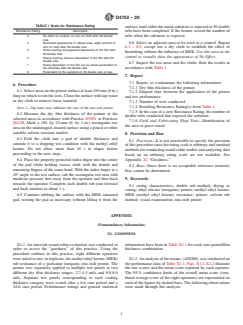
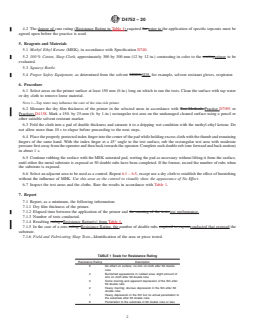
4.2 The degree of cure rating (Resistance Rating in Table 1) required prior to the application of specific topcoats must be agreed upon before the practice is used.
SCOPE
1.1 This practice describes a solvent rub technique for assessing the MEK resistance of ethyl silicate (inorganic) zinc-rich primers. The MEK resistance of some two-component ethyl silicate zinc-rich primers has been shown to correlate well with the cure of the primer as determined by diffuse reflectance infrared spectroscopy.2 The technique can be used in the laboratory, field, or in the fabricating shop. Practice D5402 is the preferred method for organic coatings.
1.2 The values stated in SI units are to be regarded as the standard. The values given in parentheses are for information only.
1.3 This standard does not purport to address all of the safety concerns, if any, associated with its use. It is the responsibility of the user of this standard to establish appropriate safety, health, and environmental practices and determine the applicability of regulatory limitations prior to use. Specific hazard statements are given in Section 6. Consult supplier’s Safety Data Sheet(s) for specific hazard information relating to the solvent used.
1.4 This international standard was developed in accordance with internationally recognized principles on standardization established in the Decision on Principles for the Development of International Standards, Guides and Recommendations issued by the World Trade Organization Technical Barriers to Trade (TBT) Committee.
- Status
- Published
- Publication Date
- 31-Jan-2020
- Technical Committee
- D01 - Paint and Related Coatings, Materials, and Applications
- Drafting Committee
- D01.46 - Industrial Protective Coatings
Buy Documents
ASTM D4752-20 - Standard Practice for Measuring MEK Resistance of Ethyl Silicate (Inorganic) Zinc-Rich Primers by Solvent Rub
REDLINE ASTM D4752-20 - Standard Practice for Measuring MEK Resistance of Ethyl Silicate (Inorganic) Zinc-Rich Primers by Solvent Rub
Overview
ASTM D4752-20 is the widely recognized standard practice for measuring the MEK (methyl ethyl ketone) resistance of ethyl silicate (inorganic) zinc-rich primers using a solvent rub method. Developed by ASTM International, this standard provides essential procedures for evaluating the degree of cure in inorganic zinc-rich primers, which is crucial for ensuring long-lasting protection and performance in industrial protective coatings. The solvent rub test described enables users to determine whether primers have achieved adequate resistance prior to topcoating, directly influencing coating system durability and corrosion resistance.
The procedures outlined in ASTM D4752-20 are applicable in laboratory settings, field environments, and fabrication shops, supporting quality control and field verification of zinc-rich primer application and performance.
Key Topics
- Purpose of MEK Resistance Testing: Assesses the degree of cure of ethyl silicate-based zinc-rich primers, verifying when a coating is suitable for topcoating.
- Solvent Rub Technique: Involves using MEK and a cotton cloth to repeatedly rub the coated surface, with results visually rated for resistance levels.
- Correlation with Cure: The solvent rub test is shown to correlate with the cure state of the primer as measured by diffuse reflectance infrared spectroscopy.
- Grading System: Results are rated from 0 (complete failure with substrate exposed) to 5 (no effect), providing a practical visual evaluation for inspection and documentation.
- Cure Dependency: Resistance ratings depend on the thickness of the coating and the curing time, supporting the need for proper environmental control during application.
- Safety and Environmental Guidance: Users must observe appropriate safety, health, and environmental practices and consult relevant regulatory and materials safety data.
Applications
ASTM D4752-20 is used extensively in industries that require robust anti-corrosive coatings, particularly those applying or specifying inorganic zinc-rich primers. Key applications include:
- Protective Coating Contractors: Ensures quality control during primer application in shop or field settings, verifying readiness for subsequent coating layers.
- Industrial Painting and Maintenance: Supports NACE, SSPC, and other industry guidelines for coating inspection and maintenance of steel structures.
- Infrastructure Projects: Applied in projects involving bridges, pipelines, storage tanks, and offshore structures where inorganic zinc-rich primers provide vital protection.
- Fabrication Shops: Assesses curing progress before transportation or subsequent fabrication steps.
- Specification Compliance: Provides objective, documentable evidence of curing and conformance with project specifications and standards.
Utilizing the MEK resistance test helps prevent premature failure of protective coating systems by ensuring only adequately cured primers are topcoated or exposed to service conditions.
Related Standards
For thorough quality assurance and compatibility with related practices, the following standards are often referenced with ASTM D4752-20:
- ASTM D7091: Practice for nondestructive measurement of dry film thickness of coatings.
- ASTM D4138: Practices for measurement of dry film thickness via destructive cross-sectioning.
- ASTM D5402: Practice for assessing MEK resistance of organic coatings, which is preferred for organic systems.
- ASTM D740: Specification for methyl ethyl ketone, covering solvent quality and handling.
These standards, when used alongside ASTM D4752-20, provide a comprehensive framework for inspection, performance assessment, and quality management of inorganic zinc-rich primer systems.
By adhering to ASTM D4752-20, industry professionals can ensure coating durability, protective performance, and specification compliance, supporting safer and longer-lasting infrastructure and industrial assets.
Relations
- Effective Date
- 01-Feb-2020
- Effective Date
- 01-Apr-2019
- Effective Date
- 01-Jun-2015
- Effective Date
- 01-Apr-2012
- Effective Date
- 01-Nov-2011
- Effective Date
- 01-Aug-2011
- Effective Date
- 01-Jul-2007
- Effective Date
- 01-Feb-2007
- Effective Date
- 01-Aug-2006
- Effective Date
- 01-Aug-2005
- Effective Date
- 15-May-2005
- Effective Date
- 01-Jan-2001
- Effective Date
- 01-Jan-2001
- Effective Date
- 01-Jan-2001
- Effective Date
- 01-Jan-2001
Buy Documents
ASTM D4752-20 - Standard Practice for Measuring MEK Resistance of Ethyl Silicate (Inorganic) Zinc-Rich Primers by Solvent Rub
REDLINE ASTM D4752-20 - Standard Practice for Measuring MEK Resistance of Ethyl Silicate (Inorganic) Zinc-Rich Primers by Solvent Rub
Frequently Asked Questions
ASTM D4752-20 is a standard published by ASTM International. Its full title is "Standard Practice for Measuring MEK Resistance of Ethyl Silicate (Inorganic) Zinc-Rich Primers by Solvent Rub". This standard covers: SIGNIFICANCE AND USE 4.1 Ethyl silicate zinc-rich primers cure by the reaction of the vehicle with moisture, thereby providing a binder for the zinc. As relative humidity and temperature vary, so does the rate of cure. A certain minimum degree of cure is necessary prior to topcoating. It has been shown that the degree of cure of ethyl silicate zinc-rich primers can be measured by the chemical changes occurring using diffuse reflectance infrared spectroscopy.2 This solvent rub test has been shown to correlate well with the infrared spectroscopic results of some two-component ethyl silicate inorganic zinc systems. 4.2 The degree of cure rating (Resistance Rating in Table 1) required prior to the application of specific topcoats must be agreed upon before the practice is used. SCOPE 1.1 This practice describes a solvent rub technique for assessing the MEK resistance of ethyl silicate (inorganic) zinc-rich primers. The MEK resistance of some two-component ethyl silicate zinc-rich primers has been shown to correlate well with the cure of the primer as determined by diffuse reflectance infrared spectroscopy.2 The technique can be used in the laboratory, field, or in the fabricating shop. Practice D5402 is the preferred method for organic coatings. 1.2 The values stated in SI units are to be regarded as the standard. The values given in parentheses are for information only. 1.3 This standard does not purport to address all of the safety concerns, if any, associated with its use. It is the responsibility of the user of this standard to establish appropriate safety, health, and environmental practices and determine the applicability of regulatory limitations prior to use. Specific hazard statements are given in Section 6. Consult supplier’s Safety Data Sheet(s) for specific hazard information relating to the solvent used. 1.4 This international standard was developed in accordance with internationally recognized principles on standardization established in the Decision on Principles for the Development of International Standards, Guides and Recommendations issued by the World Trade Organization Technical Barriers to Trade (TBT) Committee.
SIGNIFICANCE AND USE 4.1 Ethyl silicate zinc-rich primers cure by the reaction of the vehicle with moisture, thereby providing a binder for the zinc. As relative humidity and temperature vary, so does the rate of cure. A certain minimum degree of cure is necessary prior to topcoating. It has been shown that the degree of cure of ethyl silicate zinc-rich primers can be measured by the chemical changes occurring using diffuse reflectance infrared spectroscopy.2 This solvent rub test has been shown to correlate well with the infrared spectroscopic results of some two-component ethyl silicate inorganic zinc systems. 4.2 The degree of cure rating (Resistance Rating in Table 1) required prior to the application of specific topcoats must be agreed upon before the practice is used. SCOPE 1.1 This practice describes a solvent rub technique for assessing the MEK resistance of ethyl silicate (inorganic) zinc-rich primers. The MEK resistance of some two-component ethyl silicate zinc-rich primers has been shown to correlate well with the cure of the primer as determined by diffuse reflectance infrared spectroscopy.2 The technique can be used in the laboratory, field, or in the fabricating shop. Practice D5402 is the preferred method for organic coatings. 1.2 The values stated in SI units are to be regarded as the standard. The values given in parentheses are for information only. 1.3 This standard does not purport to address all of the safety concerns, if any, associated with its use. It is the responsibility of the user of this standard to establish appropriate safety, health, and environmental practices and determine the applicability of regulatory limitations prior to use. Specific hazard statements are given in Section 6. Consult supplier’s Safety Data Sheet(s) for specific hazard information relating to the solvent used. 1.4 This international standard was developed in accordance with internationally recognized principles on standardization established in the Decision on Principles for the Development of International Standards, Guides and Recommendations issued by the World Trade Organization Technical Barriers to Trade (TBT) Committee.
ASTM D4752-20 is classified under the following ICS (International Classification for Standards) categories: 87.040 - Paints and varnishes. The ICS classification helps identify the subject area and facilitates finding related standards.
ASTM D4752-20 has the following relationships with other standards: It is inter standard links to ASTM D4752-10(2015), ASTM D740-11(2019), ASTM D5402-15, ASTM D7091-12, ASTM D740-11, ASTM D5402-06(2011), ASTM D4138-07a, ASTM D4138-07, ASTM D5402-06, ASTM D7091-05, ASTM D740-05, ASTM D4138-94(2001)e1, ASTM D740-94(1997), ASTM D740-94(2001), ASTM D4138-94(1999). Understanding these relationships helps ensure you are using the most current and applicable version of the standard.
ASTM D4752-20 is available in PDF format for immediate download after purchase. The document can be added to your cart and obtained through the secure checkout process. Digital delivery ensures instant access to the complete standard document.
Standards Content (Sample)
This international standard was developed in accordance with internationally recognized principles on standardization established in the Decision on Principles for the
Development of International Standards, Guides and Recommendations issued by the World Trade Organization Technical Barriers to Trade (TBT) Committee.
Designation: D4752 − 20
Standard Practice for
Measuring MEK Resistance of Ethyl Silicate (Inorganic)
Zinc-Rich Primers by Solvent Rub
This standard is issued under the fixed designation D4752; the number immediately following the designation indicates the year of
original adoption or, in the case of revision, the year of last revision. A number in parentheses indicates the year of last reapproval. A
superscript epsilon (´) indicates an editorial change since the last revision or reapproval.
1. Scope D4138 Practices for Measurement of Dry Film Thickness of
Protective Coating Systems by Destructive, Cross-
1.1 This practice describes a solvent rub technique for
Sectioning Means
assessing the MEK resistance of ethyl silicate (inorganic)
D5402 Practice for Assessing the Solvent Resistance of
zinc-rich primers. The MEK resistance of some two-
Organic Coatings Using Solvent Rubs
component ethyl silicate zinc-rich primers has been shown to
D7091 Practice for Nondestructive Measurement of Dry
correlate well with the cure of the primer as determined by
2 Film Thickness of Nonmagnetic Coatings Applied to
diffuse reflectance infrared spectroscopy. The technique can
Ferrous Metals and Nonmagnetic, Nonconductive Coat-
be used in the laboratory, field, or in the fabricating shop.
ings Applied to Non-Ferrous Metals
Practice D5402 is the preferred method for organic coatings.
1.2 The values stated in SI units are to be regarded as the
3. Terminology
standard. The values given in parentheses are for information
3.1 Definitions of Terms Specific to This Standard:
only.
3.1.1 double rub, n—the act of rubbing a solvent saturated
1.3 This standard does not purport to address all of the
cloth in one complete forward and backward motion over a
safety concerns, if any, associated with its use. It is the
coated surface.
responsibility of the user of this standard to establish appro-
priate safety, health, and environmental practices and deter-
4. Significance and Use
mine the applicability of regulatory limitations prior to use.
4.1 Ethyl silicate zinc-rich primers cure by the reaction of
Specific hazard statements are given in Section 6. Consult
supplier’s Safety Data Sheet(s) for specific hazard information the vehicle with moisture, thereby providing a binder for the
zinc. As relative humidity and temperature vary, so does the
relating to the solvent used.
1.4 This international standard was developed in accor- rate of cure. A certain minimum degree of cure is necessary
prior to topcoating. It has been shown that the degree of cure
dance with internationally recognized principles on standard-
ization established in the Decision on Principles for the of ethyl silicate zinc-rich primers can be measured by the
chemical changes occurring using diffuse reflectance infrared
Development of International Standards, Guides and Recom-
mendations issued by the World Trade Organization Technical spectroscopy. This solvent rub test has been shown to corre-
Barriers to Trade (TBT) Committee. late well with the infrared spectroscopic results of some
two-component ethyl silicate inorganic zinc systems.
2. Referenced Documents
4.2 The degree of cure rating (Resistance Rating in Table 1)
2.1 ASTM Standards:
required prior to the application of specific topcoats must be
D740 Specification for Methyl Ethyl Ketone
agreed upon before the practice is used.
This practice is under the jurisdiction of ASTM Committee D01 on Paint and
5. Reagents and Materials
Related Coatings, Materials, and Applications and is the direct responsibility of
Subcommittee D01.46 on Industrial Protective Coatings.
5.1 Methyl Ethyl Ketone (MEK), in accordance with Speci-
Current edition approved Feb. 1, 2020. Published February 2020. Originally
fication D740.
approved in 1987. Last previous edition approved in 2015 as D4752 – 10 (2015).
DOI: 10.1520/D4752-20.
5.2 100 % Cotton, Shop Cloth, approximately 300 by 300
Starr, T. L., Henton, L. E., Lewis, W. S., and Rideout, F. A., “Improved Field
mm (12 by 12 in.) contrasting in color to the primer to be
Reliability of High Performance Coating Systems: Phase II—Develop Procedures
and Criteria in Critical Performance Areas,” available from SSPC: The Society for
evaluated.
Protective Coatings, 800 Trumbull Drive, Pittsburgh, PA 15205, www.sspc.org.
For referenced ASTM standards, visit the ASTM website, www.astm.org, or 5.3 Squeeze Bottle.
contact ASTM Customer Service at service@astm.org. For Annual Book of ASTM
5.4 Proper Safety Equipment, as determined from the sol-
Standards volume information, refer to the standard’s Document Summary page on
the ASTM website. vent SDS, for example, solvent resistant gloves, respirator.
Copyright © ASTM International, 100 Barr Harbor Drive, PO Box C700, West Conshohocken, PA 19428-2959. United States
D4752 − 20
TABLE 1 Scale for Resistance Rating
surface, until either the metal substrate is exposed or 50 double
Resistance Rating Description rubs have been completed. If the former, record the number of
5 No effect on surface; no zinc on cloth after 50 double rubs when the substrate is exposed.
rubs
6.6 Select an adjacent area to be used as a control. Repeat
4 Burnished appearance in rubbed area; slight amount of
zinc on cloth after 50 double rubs
6.1 – 6.5, except use a dry cloth to establish the effect of
3 Some marring and apparent depression of the film after
burnishing without the influence of MEK. Use this area as the
50 double rubs
control to visually show the appearance of No Effect.
2 Heavy marring; obvious depression in the film after 50
double rubs
6.7 Inspect the test areas and the cloths. Rate the results in
1 Heavy depression in the film but no actual penetration to
the substrate after 50 double rubs accordance with Table 1.
0 Penetration to the substrate in 50 double rubs or less
7. Report
7.1 Report, as a minimum, the following information:
6. Procedure
7.1.1 Dry film thickness of the primer.
6.1 Selectareasontheprimersurfaceatleast150mm(6in.)
7.1.2 Elapsed time between the application of the primer
long on which to run the tests. Clean the surface with tap water
and test performance.
or dry cloth to remove loose material.
7.1.3 Number of tests conducted.
7.1.4 Resulting Resistance Rating(s) from Table 1.
NOTE 1—Tap water may influence the cure of the zinc-rich primer.
7.1.5 In the case of a zero Resistance Rating, the number of
6.2 Measure the dry film thickness of the primer in the
double rubs conducted that exposed the substrate.
selected areas in accordance with Practice D7091 or Practices
...
This document is not an ASTM standard and is intended only to provide the user of an ASTM standard an indication of what changes have been made to the previous version. Because
it may not be technically possible to adequately depict all changes accurately, ASTM recommends that users consult prior editions as appropriate. In all cases only the current version
of the standard as published by ASTM is to be considered the official document.
Designation: D4752 − 10 (Reapproved 2015) D4752 − 20
Standard Practice for
Measuring MEK Resistance of Ethyl Silicate (Inorganic)
Zinc-Rich Primers by Solvent Rub
This standard is issued under the fixed designation D4752; the number immediately following the designation indicates the year of
original adoption or, in the case of revision, the year of last revision. A number in parentheses indicates the year of last reapproval. A
superscript epsilon (´) indicates an editorial change since the last revision or reapproval.
1. Scope
1.1 This practice describes a solvent rub technique for assessing the MEK resistance of ethyl silicate (inorganic) zinc-rich
primers. The MEK resistance of some two-component ethyl silicate zinc-rich primers has been shown to correlate well with the
cure of the primer as determined by diffuse reflectance infrared spectroscopy. The technique can be used in the laboratory, field,
or in the fabricating shop. Practice D5402 is the preferred method for organic coatings.
1.2 The values stated in SI units are to be regarded as the standard. The values given in parentheses are for information only.
1.3 This standard does not purport to address all of the safety concerns, if any, associated with its use. It is the responsibility
of the user of this standard to establish appropriate safety safety, health, and healthenvironmental practices and determine the
applicability of regulatory limitations prior to use. Specific hazard statements are given in Section 6. Consult supplier’s Material
Safety Data Sheet(s) for specific hazard information relating to the solvent used.
1.4 This international standard was developed in accordance with internationally recognized principles on standardization
established in the Decision on Principles for the Development of International Standards, Guides and Recommendations issued
by the World Trade Organization Technical Barriers to Trade (TBT) Committee.
2. Referenced Documents
2.1 ASTM Standards:
D740 Specification for Methyl Ethyl Ketone
D4138 Practices for Measurement of Dry Film Thickness of Protective Coating Systems by Destructive, Cross-Sectioning
Means
D5402 Practice for Assessing the Solvent Resistance of Organic Coatings Using Solvent Rubs
D7091 Practice for Nondestructive Measurement of Dry Film Thickness of Nonmagnetic Coatings Applied to Ferrous Metals
and Nonmagnetic, Nonconductive Coatings Applied to Non-Ferrous Metals
3. Terminology
3.1 Definitions of Terms Specific to This Standard:
3.1.1 double rub, n—the act of rubbing a solvent saturated cloth in one complete forward and backward motion over a coated
surface.
4. Significance and Use
4.1 Ethyl silicate zinc-rich primers cure by the reaction of the vehicle with moisture, thereby providing a binder. binder for the
zinc. As relative humidity and temperature vary during the day, vary, so does the rate of cure. A certain minimum degree of cure
is necessary prior to topcoating. It has been shown that the degree of cure of ethyl silicate zinc-rich primers can be measured by
the chemical changes occurring using diffuse reflectance infrared spectroscopy. This solvent rub test has been shown to correlate
well with the infrared spectroscopic results of some two-component ethyl silicate inorganic zinc systems.
This practice is under the jurisdiction of ASTM Committee D01 on Paint and Related Coatings, Materials, and Applications and is the direct responsibility of
Subcommittee D01.46 on Industrial Protective Coatings.
Current edition approved Feb. 1, 2015Feb. 1, 2020. Published February 2015February 2020. Originally approved in 1987. Last previous edition approved in 20102015
as D4752 – 10.D4752 – 10 (2015). DOI: 10.1520/D4752-10R15.10.1520/D4752-20.
Starr, T. L., Henton, L. E., Lewis, W. S., and Rideout, F. A., “Improved Field Reliability of High Performance Coating Systems: Phase II—Develop Procedures and
Criteria in Critical Performance Areas,” available from SSPC: The Society for Protective Coatings, 40 24th St., Sixth Floor, 800 Trumbull Drive, Pittsburgh, PA 15213,15205,
www.sspc.org.
For referenced ASTM standards, visit the ASTM website, www.astm.org, or contact ASTM Customer Service at service@astm.org. For Annual Book of ASTM Standards
volume information, refer to the standard’s Document Summary page on the ASTM website.
Copyright © ASTM International, 100 Barr Harbor Drive, PO Box C700, West Conshohocken, PA 19428-2959. United States
D4752 − 20
4.2 The degree of cure rating (Resistance Rating in Table 1) required for prior to the application of specific topcoats must be
agreed upon before the practice is used.
5. Reagents and Materials
5.1 Methyl Ethyl Ketone (MEK), in accordance with Specification D740.
5.2 100 % Cotton, Shop Cloth, approximately 300 by 300 mm (12 by 12 in.) contrasting in color to the coatingprimer to be
evaluated.
5.3 Squeeze Bottle.
5.4 Proper Safety Equipment, as determined from the solvent MSDS,SDS, for example, solvent resistant gloves, respirator.
6. Procedure
6.1 Select areas on the primer surface at least 150 mm (6 in.) long on which to run the tests. Clean the surface with tap water
or dry cloth to remove loose material.
NOTE 1—Tap water may influence the cure of the zinc-rich primer.
6.2 Measure the dry film thickness of the primer in the selected areas in accordance with Test Methods Practice D7091 or
Practices D4138. Mark a 150- by 25-mm (6- by 1-in.) rectangular test area on the undamaged cleaned surface using a pencil or
other suitable solvent resistant marker.
6.3 Fold the cloth into a pad of double thickness and saturate it to a dripping wet condition with the methyl ethyl ketone. Do
not allow more than 10 s to elapse before proceeding to the next steps.
6.4 Place the properly protected index finger into the center of the pad while holding excess cloth with the thumb and remaining
fingers of the same hand. With the index finger at a 45° angle to the test surface, rub the rectangular test area with moderate
pressure first away from the operator and then back towards the operator. Complete each double rub (one forward and back motion)
in about 1 s.
6.5 Continue rubbing the surface with the MEK saturated pad, wetting the pad as necessary without lifting it from the surface,
until either the metal substrate is exposed or 50 double rubs have been completed. If the former, record the number of rubs when
the substrate is exposed.
6.6 Select an adjacent area to be used as a control. Repeat 6.1 – 6.5, except use a dry cloth to establish the effect of burnishing
without the influence of MEK. Use this area as the control to visually show the appearance of No Effect.
6.7 Inspect the test areas and the cloths. Rate the results in accordance with Table 1.
7. Report
7.1 Report, as a minimum, the follo
...