

ASTM E2898-20a
(Guide)Standard Guide for Risk-Based Validation of Analytical Methods for PAT Applications
General Information
- Abstract
SIGNIFICANCE AND USE
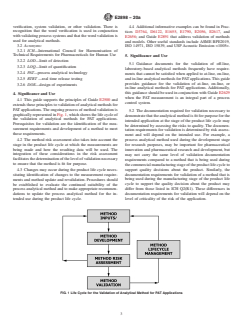
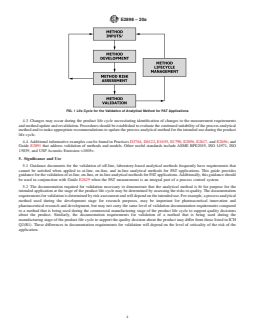
4.1 This guide supports the principles of Guide E2500 and extends these principles to validation of analytical methods for PAT applications. The ongoing process of method validation is graphically represented in Fig. 1, which shows the life cycle of the validation of analytical methods for PAT applications. Prerequisites for validation are the identification of the measurement requirements and development of a method to meet those requirements.
FIG. 1 Life Cycle for the Validation of Analytical Method for PAT Applications
4.2 The method risk assessment also takes into account the stage in the product life cycle at which the measurements are being made and how the resulting data will be used. The integration of these considerations in the risk assessment facilitates the determination of the level of validation necessary to ensure that the method is fit for purpose.
4.3 Changes may occur during the product life cycle necessitating identification of changes to the measurement requirements and method update and revalidation. Procedures should be established to evaluate the continued suitability of the process analytical method and to make appropriate recommendations to update the process analytical method for the intended use during the product life cycle.
4.4 Additional informative examples can be found in Practices D3764, D6122, E1655, E1790, E2056, E2617, and E2656; and Guide E2891 that address validation of methods and models. Other useful standards include ASME BPE2019, ISO 14971, ISO 15839, and USP Acoustic Emission .
SCOPE
1.1 This guide provides an overview to the risk-based validation of process analytical methods under a process analytical technology (PAT) paradigm for pharmaceuticals and biopharmaceuticals and as such includes guidance on assessing risk to product quality from inappropriate method validation.
1.2 This guide builds on existing standards on the topic of validation concentrating on applying such standards to analytical methods for on-line analysis. In particular, it addresses the validation of at-line, on-line, or in-line PAT measurements and covers both drug substance and drug product (DP) measurements.
1.3 The definitions of International Council for Harmonisation (ICH) validation parameters (such as specificity, precision, repeatability, etc.) apply; however, the method of demonstrating the validation parameters may vary from that described in ICH and is discussed.
1.4 As consistent with the U.S. Food and Drug Administration (FDA) process validation guidance, this document also briefly covers ongoing assurance that the method remains in a validated state during routine use.
1.5 Equipment and instrument qualification are out of the scope of this guide but will be referenced as inputs to validation of analytical methods for PAT applications.
1.6 The validation of multivariate prediction models is out of scope but will be referenced as inputs to validation of analytical methods for PAT applications.
1.6.1 The validation of any analytical model used in the PAT method is essential to the validation of the PAT method but, the details of the model validation process is out of scope. See term model validation, 3.1.7.
1.7 Microbiological methods are out of scope.
1.8 This standard does not purport to address all of the safety concerns, if any, associated with its use. It is the responsibility of the user of this standard to establish appropriate safety, health, and environmental practices and determine the applicability of regulatory limitations prior to use.
1.9 This international standard was developed in accordance with internationally recognized principles on standardization established in the Decision on Principles for the Development of International Standards, Guides and Recommendations issued by the World Trade Organization Technical Barriers to Trade (TBT) Committee.
- Status
- Published
- Publication Date
- 31-May-2020
- Technical Committee
- E55 - Manufacture of Pharmaceutical and Biopharmaceutical Products
- Drafting Committee
- E55.13 - Process Evaluation and Control
Buy Documents
ASTM E2898-20a - Standard Guide for Risk-Based Validation of Analytical Methods for PAT Applications
REDLINE ASTM E2898-20a - Standard Guide for Risk-Based Validation of Analytical Methods for PAT Applications
Overview
ASTM E2898-20a, Standard Guide for Risk-Based Validation of Analytical Methods for PAT Applications, is a comprehensive guidance document developed by ASTM International for the pharmaceutical and biopharmaceutical industries. The guide addresses the risk-based validation of process analytical methods within a Process Analytical Technology (PAT) paradigm, ensuring that analytical methods used for at-line, on-line, or in-line measurements are robust, reliable, and aligned with product quality requirements. This standard supports the principles of ASTM E2500 and applies internationally recognized practices for method validation, focusing on the unique needs of PAT applications.
Key Topics
Risk-Based Validation Approach:
- Emphasizes the assessment and documentation of risks to product quality from improper method validation.
- Encourages tailoring validation efforts to the criticality of the measurement's intended use within the product and process life cycle.
Scope of Guidance:
- Applies to validation of analytical methods for both drug substance and drug product measurements.
- Addresses at-line, on-line, and in-line PAT measurements, supporting both development and commercial stage applications.
- Equipment, instrument qualification, and multivariate model validation are referenced but not detailed within this standard.
- Microbiological methods are explicitly excluded.
Validation Life Cycle:
- Focuses on the ongoing process of method validation, including procedures for updating and revalidating methods as process or measurement requirements evolve.
- Recommends establishing processes for continued suitability through periodic review and change control.
Alignment with International Standards:
- Definitions and strategies are consistent with ICH validation parameters (e.g., specificity, precision, repeatability).
- Reflects U.S. FDA process validation guidance regarding ongoing assurance of validated state during routine use.
Applications
ASTM E2898-20a is specifically designed for:
Pharmaceutical and Biopharmaceutical Manufacturing:
- Enables the implementation of PAT strategies for real-time release testing, process optimization, and quality control.
- Supports innovation by ensuring analytical methods are fit for purpose throughout product and process development, as well as commercial production.
Risk Management in Method Validation:
- Provides a framework to identify and assess potential risks associated with analytical measurements.
- Guidance on differentiating documentation and validation requirements based on whether the application is low, medium, or high impact.
Effective Knowledge Management:
- Promotes robust documentation practices to facilitate method transfer, change management, and regulatory compliance.
- Validation processes are structured to build upon earlier studies, supporting the efficient use of resources.
Compliance with Regulatory Expectations:
- Assists laboratories and manufacturers in meeting internationally recognized standards and regulatory guidance for method validation within PAT applications.
- Encourages the use of quality risk management principles consistent with ICH Q9 and FDA requirements.
Related Standards
ASTM E2898-20a references and aligns with several key standards and guidelines, including:
ASTM Standards:
- ASTM E2500: Specification, Design, and Verification of Pharmaceutical and Biopharmaceutical Manufacturing Systems.
- ASTM D3764, D6122, E1655, E1790, E2056, E2617, E2656, E2891: Various practices and guides addressing validation and multivariate model analysis for process analyzers and PAT.
- ASTM E2476, E2629: Risk assessment and PAT-enabled control system verification.
International Standards and Guidelines:
- ICH Q2(R1): Guidance on Validation of Analytical Procedures.
- ICH Q9: Quality Risk Management.
- FDA Process Validation Guidance.
- ISO 14971: Risk Management for Medical Devices.
- ISO 15839: Specifications and Performance Tests for On-line Sensors.
- ASME BPE2019: BioProcessing Equipment Standard.
- USP Acoustic Emission <1005>.
By following ASTM E2898-20a, manufacturers ensure that their analytical methods for process analytical technology applications are properly validated, scientifically justified, and meet the rigorous demands of global regulatory frameworks, ultimately supporting product quality and patient safety.
Relations
- Effective Date
- 01-Jul-2023
- Effective Date
- 15-Jun-2019
- Effective Date
- 01-Jun-2019
- Effective Date
- 01-May-2019
- Effective Date
- 01-Jan-2019
- Effective Date
- 01-Jul-2018
- Refers
ASTM E2617-17 - Standard Practice for Validation of Empirically Derived Multivariate Calibrations - Effective Date
- 15-Dec-2017
- Effective Date
- 01-Apr-2016
- Effective Date
- 01-Apr-2015
- Effective Date
- 01-Apr-2015
- Effective Date
- 01-Nov-2013
- Effective Date
- 01-May-2013
- Effective Date
- 15-Oct-2012
- Effective Date
- 15-Apr-2011
- Effective Date
- 01-Aug-2010
Buy Documents
ASTM E2898-20a - Standard Guide for Risk-Based Validation of Analytical Methods for PAT Applications
REDLINE ASTM E2898-20a - Standard Guide for Risk-Based Validation of Analytical Methods for PAT Applications
Get Certified
Connect with accredited certification bodies for this standard

BSI Group
BSI (British Standards Institution) is the business standards company that helps organizations make excellence a habit.

TÜV Rheinland
TÜV Rheinland is a leading international provider of technical services.

TÜV SÜD
TÜV SÜD is a trusted partner of choice for safety, security and sustainability solutions.
Sponsored listings
Frequently Asked Questions
ASTM E2898-20a is a guide published by ASTM International. Its full title is "Standard Guide for Risk-Based Validation of Analytical Methods for PAT Applications". This standard covers: SIGNIFICANCE AND USE 4.1 This guide supports the principles of Guide E2500 and extends these principles to validation of analytical methods for PAT applications. The ongoing process of method validation is graphically represented in Fig. 1, which shows the life cycle of the validation of analytical methods for PAT applications. Prerequisites for validation are the identification of the measurement requirements and development of a method to meet those requirements. FIG. 1 Life Cycle for the Validation of Analytical Method for PAT Applications 4.2 The method risk assessment also takes into account the stage in the product life cycle at which the measurements are being made and how the resulting data will be used. The integration of these considerations in the risk assessment facilitates the determination of the level of validation necessary to ensure that the method is fit for purpose. 4.3 Changes may occur during the product life cycle necessitating identification of changes to the measurement requirements and method update and revalidation. Procedures should be established to evaluate the continued suitability of the process analytical method and to make appropriate recommendations to update the process analytical method for the intended use during the product life cycle. 4.4 Additional informative examples can be found in Practices D3764, D6122, E1655, E1790, E2056, E2617, and E2656; and Guide E2891 that address validation of methods and models. Other useful standards include ASME BPE2019, ISO 14971, ISO 15839, and USP Acoustic Emission . SCOPE 1.1 This guide provides an overview to the risk-based validation of process analytical methods under a process analytical technology (PAT) paradigm for pharmaceuticals and biopharmaceuticals and as such includes guidance on assessing risk to product quality from inappropriate method validation. 1.2 This guide builds on existing standards on the topic of validation concentrating on applying such standards to analytical methods for on-line analysis. In particular, it addresses the validation of at-line, on-line, or in-line PAT measurements and covers both drug substance and drug product (DP) measurements. 1.3 The definitions of International Council for Harmonisation (ICH) validation parameters (such as specificity, precision, repeatability, etc.) apply; however, the method of demonstrating the validation parameters may vary from that described in ICH and is discussed. 1.4 As consistent with the U.S. Food and Drug Administration (FDA) process validation guidance, this document also briefly covers ongoing assurance that the method remains in a validated state during routine use. 1.5 Equipment and instrument qualification are out of the scope of this guide but will be referenced as inputs to validation of analytical methods for PAT applications. 1.6 The validation of multivariate prediction models is out of scope but will be referenced as inputs to validation of analytical methods for PAT applications. 1.6.1 The validation of any analytical model used in the PAT method is essential to the validation of the PAT method but, the details of the model validation process is out of scope. See term model validation, 3.1.7. 1.7 Microbiological methods are out of scope. 1.8 This standard does not purport to address all of the safety concerns, if any, associated with its use. It is the responsibility of the user of this standard to establish appropriate safety, health, and environmental practices and determine the applicability of regulatory limitations prior to use. 1.9 This international standard was developed in accordance with internationally recognized principles on standardization established in the Decision on Principles for the Development of International Standards, Guides and Recommendations issued by the World Trade Organization Technical Barriers to Trade (TBT) Committee.
SIGNIFICANCE AND USE 4.1 This guide supports the principles of Guide E2500 and extends these principles to validation of analytical methods for PAT applications. The ongoing process of method validation is graphically represented in Fig. 1, which shows the life cycle of the validation of analytical methods for PAT applications. Prerequisites for validation are the identification of the measurement requirements and development of a method to meet those requirements. FIG. 1 Life Cycle for the Validation of Analytical Method for PAT Applications 4.2 The method risk assessment also takes into account the stage in the product life cycle at which the measurements are being made and how the resulting data will be used. The integration of these considerations in the risk assessment facilitates the determination of the level of validation necessary to ensure that the method is fit for purpose. 4.3 Changes may occur during the product life cycle necessitating identification of changes to the measurement requirements and method update and revalidation. Procedures should be established to evaluate the continued suitability of the process analytical method and to make appropriate recommendations to update the process analytical method for the intended use during the product life cycle. 4.4 Additional informative examples can be found in Practices D3764, D6122, E1655, E1790, E2056, E2617, and E2656; and Guide E2891 that address validation of methods and models. Other useful standards include ASME BPE2019, ISO 14971, ISO 15839, and USP Acoustic Emission . SCOPE 1.1 This guide provides an overview to the risk-based validation of process analytical methods under a process analytical technology (PAT) paradigm for pharmaceuticals and biopharmaceuticals and as such includes guidance on assessing risk to product quality from inappropriate method validation. 1.2 This guide builds on existing standards on the topic of validation concentrating on applying such standards to analytical methods for on-line analysis. In particular, it addresses the validation of at-line, on-line, or in-line PAT measurements and covers both drug substance and drug product (DP) measurements. 1.3 The definitions of International Council for Harmonisation (ICH) validation parameters (such as specificity, precision, repeatability, etc.) apply; however, the method of demonstrating the validation parameters may vary from that described in ICH and is discussed. 1.4 As consistent with the U.S. Food and Drug Administration (FDA) process validation guidance, this document also briefly covers ongoing assurance that the method remains in a validated state during routine use. 1.5 Equipment and instrument qualification are out of the scope of this guide but will be referenced as inputs to validation of analytical methods for PAT applications. 1.6 The validation of multivariate prediction models is out of scope but will be referenced as inputs to validation of analytical methods for PAT applications. 1.6.1 The validation of any analytical model used in the PAT method is essential to the validation of the PAT method but, the details of the model validation process is out of scope. See term model validation, 3.1.7. 1.7 Microbiological methods are out of scope. 1.8 This standard does not purport to address all of the safety concerns, if any, associated with its use. It is the responsibility of the user of this standard to establish appropriate safety, health, and environmental practices and determine the applicability of regulatory limitations prior to use. 1.9 This international standard was developed in accordance with internationally recognized principles on standardization established in the Decision on Principles for the Development of International Standards, Guides and Recommendations issued by the World Trade Organization Technical Barriers to Trade (TBT) Committee.
ASTM E2898-20a is classified under the following ICS (International Classification for Standards) categories: 11.120.99 - Other standards related to pharmaceutics. The ICS classification helps identify the subject area and facilitates finding related standards.
ASTM E2898-20a has the following relationships with other standards: It is inter standard links to ASTM D6122-23, ASTM E2629-19, ASTM D6122-19b, ASTM D6122-19a, ASTM D6122-19, ASTM D6122-18, ASTM E2617-17, ASTM E2056-04(2016), ASTM D3764-15e1, ASTM D3764-15, ASTM E2891-13, ASTM D6122-13, ASTM E2500-07(2012), ASTM E2629-11, ASTM E2656-10. Understanding these relationships helps ensure you are using the most current and applicable version of the standard.
ASTM E2898-20a is available in PDF format for immediate download after purchase. The document can be added to your cart and obtained through the secure checkout process. Digital delivery ensures instant access to the complete standard document.
Standards Content (Sample)
This international standard was developed in accordance with internationally recognized principles on standardization established in the Decision on Principles for the
Development of International Standards, Guides and Recommendations issued by the World Trade Organization Technical Barriers to Trade (TBT) Committee.
Designation: E2898 − 20a
Standard Guide for
Risk-Based Validation of Analytical Methods for PAT
Applications
This standard is issued under the fixed designation E2898; the number immediately following the designation indicates the year of
original adoption or, in the case of revision, the year of last revision. A number in parentheses indicates the year of last reapproval. A
superscript epsilon (´) indicates an editorial change since the last revision or reapproval.
1. Scope responsibility of the user of this standard to establish appro-
priate safety, health, and environmental practices and deter-
1.1 This guide provides an overview to the risk-based
mine the applicability of regulatory limitations prior to use.
validation of process analytical methods under a process
1.9 This international standard was developed in accor-
analytical technology (PAT) paradigm for pharmaceuticals and
dance with internationally recognized principles on standard-
biopharmaceuticals and as such includes guidance on assessing
ization established in the Decision on Principles for the
risk to product quality from inappropriate method validation.
Development of International Standards, Guides and Recom-
1.2 This guide builds on existing standards on the topic of
mendations issued by the World Trade Organization Technical
validation concentrating on applying such standards to analyti-
Barriers to Trade (TBT) Committee.
cal methods for on-line analysis. In particular, it addresses the
validation of at-line, on-line, or in-line PAT measurements and
2. Referenced Documents
covers both drug substance and drug product (DP) measure- 2
2.1 ASTM Standards:
ments.
D3764 Practice for Validation of the Performance of Process
1.3 The definitions of International Council for Harmonisa- Stream Analyzer Systems
tion (ICH) validation parameters (such as specificity, precision,
D6122 Practice for Validation of the Performance of Multi-
repeatability, etc.) apply; however, the method of demonstrat- variate Online, At-Line, Field and Laboratory Infrared
ing the validation parameters may vary from that described in
Spectrophotometer, and Raman Spectrometer Based Ana-
ICH and is discussed. lyzer Systems
E1655 Practices for Infrared Multivariate Quantitative
1.4 As consistent with the U.S. Food and Drug Administra-
Analysis
tion (FDA) process validation guidance, this document also
E1790 Practice for Near Infrared Qualitative Analysis
briefly covers ongoing assurance that the method remains in a
E2056 Practice for Qualifying Spectrometers and Spectro-
validated state during routine use.
photometers for Use in Multivariate Analyses, Calibrated
1.5 Equipment and instrument qualification are out of the
Using Surrogate Mixtures
scope of this guide but will be referenced as inputs to
E2476 Guide for Risk Assessment and Risk Control as it
validation of analytical methods for PAT applications.
Impacts the Design, Development, and Operation of PAT
1.6 The validation of multivariate prediction models is out Processes for Pharmaceutical Manufacture
of scope but will be referenced as inputs to validation of E2500 Guide for Specification, Design, and Verification of
analytical methods for PAT applications. Pharmaceutical and Biopharmaceutical Manufacturing
1.6.1 The validation of any analytical model used in the PAT Systems and Equipment
method is essential to the validation of the PAT method but, the E2617 Practice for Validation of Empirically Derived Mul-
details of the model validation process is out of scope. See term tivariate Calibrations
model validation, 3.1.7. E2629 Guide for Verification of Process Analytical Technol-
ogy (PAT) Enabled Control Systems
1.7 Microbiological methods are out of scope.
E2656 Practice for Real-time Release Testing of Pharmaceu-
1.8 This standard does not purport to address all of the
tical Water for the Total Organic Carbon Attribute
safety concerns, if any, associated with its use. It is the
E2891 Guide for Multivariate Data Analysis in Pharmaceu-
tical Development and Manufacturing Applications
This guide is under the jurisdiction of ASTM Committee E55 on Manufacture
of Pharmaceutical and Biopharmaceutical Products and is the direct responsibility of
Subcommittee E55.13 on Process Evaluation and Control. For referenced ASTM standards, visit the ASTM website, www.astm.org, or
Current edition approved June 1, 2020. Published June 2020. Originally contact ASTM Customer Service at service@astm.org. For Annual Book of ASTM
approved in 2013. Last previous edition approved in 2020 as E2898 – 20. DOI: Standards volume information, refer to the standard’s Document Summary page on
10.1520/E2898-20A. the ASTM website.
Copyright © ASTM International, 100 Barr Harbor Drive, PO Box C700, West Conshohocken, PA 19428-2959. United States
E2898 − 20a
2.2 ICH Standards: the estimates from the model and the reference method, and to
ICH Quality Implementation Working Group Points to test the agreement between estimates made with the model and
Consider (R2) ICH-Endorsed Guide for ICH Q8/Q9/Q10 the reference method as defined in Guide E2891.
Implementation dated 6 December 2011
3.1.8 off-line measurements, n—measurement in which the
Q2(R1) Guidance on Validation of Analytical Procedures:
sample is removed or isolated from the immediate manufac-
Text and Methodology
turing process stream, and analyzed in an area remote from the
Q7 Good Manufacturing Practice Guide for Active Pharma-
manufacturing process.
ceutical Ingredients
3.1.9 on-line measurements, n—measurement in which the
Q9 Quality Risk
sample is diverted from the manufacturing process and may be
2.3 Other Standards:
returned to the process stream.
ASME BPE2019 BioProcessing Equipment Standard
3.1.10 process analytical technology (PAT) application,
FDA Guidance for Industry Process Validation: General
n—the installation/utilization of a measurement system, for
Principles and Practices
designing, analyzing, and controlling manufacturing through
ISO 14971 Medical Devices—Application of Risk Manage-
timely measurements (that is, during processing) of critical
ment to Medical Devices
quality and performance attributes of raw and in-process
ISO 15839 Water Quality—On-line Sensors/Analysing
materials and processes, with the goal of ensuring final product
Equipment for Water—Specifications and Performance
quality. PAT
Tests
ISO/IEC Guide 51 Safety Aspects—Guidelines for Their
3.1.11 qualification, n—action of proving and documenting
Inclusion in Standards
that equipment or ancillary systems are properly installed,
PAT A Framework for Innovative Pharmaceutical
work correctly, and are fit for their intended purpose.
Development, Manufacturing, and Quality Assurance,
3.1.11.1 Discussion—Qualification is part of validation, but
Guidance for Industry, September 2004
the individual qualification steps alone do not constitute
USP Acoustic Emission <1005>
process validation. FDA/ICH Q7A
3.1.12 qualitative, adj—type of method whereby a categori-
3. Terminology
cal outcome (such as pass/fail) is generated for the attribute or
3.1 Definitions:
parameter measured.
3.1.1 acceptance criteria, n—criteria that a system or com-
3.1.12.1 Discussion—The method output may be descrip-
ponent shall satisfy to be accepted by a user or other authorized
tive rather than numerical.
entity.
3.1.13 quantitative, adj—type of method whereby a numeri-
3.1.2 at-line measurements, n—measurement in which the
cal value or result is generated for the attribute or parameter
sample is removed, isolated from, and analyzed in close
measured.
proximity to the process stream.
3.1.14 reference sample, n—representative substance of es-
3.1.3 categorical data, n—measurement output that has
tablished quality used as a reference standard for the method
distinct and predetermined output options (for example, pass/
validation.
fail, 1/0, red/yellow/green, and on/off) and is typically nonnu-
3.1.14.1 Discussion—The reference sample may be a refer-
meric in nature.
ence standard (primary or secondary) and may be commercial
3.1.4 continuous data, n—numerical information or output
or development material for which the value of its relevant
having any values within a given range.
parameter or attribute has been established. E1655
3.1.5 discrete data, n—numerical information for which a
3.1.15 risk, n—combination of the probability of occurrence
limited set of values are allowed within a given range.
of harm and the severity of that harm. ISO/IEC Guide 51,
3.1.6 in-line measurements, n—measurement in which the
ICH Q9
sample is not removed from the process stream, which may be
3.1.16 risk analysis, n—the estimation of the risk associated
either invasive or noninvasive.
with the identified hazard. ICH Q9
3.1.7 model validation, n—the process of testing a calibra-
3.1.17 risk assessment, n—a systematic process of organiz-
tion model with validation samples to determine bias between
ing information to support a risk decision to be made within a
risk management process. Consisting of identification hazards
Available from International Council for Harmonisation of Technical Require-
and the analysis and evaluation of risks associated with
ments for Pharmaceuticals for Human Use (ICH), ICH Secretariat, Route de
Pré-Bois, 20, P.O Box 1894, 1215 Geneva, Switzerland, https://www.ich.org. exposure to those hazards. ICH Q9, ISO 14971
Available from American Society of Mechanical Engineers (ASME), ASME
3.1.18 verification, n—systematic approach to demonstrate
International Headquarters, Two Park Ave., New York, NY 10016-5990, http://
that manufacturing systems, acting singly or in combination,
www.asme.org.
Available from U.S. Food and Drug Administration (FDA), 10903 New
are fit for intended use, have been properly installed, and are
Hampshire Ave., Silver Spring, MD 20993, http://www.fda.gov.
operating correctly.
Available from International Organization for Standardization (ISO), ISO
Central Secretariat, Chemin de Blandonnet 8, CP 401, 1214 Vernier, Geneva,
3.1.18.1 Discussion—This is an umbrella term that encom-
Switzerland, https://www.iso.org.
passes all types of approaches to assuring systems are fit for
Available from U.S. Pharmacopeial Convention (USP), 12601 Twinbrook
Pkwy., Rockville, MD 20852-1790, http://www.usp.org. use such as qualification, commissioning and qualification,
E2898 − 20a
verification, system validation, or other validation. There is 4.4 Additional informative examples can be found in Prac-
recognition that the word verification is used in conjunction tices D3764, D6122, E1655, E1790, E2056, E2617, and
with validating process systems and that the word validation is
E2656; and Guide E2891 that address validation of methods
used for analytical methods.
and models. Other useful standards include ASME BPE2019,
3.2 Acronyms:
ISO 14971, ISO 15839, and USP Acoustic Emission <1005>.
3.2.1 ICH—International Council for Harmonisation of
Technical Requirements for Pharmaceuticals for Human Use
5. Significance and Use
3.2.2 LOD—limit of detection
5.1 Guidance documents for the validation of off-line,
3.2.3 LOQ—limit of quantification
laboratory-based analytical methods frequently have require-
3.2.4 PAT—process analytical technology ments that cannot be satisfied when applied to at-line, on-line,
and in-line analytical methods for PAT applications. This guide
3.2.5 RTRT —real time release testing
provides guidance for the validation of at-line, on-line, or
3.2.6 DOE—design of experiments
in-line analytical methods for PAT applications. Additionally,
this guidance should be used in conjunction with Guide E2629
4. Significance and Use
when the PAT measurement is an integral part of a process
4.1 This guide supports the principles of Guide E2500 and
control system.
extends these principles to validation of analytical methods for
PAT applications. The ongoing process of method validation is
5.2 The documentation required for validation necessary to
graphically represented in Fig. 1, which shows the life cycle of
demonstrate that the analytical method is fit for purpose for the
the validation of analytical methods for PAT applications.
intended application at the stage of the product life cycle may
Prerequisites for validation are the identification of the mea-
be determined by assessing the risks to quality. The documen-
surement requirements and development of a method to meet
tation requirements for validation is determined by risk assess-
those requirements.
ment and will depend on the intended use. For example, a
4.2 The method risk assessment also takes into account the process analytical method used during the development stage
stage in the product life cycle at which the measurements are
for research purposes, may be important for pharmaceutical
being made and how the resulting data will be used. The
innovation and pharmaceutical research and development, but
integration of these considerations in the risk assessment
may not carry the same level of validation documentation
facilitates the determination of the level of validation necessary
requirements compared to a method that is being used during
to ensure that the method is fit for purpose.
the commercial manufacturing stage of the product life cycle to
support quality decisions about the product. Similarly, the
4.3 Changes may occur during the product life cycle neces-
documentation requirements for validation of a method that is
sitating identification of changes to the measurement require-
being used during the manufacturing stage of the product life
ments and method update and revalidation. Procedures should
cycle to support the quality decision about the product may
be established to evaluate the continued suitability of the
differ from those listed in ICH Q2(R1). These differences in
process analytical method and to make appropriate recommen-
dations to update the process analytical method for the in- documentation requirements for validation will depend on the
tended use during the product life cycle. level of criticality of the risk of the application.
FIG. 1 Life Cycle for the Validation of Analytical Method for PAT Applications
E2898 − 20a
6. Procedure method to be developed as previously defined in 6.1.2 includ-
ing sampling and instrument interface development consider-
6.1 Inputs to Validation:
ations. Aspects that should be considered and documented
6.1.1 There are a number of inputs to the risk assessment
include:
process such as establishing the measurement need, determin-
6.1.4.1 Attributes or parameters to be measured.
ing the intended purpose, establishing the measurement
6.1.4.2 Measurement mode—at-line, on-line, or in-line.
system, establishing the measurement interface, measurement
6.1.4.3 Choice of the instruments and the interface.
location, measurement frequency, validation of any analytical
6.1.4.4 Sampling requirement for the measurement (sam-
models used in the method, and developing the process
pling should be handled in accordance with scientifically
analytical method.
justified and representative analytical sampling procedures and
6.1.2 Defining the Intended Purpose of the Application—
may evolve throughout the method life cycle):
This includes the analytical target profile, the application and
• Static or dynamic sampling,
the level of the risk associated with the use of the specific
• Frequency of sampling and speed at which the measure-
application. This is defined well in the ICH Quality Implemen-
ment result is obtained,
tation Working Group Points to Consider (R2). While the ICH
• Number of sampling points,
guide discusses levels of as they apply to modeling, the same
• Location of sampling points, and
principle applies to the validation of analytical methods for
• Size/amount of the batch to be sampled (scientifically
PAT applications.
justified and representative analytical sampling plan should be
6.1.2.1 Low-Impact Applications—These are applications
developed).
that are typically used to support product and process devel-
(1) It should be recognized that representative sampling
opment. This level would include activities of low risk such as
could be challenging, especially for dynamic sampling under
gathering information on a process, method feasibility, process
process environment. Noise from dynamic process stream,
and formulation optimization, and other similar activities
possible artifacts from material which is stagnate on the
where no control decisions are made.
measurement interface or measuring pathway, and measure-
6.1.2.2 Medium-Impact Applications—Included in this cat-
ment instrument’s signal to noise ratio, etc., should be taken
egory are applications that assure quality, but are not the only
into consideration when developing dynamic sampling strat-
measure of product quality. Examples of this may include
egy.
many development measurements that are used to establish
6.1.4.5 Determination/understanding of the sources of pro-
design space and other in process measurements of CQAs that
cess variation and measurement robustness requirements.
may have another release test for the attribute. Other examples
6.1.4.6 Fit for purpose in terms of precision and accuracy.
may include measurements that can be used for control
6.1.5 Method Output Requirements:
decisions but the measurement is verified downstream, and the
6.1.5.1 Qualitative versus quantitative;
process data is not used specifically for release.
6.1.5.2 Discrete, continuous, or categorical;
6.1.2.3 High Impact Applications—These are applications
6.1.5.3 Trajectory/trending versus single value; and
that fall into the measurement of product quality category such
as control decisions for Real Time Release Testing (RTRT). 6.1.5.4 Understanding of process and environmental condi-
This is the application that incorporates the measurement to tions.
insure product quality by control of the process or is a 6.1.6 Risk Assessment—A risk assessment should be per-
substitute for a specification test such as product assay or is
formed to identify the focus and extent of validation documen-
replacement for dissolution. tation necessary considering the risks associated with the
(1) It is important to recognize that the level of impact of
equipment, interface, and method itself in relation to the
the applications is categorized by low, medium, and high for
intended use of the measurement information obtained from
ease of documentation and practical purpose. In reality, situa-
the method. Risks should be considered in relation to the
tion may arise that the initial categorization of the impact level
potential impact on product quality.
of the analytical method of PAT application may change, due to
6.1.6.1 The documentation requirement for validation of an
new information available or situation change which leads to
analytical method for PAT applications will frequently increase
risk categorization change.
during the product life cycle, especially during the product and
6.1.3 Establishing the PAT Measurement System—
process development stage until the product is commercialized.
Measurement system qualification is out of scope for this guide For example, little or no validation is required when the
and is referenced here as an input. The extent of the hardware
method application is of a low level such as gathering data for
and software qualifications
...
This document is not an ASTM standard and is intended only to provide the user of an ASTM standard an indication of what changes have been made to the previous version. Because
it may not be technically possible to adequately depict all changes accurately, ASTM recommends that users consult prior editions as appropriate. In all cases only the current version
of the standard as published by ASTM is to be considered the official document.
Designation: E2898 − 20 E2898 − 20a
Standard Guide for
Risk-Based Validation of Analytical Methods for PAT
Applications
This standard is issued under the fixed designation E2898; the number immediately following the designation indicates the year of
original adoption or, in the case of revision, the year of last revision. A number in parentheses indicates the year of last reapproval. A
superscript epsilon (´) indicates an editorial change since the last revision or reapproval.
1. Scope
1.1 This guide provides an overview to the risk-based validation of process analytical methods under a process analytical
technology (PAT) paradigm for pharmaceuticals and biopharmaceuticals and as such includes guidance on assessing risk to product
quality from inappropriate method validation.
1.2 This guide builds on existing standards on the topic of validation concentrating on applying such standards to analytical
methods for on-line analysis. In particular, it addresses the validation of at-line, on-line, or in-line PAT measurements and covers
both drug substance and drug product (DP) measurements.
1.3 The definitions of International Council for Harmonisation (ICH) validation parameters (such as specificity, precision,
repeatability, etc.) apply; however, the method of demonstrating the validation parameters may vary from that described in ICH
and is discussed.
1.4 As consistent with the U.S. Food and Drug Administration (FDA) process validation guidance, this document also briefly
covers ongoing assurance that the method remains in a validated state during routine use.
1.5 Equipment and instrument qualification are out of the scope of this guide but will be referenced as inputs to validation of
analytical methods for PAT applications.
1.6 The validation of multivariate prediction models is out of scope but will be referenced as inputs to validation of analytical
methods for PAT applications.
1.6.1 The validation of any analytical model used in the PAT method is essential to the validation of the PAT method but, the
details of the model validation process is out of scope. See term model validation,3.1.7.
1.7 Microbiological methods are out of scope.
1.8 This standard does not purport to address all of the safety concerns, if any, associated with its use. It is the responsibility
of the user of this standard to establish appropriate safety, health, and environmental practices and determine the applicability of
regulatory limitations prior to use.
1.9 This international standard was developed in accordance with internationally recognized principles on standardization
established in the Decision on Principles for the Development of International Standards, Guides and Recommendations issued
by the World Trade Organization Technical Barriers to Trade (TBT) Committee.
2. Referenced Documents
2.1 ASTM Standards:
D3764 Practice for Validation of the Performance of Process Stream Analyzer Systems
D6122 Practice for Validation of the Performance of Multivariate Online, At-Line, and Laboratory Infrared Spectrophotometer
Based Analyzer Systems
E1655 Practices for Infrared Multivariate Quantitative Analysis
E1790 Practice for Near Infrared Qualitative Analysis
This guide is under the jurisdiction of ASTM Committee E55 on Manufacture of Pharmaceutical and Biopharmaceutical Products and is the direct responsibility of
Subcommittee E55.01 on Process Understanding and PAT System Management, Implementation and Practice.
Current edition approved May 15, 2020June 1, 2020. Published June 2020. Originally approved in 2013. Last previous edition approved in 20142020 as E2898 – 14.20.
DOI: 10.1520/E2898-20.10.1520/E2898-20A.
For referenced ASTM standards, visit the ASTM website, www.astm.org, or contact ASTM Customer Service at service@astm.org. For Annual Book of ASTM Standards
volume information, refer to the standard’s Document Summary page on the ASTM website.
Copyright © ASTM International, 100 Barr Harbor Drive, PO Box C700, West Conshohocken, PA 19428-2959. United States
E2898 − 20a
E2056 Practice for Qualifying Spectrometers and Spectrophotometers for Use in Multivariate Analyses, Calibrated Using
Surrogate Mixtures
E2476 Guide for Risk Assessment and Risk Control as it Impacts the Design, Development, and Operation of PAT Processes
for Pharmaceutical Manufacture
E2500 Guide for Specification, Design, and Verification of Pharmaceutical and Biopharmaceutical Manufacturing Systems and
Equipment
E2617 Practice for Validation of Empirically Derived Multivariate Calibrations
E2629 Guide for Verification of Process Analytical Technology (PAT) Enabled Control Systems
E2656 Practice for Real-time Release Testing of Pharmaceutical Water for the Total Organic Carbon Attribute
E2891 Guide for Multivariate Data Analysis in Pharmaceutical Development and Manufacturing Applications
2.2 ICH Standards:
ICH Quality Implementation Working Group Points to Consider (R2) ICH-Endorsed Guide for ICH Q8/Q9/Q10 Implementation
dated 6 December 2011
Q2(R1) Guidance on Validation of Analytical Procedures: Text and Methodology
Q7 Good Manufacturing Practice Guide for Active Pharmaceutical Ingredients
Q9 Quality Risk
2.3 Other Standards:
ASME BPE2019 BioProcessing Equipment Standard
FDA Guidance for Industry Process Validation: General Principles and Practices
ISO 14971 Medical Devices—Application of Risk Management to Medical Devices
ISO 15839 Water Quality—On-line Sensors/Analysing Equipment for Water—Specifications and Performance Tests
ISO/IEC Guide 51 Safety Aspects—Guidelines for Their Inclusion in Standards
PAT A Framework for Innovative Pharmaceutical Development, Manufacturing, and Quality Assurance, Guidance for Industry,
September 2004
USP Acoustic Emission <1005>
3. Terminology
3.1 Definitions:
3.1.1 acceptance criteria, n—criteria that a system or component shall satisfy to be accepted by a user or other authorized entity.
3.1.2 at-line measurements, n—measurement in which the sample is removed, isolated from, and analyzed in close proximity
to the process stream.
3.1.3 categorical data, n—measurement output that has distinct and predetermined output options (for example, pass/fail, 1/0,
red/yellow/green, and on/off) and is typically nonnumeric in nature.
3.1.4 continuous data, n—numerical information or output having any values within a given range.
3.1.5 discrete data, n—numerical information for which a limited set of values are allowed within a given range.
3.1.6 in-line measurements, n—measurement in which the sample is not removed from the process stream, which may be either
invasive or noninvasive.
3.1.7 model validation, n—the process of testing a calibration model with validation samples to determine bias between the
estimates from the model and the reference method, and to test the agreement between estimates made with the model and the
reference method as defined in Guide E2891.
3.1.8 off-line measurements, n—measurement in which the sample is removed or isolated from the immediate manufacturing
process stream, and analyzed in an area remote from the manufacturing process.
3.1.9 on-line measurements, n—measurement in which the sample is diverted from the manufacturing process and may be
returned to the process stream.
3.1.10 process analytical technology (PAT) application, n—the installation/utilization of a measurement system, for designing,
analyzing, and controlling manufacturing through timely measurements (that is, during processing) of critical quality and
performance attributes of raw and in-process materials and processes, with the goal of ensuring final product quality. PAT
Available from International Council for Harmonisation of Technical Requirements for Pharmaceuticals for Human Use (ICH), ICH Secretariat, Route de Pré-Bois, 20,
P.O Box 1894, 1215 Geneva, Switzerland, https://www.ich.org.
Available from American Society of Mechanical Engineers (ASME), ASME International Headquarters, Two Park Ave., New York, NY 10016-5990, http://
www.asme.org.
Available from U.S. Food and Drug Administration (FDA), 10903 New Hampshire Ave., Silver Spring, MD 20993, http://www.fda.gov.
Available from International Organization for Standardization (ISO), ISO Central Secretariat, Chemin de Blandonnet 8, CP 401, 1214 Vernier, Geneva, Switzerland,
https://www.iso.org.
Available from U.S. Pharmacopeial Convention (USP), 12601 Twinbrook Pkwy., Rockville, MD 20852-1790, http://www.usp.org.
E2898 − 20a
3.1.11 qualification, n—action of proving and documenting that equipment or ancillary systems are properly installed, work
correctly, and are fit for their intended purpose.
3.1.11.1 Discussion—
Qualification is part of validation, but the individual qualification steps alone do not constitute process validation. FDA/ICH Q7A
3.1.12 qualitative, adj—type of method whereby a categorical outcome (such as pass/fail) is generated for the attribute or
parameter measured.
3.1.12.1 Discussion—
The method output may be descriptive rather than numerical.
3.1.13 quantitative, adj—type of method whereby a numerical value or result is generated for the attribute or parameter
measured.
3.1.14 reference sample, n—representative substance of established quality used as a reference standard for the method
validation.
3.1.14.1 Discussion—
The reference sample may be a reference standard (primary or secondary) and may be commercial or development material for
which the value of its relevant parameter or attribute has been established. E1655
3.1.15 risk, n—combination of the probability of occurrence of harm and the severity of that harm. ISO/IEC Guide 51, ICH
Q9
3.1.16 risk analysis, n—the estimation of the risk associated with the identified hazard. ICH Q9
3.1.17 risk assessment, n—a systematic process of organizing information to support a risk decision to be made within a risk
management process. Consisting of identification hazards and the analysis and evaluation of risks associated with exposure to those
hazards. ICH Q9, ISO 14971
3.1.18 verification, n—systematic approach to demonstrate that manufacturing systems, acting singly or in combination, are fit
for intended use, have been properly installed, and are operating correctly.
3.1.18.1 Discussion—
This is an umbrella term that encompasses all types of approaches to assuring systems are fit for use such as qualification,
commissioning and qualification, verification, system validation, or other validation. There is recognition that the word verification
is used in conjunction with validating process systems and that the word validation is used for analytical methods.
3.2 Acronyms:
3.2.1 ICH—International Council for Harmonisation of Technical Requirements for Pharmaceuticals for Human Use
3.2.2 LOD—limit of detection
3.2.3 LOQ—limit of quantification
3.2.4 PAT—process analytical technology
3.2.5 RTRT —real time release testing
3.2.6 DOE—design of experiments
4. Significance and Use
4.1 This guide supports the principles of Guide E2500 and extends these principles to validation of analytical methods for PAT
applications. The ongoing process of method validation is graphically represented in Fig. 1, which shows the life cycle of the
validation of analytical methods for PAT applications. Prerequisites for validation are the identification of the measurement
requirements and development of a method to meet those requirements.
4.2 The method risk assessment also takes into account the stage in the product life cycle at which the measurements are being
made and how the resulting data will be used. The integration of these considerations in the risk assessment facilitates the
determination of the level of validation necessary to ensure that the method is fit for purpose.
E2898 − 20a
FIG. 1 Life Cycle for the Validation of Analytical Method for PAT Applications
4.3 Changes may occur during the product life cycle necessitating identification of changes to the measurement requirements
and method update and revalidation. Procedures should be established to evaluate the continued suitability of the process analytical
method and to make appropriate recommendations to update the process analytical method for the intended use during the product
life cycle.
4.4 Additional informative examples can be found in Practices D3764, D6122, E1655, E1790, E2056, E2617, and E2656; and
Guide E2891 that address validation of methods and models. Other useful standards include ASME BPE2019, ISO 14971, ISO
15839, and USP Acoustic Emission <1005>.
5. Significance and Use
5.1 Guidance documents for the validation of off-line, laboratory-based analytical methods frequently have requirements that
cannot be satisfied when applied to at-line, on-line, and in-line analytical methods for PAT applications. This guide provides
guidance for the validation of at-line, on-line, or in-line analytical methods for PAT applications. Additionally, this guidance should
be used in conjunction with Guide E2629 when the PAT measurement is an integral part of a process control system.
5.2 The documentation required for validation necessary to demonstrate that the analytical method is fit for purpose for the
intended application at the stage of the product life cycle may be determined by assessing the risks to quality. The documentation
requirements for validation is determined by risk assessment and will depend on the intended use. For example, a process analytical
method used during the development stage for research purposes, may be important for pharmaceutical innovation and
pharmaceutical research and development, but may not carry the same level of validation documentation requirements compared
to a method that is being used during the commercial manufacturing stage of the product life cycle to support quality decisions
about the product. Similarly, the documentation requirements for validation of a method that is being used during the
manufacturing stage of the product life cycle to support the quality decision about the product may differ from those listed in ICH
Q2(R1). These differences in documentation requirements for validation will depend on the level of criticality of the risk of the
application.
E2898 − 20a
6. Procedure
6.1 Inputs to Validation:
6.1.1 There are a number of inputs to the risk assessment process such as establishing the measurement need, determining the
intended purpose, establishing the measurement system, establishing the measurement interface, measurement location,
measurement frequency, validation of any analytical models used in the method, and developing the process analytical method.
6.1.2 Defining the Intended Purpose of the Application—This includes the analytical target profile, the application and the level
of the risk associated with the use of the specific application. This is defined well in the ICH Quality Implementation Working
Group Points to Consider (R2). While the ICH guide discusses levels of as they apply to modeling, the same principle applies to
the validation of analytical methods for PAT applications.
6.1.2.1 Low-Impact Applications—These are applications that are typically used to support product and process development.
This level would include activities of low risk such as gathering information on a process, method feasibility, process and
formulation optimization, and other similar activities where no control decisions are made.
6.1.2.2 Medium-Impact Applications—Included in this category are applications that assure quality, but are not the only measure
of product quality. An example Examples of this may include many development measurements that can be used for control
decisions, but the measurements are confirmed later in the process, and the process data is not used specifically for release. are
used to establish design space and other in process measurements of CQAs that may have another release test for the attribute.
Other examples may include measurements that can be used for control, but the control decisions but the measurement is verified
downstream, and the process data is not used specifically for release.
6.1.2.3 High Impact Applications—These are applications that fall into the measurement of product quality category such as
control decisions for Real Time Release Testing (RTRT). This is the application that incorporates the measurement to insure
product quality by control of the process or is a substitute for a specification test such as product assay or is replacement for
dissolution.
(1) It is important to recognize that the level of impact of the applications is categorized by low, medium, and high for ease
of documentation and practical purpose. In reality, situation may arise that the initial categorization of the impact level of the
analytical method of PAT application may change, due to new information available or situation change which leads to risk
categorization change.
6.1.3 Establishing the PAT Measurement System—Measurement system qualification is out of scope for this guide and is
referenced here as an input. The extent of the hardware and software qualifications is linked to the purpose of the application. Refer
to Guide E2500, ASME BPE2019, and other appropriate standards for process qualification and validation reference material. The
qualification should be summarized, documented, and approved before initiating the validation process.
6.1.4 Planning and Development of the Analytical Method for PAT Applications—The process analytical method development
document should state the need and purpose of the method to be developed as previously defined in 6.1.2 including sampling and
instrument interface development considerations. Aspects that should be considered and documented include:
6.1.4.1 Attributes or parameters to be measured.
6.1.4.2 Measurement mode—at-line, on-line, or in-line.
6.1.4.3 Choice of the instruments and the interface.
6.1.4.4 Sampling requirement for the measurement (sampling should be handled in accordance with scientifically justified and
representative analytical sampling procedures and may evolve throughout the method life cycle):
• Static or dynamic sampling,
• Frequency of sampling and speed at which the measurement result is obtained,
• Number of sampling points,
• Location of sampling points, and
• Size/amount of the batch to be sampled (scientifically justified and representative analytical sampling plan should be
developed).
(1) It should be recognized that representative sampling could be challenging, especially for dynamic sampling under process
environment. Noise from dynamic process stream, possible artifacts from material which is stagnate on the measurement interface
or measuring pathway, and measurement instrument’s signal to noise ratio, etc., should be taken into consideration when
developing dynamic sampling strategy.
6.1.4.5 Determination/understanding of the sources of process variation and measurement robustness requirements.
6.1.4.6 Fit for purpose in terms of precision and accuracy.
6.1.5 Method Output Requirements:
6.1.5.1 Qualitative versus quantitative;
6.1.5.2 Discrete, continuous, or categorical;
6.1.5.3 Trajectory/trending versus single value; and
6.1.5.4 Understanding of process and environmental conditions.
E2898 − 20a
6.1.6 Risk Assessment—A risk assessment should be performed to identify the fo
...