

ASTM E3250-21
(Practice)Standard Practice for Product Temperature and Equipment Pressure Instrumentation in Pharmaceutical Freeze Drying
General Information
- Abstract
SIGNIFICANCE AND USE
3.1 This practice deals with recommended best practices for freeze dryer instrumentation, particularly which is used for monitoring the status of the product during freeze drying and perhaps for equipment capability testing. Temperature and pressure are both critical variables affecting heat transfer, mass transfer, process efficiency, and product quality. For this reason, particular emphasis is placed on product temperature and pressure measurement within the freeze dryer. The methods discussed in this guide are limited to techniques that are equally applicable at both laboratory and production scale.
3.2 Finally, it is recognized that “best practice” changes over time as new technology matures and process understanding deepens.
SCOPE
1.1 Recommended best practices in monitoring of product status during pharmaceutical freeze drying are presented focusing on methods that apply to both laboratory and production scale.
1.2 With respect to product temperature measurement, sources of uncertainty associated with any type of measurement probe are discussed, as well as important differences between the two most common types of temperature-measuring instruments ― thermocouples and resistance temperature detectors (RTD). Two types of pressure transducers are discussed ― thermal conductivity type gauges and capacitance manometers, with the Pirani gauge being the thermal conductivity type gauge of choice. It is recommended that both types of pressure gauge be used on both the product chamber and the condenser for freeze dryers with an external condenser, and the reasoning for this recommendation is discussed.
1.3 Aseptic filling and sterilization practices are outside the scope of this practice. These are recommendations to assist users in selecting best practices and they are not intended to supersede or replace regulatory requirements.
1.4 Units—The values stated in SI units are to be regarded as the standard. No other units of measurement are included in this standard with the exception of mTorr for pressure measurement
1.5 This standard does not purport to address all of the safety concerns, if any, associated with its use. It is the responsibility of the user of this standard to establish appropriate safety, health, and environmental practices and determine the applicability of regulatory limitations prior to use.
1.6 This international standard was developed in accordance with internationally recognized principles on standardization established in the Decision on Principles for the Development of International Standards, Guides and Recommendations issued by the World Trade Organization Technical Barriers to Trade (TBT) Committee.
- Status
- Published
- Publication Date
- 30-Apr-2021
- Technical Committee
- E55 - Manufacture of Pharmaceutical and Biopharmaceutical Products
- Drafting Committee
- E55.05 - Lyophilization
Overview
ASTM E3250-21: Standard Practice for Product Temperature and Equipment Pressure Instrumentation in Pharmaceutical Freeze Drying provides comprehensive best practice guidelines for instrumentation selection, installation, and usage when monitoring key process variables during pharmaceutical freeze drying (lyophilization). The standard, developed by ASTM, is intended to help both laboratory and production-scale users optimize freeze dryer performance, ensure product quality, and maintain process efficiency through effective measurement of product temperature and equipment pressure.
Product temperature and chamber pressure are critical variables influencing freeze dryer heat and mass transfer, process control, and overall outcome of lyophilization processes. This standard emphasizes practical, validated approaches for both temperature and pressure measurement, offers recommendations for calibration and data handling, and discusses sources of measurement uncertainty to support robust pharmaceutical manufacturing environments.
Key Topics
Product Temperature Measurement
- Selection between thermocouples and resistance temperature detectors (RTDs), with a practical focus on thermocouples for point measurements.
- Recommended sensor placement (center and bottom of vial) and choice of fine-gauge wires to minimize disruption and bias.
- Awareness of sources of bias introduced by probes and common logistical challenges in production environments.
Chamber and Condenser Pressure Measurement
- Comparative overview of thermal conductivity gauges (e.g., Pirani gauges) and capacitance manometers.
- Best practices for dual gauge setups: using both Pirani and capacitance manometers on chambers and condensers, enabling accurate real-time monitoring and comparative pressure measurement.
- Consideration of gas composition dependence in measurement devices and impact on process monitoring.
Calibration and Maintenance
- Guidelines for regular calibration and recommended calibration points for temperature and pressure instrumentation.
- Emphasis on risk-based calibration intervals, historical data utilization, and ensuring measurement reliability through proper methods.
Applications
ASTM E3250-21 is essential for those involved in the pharmaceutical freeze drying process, whether at the R&D, scale-up, technology transfer, or full-scale manufacturing phases. Applications include:
- Cycle Development and Optimization: Precise temperature and pressure monitoring during laboratory cycle development informs robust process design and validation.
- Process Control and Monitoring: Reliable sensor data ensure product quality by maintaining critical process parameters within specified limits.
- Scale-Up and Technology Transfer: Consistent instrumentation practices help replicate laboratory freeze-dry cycles at production scale, facilitating smooth process validation and product launch.
- Ongoing Manufacturing and Troubleshooting: Continuous monitoring and regular calibration support long-term process reliability and rapid identification of equipment issues or system failures.
- Regulatory Compliance: Following standardized best practices supports documentation and quality system requirements common to regulatory agencies overseeing pharmaceutical production.
Related Standards
Understanding and aligning with related standards enhances implementation and compliance:
- ASTM E230 - Specification for Temperature-Electromotive Force (emf) Tables for Standardized Thermocouples
- ICH Q8(R2) - Pharmaceutical Development (International Council for Harmonisation, focusing on process understanding and control)
- World Trade Organization TBT Principles - Ensuring harmonization with internationally recognized approaches to standardization and regulatory practice
Practical Value
- Ensures Reliable Freeze Drying Data: By specifying validated methods for temperature and pressure measurement, the standard minimizes variability and supports consistent product outcomes.
- Improves Process Understanding and Control: Real-time data from optimized sensor setups enable fine-tuned control of critical parameters.
- Facilitates Regulatory Compliance: Following ASTM E3250-21 demonstrates alignment with global quality expectations, benefiting both domestic and international pharmaceutical manufacturers.
- Supports Technology Advancements: Recognizes that “best practice” will evolve, encouraging the adoption of new instrumentation technologies as they mature.
Keywords: ASTM E3250-21, pharmaceutical freeze drying, lyophilization instrumentation, product temperature measurement, equipment pressure monitoring, thermocouples, RTD, Pirani gauge, capacitance manometer, calibration, pharmaceutical manufacturing standards.
Relations
- Effective Date
- 23-Sep-2003
- Effective Date
- 10-Jun-1998
Get Certified
Connect with accredited certification bodies for this standard

BSI Group
BSI (British Standards Institution) is the business standards company that helps organizations make excellence a habit.

TÜV Rheinland
TÜV Rheinland is a leading international provider of technical services.

TÜV SÜD
TÜV SÜD is a trusted partner of choice for safety, security and sustainability solutions.
Sponsored listings
Frequently Asked Questions
ASTM E3250-21 is a standard published by ASTM International. Its full title is "Standard Practice for Product Temperature and Equipment Pressure Instrumentation in Pharmaceutical Freeze Drying". This standard covers: SIGNIFICANCE AND USE 3.1 This practice deals with recommended best practices for freeze dryer instrumentation, particularly which is used for monitoring the status of the product during freeze drying and perhaps for equipment capability testing. Temperature and pressure are both critical variables affecting heat transfer, mass transfer, process efficiency, and product quality. For this reason, particular emphasis is placed on product temperature and pressure measurement within the freeze dryer. The methods discussed in this guide are limited to techniques that are equally applicable at both laboratory and production scale. 3.2 Finally, it is recognized that “best practice” changes over time as new technology matures and process understanding deepens. SCOPE 1.1 Recommended best practices in monitoring of product status during pharmaceutical freeze drying are presented focusing on methods that apply to both laboratory and production scale. 1.2 With respect to product temperature measurement, sources of uncertainty associated with any type of measurement probe are discussed, as well as important differences between the two most common types of temperature-measuring instruments ― thermocouples and resistance temperature detectors (RTD). Two types of pressure transducers are discussed ― thermal conductivity type gauges and capacitance manometers, with the Pirani gauge being the thermal conductivity type gauge of choice. It is recommended that both types of pressure gauge be used on both the product chamber and the condenser for freeze dryers with an external condenser, and the reasoning for this recommendation is discussed. 1.3 Aseptic filling and sterilization practices are outside the scope of this practice. These are recommendations to assist users in selecting best practices and they are not intended to supersede or replace regulatory requirements. 1.4 Units—The values stated in SI units are to be regarded as the standard. No other units of measurement are included in this standard with the exception of mTorr for pressure measurement 1.5 This standard does not purport to address all of the safety concerns, if any, associated with its use. It is the responsibility of the user of this standard to establish appropriate safety, health, and environmental practices and determine the applicability of regulatory limitations prior to use. 1.6 This international standard was developed in accordance with internationally recognized principles on standardization established in the Decision on Principles for the Development of International Standards, Guides and Recommendations issued by the World Trade Organization Technical Barriers to Trade (TBT) Committee.
SIGNIFICANCE AND USE 3.1 This practice deals with recommended best practices for freeze dryer instrumentation, particularly which is used for monitoring the status of the product during freeze drying and perhaps for equipment capability testing. Temperature and pressure are both critical variables affecting heat transfer, mass transfer, process efficiency, and product quality. For this reason, particular emphasis is placed on product temperature and pressure measurement within the freeze dryer. The methods discussed in this guide are limited to techniques that are equally applicable at both laboratory and production scale. 3.2 Finally, it is recognized that “best practice” changes over time as new technology matures and process understanding deepens. SCOPE 1.1 Recommended best practices in monitoring of product status during pharmaceutical freeze drying are presented focusing on methods that apply to both laboratory and production scale. 1.2 With respect to product temperature measurement, sources of uncertainty associated with any type of measurement probe are discussed, as well as important differences between the two most common types of temperature-measuring instruments ― thermocouples and resistance temperature detectors (RTD). Two types of pressure transducers are discussed ― thermal conductivity type gauges and capacitance manometers, with the Pirani gauge being the thermal conductivity type gauge of choice. It is recommended that both types of pressure gauge be used on both the product chamber and the condenser for freeze dryers with an external condenser, and the reasoning for this recommendation is discussed. 1.3 Aseptic filling and sterilization practices are outside the scope of this practice. These are recommendations to assist users in selecting best practices and they are not intended to supersede or replace regulatory requirements. 1.4 Units—The values stated in SI units are to be regarded as the standard. No other units of measurement are included in this standard with the exception of mTorr for pressure measurement 1.5 This standard does not purport to address all of the safety concerns, if any, associated with its use. It is the responsibility of the user of this standard to establish appropriate safety, health, and environmental practices and determine the applicability of regulatory limitations prior to use. 1.6 This international standard was developed in accordance with internationally recognized principles on standardization established in the Decision on Principles for the Development of International Standards, Guides and Recommendations issued by the World Trade Organization Technical Barriers to Trade (TBT) Committee.
ASTM E3250-21 is classified under the following ICS (International Classification for Standards) categories: 11.120.99 - Other standards related to pharmaceutics. The ICS classification helps identify the subject area and facilitates finding related standards.
ASTM E3250-21 has the following relationships with other standards: It is inter standard links to ASTM E230-03, ASTM E230-98. Understanding these relationships helps ensure you are using the most current and applicable version of the standard.
ASTM E3250-21 is available in PDF format for immediate download after purchase. The document can be added to your cart and obtained through the secure checkout process. Digital delivery ensures instant access to the complete standard document.
Standards Content (Sample)
This international standard was developed in accordance with internationally recognized principles on standardization established in the Decision on Principles for the
Development of International Standards, Guides and Recommendations issued by the World Trade Organization Technical Barriers to Trade (TBT) Committee.
Designation: E3250 − 21
Standard Practice for
Product Temperature and Equipment Pressure
Instrumentation in Pharmaceutical Freeze Drying
This standard is issued under the fixed designation E3250; the number immediately following the designation indicates the year of
original adoption or, in the case of revision, the year of last revision. A number in parentheses indicates the year of last reapproval. A
superscript epsilon (´) indicates an editorial change since the last revision or reapproval.
1. Scope 2. Referenced Documents
1.1 Recommended best practices in monitoring of product 2.1 ASTM Standards:
status during pharmaceutical freeze drying are presented fo- E230 Specification for Temperature-Electromotive Force
cusingonmethodsthatapplytobothlaboratoryandproduction (emf) Tables for Standardized Thermocouples
scale. 2.2 ICH Standard:
ICH Q8(R2) Pharmaceutical Development
1.2 With respect to product temperature measurement,
sources of uncertainty associated with any type of measure-
3. Significance and Use
ment probe are discussed, as well as important differences
3.1 This practice deals with recommended best practices for
between the two most common types of temperature-
freeze dryer instrumentation, particularly which is used for
measuring instruments — thermocouples and resistance tem-
monitoring the status of the product during freeze drying and
perature detectors (RTD). Two types of pressure transducers
perhaps for equipment capability testing. Temperature and
are discussed — thermal conductivity type gauges and capaci-
pressure are both critical variables affecting heat transfer, mass
tance manometers, with the Pirani gauge being the thermal
transfer, process efficiency, and product quality. For this
conductivity type gauge of choice. It is recommended that both
reason, particular emphasis is placed on product temperature
types of pressure gauge be used on both the product chamber
and pressure measurement within the freeze dryer. The meth-
and the condenser for freeze dryers with an external condenser,
ods discussed in this guide are limited to techniques that are
and the reasoning for this recommendation is discussed.
equally applicable at both laboratory and production scale.
1.3 Aseptic filling and sterilization practices are outside the
3.2 Finally, it is recognized that “best practice” changes
scope of this practice. These are recommendations to assist
over time as new technology matures and process understand-
users in selecting best practices and they are not intended to
ing deepens.
supersede or replace regulatory requirements.
1.4 Units—The values stated in SI units are to be regarded
4. Product Temperature Measurement
as the standard. No other units of measurement are included in
4.1 When developing a freeze-dry cycle for any product, it
this standard with the exception of mTorr for pressure mea-
is essential to collect reliable data on product temperature
surement
throughout the freeze-dry process. It shall be ascertained that
1.5 This standard does not purport to address all of the
the product is frozen to a suitably low temperature and held at
safety concerns, if any, associated with its use. It is the
that temperature for a sufficient time to ensure complete
responsibility of the user of this standard to establish appro-
product freezing and equilibration with the frozen temperature.
priate safety, health, and environmental practices and deter-
Identifying appropriate conditions for primary drying, which is
mine the applicability of regulatory limitations prior to use.
usually the longest part of a freeze-dry cycle, requires knowl-
1.6 This international standard was developed in accor-
edge of the equipment limit and the upper product temperature
dance with internationally recognized principles on standard-
limit for primary drying be established based on materials
ization established in the Decision on Principles for the
characterization backed by stability studies, and that the
Development of International Standards, Guides and Recom-
product temperature during primary drying remain a safe
mendations issued by the World Trade Organization Technical
Barriers to Trade (TBT) Committee.
For referenced ASTM standards, visit the ASTM website, www.astm.org, or
contact ASTM Customer Service at service@astm.org. For Annual Book of ASTM
This practice is under the jurisdiction of ASTM Committee E55 on Manufac- Standards volume information, refer to the standard’s Document Summary page on
ture of Pharmaceutical and Biopharmaceutical Products and is the direct responsi- the ASTM website.
bility of Subcommittee E55.05 on Lyophilization. Available from International Council for Harmonisation of Technical Require-
Current edition approved May 1, 2021. Published June 2021. DOI: 10.1520/ ments for Pharmaceuticals for Human Use (ICH), ICH Secretariat, Route de
E3250-21. Pré-Bois, 20, P.O Box 1894, 1215 Geneva, Switzerland, https://www.ich.org.
Copyright © ASTM International, 100 Barr Harbor Drive, PO Box C700, West Conshohocken, PA 19428-2959. United States
E3250 − 21
vial and touching the bottom. (Additional details of the device
are in X1.1 and illustrated in Fig. 1).
4.3 While there is no question of the importance of product
temperature monitoring during laboratory scale cycle
development, practices across the industry differ widely over
the use of product temperature beyond the laboratory scale.
There is widespread recognition of the usefulness of monitor-
ing product temperature during scale-up to assure that the time
course of product temperature at larger scale is reasonably
consistent with laboratory scale data. The same consideration
applies to cycle validation, stability batches at larger scale,
transfer of cycles between manufacturing sites, manufacture of
clinical supplies, and so forth.
4.4 Before going further, it is important to discuss some of
the problems and sources of uncertainty associated with
product temperature measurement. First, the presence of any
temperature probe introduces a bias in monitored vials relative
to non-monitored vials. The temperature-measuring device,
regardless of whether it is a thermocouple, a resistance
FIG. 1 Best Practice for Measuring Product Temperature in Indi-
temperature detector (RTD), or any other type of device, can
vidual Vials includes Using Fine-Gauge Thermocouple Wire
act as a nucleation site for ice. This is illustrated in Fig. 2 in
along with a Device for Maintaining the Location of the Tip of the
which nucleation temperatures for vials with a temperature
Thermocouple in the Center of the Vial Touching the Bottom
probe in the vial are compared with nucleation temperatures
with the temperature probe fastened to the outside surface of
thevialwhereitcannotinfluencenucleation.(Thedetailsarein
X1.2). As a result, monitored vials tend to sublime more
rapidly than the rest of the batch. Ten percent faster is a
reasonable estimate (1). Note, this estimate to quantify the
bias should not be assumed for all product/vial/thermocouple
combinations, and is provided merely as an estimate. This bias
shall be taken into account in establishing the end of primary
drying in cases in which product temperature is the only cycle
end-point indicator. This issue is most important for stochastic
ice nucleation; that is, nucleation of ice proceeds randomly
when an array of vials is placed on a cooled shelf. As the
technology matures for controlled nucleation in freeze drying,
using either rapid depressurization (2) or introduction of an ice
fog (3), we can expect that there would be less bias between
monitored vials and the rest of the batch.
4.5 In addition to the bias introduced by temperature-
measuring devices, there are other sources of uncertainty in the
FIG. 2 Comparison of Ice Nucleation Temperatures for Vials Con-
integrity of product temperature data that are particularly
taining a Temperature Probe Versus Vials in which the Tempera-
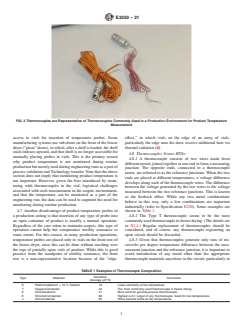
prevalent in a production environment. Fig. 3 is a photograph
ture Probe is Attached to the Outside surface of the Vial
of product thermocouples that are commonly used in a pro-
duction setting. There are at least two things “wrong with this
picture.” First, there is no provision for securing the tip of the
thermocouple in a fixed position in contact with the product.
margin below this upper limit without being unnecessarily low
Second, the heavy gauge of the thermocouple wire and the
resulting in an unnecessarily prolonged freeze-dry cycle.
consequent stiffness and weight of the wire adds to the
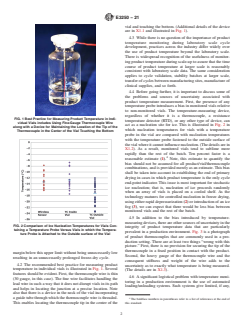
4.2 The recommended best practice for measuring product
uncertainty as to exactly what temperature is being measured.
temperature in individual vials is illustrated in Fig. 1. Several
(The details are in X1.3).
features should be evident. First, the thermocouple wire is thin
4.6 Asignificant logistical problem with temperature moni-
(30 gauge, in this case). The fine wire facilitates handling the
toring in a production environment is the use of automated
lead wire in such a way that it does not disrupt vials in its path
loading/unloading systems. Such systems give limited, if any,
and helps in locating the junction at a precise location. Note
also that there is a device in the neck of the vial incorporating
a guide tube through which the thermocouple wire is threaded.
The boldface numbers in parentheses refer to a list of references at the end of
This enables locating the thermocouple tip in the center of the this standard.
E3250 − 21
FIG. 3 Thermocouples are Representative of Thermocouples Commonly Used in a Production Environment for Product Temperature
Measurement
access to vials for insertion of temperature probes. Some effect,” in which vials on the edge of an array of vials,
manufacturing systems use sub-doors on the front of the freeze particularly the edge near the door, receive additional heat via
dryer(“pizza”doors),inwhich,afterashelfisloaded,theshelf thermal radiation (4).
stack indexes upward, and that shelf is no longer accessible for
4.8 Thermocouples Versus RTDs:
manually placing probes in vials. This is the primary reason
4.8.1 A thermocouple consists of two wires made from
why product temperature is not monitored during routine
different metals joined together at one end to form a measuring
productionbutmerelyusedduringengineeringrunsasapartof
junction. The opposite ends, connected to a thermocouple
processvalidationandTechnologytransfer.Notethattheabove
meter, are referred to as the reference junctions. When the two
section does not imply that monitoring product temperature is
ends are placed at different temperatures, a voltage difference
not important. However, given the bias introduced by moni-
develops along each of the thermocouple wires. The difference
toring with thermocouples in the vial, logistical challenges
between the voltage generated by the two wires is the voltage
associated with such measurement in the aseptic environment,
measured between the two reference junctions. This is known
and that the temperature can be monitored as a part of the
as the Seebeck effect. While any two metal combinations
engineering run, the data can be used to augment the need for
behave in this way, only a few combinations are important
monitoring during routine production.
industrially (refer to Specification E230). Some examples are
4.7 Another disadvantage of product temperature probes in shown in Table 1.
a production setting is that insertion of any type of probe into 4.8.2 The Type T thermocouple seems to be the most
an open container of product is usually a manual operation. commonlyusedthermocoupleinfreezedrying.(Thedetailsare
Regardless of the care taken to maintain asepsis, this type of in X1.4.) Regular replacement of thermocouples should be
operation cannot help but compromise sterility assurance to considered, and of course, any thermocouple registering an
some extent. For this reason, in many production operations, open circuit should be discarded.
temperature probes are placed only in vials on the front row of 4.8.3 Given that thermocouples generate only tens of mi-
the freeze dryer, since this can be done without reaching over crovolts per degree temperature difference between the mea-
the tops of partially open vials of product. While this is good surement junction and the reference junction, it is important to
avoid introduction of any metal other than the appropriate
practice from the standpoint of sterility assurance, the front
row is a non-representative location because of the “edge- thermocouple materials anywhere in the circuit, particularly in
TABLE 1 Examples of Thermocouple Composition
Sensitivity
Type Materials Comments
(Average µV/°K)
S Platinum/platinum + 10 % rhodium 10 Loses sensitivity at low temperature.
T Copper/constantan 43 The most commonly used thermocouple in freeze drying.
K Chromel/alumel 41 Most common general-purpose thermocouple.
E Chromel/constantan 68 Highest e.m.f. output of any thermocouple. Good for low temperatures.
J Iron/constantan 50 Wires become brittle at low temperatures.
E3250 − 21
areas in which there are large temperature gradients. Connec- sensing element. Of course, as the size of the sensor decreases,
tors and feedthroughs should be constructed only of thermo- the more closely the measurement approaches a “point”
couple materials. It is also important to route thermocouple measurement. Provided that the sensor is located in the bottom
wires such that they are not near wires carrying a large current of the vial, the smaller sensor minimizes the problem of the
because the large current can induce a current in the thermo- sensor being partially embedded in frozen material and par-
couple circuit causing systematic errors. tially embedded in the dried layer. In fact, there is probably an
4.8.4 An RTD is based on the idea that the resistance of a optimum sensor size that combines the advantages of “point”
metal varies in a precise and reproducible way with tempera- sensing of a thermocouple with the relative insensitivity of the
ture. A common type of RTD is a 100 ohm platinum wire measuring element to small changes in the position of the
wound around a core material and covered with some type of sensor (see Note 1).With the data logger shown in Fig. 5, there
sheath (Fig. 4). Other types of RTDs in common use consist of isstillaleadwirefromthesensingelementtothelogger,sothe
a film of platinum on a solid substrate. This wire is placed on same consideration would apply to incorporating a device to
one side of a Wheatstone bridge circuit with the other side secure the sensing element in the middle of the vial touching
incorporating a reference resistor carrying the same current. the bottom. The logger shall also be positioned in such a way
RTDs are better than thermocouples in terms of accuracy, that it does not interfere with freeze-drying operations, such as
precision, linearity, and stability. For this reason, temperature stoppering.
measurement at fixed points in a freeze dryer, such as in the
NOTE 1—It is typical for freeze dryers to use thermocouples for product
heat transfer fluid at the inlet manifold to the shelves, on the
temperature monitoring and RTDs for process control. There is no
condenser, and in the drain lines, are usually RTDs. An
industry standard with respect to calibration frequency or the number of
reference temperatures to be used for calibration. RTDs, having a much
attribute of thermocouples that makes them particularly useful
more linear response than thermocouples, require fewer temperature
for product temperature measurement, however, is that the
points for calibration. A typical procedure is to place temperature probes
thermocouple measures temperature at the point at which the
in a stirred liquid reference bath (liquid is preferred over “dry” baths
two wires are joined, that is, it is a “point” measurement. An
because of better temperature uniformity in liquid baths as well as better
RTD measures the average temperature over the area of the
thermal contact with the sensor). Calibration points in the range of –50°C
to –20°C, –20°C to 0°C, and 110°C to 130°C are representative. The
sensing element. As discussed previously, it is important to
temperature indicated on all system devices, such as recorder, controller,
monitor the product at the warmest point, which is at the
and control system displays, should be within 0.5°C of each reference
bottom of the frozen material. As seen in Fig. 4, the tempera-
temperature. If not, the system needs to be adjusted accordingly. If an
turemeasuredistheaveragetemperatureoftheexposedareaof
adjustment is needed at any reference temperature, then accuracy at each
the element. For this type of sensor, the measuring element is of the other temperatures needs to be rechecked. We recommend a
risk-based approach to the calibration frequency. For example, a typical
partiallyimmersedinthefrozenmatrixandpartiallyembedded
calibration frequency is every 30 freeze dry cycles or every 3 months,
in the partially dried solid for most of primary drying, so the
whichever comes first.
average temperature would be misleading.
4.9 Recommended Best Practice for Product Temperature
4.8.5 Some newer RTD systems incorporate much smaller
Measurement:
sensing elements than older RTD systems, which tend to be
4.9.1 Best practice with respect to product temperature
relatively bulky. The larger the sensing element, the larger the
measurement can be summarized as follows:
discrepancy between the RTD and a thermocouple. An ex-
4.9.1.1 Despite the fact that RTDs are, in many ways,
ample of more recent RTD-based technology is the data logger
superior to thermocouples, thermocouples are preferred for
(Ellab, Hilleroed, Denmark) shown in Fig. 5. Note the small
product temperature measurement because of the ability to
measure temperature at a precise point. The most appropriate
pointtomeasureproducttemperatureisinthecenterofthevial
with the tip of the thermocouple touching the bottom of the
vial.
4.9.1.2 Fine-gauge thermocouple wire is preferred because
of the flexibility of the wire and the ability to locate the tip of
the thermocouple in a precise location, for example, for small
fillvolumesinsmallvials,a36-gauge(0.13mm)thermocouple
is a good choice. For larger fill volumes in larger vials, a
somewhat larger gauge, such as 30 (0.25 mm), would be
appropriate.
4.9.1.3 Usesometypeofdevicetoholdthethermocouplein
place within a monitored vial. The open area of this device
should be very close to that of a partially stoppered vial.
4.9.1.4 Be aware of the sources of uncertainty associated
with product temperature measurement in a manufacturing
setting and do not overinterpret such data.
4.9.1.5 Be aware of the bias in freezing and freeze-drying
behavior caused by any temperature-measuring device. Recog-
FIG. 4 100Ω Platinum RTD Sensor nize that monitored vials may freeze dry significantly faster
E3250 − 21
FIG. 5 As RTD Sensing Elements Become Smaller, as Shown
Here for a Temperature Data Logger (Ellab), They More Closely
Approximate a “Point” Temperature Measurement
than the rest of the batch. The same best practices that apply at important in freeze drying because the composition of the gas
the laboratory scale should also apply in a manufacturing phase in the chamber changes dramatically from being essen-
environment.
tially 100 % water vapor during the primary drying phase to
essentially 100 % nitrogen (or whatever gas is being bled into
5. Chamber Pressure Measurement in Freeze Drying
the chamber to control pressure) late in secondary drying. The
5.1 There are many types of pressure transducers and a
free molecular conductivity of water vapor is about 60 %
review of all of them is beyond the scope of this practice. The
higher than the free molecular conductivity of nitrogen (5).
focus is on two types: thermal conductivity type sensors and
This characteristic can be used as an advantage as a process
the capacitance manometer. Both types are commonly used in
monitoring tool, explained in 5.2.3 and 5.2.4.
pharmaceutical freeze drying but are often not applied in the
5.2.3 It is important to understand that thermal conductivity
most useful way.
type gauges use a hot filament. This brings up a safety concern
5.2 Thermal Conductivity Type Gauge:
whenfreezedryingformulationscontaininganorganicsolvent,
5.2.1 Therearetwobasictypesofthermalconductivitytype
such as t-butanol. (The details are in X1.5). It is considered
pressure gauge: a thermocouple gauge and a Pirani gauge. The
best practice to turn off thermal conductivity type gauges when
thermocouple gauge consists of a thermocouple spot-welded to
freeze drying products containing an organic solvent.
a heated filament. The filament, fed by a constant current,
Alternatively, the product chamber could be evacuated and
reaches a temperature determined by the rate of energy loss
purged with nitrogen before starting freezing.
from the filament by a combination of thermal radiation and
5.2.4 It is important to be aware that different Pirani gauges
conduction through the process gas. Energy loss by thermal
vary in their robustness to repeated steam sterilization. There
radiation is kept small by using a filament with a low thermal
are no controlled studies to determine the mechanism of
emissivity, such as platinum. The higher the pressure in the
failure. Possible modes of failure could be over-pressurization
system, the more rapid the rate of energy loss from the
(the upper pressure limit for most Pirani gauges is about 1000
filament. The output of this gauge is nonlinear, and the useful
Torr) or exposure to excessively high temperature. However, it
pressure range is rather small, only about two orders of
is likely that the ability to withstand repeated steam steriliza-
magnitude. Thermocouple pressure gauges are usually found
tion has more to do with the composition of the filament.
on the less expensive laboratory scale freeze dryers.
Several filament compositions are used, including tungsten/
5.2.1.1 In the Pirani gauge, two filaments are used as the
rhenium, platinum/iridium, platinum/rhodium, platinum, and
two “arms” of a Wheatstone bridge. One filament is the
gold-plated tungsten. A gauge designed for corrosive environ-
reference filament maintained at constant pressure and gas
ments has been tested. This gauge uses a platinum/iridium
phase composition. The other filament is the measurement
filament and was demonstrated to withstand 80–100 steam
filament. In the Pirani gauge, the filament temperature is
sterilization cycles. This gauge has still not failed, although it
controlled at a constant value, and the current needed to do so
is steam sterilized less frequently. In contrast, another gauge
is monitored. A Pirani gauge has about 100 times the useful
was tested, which uses a gold-plated tungsten filament. This
range of a thermocouple gauge and is, thus, the preferred
gauge failed after two or three sterilization cycles. It is prudent
thermal conductivity type instrument for freeze drying.
toassumethataPiranigaugewillfailatsomepointandrequire
5.2.2 An important characteristic of any thermal conductiv-
ity type gauge is that the response is a function of the replacement, but it is important to be careful in selection of the
composition of the vapor phase being monitored. This is gauge.
E3250 − 21
5.3 Capacitance Manometer: 5.5 The higher apparent pressure during primary drying as
5.3.1 All capacitance-based gauges work in one of two measured by the Pirani gauge reflects the higher thermal
ways, either by keeping the geometry of the system constant
conductivity of water vapor, which makes up nearly all of the
and allowing the dielectric constant to vary or a variable
vapor phase in the chamber during primary drying. As subli-
geometry with a constant dielectric constant.The latter mecha-
mation of ice is completed, the apparent chamber pressure
nism is the basis for the capacitance manometer pressure
drops. The width of the transition region from pseudo steady
gauge. There are two sides of the transducer: a reference side
state during primary drying to equilibration with the capaci-
that is evacuated and sealed at a very low pressure of around
tance manometer is a measure of the vial-to-vial consistency in
–7
10 Torr and a measurement side that is exposed to the
primary drying rate, the more uniform the vial-to-vial subli-
process. The sides are isolated by a metal diaphragm, typically
mation rate, the sharper the apparent pressure drop during the
Inconel, a high-quality stainless steel. As the process pressure
transition. For example, the “edge effect” in which vials at the
changes, the diaphragm flexes changing the geometry and,
edge of an array of vials dry faster than the vials in the center
therefore, the capacitance, of the instrument. Capacitance
of an array would be reflected in a more gradual decrease in
manometers are the instrument of choice for pharmaceutical
apparent pressure at the end of primary drying. It is considered
freeze drying because of their wide useful range (about four
good practice to wait until the Pirani reading has nearly
orders of magnitude), accuracy, stability, and linearity.Another
reached the capacitance manometer reading before increasing
compelling feature is that a capacitance manometer measures
the shelf temperature for secondary drying. In general, a
true pressure, force per unit area, independent of gas phase
difference in pressure readings of 5–10 mTseems to work well
composition. It is best practice to use a heated transducer to
as long as the steady state pressure during primary drying is
avoid the possibility of water vapor condensation inside the
more than about 40 mT. Note that a difference between the
gauge,perhapsfromsteamsterilization,andavoidthepotential
Pirani reading and capacitance manometer in a clean, dry
for zero drift caused by variation in ambient temperature.
empty chamber results typically from a calibration offset
5.4 Best practice for monitoring the pressure in the chamber
between these pressure gauges. It is, therefore, a good idea to
and condenser of a freeze dryer is to have both a capacitance
measure this difference/correct in advance. Some freeze dryer
manometer and a Pirani gauge on both the chamber and the
manufacturers offer the very useful option of sequencing the
condenser. This configuration enables what has come to be
cyclefromprimarytosecondarydryingbasedonthedifference
called comparative pressure measurement. In this process
in apparent pressure between the capacitance manometer and
analytical method, the chamber pressure is monitored and
the Pirani gauge.
controlled using the capacitance manometer. Simultaneously,
5.6 The main advantage of comparative pressure measure-
pressure is monitored using the Pirani gauge. This technique
ment is that it does not depe
...