

ASTM D721-17
(Test Method)Standard Test Method for Oil Content of Petroleum Waxes
General Information
- Abstract
SIGNIFICANCE AND USE
4.1 The oil content of a wax may have significant effects on several of its properties, such as strength, hardness, flexibility, scuff resistance, coefficient of friction, coefficient of expansion, melting point, and oil straining. The importance of these effects may be dependent upon the ultimate use of the wax.
SCOPE
1.1 This test method covers the determination of oil in petroleum waxes having a congealing point of 30 °C (86 °F) or higher as determined in accordance with Test Method D938, and containing not more than 15 % of oil.2
Note 1: With some types of waxes, of oil contents greater than 5 %, there may be an incompatibility with MEK resulting in the formation of two liquid phases. If this occurs, the test method is not applicable to the material under test.
1.2 The values stated in inch-pound units are to be regarded as standard. The values given in parentheses are mathematical conversions to SI units that are provided for information only and are not considered standard.
1.3 This standard does not purport to address all of the safety concerns, if any, associated with its use. It is the responsibility of the user of this standard to establish appropriate safety and health practices and determine the applicability of regulatory limitations prior to use.
1.4 This international standard was developed in accordance with internationally recognized principles on standardization established in the Decision on Principles for the Development of International Standards, Guides and Recommendations issued by the World Trade Organization Technical Barriers to Trade (TBT) Committee.
- Status
- Published
- Publication Date
- 30-Apr-2017
- Technical Committee
- D02 - Petroleum Products, Liquid Fuels, and Lubricants
Overview
ASTM D721-17: Standard Test Method for Oil Content of Petroleum Waxes specifies a precise laboratory procedure to determine the oil content in petroleum waxes. This standard, published by ASTM International, is designed for waxes with a congealing point of 30°C (86°F) or higher, containing up to 15% oil by weight. The methodology is critical for industries where the physical properties of wax are closely linked to its oil content. Changes in oil content can significantly affect strength, hardness, flexibility, scuff resistance, friction, expansion, melting point, and oil straining, all of which influence the suitability of wax for different applications.
Key Topics
- Scope and Applicability:
- Applicable to petroleum waxes as defined by their congealing point and oil percentage.
- Not suitable for samples where high oil content (>5%) leads to incompatibility with methyl ethyl ketone (MEK).
- Test Method Summary:
- Dissolving the wax sample in MEK.
- Cooling the solution to precipitate wax and subsequent filtration.
- Evaporation of the solvent and weighing the residue to determine oil content.
- Significance and Use:
- Oil content impacts key functional properties of wax used in industrial and commercial products.
- Quality assurance and regulatory compliance depend on accurate measurement of oil in wax.
- Precision and Reproducibility:
- Details guidelines for repeatability and reproducibility to ensure reliable results.
Applications
- Quality Control in Manufacturing:
- Used by wax producers and refiners to ensure the product meets specified oil content limits.
- Essential for manufacturers of candles, packaging, laminates, and coatings where oil content affects performance.
- Material Selection for End Use:
- Determines suitability for specific industrial and commercial applications, such as in food packaging or cosmetics, where low oil content is crucial.
- Research and Development:
- Facilitates R&D in developing new wax blends with tailored physical properties.
- Regulatory Compliance:
- Helps companies adhere to industry standards and government requirements for petroleum waxes.
- Inter-laboratory Consistency:
- Provides a standardized procedure for consistent test results across different testing sites.
Related Standards
- ASTM D938: Test Method for Congealing Point of Petroleum Waxes, Including Petrolatum.
- ASTM E1 / E2251: Specifications for liquid-in-glass thermometers used in the method.
- ASTM E128: Test Method for maximum pore diameter and permeability of rigid porous filters, pertinent to filtration apparatus.
- Energy Institute (IP) Standards: Specifications for standard thermometers referenced in this procedure.
Practical Value
Adhering to ASTM D721-17 ensures the consistent and accurate determination of oil content in petroleum waxes, which is central to product performance, quality control, and regulatory adherence. The method supports critical decisions throughout the supply chain, from raw material acceptance to finished product release, and is a vital tool for laboratories, manufacturers, and regulatory bodies involved in the production and use of petroleum waxes.
Keywords: ASTM D721, oil content, petroleum wax, wax testing, quality control, industrial standards, manufacturing compliance.
Relations
- Effective Date
- 01-Nov-2019
- Effective Date
- 01-May-2013
- Effective Date
- 01-Oct-2011
- Effective Date
- 01-May-2011
- Effective Date
- 01-Nov-2010
- Effective Date
- 01-Nov-2007
- Effective Date
- 01-Nov-2007
- Refers
ASTM D938-05 - Standard Test Method for Congealing Point of Petroleum Waxes, Including Petrolatum - Effective Date
- 01-Nov-2005
- Effective Date
- 01-Nov-2005
- Effective Date
- 01-May-2005
- Refers
ASTM D938-04 - Standard Test Method for Congealing Point of Petroleum Waxes, Including Petrolatum - Effective Date
- 01-May-2004
- Effective Date
- 01-Nov-2003
- Effective Date
- 01-Nov-2003
- Effective Date
- 10-May-2003
- Effective Date
- 10-Jan-2003
Get Certified
Connect with accredited certification bodies for this standard

Element Materials Technology
Materials testing and product certification.

ABS Group Brazil
ABS Group certification services in Brazil.

ABS Quality Evaluations Inc.
American Bureau of Shipping quality certification.
Sponsored listings
Frequently Asked Questions
ASTM D721-17 is a standard published by ASTM International. Its full title is "Standard Test Method for Oil Content of Petroleum Waxes". This standard covers: SIGNIFICANCE AND USE 4.1 The oil content of a wax may have significant effects on several of its properties, such as strength, hardness, flexibility, scuff resistance, coefficient of friction, coefficient of expansion, melting point, and oil straining. The importance of these effects may be dependent upon the ultimate use of the wax. SCOPE 1.1 This test method covers the determination of oil in petroleum waxes having a congealing point of 30 °C (86 °F) or higher as determined in accordance with Test Method D938, and containing not more than 15 % of oil.2 Note 1: With some types of waxes, of oil contents greater than 5 %, there may be an incompatibility with MEK resulting in the formation of two liquid phases. If this occurs, the test method is not applicable to the material under test. 1.2 The values stated in inch-pound units are to be regarded as standard. The values given in parentheses are mathematical conversions to SI units that are provided for information only and are not considered standard. 1.3 This standard does not purport to address all of the safety concerns, if any, associated with its use. It is the responsibility of the user of this standard to establish appropriate safety and health practices and determine the applicability of regulatory limitations prior to use. 1.4 This international standard was developed in accordance with internationally recognized principles on standardization established in the Decision on Principles for the Development of International Standards, Guides and Recommendations issued by the World Trade Organization Technical Barriers to Trade (TBT) Committee.
SIGNIFICANCE AND USE 4.1 The oil content of a wax may have significant effects on several of its properties, such as strength, hardness, flexibility, scuff resistance, coefficient of friction, coefficient of expansion, melting point, and oil straining. The importance of these effects may be dependent upon the ultimate use of the wax. SCOPE 1.1 This test method covers the determination of oil in petroleum waxes having a congealing point of 30 °C (86 °F) or higher as determined in accordance with Test Method D938, and containing not more than 15 % of oil.2 Note 1: With some types of waxes, of oil contents greater than 5 %, there may be an incompatibility with MEK resulting in the formation of two liquid phases. If this occurs, the test method is not applicable to the material under test. 1.2 The values stated in inch-pound units are to be regarded as standard. The values given in parentheses are mathematical conversions to SI units that are provided for information only and are not considered standard. 1.3 This standard does not purport to address all of the safety concerns, if any, associated with its use. It is the responsibility of the user of this standard to establish appropriate safety and health practices and determine the applicability of regulatory limitations prior to use. 1.4 This international standard was developed in accordance with internationally recognized principles on standardization established in the Decision on Principles for the Development of International Standards, Guides and Recommendations issued by the World Trade Organization Technical Barriers to Trade (TBT) Committee.
ASTM D721-17 is classified under the following ICS (International Classification for Standards) categories: 75.140 - Waxes, bituminous materials and other petroleum products. The ICS classification helps identify the subject area and facilitates finding related standards.
ASTM D721-17 has the following relationships with other standards: It is inter standard links to ASTM E128-99(2019), ASTM E1-13, ASTM E128-99(2011), ASTM E2251-11, ASTM E2251-10, ASTM E1-07, ASTM E2251-07, ASTM D938-05, ASTM E1-05, ASTM E128-99(2005), ASTM D938-04, ASTM E1-03a, ASTM E2251-03a, ASTM E1-03, ASTM E2251-03. Understanding these relationships helps ensure you are using the most current and applicable version of the standard.
ASTM D721-17 is available in PDF format for immediate download after purchase. The document can be added to your cart and obtained through the secure checkout process. Digital delivery ensures instant access to the complete standard document.
Standards Content (Sample)
This international standard was developed in accordance with internationally recognized principles on standardization established in the Decision on Principles for the
Development of International Standards, Guides and Recommendations issued by the World Trade Organization Technical Barriers to Trade (TBT) Committee.
Designation: D721 − 17
Designation: 158/69(85)
Standard Test Method for
Oil Content of Petroleum Waxes
This standard is issued under the fixed designation D721; the number immediately following the designation indicates the year of
original adoption or, in the case of revision, the year of last revision. A number in parentheses indicates the year of last reapproval. A
superscript epsilon (´) indicates an editorial change since the last revision or reapproval.
This standard has been approved for use by agencies of the U.S. Department of Defense.
1. Scope* 2. Referenced Documents
2.1 ASTM Standards:
1.1 This test method covers the determination of oil in
D938 Test Method for Congealing Point of Petroleum
petroleum waxes having a congealing point of 30 °C (86 °F) or
Waxes, Including Petrolatum
higher as determined in accordance with Test Method D938,
E1 Specification for ASTM Liquid-in-Glass Thermometers
and containing not more than 15 % of oil.
E128 Test Method for Maximum Pore Diameter and Perme-
NOTE 1—With some types of waxes, of oil contents greater than 5 %,
ability of Rigid Porous Filters for Laboratory Use
there may be an incompatibility with MEK resulting in the formation of
E2251 Specification for Liquid-in-Glass ASTM Thermom-
two liquid phases. If this occurs, the test method is not applicable to the
eters with Low-Hazard Precision Liquids
material under test.
2.2 Energy Institute Standards:
1.2 The values stated in inch-pound units are to be regarded
Specification for IP Standard Thermometers
as standard. The values given in parentheses are mathematical
conversions to SI units that are provided for information only
3. Summary of Test Method
and are not considered standard.
3.1 The sample is dissolved in methyl ethyl ketone, the
1.3 This standard does not purport to address all of the
solution cooled to –32 °C (–25 °F) to precipitate the wax, and
safety concerns, if any, associated with its use. It is the
filtered. The oil content of the filtrate is determined by
responsibility of the user of this standard to establish appro-
evaporating the methyl ethyl ketone and weighing the residue.
priate safety and health practices and determine the applica-
4. Significance and Use
bility of regulatory limitations prior to use.
1.4 This international standard was developed in accor-
4.1 The oil content of a wax may have significant effects on
dance with internationally recognized principles on standard-
several of its properties, such as strength, hardness, flexibility,
ization established in the Decision on Principles for the
scuff resistance, coefficient of friction, coefficient of expansion,
Development of International Standards, Guides and Recom-
melting point, and oil straining. The importance of these effects
mendations issued by the World Trade Organization Technical
may be dependent upon the ultimate use of the wax.
Barriers to Trade (TBT) Committee.
5. Apparatus
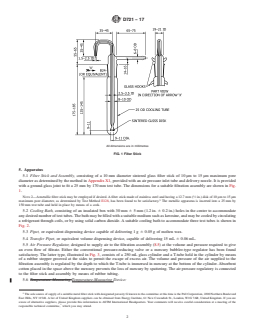
5.1 Filter Stick and Assembly, consisting of a 10 mm diam-
1 eter sintered glass filter stick of 10 μm to 15 μm maximum pore
This test method is under the jurisdiction of ASTM Committee D02 on
Petroleum Products, Liquid Fuels, and Lubricants and is the direct responsibility of diameter as determined by the method in Appendix X1,
Subcommittee D02.10 on Properties of Petroleum Waxes and Alternative Wax-like
provided with an air pressure inlet tube and delivery nozzle. It
Materials.
is provided with a ground-glass joint to fit a 25 mm by 170 mm
Current edition approved May 1, 2017. Published June 2017. Originally
test tube. The dimensions for a suitable filtration assembly are
approved in 1943. Last previous edition approved in 2015 as D721 – 15. DOI:
10.1520/D0721-17.
shown in Fig. 1.
In the IP, this test method is under the jurisdiction of the Standardization
Committee. This test method was issued as a joint ASTM-IP tentative in 1964.
This test method was prepared jointly by the Technical Association of Pulp and For referenced ASTM standards, visit the ASTM website, www.astm.org, or
Paper Industry and ASTM International. contact ASTM Customer Service at service@astm.org. For Annual Book of ASTM
This test method has been adopted for use by government agencies to replace Standards volume information, refer to the standard’s Document Summary page on
Method 5431 of Federal Test Method Standard No. 79lb. the ASTM website.
This test method is being used by some laboratories for products of higher oil Available from Energy Institute, 61 New Cavendish St., London, WIG 7AR,
content. U.K.
*A Summary of Changes section appears at the end of this standard
Copyright © ASTM International, 100 Barr Harbor Drive, PO Box C700, West Conshohocken, PA 19428-2959. United States
D721 − 17
5.5 Air Pressure Regulator, designed to supply air to the
filtration assembly (8.5) at the volume and pressure required to
give an even flow of filtrate. Either the conventional pressure-
reducing valve or a mercury bubbler-type regulator has been
found satisfactory. The latter type, illustrated in Fig. 3, consists
of a 250 mL glass cylinder and a T-tube held in the cylinder by
means of a rubber stopper grooved at the sides to permit the
escape of excess air. The volume and pressure of the air
supplied to the filtration assembly is regulated by the depth to
which the T-tube is immersed in mercury at the bottom of the
cylinder. Absorbent cotton placed in the space above the
mercury prevents the loss of mercury by spattering. The air
pressure regulatory is connected to the filter stick and assembly
by means of rubber tubing.
5.6 Temperature-Measuring Device:
5.6.1 Thermometer, having a range as shown below and
conforming to the requirements as prescribed in Specification
E1, Specification E2251, or in the Specification for IP Standard
Thermometers.
Thermometer Number
Temperature Range ASTM IP
–38 °C to +50 °C S5C .
–36 °F to +120 °F S5F .
–37 °C to +21 °C 71C 72C
–35 °F to +70 °F 71F 72F
All dimensions are in millimetres 5.6.2 Temperature-measuring devices other than those de-
scribed in 5.6.1 are satisfactory for this test method, provided
FIG. 1 Filter Stick
that they exhibit the same temperature response as the equiva-
lent mercury-in-glass thermometers.
NOTE 2—A metallic filter stick may be employed if desired. A filter
5.7 Weighing Bottles, glass-stoppered, having a typical ca-
stick made of stainless steel and having a 12.7 mm ( ⁄2 in.) disk of 10 μm
pacity of 15 mL to 25 mL.
to 15 μm maximum pore diameter, as determined by Test Method E128,
has been found to be satisfactory. The metallic apparatus is inserted into
5.8 Evaporation Assembly, consisting of an evaporating
a 25 mm by 150 mm test tube and held in place by means of a cork.
cabinet and connections, essentially as illustrated in Fig. 4, and
5.2 Cooling Bath, consisting of an insulated box with
capable of maintaining a temperature of 35 °C 6 1 °C (95 °F
30 mm 6 5 mm (1.2 in. 6 0.2 in.) holes in the center to 6 2 °F) around the evaporation flask. Construct the jets with an
accommodate any desired number of test tubes. The bath may
inside diameter of 4 mm 6 0.2 mm for delivering a stream of
be filled with a suitable medium such as kerosine, and may be clean, dry air vertically downward into the weighing bottle.
cooled by circulating a refrigerant through coils, or by using
Support each jet so that the tip is 15 mm 6 5 mm above the
solid carbon dioxide. A suitable cooling bath to accommodate surface of the liquid at the start of the evaporation. Supply
three test tubes is shown in Fig. 2. purified air at the rate of 2 L ⁄min to 3 L ⁄min per jet. One way
to purify the air is by passage through a tube of approximately
5.3 Pipet, or equivalent dispensing device capable of deliv-
10 mm bore packed loosely to a height of approximately
ering 1 g 6 0.05 g of molten wax.
200 mm with absorbent cotton. Periodically check the cleanli-
5.4 Transfer Pipet, or equivalent volume dispensing device,
ness of the air by evaporating 4 mL of methyl ethyl ketone by
capable of delivering 15 mL 6 0.06 mL.
the procedure specified in 8.5. When the residue does not
exceed 0.1 mg, the evaporation equipment is operating satis-
5 factorily.
The sole source of supply of a suitable metal filter stick with designated
porosity G known to the committee at this time is the Pall Corporation, 2200
5.9 Analytical Balance, capable of reproducing weights to
Northern Boulevard East Hills, NY 11548. A list of United Kingdom suppliers can
0.1 mg.
be obtained from Energy Institute, 61 New Cavendish St., London, W1G 7AR,
United Kingdom. If you are aware of alternative suppliers, please provide this
5.10 Wire Stirrer—A piece of stiff wire, made of iron,
information to ASTM International Headquarters. Your comments will receive
stainless steel, or Nichrome wire of about No. 20 B & S
careful consideration at a meeting of the responsible technical committee, which
you may attend. (0.9 mm in diameter) or 16 swg gage, 250 mm long. A 10 mm
D721 − 17
All dimensions are in millimetres (inches)
FIG. 2 Cooling Bath
diameter loop is formed at each end, and the loop at the bottom 6.2 Store the solvent mixture over a suitable drying agent,
end is bent so that the plane of the loop is perpendicular to the such as anhydrous calcium sulfate (five mass percent of the
wire.
solvent). Filter prior to use.
6.3 Air Supply, clean and filtered.
6. Reagents
NOTE 3—As an alternative, it is permissible to replace all references to
6.1 Methyl Ethyl Ketone, conforming to the specifications of
“air” with “nitrogen,” provided the nitrogen is clean and filtered. It should
the Committee on Analytical Reagents of the American Chemi- be noted, however, that the precision statements for the test method were
determined using air only and that the precision associated with using
cal Society.
nitrogen has not been determined.
7. Sample
Reagent Chemicals, American Chemical Society Specifications, American
Chemical Society, Washington, DC. For Suggestions on the testing of reagents not
7.1 If the sample of wax is 1 kg (2 lb) or less, obtain a
listed by the American Chemical Society, see Annual Standards for Laboratory
representative portion by melting the entire sample and stirring
Chemicals, BDH Ltd., Poole, Dorset, U.K., and the United States Pharmacopeia
thoroughly. For samples over 1 kg (2 lb), exercise special care
and National Formulary, U.S. Pharmacopeial Convention, Inc. (USPC), Rockville,
MD. to ensure obtaining a truly representative portion, bearing in
D721 − 17
in the cooling bath, which is maintained at –34.5 °C 6 1.0 °C
(–30.0 °F 6 2.0 °F). During this chilling operation it is
important that stirring by means of the temperature-measuring
device be almost continuous, in order to maintain a slurry of
uniform consistency as the wax precipitates. Do not allow
...
This document is not an ASTM standard and is intended only to provide the user of an ASTM standard an indication of what changes have been made to the previous version. Because
it may not be technically possible to adequately depict all changes accurately, ASTM recommends that users consult prior editions as appropriate. In all cases only the current version
of the standard as published by ASTM is to be considered the official document.
Designation: D721 − 15 D721 − 17
Designation: 158/69(85)
Standard Test Method for
Oil Content of Petroleum Waxes
This standard is issued under the fixed designation D721; the number immediately following the designation indicates the year of
original adoption or, in the case of revision, the year of last revision. A number in parentheses indicates the year of last reapproval. A
superscript epsilon (´) indicates an editorial change since the last revision or reapproval.
This standard has been approved for use by agencies of the U.S. Department of Defense.
1. Scope*
1.1 This test method covers the determination of oil in petroleum waxes having a congealing point of 30 °C (86 °F) or higher
as determined in accordance with Test Method D938, and containing not more than 15 % of oil.
NOTE 1—With some types of waxes, of oil contents greater than 5 %, there may be an incompatibility with MEK resulting in the formation of two
liquid phases. If this occurs, the test method is not applicable to the material under test.
1.2 The values stated in inch-pound units are to be regarded as standard. The values given in parentheses are mathematical
conversions to SI units that are provided for information only and are not considered standard.
1.3 This standard does not purport to address all of the safety concerns, if any, associated with its use. It is the responsibility
of the user of this standard to establish appropriate safety and health practices and determine the applicability of regulatory
limitations prior to use.
1.4 This international standard was developed in accordance with internationally recognized principles on standardization
established in the Decision on Principles for the Development of International Standards, Guides and Recommendations issued
by the World Trade Organization Technical Barriers to Trade (TBT) Committee.
2. Referenced Documents
2.1 ASTM Standards:
D938 Test Method for Congealing Point of Petroleum Waxes, Including Petrolatum
E1 Specification for ASTM Liquid-in-Glass Thermometers
E128 Test Method for Maximum Pore Diameter and Permeability of Rigid Porous Filters for Laboratory Use
E2251 Specification for Liquid-in-Glass ASTM Thermometers with Low-Hazard Precision Liquids
2.2 Energy Institute Standards:
Specification for IP Standard Thermometers
3. Summary of Test Method
3.1 The sample is dissolved in methyl ethyl ketone, the solution cooled to –32 °C (–25 °F) to precipitate the wax, and filtered.
The oil content of the filtrate is determined by evaporating the methyl ethyl ketone and weighing the residue.
4. Significance and Use
4.1 The oil content of a wax may have significant effects on several of its properties, such as strength, hardness, flexibility, scuff
resistance, coefficient of friction, coefficient of expansion, melting point, and oil straining. The importance of these effects may be
dependent upon the ultimate use of the wax.
This test method is under the jurisdiction of ASTM Committee D02 on Petroleum Products, Liquid Fuels, and Lubricants and is the direct responsibility of Subcommittee
D02.10.0A on Physical/Chemical Properties.
Current edition approved June 1, 2015May 1, 2017. Published June 2015June 2017. Originally approved in 1943. Last previous edition approved in 20112015 as D721 – 06
(2011).D721 – 15. DOI: 10.1520/D0721-15.10.1520/D0721-17.
In the IP, this test method is under the jurisdiction of the Standardization Committee. This test method was issued as a joint ASTM-IP tentative in 1964.
This test method was prepared jointly by the Technical Association of Pulp and Paper Industry and ASTM International.
This test method has been adopted for use by government agencies to replace Method 5431 of Federal Test Method Standard No. 79lb.
This test method is being used by some laboratories for products of higher oil content.
For referenced ASTM standards, visit the ASTM website, www.astm.org, or contact ASTM Customer Service at service@astm.org. For Annual Book of ASTM Standards
volume information, refer to the standard’s Document Summary page on the ASTM website.
Available from Energy Institute, 61 New Cavendish St., London, WIG 7AR, U.K.
*A Summary of Changes section appears at the end of this standard
Copyright © ASTM International, 100 Barr Harbor Drive, PO Box C700, West Conshohocken, PA 19428-2959. United States
D721 − 17
All dimensions are in millimetres
FIG. 1 Filter Stick
5. Apparatus
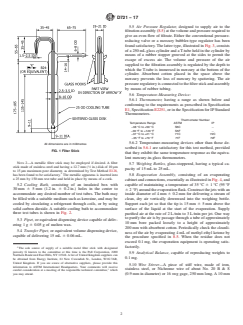
5.1 Filter Stick and Assembly, consisting of a 10 mm diameter sintered glass filter stick of 10 μm to 15 μm maximum pore
diameter as determined by the method in Appendix X1, provided with an air pressure inlet tube and delivery nozzle. It is provided
with a ground-glass joint to fit a 25 mm by 170 mm test tube. The dimensions for a suitable filtration assembly are shown in Fig.
1.
NOTE 2—A metallic filter stick may be employed if desired. A filter stick made of stainless steel and having a 12.7 mm ( ⁄2 in.) disk of 10 μm to 15 μm
maximum pore diameter, as determined by Test Method E128, has been found to be satisfactory. The metallic apparatus is inserted into a 25 mm by
150 mm test tube and held in place by means of a cork.
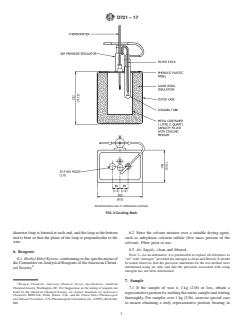
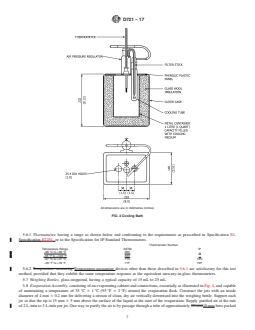
5.2 Cooling Bath, consisting of an insulated box with 30 mm 6 5 mm (1.2 in. 6 0.2 in.) holes in the center to accommodate
any desired number of test tubes. The bath may be filled with a suitable medium such as kerosine, and may be cooled by circulating
a refrigerant through coils, or by using solid carbon dioxide. A suitable cooling bath to accommodate three test tubes is shown in
Fig. 2.
5.3 Pipet, or equivalent dispensing device capable of delivering 1 g 6 0.05 g of molten wax.
5.4 Transfer Pipet, or equivalent volume dispensing device, capable of delivering 15 mL 6 0.06 mL.
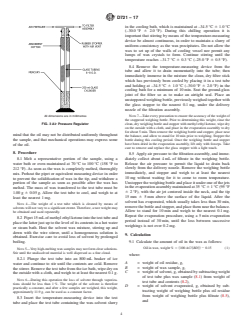
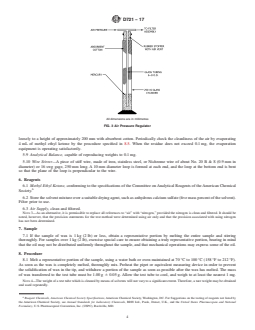
5.5 Air Pressure Regulator, designed to supply air to the filtration assembly (8.5) at the volume and pressure required to give
an even flow of filtrate. Either the conventional pressure-reducing valve or a mercury bubbler-type regulator has been found
satisfactory. The latter type, illustrated in Fig. 3, consists of a 250 mL glass cylinder and a T-tube held in the cylinder by means
of a rubber stopper grooved at the sides to permit the escape of excess air. The volume and pressure of the air supplied to the
filtration assembly is regulated by the depth to which the T-tube is immersed in mercury at the bottom of the cylinder. Absorbent
cotton placed in the space above the mercury prevents the loss of mercury by spattering. The air pressure regulatory is connected
to the filter stick and assembly by means of rubber tubing.
5.6 Temperature Measuring Temperature-Measuring Device:
The sole source of supply of a suitable metal filter stick with designated porosity G known to the committee at this time is the Pall Corporation, 2200 Northern Boulevard
East Hills, NY 11548. A list of United Kingdom suppliers can be obtained from Energy Institute, 61 New Cavendish St., London, W1G 7AR, United Kingdom. If you are
aware of alternative suppliers, please provide this information to ASTM International Headquarters. Your comments will receive careful consideration at a meeting of the
responsible technical committee, which you may attend.
D721 − 17
All dimensions are in millimetres (inches)
FIG. 2 Cooling Bath
5.6.1 Thermometer, having a range as shown below and conforming to the requirements as prescribed in Specification E1,
Specification E2251, or in the Specification for IP Standard Thermometers.
Thermometer Number
Temperature Range ASTM IP
–38 °C to +50 °C S5C .
–36 °F to +120 °F S5F .
–37 °C to +21 °C 71C 72C
–35 °F to +70 °F 71F 72F
5.6.2 Temperature measuring Temperature-measuring devices other than those described in 5.6.1 are satisfactory for this test
method, provided that they exhibit the same temperature response as the equivalent mercury-in-glass thermometers.
5.7 Weighing Bottles, glass-stoppered, having a typical capacity of 15 mL to 25 mL.
5.8 Evaporation Assembly, consisting of an evaporating cabinet and connections, essentially as illustrated in Fig. 4, and capable
of maintaining a temperature of 35 °C 6 1 °C (95 °F 6 2 °F) around the evaporation flask. Construct the jets with an inside
diameter of 4 mm 6 0.2 mm for delivering a stream of clean, dry air vertically downward into the weighing bottle. Support each
jet so that the tip is 15 mm 6 5 mm above the surface of the liquid at the start of the evaporation. Supply purified air at the rate
of 2 L ⁄min to 3 L ⁄min per jet. One way to purify the air is by passage through a tube of approximately 10-mm10 mm bore packed
D721 − 17
All dimensions are in millimetres
FIG. 3 Air Pressure Regulator
loosely to a height of approximately 200 mm with absorbent cotton. Periodically check the cleanliness of the air by evaporating
4 mL of methyl ethyl ketone by the procedure specified in 8.5. When the residue does not exceed 0.1 mg, the evaporation
equipment is operating satisfactorily.
5.9 Analytical Balance, capable of reproducing weights to 0.1 mg.
5.10 Wire Stirrer—A piece of stiff wire, made of iron, stainless steel, or Nichrome wire of about No. 20 B & S (0.9 mm in
diameter) or 16 swg gage, 250 mm long. A 10 mm diameter loop is formed at each end, and the loop at the bottom end is bent
so that the plane of the loop is perpendicular to the wire.
6. Reagents
6.1 Methyl Ethyl Ketone, conforming to the specifications of the Committee on Analytical Reagents of the American Chemical
Society.
6.2 Store the solvent mixture over a suitable drying agent, such as anhydrous calcium sulfate (five mass percent of the solvent).
Filter prior to use.
6.3 Air Supply, clean and filtered.
NOTE 3—As an alternative, it is permissible to replace all references to “air” with “nitrogen,” provided the nitrogen is clean and filtered. It should be
noted, however, that the precision statements for the test method were determined using air only and that the precision associated with using nitrogen
has not been determined.
7. Sample
7.1 If the sample of wax is 1 kg (2 lb) or less, obtain a representative portion by melting the entire sample and stirring
thoroughly. For samples over 1 kg (2 lb), exercise special care to ensure obtaining a truly representative portion, bearing in mind
that the oil may not be distributed uniformly throughout the sample, and that mechanical operations may express some of the oil.
8. Procedure
8.1 Melt a representative portion of the sample, using a water bath or oven maintained at 70 °C to 100 °C (158 °F to 212 °F).
As soon as the wax is completely melted, thoroughly mix. Preheat the pipet or equivalent measuring device in order to prevent
the solidification of wax in the tip, and withdraw a portion of the sample as soon as possible after the wax has melted. The mass
of wax transferred to the test tube must be 1.00 g 6 0.05 g. Allow the test tube to cool, and weigh to at least the nearest 1 mg.
NOTE 4—The weight of a test tube which is cleaned by means of solvents will not vary to a significant extent. Therefore, a tare weight may be obtained
and used repeatedly.
Reagent Chemicals, American Chemical Society Specifications, American Chemical Society, Washington, DC. For Suggestions on the testing of
...