

ASTM E1502-22
(Guide)Standard Guide for Use of Fixed-Point Cells for Reference Temperatures
General Information
- Abstract
SIGNIFICANCE AND USE
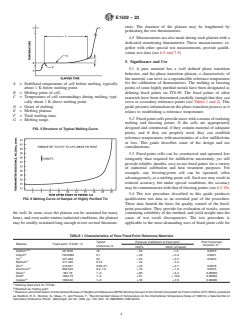
5.1 A pure material has a well defined phase transition behavior, and the phase transition plateau, a characteristic of the material, can serve as a reproducible reference temperature for the calibration of thermometers. The melting or freezing points of some highly purified metals have been designated as defining fixed points on ITS-90. The fixed points of other materials have been determined carefully enough that they can serve as secondary reference points (see Tables 1 and 2). This guide presents information on the phase transition process as it relates to establishing a reference temperature. (A) Defining fixed point for ITS-90.(B) Realized as melting point.(C) Based on recommendation of International Bureau of Weights and Measures (BIPM) Working Group 2 of the Comité Consultatif de Thermométrie (CCT-WG2); published as: Bedford, R. E., Bonnier, G., Maas, H., and Pavese, F., "Recommended Values of Temperature on the International Temperature Scale of 1990 for a Selected Set of Secondary Reference Points", Metrologia, Vol 33, 1996, pp. 133. DOI: 10.1088/0026-1394/33/2/3. (A) Values for cells of good design, construction, and material purity used with careful technique. Cells of lesser quality may not approach these values.(B) Realized as melting point.
5.2 Fixed-point cells provide users with a means of realizing melting and freezing points. If the cells are appropriately designed and constructed, if they contain material of adequate purity, and if they are properly used, they can establish reference temperatures with uncertainties of a few millikelvins or less. This guide describes some of the design and use considerations.
5.3 Fixed-point cells can be constructed and operated less stringently than required for millikelvin uncertainty, yet still provide reliable, durable, easy-to-use fixed points for a variety of industrial calibration and heat treatment purposes. For example, any freezing-point cell can be operated, often advantageously, as a melting-po...
SCOPE
1.1 This guide describes the essential features of fixed-point cells and auxiliary apparatus, and the techniques required to realize fixed points in the temperature range from 29 °C to 1085 °C.3
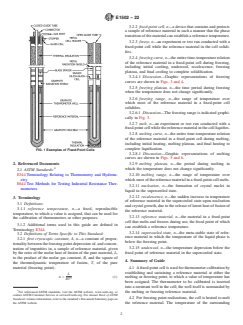
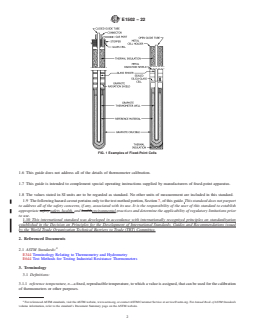
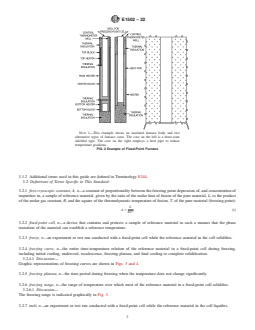
1.2 Design and construction requirements of fixed-point cells are not addressed in this guide. Typical examples are given in Figs. 1 and 2.
FIG. 1 Examples of Fixed-Point Cells
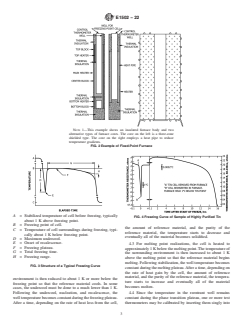
FIG. 2 Example of Fixed-Point Furnace
Note 1: This example shows an insulated furnace body and two alternative types of furnace cores. The core on the left is a three-zone shielded type. The core on the right employs a heat pipe to reduce temperature gradients.
1.3 This guide is intended to describe good practice and establish uniform procedures for the realization of fixed points.
1.4 This guide emphasizes principles. The emphasis on principles is intended to aid the user in evaluating cells, in improving technique for using cells, and in establishing procedures for specific applications.
1.5 For the purposes of this guide, the use of fixed-point cells for the accurate calibration of thermometers is restricted to immersion-type thermometers that, when inserted into the reentrant well of the cell, (1) indicate the temperature only of the isothermal region of the well, and (2) do not significantly alter the temperature of the isothermal region of the well by heat transfer.
1.6 This guide does not address all of the details of thermometer calibration.
1.7 This guide is intended to complement special operating instructions supplied by manufacturers of fixed-point apparatus.
1.8 The values stated in SI units are to be regarded as standard. No other units of measurement are included in this standard.
1.9 The following hazard caveat pertains only to the test method portion, Section 7, of this guide. This standard does not purport to address all of the safety concerns, if any, associated with its use. It is the responsibility of th...
- Status
- Published
- Publication Date
- 31-May-2022
- Technical Committee
- E20 - Temperature Measurement
- Drafting Committee
- E20.07 - Fundamentals in Thermometry
Overview
ASTM E1502-22: Standard Guide for Use of Fixed-Point Cells for Reference Temperatures provides essential principles for the realization and use of fixed-point cells in establishing reproducible reference temperatures. These reference temperatures are crucial for accurate calibration of thermometers, based on the phase transition points-melting or freezing-of highly pure materials. This guide is developed by ASTM to promote good practices, uniform procedures, and reliable outcomes in temperature measurement and calibration across a temperature range from 29 °C to 1085 °C, referencing fixed-point values on the International Temperature Scale of 1990 (ITS-90).
Key Topics
- Reference Temperatures: Using precisely defined melting and freezing points of pure substances, such as metals, as calibration standards for thermometers.
- Realization of Fixed Points: Description of the phase transition process, including plateaus at melting/freezing and the importance of material purity and uniform temperature control.
- Apparatus and Technique: Appropriate use of fixed-point cells alongside auxiliary equipment to achieve stable reference temperatures. Critical factors include the design of the cell, protection against contamination, and proper thermal equilibrium.
- Qualification and Quality Control: Procedures for qualification testing to ensure the ongoing reliability and accuracy of the fixed-point method, including monitoring and interpreting performance over repeated cycles.
- Applications Scope: Guidance restricts use to immersion-type thermometers that do not impact the isothermal environment within the cell, emphasizing the functional suitability of the method for high-precision calibration.
Applications
ASTM E1502-22 is a foundational document in the temperature calibration field. Its guidance is applicable to:
- Metrology Laboratories: Establishing national and industrial reference temperature points using fixed-point cells for high-precision thermometer calibration.
- Industrial Calibration and Heat Treatment: Providing robust and reliable fixed points suitable for routine calibration or verification processes without requiring ultra-low uncertainty.
- Quality Assurance: Assuring consistent performance in temperature sensors used for manufacturing, food processing, pharmaceuticals, and laboratory environments.
- Accreditation and Compliance: Supporting laboratories and calibration facilities in meeting international expectations for temperature measurement traceability.
By following this standard, organizations ensure that their temperature measurements reference stable, internationally recognized points, supporting credible and consistent results across various applications, from scientific research to process control.
Related Standards
- ASTM E344: Terminology Relating to Thermometry and Hydrometry - provides definitions of relevant terms used in ASTM E1502-22.
- ASTM E644: Test Methods for Testing Industrial Resistance Thermometers - supports qualification and verification procedures for thermometer types covered by E1502.
- ITS-90 (International Temperature Scale of 1990): The international framework that underpins the assignment of fixed points for reference temperatures.
- Other National and International Standards: Such as those issued by the International Bureau of Weights and Measures (BIPM), especially for reference material values and recommended procedures.
Practical Value
Implementing the ASTM E1502-22 standard provides several benefits:
- Ensures consistency and reproducibility in temperature calibration.
- Supports compliance with internationally recognized best practices in thermometry.
- Reduces uncertainty and enhances reliability in calibrated thermometers.
- Facilitates quality control and traceability in industries where precise temperature measurement is critical.
Organizations seeking reliable thermometer calibration and robust thermal references in laboratory or industrial settings will find ASTM E1502-22 an invaluable guide to best practices and essential techniques in fixed-point cell realization and use.
Relations
- Effective Date
- 01-Dec-2023
- Effective Date
- 01-Nov-2019
- Effective Date
- 01-Sep-2019
- Effective Date
- 01-Apr-2018
- Effective Date
- 01-Nov-2016
- Effective Date
- 01-May-2013
- Effective Date
- 01-May-2012
- Effective Date
- 01-May-2011
- Effective Date
- 01-Nov-2010
- Effective Date
- 01-Nov-2009
- Effective Date
- 15-Nov-2008
- Effective Date
- 01-May-2008
- Effective Date
- 01-Jun-2007
- Effective Date
- 01-Jun-2006
- Effective Date
- 01-May-2006
Get Certified
Connect with accredited certification bodies for this standard

BSMI (Bureau of Standards, Metrology and Inspection)
Taiwan's standards and inspection authority.
Sponsored listings
Frequently Asked Questions
ASTM E1502-22 is a guide published by ASTM International. Its full title is "Standard Guide for Use of Fixed-Point Cells for Reference Temperatures". This standard covers: SIGNIFICANCE AND USE 5.1 A pure material has a well defined phase transition behavior, and the phase transition plateau, a characteristic of the material, can serve as a reproducible reference temperature for the calibration of thermometers. The melting or freezing points of some highly purified metals have been designated as defining fixed points on ITS-90. The fixed points of other materials have been determined carefully enough that they can serve as secondary reference points (see Tables 1 and 2). This guide presents information on the phase transition process as it relates to establishing a reference temperature. (A) Defining fixed point for ITS-90.(B) Realized as melting point.(C) Based on recommendation of International Bureau of Weights and Measures (BIPM) Working Group 2 of the Comité Consultatif de Thermométrie (CCT-WG2); published as: Bedford, R. E., Bonnier, G., Maas, H., and Pavese, F., "Recommended Values of Temperature on the International Temperature Scale of 1990 for a Selected Set of Secondary Reference Points", Metrologia, Vol 33, 1996, pp. 133. DOI: 10.1088/0026-1394/33/2/3. (A) Values for cells of good design, construction, and material purity used with careful technique. Cells of lesser quality may not approach these values.(B) Realized as melting point. 5.2 Fixed-point cells provide users with a means of realizing melting and freezing points. If the cells are appropriately designed and constructed, if they contain material of adequate purity, and if they are properly used, they can establish reference temperatures with uncertainties of a few millikelvins or less. This guide describes some of the design and use considerations. 5.3 Fixed-point cells can be constructed and operated less stringently than required for millikelvin uncertainty, yet still provide reliable, durable, easy-to-use fixed points for a variety of industrial calibration and heat treatment purposes. For example, any freezing-point cell can be operated, often advantageously, as a melting-po... SCOPE 1.1 This guide describes the essential features of fixed-point cells and auxiliary apparatus, and the techniques required to realize fixed points in the temperature range from 29 °C to 1085 °C.3 1.2 Design and construction requirements of fixed-point cells are not addressed in this guide. Typical examples are given in Figs. 1 and 2. FIG. 1 Examples of Fixed-Point Cells FIG. 2 Example of Fixed-Point Furnace Note 1: This example shows an insulated furnace body and two alternative types of furnace cores. The core on the left is a three-zone shielded type. The core on the right employs a heat pipe to reduce temperature gradients. 1.3 This guide is intended to describe good practice and establish uniform procedures for the realization of fixed points. 1.4 This guide emphasizes principles. The emphasis on principles is intended to aid the user in evaluating cells, in improving technique for using cells, and in establishing procedures for specific applications. 1.5 For the purposes of this guide, the use of fixed-point cells for the accurate calibration of thermometers is restricted to immersion-type thermometers that, when inserted into the reentrant well of the cell, (1) indicate the temperature only of the isothermal region of the well, and (2) do not significantly alter the temperature of the isothermal region of the well by heat transfer. 1.6 This guide does not address all of the details of thermometer calibration. 1.7 This guide is intended to complement special operating instructions supplied by manufacturers of fixed-point apparatus. 1.8 The values stated in SI units are to be regarded as standard. No other units of measurement are included in this standard. 1.9 The following hazard caveat pertains only to the test method portion, Section 7, of this guide. This standard does not purport to address all of the safety concerns, if any, associated with its use. It is the responsibility of th...
SIGNIFICANCE AND USE 5.1 A pure material has a well defined phase transition behavior, and the phase transition plateau, a characteristic of the material, can serve as a reproducible reference temperature for the calibration of thermometers. The melting or freezing points of some highly purified metals have been designated as defining fixed points on ITS-90. The fixed points of other materials have been determined carefully enough that they can serve as secondary reference points (see Tables 1 and 2). This guide presents information on the phase transition process as it relates to establishing a reference temperature. (A) Defining fixed point for ITS-90.(B) Realized as melting point.(C) Based on recommendation of International Bureau of Weights and Measures (BIPM) Working Group 2 of the Comité Consultatif de Thermométrie (CCT-WG2); published as: Bedford, R. E., Bonnier, G., Maas, H., and Pavese, F., "Recommended Values of Temperature on the International Temperature Scale of 1990 for a Selected Set of Secondary Reference Points", Metrologia, Vol 33, 1996, pp. 133. DOI: 10.1088/0026-1394/33/2/3. (A) Values for cells of good design, construction, and material purity used with careful technique. Cells of lesser quality may not approach these values.(B) Realized as melting point. 5.2 Fixed-point cells provide users with a means of realizing melting and freezing points. If the cells are appropriately designed and constructed, if they contain material of adequate purity, and if they are properly used, they can establish reference temperatures with uncertainties of a few millikelvins or less. This guide describes some of the design and use considerations. 5.3 Fixed-point cells can be constructed and operated less stringently than required for millikelvin uncertainty, yet still provide reliable, durable, easy-to-use fixed points for a variety of industrial calibration and heat treatment purposes. For example, any freezing-point cell can be operated, often advantageously, as a melting-po... SCOPE 1.1 This guide describes the essential features of fixed-point cells and auxiliary apparatus, and the techniques required to realize fixed points in the temperature range from 29 °C to 1085 °C.3 1.2 Design and construction requirements of fixed-point cells are not addressed in this guide. Typical examples are given in Figs. 1 and 2. FIG. 1 Examples of Fixed-Point Cells FIG. 2 Example of Fixed-Point Furnace Note 1: This example shows an insulated furnace body and two alternative types of furnace cores. The core on the left is a three-zone shielded type. The core on the right employs a heat pipe to reduce temperature gradients. 1.3 This guide is intended to describe good practice and establish uniform procedures for the realization of fixed points. 1.4 This guide emphasizes principles. The emphasis on principles is intended to aid the user in evaluating cells, in improving technique for using cells, and in establishing procedures for specific applications. 1.5 For the purposes of this guide, the use of fixed-point cells for the accurate calibration of thermometers is restricted to immersion-type thermometers that, when inserted into the reentrant well of the cell, (1) indicate the temperature only of the isothermal region of the well, and (2) do not significantly alter the temperature of the isothermal region of the well by heat transfer. 1.6 This guide does not address all of the details of thermometer calibration. 1.7 This guide is intended to complement special operating instructions supplied by manufacturers of fixed-point apparatus. 1.8 The values stated in SI units are to be regarded as standard. No other units of measurement are included in this standard. 1.9 The following hazard caveat pertains only to the test method portion, Section 7, of this guide. This standard does not purport to address all of the safety concerns, if any, associated with its use. It is the responsibility of th...
ASTM E1502-22 is classified under the following ICS (International Classification for Standards) categories: 17.200.20 - Temperature-measuring instruments. The ICS classification helps identify the subject area and facilitates finding related standards.
ASTM E1502-22 has the following relationships with other standards: It is inter standard links to ASTM E344-23, ASTM E644-11(2019), ASTM E344-19, ASTM E344-18, ASTM E344-16, ASTM E344-13, ASTM E344-12, ASTM E644-11, ASTM E344-10, ASTM E644-09, ASTM E344-08, ASTM E644-08, ASTM E344-07, ASTM E644-06, ASTM E344-06. Understanding these relationships helps ensure you are using the most current and applicable version of the standard.
ASTM E1502-22 is available in PDF format for immediate download after purchase. The document can be added to your cart and obtained through the secure checkout process. Digital delivery ensures instant access to the complete standard document.
Standards Content (Sample)
This international standard was developed in accordance with internationally recognized principles on standardization established in the Decision on Principles for the
Development of International Standards, Guides and Recommendations issued by the World Trade Organization Technical Barriers to Trade (TBT) Committee.
Designation: E1502 − 22
Standard Guide for
Use of Fixed-Point Cells for Reference Temperatures
This standard is issued under the fixed designation E1502; the number immediately following the designation indicates the year of
original adoption or, in the case of revision, the year of last revision. A number in parentheses indicates the year of last reapproval. A
superscript epsilon (´) indicates an editorial change since the last revision or reapproval.
INTRODUCTION
Duringmeltingandfreezing,purematerialtransformsfromthesolidstatetotheliquidstateorfrom
the liquid state to the solid state at a constant temperature. That constant temperature is referred to as
a fixed point. Fixed points approached in the melting direction are referred to as melting points and
fixed points approached in the freezing direction are referred to as freezing points. Fixed points of
highly purified materials can serve as reference temperatures, and in fact, the International
Temperature Scale of 1990 (ITS-90) relies on the melting and freezing points of some highly purified
metals as defining fixed points. Fixed points can be realized in commercially available systems
incorporating fixed-point cells. When the cells are properly made and used, they establish useful
reference temperatures for the calibration of thermometers and for other industrial and laboratory
purposes; with care, these fixed points can be realized with an uncertainty of a few millikelvins or
less.
1. Scope to immersion-type thermometers that, when inserted into the
reentrant well of the cell, (1) indicate the temperature only of
1.1 This guide describes the essential features of fixed-point
the isothermal region of the well, and (2) do not significantly
cells and auxiliary apparatus, and the techniques required to
alter the temperature of the isothermal region of the well by
realize fixed points in the temperature range from 29 °C to
3 heat transfer.
1085 °C.
1.6 This guide does not address all of the details of
1.2 Design and construction requirements of fixed-point
thermometer calibration.
cells are not addressed in this guide. Typical examples are
given in Figs. 1 and 2.
1.7 This guide is intended to complement special operating
instructions supplied by manufacturers of fixed-point appara-
1.3 This guide is intended to describe good practice and
tus.
establish uniform procedures for the realization of fixed points.
1.8 The values stated in SI units are to be regarded as
1.4 This guide emphasizes principles. The emphasis on
standard. No other units of measurement are included in this
principles is intended to aid the user in evaluating cells, in
standard.
improving technique for using cells, and in establishing pro-
cedures for specific applications.
1.9 The following hazard caveat pertains only to the test
methodportion,Section7,ofthisguide.Thisstandarddoesnot
1.5 For the purposes of this guide, the use of fixed-point
purport to address all of the safety concerns, if any, associated
cells for the accurate calibration of thermometers is restricted
with its use. It is the responsibility of the user of this standard
1 to establish appropriate safety, health, and environmental
This guide is under the jurisdiction of ASTM Committee E20 on Temperature
Measurement and is the direct responsibility of Subcommittee E20.07 on Funda- practices and determine the applicability of regulatory limita-
mentals in Thermometry.
tions prior to use.
CurrenteditionapprovedJune1,2022.PublishedJuly2022.Originallyapproved
1.10 This international standard was developed in accor-
in 1992. Last previous edition approved in 2016 as E1502 – 16. DOI: 10.1520/
dance with internationally recognized principles on standard-
E1502-22.
Preston-Thomas, H., “The International Temperature Scale of 1990 (ITS-90),”
ization established in the Decision on Principles for the
Metrologia, Vol 27, No. 1, 1990, pp. 3–10. For errata see ibid, Vol 27, No. 2, 1990,
Development of International Standards, Guides and Recom-
p. 107.
3 mendations issued by the World Trade Organization Technical
In this guide, temperature intervals are expressed in kelvins (K) and millikel-
vins (mK). Values of temperature are expressed in degrees Celsius (°C), ITS-90. Barriers to Trade (TBT) Committee.
Copyright © ASTM International, 100 Barr Harbor Drive, PO Box C700, West Conshohocken, PA 19428-2959. United States
E1502 − 22
3.2.2 fixed-point cell, n—a device that contains and protects
a sample of reference material in such a manner that the phase
transition of the material can establish a reference temperature.
3.2.3 freeze, n—an experiment or test run conducted with a
fixed-point cell while the reference material in the cell solidi-
fies.
3.2.4 freezing curve, n—the entire time-temperature relation
of the reference material in a fixed-point cell during freezing,
including initial cooling, undercool, recalescence, freezing
plateau, and final cooling to complete solidification.
3.2.4.1 Discussion—Graphic representations of freezing
curves are shown in Figs. 3 and 4.
3.2.5 freezing plateau, n—the time period during freezing
when the temperature does not change significantly.
3.2.6 freezing range, n—the range of temperature over
which most of the reference material in a fixed-point cell
solidifies.
3.2.6.1 Discussion—The freezing range is indicated graphi-
cally in Fig. 3.
3.2.7 melt, n—an experiment or test run conducted with a
fixed-pointcellwhilethereferencematerialinthecellliquifies.
3.2.8 melting curve, n—the entire time-temperature relation
of the reference material in a fixed-point cell during melting,
including initial heating, melting plateau, and final heating to
complete liquification.
FIG. 1 Examples of Fixed-Point Cells
3.2.8.1 Discussion—Graphic representations of melting
curves are shown in Figs. 5 and 6.
2. Referenced Documents
3.2.9 melting plateau, n—the period during melting in
which the temperature does not change significantly.
2.1 ASTM Standards:
E344 Terminology Relating to Thermometry and Hydrom-
3.2.10 melting range, n—the range of temperature over
etry
whichmostofthereferencematerialinafixed-pointcellmelts.
E644 Test Methods for Testing Industrial Resistance Ther-
3.2.11 nucleation, n—the formation of crystal nuclei in
mometers
liquid in the supercooled state.
3.2.12 recalescence, n—the sudden increase in temperature
3. Terminology
of reference material in the supercooled state upon nucleation
3.1 Definitions:
and crystal growth, due to the release of latent heat of fusion of
3.1.1 reference temperature, n—a fixed, reproducible
the reference material.
temperature, to which a value is assigned, that can be used for
3.2.13 reference material, n—the material in a fixed-point
the calibration of thermometers or other purposes.
cell that melts and freezes during use, the fixed point of which
3.1.2 Additional terms used in this guide are defined in
can establish a reference temperature.
Terminology E344.
3.2.14 supercooled state, n—the meta-stable state of refer-
3.2 Definitions of Terms Specific to This Standard:
ence material in which the temperature of the liquid phase is
3.2.1 first cryoscopic constant, A, n—a constant of propor-
below the freezing point.
tionality between the freezing point depression of, and concen-
3.2.15 undercool, n—the temperature depression below the
tration of impurities in, a sample of reference material, given
fixed point of reference material in the supercooled state.
by the ratio of the molar heat of fusion of the pure material, L,
to the product of the molar gas constant, R, and the square of
4. Summary of Guide
the thermodynamic temperature of fusion, T, of the pure
material (freezing point): 4.1 Afixed-point cell is used for thermometer calibration by
establishing and sustaining a reference material at either the
L
A 5 (1)
melting or freezing point, to which a value of temperature has
RT
been assigned. The thermometer to be calibrated is inserted
into a reentrant well in the cell; the well itself is surrounded by
For referenced ASTM standards, visit the ASTM website, www.astm.org, or the melting or freezing reference material.
contact ASTM Customer Service at service@astm.org. For Annual Book of ASTM
4.2 For freezing point realizations, the cell is heated to melt
Standards volume information, refer to the standard’s Document Summary page on
the ASTM website. the reference material. The temperature of the surrounding
E1502 − 22
NOTE 1—This example shows an insulated furnace body and two
alternative types of furnace cores. The core on the left is a three-zone
shielded type. The core on the right employs a heat pipe to reduce
temperature gradients.
FIG. 2 Example of Fixed-Point Furnace
A = Stabilized temperature of cell before freezing, typically
FIG. 4 Freezing Curve of Sample of Highly Purified Tin
about 1 K above freezing point.
B = Freezing point of cell.
the amount of reference material, and the purity of the
C = Temperature of cell surroundings during freezing, typi-
reference material, the temperature starts to decrease and
cally about 1 K below freezing point.
eventually all of the material becomes solidified.
D = Maximum undercool.
E = Onset of recalescence.
4.3 For melting point realizations, the cell is heated to
F = Freezing plateau.
approximately1Kbelowthemeltingpoint.Thetemperatureof
G = Total freezing time.
the surrounding environment is then increased to about 1 K
H = Freezing range.
above the melting point so that the reference material begins
melting. Following stabilization, the well temperature becomes
FIG. 3 Structure of a Typical Freezing Curve
constant during the melting plateau.After a time, depending on
the rate of heat gain by the cell, the amount of reference
material, and the purity of the reference material, the tempera-
environment is then reduced to about 1 K or more below the
ture starts to increase and eventually all of the material
freezing point so that the reference material cools. In some
becomes molten.
cases, the undercool must be done to a much lower than 1 K.
Following the undercool, nucleation, and recalescence, the 4.4 Since the temperature in the reentrant well remains
welltemperaturebecomesconstantduringthefreezingplateau. constant during the phase transition plateau, one or more test
After a time, depending on the rate of heat loss from the cell, thermometers may be calibrated by inserting them singly into
E1502 − 22
eters. The duration of the plateau may be lengthened by
preheating the test thermometers.
4.5 Measurements are also made during each plateau with a
dedicated monitoring thermometer. These measurements, to-
gether with other special test measurements, provide qualifi-
cation test data (see 6.5 and 7.5).
5. Significance and Use
5.1 A pure material has a well defined phase transition
behavior, and the phase transition plateau, a characteristic of
the material, can serve as a reproducible reference temperature
for the calibration of thermometers. The melting or freezing
A = Stabilized temperature of cell before melting, typically
points of some highly purified metals have been designated as
about 1 K below melting point.
defining fixed points on ITS-90. The fixed points of other
B = Melting point of cell.
C = Temperature of cell surroundings during melting, typi-
materials have been determined carefully enough that they can
cally about 1 K above melting point. serve as secondary reference points (see Tables 1 and 2). This
D = Onset of melting.
guide presents information on the phase transition process as it
E = Melting plateau.
relates to establishing a reference temperature.
F = Total melting time.
5.2 Fixed-pointcellsprovideuserswithameansofrealizing
G = Melting range.
melting and freezing points. If the cells are appropriately
designed and constructed, if they contain material of adequate
FIG. 5 Structure of Typical Melting Curve
purity, and if they are properly used, they can establish
reference temperatures with uncertainties of a few millikelvins
or less. This guide describes some of the design and use
considerations.
5.3 Fixed-point cells can be constructed and operated less
stringently than required for millikelvin uncertainty, yet still
provide reliable, durable, easy-to-use fixed points for a variety
of industrial calibration and heat treatment purposes. For
example, any freezing-point cell can be operated, often
advantageously, as a melting-point cell. Such use may result in
reduced accuracy, but under special conditions, the accuracy
may be commensurate with that of freezing points (see 6.3.10).
5.4 The test procedure described in this guide produces
FIG. 6 Melting Curve of Sample of Highly Purified Tin qualification test data as an essential part of the procedure.
These data furnish the basis for quality control of the fixed-
point procedure. They provide for evaluation of results, assure
the well. In some cases the plateau can be sustained for many continuing reliability of the method, and yield insight into the
hours, and even under routine industrial conditions, the plateau cause of test result discrepancies. The test procedure is
may be readily sustained long enough to test several thermom- applicable to the most demanding uses of fixed-point cells for
TABLE 1 Characteristics of Pure Fixed-Point Reference Materials
Pressure Coefficient at fixed point First Cryoscopic
Typical
Material Fixed point, ITS-90, °C −1
Constant, K
Undercool, K
nK/Pa mK/m (of liquid)
A,B
Gallium 29.7646 76 − 20 −1.2 0.0073
A
Indium 156.5985 0.1 + 49 + 3.3 0.0021
A
Tin 231.928 25 + 33 + 2.2 0.0033
C
Bismuth 271.402 0.19 − 34 − 3.4 . . .
A
Zinc 419.527 0.05–0.1 + 43 + 2.7 0.0018
A
Aluminum 660.323 0.4–1.5 + 70 + 1.6 0.0015
A
Silver 961.78 1–3 + 60 + 5.4 0.00089
A
Gold 1064.18 1–3 + 61 + 10.0 0.00083
A
Copper 1084.62 1–2 + 33 + 2.6 0.00086
A
Defining fixed point for ITS-90.
B
Realized as melting point.
C
Based on recommendation of International Bureau of Weights and Measures (BIPM) Working Group 2 of the Comité Consultatif de Thermométrie (CCT-WG2); published
as: Bedford, R. E., Bonnier, G., Maas, H., and Pavese, F., 9Recommended Values of Temperature on the International Temperature Scale of 1990 for a Selected Set of
Secondary Reference Points9, Metrologia, Vol 33, 1996, pp. 133. DOI: 10.1088/0026-1394/33/2/3.
E1502 − 22
TABLE 2 Estimated Achievable Standard Uncertainties (k =1) in
6.1.7 The change in temperature during the freezing plateau
A
Fixed-Point Cells
due to a change in pressure is generally less than 0.1 µK/Pa
Laboratory
(Table 1). Thus, normal changes in atmospheric pressure have
Materials
Primary, mK Industrial, mK
little effect on the freezing point, but the effect of the pressure
B
Gallium 0.1 1
of a head of dense liquid reference material may be significant.
Indium 1 10
Thefreezingpointisusuallytakentobethetemperatureduring
Tin 1 10
Zinc 1 10 the freezing plateau at a pressure of 101 325 Pa.
Aluminum 2 20
6.2 Melting Point Realization:
Silver 2 40
Gold . .
6.2.1 Ideally pure material at a given pressure has a unique
Copper 10 50
temperature when its solid and liquid phases are in perfect
A
Values for cells of good design, construction, and material purity used with
thermal equilibrium. In contrast, the phase transition of a real
careful technique. Cells of lesser quality may not approach these values.
B
material from solid to liquid, as heat is absorbed in semi-
Realized as melting point.
equilibrium melting, exhibits a complex time-temperature
relation (melting curve) as shown in Figs. 5 and 6.
6.2.2 Theevolutionoftheliquidphasefromthatofthesolid
precise thermometer calibration; it may not be appropriate or
phase occurs spontaneously and requires no intervention to
cost-effective for all applications. It is expected that the user of
initiate the melting process.
this guide will adapt the procedure to specific needs.
6.2.3 As the sample is melting, the temperature remains
relatively constant for a while during the melting plateau. The
6. Principles
temperature associated with the melting plateau is the tempera-
6.1 Freezing Point Realization:
ture to which a value is assigned as the melting point of the
6.1.1 Ideally pure material at a given pressure has a unique
material.
temperature when its solid and liquid phases are in perfect
6.2.4 As melting progresses, trace impurities in the frozen
thermal equilibrium. In contrast, the phase transition of a real
material are liberated in place and tend to alter the melting
material from liquid to solid, as heat is released in semi-
plateau. Since impurities usually widen the melting range of
equilibrium freezing, exhibits a complex time-temperature
the reference material, the temperature of the material in-
relation (freezing curve) as shown in Figs. 3 and 4.
creases ever more rapidly until all of the material is molten.
6.1.2 Thedepositionofthesolidphasefromtheliquidphase
6.2.5 The effect of low concentrations of impurities may be
requires the presence of liquid in the supercooled state,
estimated from an approximation rule: the temperature differ-
nucleation, and crystal growth. Nucleation may begin sponta-
ence between the start of melting and midpoint of melting
neously in the meta-stable supercooled liquid, or it may be
(when half the material is molten) equals the temperature
induced artificially.As crystals nucleate and grow, the liberated
difference between the melting point of the ideally pure
latent heat of fusion produces recalescence.
material and the melting point (at the start of melting) of the
6.1.3 The undercool of materials may range from as little as
real reference material (see 9.6.2). The product of this tem-
0.05 K, for some materials such as zinc, to more than 20 K for
perature difference and the first cryoscopic constant gives an
tin and other materials (see Table 1). The magnitude of the
estimate of the mole fraction impurity concentration in the
undercool can depend on the initial temperature, the cooling
reference material. Conversely, if the impurity concentration is
rate, and the purity of the material.
known, then the temperature difference can be estimated.
6.1.4 Following recalescence, the temperature remains rela-
6.2.6 The change in temperature during the melting plateau
tively constant for a while during the freezing plateau. The
due to a change in pressure is generally less than 0.1 µK/Pa
temperature associated with the freezing plateau is the freezing
(Table 1). Thus, normal changes in atmospheric pressure have
point of the material.
little effect on the melting point, but the effect of the pressure
6.1.5 Asfreezingprogresses,traceimpuritiesinthefreezing
of a head of dense liquid reference material may be significant.
material tend to be swept in front of the advancing liquid-solid
The melting point is usually taken to be the temperature during
interface and concentrated in the remaining liquid. Since
the melting plateau at a pressure of 101 325 Pa.
impurities usually depress the freezing point of the reference
material, the temperature of the material decreases ever more 6.3 Fixed-point Cells:
rapidly until all of the material is solid. 6.3.1 The usual fixed-point apparatus consists of a fixed-
6.1.6 The effect of low concentrations of impurities may be pointcellcontainingthereferencematerialandameanstomelt
estimated from an approximation rule: the temperature differ- and freeze the reference material slowly and uniformly, with
ence between the start of freezing and midpoint of freezing provision for exposing one or more test thermometers to the
(when half the material is solid) equals the temperature fixed point. A typical cell and auxiliary furnace are shown in
difference between the freezing point of the ideally pure Figs. 1 and 2. Control equipment is not shown.
material and the freezing point (at the start of freezing) of the 6.3.2 The fixed-point apparatus shall be able to maintain a
real reference material (see 8.6.2). The product of this tem- freezing plateau of useful duration and shall include enough
perature difference and the first cryoscopic constant gives an reference material to establish an isothermal region and depth
estimate of the mole fraction impurity concentration in the of immersion suitable for the intended use.Typically, a mass of
reference material. Conversely, if the impurity concentration is reference material of 1 kg to 1.5 kg (or a sufficient mass of
known, then the temperature difference can be estimated. material to supply 50 kJ to 100 kJ of heat from the latent heat
E1502 − 22
of fusion) is used. However, carefully designed systems using object may be a rod or tube at room temperature, or even the
half the above mass of some reference materials can produce cooled monitoring thermometer itself. This procedure, some-
freezing plateaus longer than 24 h (see 6.3.6, 6.5.3, and 6.6). times referred to as inside nucleation, results in a thin mantle
of solid frozen onto the well, forming a liquid-solid interface
6.3.3 The freezing or melting point, its repeatability, and the
close to the measuring well.
duration of the plateau for a given rate of heat loss or gain
dependsonthepurityofthereferencematerial(6.1.5);material 6.3.8.2 For reference materials such as tin or another suit-
able gas, which exhibit a deep undercool of many kelvins, it is
purity shall therefore be adequate for the intended purpose.
Typically, the actual phase transition temperature of the refer- essential that freezing be induced to avoid excessive lowering
of the cell heating device temperature. An outside-nucleated
ence material in a cell will be within 10 mK of the assigned
phase transition temperature of pure material, if the impurity freeze is conveniently induced by removing the cell briefly
content of the reference material is of the order of 10 ppm from the heating device and exposing it to room temperature,
(6.1.6). or by cooling only the cell while it is in the heating device with
a controlled flow of air or suitable gas. Upon recalescence,
6.3.4 The fixed-point cell shall be fabricated to prevent
observed by a monitoring thermometer in the measuring well,
contamination of the reference material during construction
the cell is placed in the heating device, or the gas flow is
and during prolonged use of the cell. A container (crucible)
interrupted.
made of a material (such as high purity graphite) that is
6.3.9 A value of temperature shall be assigned to the fixed
chemically compatible with the reference material and will not
contaminate it, holds the reference material. This container is point of a cell; specifically, a value shall be assigned to the
reference temperature realized in the isothermal region of the
usually placed inside another vessel, or cell, that further
protects the reference material from contamination and the well. This value may be assigned by one of two methods:
container from air. The container and cell shall accommodate 6.3.9.1 If the purity of the original reference material
expansion and contraction of the reference material from
warrants it, if assembly of the cell has maintained the purity,
ambient to about 10 K above the phase transition temperature. and if subsequent qualification tests so verify, the cell may be
6.3.5 Cells often have provision for sealing and evacuation assigned the value of the fixed point of the pure material, as
promulgated by appropriate authority (for example, ITS-90)
inordertoprotectthereferencematerialsfromcontaminantsin
the gaseous or vapor phase. For example, oxygen can signifi- and, if applicable, as accepted by accreditation bodies. In this
case, there is associated with the assigned value an uncertainty
cantlyaffectthephase transition temperature of somematerials
bydissolvinginthemorbyoxidizingthem,orboth.Somecells that shall be evaluated from knowledge of impurity content of
the reference material, augmented by results of qualification
have a close-fitting glass envelope completely surrounding the
graphite crucible and well that can be hermetically sealed after tests. See 6.1.6 and 6.5.
the cell has been purged and filled with an inert gas (usually 6.3.9.2 The value of the freezing/melting point may be
argon).The value assigned to the cell phase transition tempera-
determined by measurement with several calibrated thermom-
ture shall take into account the gas pressure inside the cell eters. All of these thermometers shall be capable of measure-
during phase change experiments.
ment with smaller uncertainty than is required of the fixed-
point cell in its intended application. In this case, the assigned
6.3.6 Under preferred freezing conditions, uniform heat loss
value of temperature and its components of uncertainty are
fromthecontainerofreferencematerialproducesanadvancing
derived from the measurements and from an analysis of errors
uniform shell of solid on the walls of the container. The
liquid-solid interface, thus formed, establishes an isothermal in the complete measurement process.
shield around the reentrant well. The cell shall be designed so 6.3.10 Important considerations in the design of a fixed-
that the isothermal region of the well is long enough to
point cell include:
accommodate the type of thermometer to be calibrated (see
6.3.10.1 The use of a reference material of the highest
6.5.3 and 6.6).
practicable purity is cost-effective and justified. High material
6.3.7 Under preferred melting conditions, uniform heat gain purity minimizes variability in the observed fixed point caused
fromthecontainerofreferencematerialproducesanadvancing by variations in operating conditions and procedures, and it
uniform shell of molten material on the walls of the container. reduces the uncertainty in the value to assign to the fixed point
The liquid-solid interface, thus formed, establishes an isother- of the cell. The cell shall be designed to maintain the purity of
mal shield around the reentrant well.The cell shall be designed the reference material with repeated use.
so that the isothermal region of the well is long enough to
6.3.10.2 A major source of error in the use of fixed-point
accommodate the type of thermometer to be calibrated (see
cells is the failure of a device under test to attain the reference
6.4.3 and 6.5).
temperature because of unwanted heat flow to or from the
6.3.8 For many materials, the duration and repeatability of
object. The heat flow depends in part on the characteristics of
the freezing plateau can be enhanced by inducing freezing, a theobjectitself.Thissourceoferrorisminimizedbydesigning
procedure by which a portion of the liquid metal is rapidly the cell to (1) provide adequate immersion for the device under
solidified by cooling. testintheregionofthereferencematerial(see6.5.3and6.6.2),
and (2) provide adequate immersion of the cell in the heating
6.3.8.1 Forreferencematerialsthatexhibitarelativelysmall
device.
undercool (a few kelvins), freezing is induced, after recales-
cence is observed on a monitoring thermometer, by removing 6.3.11 Users of fixed-point cells interested in using the cells
the thermometer and inserting a cool object into the well. The to realize melting points should consider 6.3.11.1 – 6.3.11.3.A
E1502 − 22
detailed description of melting-point techniques is beyond the 6.4.4 A monitoring thermometer is recommended for each
scope of this guide. For more information, see Footnote 5. fixed point. The thermometer is used for monitoring and
6.3.11.1 Plateaus obtained during melting may have practi- qualification testing at the specific fixed point, and for no other
cal advantages. First, since heat is added to the system during purpose. The thermometer shall be of a quality suitable for the
melting, the insertion of a cold test object into the cell tends to purpose (see 6.5.4); in general, the monitoring thermometer
slow down the phase transition rather than to hasten it. Thus, it should be more sensitive and stable than the thermometers to
is easier to prolong a melting curve than a freezing curve upon be calibrated in the fixed-point cell. Cells of the highest quality
multiple insertions. Second, for reference materials such as tin should be monitored and qualified with calibrated standard
that exhibit a large undercool, it is necessary to use special platinum resistance thermometers. If at all possible, for vali-
techniques in order to initiate freezing in a useful manner, dation purposes, the monitoring thermometer should be used to
whereas melting initiation is usually simple. compare cells of the same type.
6.3.11.2 Impurity segregation upon freezing helps to pro- 6.4.5 A reference temperature such as the ice point or the
mote reproducibility of the plateau temperature from freeze to
triple point of water may be required for some monitoring
freeze. The melting process does not have this advantage and, thermometers. If the monitoring thermometer is a standard
in fact, the melting curve shape and plateau temperature may platinum resistance thermometer, the reference temperature
depend upon impurity distribution in the solid. Nonetheless,
should be the triple point of water.
melting points with reduced accuracy may still be useful for
6.5 Qualification Testing:
less demanding applications.
6.5.1 Complete Qualification Test:
6.3.11.3 A fixed-point cell that contains very pure metal
6.5.1.1 A complete qualification test should be performed
(impurity concentration less than 1 part in 10 ) will produce
each time the equipment is set up; if the equipment, operator,
melting points that are as reproducible as fixed points and that
or procedure is changed in a significant way or at any time
are indistinguishable from them. Special techniques are re-
when an anomalous result is observed during use of the cell.
quired to achieve this as described in Footnote 5. For
Althoughtheplateaucanbeutilizedineitherdirection(melting
fixed-point cells containing an impurity concentration of more
or freezing), the qualification test is best carried out on a
than 1 part in 10 , the fixed-point method may give more
freezing plateau. The purpose of this test is to observe whether
reproducible and accurate values than the melting-point
or not any changes have occurred in the characteristic features
method, since the melting range is very dependent on the
of the freezing curve that imply a change in the fixed point of
method of solidification of the metal prior to the melt.
the reference material in the cell.
6.4 Auxiliary Apparatus:
6.5.1.2 In a complete qualification test, the entire freezing
6.4.1 Heatingdevices,suchasfurnaces(ovens)orbaths,are
curve is observed using the monitoring thermometer. Observa-
used to heat the fixed-point cells.An important requirement for
tions are started while the reference material is completely
suchdevicesistemperatureuniformityintheregionofthecell,
liquid and continued until all of the material is frozen.
so that the reference material will melt and freeze uniformly.
Observations are made of the magnitude of the undercool, the
To minimize temperature gradients, furnaces may be equipped
shape and flatness of the freezi
...
This document is not an ASTM standard and is intended only to provide the user of an ASTM standard an indication of what changes have been made to the previous version. Because
it may not be technically possible to adequately depict all changes accurately, ASTM recommends that users consult prior editions as appropriate. In all cases only the current version
of the standard as published by ASTM is to be considered the official document.
Designation: E1502 − 16 E1502 − 22
Standard Guide for
Use of Fixed-Point Cells for Reference Temperatures
This standard is issued under the fixed designation E1502; the number immediately following the designation indicates the year of
original adoption or, in the case of revision, the year of last revision. A number in parentheses indicates the year of last reapproval. A
superscript epsilon (´) indicates an editorial change since the last revision or reapproval.
INTRODUCTION
During melting and freezing, pure material transforms from the solid state to the liquid state or from
the liquid state to the solid state at a constant temperature. That constant temperature is referred to as
a fixed point. Fixed points approached in the melting direction are referred to as melting points and
fixed points approached in the freezing direction are referred to as freezing points. Fixed points of
highly purified materials can serve as reference temperatures, and in fact, the International
Temperature Scale of 1990 (ITS-90) relies on the melting and freezing points of some highly purified
metals as defining fixed points. Fixed points can be realized in commercially available systems
incorporating fixed-point cells. When the cells are properly made and used, they establish useful
reference temperatures for the calibration of thermometers and for other industrial and laboratory
purposes; with care, these fixed points can be realized with an uncertainty of a few millikelvins or
less.
1. Scope
1.1 This guide describes the essential features of fixed-point cells and auxiliary apparatus, and the techniques required to realize
fixed points in the temperature range from 2929 °C to 1085°C.1085 °C.
1.2 Design and construction requirements of fixed-point cells are not addressed in this guide. Typical examples are given in Figs.
1 and 2.
1.3 This guide is intended to describe good practice and establish uniform procedures for the realization of fixed points.
1.4 This guide emphasizes principles. The emphasis on principles is intended to aid the user in evaluating cells, in improving
technique for using cells, and in establishing procedures for specific applications.
1.5 For the purposes of this guide, the use of fixed-point cells for the accurate calibration of thermometers is restricted to
immersion-type thermometers that, when inserted into the reentrant well of the cell, (1) indicate the temperature only of the
isothermal region of the well, and (2) do not significantly alter the temperature of the isothermal region of the well by heat transfer.
This guide is under the jurisdiction of ASTM Committee E20 on Temperature Measurement and is the direct responsibility of Subcommittee E20.07 on Fundamentals
in Thermometry.
Current edition approved May 1, 2016June 1, 2022. Published September 2016July 2022. Originally approved in 1992. Last previous edition approved in 20102016 as
E1502 – 10.E1502 – 16. DOI: 10.1520/E1502-16. 10.1520/E1502-22.
Preston-Thomas, H., “The International Temperature Scale of 1990 (ITS-90),” Metrologia, Vol 27, No. 1, 1990, pp. 3–10. For errata see ibid, Vol 27, No. 2, 1990, p.
107.
In this guide, temperature intervals are expressed in kelvins (K) and millikelvins (mK). Values of temperature are expressed in degrees Celsius (°C), ITS-90.
Copyright © ASTM International, 100 Barr Harbor Drive, PO Box C700, West Conshohocken, PA 19428-2959. United States
E1502 − 22
FIG. 1 Examples of Fixed-Point Cells
1.6 This guide does not address all of the details of thermometer calibration.
1.7 This guide is intended to complement special operating instructions supplied by manufacturers of fixed-point apparatus.
1.8 The values stated in SI units are to be regarded as standard. No other units of measurement are included in this standard.
1.9 The following hazard caveat pertains only to the test method portion, Section 7, of this guide. This standard does not purport
to address all of the safety concerns, if any, associated with its use. It is the responsibility of the user of this standard to establish
appropriate safety safety, health, and healthenvironmental practices and determine the applicability of regulatory limitations prior
to use.
1.10 This international standard was developed in accordance with internationally recognized principles on standardization
established in the Decision on Principles for the Development of International Standards, Guides and Recommendations issued
by the World Trade Organization Technical Barriers to Trade (TBT) Committee.
2. Referenced Documents
2.1 ASTM Standards:
E344 Terminology Relating to Thermometry and Hydrometry
E644 Test Methods for Testing Industrial Resistance Thermometers
3. Terminology
3.1 Definitions:
3.1.1 reference temperature, n—a fixed, reproducible temperature, to which a value is assigned, that can be used for the calibration
of thermometers or other purposes.
For referenced ASTM standards, visit the ASTM website, www.astm.org, or contact ASTM Customer Service at service@astm.org. For Annual Book of ASTM Standards
volume information, refer to the standard’s Document Summary page on the ASTM website.
E1502 − 22
NOTE 1—This example shows an insulated furnace body and two
alternative types of furnace cores. The core on the left is a three-zone
shielded type. The core on the right employs a heat pipe to reduce
temperature gradients.
FIG. 2 Example of Fixed-Point Furnace
3.1.2 Additional terms used in this guide are defined in Terminology E344.
3.2 Definitions of Terms Specific to This Standard:
3.2.1 first cryoscopic constant, A, n—a constant of proportionality between the freezing point depression of, and concentration of
impurities in, a sample of reference material, given by the ratio of the molar heat of fusion of the pure material, L, to the product
of the molar gas constant, R, and the square of the thermodynamic temperature of fusion, T, of the pure material (freezing point):
L
A 5 (1)
RT
3.2.2 fixed-point cell, n—a device that contains and protects a sample of reference material in such a manner that the phase
transition of the material can establish a reference temperature.
3.2.3 freeze, n—an experiment or test run conducted with a fixed-point cell while the reference material in the cell solidifies.
3.2.4 freezing curve, n—the entire time-temperature relation of the reference material in a fixed-point cell during freezing,
including initial cooling, undercool, recalescence, freezing plateau, and final cooling to complete solidification.
3.2.4.1 Discussion—
Graphic representations of freezing curves are shown in Figs. 3 and 4.
3.2.5 freezing plateau, n—the time period during freezing when the temperature does not change significantly.
3.2.6 freezing range, n—the range of temperature over which most of the reference material in a fixed-point cell solidifies.
3.2.6.1 Discussion—
The freezing range is indicated graphically in Fig. 3.
3.2.7 melt, n—an experiment or test run conducted with a fixed-point cell while the reference material in the cell liquifies.
E1502 − 22
A = Stabilized temperature of cell before freezing, typically about 1 K above freezing point.
B = Freezing point of cell.
C = Temperature of cell surroundings during freezing, typically about 1 K below freezing point.
D = Maximum undercool.
E = Onset of recalescence.
F = Freezing plateau.
G = Total freezing time.
H = Freezing range.
FIG. 3 Structure of a Typical Freezing Curve
FIG. 4 Freezing Curve of Sample of Highly Purified Tin
3.2.8 melting curve, n—the entire time-temperature relation of the reference material in a fixed-point cell during melting, including
initial heating, melting plateau, and final heating to complete liquification.
3.2.8.1 Discussion—
Graphic representations of melting curves are shown in Figs. 5 and 6.
3.2.9 melting plateau, n—the period during melting in which the temperature does not change significantly.
3.2.10 melting range, n—the range of temperature over which most of the reference material in a fixed-point cell melts.
3.2.11 nucleation, n—the formation of crystal nuclei in liquid in the supercooled state.
3.2.12 recalescence, n—the sudden increase in temperature of reference material in the supercooled state upon nucleation and
crystal growth, due to the release of latent heat of fusion of the reference material.
3.2.13 reference material, n—the material in a fixed-point cell that melts and freezes during use, the fixed point of which can
establish a reference temperature.
E1502 − 22
A = Stabilized temperature of cell before melting, typically about 1 K below melting point.
B = Melting point of cell.
C = Temperature of cell surroundings during melting, typically about 1 K above melting point.
D = Onset of melting.
E = Melting plateau.
F = Total melting time.
G = Melting range.
FIG. 5 Structure of Typical Melting Curve
FIG. 6 Melting Curve of Sample of Highly Purified Tin
3.2.14 supercooled state, n—the meta-stable state of reference material in which the temperature of the liquid phase is below the
freezing point.
3.2.15 undercool, n—the temperature depression below the fixed point of reference material in the supercooled state.
4. Summary of Guide
4.1 A fixed-point cell is used for thermometer calibration by establishing and sustaining a reference material at either the melting
or freezing point, to which a value of temperature has been assigned. The thermometer to be calibrated is inserted into a reentrant
well in the cell; the well itself is surrounded by the melting or freezing reference material.
4.2 For freezing point realizations, the cell is heated to melt the reference material. The temperature of the surrounding
environment is then reduced to about 1 K or more below the freezing point so that the reference material cools. In some cases,
the undercool must be done to a much lower than 1 K. Following the undercool, nucleation, and recalescence, the well temperature
becomes constant during the freezing plateau. After a time, depending on the rate of heat loss from the cell, the amount of reference
material, and the purity of the reference material, the temperature starts to decrease and eventually all of the material becomes
solidified.
E1502 − 22
4.3 For melting point realizations, the cell is heated to approximately 1 K below the melting point. The temperature of the
surrounding environment is then increased to about 1 K above the melting point so that the reference material begins melting.
Following stabilization, the well temperature becomes constant during the melting plateau. After a time, depending on the rate of
heat gain by the cell, the amount of reference material, and the purity of the reference material, the temperature starts to increase
and eventually all of the material becomes molten.
4.4 Since the temperature in the reentrant well remains constant during the phase transition plateau, one or more test thermometers
may be calibrated by inserting them singly into the well. In some cases the plateau can be sustained for many hours, and even under
routine industrial conditions, the plateau may be readily sustained long enough to test several thermometers. The duration of the
plateau may be lengthened by preheating the test thermometers.
4.5 Measurements are also made during each plateau with a dedicated monitoring thermometer. These measurements, together
with other special test measurements, provide qualification test data (see 6.5 and 7.5).
5. Significance and Use
5.1 A pure material has a well defined phase transition behavior, and the phase transition plateau, a characteristic of the material,
can serve as a reproducible reference temperature for the calibration of thermometers. The melting or freezing points of some
highly purified metals have been designated as defining fixed points on ITS-90. The fixed points of other materials have been
determined carefully enough that they can serve as secondary reference points (see Tables 1 and 2). This guide presents information
on the phase transition process as it relates to establishing a reference temperature.
5.2 Fixed-point cells provide users with a means of realizing melting and freezing points. If the cells are appropriately designed
and constructed, if they contain material of adequate purity, and if they are properly used, they can establish reference temperatures
with uncertainties of a few millikelvins or less. This guide describes some of the design and use considerations.
5.3 Fixed-point cells can be constructed and operated less stringently than required for millikelvin uncertainty, yet still provide
reliable, durable, easy-to-use fixed points for a variety of industrial calibration and heat treatment purposes. For example, any
freezing-point cell can be operated, often advantageously, as a melting-point cell. Such use may result in reduced accuracy, but
under special conditions, the accuracy may be commensurate with that of freezing points (see 6.3.10).
5.4 The test procedure described in this guide produces qualification test data as an essential part of the procedure. These data
furnish the basis for quality control of the fixed-point procedure. They provide for evaluation of results, assure continuing
reliability of the method, and yield insight into the cause of test result discrepancies. The test procedure is applicable to the most
demanding uses of fixed-point cells for precise thermometer calibration; it may not be appropriate or cost-effective for all
applications. It is expected that the user of this guide will adapt the procedure to specific needs.
TABLE 1 Characteristics of Pure Fixed-Point Reference Materials
Pressure Coefficient at fixed point First Cryoscopic
Typical
Material Fixed point, ITS-90, °C −1
Constant, K
Undercool, K
nK/Pa mK/m (of liquid)
A,B
Gallium 29.7646 76 − 20 −1.2 0.0073
A
Indium 156.5985 0.1 + 49 + 3.3 0.0021
A
Tin 231.928 25 + 33 + 2.2 0.0033
Bismuth 271.403 0.19 − 34 − 3.4 . . .
C
Bismuth 271.402 0.19 − 34 − 3.4 . . .
A
Zinc 419.527 0.05–0.1 + 43 + 2.7 0.0018
A
Aluminum 660.323 0.4–1.5 + 70 + 1.6 0.0015
A
Silver 961.78 1–3 + 60 + 5.4 0.00089
A
Gold 1064.18 1–3 + 61 + 10.0 0.00083
A
Copper 1084.62 1–2 + 33 + 2.6 0.00086
A
Defining fixed point for ITS-90.
B
Realized as melting point.
C
Based on recommendation of International Bureau of Weights and Measures (BIPM) Working Group 2 of the Comité Consultatif de Thermométrie (CCT-WG2); published
as: Bedford, R. E., Bonnier, G., Maas, H., and Pavese, F., 9Recommended Values of Temperature on the International Temperature Scale of 1990 for a Selected Set of
Secondary Reference Points9, Metrologia, Vol 33, 1996, pp. 133. DOI: 10.1088/0026-1394/33/2/3.
E1502 − 22
TABLE 2 Estimated Achievable Standard Uncertainties (k = 1) in
A
Fixed-Point Cells
Laboratory
Materials
Primary, mK Industrial, mK
B
Gallium 0.1 1
Indium 1 10
Tin 1 10
Zinc 1 10
Aluminum 2 20
Silver 2 40
Gold . . . . . .
Copper 10 50
A
Values for cells of good design, construction, and material purity used with
careful technique. Cells of lesser quality may not approach these values.
B
Realized as melting point.
6. Principles
6.1 Freezing Point Realization:
6.1.1 Ideally pure material at a given pressure has a unique temperature when its solid and liquid phases are in perfect thermal
equilibrium. In contrast, the phase transition of a real material from liquid to solid, as heat is released in semi-equilibrium freezing,
exhibits a complex time-temperature relation (freezing curve) as shown in Figs. 3 and 4.
6.1.2 The deposition of the solid phase from the liquid phase requires the presence of liquid in the supercooled state, nucleation,
and crystal growth. Nucleation may begin spontaneously in the meta-stable supercooled liquid, or it may be induced artificially.
As crystals nucleate and grow, the liberated latent heat of fusion produces recalescence.
6.1.3 The undercool of materials may range from as little as 0.05 K, for some materials such as zinc, to more than 20 K for tin
and other materials (see Table 1). The magnitude of the undercool can depend on the initial temperature, the cooling rate, and the
purity of the material.
6.1.4 Following recalescence, the temperature remains relatively constant for a while during the freezing plateau. The temperature
associated with the freezing plateau is the freezing point of the material.
6.1.5 As freezing progresses, trace impurities in the freezing material tend to be swept in front of the advancing liquid-solid
interface and concentrated in the remaining liquid. Since impurities usually depress the freezing point of the reference material,
the temperature of the material decreases ever more rapidly until all of the material is solid.
6.1.6 The effect of low concentrations of impurities may be estimated from an approximation rule: the temperature difference
between the start of freezing and midpoint of freezing (when half the material is solid) equals the temperature difference between
the freezing point of the ideally pure material and the freezing point (at the start of freezing) of the real reference material (see
8.6.2). The product of this temperature difference and the first cryoscopic constant gives an estimate of the mole fraction impurity
concentration in the reference material. Conversely, if the impurity concentration is known, then the temperature difference can
be estimated.
6.1.7 The change in temperature during the freezing plateau due to a change in pressure is generally less than 0.1 μK/Pa (Table
1). Thus, normal changes in atmospheric pressure have little effect on the freezing point, but the effect of the pressure of a head
of dense liquid reference material may be significant. The freezing point is usually taken to be the temperature during the freezing
plateau at a pressure of 101 325 Pa.
6.2 Melting Point Realization:
6.2.1 Ideally pure material at a given pressure has a unique temperature when its solid and liquid phases are in perfect thermal
equilibrium. In contrast, the phase transition of a real material from solid to liquid, as heat is absorbed in semi-equilibrium melting,
exhibits a complex time-temperature relation (melting curve) as shown in Figs. 5 and 6.
6.2.2 The evolution of the liquid phase from that of the solid phase occurs spontaneously and requires no intervention to initiate
the melting process.
E1502 − 22
6.2.3 As the sample is melting, the temperature remains relatively constant for a while during the melting plateau. The temperature
associated with the melting plateau is the temperature to which a value is assigned as the melting point of the material.
6.2.4 As melting progresses, trace impurities in the frozen material are liberated in place and tend to alter the melting plateau.
Since impurities usually widen the melting range of the reference material, the temperature of the material increases ever more
rapidly until all of the material is molten.
6.2.5 The effect of low concentrations of impurities may be estimated from an approximation rule: the temperature difference
between the start of melting and midpoint of melting (when half the material is molten) equals the temperature difference between
the melting point of the ideally pure material and the melting point (at the start of melting) of the real reference material (see 9.6.2).
The product of this temperature difference and the first cryoscopic constant gives an estimate of the mole fraction impurity
concentration in the reference material. Conversely, if the impurity concentration is known, then the temperature difference can
be estimated.
6.2.6 The change in temperature during the melting plateau due to a change in pressure is generally less than 0.1 μK/Pa (Table
1). Thus, normal changes in atmospheric pressure have little effect on the melting point, but the effect of the pressure of a head
of dense liquid reference material may be significant. The melting point is usually taken to be the temperature during the melting
plateau at a pressure of 101 325 Pa.
6.3 Fixed-point Cells:
6.3.1 The usual fixed-point apparatus consists of a fixed-point cell containing the reference material and a means to melt and freeze
the reference material slowly and uniformly, with provision for exposing one or more test thermometers to the fixed point. A typical
cell and auxiliary furnace are shown in Figs. 1 and 2. Control equipment is not shown.
6.3.2 The fixed-point apparatus shall be able to maintain a freezing plateau of useful duration and shall include enough reference
material to establish an isothermal region and depth of immersion suitable for the intended use. Typically, a mass of reference
material of 11 kg to 1.5 kg (or a sufficient mass of material to supply 5050 kJ to 100 kJ of heat from the latent heat of fusion) is
used. However, carefully designed systems using half the above mass of some reference materials can produce freezing plateaus
longer than 24 h (see 6.3.6, 6.5.3, and 6.6).
6.3.3 The freezing or melting point, its repeatability, and the duration of the plateau for a given rate of heat loss or gain depends
on the purity of the reference material (6.1.5); material purity shall therefore be adequate for the intended purpose. Typically, the
actual phase transition temperature of the reference material in a cell will be within 10 mK of the assigned phase transition
temperature of pure material, if the impurity content of the reference material is of the order of 10 ppm (6.1.6).
6.3.4 The fixed-point cell shall be fabricated to prevent contamination of the reference material during construction and during
prolonged use of the cell. A container (crucible) made of a material (such as high purity graphite) that is chemically compatible
with the reference material and will not contaminate it, holds the reference material. This container is usually placed inside another
vessel, or cell, that further protects the reference material from contamination and the container from air. The container and cell
shall accommodate expansion and contraction of the reference material from ambient to about 10 K above the phase transition
temperature.
6.3.5 Cells often have provision for sealing and evacuation in order to protect the reference materials from contaminants in the
gaseous or vapor phase. For example, oxygen can significantly affect the phase transition temperature of some materials by
dissolving in them or by oxidizing them, or both. Some cells have a close-fitting glass envelope completely surrounding the
graphite crucible and well that can be hermetically sealed after the cell has been purged and filled with an inert gas (usually argon).
The value assigned to the cell phase transition temperature shall take into account the gas pressure inside the cell during phase
change experiments.
6.3.6 Under preferred freezing conditions, uniform heat loss from the container of reference material produces an advancing
uniform shell of solid on the walls of the container. The liquid-solid interface, thus formed, establishes an isothermal shield around
the reentrant well. The cell shall be designed so that the isothermal region of the well is long enough to accommodate the type
of thermometer to be calibrated (see 6.5.3 and 6.6).
6.3.7 Under preferred melting conditions, uniform heat gain from the container of reference material produces an advancing
uniform shell of molten material on the walls of the container. The liquid-solid interface, thus formed, establishes an isothermal
E1502 − 22
shield around the reentrant well. The cell shall be designed so that the isothermal region of the well is long enough to accommodate
the type of thermometer to be calibrated (see 6.4.3 and 6.5).
6.3.8 For many materials, the duration and repeatability of the freezing plateau can be enhanced by inducing freezing, a procedure
by which a portion of the liquid metal is rapidly solidified by cooling.
6.3.8.1 For reference materials that exhibit a relatively small undercool (a few kelvins), freezing is induced, after recalescence is
observed on a monitoring thermometer, by removing the thermometer and inserting a cool object into the well. The object may
be a rod or tube at room temperature, or even the cooled monitoring thermometer itself. This procedure, sometimes referred to as
inside nucleation, results in a thin mantle of solid frozen onto the well, forming a liquid-solid interface close to the measuring well.
6.3.8.2 For reference materials such as tin or another suitable gas, which exhibit a deep undercool of many kelvins, it is essential
that freezing be induced to avoid excessive lowering of the cell heating device temperature. An outside-nucleated freeze is
conveniently induced by removing the cell briefly from the heating device and exposing it to room temperature, or by cooling only
the cell while it is in the heating device with a controlled flow of air or suitable gas. Upon recalescence, observed by a monitoring
thermometer in the measuring well, the cell is placed in the heating device, or the gas flow is interrupted.
6.3.9 A value of temperature shall be assigned to the fixed point of a cell; specifically, a value shall be assigned to the reference
temperature realized in the isothermal region of the well. This value may be assigned by one of two methods:
6.3.9.1 If the purity of the original reference material warrants it, if assembly of the cell has maintained the purity, and if
subsequent qualification tests so verify, the cell may be assigned the value of the fixed point of the pure material, as promulgated
by appropriate authority (for example, ITS-90). ITS-90) and, if applicable, as accepted by accreditation bodies. In this case, there
is associated with the assigned value an uncertainty that shall be evaluated from knowledge of impurity content of the reference
material, augmented by results of qualification tests. See 6.1.6 and 6.5.
6.3.9.2 The value of the freezing/melting point may be determined by measurement with several calibrated thermometers. All of
these thermometers shall be capable of measurement with smaller uncertainty than is required of the fixed-point cell in its intended
application. In this case, the assigned value of temperature and its components of uncertainty are derived from the measurements
and from an analysis of errors in the complete measurement process.
6.3.10 Important considerations in the design of a fixed-point cell include:
6.3.10.1 The use of a reference material of the highest practicable purity is cost-effective and justified. High material purity
minimizes variability in the observed fixed point caused by variations in operating conditions and procedures, and it reduces the
uncertainty in the value to assign to the fixed point of the cell. The cell shall be designed to maintain the purity of the reference
material with repeated use.
6.3.10.2 A major source of error in the use of fixed-point cells is the failure of an objecta device under test to attain the reference
temperature because of unwanted heat flow to or from the object. The heat flow depends in part on the characteristics of the object
itself. This source of error is minimized by designing the cell to (1) provide adequate immersion for the device under test object
in the region of the reference material (see 6.5.3 and 6.6.2), and (2) provide adequate immersion of the cell in the heating device.
6.3.11 Users of fixed-point cells interested in using the cells to realize melting points should consider 6.3.11.1 – 6.3.11.3. A
detailed description of melting-point techniques is beyond the scope of this guide. For more information, see Footnote 5.
6.3.11.1 Plateaus obtained during melting may have practical advantages. First, since heat is added to the system during melting,
the insertion of a cold test object into the cell tends to slow down the phase transition rather than to hasten it. Thus, it is easier
to prolong a melting curve than a freezing curve upon multiple insertions. Second, for reference materials such as tin that exhibit
a large undercool, it is necessary to use special techniques in order to initiate freezing in a useful manner, whereas melting initiation
is usually simple.
6.3.11.2 Impurity segregation upon freezing helps to promote reproducibility of the plateau temperature from freeze to freeze. The
melting process does not have this advantage and, in fact, the melting curve shape and plateau temperature may depend upon
impurity distribution in the solid. Nonetheless, melting points with reduced accuracy may still be useful for less demanding
applications.
Mangum, B. W., Bloembergen, P., Chattle, M. V., Marcarino, P., and Pokhodun, A. I., Comité Consultatif de Thermométrie, 19th Session, 1996, Document CCT/96–8,
entitled “Recommended Techniques for Improved Realization and Intercomparisons of Defining Fixed Points: Report to the CCT by Working Group 1.”
E1502 − 22
6.3.11.3 A fixed-point cell that contains very pure metal (impurity concentration less than 1 part in 10 ) will produce melting
points that are as reproducible as fixed points and that are indistinguishable from them. Special techniques are required to achieve
5 7
this as described in Footnote 5. For fixed-point cells containing an impurity concentration of more than 1 part in 10 , the
fixed-point method may give more reproducible and accurate values than the melting-point method, since the melting range is very
dependent on the method of solidification of the metal prior to the melt.
6.4 Auxiliary Apparatus:
6.4.1 Heating devices, such as furnaces (ovens) or baths, are used to heat the fixed-point cells. An important requirement for such
devices is temperature uniformity in the region of the cell, so that the reference material will melt and freeze uniformly. To
minimize temperature gradients, furnaces may be equipped with high-conductivity temperature moderator blocks or heat pipes, or
they may employ multiple zone heaters. Heating devices with very poor uniformity could also permanently damage the cell.
6.4.2 Another important requirement is the ability to control the heating device during melting and slow freezing. Control may
be achieved manually or with automatic controllers that are suitable for the task. In either case, the heating device shall not be
operated in a manner that could obscure the normal freezing plateau (for example, by establishing a period of constant temperature
near the phase transition temperature that could be mistaken for the plateau, by inadvertent remelting after the initiation of freezing,
or refreezing after the initiation of melting).
6.4.3 Auxiliary heating devices are useful for heating thermometers to a temperature near the fixed point before they are inserted
into the well (see 6.6.4).
6.4.4 A monitoring thermometer is recommended for each fixed point. The thermometer is used for monitoring and qualification
testing at the specific fixed point, and for no other purpose. The thermometer shall be of a quality suitable for the purpose (see
6.5.4); in general, the monitoring thermometer should be more sensitive and stable than the thermometers to be calibrated in the
fixed-point cell. Cells of the highest quality should be monitored and qualified with calibrated standard platinum resistance
thermometers. If at all possible, for validation purp
...