

ASTM E102/E102M-93(2021)
(Test Method)Standard Test Method for Saybolt Furol Viscosity of Bituminous Materials at High Temperatures
General Information
- Abstract
SIGNIFICANCE AND USE
5.1 This test method is useful in characterizing certain bituminous materials, as one element in establishing uniformity of shipments and sources of supply.
5.2 This test method is an extension of Test Method D88/D88M.
SCOPE
1.1 This test method covers the empirical procedures for determining the Saybolt Furol viscosities of bituminous materials at specified temperatures between 120 and 240 °C [248 and 464 °F].
1.2 The values stated in either SI units or inch-pound units are to be regarded separately as standard. The values stated in each system may not be exact equivalents; therefore, each system shall be used independently of the other. Combining values from the two systems may result in nonconformance with the standard.
1.3 This standard does not purport to address all of the safety concerns, if any, associated with its use. It is the responsibility of the user of this standard to establish appropriate safety, health, and environmental practices and determine the applicability of regulatory limitations prior to use. See 8.1.
1.4 This international standard was developed in accordance with internationally recognized principles on standardization established in the Decision on Principles for the Development of International Standards, Guides and Recommendations issued by the World Trade Organization Technical Barriers to Trade (TBT) Committee.
- Status
- Published
- Publication Date
- 30-Apr-2021
- Technical Committee
- D08 - Roofing and Waterproofing


Overview
ASTM E102/E102M-93(2021): Standard Test Method for Saybolt Furol Viscosity of Bituminous Materials at High Temperatures defines a widely used procedure for measuring the viscosity of bituminous materials at elevated temperatures. Developed and maintained by ASTM International, this test method is crucial for ensuring product uniformity and quality control across supply sources and shipments in the asphalt, road oil, and bituminous materials industries.
This standard specifies empirical procedures to determine Saybolt Furol viscosity at target temperatures between 120°C and 240°C (248°F and 464°F). Results are reported in Saybolt Furol seconds (SFS) and are essential for characterizing bituminous materials based on flow properties under controlled high temperature conditions.
Key Topics
Saybolt Furol Viscosity Definition
The Saybolt Furol viscosity is the corrected efflux time in seconds required for 60 mL of a sample to flow through a calibrated orifice under prescribed conditions. The measurement is temperature-specific and provides a standardized numeric value of viscosity.Standardized Testing Temperatures
Approved test temperatures include: 121°C, 135°C, 149°C, 163°C, 177°C, 204°C, and 232°C (250°F to 450°F). Consistency across these temperature points enables meaningful comparison between different materials and shipments.Apparatus and Calibration
A Saybolt Furol viscometer equipped with precise thermometers, a displacement ring, suitable bath medium, and a standardized receiving flask are required. Regular calibration and correction factor determination are critical for accurate, repeatable results.Units and Compliance
The standard accepts both SI and inch-pound units, but mandates separate use – mixing units may lead to nonconformance. Compliance with international standardization principles ensures global relevance, as recognized by the World Trade Organization Technical Barriers to Trade (TBT) Committee.Safety and Good Laboratory Practice
Laboratories must adopt robust safety, health, and environmental procedures, especially when handling hot materials and solvents. Proper cleaning of all equipment, particularly the viscometer and receiving flask, is necessary to prevent contamination and ensure measurement accuracy.
Applications
ASTM E102/E102M is a cornerstone test procedure for:
Quality Control of Asphalt and Bituminous Products
Verification of viscosity assists producers, suppliers, and purchasers in establishing uniformity and comparability between batches and sources of supply.Specification Compliance
Many purchasing and regulatory standards reference Saybolt Furol viscosity as a requirement for bituminous materials, especially for road construction and maintenance.Material Selection and Suitability
Accurate viscosity measurements inform engineers and specifiers about the workability and performance characteristics of asphalts, cutback asphalts, road oils, and similar products at high temperatures.Process Optimization
Refineries and asphalt plants use this method to monitor blending, ensure consistent processing, and troubleshoot product variations.
Related Standards
The ASTM E102/E102M-93(2021) standard is closely associated with and extends upon the following documents:
- ASTM D88/D88M – Test Method for Saybolt Viscosity, the foundational procedure on which E102/E102M builds.
- ASTM D140/D140M – Practice for Sampling Asphalt Materials, referenced for proper sample collection protocols.
- ASTM D92 – Test Method for Flash and Fire Points by Cleveland Open Cup Tester, relevant for assessing thermal safety parameters.
- ASTM E1 – Specification for ASTM Liquid-in-Glass Thermometers, for precise temperature measurement.
- ASTM E11 – Specification for Woven Wire Test Sieve Cloth and Test Sieves, to ensure correct sample preparation.
By following ASTM E102/E102M-93(2021), laboratories and production facilities meet global expectations for bituminous material characterization, optimize quality control, and ensure products are fit for their intended high-temperature applications.
Relations
- Effective Date
- 01-May-2024
- Effective Date
- 01-Dec-2023
- Effective Date
- 01-May-2019
- Effective Date
- 01-Jun-2016
- Effective Date
- 01-Jun-2015
- Effective Date
- 01-Jun-2014
- Effective Date
- 01-Oct-2013
- Effective Date
- 01-May-2013
- Effective Date
- 01-Nov-2012
- Effective Date
- 01-Jun-2009
- Effective Date
- 01-May-2009
- Effective Date
- 01-Nov-2007
- Effective Date
- 01-Nov-2005
- Effective Date
- 01-Jul-2005
- Effective Date
- 01-Jun-2005
Get Certified
Connect with accredited certification bodies for this standard

DIBt (Deutsches Institut für Bautechnik)
German Institute for Building Technology.
DIN CERTCO
DIN Group product certification.

Aboma Certification B.V.
Specialized in construction, metal, and transport sectors.
Sponsored listings
Frequently Asked Questions
ASTM E102/E102M-93(2021) is a standard published by ASTM International. Its full title is "Standard Test Method for Saybolt Furol Viscosity of Bituminous Materials at High Temperatures". This standard covers: SIGNIFICANCE AND USE 5.1 This test method is useful in characterizing certain bituminous materials, as one element in establishing uniformity of shipments and sources of supply. 5.2 This test method is an extension of Test Method D88/D88M. SCOPE 1.1 This test method covers the empirical procedures for determining the Saybolt Furol viscosities of bituminous materials at specified temperatures between 120 and 240 °C [248 and 464 °F]. 1.2 The values stated in either SI units or inch-pound units are to be regarded separately as standard. The values stated in each system may not be exact equivalents; therefore, each system shall be used independently of the other. Combining values from the two systems may result in nonconformance with the standard. 1.3 This standard does not purport to address all of the safety concerns, if any, associated with its use. It is the responsibility of the user of this standard to establish appropriate safety, health, and environmental practices and determine the applicability of regulatory limitations prior to use. See 8.1. 1.4 This international standard was developed in accordance with internationally recognized principles on standardization established in the Decision on Principles for the Development of International Standards, Guides and Recommendations issued by the World Trade Organization Technical Barriers to Trade (TBT) Committee.
SIGNIFICANCE AND USE 5.1 This test method is useful in characterizing certain bituminous materials, as one element in establishing uniformity of shipments and sources of supply. 5.2 This test method is an extension of Test Method D88/D88M. SCOPE 1.1 This test method covers the empirical procedures for determining the Saybolt Furol viscosities of bituminous materials at specified temperatures between 120 and 240 °C [248 and 464 °F]. 1.2 The values stated in either SI units or inch-pound units are to be regarded separately as standard. The values stated in each system may not be exact equivalents; therefore, each system shall be used independently of the other. Combining values from the two systems may result in nonconformance with the standard. 1.3 This standard does not purport to address all of the safety concerns, if any, associated with its use. It is the responsibility of the user of this standard to establish appropriate safety, health, and environmental practices and determine the applicability of regulatory limitations prior to use. See 8.1. 1.4 This international standard was developed in accordance with internationally recognized principles on standardization established in the Decision on Principles for the Development of International Standards, Guides and Recommendations issued by the World Trade Organization Technical Barriers to Trade (TBT) Committee.
ASTM E102/E102M-93(2021) is classified under the following ICS (International Classification for Standards) categories: 91.100.50 - Binders. Sealing materials. The ICS classification helps identify the subject area and facilitates finding related standards.
ASTM E102/E102M-93(2021) has the following relationships with other standards: It is inter standard links to ASTM D88/D88M-07(2024), ASTM D140/D140M-16(2023), ASTM D88/D88M-07(2019)e1, ASTM D140/D140M-16, ASTM D140/D140M-15, ASTM D140/D140M-14, ASTM E11-13, ASTM E1-13, ASTM D92-12a, ASTM D140/D140M-09, ASTM E11-09e1, ASTM E1-07, ASTM E1-05, ASTM D92-05a, ASTM D92-05. Understanding these relationships helps ensure you are using the most current and applicable version of the standard.
ASTM E102/E102M-93(2021) is available in PDF format for immediate download after purchase. The document can be added to your cart and obtained through the secure checkout process. Digital delivery ensures instant access to the complete standard document.
Standards Content (Sample)
This international standard was developed in accordance with internationally recognized principles on standardization established in the Decision on Principles for the
Development of International Standards, Guides and Recommendations issued by the World Trade Organization Technical Barriers to Trade (TBT) Committee.
Designation: E102/E102M − 93 (Reapproved 2021)
Standard Test Method for
Saybolt Furol Viscosity of Bituminous Materials at High
Temperatures
This standard is issued under the fixed designation E102/E102M; the number immediately following the designation indicates the year
of original adoption or, in the case of revision, the year of last revision. A number in parentheses indicates the year of last reapproval.
A superscript epsilon (´) indicates an editorial change since the last revision or reapproval.
1. Scope 3. Terminology
1.1 This test method covers the empirical procedures for 3.1 Definitions:
determining the Saybolt Furol viscosities of bituminous mate- 3.1.1 Furol—an acronym of “fuel and road oils.”
rials at specified temperatures between 120 and 240 °C [248
3.1.2 Saybolt Furol viscosity—the corrected efflux time in
and 464 °F].
seconds of 60 mLof sample flowing through a calibrated Furol
orifice under specified conditions. The viscosity value is
1.2 The values stated in either SI units or inch-pound units
reported in Saybolt Furol seconds, abbreviated SFS, at a
are to be regarded separately as standard. The values stated in
specified temperature.
each system may not be exact equivalents; therefore, each
system shall be used independently of the other. Combining
4. Summary of Test Method
values from the two systems may result in nonconformance
4.1 The efflux time in seconds of 60 mL of sample, flowing
with the standard.
through a calibrated orifice, is measured under carefully
1.3 This standard does not purport to address all of the
controlled conditions.The time is corrected by an orifice factor
safety concerns, if any, associated with its use. It is the
and reported as the viscosity of the sample at that temperature.
responsibility of the user of this standard to establish appro-
priate safety, health, and environmental practices and deter-
5. Significance and Use
mine the applicability of regulatory limitations prior to use.
5.1 This test method is useful in characterizing certain
See 8.1.
bituminous materials, as one element in establishing unifor-
1.4 This international standard was developed in accor-
mity of shipments and sources of supply.
dance with internationally recognized principles on standard-
5.2 This test method is an extension of Test Method
ization established in the Decision on Principles for the
D88/D88M.
Development of International Standards, Guides and Recom-
mendations issued by the World Trade Organization Technical
6. Apparatus
Barriers to Trade (TBT) Committee.
6.1 Saybolt Furol Viscometer and Bath, as shown and
2. Referenced Documents
describedinTestMethodD88/D88M,Fig.1andAnnexA1.An
externalheatermayalsobeused,butifso,itshallbemorethan
2.1 ASTM Standards:
51 mm [2 in.] from the viscometer. An aluminum-block,
D88/D88M Test Method for Saybolt Viscosity
constant-temperature bath is also acceptable, and no stirring
D92 Test Method for Flash and Fire Points by Cleveland
device is required with this type of bath.
Open Cup Tester
D140/D140M Practice for Sampling Asphalt Materials
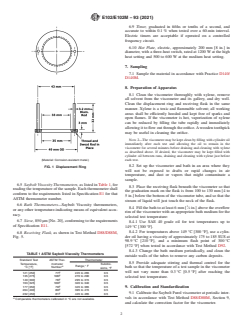
6.2 Displacement Ring, as shown in Fig. 1, constructed of
E1 Specification for ASTM Liquid-in-Glass Thermometers
the same corrosion-resistant metal as the viscometer.
E11 Specification for Woven Wire Test Sieve Cloth and Test
6.3 Cover—A metal cover for the viscometer, cylindrical
Sieves
with a flat top, approximately 57 mm [2 ⁄4 in.] in diameter and
7mm[ ⁄4 in.] deep (Note 1). One hole slightly larger than the
This test method is under the jurisdiction ofASTM Committee D08 on Roofing
diameter of a viscosity thermometer shall be drilled in the
and Waterproofing and is the direct responsibility of Subcommittee D08.05 on
Solvent-Bearing Bituminous Compounds for Roofing and Waterproofing. center of the cover, and two smaller holes to permit the vertical
Current edition approved May 1, 2021. Published May 2021. Originally
rods of the displacement ring to pass through the cover.
approved in 1954. Last previous edition approved in 2016 as E102/
E102M – 93 (2016). DOI: 10.1520/E0102_E0102M-93R21.
NOTE 1—The cover of a 90-mL [3-oz] Gill-style ointment box fulfills
For referenced ASTM standards, visit the ASTM website, www.astm.org, or
these requirements.
contact ASTM Customer Service at service@astm.org. For Annual Book of ASTM
6.4 Thermometer Support, as shown in Test Method D88/
Standards volume information, refer to the standard’s Document Summary page on
the ASTM website. D88M, Fig. 3.
Copyright © ASTM International, 100 Barr Harbor Drive, PO Box C700, West Conshohocken, PA 19428-2959. United States
E102/E102M − 93 (2021)
6.9 Timer, graduated in fifths or tenths of a second, and
accurate to within 0.1 % when tested over a 60-min interval.
Electric timers are acceptable if operated on a controlled
frequency circuit.
6.10 Hot Plate, electric, approximately 200 mm [8 in.] in
diameter, with a three-heat switch, rated at 1200 W at the high
heat setting and 500 to 600 W at the medium heat setting.
7. Sampling
7.1 Sample the material in accordance with Practice D140/
D140M.
8. Preparation of Apparatus
8.1 Clean the viscometer thoroughly with xylene, remove
all solvent from the viscometer and its gallery, and dry well.
Clean the displacement ring and receiving flask in the same
manner. Xylene is a toxic and flammable solvent; all working
areas shall be efficiently hooded and kept free of sparks and
open flames. If the viscometer is hot, vaporization of xylene
can be reduced by filling the tube rapidly and immediately
allowing it to flow out through the orifice.Awooden toothpick
may be useful in cleaning the orifice.
NOTE 2—The viscometer may be kept clean by filling with cylinder oil
immediately after each test and allowing the oil to remain in the
viscometer for several minutes before draining and cleaning with xylene
as described above. If desired, the viscometer may be kept filled with
cylinder oil between runs, draining and cleaning with xylene just before
(Material: Corrosion-resistant metal.) each test.
8.2 Set up the viscometer and bath in an area where they
FIG. 1 Displacement Ring
will not be exposed to drafts or rapid changes in air
temperature, and dust or vapors that might contaminate a
sample.
6.5 Saybolt Viscosity Thermometers, as listed in Table 1, for
8.3 Place the receiving flask beneath the viscometer so that
reading the temperature of the sample. Each thermometer shall
the graduation mark on the flask is from 100 to 130 mm [4 to
conform to the requirements listed in Specification E1 for that
5 in.] below the bottom of the viscometer tube, and so that the
ASTM thermometer number.
stream of liq
...