

ASTM E2634-18(2022)
(Specification)Standard Specification for Flat Wall Insulating Concrete Form (ICF) Systems
General Information
- Abstract
SCOPE
1.1 This specification is intended to apply to Insulating Concrete Form (ICF) Systems that will act as permanent formwork for cast-in-place reinforced concrete beams; lintels; exterior and interior, above and below grade bearing and non-bearing walls; foundations; and retaining walls. The specification is restricted to ICF Systems with a resultant uniform monolithic concrete core.
1.2 Products covered by the specification consists of molded expanded polystyrene (EPS) insulation panels that are connected by cross ties to form the ICF System.
1.3 This specification identifies test methods appropriate for establishing ICF System performance in their primary function as a stay in place concrete forming system. The use of ICF Systems covered by this specification shall be regulated by building codes that address fire performance, structural performance or both. The fire performance of the material shall be addressed through standard fire test methods established by the appropriate governing documents. The structural performance must be addressed through design of concrete structures in accordance with the appropriate Code requirements.
1.4 Details of manufacturing procedures are beyond the scope of this specification.
1.5 The values stated in SI units are to be regarded as standard. The values given in parentheses are mathematical conversions to inch-pound units that are provided for information only and are not considered standard. For conversion to metric units other than those contained in this specification, refer to IEEE/ASTM SI 10.
1.6 This standard does not purport to address all of the safety concerns, if any, associated with its use. It is the responsibility of the user of this standard to establish appropriate safety, health, and environmental practices and determine the applicability of regulatory limitations prior to use.
1.7 This international standard was developed in accordance with internationally recognized principles on standardization established in the Decision on Principles for the Development of International Standards, Guides and Recommendations issued by the World Trade Organization Technical Barriers to Trade (TBT) Committee.
- Status
- Published
- Publication Date
- 30-Sep-2022
- Technical Committee
- E06 - Performance of Buildings
- Drafting Committee
- E06.21 - Serviceability
Overview
ASTM E2634-18(2022), Standard Specification for Flat Wall Insulating Concrete Form (ICF) Systems, is the definitive international standard for Insulating Concrete Form systems used in building construction. Developed by ASTM, this standard ensures that ICF systems serve as permanent formwork for cast-in-place reinforced concrete structures such as beams, lintels, exterior and interior walls, foundations, and retaining walls. The scope of E2634 includes requirements for ICF systems with a uniform, monolithic concrete core, focusing on performance, composition, and testing criteria. This standard supports quality, safety, and durability in the application of ICF for both above and below grade, load-bearing and non-load-bearing, and fire- and structurally-regulated building environments.
Keywords: ASTM E2634, insulating concrete forms, ICF systems, concrete formwork, building standards, EPS insulation, wall construction, monolithic concrete core
Key Topics
- ICF System Composition:
Systems covered consist of molded expanded polystyrene (EPS) insulation panels, connected by cross ties (plastic or metal), forming a framework for concrete placement and providing thermal insulation. - Permanent Formwork:
ICF systems function as stay-in-place forms for structural concrete, eliminating the need for removal after the concrete has cured. - Performance Requirements:
Includes conformity to existing building codes for structural integrity and fire performance, referencing appropriate design and testing methods. - Testing and Qualification:
Specifies relevant ASTM test methods to determine critical properties such as flexural strength, density, burning rate, ignition temperature, air leakage, and water penetration. Quality assurance procedures for ongoing compliance are required. - Fire and Structural Code Compliance:
Fire performance of ICF systems must be verified using established fire testing methods. Structural performance is determined by applicable engineering codes and standards. - Quality Assurance:
Manufacturing must adhere to a quality control manual approved by an independent quality agency, who certifies ICF systems for compliance through audits and ongoing monitoring.
Applications
- Residential and Commercial Walls:
Ideal for exterior and interior walls in both above and below grade applications, providing strength and high thermal efficiency. - Foundations and Retaining Walls:
ICF systems simplify construction of robust, insulated foundations and retaining walls. - Energy-Efficient Construction:
EPS panels offer continuous insulation, reducing thermal bridging and enhancing overall building energy performance. - Fire and Sound Rated Assemblies:
When properly specified and assembled, ICF systems can meet stringent fire-resistance and airborne sound transmission requirements. - Code-Regulated Projects:
Compliant with modern building codes, making ICF suitable for projects where safety, energy efficiency, and durability are priorities.
Related Standards
- ASTM C578 - Rigid, Cellular Polystyrene Thermal Insulation: Specification referenced for EPS used in ICF panels.
- ACI 318 - Building Code Requirements for Structural Concrete: Standard applied to concrete design within ICF assemblies.
- ASTM E84, E119 - Test Methods for Fire Performance: Referenced for evaluating surface burning characteristics and fire-resistance ratings.
- ASTM E283, E331 - Test Methods for Air Leakage and Water Penetration: Govern testing for building envelope integrity.
- ISO/IEC 17025 - General Requirements for Testing Laboratory Competence: Accreditation for labs performing ICF testing.
- ANSI/ASHRAE 90.1 - Energy Standard for Buildings: Referenced for calculating thermal performance of ICF wall assemblies.
Practical Value
Adhering to ASTM E2634 assures specifiers, builders, and regulatory authorities that Insulating Concrete Form systems are manufactured and tested to deliver reliable, code-compliant performance. This standard enhances the quality, fire and structural safety, and energy efficiency of modern concrete wall systems, supporting sustainable and resilient building construction.
Relations
- Effective Date
- 01-Mar-2024
- Effective Date
- 01-Mar-2024
- Effective Date
- 01-Jan-2024
- Effective Date
- 01-Dec-2023
- Effective Date
- 01-Dec-2023
- Effective Date
- 01-Oct-2023
- Effective Date
- 29-Sep-2023
- Effective Date
- 01-Sep-2023
- Effective Date
- 01-Sep-2023
- Refers
ASTM D1761-20 - Standard Test Methods for Mechanical Fasteners in Wood and Wood-Based Materials - Effective Date
- 15-Apr-2020
- Effective Date
- 01-Dec-2019
- Effective Date
- 01-Oct-2019
- Effective Date
- 01-Oct-2019
- Effective Date
- 01-Sep-2019
- Effective Date
- 01-Sep-2019
Get Certified
Connect with accredited certification bodies for this standard

DIBt (Deutsches Institut für Bautechnik)
German Institute for Building Technology.
DIN CERTCO
DIN Group product certification.

Aboma Certification B.V.
Specialized in construction, metal, and transport sectors.
Sponsored listings
Frequently Asked Questions
ASTM E2634-18(2022) is a technical specification published by ASTM International. Its full title is "Standard Specification for Flat Wall Insulating Concrete Form (ICF) Systems". This standard covers: SCOPE 1.1 This specification is intended to apply to Insulating Concrete Form (ICF) Systems that will act as permanent formwork for cast-in-place reinforced concrete beams; lintels; exterior and interior, above and below grade bearing and non-bearing walls; foundations; and retaining walls. The specification is restricted to ICF Systems with a resultant uniform monolithic concrete core. 1.2 Products covered by the specification consists of molded expanded polystyrene (EPS) insulation panels that are connected by cross ties to form the ICF System. 1.3 This specification identifies test methods appropriate for establishing ICF System performance in their primary function as a stay in place concrete forming system. The use of ICF Systems covered by this specification shall be regulated by building codes that address fire performance, structural performance or both. The fire performance of the material shall be addressed through standard fire test methods established by the appropriate governing documents. The structural performance must be addressed through design of concrete structures in accordance with the appropriate Code requirements. 1.4 Details of manufacturing procedures are beyond the scope of this specification. 1.5 The values stated in SI units are to be regarded as standard. The values given in parentheses are mathematical conversions to inch-pound units that are provided for information only and are not considered standard. For conversion to metric units other than those contained in this specification, refer to IEEE/ASTM SI 10. 1.6 This standard does not purport to address all of the safety concerns, if any, associated with its use. It is the responsibility of the user of this standard to establish appropriate safety, health, and environmental practices and determine the applicability of regulatory limitations prior to use. 1.7 This international standard was developed in accordance with internationally recognized principles on standardization established in the Decision on Principles for the Development of International Standards, Guides and Recommendations issued by the World Trade Organization Technical Barriers to Trade (TBT) Committee.
SCOPE 1.1 This specification is intended to apply to Insulating Concrete Form (ICF) Systems that will act as permanent formwork for cast-in-place reinforced concrete beams; lintels; exterior and interior, above and below grade bearing and non-bearing walls; foundations; and retaining walls. The specification is restricted to ICF Systems with a resultant uniform monolithic concrete core. 1.2 Products covered by the specification consists of molded expanded polystyrene (EPS) insulation panels that are connected by cross ties to form the ICF System. 1.3 This specification identifies test methods appropriate for establishing ICF System performance in their primary function as a stay in place concrete forming system. The use of ICF Systems covered by this specification shall be regulated by building codes that address fire performance, structural performance or both. The fire performance of the material shall be addressed through standard fire test methods established by the appropriate governing documents. The structural performance must be addressed through design of concrete structures in accordance with the appropriate Code requirements. 1.4 Details of manufacturing procedures are beyond the scope of this specification. 1.5 The values stated in SI units are to be regarded as standard. The values given in parentheses are mathematical conversions to inch-pound units that are provided for information only and are not considered standard. For conversion to metric units other than those contained in this specification, refer to IEEE/ASTM SI 10. 1.6 This standard does not purport to address all of the safety concerns, if any, associated with its use. It is the responsibility of the user of this standard to establish appropriate safety, health, and environmental practices and determine the applicability of regulatory limitations prior to use. 1.7 This international standard was developed in accordance with internationally recognized principles on standardization established in the Decision on Principles for the Development of International Standards, Guides and Recommendations issued by the World Trade Organization Technical Barriers to Trade (TBT) Committee.
ASTM E2634-18(2022) is classified under the following ICS (International Classification for Standards) categories: 91.100.30 - Concrete and concrete products. The ICS classification helps identify the subject area and facilitates finding related standards.
ASTM E2634-18(2022) has the following relationships with other standards: It is inter standard links to ASTM C390-08(2024), ASTM C1363-24, ASTM E8/E8M-24, ASTM E84-23d, ASTM E90-23, ASTM D2863-23, ASTM D2863-95, ASTM E84-23c, ASTM C578-23, ASTM D1761-20, ASTM D1929-19, ASTM E119-19, ASTM D2863-19, ASTM C1363-19, ASTM C390-08(2019). Understanding these relationships helps ensure you are using the most current and applicable version of the standard.
ASTM E2634-18(2022) is available in PDF format for immediate download after purchase. The document can be added to your cart and obtained through the secure checkout process. Digital delivery ensures instant access to the complete standard document.
Standards Content (Sample)
This international standard was developed in accordance with internationally recognized principles on standardization established in the Decision on Principles for the
Development of International Standards, Guides and Recommendations issued by the World Trade Organization Technical Barriers to Trade (TBT) Committee.
Designation: E2634 −18 (Reapproved 2022)
Standard Specification for
Flat Wall Insulating Concrete Form (ICF) Systems
This standard is issued under the fixed designation E2634; the number immediately following the designation indicates the year of
original adoption or, in the case of revision, the year of last revision.Anumber in parentheses indicates the year of last reapproval.A
superscript epsilon (´) indicates an editorial change since the last revision or reapproval.
1. Scope ization established in the Decision on Principles for the
Development of International Standards, Guides and Recom-
1.1 This specification is intended to apply to Insulating
mendations issued by the World Trade Organization Technical
Concrete Form (ICF) Systems that will act as permanent
Barriers to Trade (TBT) Committee.
formwork for cast-in-place reinforced concrete beams; lintels;
exterior and interior, above and below grade bearing and
2. Referenced Documents
non-bearingwalls;foundations;andretainingwalls.Thespeci-
2.1 ASTM Standards:
fication is restricted to ICF Systems with a resultant uniform
C203Test Methods for Breaking Load and Flexural Proper-
monolithic concrete core.
ties of Block-Type Thermal Insulation
1.2 Productscoveredbythespecificationconsistsofmolded
C390Practice for Sampling and Acceptance of Thermal
expanded polystyrene (EPS) insulation panels that are con-
Insulation Lots
nected by cross ties to form the ICF System.
C475/C475MSpecification for Joint Compound and Joint
Tape for Finishing Gypsum Board
1.3 Thisspecificationidentifiestestmethodsappropriatefor
C578Specification for Rigid, Cellular Polystyrene Thermal
establishingICFSystemperformanceintheirprimaryfunction
Insulation
as a stay in place concrete forming system. The use of ICF
C645Specification for Nonstructural Steel Framing Mem-
Systems covered by this specification shall be regulated by
bers
building codes that address fire performance, structural perfor-
C1002Specification for Steel Self-Piercing Tapping Screws
mance or both. The fire performance of the material shall be
for Application of Gypsum Panel Products or Metal
addressedthroughstandardfiretestmethodsestablishedbythe
Plaster Bases to Wood Studs or Steel Studs
appropriate governing documents. The structural performance
C1363Test Method for Thermal Performance of Building
must be addressed through design of concrete structures in
Materials and Envelope Assemblies by Means of a Hot
accordance with the appropriate Code requirements.
Box Apparatus
1.4 Details of manufacturing procedures are beyond the
C1396/C1396MSpecification for Gypsum Board
scope of this specification.
D635Test Method for Rate of Burning and/or Extent and
1.5 The values stated in SI units are to be regarded as
Time of Burning of Plastics in a Horizontal Position
standard. The values given in parentheses are mathematical
D638Test Method for Tensile Properties of Plastics
conversions to inch-pound units that are provided for informa-
D732Test Method for Shear Strength of Plastics by Punch
tion only and are not considered standard. For conversion to
Tool
metric units other than those contained in this specification,
D1622/D1622MTest Method forApparent Density of Rigid
refer to IEEE/ASTMSI10.
Cellular Plastics
D1761Test Methods for Mechanical Fasteners inWood and
1.6 This standard does not purport to address all of the
Wood-Based Materials
safety concerns, if any, associated with its use. It is the
D1929Test Method for Determining Ignition Temperature
responsibility of the user of this standard to establish appro-
of Plastics
priate safety, health, and environmental practices and deter-
D2863Test Method for Measuring the Minimum Oxygen
mine the applicability of regulatory limitations prior to use.
Concentration to Support Candle-Like Combustion of
1.7 This international standard was developed in accor-
Plastics (Oxygen Index)
dance with internationally recognized principles on standard-
E8/E8MTest Methods for Tension Testing of Metallic Ma-
terials
This specification is under the jurisdiction of ASTM Committee E06 on
Performance of Buildings and is the direct responsibility of Subcommittee E06.21
on Serviceability. For referenced ASTM standards, visit the ASTM website, www.astm.org, or
Current edition approved Oct. 1, 2022. Published October 2022. Originally contact ASTM Customer Service at service@astm.org. For Annual Book of ASTM
approved in 2008. Last previous edition approved in 2018 as E2634-18. DOI: Standards volume information, refer to the standard’s Document Summary page on
10.1520/E2634-18R22. the ASTM website.
Copyright © ASTM International, 100 Barr Harbor Drive, PO Box C700, West Conshohocken, PA 19428-2959. United States
E2634 − 18 (2022)
FIG. 1 Flat Wall ICF, Wall Assembly
E84Test Method for Surface Burning Characteristics of ANSI/ASHRAE90.1Energy Standard for Buildings Except
Building Materials Low-Rise Residential Buildings
E90Test Method for Laboratory Measurement of Airborne
3. Terminology
Sound Transmission Loss of Building Partitions and
3.1 Definitions:
Elements
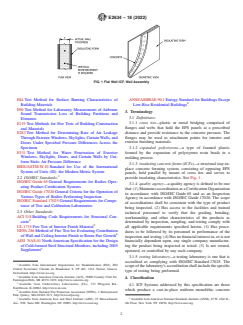
3.1.1 cross ties—plastic or metal bridging comprised of
E119Test Methods for Fire Tests of Building Construction
flanges and webs that hold the EPS panels at a prescribed
and Materials
distance and provide resistance to the concrete pressure. The
E283Test Method for Determining Rate of Air Leakage
flanges may be used as attachment points for interior and
Through ExteriorWindows, Skylights, CurtainWalls, and
exterior finishing materials.
Doors Under Specified Pressure Differences Across the
Specimen
3.1.2 expanded polystyrene—a type of foamed plastic
E331 Test Method for Water Penetration of Exterior
formed by the expansion of polystyrene resin beads in a
Windows, Skylights, Doors, and Curtain Walls by Uni-
molding process.
form Static Air Pressure Difference
3.1.3 insulating concrete forms (ICFs)—astructuralstay-in-
IEEE/ASTMSI10Standard for Use of the International
place concrete forming system, consisting of opposing EPS
System of Units (SI): the Modern Metric System
panels, held parallel by means of cross ties and serves to
2.2 ISO/IEC Standards:
provide insulating characteristics. See Fig. 1.
ISO/IECGuide65General Requirements for Bodies Oper-
3.1.4 quality agency—a quality agency is defined to be one
ating Product Certification Systems
that: (1)MaintainsaccreditationasaCertificationOrganization
ISO/IECGuide17020General Criteria for the Operation of
in accordance with ISO/IECGuide65 and as an Inspection
Various Types of Bodies Performing Inspection
Agency in accordance with ISO/IECGuide17020. The scope
ISO/IECStandard17025General Requirements for Compe-
of accreditations shall be consistent with the type of product
tence of Test and Calibration Laboratories
being inspected. (2) Has access to the facilities and trained
2.3 Other Standards:
technical personnel to verify that the grading, bonding,
ACI318Building Code Requirements for Structural Con-
workmanship, and other characteristics of the products as
crete
determined by inspection, sampling, and testing comply with
UL1715Fire Test of Interior Finish Material
all applicable requirements specified herein. (3) Has proce-
NFPA286Method of Fire Test for Evaluating Contribution
dures to be followed by its personnel in performance of the
ofWall and Ceiling Interior Finish to Room Fire Growth
inspectionandtesting. (4)Hasnofinancialinterestin,orisnot
AISI NAS-01NorthAmerican Specification for the Design
financially dependent upon, any single company manufactur-
ofCold-formedSteelStructuralMembers,including2005
ing the product being inspected or tested. (5) Is not owned,
Supplement
operated, or controlled by any such company.
3.1.5 testing laboratory—a testing laboratory is one that is
accredited as complying with ISO/IECStandard17025. The
Available from International Organization for Standardization (ISO), ISO
scopeofthelaboratory’saccreditationshallincludethespecific
Central Secretariat, Chemin de Blandonnet 8, CP 401, 1214 Vernier, Geneva,
type of testing being performed.
Switzerland, https://www.iso.org.
Available from American Concrete Institute (ACI), 38800 Country Club Dr.,
4. Classification
Farmington Hills, MI 48331-3439, http://www.concrete.org.
Available from Underwriters Laboratories (UL), 333 Pfingsten Rd.,
4.1 ICF Systems addressed by this specification are those
Northbrook, IL 60062, http://www.ul.com.
which produce a cast-in-place uniform monolithic concrete
Available from National Fire Protection Association (NFPA), 1 Batterymarch
Park, Quincy, MA 02169-7471, http://www.nfpa.org.
7 8
Available from American Iron and Steel Institute (AISI), 25 Massachusetts Available fromAmerican National Standards Institute (ANSI), 25 W. 43rd St.,
Ave., NW, Suite 800, Washington, DC 20001, http://www.steel.org. 4th Floor, New York, NY 10036, http://www.ansi.org.
E2634 − 18 (2022)
core wall where the concrete design is in accordance with 6.1.5 Surface Burning Characteristics—The EPS shall be
accepted design standards such as ACI318. tested in accordance with Test Method E84 in the maximum
thickness and density intended for use. The maximum Flame
5. Materials and Manufacture
Spread Index shall be 75 and the maximum Smoke Develop-
5.1 EPS Panels—All EPS panels are manufactured using
ment Index shall be 450.
molded EPS insulation, conforming to Specification C578.
6.1.5.1 Exception—The maximum Flame Spread Index
5.2 Cross Ties—All components shall conform to manufac- shall be 25 when the product is intended for use in non-
turing or performance standards as in accordance with 6.2. combustible construction.
Cross ties that are susceptible to UV degradation shall have a
6.2 Cross Tie Qualification:
minimum of 6 months of ultraviolet (UV) protection against
6.2.1 General—These materials, including products into
degradation of physical properties.
which recycled material is introduced, must comply with
NOTE 1—UV protection includes but is not limited to UV stabilizers,
protective coverings, or other suitable means.
requirements of 6.2.2 – 6.2.6 of this specification which
establish the base line properties of the cross ties.
6. Physical Properties
6.2.2 Rate of Burning—PlasticTies shall be tested in accor-
6.1 Expanded Polystyrene Qualification:
dancewithTestMethodD635.Theplasticshallmeetminimum
6.1.1 These materials, including products into which re-
CC2 Classification as defined by Test Method D635, X2.1.2.
cycled material is introduced, must comply with requirements
6.2.3 Ignition Temperature—Plastic Ties shall be tested in
in Specification C578, Table1.
accordance with Test Method D1929, Procedure B. The mini-
6.1.2 Qualification to the Requirements of 6.1.3—Data re-
mum Ignition Temperature shall be 350°C (662°F).
quired in 6.1.1 must be submitted in accordance with either
6.2.4 Fastener Capacity—Shall be tested in accordance
6.1.3 or 6.1.4.
with modified Test Methods D1761 on a minimum of ten
6.1.3 Where the resin supplier provides to the quality
specimens.
agency sufficient test data in compliance with 6.1.1 for each
resin grade (base formula) and for each Specification C578
6.2.4.1 LateralLoadStrengthtestspecimensshallconsistof
Type intended for application use, the ICF System owner must
full-thickness ICF panels, with the fastener for which recogni-
providereportsoftestsdemonstratingcompliancewithflexural
tion is sought, screwed into the cross-tie flange in a manner
strengthtestedinaccordancewithTestMethodsC203,Method
representative of the end-use configuration. The test shall be
I, Procedure B, and density requirements tested in accordance
conducted with an eccentricity equal to the embedment depth
with Test Method D1622/D1622M of each grade and each
of the cross tie below the surface of the EPS. Where cross ties
Specification C578 Type intended for application use for each
are flush to the EPS no eccentricity is required. Pilot holes for
recognized manufacturing plant/location.
screws shall not be predrilled into the specimen.
6.1.3.1 Exception—Oxygen index tests in accordance with
6.2.4.2 Analysis:
Test Method D2863 need only be conducted on one Specifi-
(1) Plastic Cross Ties—The allowable lateral load strength
cation C578 Type per supplier resin grade (base formula).
of the connection shall not exceed 75% of the average
6.1.3.2 Exception—Thermal resistance tests need only be
proportionallimitload,ortheaverageultimateloaddividedby
conducted at 23.8°C 6 2.8°C (75°F 6 5°F).
a factor of 3.2, whichever is lower. The factor of 3.2 assumes
6.1.4 Where the resin supplier does not provide, to the
amaximumcoefficientofvariation(COV)of15%.Wherethe
qualityagency,sufficienttestdatashowingcompliancewithall
COV is greater than 15%, the allowable load shall be
requirements of 6.1.1 for each resin grade (base formula) and
computed using the following equation:
for each Specification C578Type intended for application use,
F 5 F 1 22COV /2.24 (1)
~~ ! !
the ICF System owner must provide reports of tests to
all
demonstrate full compliance with 6.1.1 for each Specification
where:
C578 Type intended for application use at one manufacturing
F = allowable load, N,
all
location.
COV = s/F = coefficient of variation in a test series,
6.1.4.1 Exception—Oxygen index tests in accordance with
s = standard deviation in a test series, and
Test Method D2863 need only be conducted on one Specifi-
F = average ultimate load in test series, N.
cation C578 Type per supplier resin grade (base formula).
(2) Metal Cross Ties—The allowable lateral strength of the
6.1.4.2 Exception—Thermal resistance tests need only be
connection shall be determined in accordance withAISINAS-
conducted at 23.8°C 6 2.8°C (75°F 6 5°F).
01, Chapter F.
6.1.4.3 Exception—Where products manufactured with any
6.2.4.3 Withdrawal Load Strength (Plastic or Metal Cross
one of the resin grades (base formula) already quality under
6.1.4, the ICF System owner must provide reports of tests Ties)—Test specimens shall consist of full-thickness ICF
panels, with the fastener for which recognition is sought,
demonstrating compliance with flexural strength tested in
accordance with Test Methods C203, Method I, Procedure B, screwed into the cross-tie flange in a manner representative of
the end-use configuration. Pilot holes for screws shall not be
and density requirements tested in accordance with Test
Method D1622/D1622M of each grade and each Specification predrilled into the specimen.
C578 Type intended for application use for each recognized (1)The ultimate load shall be determined for each test
manufacturing plant/location. specimen.
E2634 − 18 (2022)
(2)The allowable withdrawal load strength of the connec- 7.3 Any mold ejection damage of the ICFs shall be limited
tion shall be determined based on the average ultimate load to 4.8 mm (0.19 in.) indentation and 1.6 mm (0.06 in.)
divided by a safety factor of 5. protrusion from the flat surface of the EPS.
6.2.5 Cross Tie Tensile Strength—The integrated cross tie
7.4 The cross ties embedded in the EPS panels shall be
assembly shall be tested in accordance with modified Test
spaced center to center within 66.4 mm (0.25 in.).
Method D638 for plastic cross ties and modified Test Methods
E8/E8Mformetalcrossties.ModificationofTestMethodisto
8. Workmanship, Finish, and Appearance
test the actual cross tie assembly with load rate of 25 mm
8.1 The EPS panels shall be free from defects in workman-
(1in.) per minute. The minimum tensile strength of the cross
ship. Defects in the ICFs consist of, but are not limited to, the
2 2
tie assembly shall be equivalent to 32.3 kN/m (675 lb/ft)of
following:
wall surface.
8.1.1 The EPS panels shall have warping limited to 6.4 mm
6.2.5.1 Exception—Where the manufacturer can substanti-
(0.25 in.) as measured at the center of the panel.
ate satisfactory concrete formwork capability through analysis
8.1.2 The total number of voids on the EPS panels shall not
or testing, a reduced minimum tensile strength may be accept-
2 2
exceed the average of 1 per 0.093 m (1 per ft ) with
able.
dimensionslargerthan3.3mmby3.3mmby3.3mm(0.13in.
6.2.6 Cross Tie Shear Strength—The minimum shear
by 0.13in. by 0.13 in.).
strength of the plastic material determined from Test Method
8.1.3 The cross ties shall be properly formed and free from
D732 shall be greater than the value calculated by multiplying
damage after molding.
the web tributary area by the minimum shear strength of the
8.1.4 The EPS panels shall have proper fit between the top
cross tie assembly and dividing by the minimum vertical cross
and bottom interlocking mechanism.
sectionalareaoftheportionofthecrosstiethatpassesthrough
8.1.5 The EPS panels dimensions shall conform to 7.1, 7.2,
the concrete cavity. Fig. 2 indicates the tributary area associ-
7.3,or 7.4, or a combination thereof.
ated with the web cross sectional area that is subjected to the
8.1.6 The EPS panels shall have no crushed or depressed
shear strength.
areas on any surface exceeding 3.3 mm (0.13 in.) in depth on
more than 10% of the total surface area.
6.3 System Qualification:
6.3.1 Room Corner Fire Test—The minimum thickness of
9. Sampling
the complete assembly of EPS, cross tie material, and concrete
with thermal barrier attached, but excluding exterior finishing. 9.1 Sampling of the test specimens shall be in accordance
Thetestedthermalbarriershallremaininplaceforaminimum with Practice C390, where practical, and shall be truly repre-
of 15 min when tested in accordance with UL1715 or sentative of the standard manufactured product, inclu
...