

ASTM C792-23
(Test Method)Standard Test Method for Effects of Heat Aging on Weight Loss, Cracking, and Chalking of Elastomeric Sealants
General Information
- Abstract
SIGNIFICANCE AND USE
5.1 Weight loss through volatilization of components of a sealant in a building joint may affect sealant appearance because of shrinkage, and sealant performance because of the loss of functional sealant components. Exposure to high-temperature environments will accelerate the loss of volatiles.
5.2 This test method measures weight loss. It can be used in combination with a knowledge of sealant density to estimate shrinkage. In addition, when compared to sealant theoretical weight solids, it provides an estimate of the extent to which functional sealant components can be volatilized when exposed to high service temperatures. Substantial losses of this type may help predict early failures in durability. Also, development of cracks or chalking, or both, lessens sealant service life. However, a sealant that develops no cracks or chalking, or low weight loss in this test method, does not necessarily assure good durability.
SCOPE
1.1 This test method covers a laboratory procedure for determining the effects of heat aging on weight loss, cracking, and chalking of cured-in-place elastomeric joint sealants (single- and multi-component) for use in building construction.
1.2 This standard does not purport to address all of the safety concerns, if any, associated with its use. It is the responsibility of the user of this standard to establish appropriate safety, health, and environmental practices and determine the applicability of regulatory limitations prior to use.
1.3 There is no known ISO equivalent to this test method.
1.4 This international standard was developed in accordance with internationally recognized principles on standardization established in the Decision on Principles for the Development of International Standards, Guides and Recommendations issued by the World Trade Organization Technical Barriers to Trade (TBT) Committee.
- Status
- Published
- Publication Date
- 30-Apr-2023
- Technical Committee
- C24 - Building Seals and Sealants
- Drafting Committee
- C24.20 - General Test Methods
Buy Documents


ASTM C792-23 - Standard Test Method for Effects of Heat Aging on Weight Loss, Cracking, and Chalking of Elastomeric Sealants

REDLINE ASTM C792-23 - Standard Test Method for Effects of Heat Aging on Weight Loss, Cracking, and Chalking of Elastomeric Sealants
Overview
ASTM C792-23: Standard Test Method for Effects of Heat Aging on Weight Loss, Cracking, and Chalking of Elastomeric Sealants establishes a laboratory procedure for evaluating how exposure to elevated temperatures impacts the performance of elastomeric joint sealants used in building construction. The standard specifically addresses the measurement of weight loss, and the appearance of cracking and chalking, to assess the durability and long-term viability of cured-in-place sealants. This test method is essential for professionals working with both single- and multi-component elastomeric sealants to ensure reliability and safety in building joints exposed to temperature variations.
Key Topics
- Heat Aging Testing: Exposure of cured-in-place elastomeric joint sealants to controlled elevated temperatures (70 ± 2°C or 158 ± 3.6°F) for a fixed period to simulate long-term service conditions.
- Weight Loss Evaluation: Measurement of mass reduction due to the volatilization of components, which directly impacts sealant shrinkage, appearance, and performance.
- Cracking and Chalking Assessment: Visual and comparative examination of treated specimens for signs of surface cracking or chalking, which are indications of material degradation.
- Test Specimen Preparation: Standardized methods for handling, curing, and evaluating both single- and multi-component sealant samples.
- Durability Indicators: Aids in predicting potential early failure due to excessive weight loss, cracking, or chalking, though the absence of these effects does not guarantee long-term durability.
Applications
- Building Joint Sealant Evaluation: This standard is widely used in the evaluation of sealant materials intended for building joints, where temperature-induced aging is a concern.
- Quality Assurance: Manufacturers and testers use ASTM C792-23 to qualify new products, compare formulations, and verify production consistency.
- Product Specification: Architects, builders, and construction professionals specify this test method for ensuring the performance of elastomeric joint sealants under real-world thermal stress.
- Failure Analysis: Identifies sealants at risk of premature failure due to excessive volatilization, cracking, or chalking, thus supporting maintenance and replacement planning for critical construction elements.
Related Standards
- ASTM C717: Terminology of Building Seals and Sealants - referenced for key definitions used in C792-23.
- Other ASTM standards relevant to building sealants and their testing, though no known ISO equivalent exists for this method.
Practical Value
- Predicting Performance: By quantitatively measuring weight loss and observing surface integrity after heat aging, construction professionals can make informed decisions regarding material selection for demanding applications.
- Ensuring Compliance: Adhering to ASTM C792-23 helps guarantee that sealants meet industry and regulatory expectations for durability in building joints, reducing the risk of future costly repairs.
- Supporting Product Development: Formulators and manufacturers rely on the results of this standard to improve resistance to heat-induced aging in new or existing elastomeric sealant products.
- Improved Safety and Longevity: Consistent use of this test method promotes safer and longer lasting joint sealant installations, ultimately supporting the integrity and thermal stability of buildings.
Adopting ASTM C792-23 in evaluating elastomeric sealants supports best practices in material testing, product development, and quality control, ensuring reliable performance under thermal stress in building construction.
Relations
- Effective Date
- 01-Mar-2019
- Effective Date
- 01-Mar-2018
- Effective Date
- 01-Nov-2017
- Effective Date
- 01-Jan-2017
- Effective Date
- 15-Nov-2016
- Effective Date
- 01-Sep-2016
- Effective Date
- 01-May-2014
- Effective Date
- 01-Feb-2014
- Effective Date
- 01-Nov-2013
- Effective Date
- 01-Dec-2012
- Effective Date
- 01-May-2012
- Effective Date
- 15-Jan-2012
- Effective Date
- 01-Mar-2011
- Effective Date
- 15-Jan-2011
- Effective Date
- 15-Jun-2010
Buy Documents
ASTM C792-23 - Standard Test Method for Effects of Heat Aging on Weight Loss, Cracking, and Chalking of Elastomeric Sealants
REDLINE ASTM C792-23 - Standard Test Method for Effects of Heat Aging on Weight Loss, Cracking, and Chalking of Elastomeric Sealants
Get Certified
Connect with accredited certification bodies for this standard

DIN CERTCO
DIN Group product certification.
DIBt (Deutsches Institut für Bautechnik)
German Institute for Building Technology.

Aboma Certification B.V.
Specialized in construction, metal, and transport sectors.
Sponsored listings
Frequently Asked Questions
ASTM C792-23 is a standard published by ASTM International. Its full title is "Standard Test Method for Effects of Heat Aging on Weight Loss, Cracking, and Chalking of Elastomeric Sealants". This standard covers: SIGNIFICANCE AND USE 5.1 Weight loss through volatilization of components of a sealant in a building joint may affect sealant appearance because of shrinkage, and sealant performance because of the loss of functional sealant components. Exposure to high-temperature environments will accelerate the loss of volatiles. 5.2 This test method measures weight loss. It can be used in combination with a knowledge of sealant density to estimate shrinkage. In addition, when compared to sealant theoretical weight solids, it provides an estimate of the extent to which functional sealant components can be volatilized when exposed to high service temperatures. Substantial losses of this type may help predict early failures in durability. Also, development of cracks or chalking, or both, lessens sealant service life. However, a sealant that develops no cracks or chalking, or low weight loss in this test method, does not necessarily assure good durability. SCOPE 1.1 This test method covers a laboratory procedure for determining the effects of heat aging on weight loss, cracking, and chalking of cured-in-place elastomeric joint sealants (single- and multi-component) for use in building construction. 1.2 This standard does not purport to address all of the safety concerns, if any, associated with its use. It is the responsibility of the user of this standard to establish appropriate safety, health, and environmental practices and determine the applicability of regulatory limitations prior to use. 1.3 There is no known ISO equivalent to this test method. 1.4 This international standard was developed in accordance with internationally recognized principles on standardization established in the Decision on Principles for the Development of International Standards, Guides and Recommendations issued by the World Trade Organization Technical Barriers to Trade (TBT) Committee.
SIGNIFICANCE AND USE 5.1 Weight loss through volatilization of components of a sealant in a building joint may affect sealant appearance because of shrinkage, and sealant performance because of the loss of functional sealant components. Exposure to high-temperature environments will accelerate the loss of volatiles. 5.2 This test method measures weight loss. It can be used in combination with a knowledge of sealant density to estimate shrinkage. In addition, when compared to sealant theoretical weight solids, it provides an estimate of the extent to which functional sealant components can be volatilized when exposed to high service temperatures. Substantial losses of this type may help predict early failures in durability. Also, development of cracks or chalking, or both, lessens sealant service life. However, a sealant that develops no cracks or chalking, or low weight loss in this test method, does not necessarily assure good durability. SCOPE 1.1 This test method covers a laboratory procedure for determining the effects of heat aging on weight loss, cracking, and chalking of cured-in-place elastomeric joint sealants (single- and multi-component) for use in building construction. 1.2 This standard does not purport to address all of the safety concerns, if any, associated with its use. It is the responsibility of the user of this standard to establish appropriate safety, health, and environmental practices and determine the applicability of regulatory limitations prior to use. 1.3 There is no known ISO equivalent to this test method. 1.4 This international standard was developed in accordance with internationally recognized principles on standardization established in the Decision on Principles for the Development of International Standards, Guides and Recommendations issued by the World Trade Organization Technical Barriers to Trade (TBT) Committee.
ASTM C792-23 is classified under the following ICS (International Classification for Standards) categories: 83.060 - Rubber; 91.100.50 - Binders. Sealing materials. The ICS classification helps identify the subject area and facilitates finding related standards.
ASTM C792-23 has the following relationships with other standards: It is inter standard links to ASTM C717-19, ASTM C717-18, ASTM C717-17a, ASTM C717-17, ASTM C717-16a, ASTM C717-16, ASTM C717-14a, ASTM C717-14, ASTM C717-13, ASTM C717-12b, ASTM C717-12a, ASTM C717-12, ASTM C717-11a, ASTM C717-11, ASTM C717-10. Understanding these relationships helps ensure you are using the most current and applicable version of the standard.
ASTM C792-23 is available in PDF format for immediate download after purchase. The document can be added to your cart and obtained through the secure checkout process. Digital delivery ensures instant access to the complete standard document.
Standards Content (Sample)
This international standard was developed in accordance with internationally recognized principles on standardization established in the Decision on Principles for the
Development of International Standards, Guides and Recommendations issued by the World Trade Organization Technical Barriers to Trade (TBT) Committee.
Designation: C792 − 23
Standard Test Method for
Effects of Heat Aging on Weight Loss, Cracking, and
Chalking of Elastomeric Sealants
This standard is issued under the fixed designation C792; the number immediately following the designation indicates the year of
original adoption or, in the case of revision, the year of last revision. A number in parentheses indicates the year of last reapproval. A
superscript epsilon (´) indicates an editorial change since the last revision or reapproval.
This standard has been approved for use by agencies of the U.S. Department of Defense.
1. Scope for 7 days at standard conditions. Immediately following this
initial cure time two specimens are exposed in a forced-draft
1.1 This test method covers a laboratory procedure for
oven maintained at 70 °C 6 2 °C (158 °F 6 3.6 °F) for 21
determining the effects of heat aging on weight loss, cracking,
days. At the end of this exposure the percentage weight loss of
and chalking of cured-in-place elastomeric joint sealants
the sealant is determined and examination is made for presence
(single- and multi-component) for use in building construction.
of cracks and chalking.
1.2 This standard does not purport to address all of the
safety concerns, if any, associated with its use. It is the
5. Significance and Use
responsibility of the user of this standard to establish appro-
5.1 Weight loss through volatilization of components of a
priate safety, health, and environmental practices and deter-
mine the applicability of regulatory limitations prior to use. sealant in a building joint may affect sealant appearance
because of shrinkage, and sealant performance because of the
1.3 There is no known ISO equivalent to this test method.
loss of functional sealant components. Exposure to high-
1.4 This international standard was developed in accor-
temperature environments will accelerate the loss of volatiles.
dance with internationally recognized principles on standard-
ization established in the Decision on Principles for the
5.2 This test method measures weight loss. It can be used in
Development of International Standards, Guides and Recom-
combination with a knowledge of sealant density to estimate
mendations issued by the World Trade Organization Technical
shrinkage. In addition, when compared to sealant theoretical
Barriers to Trade (TBT) Committee.
weight solids, it provides an estimate of the extent to which
functional sealant components can be volatilized when exposed
2. Referenced Documents
to high service temperatures. Substantial losses of this type
2.1 ASTM Standards:
may help predict early failures in durability. Also, development
C717 Terminology of Building Seals and Sealants
of cracks or chalking, or both, lessens sealant service life.
However, a sealant that develops no cracks or chalking, or low
3. Terminology
weight loss in this test method, does not necessarily assure
3.1 Definitions—See Terminology C717 for definitions of good durability.
the following terms used in this test method: compound,
elastomeric, non-sag sealant, sealant, standard conditions, and 6. Apparatus
self-leveling sealant.
6.1 Forced-Draft Oven, controlled at 70 °C 6 2 °C (158 °F
6 3.6 °F).
4. Summary of Test Method
4.1 Three sealant specimens are spread on thin aluminum 6.2 Balance, sensitive to 0.01 g.
plates and, after determining net weights of sealant, are cured
6.3 Rectangular Brass Frame, with inside dimensions
1 1
130 mm by 40 mm by 6.4 mm (5 in. by 1 ⁄2 in. by ⁄4 in.).
This test method is under the jurisdiction of ASTM Committee C24 on Building
6.4 Aluminum Plates, three, each 152 mm by 80 mm by
Seals and Sealants and is the direct responsibility of Subcommittee C24.20 on
General Test Methods. 0.6 mm to 1.6 mm (24 gauge to 16 gauge).
Current edition approved May 1, 2023. Published May 2023. Originally
6.5 Straightedge, metal or plastic, about 152 mm (6 in.)
approved in 1975. Last previous edition approved in 2020 as C792 – 15 (2020).
DOI: 10.1520/C0792-23.
long.
For referenced ASTM standards, visit the ASTM website, www.astm.org, or
contact ASTM Customer Service at service@astm.org. For Annual Book of ASTM
6.6 Thin Knife Blade.
Standards volume information, refer to the standard’s Document Summary page on
the ASTM website. 6.7 Spatula, steel, about 152 mm (6 in.) long.
Copyright © ASTM International, 100 Barr Harbor Drive, PO Box C700, West Conshohocken, PA 19428-2959. United States
C792 − 23
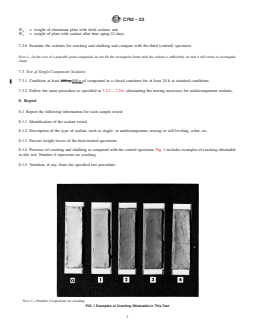
7. Procedure 7.2.6 Examine the sealants for cracking and chalking and
compare with the third (control) specimen.
7.1 Unless otherwise specified by those authorizing the test,
standard conditions of temperature and relative humidity for
NOTE 1—In the case of a pourable grade compound, do
...
This document is not an ASTM standard and is intended only to provide the user of an ASTM standard an indication of what changes have been made to the previous version. Because
it may not be technically possible to adequately depict all changes accurately, ASTM recommends that users consult prior editions as appropriate. In all cases only the current version
of the standard as published by ASTM is to be considered the official document.
Designation: C792 − 15 (Reapproved 2020) C792 − 23
Standard Test Method for
Effects of Heat Aging on Weight Loss, Cracking, and
Chalking of Elastomeric Sealants
This standard is issued under the fixed designation C792; the number immediately following the designation indicates the year of
original adoption or, in the case of revision, the year of last revision. A number in parentheses indicates the year of last reapproval. A
superscript epsilon (´) indicates an editorial change since the last revision or reapproval.
This standard has been approved for use by agencies of the U.S. Department of Defense.
1. Scope
1.1 This test method covers a laboratory procedure for determining the effects of heat aging on weight loss, cracking, and chalking
of cured-in-place elastomeric joint sealants (single- and multi-component) for use in building construction.
1.2 This standard does not purport to address all of the safety concerns, if any, associated with its use. It is the responsibility
of the user of this standard to establish appropriate safety, health, and environmental practices and determine the applicability of
regulatory limitations prior to use.
1.3 There is no known ISO equivalent to this test method.
1.4 This international standard was developed in accordance with internationally recognized principles on standardization
established in the Decision on Principles for the Development of International Standards, Guides and Recommendations issued
by the World Trade Organization Technical Barriers to Trade (TBT) Committee.
2. Referenced Documents
2.1 ASTM Standards:
C717 Terminology of Building Seals and Sealants
3. Terminology
3.1 Definitions—See Terminology C717 for definitions of the following terms used in this test method: compound, elastomeric,
non-sag sealant, sealant, standard conditions, and self-leveling sealant.
4. Summary of Test Method
4.1 Three sealant specimens are spread on thin aluminum plates and, after determining net weights of sealant, are cured for 7 days
at Standard Conditions.standard conditions. Immediately following this initial cure time two specimens are exposed in a
forced-draft oven maintained at 70 6 2°C (1586 3.6°F) 70 °C 6 2 °C (158 °F 6 3.6 °F) for 21 days. At the end of this exposure
the percentage weight loss of the sealant is determined and examination is made for presence of cracks and chalking.
This test method is under the jurisdiction of ASTM Committee C24 on Building Seals and Sealants and is the direct responsibility of Subcommittee C24.20 on General
Test Methods.
Current edition approved Jan. 15, 2020May 1, 2023. Published February 2020May 2023. Originally approved in 1975. Last previous edition approved in 20152020 as
C792 – 15.C792 – 15 (2020). DOI: 10.1520/C0792-15R20.10.1520/C0792-23.
For referenced ASTM standards, visit the ASTM website, www.astm.org, or contact ASTM Customer Service at service@astm.org. For Annual Book of ASTM Standards
volume information, refer to the standard’s Document Summary page on the ASTM website.
Copyright © ASTM International, 100 Barr Harbor Drive, PO Box C700, West Conshohocken, PA 19428-2959. United States
C792 − 23
5. Significance and Use
5.1 Weight loss through volatilization of components of a sealant in a building joint may affect sealant appearance because of
shrinkage, and sealant performance because of the loss of functional sealant components. Exposure to high-temperature
environments will accelerate the loss of volatiles.
5.2 This test method measures weight loss. It can be used in combination with a knowledge of sealant density to estimate
shrinkage. In addition, when compared to sealant theoretical weight solids, it provides an estimate of the extent to which functional
sealant components can be volatilized when exposed to high service temperatures. Substantial losses of this type may help predict
early failures in durability. Also, development of cracks or chalking, or both, lessens sealant service life. However, a sealant that
develops no cracks or chalking, or low weight loss in this test method, does not necessarily assure good durability.
6. Apparatus
6.1 Forced-Draft Oven, controlled at 70 6 2°C (158 6 3.6°F).70 °C 6 2 °C (158 °F 6 3.6 °F).
6.2 Balance, sensitive to 0.01 g.
1 1
6.3 Rectangular Brass Frame, with inside dimensions 130 by 40130 mm by 40 mm by 6.4 mm (5(5 in. by 1 ⁄2 in. by ⁄4 in.). in.).
6.4 Aluminum Plates, three, each 152 by 80 by 0.6 to 1.6 mm (24 152 mm by 80 mm by 0.6 mm to 1.6 mm (24 gauge to 16 gauge).
6.5 Straightedge, metal or plastic, about 152 mm (6 in.) long.
6.6 Thin Knife Blade.
6.7 Spatula, steel, about 152 mm (6 in.) long.
7. Procedure
7.1 Unless otherwise specified by those authorizing the test, standard conditions of temperature and relative humidity for the test
shall be found in Terminology C717.
7.2 T
...