

ASTM C910-16(2021)
(Test Method)Standard Test Method for Bond and Cohesion of One-Part Elastomeric Solvent Release-Type Sealants
General Information
- Abstract
ABSTRACT
This test method details the standard procedures for the determination of the bond and cohesion of one-part elastomeric solvent release-type sealants after high- and low-temperature aging. The materials and apparatuses needed for this test procedure are an extension machine, a forced-draft type oven, a convection type oven, a freezer chest or cold box, mortar blocks, glass plates, aluminum alloy plates, and polyethylene spacer bars. This test method also requires the use of the following reagents: acetone or methyl ethyl ketone solvents; detergent solution; and distilled water.
SCOPE
1.1 This test method determines the bond and cohesion of one-part, elastomeric, solvent release-type sealants after high- and low-temperature aging.
1.2 The subcommittee with jurisdiction is not aware of any similar ISO standard.
1.3 This standard does not purport to address all of the safety concerns, if any, associated with its use. It is the responsibility of the user of this standard to establish appropriate safety, health, and environmental practices and determine the applicability of regulatory limitations prior to use.
Note 1: Currently there is no ISO standard similar to this test method.
1.4 This international standard was developed in accordance with internationally recognized principles on standardization established in the Decision on Principles for the Development of International Standards, Guides and Recommendations issued by the World Trade Organization Technical Barriers to Trade (TBT) Committee.
- Status
- Published
- Publication Date
- 30-Apr-2021
- Technical Committee
- C24 - Building Seals and Sealants
- Drafting Committee
- C24.30 - Adhesion


Overview
ASTM C910-16(2021) is the international standard test method for assessing the bond and cohesion of one-part elastomeric solvent release-type sealants, especially after exposure to both high- and low-temperature aging. Created by ASTM International, this standard guides laboratories and manufacturers in evaluating the durability and performance of sealants used in construction and other industries. The standard ensures consistent, reliable data through a precise sequence of sample preparation, aging, and mechanical testing.
Key Topics
- Test Scope and Purpose: Evaluates both bond and cohesion properties of one-part elastomeric solvent release-type sealants. The test simulates environmental stresses such as temperature extremes and assesses the sealant's ability to maintain performance post-aging.
- Essential Equipment and Materials:
- Extension machine (for tensile testing)
- Forced-draft and convection ovens
- Freezer chest or cold box
- Mortar blocks, glass plates, and aluminum alloy plates
- Polyethylene spacer bars
- Specimen Preparation and Testing:
- Sealants are conditioned, applied in joints between standard substrates, and subjected to cycles of heating, freezing, and mechanical stretching.
- Results focus on adhesive (sealant-to-substrate) or cohesive (sealant body) failure, measured after aging cycles.
- Safety Considerations:
- Recommends adherence to proper safety, health, and environmental practices due to the use of chemical reagents such as acetone or methyl ethyl ketone.
Applications
The test method outlined in ASTM C910-16(2021) is critical in multiple practical areas:
- Product Development: Manufacturers of construction and industrial sealants use this standard to assess and optimize formulations for improved bond and cohesion performance under extreme service conditions.
- Quality Assurance: Ensures batches of sealants meet minimum performance criteria before being released to market or used on-site.
- Compliance and Certification: Construction, civil engineering, and architectural projects often require that sealants conform to recognized standards for durability and reliability.
- Independent Laboratory Testing: Third-party labs reference this standard to deliver consistent, comparable results for clients seeking validation of their sealant products.
- No Comparable ISO Standard: As of this publication, no ISO standard directly aligns with ASTM C910-16(2021), making it even more relevant for global practitioners and specifiers needing a recognized method for sealant evaluation.
Related Standards
For a comprehensive approach to sealant evaluation and application, consider these related ASTM standards:
- ASTM C717 - Terminology of Building Seals and Sealants: Provides key definitions for terms like "elastomer," "sealant," and "solvent-release sealant."
- ASTM E145 - Specification for Gravity-Convection and Forced-Ventilation Ovens: Details performance criteria for ovens used in aging and conditioning test specimens.
Additional ASTM documents and guides further support the routine testing, classification, and application of construction sealants.
Applying ASTM C910-16(2021) enhances the reliability of sealants in critical construction and industrial applications, supporting enhanced durability, safety, and regulatory compliance for projects worldwide. Use this standard to ensure your sealant products perform as expected under demanding environmental conditions.
Relations
- Effective Date
- 01-Mar-2019
- Effective Date
- 01-Mar-2019
- Effective Date
- 01-Mar-2018
- Effective Date
- 01-Nov-2017
- Effective Date
- 01-Jan-2017
- Effective Date
- 15-Nov-2016
- Effective Date
- 01-Sep-2016
- Effective Date
- 01-May-2014
- Effective Date
- 01-Feb-2014
- Effective Date
- 01-Nov-2013
- Effective Date
- 01-Dec-2012
- Effective Date
- 01-May-2012
- Effective Date
- 15-Jan-2012
- Refers
ASTM E145-94(2011) - Standard Specification for Gravity-Convection and Forced-Ventilation Ovens - Effective Date
- 01-Dec-2011
- Effective Date
- 01-Mar-2011
Get Certified
Connect with accredited certification bodies for this standard

DIN CERTCO
DIN Group product certification.
DIBt (Deutsches Institut für Bautechnik)
German Institute for Building Technology.

Aboma Certification B.V.
Specialized in construction, metal, and transport sectors.
Sponsored listings
Frequently Asked Questions
ASTM C910-16(2021) is a standard published by ASTM International. Its full title is "Standard Test Method for Bond and Cohesion of One-Part Elastomeric Solvent Release-Type Sealants". This standard covers: ABSTRACT This test method details the standard procedures for the determination of the bond and cohesion of one-part elastomeric solvent release-type sealants after high- and low-temperature aging. The materials and apparatuses needed for this test procedure are an extension machine, a forced-draft type oven, a convection type oven, a freezer chest or cold box, mortar blocks, glass plates, aluminum alloy plates, and polyethylene spacer bars. This test method also requires the use of the following reagents: acetone or methyl ethyl ketone solvents; detergent solution; and distilled water. SCOPE 1.1 This test method determines the bond and cohesion of one-part, elastomeric, solvent release-type sealants after high- and low-temperature aging. 1.2 The subcommittee with jurisdiction is not aware of any similar ISO standard. 1.3 This standard does not purport to address all of the safety concerns, if any, associated with its use. It is the responsibility of the user of this standard to establish appropriate safety, health, and environmental practices and determine the applicability of regulatory limitations prior to use. Note 1: Currently there is no ISO standard similar to this test method. 1.4 This international standard was developed in accordance with internationally recognized principles on standardization established in the Decision on Principles for the Development of International Standards, Guides and Recommendations issued by the World Trade Organization Technical Barriers to Trade (TBT) Committee.
ABSTRACT This test method details the standard procedures for the determination of the bond and cohesion of one-part elastomeric solvent release-type sealants after high- and low-temperature aging. The materials and apparatuses needed for this test procedure are an extension machine, a forced-draft type oven, a convection type oven, a freezer chest or cold box, mortar blocks, glass plates, aluminum alloy plates, and polyethylene spacer bars. This test method also requires the use of the following reagents: acetone or methyl ethyl ketone solvents; detergent solution; and distilled water. SCOPE 1.1 This test method determines the bond and cohesion of one-part, elastomeric, solvent release-type sealants after high- and low-temperature aging. 1.2 The subcommittee with jurisdiction is not aware of any similar ISO standard. 1.3 This standard does not purport to address all of the safety concerns, if any, associated with its use. It is the responsibility of the user of this standard to establish appropriate safety, health, and environmental practices and determine the applicability of regulatory limitations prior to use. Note 1: Currently there is no ISO standard similar to this test method. 1.4 This international standard was developed in accordance with internationally recognized principles on standardization established in the Decision on Principles for the Development of International Standards, Guides and Recommendations issued by the World Trade Organization Technical Barriers to Trade (TBT) Committee.
ASTM C910-16(2021) is classified under the following ICS (International Classification for Standards) categories: 83.060 - Rubber; 91.100.50 - Binders. Sealing materials. The ICS classification helps identify the subject area and facilitates finding related standards.
ASTM C910-16(2021) has the following relationships with other standards: It is inter standard links to ASTM E145-19, ASTM C717-19, ASTM C717-18, ASTM C717-17a, ASTM C717-17, ASTM C717-16a, ASTM C717-16, ASTM C717-14a, ASTM C717-14, ASTM C717-13, ASTM C717-12b, ASTM C717-12a, ASTM C717-12, ASTM E145-94(2011), ASTM C717-11a. Understanding these relationships helps ensure you are using the most current and applicable version of the standard.
ASTM C910-16(2021) is available in PDF format for immediate download after purchase. The document can be added to your cart and obtained through the secure checkout process. Digital delivery ensures instant access to the complete standard document.
Standards Content (Sample)
This international standard was developed in accordance with internationally recognized principles on standardization established in the Decision on Principles for the
Development of International Standards, Guides and Recommendations issued by the World Trade Organization Technical Barriers to Trade (TBT) Committee.
Designation: C910 − 16 (Reapproved 2021)
Standard Test Method for
Bond and Cohesion of One-Part Elastomeric Solvent
Release-Type Sealants
This standard is issued under the fixed designation C910; the number immediately following the designation indicates the year of
original adoption or, in the case of revision, the year of last revision.Anumber in parentheses indicates the year of last reapproval.A
superscript epsilon (´) indicates an editorial change since the last revision or reapproval.
1. Scope E145 Specification for Gravity-Convection and Forced-
Ventilation Ovens
1.1 This test method determines the bond and cohesion of
one-part, elastomeric, solvent release-type sealants after high-
3. Terminology
and low-temperature aging.
3.1 Definitions—Refer to Terminology C717 for definitions
1.2 The subcommittee with jurisdiction is not aware of any
of the following terms used in this test method: elastomer,
similar ISO standard.
elastomeric, sealant, standard conditions, solvent-release seal-
1.3 This standard does not purport to address all of the
ant.
safety concerns, if any, associated with its use. It is the
responsibility of the user of this standard to establish appro-
4. Apparatus
priate safety, health, and environmental practices and deter-
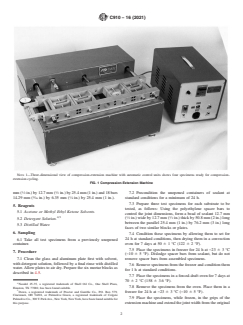
4.1 Extension Machine,asshowninFig.1,sodesignedthat
mine the applicability of regulatory limitations prior to use.
the test specimen can be automatically extended at a constant
NOTE 1—Currently there is no ISO standard similar to this test method.
1 1
rate of 3.18 mm ( ⁄8 in.)/h from a joint width of 12.7 mm ( ⁄2
1.4 This international standard was developed in accor-
in.) to 14.29 mm ( ⁄16 in.) at −23 6 3 °C (−10 6 5 °F).
dance with internationally recognized principles on standard-
4.2 Oven, forced-draft type, having temperature controlled
ization established in the Decision on Principles for the
at 70 6 2 °C (158 6 3.6 °F). See Specification E145.
Development of International Standards, Guides and Recom-
4.3 Oven,convectiontype,havingtemperaturecontrolledat
mendations issued by the World Trade Organization Technical
50 6 1 °C (122 6 2 °F).
Barriers to Trade (TBT) Committee.
4.4 Freezer Chest or Cold Box, having temperature con-
2. Referenced Documents
trolled at −23 6 3 °C (−10 6 5 °F).
2.1 ASTM Standards:
4.5 Mortar Blocks, six, prepared as described in Test Meth-
C717Terminology of Building Seals and Sealants
ods D1191, except that the blocks shall be approximately 25.4
D1191Test Method for Concrete Joint Sealers (Withdrawn
mm (1 in.) wide by 76.2 mm (3 in.) long by 25.4 mm (1 in.)
1996)
thick and surfaced by wet grinding on an iron lap with No. 60
silicon carbide or aluminum oxide grain.
4.6 Plates, six, of water-white polished float or plate glass
ThistestmethodisunderthejurisdictionofASTMCommitteeC24onBuilding
Seals and Sealants and is the direct responsibility of Subcommittee C24.30 on
approximately25.4mm(1in.)wideby76.2mm(3in.)longby
Adhesion.
6.35 mm ( ⁄4 in.) thick.
Current edition approved May 1, 2021. Published May 2021. Originally
approved in 1979. Last previous edition approved in 2016 as C910–16. DOI:
4.7 Aluminum Alloy Plates, six, 6063-T5 or 6061-T6 clear
10.1520/C0910-16R21.
anodized a minimum of 20 min over a scale-free finish,
For referenced ASTM standards, visit the ASTM website, www.astm.org, or
approximately25.4mm(1in.)wideby76.2mm(3in.)longby
contact ASTM Customer Service at service@astm.org. For Annual Book of ASTM
Standards volume information, refer to the standard’s Document Summary page on 6.35 mm ( ⁄4 in.) thick.
the ASTM website.
3 4.8 Polyethylene Spacer Bars,nine,approximately12.7mm
The last approved version of this historical standard is referenced on
1 1
www.astm.org. ( ⁄2in.) by 12.7 mm ( ⁄2 in.) by 50.8 mm (2 in.), 18 bars 12.7
Copyright © ASTM International, 100 Barr Harbor Drive, PO Box C700, West Conshohocken, PA 19428-2959. United States
C910 − 16 (2021)
NOTE 1—Three-dimensional view of compression-extension machine with automatic control units shows four specimens ready for compression-
extension cycling.
FIG. 1 Compression-Extension Machine
1 1
mm( ⁄2in.)by12.7mm( ⁄2in.)by25.4mm(1in.)and18bars 7.2 Precondition the unopened containers of sealant at
9 1
14.29 mm ( ⁄16in.) by 6.35 mm ( ⁄4in.) by 25.4 mm (1 in.). standard conditions for a minimum of 24 h.
7.3 Prepare three test specimens for each substrate to be
5. Reagents
tested, as follows: Using the polyethylene spacer bars to
5.1 Acetone or Methyl Ethyl Ketone Solvents.
control the joint dimensions, form a bead of sealant 12.7 mm
4,5 1 1
( ⁄2in.)wideby12.7mm( ⁄2in.)thickby50.8mm(2in.)long
5.2 D
...