

ASTM C793-23
(Test Method)Standard Test Method for Effects of Laboratory Accelerated Weathering on Elastomeric Joint Sealants
General Information
- Abstract
SIGNIFICANCE AND USE
5.1 It is known that solar radiation contributes to the degradation of sealants in exterior building joints. The use of a laboratory accelerated weathering machine with actinic radiation, moisture and heat appears to be a feasible means to give indications of early degradation by the appearance of sealant cracking. However, simulated weather factors in combination with extension may produce more severe degradation than weather factors only. Therefore, the effect of the weathering test is made more sensitive by the addition of the bending of the specimen at cold temperature.
SCOPE
1.1 This test method covers a laboratory procedure for determining the effects of accelerated weathering on cured-in-place elastomeric joint sealants (single- and multicomponent) for use in building construction.
1.2 The values stated in SI units are to be regarded as the standard. The values in parentheses are for information only.
1.3 The committee with jurisdiction over this standard is not aware of any comparable standards published by other ASTM committees or other organizations.
1.4 This standard does not purport to address all of the safety concerns, if any, associated with its use. It is the responsibility of the user of this standard to establish appropriate safety, health, and environmental practices and determine the applicability of regulatory limitations prior to use.
1.5 This international standard was developed in accordance with internationally recognized principles on standardization established in the Decision on Principles for the Development of International Standards, Guides and Recommendations issued by the World Trade Organization Technical Barriers to Trade (TBT) Committee.
- Status
- Published
- Publication Date
- 30-Apr-2023
- Technical Committee
- C24 - Building Seals and Sealants
- Drafting Committee
- C24.40 - Weathering
Buy Documents
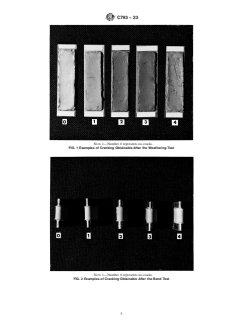

ASTM C793-23 - Standard Test Method for Effects of Laboratory Accelerated Weathering on Elastomeric Joint Sealants
REDLINE ASTM C793-23 - Standard Test Method for Effects of Laboratory Accelerated Weathering on Elastomeric Joint Sealants
Overview
ASTM C793-23: Standard Test Method for Effects of Laboratory Accelerated Weathering on Elastomeric Joint Sealants establishes a laboratory procedure to evaluate how elastomeric joint sealants resist degradation when exposed to simulated environmental conditions. This test method is crucial for building construction applications, ensuring the reliability and long-term performance of both single- and multicomponent cured-in-place sealants used in exterior joints. Using accelerated weathering devices, this standard simulates solar radiation, moisture, temperature extremes, and mechanical bending to reveal early signs of material failure, such as cracking.
Key Topics
Accelerated Weathering Testing
The procedure uses laboratory weathering devices (such as xenon arc, fluorescent UV, or open flame carbon arc apparatus) to simulate prolonged exposure to sunlight, humidity, and temperature variations in a controlled and repeatable manner.Cold Temperature Flexibility
After artificial weathering, specimens are subjected to cold temperatures (-26 ± 2°C or -15 ± 4°F) and then bent rapidly to assess their flexibility and resistance to cracking under extreme cold.Specimen Preparation and Types
The method covers both single-component and multicomponent elastomeric sealants, representative of materials used in building and construction applications.Visual and Mechanical Evaluation
Post-exposure, sealants are compared against unexposed control specimens for visual degradation (such as cracking) and behavior during bend tests.Reporting and Documentation
The standard requires detailed reporting, including material identification, test apparatus details, exposure conditions, and the post-test condition of each specimen.
Applications
Building Construction Quality Assurance
ASTM C793-23 is essential for manufacturers, architects, and specifiers aiming to select joint sealants that will maintain performance when exposed to real-world outdoor environments. The test provides predictive insights into sealant durability, guiding choices for projects requiring weather-resistant materials.Sealant Product Development
Laboratories and manufacturers use this test method to benchmark new formulations, investigate the effects of weathering on product life expectancy, and ensure compliance with market and regulatory demands.Comparative Material Assessment
The accelerated weathering process allows for rapid comparison of different sealant materials, aiding in the selection of products for climates involving high UV exposure, temperature extremes, or frequent moisture.Specification and Certification
Meeting the performance requirements established by ASTM C793-23 strengthens confidence in sealant certification processes, supports warranty claims, and aligns with industry best practices for product reliability.
Related Standards
ASTM C717 – Terminology of Building Seals and Sealants
This standard provides definitions for key terms used in building seals, sealants, and substrates, supporting the correct interpretation of ASTM C793-23.ASTM C1442 – Practice for Conducting Tests on Sealants Using Artificial Weathering Apparatus
C1442 details the apparatus and procedures for artificial weathering, as referenced in the accelerated exposure portion of C793-23.ASTM G151 – Practice for Exposing Nonmetallic Materials in Accelerated Test Devices
G151 establishes general guidelines for the exposure of nonmetallic materials, ensuring uniformity and validity during accelerated aging tests.
By applying the procedures in ASTM C793-23, stakeholders in the building and construction industry can confidently assess weathering effects on elastomeric joint sealants, helping to ensure long-term structural integrity and customer satisfaction while meeting contemporary quality standards.
Relations
- Effective Date
- 01-Mar-2019
- Effective Date
- 01-Mar-2018
- Effective Date
- 01-Nov-2017
- Effective Date
- 01-Jan-2017
- Effective Date
- 15-Nov-2016
- Effective Date
- 01-Sep-2016
- Effective Date
- 01-May-2014
- Effective Date
- 01-Feb-2014
- Effective Date
- 01-Nov-2013
- Effective Date
- 01-Dec-2012
- Effective Date
- 01-May-2012
- Effective Date
- 15-Jan-2012
- Effective Date
- 01-Apr-2011
- Effective Date
- 01-Mar-2011
- Effective Date
- 15-Jan-2011
Buy Documents
ASTM C793-23 - Standard Test Method for Effects of Laboratory Accelerated Weathering on Elastomeric Joint Sealants
REDLINE ASTM C793-23 - Standard Test Method for Effects of Laboratory Accelerated Weathering on Elastomeric Joint Sealants
Get Certified
Connect with accredited certification bodies for this standard

DIN CERTCO
DIN Group product certification.
DIBt (Deutsches Institut für Bautechnik)
German Institute for Building Technology.

Aboma Certification B.V.
Specialized in construction, metal, and transport sectors.
Sponsored listings
Frequently Asked Questions
ASTM C793-23 is a standard published by ASTM International. Its full title is "Standard Test Method for Effects of Laboratory Accelerated Weathering on Elastomeric Joint Sealants". This standard covers: SIGNIFICANCE AND USE 5.1 It is known that solar radiation contributes to the degradation of sealants in exterior building joints. The use of a laboratory accelerated weathering machine with actinic radiation, moisture and heat appears to be a feasible means to give indications of early degradation by the appearance of sealant cracking. However, simulated weather factors in combination with extension may produce more severe degradation than weather factors only. Therefore, the effect of the weathering test is made more sensitive by the addition of the bending of the specimen at cold temperature. SCOPE 1.1 This test method covers a laboratory procedure for determining the effects of accelerated weathering on cured-in-place elastomeric joint sealants (single- and multicomponent) for use in building construction. 1.2 The values stated in SI units are to be regarded as the standard. The values in parentheses are for information only. 1.3 The committee with jurisdiction over this standard is not aware of any comparable standards published by other ASTM committees or other organizations. 1.4 This standard does not purport to address all of the safety concerns, if any, associated with its use. It is the responsibility of the user of this standard to establish appropriate safety, health, and environmental practices and determine the applicability of regulatory limitations prior to use. 1.5 This international standard was developed in accordance with internationally recognized principles on standardization established in the Decision on Principles for the Development of International Standards, Guides and Recommendations issued by the World Trade Organization Technical Barriers to Trade (TBT) Committee.
SIGNIFICANCE AND USE 5.1 It is known that solar radiation contributes to the degradation of sealants in exterior building joints. The use of a laboratory accelerated weathering machine with actinic radiation, moisture and heat appears to be a feasible means to give indications of early degradation by the appearance of sealant cracking. However, simulated weather factors in combination with extension may produce more severe degradation than weather factors only. Therefore, the effect of the weathering test is made more sensitive by the addition of the bending of the specimen at cold temperature. SCOPE 1.1 This test method covers a laboratory procedure for determining the effects of accelerated weathering on cured-in-place elastomeric joint sealants (single- and multicomponent) for use in building construction. 1.2 The values stated in SI units are to be regarded as the standard. The values in parentheses are for information only. 1.3 The committee with jurisdiction over this standard is not aware of any comparable standards published by other ASTM committees or other organizations. 1.4 This standard does not purport to address all of the safety concerns, if any, associated with its use. It is the responsibility of the user of this standard to establish appropriate safety, health, and environmental practices and determine the applicability of regulatory limitations prior to use. 1.5 This international standard was developed in accordance with internationally recognized principles on standardization established in the Decision on Principles for the Development of International Standards, Guides and Recommendations issued by the World Trade Organization Technical Barriers to Trade (TBT) Committee.
ASTM C793-23 is classified under the following ICS (International Classification for Standards) categories: 83.060 - Rubber; 91.100.50 - Binders. Sealing materials. The ICS classification helps identify the subject area and facilitates finding related standards.
ASTM C793-23 has the following relationships with other standards: It is inter standard links to ASTM C717-19, ASTM C717-18, ASTM C717-17a, ASTM C717-17, ASTM C717-16a, ASTM C717-16, ASTM C717-14a, ASTM C717-14, ASTM C717-13, ASTM C717-12b, ASTM C717-12a, ASTM C717-12, ASTM C1442-11, ASTM C717-11a, ASTM C717-11. Understanding these relationships helps ensure you are using the most current and applicable version of the standard.
ASTM C793-23 is available in PDF format for immediate download after purchase. The document can be added to your cart and obtained through the secure checkout process. Digital delivery ensures instant access to the complete standard document.
Standards Content (Sample)
This international standard was developed in accordance with internationally recognized principles on standardization established in the Decision on Principles for the
Development of International Standards, Guides and Recommendations issued by the World Trade Organization Technical Barriers to Trade (TBT) Committee.
Designation: C793 − 23
Standard Test Method for
Effects of Laboratory Accelerated Weathering on
Elastomeric Joint Sealants
This standard is issued under the fixed designation C793; the number immediately following the designation indicates the year of
original adoption or, in the case of revision, the year of last revision. A number in parentheses indicates the year of last reapproval. A
superscript epsilon (´) indicates an editorial change since the last revision or reapproval.
This standard has been approved for use by agencies of the U.S. Department of Defense.
1. Scope 3. Terminology
3.1 Definitions—See Terminology C717 for applicable defi-
1.1 This test method covers a laboratory procedure for
nitions of the following terms: cure, elastomeric, joint, sealant,
determining the effects of accelerated weathering on cured-in-
and substrate.
place elastomeric joint sealants (single- and multicomponent)
for use in building construction.
4. Summary of Test Method
1.2 The values stated in SI units are to be regarded as the
4.1 Three sealant specimens are spread on aluminum plates
standard. The values in parentheses are for information only.
and exposed in one of the laboratory accelerated weathering
1.3 The committee with jurisdiction over this standard is not
chambers specified in Section 6 and operated in accordance
aware of any comparable standards published by other ASTM
with specifications in Section 8 and Practice C1442.
committees or other organizations.
4.2 Following this treatment the specimens are exposed for
1.4 This standard does not purport to address all of the
24 h in a freezer maintained at −26 °C 6 2 °C (−15 °F 6 4 °F).
safety concerns, if any, associated with its use. It is the
4.3 At the end of the cold exposure, the specimens are bent
responsibility of the user of this standard to establish appro-
over a mandrel within 1 s at the specified temperature.
priate safety, health, and environmental practices and deter-
mine the applicability of regulatory limitations prior to use.
5. Significance and Use
1.5 This international standard was developed in accor-
dance with internationally recognized principles on standard-
5.1 It is known that solar radiation contributes to the
ization established in the Decision on Principles for the
degradation of sealants in exterior building joints. The use of a
Development of International Standards, Guides and Recom-
laboratory accelerated weathering machine with actinic
mendations issued by the World Trade Organization Technical
radiation, moisture and heat appears to be a feasible means to
Barriers to Trade (TBT) Committee.
give indications of early degradation by the appearance of
sealant cracking. However, simulated weather factors in com-
2. Referenced Documents
bination with extension may produce more severe degradation
2 than weather factors only. Therefore, the effect of the weath-
2.1 ASTM Standards:
ering test is made more sensitive by the addition of the bending
C717 Terminology of Building Seals and Sealants
of the specimen at cold temperature.
C1442 Practice for Conducting Tests on Sealants Using
Artificial Weathering Apparatus
6. Apparatus
G151 Practice for Exposing Nonmetallic Materials in Accel-
erated Test Devices that Use Laboratory Light Sources
6.1 Exposure Apparatus—The exposure apparatus shall be
one of the three types of laboratory accelerated weathering
devices described in Practice C1442 that use either xenon arc,
fluorescent UV, or open flame carbon arc radiation. Consult
This test method is under the jurisdiction of ASTM Committee C24 on Building
Practice C1442, Section 7 for the differences in test parameters
Seals and Sealants and is the direct responsibility of Subcommittee C24.40 on
Weathering.
among the devices. Because of differences in test conditions,
Current edition approved May 1, 2023. Published May 2023. Originally
test results may differ with the type of device used. The choice
approved in 1975. Last previous edition approved in 2017 as C793 – 05 (2017).
of device shall be by mutual agreement among the interested
DOI: 10.1520/C0793-23.
For referenced ASTM standards, visit the ASTM website, www.astm.org, or parties.
contact ASTM Customer Service at service@astm.org. For Annual Book of ASTM
6.2 Freezer or Cold Box, having a temperature controlled
Standards volume information, refer to the standard’s Document Summary page on
the ASTM website. at −26 °C 6 2 °C (−15 °C 6 4 °F).
Copyright © ASTM International, 100 Barr Harbor Drive, PO Box C700, West Conshohocken, PA 19428-2959. United States
C793 − 23
6.3 Rectangular Brass Frame, with inside dimensions tests. The exposure duration for the xenon arc test shall be a
1 1
130 mm by 40 mm by 3 mm (5 in. by 1 ⁄2 in. by ⁄8 in.). minimum of 250 h exposure at an irradiance level of
2 2
0.51 W ⁄(m · nm) at 340 nm (459 kJ ⁄(m · nm) at 340 nm).
6.4 Aluminum Plates, three, each 152 mm by 80 mm by
0.3 mm (6 in. by 3 in. by 0.01 in.).
NOTE 2—See Annex A1 in Practice C1442 for determining the xenon
arc exposure time required to obtain the same radiant exposure at other
6.5 Steel Mandrel, 12.7 mm ( ⁄2 in.) in diameter and about
irradiance levels.
102 mm (4 in.) long.
8.1.4 At the end of exposure, remove the specimens from
6.6 Thin-Bladed Knife.
the machine and note changes in appearance as compared with
the unexposed file specimen.
6.7 Straightedge, metal or plastic, about 152 mm (6 in.)
long. 8.1.5 Place all three specimens and the mandrel in the
freezer, controlled at −26 6 2°C (−15 6 4°F) for 24 h. At the
6.8 Spatula, steel, about 152 mm (6 in.) long.
end of this period, while in the fre
...
This document is not an ASTM standard and is intended only to provide the user of an ASTM standard an indication of what changes have been made to the previous version. Because
it may not be technically possible to adequately depict all changes accurately, ASTM recommends that users consult prior editions as appropriate. In all cases only the current version
of the standard as published by ASTM is to be considered the official document.
Designation: C793 − 05 (Reapproved 2017) C793 − 23
Standard Test Method for
Effects of Laboratory Accelerated Weathering on
Elastomeric Joint Sealants
This standard is issued under the fixed designation C793; the number immediately following the designation indicates the year of
original adoption or, in the case of revision, the year of last revision. A number in parentheses indicates the year of last reapproval. A
superscript epsilon (´) indicates an editorial change since the last revision or reapproval.
This standard has been approved for use by agencies of the U.S. Department of Defense.
1. Scope
1.1 This test method covers a laboratory procedure for determining the effects of accelerated weathering on cured-in-place
elastomeric joint sealants (single- and multicomponent) for use in building construction.
1.2 The values stated in SI units are to be regarded as the standard. The values in parentheses are for information only.
1.3 The committee with jurisdiction over this standard is not aware of any comparable standards published by other ASTM
committees or other organizations.
1.4 This standard does not purport to address all of the safety concerns, if any, associated with its use. It is the responsibility
of the user of this standard to establish appropriate safety and healthsafety, health, and environmental practices and determine
the applicability of regulatory limitations prior to use.
1.5 This international standard was developed in accordance with internationally recognized principles on standardization
established in the Decision on Principles for the Development of International Standards, Guides and Recommendations issued
by the World Trade Organization Technical Barriers to Trade (TBT) Committee.
2. Referenced Documents
2.1 ASTM Standards:
C717 Terminology of Building Seals and Sealants
C1442 Practice for Conducting Tests on Sealants Using Artificial Weathering Apparatus
G151 Practice for Exposing Nonmetallic Materials in Accelerated Test Devices that Use Laboratory Light Sources
3. Terminology
3.1 Definitions—See Terminology C717 for applicable definitions of the following terms: cure, elastomeric, joint, sealant, and
substrate.
4. Summary of Test Method
4.1 Three sealant specimens are spread on aluminum plates and exposed in one of the laboratory accelerated weathering chambers
specified in Section 6 and operated in accordance with specifications in Section 8 and Practice C1442.
This test method is under the jurisdiction of ASTM Committee C24 on Building Seals and Sealants and is the direct responsibility of Subcommittee C24.40 on
Weathering.
Current edition approved Feb. 1, 2017May 1, 2023. Published March 2017May 2023. Originally approved in 1975. Last previous edition approved in 20102017 as
C793 – 05 (2017).(2010). DOI: 10.1520/C0793-05R17.10.1520/C0793-23.
For referenced ASTM standards, visit the ASTM website, www.astm.org, or contact ASTM Customer Service at service@astm.org. For Annual Book of ASTM Standards
volume information, refer to the standard’s Document Summary page on the ASTM website.
Copyright © ASTM International, 100 Barr Harbor Drive, PO Box C700, West Conshohocken, PA 19428-2959. United States
C793 − 23
4.2 Following this treatment the specimens are exposed for 24 h in a freezer maintained at −26 6 2°C (−15 6 4°F).−26 °C 6
2 °C (−15 °F 6 4 °F).
4.3 At the end of the cold exposure, the specimens are bent over a mandrel within 1 s 1 s at the specified temperature.
5. Significance and Use
5.1 It is known that solar radiation contributes to the degradation of sealants in exterior building joints. The use of a laboratory
accelerated weathering machine with actinic radiation, moisture and heat appears to be a feasible means to give indications of early
degradation by the appearance of sealant cracking. However, simulated weather factors in combination with extension may
produce more severe degradation than weather factors only. Therefore, the effect of the weathering test is made more sensitive by
the addition of the bending of the specimen at cold temperature.
6. Apparatus
6.1 Exposure Apparatus—The exposure apparatus shall be one of the three types of laboratory accelerated weathering devices
described in Practice C1442 that use either xenon arc, fluorescent UV, or open flame carbon arc radiation. Consult Practice C1442,
Section 7 for the differences in test parameters among the devices. Because of differences in test conditions, test results may differ
with the type of device used. The choice of device shall be by mutual agreement among the interested parties.
6.2 Freezer or Cold Box, having a temperature controlled at −26 6 2°C (−15 6 4°F).at −26 °C 6 2 °C (−15 °C 6 4 °F).
1 1
6.3 Rectangular Brass Frame, with inside dimensions 130 by 40130 mm by 40 mm by 3 mm (5(5 in. by 1 ⁄2 in. by ⁄8 in.). in.).
6.4 Aluminum Plates, three, each 152 by 80 by 0.3 mm (6 by 3 by 0.01 in.).152 mm by 80 mm by 0.3 mm (6 in. by 3 in. by
0.01 in.).
6.5 Steel Mandrel, 12.7 mm ( ⁄2 in.) in diameter and about 102 mm (4 in.) long.
6.6 Thin-Bladed Knife.
6.7 Straightedge, metal or plastic, about 152 mm (6 in.) long.
6.8 Spatula, steel, about 152 mm (6 in.) long.
7. Standard Test Conditions
7.1 Unless otherwise specified by those authorizing the test, standard conditions shall be as described in Terminology C717.
8. Procedure
8.1 Test of Multicomponent Sealants:
8.1.1 Condition at least 200 g 200 g of base compound and appropriate amount of curing agent and pigment, if required, in a
closed container for at least 24 h 24 h at standard conditions; then mix thoroughly for 5 min.
8.1.2 Fill the brass frame, after centering it on the aluminum plate, with a portion of the mixed compound and strike
...