

ASTM B747-20
(Specification)Standard Specification for Copper-Zirconium Alloy Sheet and Strip
General Information
- Abstract
ABSTRACT
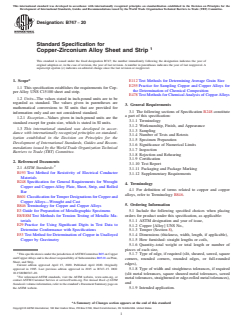
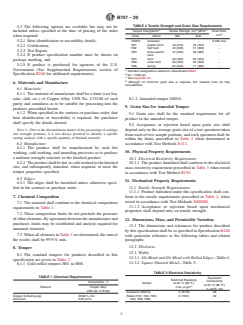
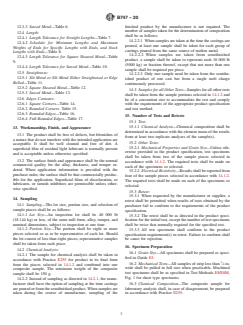
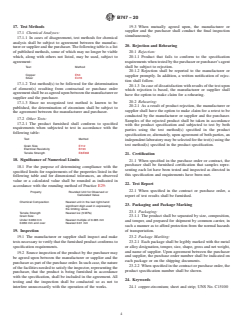
This specification establishes the requirements for sheets and strips of copper-zirconium alloys with Copper Alloy UNS No. C15100. The material for manufacture shall be a cast bar, slab, cake, billet, or others of such purity and soundness as to be suitable for processing by hot working, cold working, and annealing to produce a uniform wrought structure in the finished product. Products shall be sampled and prepared, then tested accordingly to examine their conformance to dimensional (thickness, length, width, mass, straightness, and edges), mechanical (tensile strength, and hardness), electrical resistivity, chemical composition, and grain size requirements.
SCOPE
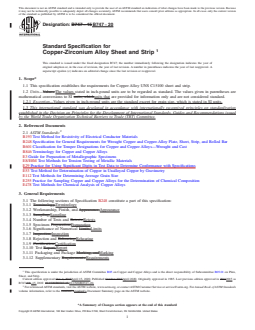
1.1 This specification establishes the requirements for Copper Alloy UNS C15100 sheet and strip.
1.2 Units—The values stated in inch-pound units are to be regarded as standard. The values given in parentheses are mathematical conversions to SI units that are provided for information only and are not considered standard.
1.2.1 Exception—Values given in inch-pound units are the standard except for grain size, which is stated in SI units.
1.3 This international standard was developed in accordance with internationally recognized principles on standardization established in the Decision on Principles for the Development of International Standards, Guides and Recommendations issued by the World Trade Organization Technical Barriers to Trade (TBT) Committee.
- Status
- Published
- Publication Date
- 14-Apr-2020
- Technical Committee
- B05 - Copper and Copper Alloys
- Drafting Committee
- B05.01 - Plate, Sheet, and Strip
Buy Documents
ASTM B747-20 - Standard Specification for Copper-Zirconium Alloy Sheet and Strip
REDLINE ASTM B747-20 - Standard Specification for Copper-Zirconium Alloy Sheet and Strip
Overview
ASTM B747-20: Standard Specification for Copper-Zirconium Alloy Sheet and Strip establishes precise requirements for sheet and strip products made from copper-zirconium alloy, specifically Copper Alloy UNS No. C15100. Developed by ASTM International, this standard supports manufacturers and users in ensuring consistent material quality for industrial and commercial applications by addressing the essential chemical, mechanical, physical, and dimensional properties required for these copper alloys.
This specification is applicable to material produced in various wrought forms such as cast bar, slab, or billet, which are processed by hot working, cold working, and annealing to obtain a uniform and reliable product. The standard’s requirements help guarantee that the finished products are suitable for a wide range of demanding applications, especially where electrical conductivity and mechanical performance are critical.
Key Topics
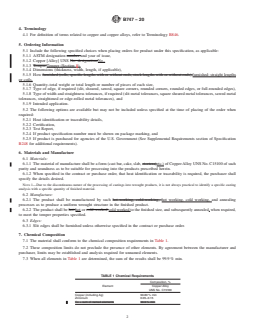
- Material Requirements: The copper-zirconium alloy must meet strict chemical composition limits, including a minimum copper content (including silver) of 99.80% and zirconium content between 0.05% and 0.15%. The sum of all named elements must equal at least 99.9%.
- Dimensional Tolerances: Products must adhere to specific tolerances for thickness, width, length, edges, and mass, ensuring consistency across batches per ASTM B248.
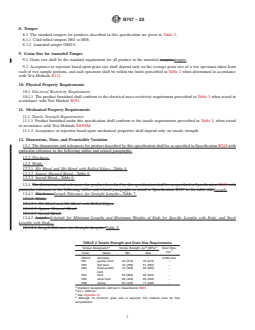
- Mechanical Properties: The sheet and strip must meet designated tensile strength and hardness requirements. For instance, various tempers from annealed to extra hard (e.g., H01 to H08) are defined, each with assigned minimum and maximum tensile strength values.
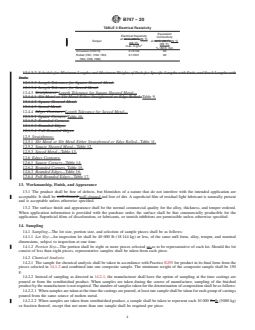
- Electrical Properties: Electrical resistivity and conductivity are critical, with required test methods specified to ensure suitability for applications in the electrical industry.
- Grain Size Control: Especially for annealed tempers, average grain size must be within defined limits, supporting both performance and formability.
- Sampling and Testing: Rigorous procedures for sampling and testing product lots are described, including tests for chemical composition, grain size, mechanical properties, and electrical resistivity.
- Quality and Workmanship: The finished sheet or strip must be free from defects that impair use but may show minor blemishes not affecting performance.
Applications
Copper-zirconium alloy sheet and strip materials covered by ASTM B747-20 are widely used in:
- Electrical Conductors: Owing to high electrical conductivity, these materials are ideal for connectors, switchgear components, and electrical contacts.
- Thermal Management: The alloy’s properties support use in heat exchangers and electronic cooling parts, where conductive and mechanical performance are both necessary.
- Automotive Components: Suitable for stamped and formed parts requiring good mechanical strength combined with reliable conductivity.
- Aerospace and Defense: Used in precision components that demand exact chemical and mechanical characteristics for safety and functionality.
By complying with ASTM B747-20, manufacturers and engineers ensure that the copper-zirconium alloy products will meet the high standards required for these critical applications.
Related Standards
For organizations engaged in copper alloy processing or product design, these additional standards are often referenced alongside ASTM B747-20:
- ASTM B193 - Test Method for Resistivity of Electrical Conductor Materials
- ASTM B248 - Specification for General Requirements for Wrought Copper and Copper-Alloy Plate, Sheet, Strip, and Rolled Bar
- ASTM B601 - Classification for Temper Designations for Copper and Copper Alloys (Wrought and Cast)
- ASTM B846 - Terminology for Copper and Copper Alloys
- ASTM E8/E8M - Test Methods for Tension Testing of Metallic Materials
- ASTM E112 - Test Methods for Determining Average Grain Size
Aligning with these standards ensures best practices in material selection, property validation, and quality assurance for copper-zirconium alloy sheet and strip products in accordance with ASTM B747-20.
Keywords: ASTM B747-20, copper-zirconium alloy, sheet and strip, UNS C15100, electrical conductivity, tensile strength, grain size, material specification, copper alloy standards.
Relations
- Effective Date
- 15-Apr-2020
- Effective Date
- 01-Jan-2024
- Effective Date
- 01-Aug-2019
- Effective Date
- 01-Jan-2019
- Effective Date
- 01-Oct-2018
- Effective Date
- 01-Mar-2018
- Effective Date
- 01-Oct-2016
- Effective Date
- 15-Jul-2016
- Effective Date
- 01-Apr-2016
- Effective Date
- 01-Feb-2015
- Effective Date
- 01-Apr-2014
- Effective Date
- 01-Jun-2013
- Effective Date
- 15-Nov-2012
- Effective Date
- 01-Oct-2012
- Effective Date
- 01-Apr-2012
Buy Documents
ASTM B747-20 - Standard Specification for Copper-Zirconium Alloy Sheet and Strip
REDLINE ASTM B747-20 - Standard Specification for Copper-Zirconium Alloy Sheet and Strip
Get Certified
Connect with accredited certification bodies for this standard

Element Materials Technology
Materials testing and product certification.

Inštitut za kovinske materiale in tehnologije
Institute of Metals and Technology. Materials testing, metallurgical analysis, NDT.
Sponsored listings
Frequently Asked Questions
ASTM B747-20 is a technical specification published by ASTM International. Its full title is "Standard Specification for Copper-Zirconium Alloy Sheet and Strip". This standard covers: ABSTRACT This specification establishes the requirements for sheets and strips of copper-zirconium alloys with Copper Alloy UNS No. C15100. The material for manufacture shall be a cast bar, slab, cake, billet, or others of such purity and soundness as to be suitable for processing by hot working, cold working, and annealing to produce a uniform wrought structure in the finished product. Products shall be sampled and prepared, then tested accordingly to examine their conformance to dimensional (thickness, length, width, mass, straightness, and edges), mechanical (tensile strength, and hardness), electrical resistivity, chemical composition, and grain size requirements. SCOPE 1.1 This specification establishes the requirements for Copper Alloy UNS C15100 sheet and strip. 1.2 Units—The values stated in inch-pound units are to be regarded as standard. The values given in parentheses are mathematical conversions to SI units that are provided for information only and are not considered standard. 1.2.1 Exception—Values given in inch-pound units are the standard except for grain size, which is stated in SI units. 1.3 This international standard was developed in accordance with internationally recognized principles on standardization established in the Decision on Principles for the Development of International Standards, Guides and Recommendations issued by the World Trade Organization Technical Barriers to Trade (TBT) Committee.
ABSTRACT This specification establishes the requirements for sheets and strips of copper-zirconium alloys with Copper Alloy UNS No. C15100. The material for manufacture shall be a cast bar, slab, cake, billet, or others of such purity and soundness as to be suitable for processing by hot working, cold working, and annealing to produce a uniform wrought structure in the finished product. Products shall be sampled and prepared, then tested accordingly to examine their conformance to dimensional (thickness, length, width, mass, straightness, and edges), mechanical (tensile strength, and hardness), electrical resistivity, chemical composition, and grain size requirements. SCOPE 1.1 This specification establishes the requirements for Copper Alloy UNS C15100 sheet and strip. 1.2 Units—The values stated in inch-pound units are to be regarded as standard. The values given in parentheses are mathematical conversions to SI units that are provided for information only and are not considered standard. 1.2.1 Exception—Values given in inch-pound units are the standard except for grain size, which is stated in SI units. 1.3 This international standard was developed in accordance with internationally recognized principles on standardization established in the Decision on Principles for the Development of International Standards, Guides and Recommendations issued by the World Trade Organization Technical Barriers to Trade (TBT) Committee.
ASTM B747-20 is classified under the following ICS (International Classification for Standards) categories: 77.150.30 - Copper products. The ICS classification helps identify the subject area and facilitates finding related standards.
ASTM B747-20 has the following relationships with other standards: It is inter standard links to ASTM B747-15, ASTM E8/E8M-24, ASTM B846-19a, ASTM B846-19, ASTM B601-18a, ASTM B601-18, ASTM B601-16, ASTM E8/E8M-16, ASTM B193-16, ASTM E8/E8M-15, ASTM B193-02(2014), ASTM E8/E8M-13, ASTM E112-12, ASTM B601-12, ASTM B248-12. Understanding these relationships helps ensure you are using the most current and applicable version of the standard.
ASTM B747-20 is available in PDF format for immediate download after purchase. The document can be added to your cart and obtained through the secure checkout process. Digital delivery ensures instant access to the complete standard document.
Standards Content (Sample)
This international standard was developed in accordance with internationally recognized principles on standardization established in the Decision on Principles for the
Development of International Standards, Guides and Recommendations issued by the World Trade Organization Technical Barriers to Trade (TBT) Committee.
Designation:B747 −20
Standard Specification for
Copper-Zirconium Alloy Sheet and Strip
This standard is issued under the fixed designation B747; the number immediately following the designation indicates the year of
original adoption or, in the case of revision, the year of last revision. A number in parentheses indicates the year of last reapproval. A
superscript epsilon (´) indicates an editorial change since the last revision or reapproval.
1. Scope* E112 Test Methods for Determining Average Grain Size
E255 Practice for Sampling Copper and Copper Alloys for
1.1 This specification establishes the requirements for Cop-
the Determination of Chemical Composition
per Alloy UNS C15100 sheet and strip.
E478 Test Methods for ChemicalAnalysis of CopperAlloys
1.2 Units—The values stated in inch-pound units are to be
regarded as standard. The values given in parentheses are
3. General Requirements
mathematical conversions to SI units that are provided for
3.1 The following sections of Specification B248 constitute
information only and are not considered standard.
a part of this specification:
1.2.1 Exception—Values given in inch-pound units are the
3.1.1 Terminology
standard except for grain size, which is stated in SI units.
3.1.2 Workmanship, Finish, and Appearance
1.3 This international standard was developed in accor-
3.1.3 Sampling
dance with internationally recognized principles on standard-
3.1.4 Number of Tests and Retests
ization established in the Decision on Principles for the
3.1.5 Specimen Preparation
Development of International Standards, Guides and Recom-
3.1.6 Significance of Numerical Limits
mendations issued by the World Trade Organization Technical
3.1.7 Inspection
Barriers to Trade (TBT) Committee.
3.1.8 Rejection and Rehearing
3.1.9 Certification
2. Referenced Documents
3.1.10 Test Report
2.1 ASTM Standards:
3.1.11 Packaging and Package Marking
B193 Test Method for Resistivity of Electrical Conductor
3.1.12 Supplementary Requirements
Materials
B248 Specification for General Requirements for Wrought
4. Terminology
Copper and Copper-Alloy Plate, Sheet, Strip, and Rolled
4.1 For definition of terms related to copper and copper
Bar
alloys, refer to Terminology B846.
B601 Classification forTemper Designations for Copper and
Copper Alloys—Wrought and Cast
5. Ordering Information
B846 Terminology for Copper and Copper Alloys
E3 Guide for Preparation of Metallographic Specimens 5.1 Include the following specified choices when placing
E8/E8M Test Methods for Tension Testing of Metallic Ma- orders for product under this specification, as applicable:
terials
5.1.1 ASTM designation and year of issue,
E29 Practice for Using Significant Digits in Test Data to 5.1.2 Copper [Alloy] UNS No.,
Determine Conformance with Specifications
5.1.3 Temper (Section 8),
E53 Test Method for Determination of Copper in Unalloyed 5.1.4 Dimensions (thickness, width, length, if applicable),
Copper by Gravimetry
5.1.5 How furnished: straight lengths or coils,
5.1.6 Quantity–total weight or total length or number of
pieces of each size,
ThisspecificationisunderthejurisdictionofASTMCommitteeB05onCopper
5.1.7 Type of edge, if required (slit, sheared, sawed, square
andCopperAlloysandisthedirectresponsibilityofSubcommitteeB05.01onPlate,
corners, rounded corners, rounded edges, or full-rounded
Sheet, and Strip.
edges),
Current edition approved April 15, 2020. Published April 2020. Originally
5.1.8 Type of width and straightness tolerances, if required
approved in 1985. Last previous edition approved in 2015 as B747–15. DOI:
10.1520/B0747–20.
(slit metal tolerances, square sheared metal tolerances, sawed
For referenced ASTM standards, visit the ASTM website, www.astm.org, or
metal tolerances, straightened or edge-rolled metal tolerances),
contact ASTM Customer Service at service@astm.org. For Annual Book of ASTM
and
Standards volume information, refer to the standard’s Document Summary page on
the ASTM website. 5.1.9 Intended application.
*A Summary of Changes section appears at the end of this standard
Copyright © ASTM International, 100 Barr Harbor Drive, PO Box C700, West Conshohocken, PA 19428-2959. United States
B747−20
TABLE 2 Tensile Strength and Grain Size Requirements
5.2 The following options are available but may not be
A B C
included unless specified at the time of placing of the order Temper Designation Tensile Strength, ksi (MPa) Grain Size,
D
mm
when required: Code Name Min Max
5.2.1 Heat identification or traceability details, OS015 annealed . . 0.030 max
H01 quarter hard 40 (275) 45 (310) .
5.2.2 Certification,
H02 half hard 43 (295) 51 (350) .
5.2.3 Test Report,
H03 three-quarter 47 (325) 56 (385) .
5.2.4 If product specification number must be shown on hard
H04 hard 53 (365) 62 (425) .
package marking, and
H06 extra hard 59 (405) 65 (450) .
5.2.5 If product is purchased for agencies of the U.S.
H08 spring 64 (440) 71 (490) .
Government (See Supplemental Requirements section of
A
Standard designations defined in Classification B601.
B
Specification B248 for additional requirements).
ksi = 1000 psi.
C
See Appendix X1.
D
Although no minimum grain size is required, this material must be fully
6. Materials and Manufacture
recrystallized.
6.1 Materials:
6.1.1 The material of manufacture shall be a form (cast bar,
cake, slab, etc.) of Copper Alloy UNS No. C15100 of such
8.1.2 Annealed temper OS015.
purity and soundness as to be suitable for processing into the
9. Grain Size for Annealed Temper
products prescribed herein.
6.1.2 When specified in the contract or purchase order, that
9.1 Grain size shall be the standard requirement for all
heat identification or traceability is required, the purchaser
product in the annealed temper.
shall specify the details desired.
9.2 Acceptance or rejection based upon grain size shall
NOTE 1—Due to the discontinuous nature of the processing of castings depend only on the average grain size of a test specimen taken
into wrought products, it is not always practical to identify a specific
from each of two sample portions, and each specimen shall be
casting analysis with a specific quantity of finished material.
within the limits prescribed in Table 2 when determined in
6.2 Manufacture:
accordance with Test Methods E112.
6.2.1 The product shall be manufactured by such hot
10. Physical Property Requirements
working, cold working, and annealing processes as to produce
a uniform wrought structure in the finished product.
10.1 Electrical Resistivity Requirement:
6.2.2 Theproductshallbehotorcoldworkedtothefinished
10.1.1 The product furnished shall conform to the electrical
size, and subsequently annealed, when required, to meet the
mass resistivity requirement prescribed in Table 3 when tested
temper properties specified.
in accordance with Test Method B193.
6.3 Edges:
11. Mechanical Property Requirements
6.3.1 Slit edges shall be furnished unless otherwise speci-
11.1 Tensile Strength Requirements:
fied in the contract or purchase order.
11.1.1 Product furnished under this specification shall con-
7. Chemical Composition
form to the tensile requirements prescribed in Table 2, when
tested in accordance with Test Methods E8/E8M.
7.1 The material shall conform to the chemical composition
11.1.2 Acceptance or rejection based upon mechanical
requirements in Table 1.
properties shall depend only on tensile strength.
7.2 These composition limits do not preclude the presence
ofotherelements.Byagreementbetweenthemanufacturerand
12. Dimensions, Mass, and Permissible Variation
purchaser, limits may be established and analysis required for
12.1 The dimensions and tolerances for product described
unnamed elements.
by this specification shall be as specified in Specification B248
7.3 When all elements in Table 1 are determined, the sum of
with particular reference to the following tables and related
the results shall be 99.9 % min.
paragraphs:
12.2 Thickness.
8. Temper
12.3 Width:
8.1 The standard tempers for products described in this
12.3.1 Slit Metal and Slit Metal with Rolled Edges—Table4.
specification are given in Table 2.
12.3.2 Square Sheared Metal—Table 5.
8.1.1 Cold rolled tempers H01 to H08.
TABLE 3 Electrical Resistivity
TABLE 1 Chemical Requirements
Equivalent
Electrical Resistivity
Conductivity
Composition, %
Temper at 20 °C (68 °F),
at 20 °C (68 °F),
Element
max,Ω·g/m
Copper Alloy
% IACS, min
UNS No. C15100
Annealed (OS015) 0.16136 95
Copper (including Ag) 99.80 % min Rolled (H01, H02, H03, 0.17031 90
Zirconium 0.05–0.15 H04, H06, H08)
B747−20
12.3.3 Sawed Metal—Table 6. finished product by the manufacturer is not required. The
number of samples taken for the determination of composition
12.4 Length:
shall be as follows:
12.4.1 Length Tolerance for Straight Lengths—Table 7.
14.2.2.1 Whensamplesaretakenatthetimethecastingsare
12.4.2 Schedule for Minimum Lengths and Maximum
poured, at least one sample shall be taken for each group of
Weights of Ends for Specific Lengths with Ends, and Stock
castings poured from the same source of molten metal.
Lengths with Ends—Table 8.
14.2.2.2 When samples are taken from semifinished
12.4.3 Length Tolerance for Square Sheared Metal—Table
product, a sample shall be taken to represent each 10 000 lb
9.
(5000 kg) or fraction thereof, except that not more than one
12.4.4 Length Tolerance for Sawed Metal—Table 10.
sample shall be required per piece.
12.5 Straightness:
14.2.2.3 Only one sample need be taken from the semifin-
12.5.1 Slit Metal or Slit Metal Either Straightened or Edge
ished product of one cast bar from a single melt charge
Rolled—Table 11.
continuously processed.
12.5.2 Square Sheared Metal—Table 12.
14.3 Samples for all Other Tests—Samplesforallothertests
12.5.3 Sawed Metal—Table 13.
shall be taken from the sample portions selected in 14.1.2 and
12.6 Edges Contours: be of a convenient size to accommodate the test and comply
12.6.1 Square Corners—Table 14.
with the requirements of the appropriate product specification
12.6.2 Rounded Corners. Table 15. and test method.
12.6.3 Rounded Edges—Table 16.
15. Number of Tests and Retests
12.6.4 Full-Rounded Edges—Table 17.
15.1 Tes
...
This document is not an ASTM standard and is intended only to provide the user of an ASTM standard an indication of what changes have been made to the previous version. Because
it may not be technically possible to adequately depict all changes accurately, ASTM recommends that users consult prior editions as appropriate. In all cases only the current version
of the standard as published by ASTM is to be considered the official document.
Designation: B747 − 15 B747 − 20
Standard Specification for
Copper-Zirconium Alloy Sheet and Strip
This standard is issued under the fixed designation B747; the number immediately following the designation indicates the year of
original adoption or, in the case of revision, the year of last revision. A number in parentheses indicates the year of last reapproval. A
superscript epsilon (´) indicates an editorial change since the last revision or reapproval.
1. Scope*
1.1 This specification establishes the requirements for Copper Alloy UNS C15100 sheet and strip.
1.2 Units—Values The values stated in inch-pound units are to be regarded as standard. The values given in parentheses are
mathematical conversions to SI units, whichunits that are provided for information only and are not considered standard.
1.2.1 Exception—Values given in inch-pound units are the standard except for grain size, which is stated in SI units.
1.3 This international standard was developed in accordance with internationally recognized principles on standardization
established in the Decision on Principles for the Development of International Standards, Guides and Recommendations issued
by the World Trade Organization Technical Barriers to Trade (TBT) Committee.
2. Referenced Documents
2.1 ASTM Standards:
B193 Test Method for Resistivity of Electrical Conductor Materials
B248 Specification for General Requirements for Wrought Copper and Copper-Alloy Plate, Sheet, Strip, and Rolled Bar
B601 Classification for Temper Designations for Copper and Copper Alloys—Wrought and Cast
B846 Terminology for Copper and Copper Alloys
E3 Guide for Preparation of Metallographic Specimens
E8/E8M Test Methods for Tension Testing of Metallic Materials
E29 Practice for Using Significant Digits in Test Data to Determine Conformance with Specifications
E53 Test Method for Determination of Copper in Unalloyed Copper by Gravimetry
E112 Test Methods for Determining Average Grain Size
E255 Practice for Sampling Copper and Copper Alloys for the Determination of Chemical Composition
E478 Test Methods for Chemical Analysis of Copper Alloys
3. General Requirements
3.1 The following sections of Specification B248 constitute a part of this specification:
3.1.1 Terminology,Terminology
3.1.2 Workmanship, Finish, and Appearance,Appearance
3.1.3 Sampling,Sampling
3.1.4 Number of Tests and Retests,Retests
3.1.5 Specimen Preparation,Preparation
3.1.6 Significance of Numerical Limits,Limits
3.1.7 Inspection,Inspection
3.1.8 Rejection and Rehearing,Rehearing
3.1.9 Certification,Certification
3.1.10 Test Report,Report
3.1.11 Packaging and Package Marking, andMarking
3.1.12 Supplementary Requirements.Requirements
This specification is under the jurisdiction of ASTM Committee B05 on Copper and Copper Alloys and is the direct responsibility of Subcommittee B05.01 on Plate,
Sheet, and Strip.
Current edition approved Oct. 1, 2015April 15, 2020. Published October 2015April 2020. Originally approved in 1985. Last previous edition approved in 20112015 as
B747–11.–15. DOI: 10.1520/B0747-15.10.1520/B0747–20.
For referenced ASTM standards, visit the ASTM website, www.astm.org, or contact ASTM Customer Service at service@astm.org. For Annual Book of ASTM Standards
volume information, refer to the standard’sstandard’s Document Summary page on the ASTM website.
*A Summary of Changes section appears at the end of this standard
Copyright © ASTM International, 100 Barr Harbor Drive, PO Box C700, West Conshohocken, PA 19428-2959. United States
B747 − 20
4. Terminology
4.1 For definition of terms related to copper and copper alloys, refer to Terminology B846.
5. Ordering Information
5.1 Include the following specified choices when placing orders for product under this specification, as applicable:
5.1.1 ASTM designation number and year of issue,
5.1.2 Copper [Alloy] UNS No. designation,No.,
5.1.3 Temper,Temper (Section 8),
5.1.4 Dimensions (thickness, width, length, if applicable),
5.1.5 How furnished (rolls, specific lengths with or without ends, stock lengths with or without ends),furnished: straight lengths
or coils,
5.1.6 Quantity–total weight or total length or number of pieces of each size,
5.1.7 Type of edge, if required (slit, sheared, sawed, square corners, rounded corners, rounded edges, or full-rounded edges),
5.1.8 Type of width and straightness tolerances, if required (slit metal tolerances, square sheared metal tolerances, sawed metal
tolerances, straightened or edge-rolled metal tolerances), and
5.1.9 Intended application.
5.2 The following options are available but may not be included unless specified at the time of placing of the order when
required:
5.2.1 Heat identification or traceability details,
5.2.2 Certification,
5.2.3 Test Report,
5.2.4 If product specification number must be shown on package marking, and
5.2.5 If product is purchased for agencies of the U.S. Government (See Supplemental Requirements section of Specification
B248 for additional requirements).
6. Materials and Manufacture
6.1 Materials:
6.1.1 The material of manufacture shall be a form (cast bar, cake, slab, etcetera)etc.) of Copper Alloy UNS No. C15100 of such
purity and soundness as to be suitable for processing into the products prescribed herein.
6.1.2 When specified in the contract or purchase order, that heat identification or traceability is required, the purchaser shall
specify the details desired.
NOTE 1—Due to the discontinuous nature of the processing of castings into wrought products, it is not always practical to identify a specific casting
analysis with a specific quantity of finished material.
6.2 Manufacture:
6.2.1 The product shall be manufactured by such hot-working, cold-working, hot working, cold working, and annealing
processes as to produce a uniform wrought structure in the finished product.
6.2.2 The product shall be hot-hot or cold-worked cold worked to the finished size, and subsequently annealed, when required,
to meet the temper properties specified.
6.3 Edges:
6.3.1 Slit edges shall be furnished unless otherwise specified in the contract or purchase order.
7. Chemical Composition
7.1 The material shall conform to the chemical composition requirements in Table 1.
7.2 These composition limits do not preclude the presence of other elements. By agreement between the manufacturer and
purchaser, limits may be established and analysis required for unnamed elements.
7.3 When all elements in Table 1 are determined, the sum of the results shall be 99.9 % min.
TABLE 1 Chemical Requirements
Composition, %
Element
Copper Alloy
UNS No. C15100
Copper (including Ag) 99.80 % min
Zirconium 0.05–0.15
Cu + sum of named elements 99.9 % min
B747 − 20
8. Temper
8.1 The standard tempers for products described in this specification are given in Table 2.
8.1.1 Cold rolled tempers H01 to H08.
8.1.2 Annealed temper OS015.
9. Grain Size for Annealed Temper
9.1 Grain size shall be the standard requirement for all product in the annealed tempers.temper.
9.2 Acceptance or rejection based upon grain size shall depend only on the average grain size of a test specimen taken from
each of two sample portions, and each specimen shall be within the limits prescribed in Table 2 when determined in accordance
with Test Methods E112.
10. Physical Property Requirements
10.1 Electrical Resistivity Requirement:
10.1.1 The product furnished shall conform to the electrical mass resistivity requirement prescribed in Table 3 when tested in
accordance with Test Method B193.
11. Mechanical Property Requirements
11.1 Tensile Strength Requirements:
11.1.1 Product furnished under this specification shall conform to the tensile requirements prescribed in Table 2, when tested
in accordance with Test Methods E8/E8M.
11.1.2 Acceptance or rejection based upon mechanical properties shall depend only on tensile strength.
12. Dimensions, Mass, and Permissible Variation
12.1 The dimensions and tolerances for product described by this specification shall be as specified in Specification B248 with
particular reference to the following tables and related paragraphs:
12.2 Thickness.
12.3 Width:
12.3.1 Slit Metal and Slit Metal with Rolled Edges—Table 4.
12.3.2 Square Sheared Metal—Table 5.
12.3.3 Sawed Metal—Table 6.
12.4 The dimensions and tolerances for product described by this specification shall be as specified in Specification B248 with
particular reference to the following tables and related paragraphs as noted to Specification B747 in the table title:Length:
12.4.1 Thickness. Length Tolerance for Straight Lengths—Table 7.
12.1.2 Width:
12.1.2.1 Slit Metal and Slit Metal with Rolled Edges.
12.1.2.2 Square Sheared Metal.
12.1.2.3 Sawed Metal.
12.4.2 Length: Schedule for Minimum Lengths and Maximum Weights of Ends for Specific Lengths with Ends, and Stock
Lengths with Ends—
12.1.3.1 Length Tolerance for Straight Lengths. Table 8.
TABLE 2 Tensile Strength and Grain Size Requirements
A B C
Temper Designation Tensile Strength, ksi (MPa) Grain Size,
D
mm
Code Name Min Max
OS015 annealed . . 0.030 max
H01 quarter hard 40 (275) 45 (310) .
H02 half hard 43 (295) 51 (350) .
H03 three-quarter 47 (325) 56 (385) .
hard
H04 hard 53 (365) 62 (425) .
H06 extra hard 59 (405) 65 (450) .
H08 spring 64 (440) 71 (490) .
A
Standard designations defined in Classification B601.
B
ksi = 1000 psi.
C
See Appendix X1.
D
Although no minimum grain size is required, this material must be fully
recrystallized.
B747 − 20
TABLE 3 Electrical Resistivity
Equivalent
Electrical Resistivity
Conductivity
at 20°C (68°F),20 °C
Temper at 20°C (68°F),20 °C
(68 °F),
(68 °F),
max, Ω·g/m
% IACS, min
Annealed (OS015) 0.16136 95
Rolled (H01, H02, H03, 0.17031 90
H04, H06, H08)
12.1.3.2 Schedule for Minimum Lengths and Maximum Weights of Ends for Specific Lengths with Ends, and Stock Lengths with
Ends.
12.1.3.3 Length Tolerance for Square Sheared Metal.
12.1.3.4 Length Tolerance for Sawed Metal.
12.4.3 Straightness: Length Tolerance for Square Sheared Metal—
12.1.4.1 Slit Metal or Slit Metal Either Straightened or Edge Rolled. Table 9.
12.1.4.2 Square Sheared Metal.
12.1.4.3 Sawed Metal.
12.4.4 Edges Contours: Length Tolerance for Sawed Metal—
12.1.5.1 Square Corners. Table 10.
12.1.5.2 Rounded Corners.
12.1.5.3 Rounded Edges.
12.1.5.4 Full-Rounded Edges.
12.5 Straightness:
12.5.1 Slit Metal or Slit Metal Either Straightened or Edge Rolled—Table 11.
12.5.2 Square Sheared Metal—Table 12.
12.5.3 Sawed Metal—Table 13.
12.6 Edges Contours:
12.6.1 Square Corners—Table 14.
12.6.2 Rounded Corners. Table 15.
12.6.3 Rounded Edges—Table 16.
12.6.4 Full-Rounded Edges—Table 17.
13. Workmanship, Finish, and Appearance
13.1 The product shall be free of defects, but blemishes of a nature that do not interfere with the intended application are
acceptable. It shall be well-cleaned well cleaned and free of dirt. A superficial film of residual light lubricant is normally present
and is acceptable unless other
...