

ASTM D7643-22
(Practice)Standard Practice for Determining the Continuous Grading Temperatures and Continuous Grades for PG Graded Asphalt Binders
General Information
- Abstract
SIGNIFICANCE AND USE
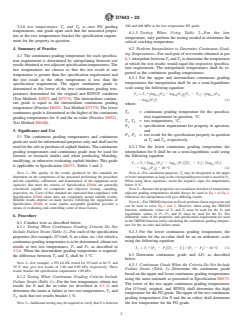
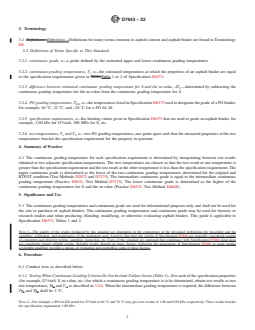
5.1 The continuous grading temperatures and continuous grade are used for informational purposes only and shall not be used for the sale or purchase of asphalt binders. The continuous grading temperatures and continuous grade may be used for forensic or research studies and when producing, blending, modifying, or otherwise evaluating asphalt binders. This guide is applicable to Specification D6373, Tables 1 and 2.
Note 1: The quality of the results produced by this standard are dependent on the competence of the personnel performing the procedure and the capability, calibration, and maintenance of the equipment used. Agencies that meet the criteria of Specification D3666 are generally considered capable of competent and objective testing, sampling, inspection, etc. Users of this standard are cautioned that compliance with Specification D3666 alone does not completely ensure reliable results. Reliable results depend on many factors; following the suggestions of Specification D3666 or some similar acceptable guideline provides a means of evaluating and controlling some of those factors.
SCOPE
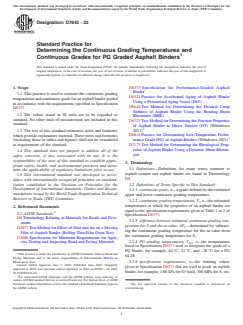
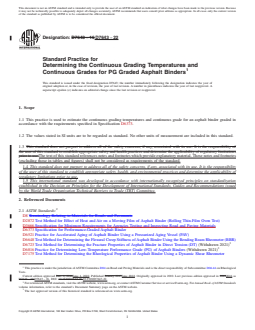
1.1 This practice is used to estimate the continuous grading temperatures and continuous grade for an asphalt binder graded in accordance with the requirements specified in Specification D6373.
1.2 The values stated in SI units are to be regarded as standard. No other units of measurement are included in this standard.
1.3 The text of this standard references notes and footnotes which provide explanatory material. These notes and footnotes (excluding those in tables and figures) shall not be considered as requirements of the standard.
1.4 This standard does not purport to address all of the safety concerns, if any, associated with its use. It is the responsibility of the user of this standard to establish appropriate safety, health, and environmental practices and determine the applicability of regulatory limitations prior to use.
1.5 This international standard was developed in accordance with internationally recognized principles on standardization established in the Decision on Principles for the Development of International Standards, Guides and Recommendations issued by the World Trade Organization Technical Barriers to Trade (TBT) Committee.
- Status
- Published
- Publication Date
- 31-May-2022
- Technical Committee
- D04 - Road and Paving Materials
- Drafting Committee
- D04.44 - Rheological Tests
Buy Documents
ASTM D7643-22 - Standard Practice for Determining the Continuous Grading Temperatures and Continuous Grades for PG Graded Asphalt Binders
REDLINE ASTM D7643-22 - Standard Practice for Determining the Continuous Grading Temperatures and Continuous Grades for PG Graded Asphalt Binders
Overview
ASTM D7643-22: Standard Practice for Determining the Continuous Grading Temperatures and Continuous Grades for PG Graded Asphalt Binders establishes a method for estimating continuous grading temperatures and corresponding grades for performance-graded (PG) asphalt binders. This ASTM standard is primarily intended for use in research, forensic analysis, production, blending, modification, and evaluation of asphalt binders. It supports informed decision-making in the context of Specification D6373 but explicitly prohibits use for the sale or purchase of asphalt binders.
This practice provides guidance on interpolating test results between predetermined specification limits to obtain more precise temperature ratings for asphalt binder performance across a continuous temperature scale, allowing for more granular performance analysis and binder selection tailored to specific applications.
Key Topics
- Continuous Grading Temperatures: The standard describes procedures to determine the specific high, intermediate, and low continuous grading temperatures at which asphalt binders meet the requirements of ASTM Specification D6373.
- Continuous Grade: Defined based on the estimated upper and lower continuous grading temperatures, providing a more precise grade than traditional PG intervals (e.g., PG 64-22).
- Test Methods: Relies on interpolating between bracketing test results (both above and below specification requirements) using semi-logarithmic or arithmetic calculations, depending on the property tested.
- Reporting: Specifies how to report continuous grading temperatures and grades to the nearest 0.1°C and how to include information on grading criteria as well as ΔT values (difference between S and m-value temperatures).
- Competency and Calibration: Emphasizes that results depend on the proficiency of laboratory personnel and calibration of equipment, referencing ASTM Specification D3666 as a guideline for agency qualification.
Applications
ASTM D7643-22 is specifically intended for informational and technical evaluation purposes rather than commercial transactions. Key applications include:
- Forensic and Research Studies: Investigators and researchers can use continuous grades to analyze binder performance in actual pavement distress scenarios or during development of new materials.
- Production and Blending: Refineries and laboratories may employ continuous grading to optimize binder formulations and blends for target climate or application-specific performance properties.
- Binder Modification: Evaluation of the effects of polymer modifiers or recycled additives on the binder can be analyzed in greater detail using continuous temperature gradations.
- Specification Support: The standard supports application of Specification D6373, aiding in the assessment of compliance and performance, particularly in challenging environments or for advanced binder selections.
Related Standards
- ASTM D6373: Specification for Performance Graded Asphalt Binder-Provides the core requirements referenced in continuous grading.
- ASTM D2872: Test Method for Effect of Heat and Air on a Moving Film of Asphalt Binder (Rolling Thin-Film Oven Test)-Assesses binder aging.
- ASTM D7175: Test Method for Determining the Rheological Properties of Asphalt Binder Using a Dynamic Shear Rheometer.
- ASTM D6521: Practice for Accelerated Aging of Asphalt Binder Using a Pressurized Aging Vessel.
- ASTM D6648: Test Method for Determining the Flexural Creep Stiffness of Asphalt Binder Using the Bending Beam Rheometer.
- ASTM D3666: Specification for Minimum Requirements for Agencies Testing and Inspecting Road and Paving Materials.
- ASTM D8: Terminology Relating to Materials for Roads and Pavements.
For full implementation, consultation with Specification D6373 and adherence to practices regarding laboratory quality management (such as those outlined in D3666) is essential to maintain accurate and reliable results in applying ASTM D7643-22.
Keywords: ASTM D7643-22, continuous grading temperatures, continuous grades, PG graded asphalt binders, performance-graded binders, asphalt binder testing, Specification D6373, forensic analysis, binder blending, pavement materials.
Relations
- Effective Date
- 15-Dec-2023
- Effective Date
- 01-Aug-2019
- Effective Date
- 01-Jul-2019
- Effective Date
- 15-Dec-2018
- Effective Date
- 15-Aug-2018
- Effective Date
- 01-Jul-2018
- Effective Date
- 01-Jul-2018
- Effective Date
- 01-Feb-2018
- Effective Date
- 15-Jul-2017
- Effective Date
- 15-Jun-2017
- Effective Date
- 01-May-2017
- Effective Date
- 01-Mar-2017
- Effective Date
- 01-Dec-2016
- Effective Date
- 01-Oct-2016
- Effective Date
- 15-Sep-2016
Buy Documents
ASTM D7643-22 - Standard Practice for Determining the Continuous Grading Temperatures and Continuous Grades for PG Graded Asphalt Binders
REDLINE ASTM D7643-22 - Standard Practice for Determining the Continuous Grading Temperatures and Continuous Grades for PG Graded Asphalt Binders
Get Certified
Connect with accredited certification bodies for this standard

DIBt (Deutsches Institut für Bautechnik)
German Institute for Building Technology.
DIN CERTCO
DIN Group product certification.

Aboma Certification B.V.
Specialized in construction, metal, and transport sectors.
Sponsored listings
Frequently Asked Questions
ASTM D7643-22 is a standard published by ASTM International. Its full title is "Standard Practice for Determining the Continuous Grading Temperatures and Continuous Grades for PG Graded Asphalt Binders". This standard covers: SIGNIFICANCE AND USE 5.1 The continuous grading temperatures and continuous grade are used for informational purposes only and shall not be used for the sale or purchase of asphalt binders. The continuous grading temperatures and continuous grade may be used for forensic or research studies and when producing, blending, modifying, or otherwise evaluating asphalt binders. This guide is applicable to Specification D6373, Tables 1 and 2. Note 1: The quality of the results produced by this standard are dependent on the competence of the personnel performing the procedure and the capability, calibration, and maintenance of the equipment used. Agencies that meet the criteria of Specification D3666 are generally considered capable of competent and objective testing, sampling, inspection, etc. Users of this standard are cautioned that compliance with Specification D3666 alone does not completely ensure reliable results. Reliable results depend on many factors; following the suggestions of Specification D3666 or some similar acceptable guideline provides a means of evaluating and controlling some of those factors. SCOPE 1.1 This practice is used to estimate the continuous grading temperatures and continuous grade for an asphalt binder graded in accordance with the requirements specified in Specification D6373. 1.2 The values stated in SI units are to be regarded as standard. No other units of measurement are included in this standard. 1.3 The text of this standard references notes and footnotes which provide explanatory material. These notes and footnotes (excluding those in tables and figures) shall not be considered as requirements of the standard. 1.4 This standard does not purport to address all of the safety concerns, if any, associated with its use. It is the responsibility of the user of this standard to establish appropriate safety, health, and environmental practices and determine the applicability of regulatory limitations prior to use. 1.5 This international standard was developed in accordance with internationally recognized principles on standardization established in the Decision on Principles for the Development of International Standards, Guides and Recommendations issued by the World Trade Organization Technical Barriers to Trade (TBT) Committee.
SIGNIFICANCE AND USE 5.1 The continuous grading temperatures and continuous grade are used for informational purposes only and shall not be used for the sale or purchase of asphalt binders. The continuous grading temperatures and continuous grade may be used for forensic or research studies and when producing, blending, modifying, or otherwise evaluating asphalt binders. This guide is applicable to Specification D6373, Tables 1 and 2. Note 1: The quality of the results produced by this standard are dependent on the competence of the personnel performing the procedure and the capability, calibration, and maintenance of the equipment used. Agencies that meet the criteria of Specification D3666 are generally considered capable of competent and objective testing, sampling, inspection, etc. Users of this standard are cautioned that compliance with Specification D3666 alone does not completely ensure reliable results. Reliable results depend on many factors; following the suggestions of Specification D3666 or some similar acceptable guideline provides a means of evaluating and controlling some of those factors. SCOPE 1.1 This practice is used to estimate the continuous grading temperatures and continuous grade for an asphalt binder graded in accordance with the requirements specified in Specification D6373. 1.2 The values stated in SI units are to be regarded as standard. No other units of measurement are included in this standard. 1.3 The text of this standard references notes and footnotes which provide explanatory material. These notes and footnotes (excluding those in tables and figures) shall not be considered as requirements of the standard. 1.4 This standard does not purport to address all of the safety concerns, if any, associated with its use. It is the responsibility of the user of this standard to establish appropriate safety, health, and environmental practices and determine the applicability of regulatory limitations prior to use. 1.5 This international standard was developed in accordance with internationally recognized principles on standardization established in the Decision on Principles for the Development of International Standards, Guides and Recommendations issued by the World Trade Organization Technical Barriers to Trade (TBT) Committee.
ASTM D7643-22 is classified under the following ICS (International Classification for Standards) categories: 91.100.50 - Binders. Sealing materials. The ICS classification helps identify the subject area and facilitates finding related standards.
ASTM D7643-22 has the following relationships with other standards: It is inter standard links to ASTM D7175-23, ASTM D8-19, ASTM D6521-19, ASTM D8-18c, ASTM D8-18b, ASTM D6521-18, ASTM D8-18a, ASTM D8-18, ASTM D8-17c, ASTM D8-17b, ASTM D8-17a, ASTM D8-17, ASTM D8-16b, ASTM D3666-16, ASTM D8-16a. Understanding these relationships helps ensure you are using the most current and applicable version of the standard.
ASTM D7643-22 is available in PDF format for immediate download after purchase. The document can be added to your cart and obtained through the secure checkout process. Digital delivery ensures instant access to the complete standard document.
Standards Content (Sample)
This international standard was developed in accordance with internationally recognized principles on standardization established in the Decision on Principles for the
Development of International Standards, Guides and Recommendations issued by the World Trade Organization Technical Barriers to Trade (TBT) Committee.
Designation: D7643 − 22
Standard Practice for
Determining the Continuous Grading Temperatures and
Continuous Grades for PG Graded Asphalt Binders
This standard is issued under the fixed designation D7643; the number immediately following the designation indicates the year of
original adoption or, in the case of revision, the year of last revision. A number in parentheses indicates the year of last reapproval. A
superscript epsilon (´) indicates an editorial change since the last revision or reapproval.
1. Scope D6373 Specification for Performance-Graded Asphalt
Binder
1.1 This practice is used to estimate the continuous grading
D6521 Practice for Accelerated Aging of Asphalt Binder
temperaturesandcontinuousgradeforanasphaltbindergraded
Using a Pressurized Aging Vessel (PAV)
in accordance with the requirements specified in Specification
D6648 Test Method for Determining the Flexural Creep
D6373.
Stiffness of Asphalt Binder Using the Bending Beam
1.2 The values stated in SI units are to be regarded as
Rheometer (BBR)
standard. No other units of measurement are included in this
D6723 Test Method for Determining the Fracture Properties
standard.
of Asphalt Binder in Direct Tension (DT) (Withdrawn
2021)
1.3 The text of this standard references notes and footnotes
which provide explanatory material. These notes and footnotes D6816 Practice for Determining Low-Temperature Perfor-
mance Grade (PG) ofAsphalt Binders (Withdrawn 2021)
(excluding those in tables and figures) shall not be considered
as requirements of the standard. D7175 Test Method for Determining the Rheological Prop-
erties of Asphalt Binder Using a Dynamic Shear Rheom-
1.4 This standard does not purport to address all of the
eter
safety concerns, if any, associated with its use. It is the
responsibility of the user of this standard to establish appro-
3. Terminology
priate safety, health, and environmental practices and deter-
3.1 Definitions—Definitions for many terms common to
mine the applicability of regulatory limitations prior to use.
asphalt cement and asphalt binder are found in Terminology
1.5 This international standard was developed in accor-
D8.
dance with internationally recognized principles on standard-
ization established in the Decision on Principles for the
3.2 Definitions of Terms Specific to This Standard:
Development of International Standards, Guides and Recom-
3.2.1 continuous grade, n—a grade defined by the estimated
mendations issued by the World Trade Organization Technical
upper and lower continuous grading temperatures.
Barriers to Trade (TBT) Committee.
3.2.2 continuousgradingtemperatures,T,n—theestimated
c
temperatures at which the properties of an asphalt binder are
2. Referenced Documents
equal to the specification requirements given in Table 1 or 2 of
2.1 ASTM Standards:
Specification D6373.
D8 Terminology Relating to Materials for Roads and Pave-
3.2.3 difference between estimated continuous grading tem-
ments
perature for S and the m-value, ∆T —determined by subtract-
C
D2872 Test Method for Effect of Heat and Air on a Moving
ing the continuous grading temperature for the m-value from
Film of Asphalt Binder (Rolling Thin-Film Oven Test)
the continuous grading temperature for S.
D3666 Specification for Minimum Requirements for Agen-
3.2.4 PG grading temperatures, T ,n—the temperatures
cies Testing and Inspecting Road and Paving Materials PG
listed in Specification D6373 used to designate the grade of a
PG binder, for example, 64 °C, 22 °C, and –28 °C for a PG
This practice is under the jurisdiction of ASTM Committee D04 on Road and
64-28.
Paving Materials and is the direct responsibility of Subcommittee D04.44 on
Rheological Tests.
3.2.5 specification requirements, n—the limiting values
Current edition approved June 1, 2022. Published June 2022. Originally
given in Specification D6373 that are used to grade an asphalt
approved in 2010. Last previous edition approved in 2016 as D7643 – 16. DOI:
binder, for example, 1.00 kPa for G*/sinδ, 300 MPa for S, etc.
10.1520/D7643-22.
For referenced ASTM standards, visit the ASTM website, www.astm.org, or
contact ASTM Customer Service at service@astm.org. For Annual Book of ASTM
Standards volume information, refer to the standard’s Document Summary page on The last approved version of this historical standard is referenced on
the ASTM website. www.astm.org.
Copyright © ASTM International, 100 Barr Harbor Drive, PO Box C700, West Conshohocken, PA 19428-2959. United States
D7643 − 22
300 and 600 MPa at the low temperature PG grade.
3.2.6 test temperatures, T and T,n—two PG grading
1 2
temperatures, one grade apart such that the measured proper-
6.1.3 Testing When Using Table 2—For the low
ties at the two temperatures bracket the specification require-
temperature, only perform the testing needed to determine the
ment for the property in question.
critical cracking temperature.
4. Summary of Practice 6.2 Perform Interpolation to Determine Continuous Grad-
ing Temperatures—For each pair of test results obtained as per
4.1 The continuous grading temperature for each specifica-
6.1,interpolatebetweenT andT todeterminethetemperature
1 2
tion requirement is determined by interpolating between test
at which the test results would equal the respective specifica-
resultsobtainedattwoadjacentspecificationtemperatures.The
tion requirement. The interpolated temperatures shall be re-
two temperatures are chosen so that the test result at one
ported as the continuous grading temperatures.
temperature is greater than the specification requirement and
6.2.1 For the upper and intermediate continuous grading
the test result at the other temperature is less than the
temperatures the interpolation shall be on a semi-logarithmic
specification requirement. The upper continuous grade is
scale using the following equation:
determined as the lower of the two continuous grading tem-
peratures determined for the original and RTFOT condition
T 5 T 1$log ~P ! 2 log ~P !%$T 2 T % ⁄ $log ~P !
C 1 10 S 10 1 2 1 10 2
(Test Methods D2872 and D7175). The intermediate continu-
2 log ~P !% (1)
10 1
ous grade is equal to the intermediate continuous grading
where:
temperature (Practice D6521, Test Method D7175). The lower
T = continuous grading temperature for the specifica-
continuous grade is determined as the higher of the continuous C
tion requirement in question, °C,
grading temperatures for S and the m-value (Practice D6521,
T,T = test temperatures, °C,
1 2
Test Method D6648).
P = specification requirement for property in question,
S
and
5. Significance and Use
P,P = test result for the specification property in question
1 2
5.1 The continuous grading temperatures and continuous
at T and T , respectively.
1 2
grade are used for informational purposes only and shall not be
usedforthesaleorpurchaseofasphaltbinders.Thecontinuous 6.2.2 For the lower continuous grading temperature the
grading temperatures and continuous grade may be used for interpolation for S shall be on a semi-logarithmic scale using
forensic or research studies and when producing, blending, the following equation:
modifying, or otherwise evaluating asphalt binders. This guide
T 5 T 1 log P 2 log P T 2 T ⁄ log P
$ ~ ! ~ !%$ % $ ~ !
C 1 10 S 10 1 2 1 10 2
is applicable to Specification D6373, Tables 1 and 2.
2 log ~P !% 2 10 °C (2)
10 1
NOTE 1—The quality of the results produced by this standard are NOTE 4—For calculation purposes, T may be designated as the upper
dependent on the competence of the personnel performing the procedure
orlowertemperatureaslongasthecorrespondingtestresultisusedforP .
and the capability, calibration, and maintenance of the equipment used. When using these equations, retain the negative signs for temperatures
Agencies that meet the criteria of Specification D3666 are generally
below 0 °C.
considered capable of competent and objective testing, sampling,
NOTE5—Becausethepropertiesareanonlinearfunctionoftemperature
inspection, etc. Users of this standard are cautioned that compliance with
adjacent grading temperatures should always be used in Eq 1 or Eq 2.
Specification D3666 alone does not completely ensure reliable results.
Otherwise the interpolation will give differing results.
Reliable results depend on many factors; following the suggestions of
NOTE 6—The TREND function in Excel performs linear regression and
Specification D3666 or some similar acceptable guideline provides a
can be used to solve Eq 1 and 2. However, when using the TREND
means of evaluating and controlling some of those factors.
function, arithmetic values of T and T must be used for the Ys and
1 2
logarithmic values of P , P , and P must be used for the Xs. The
1 2 S
6. Procedure
arithmetic value of the properties and specification requirement are used
in theTREND function when calculating the continuous grading tempera-
6.1 Conduct tests as described below.
ture for the m-value and failure strain.
6.1.1 Testing When Continuous Grading Criteria Do Not
Include Failure Strain (Table 1)—For each of the specification 6.2.3 For the lower continuous grading temperature, the
interpolation for the m-value shall be on an arithmetic scale
properties (for example, G*/sinδ, S, m-value, etc.) for which a
continuous grading temperature is to be determined, obtain test using the following equation:
results at two test temperatures, T and T , as described in
1 2
T 5 T 1$P 2 P %$T 2 T % ⁄ $P 2 P % 2 10 °C (3)
C 1 S 1 2 1 2 1
3.2.6. When the intermediate grading temperature is required,
6.3 Determine continuous grade and ∆T as described
C
the difference between T and T shall be 3 °C.
1 2
below.
NOTE 2—For example, a PG 64-XX tested for G*/sinδ at 64 °C and
6.3.1 Continuous Grade When the Criteria Do Not Include
70 °C may give test results of 1.86 and 0.89 kPa, respectively. These
Failure Strain (Table 1)—Determine the continuous grade
results bracket the specification requirement 1.00 kPa.
based on the upper and lower continuous grading temperatures
6.1.2 Testing When Continuous Grading Criteria Include
using the same rationale as presented in Specification D6373.
Failure Strain (Table 1)—For the low temperature, obtain test
The lower of the two upper continuous grading temperatures
results for S and the m-value (as described in 6.1.1) and
(for G*/sinδ, original, and RTFO) shall determine the high
determine the strain at failure at two test temperatures, T and
temperature for the PG grade.The upper of the two continuous
T , such that t
...
This document is not an ASTM standard and is intended only to provide the user of an ASTM standard an indication of what changes have been made to the previous version. Because
it may not be technically possible to adequately depict all changes accurately, ASTM recommends that users consult prior editions as appropriate. In all cases only the current version
of the standard as published by ASTM is to be considered the official document.
Designation: D7643 − 16 D7643 − 22
Standard Practice for
Determining the Continuous Grading Temperatures and
Continuous Grades for PG Graded Asphalt Binders
This standard is issued under the fixed designation D7643; the number immediately following the designation indicates the year of
original adoption or, in the case of revision, the year of last revision. A number in parentheses indicates the year of last reapproval. A
superscript epsilon (´) indicates an editorial change since the last revision or reapproval.
1. Scope
1.1 This practice is used to estimate the continuous grading temperatures and continuous grade for an asphalt binder graded in
accordance with the requirements specified in Specification D6373.
1.2 The values stated in SI units are to be regarded as standard. No other units of measurement are included in this standard.
1.3 This standard does not purport to address all of the safety concerns, if any, associated with its use. It is the responsibility of
the user of this standard to establish appropriate safety and health practices and determine the applicability of regulatory limitations
prior to use.The text of this standard references notes and footnotes which provide explanatory material. These notes and footnotes
(excluding those in tables and figures) shall not be considered as requirements of the standard.
1.4 This standard does not purport to address all of the safety concerns, if any, associated with its use. It is the responsibility
of the user of this standard to establish appropriate safety, health, and environmental practices and determine the applicability of
regulatory limitations prior to use.
1.5 This international standard was developed in accordance with internationally recognized principles on standardization
established in the Decision on Principles for the Development of International Standards, Guides and Recommendations issued
by the World Trade Organization Technical Barriers to Trade (TBT) Committee.
2. Referenced Documents
2.1 ASTM Standards:
D8 Terminology Relating to Materials for Roads and Pavements
D2872 Test Method for Effect of Heat and Air on a Moving Film of Asphalt Binder (Rolling Thin-Film Oven Test)
D3666 Specification for Minimum Requirements for Agencies Testing and Inspecting Road and Paving Materials
D6373 Specification for Performance-Graded Asphalt Binder
D6521 Practice for Accelerated Aging of Asphalt Binder Using a Pressurized Aging Vessel (PAV)
D6648 Test Method for Determining the Flexural Creep Stiffness of Asphalt Binder Using the Bending Beam Rheometer (BBR)
D6723 Test Method for Determining the Fracture Properties of Asphalt Binder in Direct Tension (DT) (Withdrawn 2021)
D6816 Practice for Determining Low-Temperature Performance Grade (PG) of Asphalt Binders (Withdrawn 2021)
D7175 Test Method for Determining the Rheological Properties of Asphalt Binder Using a Dynamic Shear Rheometer
This practice is under the jurisdiction of ASTM Committee D04 on Road and Paving Materials and is the direct responsibility of Subcommittee D04.44 on Rheological
Tests.
Current edition approved Dec. 1, 2016June 1, 2022. Published January 2017June 2022. Originally approved in 2010. Last previous edition approved in 20102016 as
D7643 – 10.D7643 – 16. DOI: 10.1520/D7643-16.10.1520/D7643-22.
For referenced ASTM standards, visit the ASTM website, www.astm.org, or contact ASTM Customer Service at service@astm.org. For Annual Book of ASTM Standards
volume information, refer to the standard’s Document Summary page on the ASTM website.
The last approved version of this historical standard is referenced on www.astm.org.
Copyright © ASTM International, 100 Barr Harbor Drive, PO Box C700, West Conshohocken, PA 19428-2959. United States
D7643 − 22
3. Terminology
3.1 Definitions: Definitions—Definitions for many terms common to asphalt cement and asphalt binder are found in Terminology
D8.
3.2 Definitions of Terms Specific to This Standard:
3.2.1 continuous grade, n—a grade defined by the estimated upper and lower continuous grading temperatures.
3.2.2 continuous grading temperatures, T , n—the estimated temperatures at which the properties of an asphalt binder are equal
c
to the specification requirements given in TablesTable 1 or 2 of Specification D6373.
3.2.3 difference between estimated continuous grading temperature for S and the m-value, ΔT —determined by subtracting the
C
continuous grading temperature for the m-value from the continuous grading temperature for S.
3.2.4 PG grading temperatures, T , n—the temperatures listed in Specification D6373 used to designate the grade of a PG binder,
PG
for example, 64 °C, 22 °C, and –28 °C for a PG 64-28.
3.2.5 specification requirements, n—the limiting values given in Specification D6373 that are used to grade an asphalt binder, for
example, 1.00 kPa for G*/sinδ, 300 MPa for S, etc.
3.2.6 test temperatures, T and T , n—two PG grading temperatures, one grade apart such that the measured properties at the two
1 2
temperatures bracket the specification requirement for the property in question.
4. Summary of Practice
4.1 The continuous grading temperature for each specification requirement is determined by interpolating between test results
obtained at two adjacent specification temperatures. The two temperatures are chosen so that the test result at one temperature is
greater than the specification requirement and the test result at the other temperature is less than the specification requirement. The
upper continuous grade is determined as the lower of the two continuous grading temperatures determined for the original and
RTFOT condition (Test Methods D2872 and D7175). The intermediate continuous grade is equal to the intermediate continuous
grading temperature (Practice D6521, Test Method D7175). The lower continuous grade is determined as the higher of the
continuous grading temperatures for S and the m-value (Practice D6521, Test Method D6648).
5. Significance and Use
5.1 The continuous grading temperatures and continuous grade are used for informational purposes only and shall not be used for
the sale or purchase of asphalt binders. The continuous grading temperatures and continuous grade may be used for forensic or
research studies and when producing, blending, modifying, or otherwise evaluating asphalt binders. This guide is applicable to
Specification D6373, Tables 1 and 2.
NOTE 1—The quality of the results produced by this standard are dependent on the competence of the personnel performing the procedure and the
capability, calibration, and maintenance of the equipment used. Agencies that meet the criteria of Specification D3666 are generally considered capable
of competent and objective testing, sampling, inspection, etc. Users of this standard are cautioned that compliance with Specification D3666 alone does
not completely ensure reliable results. Reliable results depend on many factors; following the suggestions of Specification D3666 or some similar
acceptable guideline provides a means of evaluating and controlling some of those factors.
6. Procedure
6.1 Conduct tests as described below.
6.1.1 Testing When Continuous Grading Criteria Do Not Include Failure Strain (Table 1)—For each of the specification properties
(for example, G*/sinδ, S, m-value, etc.) for which a continuous grading temperature is to be determined, obtain test results at two
test temperatures, T and T , as described in 3.2.6. When the intermediate grading temperature is required, the difference between
11 2
T and T shall be 3 °C.
11 22
NOTE 2—For example, a PG 64-XX tested for G*/sinδ at 64 °C and 70 °C may give test results of 1.86 and 0.89 kPa, respectively. These results bracket
the specification requirement 1.00 kPa.
D7643 − 22
6.1.2 Testing When Continuous Grading Criteria Include Failure Strain (Table 1)—For the low temperature, obtain test results for
S and the m-value (as described in 6.1.1) and determine the strain at failure at two test temperatures, T and T , such that test
11 2
results bracket 1 %.
NOTE 3—Additional testing may be required to verify that S is between 300 and 600 MPa at the low temperature PG grade.
6.1.3 Testing When Using Table 2—For the low temperature, only perform the testing needed to determine the critical cracking
temperature.
6.2 Perform Interpolation to Determine Continuous Grading Temperatures—For each pair of test results obtained as per 6.1,
interpolate between T and T to determine the temperature at which the test results would equal the respective specification
11 22
requirement. The interpolated temperatures shall be reported as the continuous grading temperatures.
6.2.1 For the upper and intermediate continuous grading temperatures the interpolation shall be on a semi-logarithmic scale using
the following equation:
T 5 T 1 log P 2 log P T 2 T ⁄ log P 2 log P (1)
$ ~ ! ~ !%$ % $ ~ ! ~ !%
C 1 10 S 10 1 2 1 10 2 10 1
where:
T = continuous grading temperature for the specification requirement in question, °C,
C
T , T = test temperatures, °C,
1 2
P = specification requirement for property in question, and
S
P , P = test result for the specification property in question at T and T , respectively.
1 2 1 2
P , P = test result for the specification property in question at T and T , respectively.
1 2 1 2
6.2.2 For the lower continuous grading temperature the interpolation for S shall be on a semi-logarithmic scale using the following
equation:
T 5 T 1$log ~P ! 2 log ~P !%$T 2 T % ⁄ $log ~P ! 2 log ~P !% 2 10° C (2)
C 1 10 S 10 1 2 1 10 2 10 1
T 5 T 1$log ~P ! 2 log ~P !%$T 2 T % ⁄ $log ~P ! 2 log ~P !% 2 10 °C (2)
C 1 10 S 10 1 2 1 10 2 10 1
NOTE 4—For calculation purposes, T may be designated as the upper or lower temperature as long as the corresponding test result is used for P . When
11 1
using these equations, retain the negative signs for temperatures below 0 °C.
NOTE 5—Because the properties are a non-linearnonlinear function of temperature adjacent grading temperatures should always be used in Eq 1 or Eq
2. Otherwise the interpolation will give differing results.
NOTE 6—The TREND function in Excel performs linear regression and can be used to solve Eq 1 and 2. However, when using the TREND function,
arithmetic values of T and T must be used for the Ys and logarithmic values of P , P , and P must be used for the Xs. The arithmetic value of the
11 22 1 2 S
properties and specification requirement are used in the TREND function when calculating the continuous grading temperature for the m-value and failure
strain.
6.2.3 For the lower continuous grading temperature, the interpolation for the m-value shall be on an arithmetic scale using the
following equation:
T 5 T 1$P 2 P %$T 2 T % ⁄ $P 2 P % 2 10° C (3)
C 1 S 1 2 1 2 1
T 5 T 1$P 2 P %$T 2 T % ⁄ $P 2 P % 2 10 °C (3)
C 1 S 1 2 1 2 1
6.3 Determine continuous grade and ΔT as described be
...