

ASTM D5751-99(2019)
(Specification)Standard Specification for Adhesives Used for Laminate Joints in Nonstructural Lumber Products
General Information
- Abstract
ABSTRACT
This specification covers performance levels for adhesives to be used in laminate joints in nonstructural lumber products. Such products include, but are not limited to, interior and exterior mouldings, window and door components or parts, and bonded lumber panels. This specification is to be used to evaluate adhesives as well as the adhesive bonds in nonstructural-glued-lumber products. Dry test, soak test, elevated temperature test, boil test, and vacuum pressure test shall be performed to meet the requirements prescribed. The precision and bias of exposure condition shall be tested to meet the requirements prescribed.
SCOPE
1.1 This specification covers performance levels for adhesives to be used in laminate joints in nonstructural lumber products. Such products include, but are not limited to, interior and exterior mouldings, window and door components or parts, and bonded lumber panels. This specification is to be used to evaluate adhesives as well as the adhesive bonds in nonstructural-glued-lumber products.
Note 1: This specification supersedes the laminate-joint portion of Specification D3110.
Note 2: See 3.2.1 and 3.2.2 for descriptions of a dry-use-nonstructural adhesive and a wet-use-nonstructural adhesive.
1.2 This specification applies to laminate-joint specimens made under both laboratory and field conditions. See Section 4 for limitations in using this specification to evaluate industrially manufactured laminate joint products.
1.3 The following safety caveat applies only to the apparatus and test methods portions, Sections 6, 7, 8, and 9 of this specification: This standard does not purport to address all of the safety concerns, if any, associated with its use. It is the responsibility of the user of this standard to establish appropriate safety, health, and environmental practices and determine the applicability of regulatory limitations prior to use.
1.4 The values stated in inch-pound units are to be regarded as standard.
1.5 In this specification, laminate joint refers to both face and edge joints.
1.6 The following index is provided as a guide to the test methods in this specification:
Section
Apparatus
6
Conditioning
7
Material and Preparation of Assemblies and Specimens
8
Exposure Conditions and Treatments
9
Testing, Calculation, and Reporting
10
Note 3: The conditioning needed for various stages in the preparation of the specimens and for the exposure tests are given in Sections 7, 8, and 9.
1.7 This international standard was developed in accordance with internationally recognized principles on standardization established in the Decision on Principles for the Development of International Standards, Guides and Recommendations issued by the World Trade Organization Technical Barriers to Trade (TBT) Committee.
- Status
- Published
- Publication Date
- 31-Jan-2019
- Technical Committee
- D14 - Adhesives
- Drafting Committee
- D14.30 - Wood Adhesives
Overview
ASTM D5751-99(2019), Standard Specification for Adhesives Used for Laminate Joints in Nonstructural Lumber Products, establishes the performance criteria and evaluation methods for adhesives intended for bonding laminate joints in nonstructural wood products. This international standard is developed by ASTM International and is used to evaluate both adhesives and the resulting adhesive bonds in products such as interior and exterior mouldings, window and door components, and bonded lumber panels. The specification provides comprehensive guidance on testing adhesives under various service and environmental conditions using standardized methods to determine their suitability for nonstructural applications.
Key Topics
Performance Classification:
- Defines two main adhesive types: dry-use and wet-use nonstructural adhesives.
- Tests simulate typical service exposures, including short-term elevated temperature conditions.
Testing and Evaluation:
- Adhesive performance is evaluated via dry, soak, elevated temperature, boil, and vacuum pressure tests.
- Specimens may be prepared and conditioned under laboratory or field conditions.
- Strength and durability are measured by shear strength and percentage of wood failure per group and specimen.
Lumber and Joint Types:
- Applies to both face joints (layers bonded face to face) and edge joints (bonded edge to edge).
- Specifies requirements for wood properties such as moisture content, grain orientation, and absence of defects to ensure consistent test results.
Reporting and Certification:
- Requires detailed documentation of species used, test results, and compliance with minimum standards for average and individual shear strength values and wood failure.
- Testing and data entry must follow prescribed forms for clarity and comparability.
Safety and Units:
- Addresses the responsibilities of the user to adhere to proper safety, health, and environmental practices.
- All values are presented in inch-pound units as standard.
Applications
Practical Value for Industry:
- Manufacturers and suppliers of adhesives use the standard to qualify and certify products for nonstructural joinery in lumber-based products.
- Quality control laboratories employ these test procedures to evaluate both in-development and production adhesives to ensure consistent performance for interior and exterior wood components.
- Product designers and specifiers reference ASTM D5751 to select adhesives for applications such as window and door parts, mouldings, and panels where structural load-bearing is not a critical requirement.
- Facilitates regulatory compliance and third-party certification for wood products, supporting customer assurance and international trade by meeting globally recognized standards.
Field and Laboratory Use:
- The methods in ASTM D5751 are applicable to specimens produced under controlled lab conditions as well as samples taken from field-processed or industrially manufactured products.
Related Standards
Key Referenced ASTM Standards:
- ASTM D905: Test Method for Strength Properties of Adhesive Bonds in Shear by Compression Loading
- ASTM D907: Terminology of Adhesives
- ASTM D2555: Practice for Establishing Clear Wood Strength Values
- ASTM D4442: Test Methods for Direct Moisture Content Measurement of Wood and Wood-Based Materials
- ASTM D5266: Practice for Estimating the Percentage of Wood Failure in Adhesive Bonded Joints
Superseded/Related:
- Supersedes laminate-joint provisions in ASTM D3110.
- Developed in accordance with the WTO Technical Barriers to Trade (TBT) Committee principles for international standards.
Keywords: ASTM D5751, adhesive performance, laminate joint, nonstructural lumber, wood adhesive testing, edge joint, face joint, interior and exterior mouldings, nonstructural glued lumber, quality assurance, nonstructural adhesive bonds, wood product standardization.
Relations
- Effective Date
- 01-Feb-2019
- Effective Date
- 01-Feb-2024
- Effective Date
- 01-Feb-2024
- Effective Date
- 01-Mar-2020
- Effective Date
- 01-Aug-2017
- Effective Date
- 15-Apr-2017
- Effective Date
- 15-Nov-2016
- Effective Date
- 01-Aug-2016
- Effective Date
- 01-Sep-2015
- Effective Date
- 01-Jun-2015
- Effective Date
- 01-Jun-2014
- Effective Date
- 01-May-2014
- Effective Date
- 01-May-2013
- Effective Date
- 01-May-2013
- Effective Date
- 01-May-2013
Get Certified
Connect with accredited certification bodies for this standard

DIN CERTCO
DIN Group product certification.

Smithers Quality Assessments
US management systems and product certification.
Sponsored listings
Frequently Asked Questions
ASTM D5751-99(2019) is a technical specification published by ASTM International. Its full title is "Standard Specification for Adhesives Used for Laminate Joints in Nonstructural Lumber Products". This standard covers: ABSTRACT This specification covers performance levels for adhesives to be used in laminate joints in nonstructural lumber products. Such products include, but are not limited to, interior and exterior mouldings, window and door components or parts, and bonded lumber panels. This specification is to be used to evaluate adhesives as well as the adhesive bonds in nonstructural-glued-lumber products. Dry test, soak test, elevated temperature test, boil test, and vacuum pressure test shall be performed to meet the requirements prescribed. The precision and bias of exposure condition shall be tested to meet the requirements prescribed. SCOPE 1.1 This specification covers performance levels for adhesives to be used in laminate joints in nonstructural lumber products. Such products include, but are not limited to, interior and exterior mouldings, window and door components or parts, and bonded lumber panels. This specification is to be used to evaluate adhesives as well as the adhesive bonds in nonstructural-glued-lumber products. Note 1: This specification supersedes the laminate-joint portion of Specification D3110. Note 2: See 3.2.1 and 3.2.2 for descriptions of a dry-use-nonstructural adhesive and a wet-use-nonstructural adhesive. 1.2 This specification applies to laminate-joint specimens made under both laboratory and field conditions. See Section 4 for limitations in using this specification to evaluate industrially manufactured laminate joint products. 1.3 The following safety caveat applies only to the apparatus and test methods portions, Sections 6, 7, 8, and 9 of this specification: This standard does not purport to address all of the safety concerns, if any, associated with its use. It is the responsibility of the user of this standard to establish appropriate safety, health, and environmental practices and determine the applicability of regulatory limitations prior to use. 1.4 The values stated in inch-pound units are to be regarded as standard. 1.5 In this specification, laminate joint refers to both face and edge joints. 1.6 The following index is provided as a guide to the test methods in this specification: Section Apparatus 6 Conditioning 7 Material and Preparation of Assemblies and Specimens 8 Exposure Conditions and Treatments 9 Testing, Calculation, and Reporting 10 Note 3: The conditioning needed for various stages in the preparation of the specimens and for the exposure tests are given in Sections 7, 8, and 9. 1.7 This international standard was developed in accordance with internationally recognized principles on standardization established in the Decision on Principles for the Development of International Standards, Guides and Recommendations issued by the World Trade Organization Technical Barriers to Trade (TBT) Committee.
ABSTRACT This specification covers performance levels for adhesives to be used in laminate joints in nonstructural lumber products. Such products include, but are not limited to, interior and exterior mouldings, window and door components or parts, and bonded lumber panels. This specification is to be used to evaluate adhesives as well as the adhesive bonds in nonstructural-glued-lumber products. Dry test, soak test, elevated temperature test, boil test, and vacuum pressure test shall be performed to meet the requirements prescribed. The precision and bias of exposure condition shall be tested to meet the requirements prescribed. SCOPE 1.1 This specification covers performance levels for adhesives to be used in laminate joints in nonstructural lumber products. Such products include, but are not limited to, interior and exterior mouldings, window and door components or parts, and bonded lumber panels. This specification is to be used to evaluate adhesives as well as the adhesive bonds in nonstructural-glued-lumber products. Note 1: This specification supersedes the laminate-joint portion of Specification D3110. Note 2: See 3.2.1 and 3.2.2 for descriptions of a dry-use-nonstructural adhesive and a wet-use-nonstructural adhesive. 1.2 This specification applies to laminate-joint specimens made under both laboratory and field conditions. See Section 4 for limitations in using this specification to evaluate industrially manufactured laminate joint products. 1.3 The following safety caveat applies only to the apparatus and test methods portions, Sections 6, 7, 8, and 9 of this specification: This standard does not purport to address all of the safety concerns, if any, associated with its use. It is the responsibility of the user of this standard to establish appropriate safety, health, and environmental practices and determine the applicability of regulatory limitations prior to use. 1.4 The values stated in inch-pound units are to be regarded as standard. 1.5 In this specification, laminate joint refers to both face and edge joints. 1.6 The following index is provided as a guide to the test methods in this specification: Section Apparatus 6 Conditioning 7 Material and Preparation of Assemblies and Specimens 8 Exposure Conditions and Treatments 9 Testing, Calculation, and Reporting 10 Note 3: The conditioning needed for various stages in the preparation of the specimens and for the exposure tests are given in Sections 7, 8, and 9. 1.7 This international standard was developed in accordance with internationally recognized principles on standardization established in the Decision on Principles for the Development of International Standards, Guides and Recommendations issued by the World Trade Organization Technical Barriers to Trade (TBT) Committee.
ASTM D5751-99(2019) is classified under the following ICS (International Classification for Standards) categories: 83.180 - Adhesives. The ICS classification helps identify the subject area and facilitates finding related standards.
ASTM D5751-99(2019) has the following relationships with other standards: It is inter standard links to ASTM D5751-99(2012), ASTM D2555-17a(2024), ASTM D2555-17a(2024)e1, ASTM D4442-20, ASTM D2555-17a, ASTM D2555-17, ASTM D4442-16, ASTM D2555-16, ASTM D2555-15, ASTM D4442-15, ASTM E4-14, ASTM E177-14, ASTM D5266-13, ASTM E691-13, ASTM E177-13. Understanding these relationships helps ensure you are using the most current and applicable version of the standard.
ASTM D5751-99(2019) is available in PDF format for immediate download after purchase. The document can be added to your cart and obtained through the secure checkout process. Digital delivery ensures instant access to the complete standard document.
Standards Content (Sample)
This international standard was developed in accordance with internationally recognized principles on standardization established in the Decision on Principles for the
Development of International Standards, Guides and Recommendations issued by the World Trade Organization Technical Barriers to Trade (TBT) Committee.
Designation:D5751 −99 (Reapproved 2019)
Standard Specification for
Adhesives Used for Laminate Joints in Nonstructural
Lumber Products
This standard is issued under the fixed designation D5751; the number immediately following the designation indicates the year of
original adoption or, in the case of revision, the year of last revision. A number in parentheses indicates the year of last reapproval. A
superscript epsilon (´) indicates an editorial change since the last revision or reapproval.
NOTE 3—The conditioning needed for various stages in the preparation
1. Scope
of the specimens and for the exposure tests are given in Sections 7, 8, and
1.1 This specification covers performance levels for adhe-
9.
sives to be used in laminate joints in nonstructural lumber
1.7 This international standard was developed in accor-
products. Such products include, but are not limited to, interior
dance with internationally recognized principles on standard-
andexteriormouldings,windowanddoorcomponentsorparts,
ization established in the Decision on Principles for the
and bonded lumber panels. This specification is to be used to
Development of International Standards, Guides and Recom-
evaluate adhesives as well as the adhesive bonds in
mendations issued by the World Trade Organization Technical
nonstructural-glued-lumber products.
Barriers to Trade (TBT) Committee.
NOTE 1—This specification supersedes the laminate-joint portion of
Specification D3110. 2. Referenced Documents
NOTE 2—See 3.2.1 and 3.2.2 for descriptions of a dry-use-nonstructural
2.1 ASTM Standards:
adhesive and a wet-use-nonstructural adhesive.
D905 Test Method for Strength Properties of Adhesive
1.2 This specification applies to laminate-joint specimens
Bonds in Shear by Compression Loading
made under both laboratory and field conditions. See Section 4
D907 Terminology of Adhesives
for limitations in using this specification to evaluate industri-
D2555 PracticeforEstablishingClearWoodStrengthValues
ally manufactured laminate joint products.
D3110 Specification for Adhesives Used in Laminate Joints
1.3 The following safety caveat applies only to the appara-
for Nonstructural Glued Lumber Products (Withdrawn
tus and test methods portions, Sections 6, 7, 8, and 9 of this
1996)
specification: This standard does not purport to address all of
D4442 Test Methods for Direct Moisture Content Measure-
the safety concerns, if any, associated with its use. It is the
ment of Wood and Wood-Based Materials
responsibility of the user of this standard to establish appro-
D5266 Practice for Estimating the Percentage of Wood
priate safety, health, and environmental practices and deter-
Failure in Adhesive Bonded Joints
mine the applicability of regulatory limitations prior to use.
E4 Practices for Force Verification of Testing Machines
1.4 The values stated in inch-pound units are to be regarded
E6 Terminology Relating to Methods of Mechanical Testing
as standard.
E41 Terminology Relating to Conditioning (Withdrawn
2019)
1.5 In this specification, laminate joint refers to both face
E177 Practice for Use of the Terms Precision and Bias in
and edge joints.
ASTM Test Methods
1.6 The following index is provided as a guide to the test
E691 Practice for Conducting an Interlaboratory Study to
methods in this specification:
Determine the Precision of a Test Method
Section
Apparatus 6
3. Terminology
Conditioning 7
Material and Preparation of Assemblies and 8
3.1 Definitions:Many terms in this specification are defined
Specimens
in Terminologies D907, E6, and E41.
Exposure Conditions and Treatments 9
Testing, Calculation, and Reporting 10 3.1.1 bond, n—the union of materials by adhesives.
1 2
This specification is under the jurisdiction of ASTM Committee D14 on For referenced ASTM standards, visit the ASTM website, www.astm.org, or
Adhesives and is the direct responsibility of Subcommittee D14.30 on Wood contact ASTM Customer Service at service@astm.org. For Annual Book of ASTM
Adhesives. Standards volume information, refer to the standard’s Document Summary page on
Current edition approved Feb. 1, 2019. Published February 2019. Originally the ASTM website.
approved in 1995. Last previous edition approved in 2012 as D5751 – 99 (2012). The last approved version of this historical standard is referenced on
DOI: 10.1520/D5751-99R19. www.astm.org.
Copyright © ASTM International, 100 Barr Harbor Drive, PO Box C700, West Conshohocken, PA 19428-2959. United States
D5751−99 (2019)
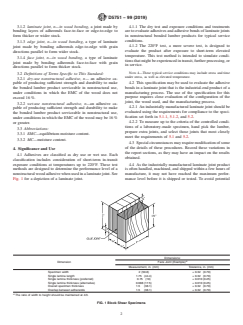
3.1.2 laminate joint, n—in wood bonding, a joint made by 4.1.1 The dry test and exposure conditions and treatments
bonding layers of adherends face-to-face or edge-to-edge to aretoevaluateadhesivesandadhesivebondsoflaminatejoints
form thicker or wider stock. in nonstructural bonded lumber products for typical service
conditions.
3.1.3 edge joint, n—in wood bonding, a type of laminate
4.1.2 The 220°F test, a more severe test, is designed to
joint made by bonding adherends edge-to-edge with grain
evaluate the product after exposure to short-term elevated
directions parallel to form wider stock.
temperature. This test method is intended to simulate condi-
3.1.4 face joint, n—in wood bonding, a type of laminate
tionsthatmightbeexperiencedintransit,furtherprocessing,or
joint made by bonding adherends face-to-face with grain
in service.
directions parallel to form thicker stock.
NOTE 4—These typical service conditions may include stress and time
3.2 Definitions of Terms Specific to This Standard:
under stress, as well as elevated temperature.
3.2.1 dry-use nonstructural adhesive, n— an adhesive ca-
4.2 This specification may be used to evaluate the adhesive
pable of producing sufficient strength and durability to make
bonds in a laminate joint that is the industrial-end product of a
the bonded lumber product serviceable in nonstructural use,
under conditions in which the EMC of the wood does not manufacturing process. The use of the specification for this
purpose requires close evaluation of the configuration of the
exceed 16 %.
joint, the wood used, and the manufacturing process.
3.2.2 wet-use nonstructural adhesive, n—an adhesive ca-
4.2.1 An industrially manufactured laminate joint should be
pable of producing sufficient strength and durability to make
evaluated using the requirements for compliance to the speci-
the bonded lumber product serviceable in nonstructural use,
fication set forth in 5.1.1, 5.1.2, and 5.2.
under conditions in which the EMC of the wood may be 16 %
4.2.2 To measure up to the criteria of the controlled condi-
or greater.
tions of a laboratory-made specimen, hand pick the lumber,
3.3 Abbreviations:
prepare extra joints, and select those joints that most closely
3.3.1 EMC—equilibrium moisture content.
meet the requirements of 5.1 and 5.2.
3.3.2 MC—moisture content.
4.3 Specialcircumstancesmayrequiremodificationofsome
of the details of these procedures. Record these variations in
4. Significance and Use
the report sections, as they may have an impact on the results
4.1 Adhesives are classified as dry use or wet use. Each
obtained.
classification includes consideration of short-term in-transit
exposure conditions at temperatures up to 220°F. These test 4.4 As the industrially manufactured laminate joint product
methods are designed to determine the performance level of a is often handled, machined, and shipped within a few hours of
nonstructuralwoodadhesivewhenusedinalaminatejoint.See manufacture, it may not have reached the maximum perfor-
mance level before it is shipped or tested. To avoid potential
Fig. 1 for a depiction of a laminate joint.
Dimensions:
A
Dimension Face Joint (Example)
Measurement, in. (mm) Tolerance, in. (mm)
Specimen width 2 (50.8) + 0.32 (0.79)
Single lamina length 1.75 (44.4) + 0.32 (0.79)
Single lamina thickness (preferred) 0.75 (19) + 0.010 (0.25)
Single lamina thickness (alternative) 0.688 (17.5) + 0.010 (0.25)
Overall specimen thickness 1.5 (38.1) + 0.32 (0.79)
Overlap between adherends 1.5 (38.1) + 0.32 (0.79)
A
The ratio of width to height should be maintained at 4/3.
FIG. 1Block Shear Specimens
D5751−99 (2019)
TABLE 1 Minimum Test Requirements
B
Laminate Joint in Shear
C D
Paragraph No. Strength %Wood Failure
Performance Classification
for Exposure
A Group Individual
E,G F,G
and Exposure Conditions
Group Average,% Individual Minimum, %
Description
E F,G
Average,% Minimum,%
Soft Wood Hard Wood Soft Wood Hard Wood
Dry Use:
Cured (Dry) 9.1.1 60 30 60 30 30 15
H
Three-Cycle Soak 9.1.2 30 15 30 15 15
H
Elevated Temperature 9.1.3 40 20 40 20 20
(220°F)
Wet Use:
Cured (Dry) 9.2.1 60 30 60 30 30 15
H
Boil 9.2.2 50 25 50 25 25
H
Elevated Temperature 9.2.3 40 20 40 20 20
(220°F)
H
Vacuum Pressure 9.2.4 50 25 50 25 25
A
Twenty specimens are required for each classification and exposure.
B
Parallel to the grain.
C
The shear strength of the test specimens expressed as a percentage of the average shear strength of the wood species at 12 % MC. (See Table 2.) Adjustments are
required for lower MC values. (See Footnote A in Table 2 (a).)
D
The wood failure values given are for softwoods and hardwoods. Groups 3 and 4 hardwoods (Table 3) are listed at 50 % of the softwood value, with no requirement if
the wood failure value calculates to 15 % or less. (See 5.1.2.2 and Table 3.)
E
For all specimens tested.
F
For 90 % of the specimens tested, they shall meet or exceed the minimum wood failure values shown. If a zero value is obtained for any of the specimens, the test shall
be ruled a failure.
G
See recommended average specific gravity in Table 4.
H
No requirement.
product damage, the adhesive-performance level should be 5.1.2.1 The wood failure requirements of Table 1 are given
determined by the laminate-joint manufacturer prior to initial for softwoods, Groups 1 and 2, and for hardwoods, Groups 3
handling and early shipment. Before beginning the full testing and 4.
process, the testing laboratory should ensure that the product
5.1.2.2 In the event that the adhesive user or supplier, or
conforms with the performance level certified by the adhesive both, cannot accept the designated groupings in Table 3, either
manufacturer and has not been damaged by early handling and
party shall have the option of requesting a test on an individual
shipping. species.
5.2 Industrially Manufactured Laminate Joints—An indus-
5. Test Requirements
trially manufactured laminate joint may be used to evaluate the
5.1 Test Adhesive:
adhesiveusedtoproduceit,provideditsconstructionmeetsthe
5.1.1 To comply with this specification, the test adhesive
requirements in Sections 7 and 8, and the joint is tested in
shall be tested for performance in accordance with Sections 7
accordance with the requirements in Table 1.
through10,anditshallmeettherequirementsinTable1forthe
selected performance classification as measured against the
6. Apparatus
average shearing strength of lumber from common species of
6.1 Environmental Chambers—For moist-heat aging, ca-
wood as shown on Table 2(a) and Table 2(b).
pable of conditioning specimens at 80 6 5°F (27 6 3°C) and
5.1.1.1 For certification, a test shall be conducted on a
80 6 5 % relative humidity, and with capacity for up to 20
laminate joint using the test adhesive.
specimens well-spaced and supported on racks to allow free air
5.1.1.2 Lumber with various grain orientations (for
flow.
example,flatsawnorquartersawn)shallbeallowedtobeused
interchangeably, provided they do not fall outside the require- 6.2 Oven(s)—Capable of meeting all the temperature re-
quirements of 9.1.2, 105 6 5°F (41 6 3°C); 9.1.3, 220 and
ments of 8.1.1.
5.1.2 Compliance with this specification shall warrant cer- 2306 5°F (104 and 110 6 3°C); 9.2.2 and 9.2.3, 145 6 5°F
(63 6 3°C), with sufficient air circulation to remove moisture
tification of the adhesive for use on a designated grouping of
wood, either softwood or hardwood, when tested and found to from the chamber. An oven capable of enclosing the testing
machine is also recommended. (See 9.1.3.1.)
be in accordance with any one of the species of that group. See
Table 3 for the designated groupings of commonly used
6.3 Tank for Soaking, meeting the requirements of 9.1.2,so
domestic and imported woods, as accepted in this specifica-
that all of the specimens are completely covered with water for
tion.
the duration of the soak cycles.
6.4 Tank for Boiling, meeting the requirements of 9.2.2,so
that all of the specimens are completely covered with water for
For wood property information on imported woods, refer to U.S. Forest
Service, Agricultural Handbook No. 72, Wood Handbook, 1987 ed., Table 4.4. the duration of the boil cycles.
D5751−99 (2019)
A
TABLE 2 (a) Average Shear Strength of Common Woods at 12% Moisture Content, psi
Dry to
B
Species Green Value Green 100 % Value 60 % Value 50 % Value 40 % Value 25 % Value 20 % Value 15 % Value
C
Ratio
Cedar, Incense Incense 834 1.05 878 527 439 351 220 176 132
Douglas-Fir, Coast-Type 904 1.25 1130 678 565 452 282 226 170
Fir, White 756 1.46 1104 662 552 442 276 221 166
Hemlock, Western 864 1.49 1287 772 644 515 322 257 193
Pine, Ponderosa 704 1.61 1133 680 567 453 283 227 170
Pine, Sugar 718 1.58 1134 680 567 454 284 227 170
D
Redwood 894 1.25 1118 671 559 447 280 224 168
A
For tests conducted in which the wood moisture content is less than or greater than 12 %, the measured strength should be adjusted upward 3 % for each 1 % decrease
in moisture content, or downward 3 % for each 1 % increase in moisture content.
B
For these or other species, values are those for shear parallel to the grain in Test Methods D2555, adjusting to 12 % moisture content using the ratios of dry to green
clear wood properties of Test Methods D2555.
C
Ratio of dry to green strength in Test Methods D2555.
D
Second growth.
A
TABLE(b) Average Shear Strength of Common Woods at 12% Moisture Content, MPa
Dry to
B
Species Green Value Green Ra- 100 % Value 60 % Value 50 % Value 40 % Value 25 % Value 20 % Value 15 % Value
C
tio
Cedar, Incense Incense 5.75 1.05 6.05 3.63 3.03 2.42 1.52 1.21 0.91
Douglas-Fir, Coast-Type 6.23 1.25 7.79 4.67 3.90 3.12 1.94 1.56 1.17
Fir, White 5.21 1.46 7.61 4.56 3.80 3.05 1.90 1.52 1.14
Hemlock, Western 5.96 1.49 8.87 5.32 4.44 3.55 2.22 1.77 1.33
Pine, Ponderosa 4.85 1.61 7.81 4.69 3.91 3.12 1.95 1.56 1.17
Pine, Sugar 4.95 1.58 7.82 4.68 3.91 3.13 1.96 1.56 1.17
D
Redwood 6.16 1.25 7.71 4.63 3.85 3.08 1.93 1.54 1.16
A
For tests conducted in which the wood moisture content is less than or greater than 12 %, the measured strength should be adjusted upward 3 % for each 1 % decrease
in moisture content, or downward 3 % for each 1 % increase in moisture content.
B
For these or other species, values are those for shear parallel to the grain in Test Methods D2555, adjusting to 12 % moisture content using the ratios of dry to green
clear wood properties of Test Methods D2555.
C
Ratio of dry to green strength in Test Methods D2555.
D
Second growth.
6.5 Testing Machine—Capacity of not less than 15 000 lb from 10 to 12 %, use an environmental chamber to bring the
(6810kg)incompression,fittedwithashearingtoolcontaining assemblies into that range.
a self-aligning seat to ensure uniform lateral distribution of the
7.3 Specimen Conditioning During the Testing Process—
load, capable of maintaining a uniform rate of loading in
The allowable variation in MC at the completion of a drying
accordance with 10.1, and located in an atmosphere such that
cycle or before testing dry is 61 % MC. For example, if the
the moisture content of the specimens to be tested dry, as
MC of the specimen before exposure is 9 %, the acceptable
developedundertheconditionsinSection9,isnotsignificantly
range for testing is 8 to 10 %. Wood failure is estimated on
altered during testing.
specimens after they
...