

ASTM D8135-17(2023)
(Guide)Standard Guide for Selection of Substitute, Non-hazardous, Particulate Solid Filling Substances for Packagings Subjected to the United Nations Performance Tests
General Information
- Abstract
SIGNIFICANCE AND USE
5.1 Regulations prescribing the test procedures for hazardous materials packaging allow for the substitution of non-hazardous fill materials for packaging performance tests with certain limitations prescribed and guidance offered (see 49 CFR 178.602(c)). This regulatory guidance has proven to be flexible enough, in common industry practice, to produce variations in the selection of fill materials for package performance tests sufficient to cause inconsistent and non-repeatable test results. This variation creates significant problems in product liability, packaging selection and regulatory enforcement in this highly regulated industry. Use of this guide should enhance uniformity in test procedures.
5.2 Consistent and repeatable test results coupled with clear test fill product descriptions will enhance transportation safety by simplifying packaging selection. This will also increase the general level of confidence that package testing, manufacture, and use are being guided by sound, generally accepted engineering principles. It also aids in clarifying expectations between the packaging industry and the regulatory authorities.
5.3 The guide will be used by packaging manufacturers and packaging test labs to create packaging test plans that meet customer needs and conform to the HMR. In addition, for the user of a packaging, certain information about the type and physical characteristics of the material used to test the packaging must be available in the test report and/or notification instruction to allow evaluation of whether a particular packaging was tested with a substitute material appropriate for the hazardous material to be shipped.
SCOPE
1.1 The purpose of this guide is to clarify the selection, use, and description criteria of non-hazardous particulate solid substitutes used to replace hazardous materials for the purpose of performance testing packagings. This includes identification of the physical parameters of substitute non-hazardous solid test fill materials that may affect packaging performance and test results and should be considered when selecting and describing a test fill material that conforms to the requirements of the Hazardous Materials Regulations (HMR). This guide is intended for use with package testing procedures for particulate solid materials that have flow characteristics. It is not intended for use with hazardous articles.
1.2 This guide provides information to assist packaging users, manufacturers, and performance testing service suppliers regarding the types of physical properties that should be considered when selecting substitute filling substances for the testing, certification and manufacture of packagings under the United Nations packaging protocols (UN Recommendations on the Transport of Dangerous Goods-Model Regulations) as adopted by US DOT in 49 CFR HMR.
1.3 This guide provides the suggested minimum information concerning the physical characteristics of the filling substances that should be documented in the certification test report and notification to users to allow for test repeatability and analysis, and to provide guidance to the user of a packaging of pertinent physical differences between potential hazardous lading and the filling substance with which the packaging was tested.
1.4 This guide does not purport to address regulatory requirements regarding the compatibility of filling substances with transport packagings. Compatibility requirements must be assessed separately, but it should be noted that under certain national and international dangerous goods regulations, the selection of the filling substances for package performance testing may be prescribed with respect to chemical compatibility requirements.
Note 1: Under the US HMR determination of packaging compatibility with a particular hazardous fill material is “the responsibility of the person offering the hazardous material for transportation” as prescribed in 49 CFR §...
- Status
- Published
- Publication Date
- 14-Mar-2023
- Technical Committee
- D10 - Packaging
- Drafting Committee
- D10.22 - Hazardous Materials
Overview
ASTM D8135-17(2023) is the international standard guide for the selection, use, and documentation of substitute, non-hazardous, particulate solid filling substances in packaging subjected to United Nations (UN) performance tests. Developed by ASTM International, this standard supports manufacturers, labs, and users in achieving consistent and reliable performance test results for packaging used in the transportation of hazardous materials, as required by global regulations such as the US DOT Hazardous Materials Regulations (HMR, 49 CFR), the UN Recommendations on the Transport of Dangerous Goods (UN Orange Book), and other international protocols.
The guide addresses the industry need for standardized, non-hazardous fill materials in performance testing, minimizing inconsistent or non-repeatable results that can have significant regulatory and liability impacts.
Key Topics
Substitute Fill Material Selection
Provides detailed criteria for choosing appropriate non-hazardous particulate solids as test fill, taking into account bulk density (specific gravity), particle size, angle of repose, and flow characteristics.Consistency in Testing
Establishes guidelines to enhance test repeatability and comparability by specifying minimum information about fill substances (density, particle size distribution, angle of repose) to be documented in certification reports.Compliance with Regulations
Aligns testing protocols with UN, US DOT (49 CFR), ICAO, IATA, IMDG, and ISO regulatory frameworks, ensuring that package performance tests accurately reflect the physical characteristics of hazardous goods, while keeping the process safe and practical.Documentation Requirements
Standardizes the type and level of information to be included in test reports, facilitating easier evaluation by regulatory authorities and packaging users.Test Plan Development
Supports packaging manufacturers and testing facilities in developing test plans that are fit-for-purpose and meet regulatory and customer requirements.
Applications
ASTM D8135-17(2023) is essential for:
Manufacturers of Transport Packaging
Enables consistent, recognized methods for testing packagings intended for hazardous materials shipments.Test Laboratories and Certification Bodies
Provides guidance to plan and execute performance tests using substitute fill substances that simulate hazardous materials, improving test credibility and reliability.Regulatory Compliance
Ensures that performance testing of packagings aligns with hazardous materials regulations, reducing the risk of regulatory non-compliance and aiding smooth international transport.Safety and Risk Management
Enhances transportation safety by supporting packaging designs that have been reliably tested, thus reducing product liability and regulatory enforcement challenges.Stakeholder Communication
Facilitates clear communication between manufacturers, users, and regulatory agencies regarding the methods and materials used in package testing.
Examples of non-hazardous substitute materials include sand, clay, aluminum oxide, lead shot, PE pellets, salt, vermiculite, and various granular materials, chosen based on properties like bulk density and angle of repose.
Related Standards
For organizations working with ASTM D8135-17(2023), the following standards and regulations are also highly relevant:
- ASTM D4919 - Guide for Testing of Hazardous Materials (Dangerous Goods) Packagings
- ASTM D6393 - Test Method for Bulk Solids Characterization by Carr Indices
- ASTM D7481 - Test Methods for Determining Loose and Tapped Bulk Densities of Powders
- ASTM E11 - Specification for Woven Wire Test Sieve Cloth and Test Sieves
- ISO 2234 - Packaging-Complete, Filled Transport Packages-Stacking Tests
- ISO 16495 - Packaging-Transport Packaging for Dangerous Goods-Test Methods
- 49 CFR Parts 100–199 - US DOT Hazardous Materials Regulations (HMR)
- UN Recommendations on the Transport of Dangerous Goods – Model Regulations
- IATA Dangerous Goods Regulations
- ICAO Technical Instructions
- IMDG Code (International Maritime Dangerous Goods Code)
Practical Value
Adopting ASTM D8135-17(2023) supports global supply chain safety and compliance by:
- Reducing the risk associated with using actual hazardous materials in testing scenarios.
- Ensuring the uniformity and credibility of packaging performance data.
- Bridging gaps between regulatory expectations and real-world testing practices, facilitating safer, smoother transport of hazardous goods across modes and borders.
Keywords: packaging performance testing, hazardous materials, non-hazardous substitute, particulate solid fill, UN performance tests, transportation regulations, ASTM D8135, packagings, bulk density, angle of repose.
Relations
- Effective Date
- 01-Oct-2013
- Effective Date
- 01-Oct-2009
- Effective Date
- 01-May-2009
- Effective Date
- 01-Oct-2008
- Effective Date
- 01-Oct-2008
- Effective Date
- 15-Oct-2006
- Effective Date
- 01-May-2004
- Effective Date
- 10-Apr-2003
- Effective Date
- 10-May-2001
- Effective Date
- 10-May-2001
- Effective Date
- 10-Apr-1999
- Effective Date
- 10-May-1997
Get Certified
Connect with accredited certification bodies for this standard

BRCGS (Brand Reputation Compliance Global Standards)
Global food safety and quality standards owner.
Sponsored listings
Frequently Asked Questions
ASTM D8135-17(2023) is a guide published by ASTM International. Its full title is "Standard Guide for Selection of Substitute, Non-hazardous, Particulate Solid Filling Substances for Packagings Subjected to the United Nations Performance Tests". This standard covers: SIGNIFICANCE AND USE 5.1 Regulations prescribing the test procedures for hazardous materials packaging allow for the substitution of non-hazardous fill materials for packaging performance tests with certain limitations prescribed and guidance offered (see 49 CFR 178.602(c)). This regulatory guidance has proven to be flexible enough, in common industry practice, to produce variations in the selection of fill materials for package performance tests sufficient to cause inconsistent and non-repeatable test results. This variation creates significant problems in product liability, packaging selection and regulatory enforcement in this highly regulated industry. Use of this guide should enhance uniformity in test procedures. 5.2 Consistent and repeatable test results coupled with clear test fill product descriptions will enhance transportation safety by simplifying packaging selection. This will also increase the general level of confidence that package testing, manufacture, and use are being guided by sound, generally accepted engineering principles. It also aids in clarifying expectations between the packaging industry and the regulatory authorities. 5.3 The guide will be used by packaging manufacturers and packaging test labs to create packaging test plans that meet customer needs and conform to the HMR. In addition, for the user of a packaging, certain information about the type and physical characteristics of the material used to test the packaging must be available in the test report and/or notification instruction to allow evaluation of whether a particular packaging was tested with a substitute material appropriate for the hazardous material to be shipped. SCOPE 1.1 The purpose of this guide is to clarify the selection, use, and description criteria of non-hazardous particulate solid substitutes used to replace hazardous materials for the purpose of performance testing packagings. This includes identification of the physical parameters of substitute non-hazardous solid test fill materials that may affect packaging performance and test results and should be considered when selecting and describing a test fill material that conforms to the requirements of the Hazardous Materials Regulations (HMR). This guide is intended for use with package testing procedures for particulate solid materials that have flow characteristics. It is not intended for use with hazardous articles. 1.2 This guide provides information to assist packaging users, manufacturers, and performance testing service suppliers regarding the types of physical properties that should be considered when selecting substitute filling substances for the testing, certification and manufacture of packagings under the United Nations packaging protocols (UN Recommendations on the Transport of Dangerous Goods-Model Regulations) as adopted by US DOT in 49 CFR HMR. 1.3 This guide provides the suggested minimum information concerning the physical characteristics of the filling substances that should be documented in the certification test report and notification to users to allow for test repeatability and analysis, and to provide guidance to the user of a packaging of pertinent physical differences between potential hazardous lading and the filling substance with which the packaging was tested. 1.4 This guide does not purport to address regulatory requirements regarding the compatibility of filling substances with transport packagings. Compatibility requirements must be assessed separately, but it should be noted that under certain national and international dangerous goods regulations, the selection of the filling substances for package performance testing may be prescribed with respect to chemical compatibility requirements. Note 1: Under the US HMR determination of packaging compatibility with a particular hazardous fill material is “the responsibility of the person offering the hazardous material for transportation” as prescribed in 49 CFR §...
SIGNIFICANCE AND USE 5.1 Regulations prescribing the test procedures for hazardous materials packaging allow for the substitution of non-hazardous fill materials for packaging performance tests with certain limitations prescribed and guidance offered (see 49 CFR 178.602(c)). This regulatory guidance has proven to be flexible enough, in common industry practice, to produce variations in the selection of fill materials for package performance tests sufficient to cause inconsistent and non-repeatable test results. This variation creates significant problems in product liability, packaging selection and regulatory enforcement in this highly regulated industry. Use of this guide should enhance uniformity in test procedures. 5.2 Consistent and repeatable test results coupled with clear test fill product descriptions will enhance transportation safety by simplifying packaging selection. This will also increase the general level of confidence that package testing, manufacture, and use are being guided by sound, generally accepted engineering principles. It also aids in clarifying expectations between the packaging industry and the regulatory authorities. 5.3 The guide will be used by packaging manufacturers and packaging test labs to create packaging test plans that meet customer needs and conform to the HMR. In addition, for the user of a packaging, certain information about the type and physical characteristics of the material used to test the packaging must be available in the test report and/or notification instruction to allow evaluation of whether a particular packaging was tested with a substitute material appropriate for the hazardous material to be shipped. SCOPE 1.1 The purpose of this guide is to clarify the selection, use, and description criteria of non-hazardous particulate solid substitutes used to replace hazardous materials for the purpose of performance testing packagings. This includes identification of the physical parameters of substitute non-hazardous solid test fill materials that may affect packaging performance and test results and should be considered when selecting and describing a test fill material that conforms to the requirements of the Hazardous Materials Regulations (HMR). This guide is intended for use with package testing procedures for particulate solid materials that have flow characteristics. It is not intended for use with hazardous articles. 1.2 This guide provides information to assist packaging users, manufacturers, and performance testing service suppliers regarding the types of physical properties that should be considered when selecting substitute filling substances for the testing, certification and manufacture of packagings under the United Nations packaging protocols (UN Recommendations on the Transport of Dangerous Goods-Model Regulations) as adopted by US DOT in 49 CFR HMR. 1.3 This guide provides the suggested minimum information concerning the physical characteristics of the filling substances that should be documented in the certification test report and notification to users to allow for test repeatability and analysis, and to provide guidance to the user of a packaging of pertinent physical differences between potential hazardous lading and the filling substance with which the packaging was tested. 1.4 This guide does not purport to address regulatory requirements regarding the compatibility of filling substances with transport packagings. Compatibility requirements must be assessed separately, but it should be noted that under certain national and international dangerous goods regulations, the selection of the filling substances for package performance testing may be prescribed with respect to chemical compatibility requirements. Note 1: Under the US HMR determination of packaging compatibility with a particular hazardous fill material is “the responsibility of the person offering the hazardous material for transportation” as prescribed in 49 CFR §...
ASTM D8135-17(2023) is classified under the following ICS (International Classification for Standards) categories: 55.020 - Packaging and distribution of goods in general. The ICS classification helps identify the subject area and facilitates finding related standards.
ASTM D8135-17(2023) has the following relationships with other standards: It is inter standard links to ASTM E11-13, ASTM D7481-09, ASTM E11-09e1, ASTM D6393-08, ASTM D4919-03(2008), ASTM D6393-99(2006), ASTM E11-04, ASTM D4919-03, ASTM E11-01, ASTM E11-95, ASTM D6393-99, ASTM D4919-89(1997). Understanding these relationships helps ensure you are using the most current and applicable version of the standard.
ASTM D8135-17(2023) is available in PDF format for immediate download after purchase. The document can be added to your cart and obtained through the secure checkout process. Digital delivery ensures instant access to the complete standard document.
Standards Content (Sample)
This international standard was developed in accordance with internationally recognized principles on standardization established in the Decision on Principles for the
Development of International Standards, Guides and Recommendations issued by the World Trade Organization Technical Barriers to Trade (TBT) Committee.
Designation: D8135 − 17 (Reapproved 2023)
Standard Guide for
Selection of Substitute, Non-hazardous, Particulate Solid
Filling Substances for Packagings Subjected to the United
Nations Performance Tests
This standard is issued under the fixed designation D8135; the number immediately following the designation indicates the year of
original adoption or, in the case of revision, the year of last revision. A number in parentheses indicates the year of last reapproval. A
superscript epsilon (´) indicates an editorial change since the last revision or reapproval.
1. Scope selection of the filling substances for package performance
testing may be prescribed with respect to chemical compatibil-
1.1 The purpose of this guide is to clarify the selection, use,
ity requirements.
and description criteria of non-hazardous particulate solid
substitutes used to replace hazardous materials for the purpose
NOTE 1—Under the US HMR determination of packaging compatibility
with a particular hazardous fill material is “the responsibility of the person
of performance testing packagings. This includes identification
offering the hazardous material for transportation” as prescribed in 49
of the physical parameters of substitute non-hazardous solid
CFR § 173.24(e).
test fill materials that may affect packaging performance and
1.5 When testing packaging designs intended for hazardous
test results and should be considered when selecting and
materials (dangerous goods), the user of this guide shall be
describing a test fill material that conforms to the requirements
trained in accordance with 49 CFR §172.700 and other
of the Hazardous Materials Regulations (HMR). This guide is
applicable hazardous materials regulations such as the ICAO
intended for use with package testing procedures for particulate
Technical Instructions, IMDG Code, other applicable national
solid materials that have flow characteristics. It is not intended
or international dangerous goods regulations that govern the
for use with hazardous articles.
testing, manufacture and use of packagings authorized for the
1.2 This guide provides information to assist packaging
transportation of dangerous goods, and carrier rules such as the
users, manufacturers, and performance testing service suppliers
IATA Dangerous Goods Regulations.
regarding the types of physical properties that should be
1.6 The units of measurement are consistent with the HMR.
considered when selecting substitute filling substances for the
testing, certification and manufacture of packagings under the
1.7 This standard does not purport to address all of the
United Nations packaging protocols (UN Recommendations
safety concerns, if any, associated with its use. It is the
on the Transport of Dangerous Goods-Model Regulations) as
responsibility of the user of this standard to establish appro-
adopted by US DOT in 49 CFR HMR.
priate safety, health, and environmental practices and deter-
mine the applicability of regulatory limitations prior to use.
1.3 This guide provides the suggested minimum informa-
1.8 This international standard was developed in accor-
tion concerning the physical characteristics of the filling
dance with internationally recognized principles on standard-
substances that should be documented in the certification test
ization established in the Decision on Principles for the
report and notification to users to allow for test repeatability
Development of International Standards, Guides and Recom-
and analysis, and to provide guidance to the user of a
mendations issued by the World Trade Organization Technical
packaging of pertinent physical differences between potential
Barriers to Trade (TBT) Committee.
hazardous lading and the filling substance with which the
packaging was tested.
2. Referenced Documents
1.4 This guide does not purport to address regulatory
2.1 ASTM Standards:
requirements regarding the compatibility of filling substances
D4919 Guide for Testing of Hazardous Materials (Danger-
with transport packagings. Compatibility requirements must be
ous Goods) Packagings
assessed separately, but it should be noted that under certain
D6393 Test Method for Bulk Solids Characterization by
national and international dangerous goods regulations, the
Carr Indices
This guide is under the jurisdiction of ASTM Committee D10 on Packaging and
is the direct responsibility of Subcommittee D10.22 on Hazardous Materials. For referenced ASTM standards, visit the ASTM website, www.astm.org, or
Current edition approved March 15, 2023. Published March 2023. Originally contact ASTM Customer Service at service@astm.org. For Annual Book of ASTM
approved in 2017. Last previous edition approved in 2017 as D8135 – 17. DOI: Standards volume information, refer to the standard’s Document Summary page on
10.1520/D8135-17R23. the ASTM website.
Copyright © ASTM International, 100 Barr Harbor Drive, PO Box C700, West Conshohocken, PA 19428-2959. United States
D8135 − 17 (2023)
D7481 Test Methods for Determining Loose and Tapped 3.1.2 bulk density, n—the mass (weight) of particulate solids
Bulk Densities of Powders using a Graduated Cylinder divided by the total volume of sample; that is, bulk density is
E11 Specification for Woven Wire Test Sieve Cloth and Test the ratio of the mass of large number particles of the material
Sieves to the total volume of the sample and is an aggregate property
that includes the volume(s) of the particles, inter-particle
2.2 Federal Standard:
interstices and particle porosity. It is expressed as a ratio of
U.S. Department of Transportation Code of Federal Regula-
weight/volume, or may be expressed as a unit-less ratio
tions Title 49, Transportation (49 CFR) Parts 100-199
referenced to a standard material, such as water, as a specific
2.3 UN Standard:
gravity.
United Nations Recommendations on the Transport of Dan-
3.1.2.1 Discussion—It is not a characteristic intrinsic to a
gerous Goods, Model Regulations (UN Orange Book)
material. It is affected by how the sample is handled. Com-
2.4 International Air Transport Association (IATA) Stan-
monly expressed as “freely settled” or “poured” density; in
dard:
distinction to a “tapped” density value that would be deter-
International Air Transport Association (IATA) Dangerous
mined by a compaction method such as tapping a sample on a
Goods Regulations
table during filling to represent compaction due to various
2.5 ICAO Standard:
types of vibration. For this guide, poured density would be the
International Civil Aviation Organization (ICAO) Technical
most applicable.
Instructions for the Safe Transport of Dangerous Goods by
3.1.3 particle size distribution, n—the physical size of the
Air
individual particles in a given sample of a particulate solid. In
2.6 IMDG Standard:
almost all common solids this will be expressed as a particle
International Maritime Dangerous Goods Code (IMDG
size distribution. There are many ways to model or measure
Code)
this distribution given the wide variety and irregularity of
2.7 ISO Standards:
particle geometries and styles.
ISO 2234 Packaging – Complete, Filled Transport Packages
3.1.3.1 Discussion—The most effective and common way to
– Stacking Tests using Static Load
measure this property is by sieve analysis. Where the particle
ISO 16495 Packaging – Transport Packaging for Dangerous
size distribution is expressed as a percentage of the weight of
Goods – Test Methods
the sample, retained in each step as the sample is passed
3. Terminology through progressively finer sieves, to the weight of the whole
sample. See Specification E11 and Table X1.2.
3.1 Definitions:
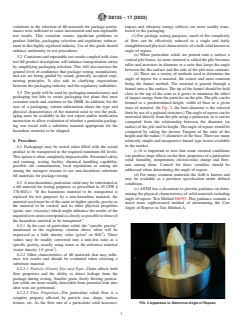
3.1.1 angle of repose, n—when particulate solids are poured 3.1.4 specification packaging, n—a packaging conforming
onto a flat, horizontal surface, they form a conical pile. The to one of the specifications or standards for packagings in part
angle of repose is the interior angle formed between the base of 178 or part 179 of this subchapter (49 CFR).
this cone and its side (see Fig. 1). 3.1.4.1 Discussion—Packaging, as used in this guide, in-
cludes packaging constructed and tested to UN performance
standards as adopted in the HMR (the focus of this guide) but
does not exclude its use for other types of packagings.
NOTE 2—Additional terms and definitions are located in 49 CFR
sections 171.8 and the UN Orange Book, Section 1.2.1.
4. Summary of Guide
4.1 The manufacturer, test facility or user of a packaging
will apply the procedural considerations, based on the physical
characteristics of the particulate solid hazardous material to be
FIG. 1 Angle of Repose transported, outlined in this guide to select an appropriate fill
material to use when testing a packaging. In addition, packag-
ing manufacturers and test facilities will use this guide to
provide sufficient information concerning the relevant physical
Available from Superintendent of Documents, U.S. Government Printing
Office, Washington, DC 20402-9371 (website: http://phmsa.dot.gov/hazmat).
characteristics of the test fill material to the user of a packaging
Available from the UN Economic Commission for Europe, Information
to allow for a proper evaluation of suitability of a packaging for
Service, Palais des Nations, CH-1211 Geneva 10 Switzerland (website: http://
a particular particulate solid hazardous material.
www.unece.org/trans/danger/danger.htm).
Available from the International Air Transport Association (IATA), 800 Place
5. Significance and Use
Victoria PO Box 113 Montreal - H4Z 1M1 Quebec - Canada (website: http://
www.iata.org).
6 5.1 Regulations prescribing the test procedures for hazard-
Available from the International Civil Aviation Organization, (ICAO) 999
ous materials packaging allow for the substitution of non-
University Street, Montréal, Quebec H3C 5H7, Canada (website: http://
www.icao.org).
hazardous fill materials for packaging performance tests with
Available from the International Marine Organization (IMO), 4 Albert
certain limitations prescribed and guidance offered (see 49
Embankment, London, SE1 7SR United Kingdom (website: http://www.imo.org/).
CFR 178.602(c)). This regulatory guidance has proven to be
Available from American National Standards Institute (ANSI), 25 W. 43rd St.,
4th Floor, New York, NY 10036, http://www.ansi.org. flexible enough, in common industry practice, to produce
D8135 − 17 (2023)
variations in the selection of fill materials for package perfor- impact and vibratory energy (effects) are more readily trans-
mance tests sufficient to cause inconsistent and non-repeatable ferred to the packaging.
test results. This variation creates significant problems in (1) For package testing purposes, much of the complexity
product liability, packaging selection and regulatory enforce- of flow can be effectively reduced to a single and fairly
ment in this highly regulated industry. Use of this guide should straightforward physical characteristic of a bulk solid known as
enhance uniformity in test procedures. angle of repose.
(a) When particulate solids are poured onto a surface a
5.2 Consistent and repeatable test results coupled with clear
conical pile forms. As more material is added the pile becomes
test fill product descriptions will enhance transportation safety
taller and increases in diameter at a ratio that keeps the angle
by simplifying packaging selection. This will also increase the
between the flat surface and the side of the pile near constant.
general level of confidence that package testing, manufacture,
(b) There are a variety of methods used to determine the
and use are being guided by sound, generally accepted engi-
angle of repose for a material, the easiest and most comm
...