

ASTM D2239-22
(Specification)Standard Specification for Polyethylene (PE) Plastic Pipe (SIDR-PR) Based on Controlled Inside Diameter
General Information
- Abstract
ABSTRACT
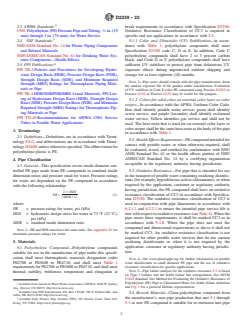
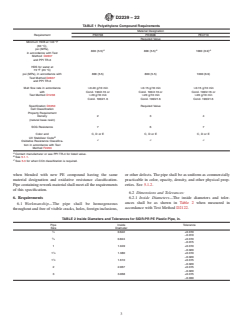
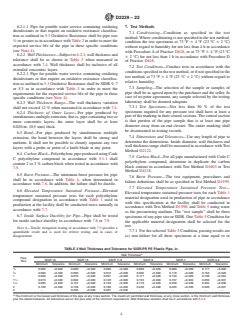
This specification covers polyethylene (PE) pipe made in standard thermoplastic pipe dimension ratios and pressure rated for water. Polyethylene plastics used to make pipe meeting the requirements of this specification are categorized in two criteria: short-term strength tests and long-term strength tests. The plastics are defined by four hydrostatic design stresses developed on the basis of long-term tests. The material shall conform to the required limits of burst pressure, environmental stress cracking, and sustained pressure.
SCOPE
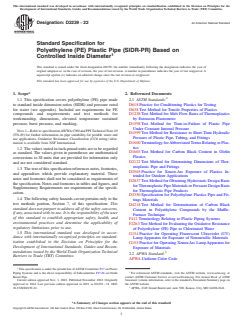
1.1 This specification covers polyethylene (PE) pipe made to standard inside dimension ratios (SIDR) and pressure rated for water (see appendix). Included are requirements for PE compounds and requirements and test methods for workmanship, dimensions, elevated temperature sustained pressure, burst pressure, and marking.
Note 1: Refer to specification AWWA C901and PPI Technical Note 49 (TN-49) for further information on pipe suitability for potable water end use applications. Oxidative Resistance Classification (CC# rating) information is available from NSF International.
1.2 The values stated in inch-pound units are to be regarded as standard. The values given in parentheses are mathematical conversions to SI units that are provided for information only and are not considered standard.
1.3 The text of this specification references notes, footnotes, and appendixes which provide explanatory material. These notes and footnotes shall not be considered as requirements of the specification. Notes and footnotes in tables and figures, and Supplementary Requirements are requirements of the specification.
1.4 The following safety hazards caveat pertains only to the test methods portion, Section 7, of this specification: This standard does not purport to address all of the safety concerns, if any, associated with its use. It is the responsibility of the user of this standard to establish appropriate safety, health, and environmental practices and determine the applicability of regulatory limitations prior to use.
1.5 This international standard was developed in accordance with internationally recognized principles on standardization established in the Decision on Principles for the Development of International Standards, Guides and Recommendations issued by the World Trade Organization Technical Barriers to Trade (TBT) Committee.
- Status
- Published
- Publication Date
- 31-Oct-2022
- Technical Committee
- F17 - Plastic Piping Systems
- Drafting Committee
- F17.26 - Olefin Based Pipe
Buy Documents
ASTM D2239-22 - Standard Specification for Polyethylene (PE) Plastic Pipe (SIDR-PR) Based on Controlled Inside Diameter
REDLINE ASTM D2239-22 - Standard Specification for Polyethylene (PE) Plastic Pipe (SIDR-PR) Based on Controlled Inside Diameter
Overview
ASTM D2239-22 is the recognized standard specification for Polyethylene (PE) Plastic Pipe (SIDR-PR) Based on Controlled Inside Diameter. Developed by ASTM International, this standard details requirements for PE pipe manufactured to standard inside dimension ratios (SIDR) and pressure-rated for water distribution applications. ASTM D2239-22 specifies essential criteria for PE compounds, dimensions, manufacturing quality, mechanical properties, and performance testing, ensuring pipe reliability and safety for water service systems.
The standard applies to PE pipe used for water applications, including potable water distribution, irrigation, and reclaimed water systems, and addresses needs for both short-term and long-term strength. It outlines qualifications for material performance, such as hydrostatic strength, resistance to burst and environmental stress cracking, as well as oxidative resistance where needed.
Key Topics
Material Requirements
- Polyethylene compounds must meet ASTM-specified designation codes (PE2708, PE3608, or PE4710).
- Standards for density, color coding, and ultraviolet (UV) stabilization are provided.
- Requirements ensure adequate burst pressure, sustained pressure, and environmental stress crack resistance.
- Compounds used for potable water applications must also meet health-effect regulations (e.g., NSF/ANSI 61).
Dimensional Control
- Pipes are designated by standard inside dimension ratio (SIDR), ensuring consistent flow characteristics.
- Inside diameter and wall thickness tolerances are rigorously defined.
- The specification includes guidelines for concentric multi-layer pipe and marking requirements.
Performance Testing
- Pipes are subjected to mechanical tests for burst pressure, sustained pressure at elevated temperatures, and ductility.
- Oxidative resistance classification (CC3) is required for pipes transporting chlorinated water.
- Routine quality assurance procedures are required to maintain compliance.
Marking and Traceability
- Pipes must be clearly marked with size, SIDR, material designation, pressure rating, manufacturer, and relevant certification marks.
- Additional marking for oxidative resistance classification is required where applicable.
Applications
ASTM D2239-22 is widely applied in the design, specification, and acceptance of PE pipes within the following fields:
Water Supply Systems
- Potable water distribution in residential, commercial, and municipal networks
- Irrigation and agricultural water supply lines
Reclaimed Water and Sewer Systems
- Suitable for pressurized reclaimed water and certain sewer applications according to color code and marking requirements
Irrigation and Rural Water Services
- Used in agricultural irrigation and rural water supply due to its flexibility and corrosion resistance
Other Pressurized Fluid Systems
- Applicable to other pressurized liquid transport systems, as long as the PE compounds and dimensions fulfill required criteria
The use of controlled inside diameter PE pipe under ASTM D2239-22 helps ensure consistent hydraulic performance, long service life, and regulatory compliance in diverse water infrastructure projects.
Related Standards
For complete alignment and product suitability, reference is made to several related documents:
- AWWA C901: Specification for PE pressure pipe and tubing for water service
- NSF/ANSI 14 & 61: Standards for plastic piping system components and their impact on health
- ASTM D3350: Specification for PE plastics pipe and fittings materials
- PPI Technical Note 49 (TN-49): Recommendations for PE pipe in potable water applications
- ASTM D2837: Method for obtaining hydrostatic design basis for thermoplastic pipe materials
ASTM D2239-22 is essential for engineers, manufacturers, and water utilities aiming for robust and compliant polyethylene plastic pipe systems for reliable water service infrastructure.
Relations
- Refers
ASTM D1238-23a - Standard Test Method for Melt Flow Rates of Thermoplastics by Extrusion Plastometer - Effective Date
- 15-Nov-2023
- Effective Date
- 01-Oct-2023
- Effective Date
- 01-Apr-2020
- Effective Date
- 01-Feb-2020
- Effective Date
- 01-Feb-2020
- Effective Date
- 01-Feb-2019
- Effective Date
- 01-Jan-2019
- Effective Date
- 01-Sep-2018
- Refers
ASTM D1600-18 - Standard Terminology for Abbreviated Terms Relating to Plastics (Withdrawn 2024) - Effective Date
- 01-Jan-2018
- Effective Date
- 01-Aug-2017
- Effective Date
- 01-Feb-2017
- Effective Date
- 15-Nov-2016
- Effective Date
- 01-Aug-2016
- Effective Date
- 01-Dec-2015
- Effective Date
- 01-Nov-2015
Buy Documents
ASTM D2239-22 - Standard Specification for Polyethylene (PE) Plastic Pipe (SIDR-PR) Based on Controlled Inside Diameter
REDLINE ASTM D2239-22 - Standard Specification for Polyethylene (PE) Plastic Pipe (SIDR-PR) Based on Controlled Inside Diameter
Get Certified
Connect with accredited certification bodies for this standard

Institut za varilstvo d.o.o. (Welding Institute)
Slovenia's leading welding institute since 1952. ISO 3834, EN 1090, pressure equipment certification, NDT personnel, welder qualification. Only IIW Au
Sponsored listings
Frequently Asked Questions
ASTM D2239-22 is a technical specification published by ASTM International. Its full title is "Standard Specification for Polyethylene (PE) Plastic Pipe (SIDR-PR) Based on Controlled Inside Diameter". This standard covers: ABSTRACT This specification covers polyethylene (PE) pipe made in standard thermoplastic pipe dimension ratios and pressure rated for water. Polyethylene plastics used to make pipe meeting the requirements of this specification are categorized in two criteria: short-term strength tests and long-term strength tests. The plastics are defined by four hydrostatic design stresses developed on the basis of long-term tests. The material shall conform to the required limits of burst pressure, environmental stress cracking, and sustained pressure. SCOPE 1.1 This specification covers polyethylene (PE) pipe made to standard inside dimension ratios (SIDR) and pressure rated for water (see appendix). Included are requirements for PE compounds and requirements and test methods for workmanship, dimensions, elevated temperature sustained pressure, burst pressure, and marking. Note 1: Refer to specification AWWA C901and PPI Technical Note 49 (TN-49) for further information on pipe suitability for potable water end use applications. Oxidative Resistance Classification (CC# rating) information is available from NSF International. 1.2 The values stated in inch-pound units are to be regarded as standard. The values given in parentheses are mathematical conversions to SI units that are provided for information only and are not considered standard. 1.3 The text of this specification references notes, footnotes, and appendixes which provide explanatory material. These notes and footnotes shall not be considered as requirements of the specification. Notes and footnotes in tables and figures, and Supplementary Requirements are requirements of the specification. 1.4 The following safety hazards caveat pertains only to the test methods portion, Section 7, of this specification: This standard does not purport to address all of the safety concerns, if any, associated with its use. It is the responsibility of the user of this standard to establish appropriate safety, health, and environmental practices and determine the applicability of regulatory limitations prior to use. 1.5 This international standard was developed in accordance with internationally recognized principles on standardization established in the Decision on Principles for the Development of International Standards, Guides and Recommendations issued by the World Trade Organization Technical Barriers to Trade (TBT) Committee.
ABSTRACT This specification covers polyethylene (PE) pipe made in standard thermoplastic pipe dimension ratios and pressure rated for water. Polyethylene plastics used to make pipe meeting the requirements of this specification are categorized in two criteria: short-term strength tests and long-term strength tests. The plastics are defined by four hydrostatic design stresses developed on the basis of long-term tests. The material shall conform to the required limits of burst pressure, environmental stress cracking, and sustained pressure. SCOPE 1.1 This specification covers polyethylene (PE) pipe made to standard inside dimension ratios (SIDR) and pressure rated for water (see appendix). Included are requirements for PE compounds and requirements and test methods for workmanship, dimensions, elevated temperature sustained pressure, burst pressure, and marking. Note 1: Refer to specification AWWA C901and PPI Technical Note 49 (TN-49) for further information on pipe suitability for potable water end use applications. Oxidative Resistance Classification (CC# rating) information is available from NSF International. 1.2 The values stated in inch-pound units are to be regarded as standard. The values given in parentheses are mathematical conversions to SI units that are provided for information only and are not considered standard. 1.3 The text of this specification references notes, footnotes, and appendixes which provide explanatory material. These notes and footnotes shall not be considered as requirements of the specification. Notes and footnotes in tables and figures, and Supplementary Requirements are requirements of the specification. 1.4 The following safety hazards caveat pertains only to the test methods portion, Section 7, of this specification: This standard does not purport to address all of the safety concerns, if any, associated with its use. It is the responsibility of the user of this standard to establish appropriate safety, health, and environmental practices and determine the applicability of regulatory limitations prior to use. 1.5 This international standard was developed in accordance with internationally recognized principles on standardization established in the Decision on Principles for the Development of International Standards, Guides and Recommendations issued by the World Trade Organization Technical Barriers to Trade (TBT) Committee.
ASTM D2239-22 is classified under the following ICS (International Classification for Standards) categories: 23.040.20 - Plastics pipes. The ICS classification helps identify the subject area and facilitates finding related standards.
ASTM D2239-22 has the following relationships with other standards: It is inter standard links to ASTM D1238-23a, ASTM D2565-23, ASTM F412-20, ASTM D4218-20, ASTM D1603-20, ASTM F2263-14(2019), ASTM F412-19, ASTM D1599-18, ASTM D1600-18, ASTM F412-17a, ASTM F412-17, ASTM F412-16a, ASTM F412-16, ASTM D4218-15, ASTM D1598-15. Understanding these relationships helps ensure you are using the most current and applicable version of the standard.
ASTM D2239-22 is available in PDF format for immediate download after purchase. The document can be added to your cart and obtained through the secure checkout process. Digital delivery ensures instant access to the complete standard document.
Standards Content (Sample)
This international standard was developed in accordance with internationally recognized principles on standardization established in the Decision on Principles for the
Development of International Standards, Guides and Recommendations issued by the World Trade Organization Technical Barriers to Trade (TBT) Committee.
Designation: D2239 −22 An American National Standard
Standard Specification for
Polyethylene (PE) Plastic Pipe (SIDR-PR) Based on
Controlled Inside Diameter
This standard is issued under the fixed designation D2239; the number immediately following the designation indicates the year of
original adoption or, in the case of revision, the year of last revision. A number in parentheses indicates the year of last reapproval. A
superscript epsilon (´) indicates an editorial change since the last revision or reapproval.
This standard has been approved for use by agencies of the U.S. Department of Defense.
1. Scope* 2. Referenced Documents
1.1 This specification covers polyethylene (PE) pipe made 2.1 ASTM Standards:
to standard inside dimension ratios (SIDR) and pressure rated D618 Practice for Conditioning Plastics for Testing
for water (see appendix). Included are requirements for PE D638 Test Method for Tensile Properties of Plastics
compounds and requirements and test methods for D1238 Test Method for Melt Flow Rates of Thermoplastics
workmanship, dimensions, elevated temperature sustained by Extrusion Plastometer
pressure, burst pressure, and marking. D1598 Test Method for Time-to-Failure of Plastic Pipe
Under Constant Internal Pressure
NOTE1—RefertospecificationAWWAC901andPPITechnicalNote49
D1599 Test Method for Resistance to Short-Time Hydraulic
(TN-49) for further information on pipe suitability for potable water end
Pressure of Plastic Pipe, Tubing, and Fittings
use applications. Oxidative Resistance Classification (CC# rating) infor-
mation is available from NSF International.
D1600 TerminologyforAbbreviatedTermsRelatingtoPlas-
tics
1.2 The values stated in inch-pound units are to be regarded
D1603 Test Method for Carbon Black Content in Olefin
as standard. The values given in parentheses are mathematical
Plastics
conversions to SI units that are provided for information only
D2122 Test Method for Determining Dimensions of Ther-
and are not considered standard.
moplastic Pipe and Fittings
1.3 Thetextofthisspecificationreferencesnotes,footnotes,
D2565 Practice for Xenon-Arc Exposure of Plastics In-
and appendixes which provide explanatory material. These
tended for Outdoor Applications
notes and footnotes shall not be considered as requirements of
D2837 Test Method for Obtaining Hydrostatic Design Basis
the specification. Notes and footnotes in tables and figures, and
forThermoplasticPipeMaterialsorPressureDesignBasis
Supplementary Requirements are requirements of the specifi-
for Thermoplastic Pipe Products
cation.
D3350 Specification for Polyethylene Plastics Pipe and Fit-
1.4 The following safety hazards caveat pertains only to the
tings Materials
test methods portion, Section 7, of this specification: This
D4218 Test Method for Determination of Carbon Black
standard does not purport to address all of the safety concerns,
Content in Polyethylene Compounds by the Muffle-
if any, associated with its use. It is the responsibility of the user
Furnace Technique
of this standard to establish appropriate safety, health, and
F412 Terminology Relating to Plastic Piping Systems
environmental practices and determine the applicability of
F2263 Test Method for Evaluating the Oxidative Resistance
regulatory limitations prior to use.
of Polyethylene (PE) Pipe to Chlorinated Water
1.5 This international standard was developed in accor-
G154 Practice for Operating Fluorescent Ultraviolet (UV)
dance with internationally recognized principles on standard-
Lamp Apparatus for Exposure of Nonmetallic Materials
ization established in the Decision on Principles for the
G155 Practice for Operating XenonArc LampApparatus for
Development of International Standards, Guides and Recom-
Exposure of Materials
mendations issued by the World Trade Organization Technical
2.2 APWA Standard:
Barriers to Trade (TBT) Committee.
APWA Uniform Color Code
This specification is under the jurisdiction ofASTM Committee F17 on Plastic
Piping Systems and is the direct responsibility of Subcommittee F17.26 on Olefin For referenced ASTM standards, visit the ASTM website, www.astm.org, or
Based Pipe. contact ASTM Customer Service at service@astm.org. For Annual Book of ASTM
Current edition approved Nov. 1, 2022. Published November 2022. Originally Standards volume information, refer to the standard’s Document Summary page on
approved in 1964. Last previous edition approved in 2021 as D2239 – 21. DOI: the ASTM website.
10.1520/D2239-22. APWA, 2345 Grand Boulevard, suite 500, Kansas, City, MO 64108-2641.
*A Summary of Changes section appears at the end of this standard
Copyright © ASTM International, 100 Barr Harbor Drive, PO Box C700, West Conshohocken, PA 19428-2959. United States
D2239 − 22
2.3 AWWA Standards: break requirements in accordance with Specification D3350.
C901 Polyethylene(PE)PressurePipeandTubing, ⁄4 in.(19 Oxidative Resistance Classification of CC3 is required in
mm) through 3 in. (76 mm), for Water Service specific end use applications in accordance with 5.3.
2.4 NSF Standards: 5.1.1 Color and Ultraviolet (UV) Stabilization—in accor-
NSF/ANSI Standard No. 14 for Plastic Piping Components dance with Table 1, polyethylene compounds shall meet
and Related Materials Specification D3350 code C, D or E. In addition, Code C
NSF/ANSI/CAN Standard No. 61 for Drinking Water Sys- polyethylene compounds shall have 2 to 3 percent carbon
tems Components—Health Effects black, and Code D or E polyethylene compounds shall have
2.5 PPI Publications: sufficient UV stabilizer to protect pipe from deleterious UV
exposure effects during unprotected outdoor shipping and
PPI TR-3 Policies and Procedures for Developing Hydro-
static Design Basis (HDB), Pressure Design Basis (PDB), storage for at least eighteen (18) months.
Strength Design Basis (SDB), and Minimum Required
NOTE 3—Pipe users should consult with the pipe manufacturer about
Strength (MRS) Ratings for Thermoplastic Piping Mate-
the outdoor exposure life of the product under consideration. Evaluation
rials or Pipe
of UV stabilizer in Code E color PE compound using Practice D2565 or
Practice G154 or Practice G155 may be useful for this purpose.
PPI TR-4 HDB/SDB/PDB/MRS Listed Materials, PPI List-
ing of Hydrostatic Design Basis (HDB), Strength Design
5.1.2 Colors for solid color, an external color layer or color
Basis(SDB),PressureDesignBasis(PDB),andMinimum
stripes—In accordance with the APWA Uniform Color Code,
Required Strength (MRS) Ratings for Thermoplastic Pip-
blue shall identify potable water service; green shall identify
ing Materials or Pipe
sewer service; and purple (lavender) shall identify reclaimed
PPI TN-49 Recommendations for AWWA C901 Service
water service. Yellow identifies gas service and shall not be
Tubes in Potable Water Applications
used. The base resin that is used for an external color layer or
colorstripesshallbethesamebaseresinasthebodyofthepipe
3. Terminology
in accordance with Table 1.
3.1 Definitions—Definitions are in accordance with Termi-
5.2 Health Effects Requirement—PEcompoundintendedfor
nology F412, and abbreviations are in accordance with Termi-
contact with potable water, or when otherwise required, shall
nologyD1600,unlessotherwisespecified.Theabbreviationfor
be evaluated, tested, and certified for conformance with NSF/
polyethylene plastic is PE.
ANSI Standard No. 61 or the health effects portion of NSF/
ANSI/CAN Standard No. 14 by a certifying organization
4. Pipe Classification
acceptable to the regulatory authority having jurisdiction.
4.1 General—This specification covers inside diameter con-
5.3 Oxidative Resistance—For pipe that is intended for use
trolled PE pipe made from PE compounds in standard inside
in the transport of potable water containing oxidizing disinfec-
dimension ratios and pressure rated for water. Pressure ratings
tants(forexample,hypochlorousacidorchloramines),orwhen
for water are dependent on the PE compound in accordance
required by the application, customer or regulatory authority
with the following relationship:
having jurisdiction, the PE compound shall have an oxidative
2 3HDS
PR 5 (1) resistance classification of CC3 in accordance with Specifica-
SIDR11
~ !
tion D3350. The oxidative resistance classification of CC3 is
where:
used in conjunction with pipe dimensions in accordance with
6.2.1.1 and 6.2.2.1 to ensure the intended pipe service life is
PR = pressure rating for water, psi (kPa)
HDS = hydrostatic design stress for water at 73 °F (23 °C), met with respect to oxidative resistance (see Note 4).When the
pipe meets these requirements, it shall be marked CC3 as in
psi (kPa)
SIDR = standard inside dimension ratio
accordance with 9.1.8. When the pipe does not meet the
compound and dimensional requirements as above it shall not
NOTE 2—PR and HDS must have the same units. See Appendix X1 for
be marked CC3. An oxidative resistance classification is not
maximum pressure ratings for water.
required for other potable water services that do not contain
5. Materials
oxidizing disinfectants or when it is not required by the
application, customer or regulatory authority having jurisdic-
5.1 Polyethylene Compound—Polyethylene compounds
tion.
suitable for use in the manufacture of pipe under this specifi-
cation shall meet thermoplastic materials designation codes
NOTE 4—See www.plasticpipe.org for further information on potable
PE2708 or PE3608 or PE4710, and shall meet Table 1 water disinfectants in small diameter PE pipe and the use of oxidative
resistance classification for specific applications.
requirementsforPE2708orPE3608orPE4710,andshallmeet
NOTE 5—Pipe failure analysis for the oxidative resistance 5.3 is based
thermal stability, brittleness temperature and elongation at
on Type 2 failures and the brittle failure line extrapolation. See ASTM
F2263 Standard Test Method for Evaluating the Oxidative Resistance of
4 Polyethylene (PE) Pipe to Chlorinated Water for brittle failure definition
Available fromAmerican Water WorksAssociation (AWWA), 6666 W. Quincy
and Fig. 1 for a pictorial lifetime representation.
Ave., Denver, CO 80235, http://www.awwa.org.
Available from NSF International, P.O. Box 130140, 789 N. Dixboro Rd.,Ann
5.4 Rework Material—Clean polyethylene compound from
Arbor, MI 48113-0140, http://www.nsf.org.
the manufacturer’s own pipe production that met 5.1 through
Available from Plastics Pipe Institute (PPI), 105 Decker Court, Suite 825,
Irving, TX 75062, http://www.plasticpipe.org. 5.3 as new PE compound is suitable for re-extrusion into pipe
D2239 − 22
TABLE 1 Polyethylene Compound Requirements
Material Designation
Requirement PE2708 PE3608 PE4710
Required Value
Minimum HDB at 140 °F
(60 °C),
psi (MPa),
A A A
800 (5.5) 800 (5.5) 1000 (6.9)
in accordance with Test
Method D2837
and PPI TR-3
HDS for water at
73 °F (23 °C)
psi (MPa), in accordance with 800 (5.5) 800 (5.5) 1000 (6.9)
Test Method D2837
and PPI TR-3
Melt flow rate in accordance #0.40 g/10 min #0.15 g/10 min #0.15 g/10 min
with Cond. 190/2.16 or Cond. 190/2.16 or Cond. 190/2.16 or
Test Method D1238 #20 g/10 min #20 g/10 min #20 g/10 min
Cond. 190/21.6 Cond. 190/21.6 Cond. 190/21.6
Specification D3350 Required Value
Cell Classification
Property Requirement
Density 234
(natural base resin)
SCG Resistance 7 6 7
Color and C, D or E C, D or E C, D or E
B
UV Stabilizer Code
CCC
Oxidative Resistance Classifica-
tion in accordance with Test
Method F2263
A
Contact manufacturer or see PPI TR-4 for listed value.
B
See 5.1.1.
C
See 5.3 for when CC3 classification is required.
when blended with new PE compound having the same or other defects. The pipe shall be as uniform as commercially
material designation and oxidative resistance classification. practicable in color, opacity, density, and other physical prop-
Pipecontainingreworkmaterialshallmeetalltherequirements
erties. See 5.1.2.
of this specification.
6.2 Dimensions and Tolerances:
6. Requirements
6.2.1 Inside Diameters—The inside diameters and toler-
ances shall be as shown in Table 2 when measured in
6.1 Workmanship—The pipe shall be homogeneous
accordance with Test Method D2122.
throughout and free of visible cracks, holes, foreign inclusions,
TABLE 2 Inside Diameters and Tolerances for SIDR-PR PE Plastic Pipe, in.
Pipe Inside Tolerance
Size Diameter
⁄2 0.622 +0.010
–0.010
⁄4 0.824 +0.010
–0.015
1 1.049 +0.010
–0.020
1 ⁄4 1.380 +0.010
–0.020
1 ⁄2 1.610 +0.015
–0.020
2 2.067 +0.015
–0.020
3 3.068 +0.015
–0.030
D2239 − 22
6.2.1.1 Pipe for potable water service containing oxidizing 7. Test Methods
disinfectants or that require an oxidative resistance classifica-
7.1 Conditioning—Condition as specified in the test
tion as outlined in 5.3 Oxidative Resistance shall be pipe size
method.Whereconditioningisnotspecifiedinthetestmethod,
⁄4 or greater as in accordance with Table 2 in order to meet the
condition the test specimens at 73 °F 6 4 °F (23 °C 6 2 °C)
expected service life of the pipe in these specific conditions
without regard to humidity for not less than4hin accordance
(see Note 4).
with Procedure A of Practice D618,orat73°F 6 4 °F (23 °C
6.2.2 WallThicknesses—Subjectto6.2.3,wallthicknessand
6 2 °C) for not less than1hin accordance with Procedure D
tolerance shall be as shown in Table 3 when measured in
of Practice D618.
accordance with 7.4. Wall thickness shall be inclusive of all
7.2 Test Conditions—Conduct tests in accordance with the
extruded concentric layers.
conditionsspecifiedinthetestmethod,orifnotspecifiedinthe
6.2.2.1 Pipe for potable water service containing oxidizing
test method, at 73 °F 6 4 °F (23 °C 6 2 °C) without regard to
disinfectants or that require an oxidative resistance classifica-
relative humidity.
tion as outlined in 5.3 Oxidative Resistance shall be SIDR 9, 7
7.3 Sampling—The selection of the sample or samples of
or 5.3 as in accordance with Table 3 in order to meet the
pipe shall be as agreed upon by the purchaser and the seller. In
requirements for the expected service life of the pipe in these
case of no prior agreement, any sample selected by the testing
specific conditions (see Note 4).
laboratory shall be deemed adequate.
6.2.3 Wall Thickness Range—The wall thickness variation
7.3.1 Test Specimens—Not less than 50 % of the test
shall not exceed 12 % when measured in accordance with 7.4.
specimens required for any pressure test shall have at least a
6.2.4 Thickness of Outer Layer—For pipe produced by
partofthemarkingintheircentralsections.Thecentralsection
simultaneous multiple extrusion, that is, pipe containing two or
is that portion of the pipe sample that is at least one pipe
more concentric layers, the outer layer shall be at least
diameter away from an end closure. The entire marking shall
0.020-in. (0.5 mm) thick.
be documented in testing records.
6.3 Bond—For pipe produced by simultaneous multiple
7.4 Dimensions and Tolerances—Use any length of pipe to
extrusion, the bond between the layers shall be strong and
determine the dimensions. Inside diameter, wall thickness and
uniform. It shall not be possible to cleanly separate any two
wall thickness range shall be measured in accordance withTest
layers with a probe or point of a knife blade at any point.
Method D2122.
6.4 Carbon Black—Polyethylene pipe produced using Code
7.5 Carbon Black—For all pipe manufactured with Code C
C polyethylene compound in accordance with 5.1.1 shall
polyethylene compound, determine in duplicate the carbon
contain 2 to 3 % carbon black when tested in accordance with
black content in accordance with Test Method D1603 or Test
7.5.
Method D4218.
6.5 Burst Pressure—The minimum burst pressure for pipe
7.6 Burst Pressure—The test
...
This document is not an ASTM standard and is intended only to provide the user of an ASTM standard an indication of what changes have been made to the previous version. Because
it may not be technically possible to adequately depict all changes accurately, ASTM recommends that users consult prior editions as appropriate. In all cases only the current version
of the standard as published by ASTM is to be considered the official document.
Designation: D2239 − 21 D2239 − 22 An American National Standard
Standard Specification for
Polyethylene (PE) Plastic Pipe (SIDR-PR) Based on
Controlled Inside Diameter
This standard is issued under the fixed designation D2239; the number immediately following the designation indicates the year of
original adoption or, in the case of revision, the year of last revision. A number in parentheses indicates the year of last reapproval. A
superscript epsilon (´) indicates an editorial change since the last revision or reapproval.
This standard has been approved for use by agencies of the U.S. Department of Defense.
1. Scope*
1.1 This specification covers polyethylene (PE) pipe made to standard inside dimension ratios (SIDR) and pressure rated for water
(see appendix). Included are requirements for PE compounds and requirements and test methods for workmanship, dimensions,
elevated temperature sustained pressure, burst pressure, and marking.
NOTE 1—Refer to specification AWWA C901and PPI Technical Note 49 (TN-49) for further information on pipe suitability for potable water end use
applications. Oxidative Resistance Classification (CC# rating) information is available from NSF International.
1.2 The values stated in inch-pound units are to be regarded as standard. The values given in parentheses are mathematical
conversions to SI units that are provided for information only and are not considered standard.
1.3 The text of this specification references notes, footnotes, and appendixes which provide explanatory material. These notes and
footnotes shall not be considered as requirements of the specification. Notes and footnotes in tables and figures, and Supplementary
Requirements are requirements of the specification.
1.4 The following safety hazards caveat pertains only to the test methods portion, Section 7, of this specification: This standard
does not purport to address all of the safety concerns, if any, associated with its use. It is the responsibility of the user of this
standard to establish appropriate safety, health, and environmental practices and determine the applicability of regulatory
limitations prior to use.
1.5 This international standard was developed in accordance with internationally recognized principles on standardization
established in the Decision on Principles for the Development of International Standards, Guides and Recommendations issued
by the World Trade Organization Technical Barriers to Trade (TBT) Committee.
2. Referenced Documents
2.1 ASTM Standards:
D618 Practice for Conditioning Plastics for Testing
D638 Test Method for Tensile Properties of Plastics
D1238 Test Method for Melt Flow Rates of Thermoplastics by Extrusion Plastometer
D1598 Test Method for Time-to-Failure of Plastic Pipe Under Constant Internal Pressure
This specification is under the jurisdiction of ASTM Committee F17 on Plastic Piping Systems and is the direct responsibility of Subcommittee F17.26 on Olefin Based
Pipe.
Current edition approved Aug. 1, 2021Nov. 1, 2022. Published August 2021November 2022. Originally approved in 1964. Last previous edition approved in 20202021
as D2239 – 12aD2239 – 21.(2020). DOI: 10.1520/D2239-21.10.1520/D2239-22.
For referenced ASTM standards, visit the ASTM website, www.astm.org, or contact ASTM Customer Service at service@astm.org. For Annual Book of ASTM Standards
volume information, refer to the standard’s Document Summary page on the ASTM website.
*A Summary of Changes section appears at the end of this standard
Copyright © ASTM International, 100 Barr Harbor Drive, PO Box C700, West Conshohocken, PA 19428-2959. United States
D2239 − 22
D1599 Test Method for Resistance to Short-Time Hydraulic Pressure of Plastic Pipe, Tubing, and Fittings
D1600 Terminology for Abbreviated Terms Relating to Plastics
D1603 Test Method for Carbon Black Content in Olefin Plastics
D2122 Test Method for Determining Dimensions of Thermoplastic Pipe and Fittings
D2565 Practice for Xenon-Arc Exposure of Plastics Intended for Outdoor Applications
D2837 Test Method for Obtaining Hydrostatic Design Basis for Thermoplastic Pipe Materials or Pressure Design Basis for
Thermoplastic Pipe Products
D3350 Specification for Polyethylene Plastics Pipe and Fittings Materials
D4218 Test Method for Determination of Carbon Black Content in Polyethylene Compounds by the Muffle-Furnace Technique
F412 Terminology Relating to Plastic Piping Systems
F2263 Test Method for Evaluating the Oxidative Resistance of Polyethylene (PE) Pipe to Chlorinated Water
G154 Practice for Operating Fluorescent Ultraviolet (UV) Lamp Apparatus for Exposure of Nonmetallic Materials
G155 Practice for Operating Xenon Arc Lamp Apparatus for Exposure of Materials
2.2 APWA Standard:
APWA Uniform Color Code
2.3 AWWA Standards:
C901 Polyethylene (PE) Pressure Pipe and Tubing, ⁄4 in. (19 mm) through 3 in. (76 mm), for Water Service
2.4 NSF Standards:
NSF/ANSI Standard No. 14 for Plastic Piping Components and Related Materials
NSF/ANSI/CAN Standard No. 61 for Drinking Water Systems Components—Health Effects
2.5 PPI Standards:Publications:
PPI TR-3 Policies and Procedures for Developing Hydrostatic Design Basis (HDB), Pressure Design Basis (PDB), Strength
Design Basis (SDB), and Minimum Required Strength (MRS) Ratings for Thermoplastic Piping Materials or Pipe
PPI TR-4 HDB/SDB/PDB/MRS Listed Materials, PPI Listing of Hydrostatic Design Basis (HDB), Strength Design Basis
(SDB), Pressure Design Basis (PDB), and Minimum Required Strength (MRS) Ratings for Thermoplastic Piping Materials
or Pipe
PPI TN-49 Recommendations for AWWA C901 Service Tubes in Potable Water Applications
3. Terminology
3.1 Definitions—Definitions are in accordance with Terminology F412, and abbreviations are in accordance with Terminology
D1600, unless otherwise specified. The abbreviation for polyethylene plastic is PE.
4. Pipe Classification
4.1 General—This specification covers inside diameter controlled PE pipe made from PE compounds in standard inside dimension
ratios and pressure rated for water. Pressure ratings for water are dependent on the PE compound in accordance with the following
relationship:
23HDS
PR 5 (1)
SIDR11
~ !
where:
PR = pressure rating for water, psi (kPa)
HDS = hydrostatic design stress for water at 73 °F (23 °C), psi (kPa)
SIDR = standard inside dimension ratio
NOTE 2—PR and HDS must have the same units. See Appendix X1 for maximum pressure ratings for water.
5. Materials
5.1 Polyethylene Compound—Polyethylene compounds suitable for use in the manufacture of pipe under this specification shall
meet thermoplastic materials designation codes PE2708 or PE3608 or PE4710, and shall meet Table 1 requirements for PE2708
APWA, 2345 Grand Boulevard, suite 500, Kansas, City, MO 64108-2641.
Available from American Water Works Association (AWWA), 6666 W. Quincy Ave., Denver, CO 80235, http://www.awwa.org.
Available from NSF International, P.O. Box 130140, 789 N. Dixboro Rd., Ann Arbor, MI 48113-0140, http://www.nsf.org.
Available from Plastics Pipe Institute (PPI), 105 Decker Court, Suite 825, Irving, TX 75062, http://www.plasticpipe.org.
D2239 − 22
TABLE 1 Polyethylene Compound Requirements
Material Designation
Requirement PE2708 PE3608 PE4710
Required Value
Minimum HDB at 140 °F
(60 °C),
psi (MPa),
A A A
800 (5.5) 800 (5.5) 1000 (6.9)
in accordance with Test
Method D2837
and PPI TR-3
HDS for water at
73 °F (23 °C)
psi (MPa), in accordance with 800 (5.5) 800 (5.5) 1000 (6.9)
Test Method D2837
and PPI TR-3
Melt flow rate in accordance #0.40 g/10 min #0.15 g/10 min #0.15 g/10 min
with Cond. 190/2.16 or Cond. 190/2.16 or Cond. 190/2.16 or
Test Method D1238 #20 g/10 min #20 g/10 min #20 g/10 min
Cond. 190/21.6 Cond. 190/21.6 Cond. 190/21.6
Specification D3350 Required Value
Cell Classification
Property Requirement
Density 2 3 4
(natural base resin)
SCG Resistance 7 6 7
Color and C, D or E C, D or E C, D or E
B
UV Stabilizer Code
C C C
Oxidative Resistance Classifica-
tion in accordance with Test
Method F2263
A
Contact manufacturer or see PPI TR-4 for listed value.
B
See 5.1.1.
C
See 5.3 for when CC3 classification is required.
or PE3608 or PE4710, and shall meet thermal stability, brittleness temperature and elongation at break requirements in accordance
with Specification D3350. Oxidative Resistance Classification of CC3 is required in specific end use applications in accordance
with 5.3.
5.1.1 Color and Ultraviolet (UV) Stabilization—in accordance with Table 1, polyethylene compounds shall meet Specification
D3350 code C, D or E. In addition, Code C polyethylene compounds shall have 2 to 3 percent carbon black, and Code D or E
polyethylene compounds shall have sufficient UV stabilizer to protect pipe from deleterious UV exposure effects during
unprotected outdoor shipping and storage for at least eighteen (18) months.
NOTE 3—Pipe users should consult with the pipe manufacturer about the outdoor exposure life of the product under consideration. Evaluation of UV
stabilizer in Code E color PE compound using Practice D2565 or Practice G154 or Practice G155 may be useful for this purpose.
5.1.2 Colors for solid color, an external color layer or color stripes—In accordance with the APWA Uniform Color Code, blue
shall identify potable water service; green shall identify sewer service; and purple (lavender) shall identify reclaimed water service.
Yellow identifies gas service and shall not be used. The base resin that is used for an external color layer or color stripes shall be
the same base resin as the body of the pipe in accordance with Table 1.
5.2 Health Effects Requirement—PE compound intended for contact with potable water, or when otherwise required, shall be
evaluated, tested, and certified for conformance with NSF/ANSI Standard No. 61 or the health effects portion of NSF/ANSI/CAN
Standard No. 14 by a certifying organization acceptable to the regulatory authority having jurisdiction.
5.3 Oxidative Resistance—For pipe that is intended for use in the transport of potable water containing oxidizing disinfectants (for
example, hypochlorous acid or chloramines), or when required by the application, customer or regulatory authority having
jurisdiction, the PE compound shall have an oxidative resistance classification of CC3 in accordance with Specification D3350.
The oxidative resistance classification of CC3 is used in conjunction with pipe dimensions in accordance with 6.2.1.1 and 6.2.2.1
to ensure the intended pipe service life is met with respect to oxidative resistance (see Note 34). When the pipe meets these
D2239 − 22
requirements, it shall be marked CC3 as in accordance with 9.1.8. When the pipe does not meet the compound and dimensional
requirements as above it shall not be marked CC3. An oxidative resistance classification is not required for other potable water
services that do not contain oxidizing disinfectants or when it is not required by the application, customer or regulatory authority
having jurisdiction.
NOTE 4—See www.plasticpipe.org for further information on potable water disinfectants in small diameter PE pipe and the use of oxidative resistance
classification for specific applications.
NOTE 5—Pipe failure analysis for the oxidative resistance 5.3 is based on Type 2 failures and the brittle failure line extrapolation. See ASTM F2263
Standard Test Method for Evaluating the Oxidative Resistance of Polyethylene (PE) Pipe to Chlorinated Water for brittle failure definition and Fig. 1 for
a pictorial lifetime representation.
5.4 Rework Material—Clean polyethylene compound from the manufacturer’s own pipe production that met 5.1 through 5.3 as
new PE compound is suitable for re-extrusion into pipe when blended with new PE compound having the same material
designation and oxidative resistance classification. Pipe containing rework material shall meet all the requirements of this
specification.
6. Requirements
6.1 Workmanship—The pipe shall be homogeneous throughout and free of visible cracks, holes, foreign inclusions, or other
defects. The pipe shall be as uniform as commercially practicable in color, opacity, density, and other physical properties. See 5.1.2.
6.2 Dimensions and Tolerances:
6.2.1 Inside Diameters—The inside diameters and tolerances shall be as shown in Table 2 when measured in accordance with Test
Method D2122.
6.2.1.1 Pipe for potable water service containing oxidizing disinfectants or that require an oxidative resistance classification as
outlined in 5.3 Oxidative Resistance shall be pipe size ⁄4 or greater as in accordance with Table 2 in order to meet the expected
service life of the pipe in these specific conditions (see Note 34).
6.2.2 Wall Thicknesses—Subject to 6.2.3, wall thickness and tolerance shall be as shown in Table 3 when measured in accordance
with 7.4. Wall thickness shall be inclusive of all extruded concentric layers.
6.2.2.1 Pipe for potable water service containing oxidizing disinfectants or that require an oxidative resistance classification as
outlined in 5.3 Oxidative Resistance shall be SIDR 9, 7 or 5.3 as in accordance with Table 3 in order to meet the requirements
for the expected service life of the pipe in these specific conditions (see Note 34).
6.2.3 Wall Thickness Range—The wall thickness variation shall not exceed 12 % when measured in accordance with 7.4.
6.2.4 Thickness of Outer Layer—For pipe produced by simultaneous multiple extrusion, that is, pipe containing two or more
concentric layers, the outer layer shall be at least 0.020-in. (0.5 mm) thick.
TABLE 2 Inside Diameters and Tolerances for SIDR-PR PE Plastic Pipe, in.
Pipe Inside Tolerance
Size Diameter
⁄2 0.622 +0.010
–0.010
⁄4 0.824 +0.010
–0.015
1 1.049 +0.010
–0.020
1 ⁄4 1.380 +0.010
–0.020
1 ⁄2 1.610 +0.015
–0.020
2 2.067 +0.015
–0.020
3 3.068 +0.015
–0.030
D2239 − 22
TABLE 3 Wall Thickness and Tolerance for SIDR-PR PE Plastic Pipe, in.
A
Wall Thickness
Pipe
SIDR 19 SIDR 15 SIDR 11.5 SIDR 9 SIDR 7 SIDR 5.3
Size
Minimum Tolerance Minimum Tolerance Minimum Tolerance Minimum Tolerance Minimum Tolerance Minimum Tolerance
⁄2 0.060 +0.020 0.060 +0.020 0.060 +0.020 0.069 +0.020 0.089 +0.020 0.117 +0.020
⁄4 0.060 +0.020 0.060 +0.020 0.072 +0.020 0.092 +0.020 0.118 +0.020 0.155 +0.020
1 0.060 +0.020 0.070 +0.020 0.091 +0.020 0.117 +0.020 0.150 +0.020 0.198 +0.024
1 ⁄4 0.073 +0.020 0.092 +0.020 0.120 +0.020 0.153 +0.020 0.197 +0.024 0.260 +0.031
1 ⁄2 0.085 +0.020 0.107 +0.020 0.140 +0.020 0.179 +0.020 0.230 +0.028 0.304 +0.036
2 0.109 +0.020 0.138 +0.020 0.180 +0.022 0.230 +0.028 0.295 +0.035 0.390 +0.047
3 . . 0.205 +0.020 0.267 +0.032 . . . . . .
A
The minimum is the lowest wall thickness of the pipe at any cross section. The maximum permitted wall thickness, at any cross section, is the minimum wall thickness
plus the stated tolerance. All tolerances are on the plus side of the minimum requirement. Wall thickness variation shall be in accordance with 6.2.3.
6.3 Bond—For pipe produced by simultaneous multiple extrusion, the bond between the layers shall be strong and uniform. It shall
not be possible to cleanly separate any two layers with a probe or point of a knife blade at any point.
6.4 Carbon Black—Polyethylene pipe produced using Code C polyethylene compound in accordance with 5.1.1 shall contain 2
to 3 % carbon black when tested in accordance with 7.5.
6.5 Burst Pressure—The minimum burst pressure for pipe shall be in accordance with Table 4, when determined in accordance
with 7.77.6. In addition, the failure shall be ductile.
6.6 Sustained Pressure—Pipe made from PE1404 compound shall be tested twice annually in accordance with 7.6. The average
failure time shall be ≥80 hours at 580 psi (4.00 MPa) test pressure hoop stress, or ≥150 hours at 435 psi (3.00 MPa) test pressure
hoop stress.
6.6 Elevated Temperature Sustained Pressure—Except as provided in Elevated 6.6, elevated temperature sustained pressure tests
for each polyethylene compound designation in accordance with Table 1 used in production at the facility shall be conducted twice
annually in accordance with 7.87.7.
6.7 Inside Surface Ductility for Pipe——PipePipe shall be tested for inside surface ductility in accordance with 7.9
...