

ASTM E1293-02(2019)
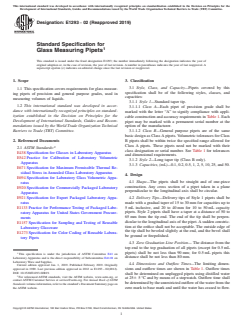
(Specification)Standard Specification for Glass Measuring Pipets
General Information
- Abstract
ABSTRACT
This specification covers requirements of precision (Class A) and general purpose (Class B) grade glass measuring pipets used for volume measurement of liquids. Pipets covered by this specification may be of the standard taper tip type (Style 1) or of the long taper tip type (Style 2), which is only available for Class B pipets, and are available in nine different capacities. The pipet shall be manufactured from annealed borosilicate glass into a straight, one-piece construction that is free of defects which may distort the appearance of the liquid surface. The pipets shall be marked wit permanent and legible graduation lines lying in a plane perpendicular to the vertical axis of the pipet by etching the glass and filling the etched area with a permanent pigment, by etching through a vertical colored stripe fused into the glass, by applying a stain fired into the glass without etching, or by applying an enamel fired into the glass without etching. In addition, the pipet shall also be color coded with one or two color bands. Pipets shall undergo testing such as specified for reusable laboratory glassware.
SCOPE
1.1 This specification covers requirements for glass measuring pipets of precision and general purpose grades, used in measuring volumes of liquids.
1.2 This international standard was developed in accordance with internationally recognized principles on standardization established in the Decision on Principles for the Development of International Standards, Guides and Recommendations issued by the World Trade Organization Technical Barriers to Trade (TBT) Committee.
- Status
- Published
- Publication Date
- 31-Dec-2018
- Technical Committee
- E41 - Laboratory Apparatus
- Drafting Committee
- E41.01 - Laboratory Ware and Supplies


Overview
ASTM E1293-02(2019): Standard Specification for Glass Measuring Pipets establishes the specifications for precision (Class A) and general purpose (Class B) glass pipets designed to accurately measure and deliver liquid volumes in laboratory environments. Developed by ASTM International, this standard ensures that glass measuring pipets meet strict criteria for accuracy, construction, marking, and calibration. The specification includes requirements for pipet styles, dimensions, tolerances, markings, and materials, supporting reliable and repeatable measurements in analytical and quality control laboratories globally.
Key Topics
Pipet Grades and Styles:
- Precision Grade (Class A): Highest accuracy for critical measurements; must display "A" marking and may include a serial number.
- General Purpose Grade (Class B): Same design as Class A but with tolerances up to twice those of Class A. Suitable for less stringent applications.
- Styles:
- Style 1: Standard taper tip - available for both Class A and B.
- Style 2: Long taper tip - only available for Class B pipets.
Construction and Materials:
- Manufactured from annealed borosilicate glass for chemical resistance and durability.
- Straight, one-piece design ensures uniformity and strength.
- Free of defects that could affect liquid measurement or appearance.
Graduations and Markings:
- Permanent, legible graduation lines placed perpendicular to the pipet axis.
- Markings applied by methods such as etching, staining, or enamel firing.
- Color band coding for easy identification, with details outlined in ASTM E1273.
- Identification includes manufacturer, nominal capacity, calibration temperature (20 °C), and "delivers" designation (TD or equivalent).
Dimensional Requirements and Outflow Times:
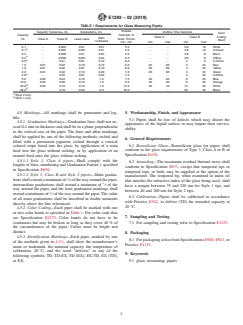
- Specific tolerances and minimum outflow times by pipet capacity.
- Design features like tip taper and graduation spacing are tightly controlled to promote consistent liquid delivery and readability.
Applications
- Analytical Laboratories: Used for high-precision liquid measurement in chemical, biological, and medical laboratories requiring stringent accuracy and repeatability.
- Quality Control: Essential for industrial and research labs for preparing standard solutions, dilutions, and reagent measurements.
- Educational Use: Universities and learning institutions employ standardized glass pipets in teaching laboratories to ensure consistent practices and accurate results.
- General Laboratory Work: Suitable for a wide range of liquid handling needs, from pharmaceutical research to environmental analysis.
These pipets are critical tools in any setting where accurate liquid volume measurement is needed, supporting tasks such as titration, sample preparation, and quantitative analysis.
Related Standards
The following standards are frequently referenced alongside ASTM E1293-02(2019) to ensure comprehensive compliance and performance:
- ASTM E438: Specification for Glasses in Laboratory Apparatus - outlines glass types suitable for laboratory ware.
- ASTM E542: Practice for Calibration of Laboratory Volumetric Apparatus - provides procedures for calibration of measuring equipment.
- ASTM E671: Specification for Maximum Permissible Thermal Residual Stress in Annealed Glass Laboratory Apparatus.
- ASTM E694: Specification for Laboratory Glass Volumetric Apparatus - covers dimensions and quality for volumetric glassware.
- ASTM E920 / E921: Specifications for Commercially and Export Packaged Laboratory Apparatus.
- ASTM E1133: Practice for Performance Testing of Packaged Laboratory Apparatus.
- ASTM E1157: Specification for Sampling and Testing of Reusable Laboratory Glassware.
- ASTM E1273: Specification for Color Coding of Reusable Laboratory Pipets.
Keywords: glass measuring pipets, ASTM E1293, laboratory pipet standards, Class A pipet, Class B pipet, borosilicate pipet, laboratory volumetric apparatus, glassware calibration.
Relations
- Effective Date
- 01-Jan-2019
- Effective Date
- 01-Feb-2024
- Effective Date
- 01-Feb-2024
- Effective Date
- 01-Jul-2019
- Effective Date
- 01-Jul-2019
- Effective Date
- 01-Jan-2018
- Effective Date
- 01-Jan-2018
- Effective Date
- 01-Nov-2013
- Effective Date
- 01-Nov-2013
- Effective Date
- 01-Dec-2011
- Effective Date
- 01-Dec-2011
- Effective Date
- 01-Dec-2011
- Effective Date
- 01-Sep-2010
- Effective Date
- 01-Jul-2010
- Effective Date
- 15-May-2010
Get Certified
Connect with accredited certification bodies for this standard

ECOCERT
Organic and sustainability certification.

Eurofins Food Testing Global
Global leader in food, environment, and pharmaceutical product testing.

Intertek Bangladesh
Intertek certification and testing services in Bangladesh.
Sponsored listings
Frequently Asked Questions
ASTM E1293-02(2019) is a technical specification published by ASTM International. Its full title is "Standard Specification for Glass Measuring Pipets". This standard covers: ABSTRACT This specification covers requirements of precision (Class A) and general purpose (Class B) grade glass measuring pipets used for volume measurement of liquids. Pipets covered by this specification may be of the standard taper tip type (Style 1) or of the long taper tip type (Style 2), which is only available for Class B pipets, and are available in nine different capacities. The pipet shall be manufactured from annealed borosilicate glass into a straight, one-piece construction that is free of defects which may distort the appearance of the liquid surface. The pipets shall be marked wit permanent and legible graduation lines lying in a plane perpendicular to the vertical axis of the pipet by etching the glass and filling the etched area with a permanent pigment, by etching through a vertical colored stripe fused into the glass, by applying a stain fired into the glass without etching, or by applying an enamel fired into the glass without etching. In addition, the pipet shall also be color coded with one or two color bands. Pipets shall undergo testing such as specified for reusable laboratory glassware. SCOPE 1.1 This specification covers requirements for glass measuring pipets of precision and general purpose grades, used in measuring volumes of liquids. 1.2 This international standard was developed in accordance with internationally recognized principles on standardization established in the Decision on Principles for the Development of International Standards, Guides and Recommendations issued by the World Trade Organization Technical Barriers to Trade (TBT) Committee.
ABSTRACT This specification covers requirements of precision (Class A) and general purpose (Class B) grade glass measuring pipets used for volume measurement of liquids. Pipets covered by this specification may be of the standard taper tip type (Style 1) or of the long taper tip type (Style 2), which is only available for Class B pipets, and are available in nine different capacities. The pipet shall be manufactured from annealed borosilicate glass into a straight, one-piece construction that is free of defects which may distort the appearance of the liquid surface. The pipets shall be marked wit permanent and legible graduation lines lying in a plane perpendicular to the vertical axis of the pipet by etching the glass and filling the etched area with a permanent pigment, by etching through a vertical colored stripe fused into the glass, by applying a stain fired into the glass without etching, or by applying an enamel fired into the glass without etching. In addition, the pipet shall also be color coded with one or two color bands. Pipets shall undergo testing such as specified for reusable laboratory glassware. SCOPE 1.1 This specification covers requirements for glass measuring pipets of precision and general purpose grades, used in measuring volumes of liquids. 1.2 This international standard was developed in accordance with internationally recognized principles on standardization established in the Decision on Principles for the Development of International Standards, Guides and Recommendations issued by the World Trade Organization Technical Barriers to Trade (TBT) Committee.
ASTM E1293-02(2019) is classified under the following ICS (International Classification for Standards) categories: 71.040.20 - Laboratory ware and related apparatus. The ICS classification helps identify the subject area and facilitates finding related standards.
ASTM E1293-02(2019) has the following relationships with other standards: It is inter standard links to ASTM E1293-02(2012), ASTM E438-92(2024), ASTM E694-18(2024), ASTM E920-97(2019), ASTM E1273-88(2019), ASTM E694-18, ASTM E438-92(2018), ASTM E920-97(2013), ASTM E1273-88(2013), ASTM E438-92(2011), ASTM E1157-87(2011), ASTM E1157-87(2018)e1, ASTM E1133-86(2010), ASTM E694-99(2010), ASTM E921-97(2010). Understanding these relationships helps ensure you are using the most current and applicable version of the standard.
ASTM E1293-02(2019) is available in PDF format for immediate download after purchase. The document can be added to your cart and obtained through the secure checkout process. Digital delivery ensures instant access to the complete standard document.
Standards Content (Sample)
This international standard was developed in accordance with internationally recognized principles on standardization established in the Decision on Principles for the
Development of International Standards, Guides and Recommendations issued by the World Trade Organization Technical Barriers to Trade (TBT) Committee.
Designation:E1293 −02 (Reapproved 2019)
Standard Specification for
Glass Measuring Pipets
This standard is issued under the fixed designation E1293; the number immediately following the designation indicates the year of
original adoption or, in the case of revision, the year of last revision. A number in parentheses indicates the year of last reapproval. A
superscript epsilon (´) indicates an editorial change since the last revision or reapproval.
1. Scope 3. Classification
3.1 Style, Class, and Capacity—Pipets covered by this
1.1 This specification covers requirements for glass measur-
specification shall be of the following styles, classes, and
ing pipets of precision and general purpose grades, used in
capacities:
measuring volumes of liquids.
3.1.1 Style 1—Standard taper tip.
1.2 This international standard was developed in accor-
3.1.1.1 Class A—Each pipet of precision grade shall be
dance with internationally recognized principles on standard-
marked with the letter “A” to signify compliance with appli-
ization established in the Decision on Principles for the
cable construction and accuracy requirements in Table 1. Each
Development of International Standards, Guides and Recom-
pipet may be marked with a permanent serial number at the
mendations issued by the World Trade Organization Technical
option of the manufacturer.
Barriers to Trade (TBT) Committee.
3.1.1.2 Class B—General purpose pipets are of the same
basic design as ClassApipets. Volumetric tolerances for Class
2. Referenced Documents B pipets shall be within twice the specified range allowed for
Class A pipets. These pipets need not be marked with their
2.1 ASTM Standards:
class designation or serial number. See Table 1 for tolerances
E438 Specification for Glasses in Laboratory Apparatus
and dimensional requirements.
E542 Practice for Calibration of Laboratory Volumetric
3.1.2 Style 2—Long taper tip (Class B only).
Apparatus
3.1.3 Capacities, (mL)—0.1, 0.2, 0.5, 1, 2, 5, 10, 25, and 50.
E671 Specification for Maximum Permissible Thermal Re-
sidual Stress in Annealed Glass Laboratory Apparatus
4. Design
E694 Specification for Laboratory Glass Volumetric Appa-
4.1 Shape—The pipets shall be straight and of one-piece
ratus
construction. Any cross section of a pipet taken in a plane
E920 Specification for Commercially Packaged Laboratory
perpendicular to the longitudinal axis shall be circular.
Apparatus
4.2 Delivery Tips—Delivery tips of Style 1 pipets shall be
E921 Specification for Export Packaged Laboratory Appa-
made with a gradual taper of 15 to 30 mm for capacities up to
ratus
5 mL inclusive, and 20 to 40 mm for 10 to 50 mL capacity
E1133 Practice for Performance Testing of Packaged Labo-
pipets. Style 2 pipets shall have a taper at a distance of 50 to
ratory Apparatus for United States Government Procure-
65 mm from the tip end. The end of the tip shall be perpen-
ments
dicular to the longitudinal axis of the pipet.Asudden constric-
E1157 Specification for Sampling and Testing of Reusable
tion at the orifice shall not be acceptable. The outside edge of
Laboratory Glassware
the tip shall be beveled slightly at the end, and the bevel shall
E1273 Specification for Color Coding of Reusable Labora-
be ground or firepolished.
tory Pipets
4.3 Zero Graduation Line Position— The distance from the
top end to the top graduation of all pipets (except for 0.5 mL
pipets) shall be not less than 90 mm; for 0.5 mL pipets this
This specification is under the jurisdiction of ASTM Committee E41 on
distance shall be not less than 80 mm.
Laboratory Apparatus and is the direct responsibility of Subcommittee E41.01 on
Laboratory Ware and Supplies.
4.4 Dimensions and Outflow Times—The limiting dimen-
Current edition approved Jan. 1, 2019. Published February 2019. Originally
sions and outflow times are shown in Table 1. Outflow times
approved in 1989. Last previous edition approved in 2012 as E1293 – 02(2012).
DOI: 10.1520/E1293-02R19.
shall be determined on unplugged pipets using distilled water
For referenced ASTM standards, visit the ASTM website, www.astm.org, or
at 256 5 °C and by means of a stopwatch. Outflow time shall
contact ASTM Customer Service at service@astm.org. For Annual Book of ASTM
be determined by the unrestricted outflow of the water from the
Standards volume information, refer to the standard’s Document Summary page on
the ASTM website. zero mark to base mark and until the water has ceased to flow.
Copyright © ASTM International, 100 Barr Harbor Drive, PO Box C700, West Conshohocken, PA 19428-2959. United States
E1293−02 (2019)
TABLE 1 Requirements for Glass Measuring Pipets
Capacity Tolerance± mL Graduations, mL Outside Outflow Time Seconds
Color
Capacity Diameter of
Class A Class B Cod
...