

ASTM A723/A723M-18a(2023)
(Specification)Standard Specification for Alloy Steel Forgings for High-Strength Pressure Component Application
General Information
- Abstract
ABSTRACT
This specification covers the standard requirements for high-strength quenched and tempered alloy steel forgings for pressure vessels, isostatic presses, shock tubes, and similar components. These materials are not intended for welded construction. Three grades of nickel-chromium-molybdenum steels and six classes of increasing tensile strength are included. The strength class, section size, and configuration of the forging will largely dictate the applicable type of steel. Materials shall be manufactured by steel melting processes, rough machining, and final heat treatment, which shall consist of normalizing, reaustenitization, liquid quenching, and tempering. Conformance of the forging specimens to chemical composition requirements shall be analyzed by heat and product analyses. Proper sampling methods for mechanical properties testing shall be done by any of four possible ways, as judged appropriate. Steel specimens shall also undergo straight-beam and angle-beam ultrasonic examination, and magnetic particle examination procedures to evaluate nondestructive examination requirements. Repair welding of the forgings shall not be permitted.
SCOPE
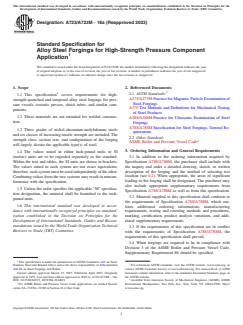
1.1 This specification2 covers requirements for high-strength quenched and tempered alloy steel forgings for pressure vessels, isostatic presses, shock tubes, and similar components.
1.2 These materials are not intended for welded construction.
1.3 Three grades of nickel-chromium-molybdenum steels and six classes of increasing tensile strength are included. The strength class, section size, and configuration of the forging will largely dictate the applicable type(s) of steel.
1.4 The values stated in either inch-pound units or SI (metric) units are to be regarded separately as the standard. Within the text and tables, the SI units are shown in brackets. The values stated in each system are not exact equivalents; therefore, each system must be used independently of the other. Combining values from the two systems may result in nonconformance with the specification.
1.5 Unless the order specifies the applicable “M” specification designation, the material shall be furnished to the inch-pound units.
1.6 This international standard was developed in accordance with internationally recognized principles on standardization established in the Decision on Principles for the Development of International Standards, Guides and Recommendations issued by the World Trade Organization Technical Barriers to Trade (TBT) Committee.
- Status
- Published
- Publication Date
- 14-Mar-2023
- Technical Committee
- A01 - Steel, Stainless Steel and Related Alloys
- Drafting Committee
- A01.06 - Steel Forgings and Billets
Overview
ASTM A723/A723M-18a(2023) is the internationally recognized standard specification for high-strength quenched and tempered alloy steel forgings used in pressure component applications. Developed by ASTM, this standard sets out comprehensive requirements for the chemical composition, mechanical properties, manufacturing processes, and nondestructive examination of alloy steel forgings designed for high-pressure environments, such as pressure vessels, isostatic presses, and shock tubes. It is particularly suitable for components where welded construction is not intended.
This standard encompasses three grades of nickel-chromium-molybdenum alloy steels and six classes with ascending tensile strength. Proper adherence to ASTM A723/A723M ensures materials are produced and tested to stringent criteria, supporting reliability and safety in critical pressure equipment.
Key Topics
Material Grades and Classes
- Covers three grades of nickel-chromium-molybdenum steels
- Six classes defined by increasing tensile strength
- Selection based on strength class, forging size, and configuration
Manufacturing and Heat Treatment
- Steel melting excludes open-hearth; vacuum degassing required
- Steps include normalizing, reaustenitization, liquid quenching, and tempering
- Rough machining prior to final heat treatment is specified to aid full hardening
Mechanical and Chemical Requirements
- Strict chemical composition requirements tested by heat and product analysis
- Mechanical properties assessed for tensile strength, yield strength, elongation, and impact resistance
- Precise methods for specimen sampling, location, and orientation are provided
Nondestructive Testing
- Mandatory ultrasonic and magnetic particle examinations as per ASTM A388/A388M and A275/A275M
- Detailed acceptance and rejection criteria for detecting internal and surface defects
- Forgings with repair welds are not permitted
Ordering and Certification
- Purchasers must specify detailed forging drawings and testing requirements
- Certification includes results of analyses, test locations, and supplementary requirements as needed
Applications
High-Strength Pressure Vessels:
Used in the fabrication of pressure vessels that demand robust mechanical performance and crack resistance, especially in applications where no welding is involved.Isostatic Presses and Shock Tubes:
Ideal for forming and testing equipment exposed to cyclic or dynamic high pressures.Critical Engineered Components:
Suitable for high-integrity main closures, covers, and structural supports where mechanical reliability and nonweldable construction are essential.Industries Served:
- Oil and gas processing
- Power generation (including nuclear)
- Chemical and petrochemical plants
- Aerospace and defense
Related Standards
- ASTM A370 – Test Methods and Definitions for Mechanical Testing of Steel Products
- ASTM A388/A388M – Practice for Ultrasonic Examination of Steel Forgings
- ASTM A275/A275M – Practice for Magnetic Particle Examination of Steel Forgings
- ASTM A788/A788M – Specification for General Requirements for Steel Forgings
- ASME Boiler and Pressure Vessel Code (Section II, SA-723/SA-723M) – Reference for pressure vessel applications
Practical Value
Adhering to ASTM A723/A723M-18a(2023) assures manufacturers and end-users of alloy steel forgings that their components meet rigorous international standards for quality, safety, and performance. This standard is essential for the supply of high-strength, impact-tested forge parts used in demanding pressure applications where reliability cannot be compromised. Following its requirements helps ensure compliance with global industry regulations and enhances the integrity of critical pressure systems.
Relations
- Effective Date
- 01-Mar-2024
- Effective Date
- 01-Nov-2023
- Effective Date
- 01-Nov-2023
- Effective Date
- 01-Jul-2019
- Effective Date
- 01-May-2019
- Effective Date
- 01-Nov-2018
- Effective Date
- 01-Sep-2018
- Effective Date
- 01-Mar-2018
- Refers
ASTM A370-17a - Standard Test Methods and Definitions for Mechanical Testing of Steel Products - Effective Date
- 15-Nov-2017
- Effective Date
- 01-Nov-2017
- Effective Date
- 01-May-2017
- Effective Date
- 01-Jan-2017
- Effective Date
- 01-Dec-2016
- Effective Date
- 01-Nov-2015
- Effective Date
- 01-May-2015
Get Certified
Connect with accredited certification bodies for this standard

Element Materials Technology
Materials testing and product certification.

Inštitut za kovinske materiale in tehnologije
Institute of Metals and Technology. Materials testing, metallurgical analysis, NDT.
Sponsored listings
Frequently Asked Questions
ASTM A723/A723M-18a(2023) is a technical specification published by ASTM International. Its full title is "Standard Specification for Alloy Steel Forgings for High-Strength Pressure Component Application". This standard covers: ABSTRACT This specification covers the standard requirements for high-strength quenched and tempered alloy steel forgings for pressure vessels, isostatic presses, shock tubes, and similar components. These materials are not intended for welded construction. Three grades of nickel-chromium-molybdenum steels and six classes of increasing tensile strength are included. The strength class, section size, and configuration of the forging will largely dictate the applicable type of steel. Materials shall be manufactured by steel melting processes, rough machining, and final heat treatment, which shall consist of normalizing, reaustenitization, liquid quenching, and tempering. Conformance of the forging specimens to chemical composition requirements shall be analyzed by heat and product analyses. Proper sampling methods for mechanical properties testing shall be done by any of four possible ways, as judged appropriate. Steel specimens shall also undergo straight-beam and angle-beam ultrasonic examination, and magnetic particle examination procedures to evaluate nondestructive examination requirements. Repair welding of the forgings shall not be permitted. SCOPE 1.1 This specification2 covers requirements for high-strength quenched and tempered alloy steel forgings for pressure vessels, isostatic presses, shock tubes, and similar components. 1.2 These materials are not intended for welded construction. 1.3 Three grades of nickel-chromium-molybdenum steels and six classes of increasing tensile strength are included. The strength class, section size, and configuration of the forging will largely dictate the applicable type(s) of steel. 1.4 The values stated in either inch-pound units or SI (metric) units are to be regarded separately as the standard. Within the text and tables, the SI units are shown in brackets. The values stated in each system are not exact equivalents; therefore, each system must be used independently of the other. Combining values from the two systems may result in nonconformance with the specification. 1.5 Unless the order specifies the applicable “M” specification designation, the material shall be furnished to the inch-pound units. 1.6 This international standard was developed in accordance with internationally recognized principles on standardization established in the Decision on Principles for the Development of International Standards, Guides and Recommendations issued by the World Trade Organization Technical Barriers to Trade (TBT) Committee.
ABSTRACT This specification covers the standard requirements for high-strength quenched and tempered alloy steel forgings for pressure vessels, isostatic presses, shock tubes, and similar components. These materials are not intended for welded construction. Three grades of nickel-chromium-molybdenum steels and six classes of increasing tensile strength are included. The strength class, section size, and configuration of the forging will largely dictate the applicable type of steel. Materials shall be manufactured by steel melting processes, rough machining, and final heat treatment, which shall consist of normalizing, reaustenitization, liquid quenching, and tempering. Conformance of the forging specimens to chemical composition requirements shall be analyzed by heat and product analyses. Proper sampling methods for mechanical properties testing shall be done by any of four possible ways, as judged appropriate. Steel specimens shall also undergo straight-beam and angle-beam ultrasonic examination, and magnetic particle examination procedures to evaluate nondestructive examination requirements. Repair welding of the forgings shall not be permitted. SCOPE 1.1 This specification2 covers requirements for high-strength quenched and tempered alloy steel forgings for pressure vessels, isostatic presses, shock tubes, and similar components. 1.2 These materials are not intended for welded construction. 1.3 Three grades of nickel-chromium-molybdenum steels and six classes of increasing tensile strength are included. The strength class, section size, and configuration of the forging will largely dictate the applicable type(s) of steel. 1.4 The values stated in either inch-pound units or SI (metric) units are to be regarded separately as the standard. Within the text and tables, the SI units are shown in brackets. The values stated in each system are not exact equivalents; therefore, each system must be used independently of the other. Combining values from the two systems may result in nonconformance with the specification. 1.5 Unless the order specifies the applicable “M” specification designation, the material shall be furnished to the inch-pound units. 1.6 This international standard was developed in accordance with internationally recognized principles on standardization established in the Decision on Principles for the Development of International Standards, Guides and Recommendations issued by the World Trade Organization Technical Barriers to Trade (TBT) Committee.
ASTM A723/A723M-18a(2023) is classified under the following ICS (International Classification for Standards) categories: 77.140.30 - Steels for pressure purposes. The ICS classification helps identify the subject area and facilitates finding related standards.
ASTM A723/A723M-18a(2023) has the following relationships with other standards: It is inter standard links to ASTM A370-24, ASTM A388/A388M-23, ASTM A275/A275M-23, ASTM A370-19, ASTM A788/A788M-19, ASTM A788/A788M-18b, ASTM A788/A788M-18a, ASTM A788/A788M-18, ASTM A370-17a, ASTM A788/A788M-17a, ASTM A788/A788M-17, ASTM A370-17, ASTM A788/A788M-16a, ASTM A370-15, ASTM A788/A788M-15. Understanding these relationships helps ensure you are using the most current and applicable version of the standard.
ASTM A723/A723M-18a(2023) is available in PDF format for immediate download after purchase. The document can be added to your cart and obtained through the secure checkout process. Digital delivery ensures instant access to the complete standard document.
Standards Content (Sample)
This international standard was developed in accordance with internationally recognized principles on standardization established in the Decision on Principles for the
Development of International Standards, Guides and Recommendations issued by the World Trade Organization Technical Barriers to Trade (TBT) Committee.
Designation: A723/A723M − 18a (Reapproved 2023)
Standard Specification for
Alloy Steel Forgings for High-Strength Pressure Component
Application
This standard is issued under the fixed designation A723/A723M; the number immediately following the designation indicates the year
of original adoption or, in the case of revision, the year of last revision. A number in parentheses indicates the year of last reapproval.
A superscript epsilon (´) indicates an editorial change since the last revision or reapproval.
1. Scope 2. Referenced Documents
2.1 ASTM Standards:
1.1 This specification covers requirements for high-
A275/A275M Practice for Magnetic Particle Examination of
strength quenched and tempered alloy steel forgings for pres-
Steel Forgings
sure vessels, isostatic presses, shock tubes, and similar com-
A370 Test Methods and Definitions for Mechanical Testing
ponents.
of Steel Products
1.2 These materials are not intended for welded construc-
A388/A388M Practice for Ultrasonic Examination of Steel
tion.
Forgings
A788/A788M Specification for Steel Forgings, General Re-
1.3 Three grades of nickel-chromium-molybdenum steels
quirements
and six classes of increasing tensile strength are included. The
2.2 Other Standard:
strength class, section size, and configuration of the forging
ASME Boiler and Pressure Vessel Code
will largely dictate the applicable type(s) of steel.
3. Ordering Information and General Requirements
1.4 The values stated in either inch-pound units or SI
(metric) units are to be regarded separately as the standard.
3.1 In addition to the ordering information required by
Within the text and tables, the SI units are shown in brackets.
Specification A788/A788M, the purchaser shall include with
The values stated in each system are not exact equivalents; the inquiry and order a detailed drawing, sketch, or written
therefore, each system must be used independently of the other. description of the forging and the method of selecting test
location (see 6.2). When appropriate, the areas of significant
Combining values from the two systems may result in noncon-
loading in the forging shall be designated. The purchaser may
formance with the specification.
also include appropriate supplementary requirements from
1.5 Unless the order specifies the applicable “M” specifica-
Specification A788/A788M as well as from this specification.
tion designation, the material shall be furnished to the inch-
3.2 Material supplied to this specification shall conform to
pound units.
the requirements of Specification A788/A788M, which out-
1.6 This international standard was developed in accor-
lines additional ordering information, manufacturing
dance with internationally recognized principles on standard-
requirements, testing and retesting methods and procedures,
ization established in the Decision on Principles for the
marking, certification, product analysis variations, and addi-
Development of International Standards, Guides and Recom- tional supplementary requirements.
mendations issued by the World Trade Organization Technical
3.3 If the requirements of this specification are in conflict
Barriers to Trade (TBT) Committee.
with the requirements of Specification A788/A788M, the
requirements of this specification shall prevail.
3.4 When forgings are required to be in compliance with
Division 3 of the ASME Boiler and Pressure Vessel Code,
Supplementary Requirement S6 should be specified.
This specification is under the jurisdiction of ASTM Committee A01 on Steel,
Stainless Steel and Related Alloys and is the direct responsibility of Subcommittee For referenced ASTM standards, visit the ASTM website, www.astm.org, or
A01.06 on Steel Forgings and Billets. contact ASTM Customer Service at service@astm.org. For Annual Book of ASTM
Current edition approved March 15, 2023. Published April 2023. Originally Standards volume information, refer to the standard’s Document Summary page on
approved in 1975. Last previous edition approved in 2018 as A723/A723M – 18a. the ASTM website.
DOI: 10.1520/A0723_A0723M–18AR23. Available from American Society of Mechanical Engineers (ASME), ASME
For ASME Boiler and Pressure Vessel Code applications see related Specifi- International Headquarters, Two Park Ave., New York, NY 10016-5990, http://
cation SA–723/SA–723M in Section II of that Code. www.asme.org.
Copyright © ASTM International, 100 Barr Harbor Drive, PO Box C700, West Conshohocken, PA 19428-2959. United States
A723/A723M − 18a (2023)
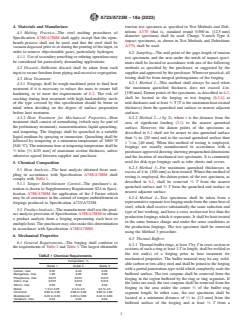
4. Materials and Manufacture tension test specimen as specified in Test Methods and Defi-
nitions A370 (that is, standard round 0.500 in. [12.5 mm]
4.1 Melting Practice—The steel melting procedures of
diameter specimen) shall be used. Charpy V-notch Type A
Specification A788/A788M shall apply except that the open-
impact specimens, as shown in Test Methods and Definitions
hearth process shall not be used, and that the steel shall be
A370, shall be used.
vacuum degassed prior to or during the pouring of the ingot, in
order to remove objectionable gases, particularly hydrogen.
6.2 Sampling—The mid-point of the gage length of tension
4.1.1 Use of secondary remelting or refining operations may
test specimens and the area under the notch of impact speci-
be considered for particularly demanding applications.
mens shall be located in accordance with one of the following
4.2 Discard—Sufficient discard shall be taken from each methods as specified by the purchaser, or suggested by the
supplier and approved by the purchaser. Wherever practical, all
ingot to secure freedom from piping and excessive segregation.
testing shall be from integral prolongations of the forging.
4.3 Heat Treatment:
6.2.1 Method 1—This method shall always be used when
4.3.1 Forgings shall be rough-machined prior to final heat
the maximum quenched thickness does not exceed 4 in.
treatment if it is necessary to reduce the mass to ensure full
[100 mm]. Datum points of the specimens, as described in 6.2,
hardening or to meet the requirements of 6.2. The risk of
shall be located in the forging or test forging (6.2.4) at
cracking during heat treatment with high-hardenability steels
mid-thickness and at least ⁄3 T (T is the maximum heat-treated
of the type covered by this specification should be borne in
thickness) from the quenched end surface or nearest adjacent
mind when deciding on the degree of surface preparation
before heat treatment. surfaces.
4.3.2 Heat Treatment for Mechanical Properties—Heat
6.2.2 Method 2—t by 2t, where t is the distance from the
treatment shall consist of normalizing (which may be part of
area of significant loading (3.1) to the nearest quenched
the preliminary treatment), reaustenitization, liquid quenching,
surface. However, the datum points of the specimens as
and tempering. The forgings shall be quenched in a suitable
described in 6.2 shall not be nearer to one quenched surface
liquid medium by spraying or immersion. Quenching shall be
than ⁄4 in. [20 mm] and to the second quenched surface than
followed by tempering at a minimum temperature of 1000 °F 1
1 ⁄2 in. [40 mm]. When this method of testing is employed,
[540 °C]. The minimum time at tempering temperature shall be
forgings are usually manufactured in accordance with a
1 1
⁄2 h/in. [ ⁄2 h/25 mm] of maximum section thickness, unless
purchaser-approved drawing showing prequenched dimensions
otherwise agreed between supplier and purchaser.
and the location of mechanical test specimens. It is commonly
used for disk-type forgings such as tube sheets and covers.
5. Chemical Composition
6.2.3 Method 3—For maximum quenched thicknesses in
5.1 Heat Analysis—The heat analysis obtained from sam-
excess of 4 in. [100 mm] as heat-treated. Where this method of
pling in accordance with Specification A788/A788M shall
testing is employed, the datum points of the test specimen, as
comply with Table 1.
described in 6.2, shall be removed ⁄4 T from the nearest
5.1.1 Temper Embrittlement Control—The purchaser’s at-
quenched surface and ⁄3 T from the quenched end surface or
tention is drawn to Supplementary Requirement S24 in Speci-
nearest adjacent surface.
fication A788/A788M for application of the J Factor which
6.2.4 Method 4—Test specimens shall be taken from a
may be of assistance in the control of temper embrittlement in
representative separate test forging made from the same heat of
forgings produced to Specification A723/A723M.
steel, which shall receive substantially the same reduction and
5.2 Product Analysis—The manufacturer shall use the prod-
type of hot working, and have a cross section not less than the
uct analysis provision of Specification A788/A788M to obtain
production forgings which it represents. It shall be heat-treated
a product analysis from a forging representing each heat or
in the same furnace charge and under the same conditions as
multiple heat. The purchaser may also make this determination
the production forgings. The test specimen shall be removed
in accordance with Specification A788/A788M.
using the Method 3 procedure.
6. Mechanical Properties
6.3 Thermal Buffers:
6.1 General Requirements—The forging shall conform to
6.3.1 Thermal buffer rings, at least T by T in cross section or
the requirements of Table 2 and Table 3. The largest obtainable
sections of such a ring at least 3 T in length, shall be welded to
the test end(s) of a forging prior to heat treatment for
TABLE 1 Chemical Requirements
mechanical properties. The buffer material may be any weld-
Composition, %
able carbon or low-alloy steel and shall be joined to the forging
Grade 1 Grade 2 Grade 3
with a partial penetration-type weld which completely seals the
Carbon, max 0.35 0.40 0.40
buffered surface. The test coupons shall be removed from the
Manganese, max 1.00 0.90 0.90
Phosphorus, max 0.015 0.015 0.015
forging in the region buffered by the ring or ring segments. If
Sulfur, max 0.015 0.015 0.015
the latter are used, the test coupons shall be removed from the
Silicon, max 0.35 0.35 0.35
forging in the area under the center ⁄3 of the buffer ring
Nickel 1.5 to 2.25 2.3 to 3.3 3.3 to 4.5
Chromium 0.80 to 2.00 0.80 to 2.00 0.80 to 2.00
segment length. In either case, the test specimens shall be
Molybdenum 0.20 to 0.50 0.30 to 0.60 0.40 to 0.80
located at a minimum distance of ⁄2 in. [13 mm] from the
Vanadium, max 0.20 0.20 0.20
buffered surface of the forging and at least ⁄4 T from a
A723/A723M − 18a (2023)
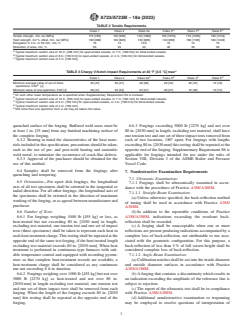
TABLE 2 Tensile Requirements
A B C
Class 1 Class 2 Class 2a Class 3 Class 4 Class 5
Tensile strength, min, ksi [MPa] 115 [795] 135 [930] 145 [1000] 155 [1070] 175 [1205] 190 [1310]
Yield strength, 0.2 % offset, min, ksi [MPa] 100 [690] 120 [825] 130 [895] 140 [965] 160 [1105] 180 [1240]
Elongation in 2 in. or 50 mm, min, % 16 14 13.5 13 12 10
Reduction of area, min, % 50 45 43 40 35 30
A
Typical maximum section size of 10 in. [255 mm] for open-ended vessels, or 7 in. [180 mm] for blind-ended vessels.
B
Typical maximum section size of 6 in. [150 mm] for open-ended vessels, or 4 in. [10
...