

ASTM C685/C685M-17
(Specification)Standard Specification for Concrete Made by Volumetric Batching and Continuous Mixing
General Information
- Abstract
ABSTRACT
This specification covers concrete made by volumetric batching and continuous mixing. Requirements for quality of concrete shall be either as hereinafter specified or as specified by the purchaser. When the requirements of the purchaser differ from this specification, the purchaser's specification shall govern. This specification does not cover the placement, consolidation, finishing, curing, or protection of the concrete after delivery to the purchaser. Tests and criteria for batching accuracy and mixing efficiency are specified herein. Materials such as cement, aggregates, water, ground granulated blast-furnace slag, air-entraining admixtures, and chemical admixtures shall conform to the requirements covered in this specification. The material shall be subjected to the following test methods: compression test specimens; compression tests; yield; unit weight; air content; slump; and temperature.
SIGNIFICANCE AND USE
A1.2 Significance and Use
A1.2.1 These tests and requirements are used to evaluate loading and operating procedures; verify the accuracy of proportioning and indicating systems; and determine if mixing uniformity has been degraded by excessive wear or by accumulations of hardened concrete, or both (Note A1.1).
Note A1.1: The method of loading the batching-mixing unit, proper maintenance, and other factors may have an effect on the ability of the unit to produce uniformly mixed concrete. For this reason, the use of this test method not only measures the efficiency of the mixer, but also the combined effect of the method of loading and operating the unit.
A1.2.2 This annex provides additional procedures and cautions that are necessary in the application of existing test methods and practices when used to determine the uniformity of freshly mixed concrete.
SCOPE
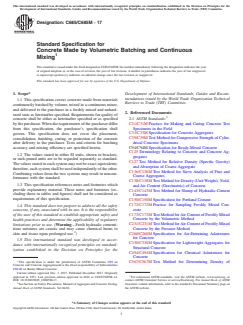
1.1 This specification covers concrete made from materials continuously batched by volume, mixed in a continuous mixer, and delivered to the purchaser in a freshly mixed and unhardened state as hereinafter specified. Requirements for quality of concrete shall be either as hereinafter specified or as specified by the purchaser. When the requirements of the purchaser differ from this specification, the purchaser's specification shall govern. This specification does not cover the placement, consolidation, finishing, curing, or protection of the concrete after delivery to the purchaser. Tests and criteria for batching accuracy and mixing efficiency are specified herein.
1.2 The values stated in either SI units, shown in brackets, or inch-pound units are to be regarded separately as standard. The values stated in each system may not be exact equivalents; therefore, each system shall be used independently of the other. Combining values from the two systems may result in nonconformance with the standard.
1.3 This specification references notes and footnotes which provide explanatory material. These notes and footnotes (excluding those in tables and figures) shall not be considered as requirements of this specification.
1.4 This standard does not purport to address all the safety concerns, if any, associated with its use. It is the responsibility of the user of this standard to establish appropriate safety and health practices and determine the applicability of regulatory limitations prior to use. (Warning—Fresh hydraulic cementitious mixtures are caustic and may cause chemical burns to skin and tissue upon prolonged use.2)
1.5 This international standard was developed in accordance with internationally recognized principles on standardization established in the Decision on Principles for the Development of International Standards, Guides and Recommendations issued by the World Trade Organization Technical Barriers to Trade (TBT) Committee.
- Status
- Published
- Publication Date
- 30-Nov-2017
- Technical Committee
- C09 - Concrete and Concrete Aggregates
- Drafting Committee
- C09.40 - Ready-Mixed Concrete
Buy Documents
ASTM C685/C685M-17 - Standard Specification for Concrete Made by Volumetric Batching and Continuous Mixing
REDLINE ASTM C685/C685M-17 - Standard Specification for Concrete Made by Volumetric Batching and Continuous Mixing
Overview
ASTM C685/C685M-17: Standard Specification for Concrete Made by Volumetric Batching and Continuous Mixing defines the requirements for concrete produced by volumetrically batching the constituent materials and mixing them in a continuous mixer. This internationally recognized ASTM standard is widely used in the construction industry, particularly for on-site concrete production where flexibility and real-time adjustments are essential. The standard provides guidelines for material quality, batching accuracy, and mixing efficiency, ensuring consistent, high-quality concrete output.
ASTM C685/C685M-17 specifies only the requirements for the freshly mixed and unhardened state of concrete delivered to the purchaser. It does not cover subsequent processes like placement, consolidation, finishing, curing, or protection.
Key Topics
Scope of Application
The standard applies to freshly mixed concrete made with materials continuously batched by volume and mixed in continuous mixers, typically on-site. Both SI and inch-pound units are recognized, but values from these systems should not be intermixed.Material Requirements
Materials, including cement, aggregates (normal, lightweight, or heavy weight), water, ground granulated blast-furnace slag, air-entraining admixtures, and chemical admixtures, must meet their respective ASTM specifications.Proportioning and Batching
All primary ingredients (cement, aggregates, water, admixtures) must be measured by volume with specified tolerances. The standard mandates the use of calibration and control systems to ensure batching accuracy and mixing efficiency.Quality Control and Testing
Testing must be conducted for properties such as compressive strength, unit weight, air content, slump, temperature, and overall batch yield. Specific ASTM test methods (e.g., C39 for compressive strength, C138 for density, C143 for slump) are referenced for these measurements.Uniformity and Performance
Procedures for evaluating mixer uniformity and verifying loading and operating procedures are specified. Regular checks for batching accuracy and mixer efficiency are required to prevent degraded mixing performance.Purchase Requirements The standard offers various options for specifying mix proportions and quality, allowing either the concrete producer or the purchaser to assume responsibility for mixture proportions, compressive strength, and other characteristics.
Applications
On-Site Concrete Production
Ideal for construction sites requiring variable concrete quantities, customized mixes, or just-in-time production. Volumetric mixers are commonly used for road repair, utility installations, and remote projects.Infrastructure Projects
Widely adopted for highways, bridges, pipelines, and marine structures where flexibility and immediate mixing adjustments are necessary.Specialty and Remote Projects
Suitable for specialty concrete applications, such as lightweight or heavyweight concrete, or where ready-mixed concrete delivery is impractical.Repair and Maintenance
Enables precise batch sizes and quality control, reducing waste and facilitating efficient repair operations.
Related Standards
- ASTM C94/C94M: Specification for Ready-Mixed Concrete
- ASTM C33/C33M: Specification for Concrete Aggregates
- ASTM C150/C150M: Specification for Portland Cement
- ASTM C260/C260M: Specification for Air-Entraining Admixtures
- ASTM C494/C494M: Specification for Chemical Admixtures for Concrete
- ASTM C39/C39M: Test Method for Compressive Strength of Cylindrical Concrete Specimens
- ASTM C143/C143M: Test Method for Slump of Hydraulic-Cement Concrete
- ACI 304.6R: Guide for Use of Volumetric-Measuring and Continuous-Mixing Concrete Equipment
Understanding and applying ASTM C685/C685M-17 helps ensure that volumetric batching and continuous mixing operations achieve high standards of consistency, reliability, and performance, critical for demanding construction applications. For effective compliance and implementation, ensure all referenced ASTM standards and detailed testing protocols are followed.
Relations
- Effective Date
- 01-Apr-2024
- Refers
ASTM C31/C31M-24a - Standard Practice for Making and Curing Concrete Test Specimens in the Field - Effective Date
- 01-Apr-2024
- Effective Date
- 01-Feb-2024
- Effective Date
- 01-Jan-2024
- Effective Date
- 01-Jan-2024
- Effective Date
- 01-Jan-2024
- Effective Date
- 01-Jan-2024
- Refers
ASTM C31/C31M-24 - Standard Practice for Making and Curing Concrete Test Specimens in the Field - Effective Date
- 01-Jan-2024
- Refers
ASTM C39/C39M-23 - Standard Test Method for Compressive Strength of Cylindrical Concrete Specimens - Effective Date
- 01-Dec-2023
- Effective Date
- 01-Dec-2023
- Effective Date
- 01-Sep-2023
- Effective Date
- 01-Jan-2020
- Effective Date
- 15-Dec-2019
- Effective Date
- 01-Jul-2019
- Effective Date
- 01-Apr-2019
Buy Documents
ASTM C685/C685M-17 - Standard Specification for Concrete Made by Volumetric Batching and Continuous Mixing
REDLINE ASTM C685/C685M-17 - Standard Specification for Concrete Made by Volumetric Batching and Continuous Mixing
Get Certified
Connect with accredited certification bodies for this standard

DIBt (Deutsches Institut für Bautechnik)
German Institute for Building Technology.
DIN CERTCO
DIN Group product certification.

Aboma Certification B.V.
Specialized in construction, metal, and transport sectors.
Sponsored listings
Frequently Asked Questions
ASTM C685/C685M-17 is a technical specification published by ASTM International. Its full title is "Standard Specification for Concrete Made by Volumetric Batching and Continuous Mixing". This standard covers: ABSTRACT This specification covers concrete made by volumetric batching and continuous mixing. Requirements for quality of concrete shall be either as hereinafter specified or as specified by the purchaser. When the requirements of the purchaser differ from this specification, the purchaser's specification shall govern. This specification does not cover the placement, consolidation, finishing, curing, or protection of the concrete after delivery to the purchaser. Tests and criteria for batching accuracy and mixing efficiency are specified herein. Materials such as cement, aggregates, water, ground granulated blast-furnace slag, air-entraining admixtures, and chemical admixtures shall conform to the requirements covered in this specification. The material shall be subjected to the following test methods: compression test specimens; compression tests; yield; unit weight; air content; slump; and temperature. SIGNIFICANCE AND USE A1.2 Significance and Use A1.2.1 These tests and requirements are used to evaluate loading and operating procedures; verify the accuracy of proportioning and indicating systems; and determine if mixing uniformity has been degraded by excessive wear or by accumulations of hardened concrete, or both (Note A1.1). Note A1.1: The method of loading the batching-mixing unit, proper maintenance, and other factors may have an effect on the ability of the unit to produce uniformly mixed concrete. For this reason, the use of this test method not only measures the efficiency of the mixer, but also the combined effect of the method of loading and operating the unit. A1.2.2 This annex provides additional procedures and cautions that are necessary in the application of existing test methods and practices when used to determine the uniformity of freshly mixed concrete. SCOPE 1.1 This specification covers concrete made from materials continuously batched by volume, mixed in a continuous mixer, and delivered to the purchaser in a freshly mixed and unhardened state as hereinafter specified. Requirements for quality of concrete shall be either as hereinafter specified or as specified by the purchaser. When the requirements of the purchaser differ from this specification, the purchaser's specification shall govern. This specification does not cover the placement, consolidation, finishing, curing, or protection of the concrete after delivery to the purchaser. Tests and criteria for batching accuracy and mixing efficiency are specified herein. 1.2 The values stated in either SI units, shown in brackets, or inch-pound units are to be regarded separately as standard. The values stated in each system may not be exact equivalents; therefore, each system shall be used independently of the other. Combining values from the two systems may result in nonconformance with the standard. 1.3 This specification references notes and footnotes which provide explanatory material. These notes and footnotes (excluding those in tables and figures) shall not be considered as requirements of this specification. 1.4 This standard does not purport to address all the safety concerns, if any, associated with its use. It is the responsibility of the user of this standard to establish appropriate safety and health practices and determine the applicability of regulatory limitations prior to use. (Warning—Fresh hydraulic cementitious mixtures are caustic and may cause chemical burns to skin and tissue upon prolonged use.2) 1.5 This international standard was developed in accordance with internationally recognized principles on standardization established in the Decision on Principles for the Development of International Standards, Guides and Recommendations issued by the World Trade Organization Technical Barriers to Trade (TBT) Committee.
ABSTRACT This specification covers concrete made by volumetric batching and continuous mixing. Requirements for quality of concrete shall be either as hereinafter specified or as specified by the purchaser. When the requirements of the purchaser differ from this specification, the purchaser's specification shall govern. This specification does not cover the placement, consolidation, finishing, curing, or protection of the concrete after delivery to the purchaser. Tests and criteria for batching accuracy and mixing efficiency are specified herein. Materials such as cement, aggregates, water, ground granulated blast-furnace slag, air-entraining admixtures, and chemical admixtures shall conform to the requirements covered in this specification. The material shall be subjected to the following test methods: compression test specimens; compression tests; yield; unit weight; air content; slump; and temperature. SIGNIFICANCE AND USE A1.2 Significance and Use A1.2.1 These tests and requirements are used to evaluate loading and operating procedures; verify the accuracy of proportioning and indicating systems; and determine if mixing uniformity has been degraded by excessive wear or by accumulations of hardened concrete, or both (Note A1.1). Note A1.1: The method of loading the batching-mixing unit, proper maintenance, and other factors may have an effect on the ability of the unit to produce uniformly mixed concrete. For this reason, the use of this test method not only measures the efficiency of the mixer, but also the combined effect of the method of loading and operating the unit. A1.2.2 This annex provides additional procedures and cautions that are necessary in the application of existing test methods and practices when used to determine the uniformity of freshly mixed concrete. SCOPE 1.1 This specification covers concrete made from materials continuously batched by volume, mixed in a continuous mixer, and delivered to the purchaser in a freshly mixed and unhardened state as hereinafter specified. Requirements for quality of concrete shall be either as hereinafter specified or as specified by the purchaser. When the requirements of the purchaser differ from this specification, the purchaser's specification shall govern. This specification does not cover the placement, consolidation, finishing, curing, or protection of the concrete after delivery to the purchaser. Tests and criteria for batching accuracy and mixing efficiency are specified herein. 1.2 The values stated in either SI units, shown in brackets, or inch-pound units are to be regarded separately as standard. The values stated in each system may not be exact equivalents; therefore, each system shall be used independently of the other. Combining values from the two systems may result in nonconformance with the standard. 1.3 This specification references notes and footnotes which provide explanatory material. These notes and footnotes (excluding those in tables and figures) shall not be considered as requirements of this specification. 1.4 This standard does not purport to address all the safety concerns, if any, associated with its use. It is the responsibility of the user of this standard to establish appropriate safety and health practices and determine the applicability of regulatory limitations prior to use. (Warning—Fresh hydraulic cementitious mixtures are caustic and may cause chemical burns to skin and tissue upon prolonged use.2) 1.5 This international standard was developed in accordance with internationally recognized principles on standardization established in the Decision on Principles for the Development of International Standards, Guides and Recommendations issued by the World Trade Organization Technical Barriers to Trade (TBT) Committee.
ASTM C685/C685M-17 is classified under the following ICS (International Classification for Standards) categories: 91.100.30 - Concrete and concrete products. The ICS classification helps identify the subject area and facilitates finding related standards.
ASTM C685/C685M-17 has the following relationships with other standards: It is inter standard links to ASTM C94/C94M-24a, ASTM C31/C31M-24a, ASTM C989/C989M-24, ASTM C231/C231M-24, ASTM C173/C173M-24, ASTM C1077-24, ASTM C94/C94M-24, ASTM C31/C31M-24, ASTM C39/C39M-23, ASTM C1064/C1064M-23, ASTM C173/C173M-23, ASTM C637-20, ASTM C125-19a, ASTM C94/C94M-19, ASTM C150/C150M-19. Understanding these relationships helps ensure you are using the most current and applicable version of the standard.
ASTM C685/C685M-17 is available in PDF format for immediate download after purchase. The document can be added to your cart and obtained through the secure checkout process. Digital delivery ensures instant access to the complete standard document.
Standards Content (Sample)
This international standard was developed in accordance with internationally recognized principles on standardization established in the Decision on Principles for the
Development of International Standards, Guides and Recommendations issued by the World Trade Organization Technical Barriers to Trade (TBT) Committee.
Designation:C685/C685M −17
Standard Specification for
Concrete Made by Volumetric Batching and Continuous
Mixing
This standard is issued under the fixed designation C685/C685M; the number immediately following the designation indicates the year
of original adoption or, in the case of revision, the year of last revision. A number in parentheses indicates the year of last reapproval.
A superscript epsilon (´) indicates an editorial change since the last revision or reapproval.
This standard has been approved for use by agencies of the U.S. Department of Defense.
1. Scope* Development of International Standards, Guides and Recom-
mendations issued by the World Trade Organization Technical
1.1 This specification covers concrete made from materials
Barriers to Trade (TBT) Committee.
continuously batched by volume, mixed in a continuous mixer,
and delivered to the purchaser in a freshly mixed and unhard-
2. Referenced Documents
ened state as hereinafter specified. Requirements for quality of
2.1 ASTM Standards:
concrete shall be either as hereinafter specified or as specified
C31/C31M Practice for Making and Curing Concrete Test
bythepurchaser.Whentherequirementsofthepurchaserdiffer
Specimens in the Field
from this specification, the purchaser’s specification shall
C33/C33M Specification for Concrete Aggregates
govern. This specification does not cover the placement,
C39/C39M Test Method for Compressive Strength of Cylin-
consolidation, finishing, curing, or protection of the concrete
drical Concrete Specimens
after delivery to the purchaser. Tests and criteria for batching
C94/C94M Specification for Ready-Mixed Concrete
accuracy and mixing efficiency are specified herein.
C125 Terminology Relating to Concrete and Concrete Ag-
1.2 The values stated in either SI units, shown in brackets,
gregates
or inch-pound units are to be regarded separately as standard.
C127 Test Method for Relative Density (Specific Gravity)
The values stated in each system may not be exact equivalents;
and Absorption of Coarse Aggregate
therefore,eachsystemshallbeusedindependentlyoftheother.
C136/C136M Test Method for Sieve Analysis of Fine and
Combining values from the two systems may result in noncon-
Coarse Aggregates
formance with the standard.
C138/C138M Test Method for Density (Unit Weight),Yield,
1.3 This specification references notes and footnotes which
and Air Content (Gravimetric) of Concrete
provide explanatory material. These notes and footnotes (ex-
C143/C143M Test Method for Slump of Hydraulic-Cement
cluding those in tables and figures) shall not be considered as
Concrete
requirements of this specification.
C150/C150M Specification for Portland Cement
C172/C172M Practice for Sampling Freshly Mixed Con-
1.4 This standard does not purport to address all the safety
crete
concerns, if any, associated with its use. It is the responsibility
C173/C173M Test Method forAir Content of Freshly Mixed
of the user of this standard to establish appropriate safety and
Concrete by the Volumetric Method
health practices and determine the applicability of regulatory
C231/C231M Test Method forAir Content of Freshly Mixed
limitations prior to use. (Warning—Fresh hydraulic cementi-
Concrete by the Pressure Method
tious mixtures are caustic and may cause chemical burns to
C260/C260M Specification for Air-Entraining Admixtures
skin and tissue upon prolonged use. )
for Concrete
1.5 This international standard was developed in accor-
C330/C330M Specification for Lightweight Aggregates for
dance with internationally recognized principles on standard-
Structural Concrete
ization established in the Decision on Principles for the
C494/C494M Specification for Chemical Admixtures for
Concrete
This specification is under the jurisdiction of ASTM Committee C09 on
C567/C567M Test Method for Determining Density of
Concrete and Concrete Aggregatesand is the direct responsibility of Subcommittee
C09.40 on Ready-Mixed Concrete.
Current edition approved Dec. 1, 2017. Published December 2017. Originally
approved in 1971. Last previous edition approved in 2014 as C685/C685M–14. For referenced ASTM standards, visit the ASTM website, www.astm.org, or
DOI: 10.1520/C0685_C0685M-17. contact ASTM Customer Service at service@astm.org. For Annual Book of ASTM
See Section on Safety Precautions, Manual ofAggregate and Concrete Testing, Standards volume information, refer to the standard’s Document Summary page on
Annual Book of ASTM Standards, Vol 04.02. the ASTM website.
*A Summary of Changes section appears at the end of this standard
Copyright © ASTM International, 100 Barr Harbor Drive, PO Box C700, West Conshohocken, PA 19428-2959. United States
C685/C685M−17
Structural Lightweight Concrete 3. Terminology
C595/C595M Specification for Blended Hydraulic Cements
3.1 Definitions: For definitions of terms used in this
C618 Specification for Coal Fly Ash and Raw or Calcined
specification, refer to Terminology C125.
Natural Pozzolan for Use in Concrete
3.2 Definitions of Terms Specific to This Standard:
C637 Specification for Aggregates for Radiation-Shielding
3.2.1 manufacturer, n—of concrete, the producer of the
Concrete
concrete.
C989/C989M Specification for Slag Cement for Use in
Concrete and Mortars
3.2.2 purchaser, n—of concrete, the buyer of the concrete.
C1017/C1017M Specification for Chemical Admixtures for
Use in Producing Flowing Concrete
4. Basis of Purchase
C1064/C1064M Test Method for Temperature of Freshly
4.1 The basis of purchase shall be the cubic yard or cubic
Mixed Hydraulic-Cement Concrete
metre of fresh concrete as it is continuously discharged from
C1077 Practice forAgencies Testing Concrete and Concrete
the batching and mixing apparatus.
Aggregates for Use in Construction and Criteria for
Testing Agency Evaluation
4.2 The volume of fresh concrete in a given batch shall be
C1157/C1157M Performance Specification for Hydraulic
determined by, or calculated from, a calibrated indicating
Cement
device driven directly by the batching apparatus.
C1240 Specification for Silica Fume Used in Cementitious
NOTE 1—It should be understood that the volume of hardened concrete
Mixtures may be, or may appear to be, less than expected due to waste and spillage,
over-excavation,spreadingforms,somelossofentrainedair,orsettlement
C1602/C1602M Specification for Mixing Water Used in the
of wet mixtures, none of which are the responsibility of the manufacturer.
Production of Hydraulic Cement Concrete
2.2 ACI Documents:
5. Materials
CP-1 Technician Workbook for ACI Certification of Con-
5.1 In the absence of designated applicable specifications
crete Field Testing Technician-Grade I
covering requirements for quality of materials, the following
211.1 Standard Practice for Selecting Proportions for
specifications shall govern:
Normal, Heavyweight, and Mass Concrete
211.2 Standard Practice for Selecting Proportions for Struc-
5.2 Cementitious Materials:
tural Lightweight Concrete
5.2.1 Hydraulic Cement—Hydraulic Cement shall conform
301 Standard Specifications for Structural Concrete
to Specification C150/C150M, Specification C595/C595M,or
304.6R Guide for Use of Volumetric-Measuring and
Specification C1157/C1157M (Note 2).
Continuous-Mixing Concrete Equipment
5.2.2 Supplementary Cementitious Materials—CoalFlyAsh
305R Hot Weather Concreting
or natural pozzolans shall conform to Specification C618. Slag
306R Cold Weather Concreting
Cement shall conform to Specification C989/C989M. Silica
318 Building Code Requirements for Structural Concrete
Fume shall conform to Specification C1240.
and Commentary
NOTE 2—These different cementitious materials will produce concretes
2.3 Other Documents:
of different properties and should not be used interchangeably.
Bureau of Reclamation Concrete Manual
VMMB 100-01 Volumetric Mixer Standards of theVolumet-
5.3 Aggregates—Normal weight aggregates shall conform
ric Mixer Manufacturers Bureau to Specification C33/C33M. Lightweight aggregates shall con-
form to Specification C330/C330M and heavyweight aggre-
gates shall conform to Specification C637.
5.4 Water—Water shall conform to Specification C1602/
Available fromAmerican Concrete Institute (ACI), P.O. Box 9094, Farmington
C1602M.
Hills, MI 48333-9094, http://www.aci-int.org.
Available from Superintendent of Documents, U.S. Government Printing 5.5 Air-Entraining Admixtures—Air-entraining admixtures
Office, Washington, DC 20402.
shall conform to Specification C260/C260M (Note 3).
Available from theVolumetric Mixer Manufacturers Bureau, 900 Spring Street,
Silver Spring, MD 20910, www.vmmb.org.
A
TABLE 1 Recommended Total Air Content for Air-Entrained Concrete
Total Air Content, %
B,C
Exposure Condition Nominal Max Sizes of Aggregate, in. [mm]
3 1 3 1
⁄8 [9.5] ⁄2 [12.5] ⁄4 [19.0] 1 [25.0] 1 ⁄2 [37.5] 2 [50.0] 3 [75.0]
Mild 4.5 4.0 3.5 3.0 2.5 2.0 1.5
Moderate 6.0 5.5 5.0 4.5 4.5 4.0 3.5
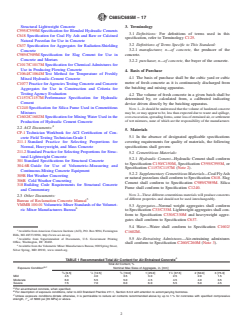
Severe 7.5 7.0 6.0 6.0 5.5 5.0 4.5
A
For air-entrained concrete, when specified.
B
For description of exposure conditions, refer to ACI Standard Practice 211.1, Section 6.3.3 with attention to accompanying footnotes.
C
Unless exposure conditions dictate otherwise, it is permissible to reduce air contents recommended above by up to 1 % for concretes with specified compressive
strength, f ' , of 5000 psi [35 MPa] or above.
c
C685/C685M−17
5.6 Chemical Admixtures—Chemical admixtures shall con- 6.3.1 When the purchaser assumes responsibility for the
form to either Specification C494/C494M or C1017/C1017M, proportioning of the concrete mixture, the purchaser shall also
as applicable (Note 3). specify the following:
NOTE 3—In any given instance, the required dosage of air-entraining, 6.3.1.1 Cement content in pounds per cubic yard or kilo-
accelerating, and retarding admixtures may vary. Therefore, a range of
grams per cubic metre of concrete, or equivalent units,
dosages should be allowed which will permit obtaining the desired effect.
6.3.1.2 Maximum allowable water content in gallons per
cubic yard or litres or kilograms per cubic metre of concrete or
6. Ordering Information
equivalent units, including surface moisture on the aggregates,
but excluding water of absorption (Note 6), and
6.1 In the absence of designated applicable general
specifications, the purchaser shall specify the following: 6.3.1.3 If admixtures are required, the type, name, and
dosage range to be used. Admixtures shall not be used as a
6.1.1 Designated size or sizes of coarse aggregate,
substitute for a portion of specified amounts of cement without
6.1.2 Slump or slumps desired at the point of delivery (see
the written approval of the purchaser.
10.3),
6.1.3 When air-entrained concrete is specified, the air con-
NOTE 6—The purchaser, in selecting requirements for which he
assumes responsibility should give consideration to requirements for
tent of samples taken at the point of discharge from the
workability, placeability, durability, surface texture, and density, in addi-
transportationunit(see10.4andTable1forthetotalaircontent
tion to those for structural design. The purchaser is referred to ACI
and tolerances) (Note 4),
Standard Practice 211.1 for normal weight concrete, and ACI Standard
6.1.4 When structural lightweight concrete is specified, the Practice 211.2 for lightweight concrete, for the selection of proportions
that will result in concrete suitable for various types of structures and
density as fresh density, equilibrium density, or oven-dry
conditions of exposure. The water-cement ratio of most structural light-
density (Note 5), and
weight concretes cannot be determined with sufficient accuracy for use as
6.1.5 Which of Options A, B, or C shall be used as a basis
a specification basis.
for determining the proportions of the concrete to produce the
6.3.2 Attherequestofthepurchaser,themanufacturershall,
required quality (see 6.2, 6.3,or 6.4).
prior to the actual delivery of the concrete, furnish a statement
to the purchaser giving the sources, densities, and sieve
NOTE 4—In selecting the specified air content, the purchaser should
consider the exposure conditions to which the concrete will be subjected.
analyses of the aggregates and the dry mass of cement and
Air contents less than shown in Table 1 may not give the required
saturated surface-dry mass of fine and coarse aggregate and
resistance to freezing and thawing, which is the primary purpose of
quantities, type, and name of admixture (if any) and of water
air-entrained concrete. Air contents higher than the levels shown may
per cubic yard or cubic metre of concrete that will be used in
reduce strength without contributing any further improvement of durabil-
the manufacture of each class of concrete ordered by the
ity.
NOTE 5—The density of fresh concrete, which is the only density
purchaser.
determinable at the time of delivery, is always higher than the equilibrium
6.4 Option C:
density, or oven-dry density. Definitions of, and methods for determining
or calculating equilibrium density and oven-dry density, are covered in 6.4.1 When the purchaser requires the manufacturer to
Test Method C567/C567M.
assume responsibility for the selection of the proportions for
the concrete mixture with the minimum allowable cement
6.2 Option A:
contentspecified,thepurchasershallalsospecifythefollowing
6.2.1 When the purchaser requires the manufacturer to
in addition to the requirements of 6.1.1 through 6.1.5:
assume full responsibility for the selection of the proportions
6.4.1.1 Required compressive strength as determined on
for the concrete mixture, the purchaser shall also specify the
samples taken from the mixer at the point of discharge and
following:
evaluated in accordance with Section 11. The purchaser shall
6.2.1.1 Requirements for compressive strength as deter-
specify the requirements for strength in terms of tests of
mined on samples taken from the mixer at the point of
standard specimens cured under standard curing conditions for
discharge and evaluated in accordance with Section 11. The
moistcuring.Unlessotherwisespecified,theageattestshallbe
purchaser shall specify the requirements in terms of the
28 days.
compressive strength of standard specimens cured under stan-
6.4.1.2 Minimum cement content in pounds per cubic yard
dard curing conditions for moist curing. Unless otherwise
or kilograms per cubic metre of concrete (Note 7), and
specified, the age at test shall be 28 days, and
6.4.1.3 If admixtures are required, the type, name, and
6.2.2 Attherequestofthepurchaser,themanufacturershall,
dosage range to be used. The cement content shall not be
prior to the actual delivery of the concrete, furnish a statement
reduced when admixtures are used.
to the purchaser, giving the dry mass of cement and saturated
6.4.2 Attherequestofthepurchaser,themanufacturershall,
surface-dry mass of fine and coarse aggregate and quantities,
prior to the actual delivery of the concrete, furnish a statement
type, and name of admixtures (if any) and of water per cubic
to the purchaser, giving the dry mass of cement and saturated
yard or cubic metre of concrete that will be used in the
surface-dry mass of fine and coarse aggregate and quantities,
manufactureofeachclassofconcreteorderedbythepurchaser.
type, and name of admixture (if any) and of water per cubic
Themanufacturershallalsofurnishevidencesatisfactorytothe
yard or cubic metre of concrete that will be used in the
purchaserthatthematerialstobeusedandproportionsselected
manufactureofeachclassofconcreteorderedbythepurchaser.
will produce concrete of the quality specified.
Themanufacturershallalsofurnishevidencesatisfactorytothe
6.3 Option B: purchaserthatthematerialstobeusedandproportionsselected
C685/C685M−17
will produce concrete of the quality specified. Whatever of the output indicator is thus checked by this expedient. For
strengths are attained the quantity of cement used shall not be furtherguidanceandasuggestedcalibrationprocedure,referto
less than the minimum specified.
ACI 304.6R and VMMB 100-01.
3 3
NOTE 7—Option C can be distinctive and useful only if the designated
NOTE9—Itisrecommendedthatabout2.5to3.0ft [0.070to0.085m ]
minimum cement content is at about the same level that would ordinarily
be discharged for this purpose; this amount of concrete will weigh from
be required for the strength, aggregate size, and slump specified. At the
350 to 500 lb [160 to 225 kg] and can be discharged into and contained in
same time, it must be an amount that will be sufficient to ensure durability
a 35 or 55-gal [130 to 210-dm ] drum or other suitable container which in
under expected service conditions, as well as satisfactory surface texture
turn can be placed on a scale of adequate capacity. The output of a
and density, in the event specified strength is attained with it.Attention is
batcher-mixer unit may be indicated by the number of revolutions, travel
directed to ACI Standard Practices 211.1 and 211.2 for additional
of a belt, or changes in gage readings; if so, these figures should be used
information on mixture proportions.
as a measure of output.
6.5 The proportions arrived at by Options A, B, or C for
7.5 Proportioning Check—Whenever the sources or charac-
each class of concrete and which are approved for use in a
teristics of the ingredients are changed, or the characteristics of
project shall be assigned a designation (7CV.PK7, etc.) to
the mixture are noted to have changed, the purchaser is
facilitate identification of each concrete mixture delivered to
permitted to require a check of the fine aggregate content and
the project. This is the designation required in 15.1.7 and
the coarse aggregate content by use of the washout test.
suppliesinformationonconcreteproportionswhentheyarenot
3 3
Essentially, in the washout test, 1 ft [0.03 m ] of concrete is
given separately on each delivery ticket as outlined in 15.2.
washed through a No. 4 [4.75-mm] sieve and through a No.
However, each delivery of concrete shall be covered by a
delivery ticket showing enough information to establish that 100 [150-µm] sieve; that retained on the No. 4 sieve is
normally considered coarse aggregate whereas that passing the
the mix conforms to the mix designs previously approved for
the work. No. 4 and retained on the No. 100 sieve is considered fine
aggregate. Corrections to the quantity of aggregates (per cubic
6.6 The purchaser shall ensure that the manufacturer is
foot or cubic metre of concrete) shall be made if the original
provided copies of all reports of tests performed on concrete
sieve analysis of each aggregate is available.
samples taken to determine compliance with specification
requirements. Reports will be provided on a timely basis.
7.6 The rate of water supplied the continuous mixer shall be
measured by a calibrated flowmeter coordinated with the
7. Controlling and Measuring Materials
cement and aggregate feeding mechanism, and with the mixer.
7.1 Cement, fine and coarse aggregates, water, and admix-
The device for the control of water shall be capable of
tures shall be measured by volume. Devices such as counters,
delivering to the batch the required quantity. The rate shall be
calibrated gate openings, control valves, or flowmeters shall be
capable of being adjusted in order to control slump at the
available for controlling and determining the quantities of the
desired levels and to determine that the water-cement (permit-
ingredients discharged. The entire measuring and dispensing
ted or required) ratios are being met.
mechanism shall produce the specified proportions of each
7.7 Liquid admixtures shall be dispensed through a con-
ingredient within the tolerances in 7.8.
trolled flowmeter.
NOTE 8—The recommendations of the equipment manufacturer in the
operation of the equipment and in calibrating and using the various gages,
7.8 Tolerances in proportioning the various ingredients are
revolution counters, speed indicators, or other control devices should be
as follows:
followed.
7.2 All indicating devices that bear on the accuracy of
proportioning and mixing of concrete shall be in full view and
Cement, mass % 0 to +4
near enough to be read by the operator while concrete is being
Fine Aggregate, mass % ±2
produced. The operator shall have convenient access to all Coarse Aggregate, mass % ±2
Admixtures, mass or volume % ±3
controls.
Water, mass or volume % ±1
7.3 The proportioning and indicating devices shall be indi-
vidually checked by following the equipment manufacturer’s
recommendations as related to each individual concrete batch-
The tolerances are based on a volume/mass relationship
ing and mixing unit. Adequate standard volume measures,
established by calibration of the measuring devices furnished
scales, and weights shall be made available for the checking
as an integral part of the whole equipment.
accuracy of the proportioning mechanism.
7.4 Yield Check—Essentially, the volume of concrete dis-
NOTE 10—It is noted that to meet these tolerances, attention should be
charged from the mixer is checked by first determining the
given to:
(1) Degree of compaction of the cement,
mass of the amount of concrete discharged during some
(2) Grading and other physical characteristics of the fine and coarse
number of revolutions, or as determined by some other output
aggregates,
indicator; this is then followed immediately by a determination
(3) Moisture content and bulking factor of the fine aggregate,
of the density. The mass of concrete discharged divided by the
(4) Viscosity of the admixture, and
density is equal to the number of cubic feet or cubic metres
(5) Other factors of influence, for example, mechanical condition and
mixed and discharged during the chosen interval.The accuracy weather.
C685/C685M−17
8. Mixing Mechanism 10.3.1 Unless other tolerances are included in the project
specifications, the following shall apply:
8.1 The continuous mixer shall be an auger-type mixer or
10.3.1.1 When the project specifications for slump are
anyothertypesuitableformixingconcretetomeettherequired
written as a “maximum” or “not to exceed” requirement:
consistency and uniformity requirements (see 14.2.3).
8.2 Each batching and mixing unit, or both, shall carry in a
prominent place a metal plate or plates on which is plainly
Specified Slump Tolerance, in. (mm)
marked the gross volume of the unit in terms of mixed
3 in. [75 mm] or less +0–1 ⁄2 [40]
concrete. The mixer shall produce a thoroughly mixed and More than 3 in. [75 mm] +0–2 ⁄2 [65]
uniform concrete.
This option is to be used only if one addition of water is
NOTE 11—Slump and air content tests of samples taken in accordance
permitted on the job provided such addition does not
with 14.2.3 can be made for a quick check of the probable degree of
increase the water-cement ratio above the maximum
uniformity.
permitted by the specifications.
9. Mixing and Delivery
10.3.1.2 When the project specifications for slump are not
written as a “maximum” or “not to exceed” requirement:
9.1 The batcher-mixer unit shall contain in separate com-
partments all the necessary ingredients needed for the manu-
Specified Slump Tolerance, in. (mm)
facture of concrete. The unit shall be equipped with calibrated
2 in. [50 mm] and less ± ⁄2 [15]
proportioning devices to vary the mix proportions and it shall
More than 2 in. [50 mm] through 4 ±1 [25]
produce concrete as required by
...
This document is not an ASTM standard and is intended only to provide the user of an ASTM standard an indication of what changes have been made to the previous version. Because
it may not be technically possible to adequately depict all changes accurately, ASTM recommends that users consult prior editions as appropriate. In all cases only the current version
of the standard as published by ASTM is to be considered the official document.
Designation: C685/C685M − 14 C685/C685M − 17
Standard Specification for
Concrete Made by Volumetric Batching and Continuous
Mixing
This standard is issued under the fixed designation C685/C685M; the number immediately following the designation indicates the year
of original adoption or, in the case of revision, the year of last revision. A number in parentheses indicates the year of last reapproval.
A superscript epsilon (´) indicates an editorial change since the last revision or reapproval.
This standard has been approved for use by agencies of the U.S. Department of Defense.
1. Scope*
1.1 This specification covers concrete made from materials continuously batched by volume, mixed in a continuous mixer, and
delivered to the purchaser in a freshly mixed and unhardened state as hereinafter specified. Requirements for quality of concrete
shall be either as hereinafter specified or as specified by the purchaser. When the requirements of the purchaser differ from this
specification, the purchaser’s specification shall govern. This specification does not cover the placement, consolidation, finishing,
curing, or protection of the concrete after delivery to the purchaser. Tests and criteria for batching accuracy and mixing efficiency
are specified herein.
1.2 The values stated in either SI units, shown in brackets, or inch-pound units are to be regarded separately as standard. The
values stated in each system may not be exact equivalents; therefore, each system shall be used independently of the other.
Combining values from the two systems may result in nonconformance with the standard.
1.3 This specification references notes and footnotes which provide explanatory material. These notes and footnotes (excluding
those in tables and figures) shall not be considered as requirements of this specification.
1.4 This standard does not purport to address all the safety concerns, if any, associated with its use. It is the responsibility of
the user of this standard to establish appropriate safety and health practices and determine the applicability of regulatory
limitations prior to use. (Warning—Fresh hydraulic cementitious mixtures are caustic and may cause chemical burns to skin and
tissue upon prolonged use. )
1.5 This international standard was developed in accordance with internationally recognized principles on standardization
established in the Decision on Principles for the Development of International Standards, Guides and Recommendations issued
by the World Trade Organization Technical Barriers to Trade (TBT) Committee.
2. Referenced Documents
2.1 ASTM Standards:
C31/C31M Practice for Making and Curing Concrete Test Specimens in the Field
C33C33/C33M Specification for Concrete Aggregates
C39/C39M Test Method for Compressive Strength of Cylindrical Concrete Specimens
C94/C94M Specification for Ready-Mixed Concrete
C125 Terminology Relating to Concrete and Concrete Aggregates
C127 Test Method for Relative Density (Specific Gravity) and Absorption of Coarse Aggregate
C136C136/C136M Test Method for Sieve Analysis of Fine and Coarse Aggregates
C138/C138M Test Method for Density (Unit Weight), Yield, and Air Content (Gravimetric) of Concrete
C143/C143M Test Method for Slump of Hydraulic-Cement Concrete
C150/C150M Specification for Portland Cement
C172/C172M Practice for Sampling Freshly Mixed Concrete
This specification is under the jurisdiction of ASTM Committee C09 on Concrete and Concrete Aggregatesand is the direct responsibility of Subcommittee C09.40 on
Ready-Mixed Concrete.
Current edition approved Dec. 15, 2014Dec. 1, 2017. Published February 2015December 2017. Originally approved in 1971. Last previous edition approved in 20112014
as C685/C685M–11.–14. DOI: 10.1520/C0685_C0685M-14.10.1520/C0685_C0685M-17.
See Section on Safety Precautions, Manual of Aggregate and Concrete Testing, Annual Book of ASTM Standards, Vol 04.02.
For referenced ASTM standards, visit the ASTM website, www.astm.org, or contact ASTM Customer Service at service@astm.org. For Annual Book of ASTM Standards
volume information, refer to the standard’s Document Summary page on the ASTM website.
*A Summary of Changes section appears at the end of this standard
Copyright © ASTM International, 100 Barr Harbor Drive, PO Box C700, West Conshohocken, PA 19428-2959. United States
C685/C685M − 17
C173/C173M Test Method for Air Content of Freshly Mixed Concrete by the Volumetric Method
C231C231/C231M Test Method for Air Content of Freshly Mixed Concrete by the Pressure Method
C260C260/C260M Specification for Air-Entraining Admixtures for Concrete
C330C330/C330M Specification for Lightweight Aggregates for Structural Concrete
C494/C494M Specification for Chemical Admixtures for Concrete
C567C567/C567M Test Method for Determining Density of Structural Lightweight Concrete
C595/C595M Specification for Blended Hydraulic Cements
C618 Specification for Coal Fly Ash and Raw or Calcined Natural Pozzolan for Use in Concrete
C637 Specification for Aggregates for Radiation-Shielding Concrete
C989/C989M Specification for Slag Cement for Use in Concrete and Mortars
C1017/C1017M Specification for Chemical Admixtures for Use in Producing Flowing Concrete
C1064/C1064M Test Method for Temperature of Freshly Mixed Hydraulic-Cement Concrete
C1077 Practice for Agencies Testing Concrete and Concrete Aggregates for Use in Construction and Criteria for Testing Agency
Evaluation
C1157/C1157M Performance Specification for Hydraulic Cement
C1240 Specification for Silica Fume Used in Cementitious Mixtures
C1602/C1602M Specification for Mixing Water Used in the Production of Hydraulic Cement Concrete
2.2 ACI Documents:
CP-1 Technician Workbook for ACI Certification of Concrete Field Testing Technician-Grade I
211.1 Standard Practice for Selecting Proportions for Normal, Heavyweight, and Mass Concrete
211.2 Standard Practice for Selecting Proportions for Structural Lightweight Concrete
301 Standard Specifications for Structural Concrete
304.6R Guide for Use of Volumetric-Measuring and Continuous-Mixing Concrete Equipment
305R Hot Weather Concreting
306R Cold Weather Concreting
318 Building Code Requirements for Structural Concrete and Commentary
2.3 Other Documents:
Bureau of Reclamation Concrete Manual
VMMB 100-01 Volumetric Mixer Standards of the Volumetric Mixer Manufacturers Bureau
3. Terminology
3.1 Definitions: For definitions of terms used in this specification, refer to Terminology C125.
3.2 Definitions of Terms Specific to This Standard:
3.2.1 manufacturer, n—of concrete, the producer of the concrete.
3.2.2 purchaser, n—of concrete, the buyer of the concrete.
4. Basis of Purchase
4.1 The basis of purchase shall be the cubic yard or cubic metre of fresh concrete as it is continuously discharged from the
batching and mixing apparatus.
4.2 The volume of fresh concrete in a given batch shall be determined by, or calculated from, a calibrated indicating device
driven directly by the batching apparatus.
NOTE 1—It should be understood that the volume of hardened concrete may be, or may appear to be, less than expected due to waste and spillage,
over-excavation, spreading forms, some loss of entrained air, or settlement of wet mixtures, none of which are the responsibility of the manufacturer.
A
TABLE 1 Recommended Total Air Content for Air-Entrained Concrete
Total Air Content, %
B,C
Exposure Condition Nominal Max Sizes of Aggregate, in. [mm]
3 1 3 1
⁄8 [9.5] ⁄2 [12.5] ⁄4 [19.0] 1 [25.0] 1 ⁄2 [37.5] 2 [50.0] 3 [75.0]
Mild 4.5 4.0 3.5 3.0 2.5 2.0 1.5
Moderate 6.0 5.5 5.0 4.5 4.5 4.0 3.5
Severe 7.5 7.0 6.0 6.0 5.5 5.0 4.5
A
For air-entrained concrete, when specified.
B
For description of exposure conditions, refer to ACI Standard Practice 211.1, Section 6.3.3 with attention to accompanying footnotes.
C
Unless exposure conditions dictate otherwise, it is permissible to reduce air contents recommended above by up to 1 % for concretes with specified compressive
strength, f' , of 5000 psi [35 MPa] or above.
c
Available from American Concrete Institute (ACI), P.O. Box 9094, Farmington Hills, MI 48333-9094, http://www.aci-int.org.
Available from Superintendent of Documents, U.S. Government Printing Office, Washington, DC 20402.
Available from the Volumetric Mixer Manufacturers Bureau, 900 Spring Street, Silver Spring, MD 20910, www.vmmb.org.
C685/C685M − 17
5. Materials
5.1 In the absence of designated applicable specifications covering requirements for quality of materials, the following
specifications shall govern:
5.2 Cementitious Materials:
5.2.1 Hydraulic Cement—Hydraulic Cement shall conform to Specification C150/C150M, Specification C595/C595M, or
Specification C1157/C1157M (Note 2).
5.2.2 Supplementary Cementitious Materials—Coal Fly Ash or natural pozzolans shall conform to Specification C618. Slag
Cement shall conform to Specification C989/C989M. Silica Fume shall conform to Specification C1240.
NOTE 2—These different cementitious materials will produce concretes of different properties and should not be used interchangeably.
5.3 Aggregates—Normal weight aggregates shall conform to Specification C33C33/C33M. Lightweight aggregates shall
conform to Specification C330C330/C330M and heavyweight aggregates shall conform to Specification C637.
5.4 Water—Water shall conform to Specification C1602/C1602M.
5.5 Air-Entraining Admixtures—Air-entraining admixtures shall conform to Specification C260C260/C260M (Note 3).
5.6 Chemical Admixtures—Chemical admixtures shall conform to either Specification C494/C494M or C1017/C1017M, as
applicable (Note 3).
NOTE 3—In any given instance, the required dosage of air-entraining, accelerating, and retarding admixtures may vary. Therefore, a range of dosages
should be allowed which will permit obtaining the desired effect.
6. Ordering Information
6.1 In the absence of designated applicable general specifications, the purchaser shall specify the following:
6.1.1 Designated size or sizes of coarse aggregate,
6.1.2 Slump or slumps desired at the point of delivery (see 10.3),
6.1.3 When air-entrained concrete is specified, the air content of samples taken at the point of discharge from the transportation
unit (see 10.4 and Table 1 for the total air content and tolerances) (Note 4),
6.1.4 When structural lightweight concrete is specified, the density as fresh density, equilibrium density, or oven-dry density
(Note 5), and
6.1.5 Which of Options A, B, or C shall be used as a basis for determining the proportions of the concrete to produce the
required quality (see 6.2, 6.3, or 6.4).
NOTE 4—In selecting the specified air content, the purchaser should consider the exposure conditions to which the concrete will be subjected. Air
contents less than shown in Table 1 may not give the required resistance to freezing and thawing, which is the primary purpose of air-entrained concrete.
Air contents higher than the levels shown may reduce strength without contributing any further improvement of durability.
NOTE 5—The density of fresh concrete, which is the only density determinable at the time of delivery, is always higher than the equilibrium density,
or oven-dry density. Definitions of, and methods for determining or calculating equilibrium density and oven-dry density, are covered in Test Method
C567C567/C567M.
6.2 Option A:
6.2.1 When the purchaser requires the manufacturer to assume full responsibility for the selection of the proportions for the
concrete mixture, the purchaser shall also specify the following:
6.2.1.1 Requirements for compressive strength as determined on samples taken from the mixer at the point of discharge and
evaluated in accordance with Section 11. The purchaser shall specify the requirements in terms of the compressive strength of
standard specimens cured under standard curing conditions for moist curing. Unless otherwise specified, the age at test shall be
28 days, and
6.2.2 At the request of the purchaser, the manufacturer shall, prior to the actual delivery of the concrete, furnish a statement to
the purchaser, giving the dry mass of cement and saturated surface-dry mass of fine and coarse aggregate and quantities, type, and
name of admixtures (if any) and of water per cubic yard or cubic metre of concrete that will be used in the manufacture of each
class of concrete ordered by the purchaser. The manufacturer shall also furnish evidence satisfactory to the purchaser that the
materials to be used and proportions selected will produce concrete of the quality specified.
6.3 Option B:
6.3.1 When the purchaser assumes responsibility for the proportioning of the concrete mixture, the purchaser shall also specify
the following:
6.3.1.1 Cement content in pounds per cubic yard or kilograms per cubic metre of concrete, or equivalent units,
6.3.1.2 Maximum allowable water content in gallons per cubic yard or litres or kilograms per cubic metre of concrete or
equivalent units, including surface moisture on the aggregates, but excluding water of absorption (Note 6), and
6.3.1.3 If admixtures are required, the type, name, and dosage range to be used. Admixtures shall not be used as a substitute
for a portion of specified amounts of cement without the written approval of the purchaser.
NOTE 6—The purchaser, in selecting requirements for which he assumes responsibility should give consideration to requirements for workability,
placeability, durability, surface texture, and density, in addition to those for structural design. The purchaser is referred to ACI Standard Practice 211.1
C685/C685M − 17
for normal weight concrete, and ACI Standard Practice 211.2 for lightweight concrete, for the selection of proportions that will result in concrete suitable
for various types of structures and conditions of exposure. The water-cement ratio of most structural lightweight concretes cannot be determined with
sufficient accuracy for use as a specification basis.
6.3.2 At the request of the purchaser, the manufacturer shall, prior to the actual delivery of the concrete, furnish a statement to
the purchaser giving the sources, densities, and sieve analyses of the aggregates and the dry mass of cement and saturated
surface-dry mass of fine and coarse aggregate and quantities, type, and name of admixture (if any) and of water per cubic yard
or cubic metre of concrete that will be used in the manufacture of each class of concrete ordered by the purchaser.
6.4 Option C:
6.4.1 When the purchaser requires the manufacturer to assume responsibility for the selection of the proportions for the concrete
mixture with the minimum allowable cement content specified, the purchaser shall also specify the following in addition to the
requirements of 6.1.1 through 6.1.5:
6.4.1.1 Required compressive strength as determined on samples taken from the mixer at the point of discharge and evaluated
in accordance with Section 11. The purchaser shall specify the requirements for strength in terms of tests of standard specimens
cured under standard curing conditions for moist curing. Unless otherwise specified, the age at test shall be 28 days.
6.4.1.2 Minimum cement content in pounds per cubic yard or kilograms per cubic metre of concrete (Note 7), and
6.4.1.3 If admixtures are required, the type, name, and dosage range to be used. The cement content shall not be reduced when
admixtures are used.
6.4.2 At the request of the purchaser, the manufacturer shall, prior to the actual delivery of the concrete, furnish a statement to
the purchaser, giving the dry mass of cement and saturated surface-dry mass of fine and coarse aggregate and quantities, type, and
name of admixture (if any) and of water per cubic yard or cubic metre of concrete that will be used in the manufacture of each
class of concrete ordered by the purchaser. The manufacturer shall also furnish evidence satisfactory to the purchaser that the
materials to be used and proportions selected will produce concrete of the quality specified. Whatever strengths are attained the
quantity of cement used shall not be less than the minimum specified.
NOTE 7—Option C can be distinctive and useful only if the designated minimum cement content is at about the same level that would ordinarily be
required for the strength, aggregate size, and slump specified. At the same time, it must be an amount that will be sufficient to ensure durability under
expected service conditions, as well as satisfactory surface texture and density, in the event specified strength is attained with it. Attention is directed to
ACI Standard Practices 211.1 and 211.2 for additional information on mixture proportions.
6.5 The proportions arrived at by Options A, B, or C for each class of concrete and which are approved for use in a project shall
be assigned a designation (7CV.PK7, etc.) to facilitate identification of each concrete mixture delivered to the project. This is the
designation required in 15.1.7 and supplies information on concrete proportions when they are not given separately on each
delivery ticket as outlined in 15.2. However, each delivery of concrete shall be covered by a delivery ticket showing enough
information to establish that the mix conforms to the mix designs previously approved for the work.
6.6 The purchaser shall ensure that the manufacturer is provided copies of all reports of tests performed on concrete samples
taken to determine compliance with specification requirements. Reports will be provided on a timely basis.
7. Controlling and Measuring Materials
7.1 Cement, fine and coarse aggregates, water, and admixtures shall be measured by volume. Devices such as counters,
calibrated gate openings, control valves, or flowmeters shall be available for controlling and determining the quantities of the
ingredients discharged. The entire measuring and dispensing mechanism shall produce the specified proportions of each ingredient
within the tolerances in 7.8.
NOTE 8—The recommendations of the equipment manufacturer in the operation of the equipment and in calibrating and using the various gages,
revolution counters, speed indicators, or other control devices should be followed.
7.2 All indicating devices that bear on the accuracy of proportioning and mixing of concrete shall be in full view and near
enough to be read by the operator while concrete is being produced. The operator shall have convenient access to all controls.
7.3 The proportioning and indicating devices shall be individually checked by following the equipment manufacturer’s
recommendations as related to each individual concrete batching and mixing unit. Adequate standard volume measures, scales, and
weights shall be made available for the checking accuracy of the proportioning mechanism.
7.4 Yield Check—Essentially, the volume of concrete discharged from the mixer is checked by first determining the mass of the
amount of concrete discharged during some number of revolutions, or as determined by some other output indicator; this is then
followed immediately by a determination of the density. The mass of concrete discharged divided by the density is equal to the
number of cubic feet or cubic metres mixed and discharged during the chosen interval. The accuracy of the output indicator is thus
checked by this expedient. For further guidance and a suggested calibration procedure, refer to ACI 304.6R and VMMB 100-01.
3 3
NOTE 9—It is recommended that about 2.5 to 3.0 ft [0.070 to 0.085 m ] be discharged for this purpose; this amount of concrete will weigh from 350
to 500 lb [160 to 225 kg] and can be discharged into and contained in a 35 or 55-gal [130 to 210-dm ] drum or other suitable container which in turn
can be placed on a scale of adequate capacity. The output of a batcher-mixer unit may be indicated by the number of revolutions, travel of a belt, or
changes in gage readings; if so, these figures should be used as a measure of output.
C685/C685M − 17
7.5 Proportioning Check—Whenever the sources or characteristics of the ingredients are changed, or the characteristics of the
mixture are noted to have changed, the purchaser is permitted to require a check of the fine aggregate content and the coarse
3 3
aggregate content by use of the washout test. Essentially, in the washout test, 1 ft [0.03 m ] of concrete is washed through a No.
4 [4.75-mm] sieve and through a No. 100 [150-μm] sieve; that retained on the No. 4 sieve is normally considered coarse aggregate
whereas that passing the No. 4 and retained on the No. 100 sieve is considered fine aggregate. Corrections to the quantity of
aggregates (per cubic foot or cubic metre of concrete) shall be made if the original sieve analysis of each aggregate is available.
7.6 The rate of water supplied the continuous mixer shall be measured by a calibrated flowmeter coordinated with the cement
and aggregate feeding mechanism, and with the mixer. The device for the control of water shall be capable of delivering to the
batch the required quantity. The rate shall be capable of being adjusted in order to control slump at the desired levels and to
determine that the water-cement (permitted or required) ratios are being met.
7.7 Liquid admixtures shall be dispensed through a controlled flowmeter.
7.8 Tolerances in proportioning the various ingredients are as follows:
Cement, mass % 0 to +4
Fine Aggregate, mass % ±2
Coarse Aggregate, mass % ±2
Admixtures, mass or volume % ±3
Water, mass or volume % ±1
The tolerances are based on a volume/mass relationship established by calibration of the measuring devices furnished as an
integral part of the whole equipment.
NOTE 10—It is noted that to meet these tolerances, attention should be given to:
(1) Degree of compaction of the cement,
(2) Grading and other physical characteristics of the fine and coarse aggregates,
(3) Moisture content and bulking factor of the fine aggregate,
(4) Viscosity of the admixture, and
(5) Other factors of influence, for example, mechanical condition and weather.
8. Mixing Mechanism
8.1 The continuous mixer shall be an auger-type mixer or any other type suitable for mixing concrete to meet the required
consistency and uniformity requirements (see 14.2.3).
8.2 Each batching and mixing unit, or both, shall carry in a prominent place a metal plate or plates on which is plainly marked
the gross volume of the unit in terms of mixed concrete. The mixer shall produce a thoroughly mixed and uniform concrete.
NOTE 11—Slump and air content tests of samples taken in accordance with 14.2.3 can be made for a quick check of the probable degree of uniformity.
9. Mixing and Delivery
9.1 The batcher-mixer unit shall contain in separate compartments all the necessary ingredients needed for the manufacture of
concrete. The unit shall be equipped with calibrated proportioning devices to vary the mix proportions and it shall produce concrete
as required by this specification and those of the project.
9.2 Cold Weather Concrete—Concrete delivered in cold weather shall have the applicable minimum temperature indicated in
the following table. (The purchaser shall inform the producer as to the type of construction for which the concrete is intended.)
Minimum Concrete Temperature as Placed
Section Size, <12 12 to 36 36 to 72 >72
in. [mm] [<300] [300 to 900] [900 to 1800] [>1800]
Temperature, 55 50 45 40
min, °F (°C) [13] [10] [7] [5]
The maximum temperature of concrete produced with heated aggregates, heated water, or both, shall at no time during its
production or transportation exceed 90 °F [32 °C].
NOTE 12—When hot water is used rapid stiffening may occur if hot water is brought in direct contact with the cement. Additional information on cold
weather concreting is contained in ACI 306R.
9.3 The producer shall deliver the concrete during hot weather at concrete temperatures as low as pra
...