

ASTM B372-22
(Specification)Standard Specification for Seamless Copper and Copper-Alloy Rectangular Waveguide Tube
General Information
- Abstract
ABSTRACT
This specification covers seamless copper and copper-alloy rectangular waveguide tube intended for use as transmission lines in electronic equipment. Four types of material are specified having the following nominal compositions: C10200, C10300, C12000, and C22000. The copper and copper-alloy tubes shall be finished by such cold-working and annealing operations as are necessary to meet the required properties. The material shall conform to the chemical requirements specified. The material shall conform to the Rockwell hardness requirements prescribed. The test specimens of copper UNS nos. C10200, C10300, and C12000 shall be free of cuprous oxide. It is to be expected that samples of Copper UNS Nos. C10200, C10300, and C12000 shall be capable of passing the embrittlement test. It is to be expected that samples of copper UNS nos. C10200, C10300, and C12000 will conform to the prescribed electrical resistivity requirements. Samples for chemical analysis shall be taken accordingly.
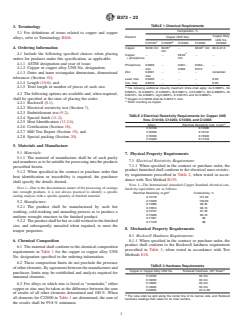
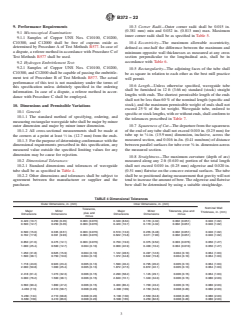
SIGNIFICANCE AND USE
15.1 For purposes of determining compliance with the specified limits for requirements of chemical composition, hardness, and electrical resistivity, an observed value or a calculated value shall be rounded as indicated in accordance with the rounding method of Practice E29.
SCOPE
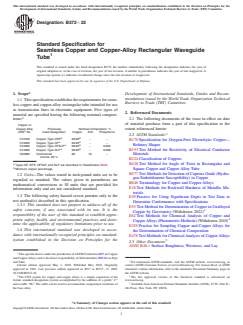
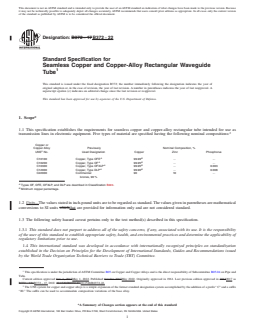
1.1 This specification establishes the requirements for seamless copper and copper-alloy rectangular tube intended for use as transmission lines in electronic equipment. Five types of material are specified having the following nominal compositions:2
Copper or
Copper Alloy
UNS2 No.
Previously
Used Designation
Nominal Composition, %
Copper
Zinc
Phosphorus
C10100
Copper, Type OFEA
99.99B
...
...
C10200
Copper, Type OFA
99.95B
...
...
C10300
Copper, Type OFXLPA
99.95B
...
0.003
C12000
Copper, Type DLPA
99.90B
...
0.008
C22000
Commercial
bronze, 90 %
90
10
...
1.2 Units—The values stated in inch-pound units are to be regarded as standard. The values given in parentheses are mathematical conversions to SI units that are provided for information only and are not considered standard.
1.3 The following safety hazard caveat pertains only to the test method(s) described in this specification.
1.3.1 This standard does not purport to address all of the safety concerns, if any, associated with its use. It is the responsibility of the user of this standard to establish appropriate safety, health, and environmental practices and determine the applicability of regulatory limitations prior to use.
1.4 This international standard was developed in accordance with internationally recognized principles on standardization established in the Decision on Principles for the Development of International Standards, Guides and Recommendations issued by the World Trade Organization Technical Barriers to Trade (TBT) Committee.
- Status
- Published
- Publication Date
- 30-Apr-2022
- Technical Committee
- B05 - Copper and Copper Alloys
- Drafting Committee
- B05.04 - Pipe and Tube
Buy Documents
ASTM B372-22 - Standard Specification for Seamless Copper and Copper-Alloy Rectangular Waveguide Tube
REDLINE ASTM B372-22 - Standard Specification for Seamless Copper and Copper-Alloy Rectangular Waveguide Tube
Overview
ASTM B372-22: Standard Specification for Seamless Copper and Copper-Alloy Rectangular Waveguide Tube is a widely recognized standard developed by ASTM International. This specification covers requirements for seamless copper and copper-alloy rectangular waveguide tubes designed for use as transmission lines in electronic equipment. The standard ensures product quality and performance by specifying chemical composition, mechanical, electrical, and dimensional properties for these tubes, which are frequently utilized in RF and microwave applications.
This specification is applicable to five types of material identified by their UNS designations: C10100, C10200, C10300, C12000, and C22000. The tubes produced according to this standard undergo cold-working and annealing processes to meet stringent performance criteria.
Key Topics
Material Types and Composition:
- Copper and copper alloys with nominal compositions: C10100, C10200, C10300, C12000, and C22000
- Chemical requirements, including copper, zinc, and phosphorus content
Mechanical and Physical Requirements:
- Rockwell hardness requirements for all specified alloys
- Electrical resistivity considerations for minimal power loss in electronic applications
- Free from cuprous oxide for C10100, C10200, C10300, and C12000 grades
Dimensional and Quality Standards:
- Strict tolerances for outer and inner dimensions, wall thickness, and straightness
- Minimum and maximum permissible radii for corners and allowable eccentricity
- Interior and exterior surface finish requirements to ensure optimal performance in high-frequency applications
- Detailed packaging and marking procedures for traceability
Testing and Inspection:
- Sampling practices for quality assurance
- Procedures for chemical analysis, hardness testing, resistivity testing, and hydrogen embrittlement assessment
- Rejection and retest protocols to ensure compliance
Applications
Rectangular seamless copper and copper-alloy waveguide tubes standardized under ASTM B372-22 are essential for:
- Electronic Transmission Lines:
Providing reliable RF and microwave transmission lines in radar, satellite, and communication systems - Telecommunications Infrastructure:
Used in base stations and signal transmission networks for consistent performance - Military and Aerospace:
Critical components in defense and space applications due to their high conductivity and robust mechanical properties - Industrial and Scientific Equipment:
Utilized in test and measurement devices as well as high-frequency laboratory installations
These tubes are chosen for their superior electrical conductivity, tight dimensional tolerances, and high surface quality, which are crucial for minimizing signal loss and distortion in demanding environments.
Related Standards
- ASTM B170: Specification for Oxygen-Free Electrolytic Copper-Refinery Shapes
- ASTM B193: Test Method for Resistivity of Electrical Conductor Materials
- ASTM B224: Classification of Coppers
- ASTM B428: Test Method for Angle of Twist in Rectangular and Square Copper and Copper Alloy Tube
- ASTM B577: Test Methods for Detection of Cuprous Oxide (Hydrogen Embrittlement Susceptibility) in Copper
- ASTM B846: Terminology for Copper and Copper Alloys
- ANSI B46.1: Surface Roughness, Waviness, and Lay
For manufacturers, suppliers, and end-users, ASTM B372-22 provides a comprehensive framework to ensure that seamless copper and copper-alloy rectangular waveguide tubes meet the high standards required for modern electronic and communications applications. Adhering to this standard ensures consistent product quality, reliability, and compatibility across a wide range of industries.
Relations
- Effective Date
- 01-Aug-2019
- Effective Date
- 01-Apr-2019
- Effective Date
- 01-Jan-2019
- Effective Date
- 01-Jul-2018
- Effective Date
- 01-Mar-2018
- Effective Date
- 01-Jul-2017
- Effective Date
- 01-Apr-2016
- Effective Date
- 01-Apr-2016
- Effective Date
- 15-Oct-2015
- Effective Date
- 01-May-2015
- Effective Date
- 01-Jul-2014
- Effective Date
- 01-Apr-2014
- Effective Date
- 01-Oct-2013
- Effective Date
- 01-Dec-2012
- Effective Date
- 01-Nov-2011
Buy Documents
ASTM B372-22 - Standard Specification for Seamless Copper and Copper-Alloy Rectangular Waveguide Tube
REDLINE ASTM B372-22 - Standard Specification for Seamless Copper and Copper-Alloy Rectangular Waveguide Tube
Get Certified
Connect with accredited certification bodies for this standard

Element Materials Technology
Materials testing and product certification.

Inštitut za kovinske materiale in tehnologije
Institute of Metals and Technology. Materials testing, metallurgical analysis, NDT.
Sponsored listings
Frequently Asked Questions
ASTM B372-22 is a technical specification published by ASTM International. Its full title is "Standard Specification for Seamless Copper and Copper-Alloy Rectangular Waveguide Tube". This standard covers: ABSTRACT This specification covers seamless copper and copper-alloy rectangular waveguide tube intended for use as transmission lines in electronic equipment. Four types of material are specified having the following nominal compositions: C10200, C10300, C12000, and C22000. The copper and copper-alloy tubes shall be finished by such cold-working and annealing operations as are necessary to meet the required properties. The material shall conform to the chemical requirements specified. The material shall conform to the Rockwell hardness requirements prescribed. The test specimens of copper UNS nos. C10200, C10300, and C12000 shall be free of cuprous oxide. It is to be expected that samples of Copper UNS Nos. C10200, C10300, and C12000 shall be capable of passing the embrittlement test. It is to be expected that samples of copper UNS nos. C10200, C10300, and C12000 will conform to the prescribed electrical resistivity requirements. Samples for chemical analysis shall be taken accordingly. SIGNIFICANCE AND USE 15.1 For purposes of determining compliance with the specified limits for requirements of chemical composition, hardness, and electrical resistivity, an observed value or a calculated value shall be rounded as indicated in accordance with the rounding method of Practice E29. SCOPE 1.1 This specification establishes the requirements for seamless copper and copper-alloy rectangular tube intended for use as transmission lines in electronic equipment. Five types of material are specified having the following nominal compositions:2 Copper or Copper Alloy UNS2 No. Previously Used Designation Nominal Composition, % Copper Zinc Phosphorus C10100 Copper, Type OFEA 99.99B ... ... C10200 Copper, Type OFA 99.95B ... ... C10300 Copper, Type OFXLPA 99.95B ... 0.003 C12000 Copper, Type DLPA 99.90B ... 0.008 C22000 Commercial bronze, 90 % 90 10 ... 1.2 Units—The values stated in inch-pound units are to be regarded as standard. The values given in parentheses are mathematical conversions to SI units that are provided for information only and are not considered standard. 1.3 The following safety hazard caveat pertains only to the test method(s) described in this specification. 1.3.1 This standard does not purport to address all of the safety concerns, if any, associated with its use. It is the responsibility of the user of this standard to establish appropriate safety, health, and environmental practices and determine the applicability of regulatory limitations prior to use. 1.4 This international standard was developed in accordance with internationally recognized principles on standardization established in the Decision on Principles for the Development of International Standards, Guides and Recommendations issued by the World Trade Organization Technical Barriers to Trade (TBT) Committee.
ABSTRACT This specification covers seamless copper and copper-alloy rectangular waveguide tube intended for use as transmission lines in electronic equipment. Four types of material are specified having the following nominal compositions: C10200, C10300, C12000, and C22000. The copper and copper-alloy tubes shall be finished by such cold-working and annealing operations as are necessary to meet the required properties. The material shall conform to the chemical requirements specified. The material shall conform to the Rockwell hardness requirements prescribed. The test specimens of copper UNS nos. C10200, C10300, and C12000 shall be free of cuprous oxide. It is to be expected that samples of Copper UNS Nos. C10200, C10300, and C12000 shall be capable of passing the embrittlement test. It is to be expected that samples of copper UNS nos. C10200, C10300, and C12000 will conform to the prescribed electrical resistivity requirements. Samples for chemical analysis shall be taken accordingly. SIGNIFICANCE AND USE 15.1 For purposes of determining compliance with the specified limits for requirements of chemical composition, hardness, and electrical resistivity, an observed value or a calculated value shall be rounded as indicated in accordance with the rounding method of Practice E29. SCOPE 1.1 This specification establishes the requirements for seamless copper and copper-alloy rectangular tube intended for use as transmission lines in electronic equipment. Five types of material are specified having the following nominal compositions:2 Copper or Copper Alloy UNS2 No. Previously Used Designation Nominal Composition, % Copper Zinc Phosphorus C10100 Copper, Type OFEA 99.99B ... ... C10200 Copper, Type OFA 99.95B ... ... C10300 Copper, Type OFXLPA 99.95B ... 0.003 C12000 Copper, Type DLPA 99.90B ... 0.008 C22000 Commercial bronze, 90 % 90 10 ... 1.2 Units—The values stated in inch-pound units are to be regarded as standard. The values given in parentheses are mathematical conversions to SI units that are provided for information only and are not considered standard. 1.3 The following safety hazard caveat pertains only to the test method(s) described in this specification. 1.3.1 This standard does not purport to address all of the safety concerns, if any, associated with its use. It is the responsibility of the user of this standard to establish appropriate safety, health, and environmental practices and determine the applicability of regulatory limitations prior to use. 1.4 This international standard was developed in accordance with internationally recognized principles on standardization established in the Decision on Principles for the Development of International Standards, Guides and Recommendations issued by the World Trade Organization Technical Barriers to Trade (TBT) Committee.
ASTM B372-22 is classified under the following ICS (International Classification for Standards) categories: 77.150.30 - Copper products. The ICS classification helps identify the subject area and facilitates finding related standards.
ASTM B372-22 has the following relationships with other standards: It is inter standard links to ASTM B846-19a, ASTM B577-19, ASTM B846-19, ASTM E18-18, ASTM B428-09(2018), ASTM E18-17, ASTM B577-16, ASTM B193-16, ASTM B170-99(2015), ASTM B224-15, ASTM B224-14, ASTM B193-02(2014), ASTM B428-09(2013), ASTM E18-12, ASTM E18-11. Understanding these relationships helps ensure you are using the most current and applicable version of the standard.
ASTM B372-22 is available in PDF format for immediate download after purchase. The document can be added to your cart and obtained through the secure checkout process. Digital delivery ensures instant access to the complete standard document.
Standards Content (Sample)
This international standard was developed in accordance with internationally recognized principles on standardization established in the Decision on Principles for the
Development of International Standards, Guides and Recommendations issued by the World Trade Organization Technical Barriers to Trade (TBT) Committee.
Designation:B372 −22
Standard Specification for
Seamless Copper and Copper-Alloy Rectangular Waveguide
Tube
This standard is issued under the fixed designation B372; the number immediately following the designation indicates the year of
original adoption or, in the case of revision, the year of last revision. A number in parentheses indicates the year of last reapproval. A
superscript epsilon (´) indicates an editorial change since the last revision or reapproval.
This standard has been approved for use by agencies of the U.S. Department of Defense.
1. Scope* Development of International Standards, Guides and Recom-
mendations issued by the World Trade Organization Technical
1.1 Thisspecificationestablishestherequirementsforseam-
Barriers to Trade (TBT) Committee.
less copper and copper-alloy rectangular tube intended for use
as transmission lines in electronic equipment. Five types of
2. Referenced Documents
material are specified having the following nominal composi-
tions: 2.1 The following documents of the issue in effect on date
of material purchase form a part of this specification to the
Copper or
Copper Alloy Previously Nominal Composition, %
extent referenced herein:
UNS No. Used Designation Copper Zinc Phosphorus
2.2 ASTM Standards:
A B
C10100 Copper, Type OFE 99.99 . .
B170 Specification for Oxygen-Free Electrolytic Copper—
A B
C10200 Copper, Type OF 99.95 . .
Refinery Shapes
A B
C10300 Copper, Type OFXLP 99.95 . 0.003
A B
B193 Test Method for Resistivity of Electrical Conductor
C12000 Copper, Type DLP 99.90 . 0.008
C22000 Commercial 90 10 .
Materials
bronze, 90 %
B224 Classification of Coppers
B428 Test Method for Angle of Twist in Rectangular and
A
Types OF, OFE, OFXLP, and DLP are described in Classification B224.
B
Minimum copper percentage. Square Copper and Copper Alloy Tube
B577 Test Methods for Detection of Cuprous Oxide (Hydro-
1.2 Units—The values stated in inch-pound units are to be
gen Embrittlement Susceptibility) in Copper
regarded as standard. The values given in parentheses are
B846 Terminology for Copper and Copper Alloys
mathematical conversions to SI units that are provided for
E18 Test Methods for Rockwell Hardness of Metallic Ma-
information only and are not considered standard.
terials
1.3 The following safety hazard caveat pertains only to the
E29 Practice for Using Significant Digits in Test Data to
test method(s) described in this specification.
Determine Conformance with Specifications
1.3.1 This standard does not purport to address all of the
E53 Test Method for Determination of Copper in Unalloyed
safety concerns, if any, associated with its use. It is the 4
Copper by Gravimetry (Withdrawn 2022)
responsibility of the user of this standard to establish appro-
E62 Test Methods for Chemical Analysis of Copper and
priate safety, health, and environmental practices and deter- 4
CopperAlloys (Photometric Methods) (Withdrawn 2010)
mine the applicability of regulatory limitations prior to use.
E255 Practice for Sampling Copper and Copper Alloys for
1.4 This international standard was developed in accor-
the Determination of Chemical Composition
dance with internationally recognized principles on standard-
E478 Test Methods for ChemicalAnalysis of CopperAlloys
ization established in the Decision on Principles for the 5
2.3 Other Document:
ANSI B46.1 Surface Roughness, Waviness, and Lay
ThisspecificationisunderthejurisdictionofASTMCommitteeB05onCopper
and CopperAlloys and is the direct responsibility of Subcommittee B05.04 on Pipe
and Tube. For referenced ASTM standards, visit the ASTM website, www.astm.org, or
Current edition approved May 1, 2022. Published May 2022. Originally contact ASTM Customer Service at service@astm.org. For Annual Book of ASTM
approved in 1961. Last previous edition approved in 2017 as B372 – 17. DOI: Standards volume information, refer to the standard’s Document Summary page on
10.1520/B0372-22. the ASTM website.
2 4
The UNS system for copper and copper alloys is a simple expansion of the The last approved version of this historical standard is referenced on
former standard designation system accomplished by the addition of a prefix“ C” www.astm.org.
and a suffix “00.” The suffix can be used to accommodate composition variations of Available from American National Standards Institute (ANSI), 25 W. 43rd St.,
the base alloy. 4th Floor, New York, NY 10036.
*A Summary of Changes section appears at the end of this standard
Copyright © ASTM International, 100 Barr Harbor Drive, PO Box C700, West Conshohocken, PA 19428-2959. United States
B372−22
TABLE 1 Chemical Requirements
3. Terminology
Composition, %
3.1 For definitions of terms related to copper and copper
Copper Alloy
Copper UNS Nos.
Element
alloys, refer to Terminology B846.
UNS No.
A B
C10100 C10200 C10300 C12000
C22000
C C
4. Ordering Information
Copper 99.99 min 99.95 . 99.90 min 89.0–91.0
min
C
4.1 Include the following specified choices when placing
Copper, . . 99.95 . .
min
+ phosphorus
orders for products under this specification, as applicable:
4.1.1 ASTM designation and year of issue;
Phosphorus 0.0003 . 0.001– 0.004– .
4.1.2 Copper or copper alloy UNS No. designation;
max 0.005 0.012
Zinc 0.0001 . . . remainder
4.1.3 Outer and inner rectangular dimensions, dimensional
max
tolerances (Section 10);
Lead, max 0.0005 . . . 0.05
4.1.4 Length (10.6); and
Iron, max 0.0010 . . . 0.05
4.1.5 Total length or number of pieces of each size. A
The following additional impurity maximum limits shall apply: As 0.0005%, Sb
0.0004%, Te 0.0002%, O 0.0005%, Bi 0.0001%, Cd 0.0001%, Mn 0.00005%, Ni
4.2 The following options are available and, when required,
0.0010%, Se 0.0003%, Ag 0.0025%, S 0.0015% and Sn 0.0002%.
B
shall be specified at the time of placing the order:
Oxygen in C10200 shall be 0.0010 % max.
C
Silver counting as copper.
4.2.1 Rockwell (8.1),
4.2.2 Electrical resistivity test (Section 7),
4.2.3 Embrittlement test (9.2),
TABLE 2 Electrical Resistivity Requirements for Copper UNS
4.2.4 Special finish (11.2),
Nos. C10100, C10200, C10300, and C12000
4.2.5 Heat Identification (12.2.6),
Alloys Electrical Resistivity max.Ω·g/m
4.2.6 Certification (Section 18),
C10100 0.15585
4.2.7 Mill Test Report (Section 19), and
C10200 0.15737
C10300 0.15940
4.2.8 Special packing (Section 20).
C12000 0.17418
5. Materials and Manufacture
5.1 Materials:
7. Physical Property Requirements
5.1.1 The material of manufacture shall be of such purity
7.1 Electrical Resistivity Requirement:
andsoundnessastobesuitableforprocessingintotheproducts
7.1.1 When specified in the contract or purchase order, the
prescribed herein.
product furnished shall conform to the electrical mass resistiv-
5.1.2 When specified in the contract or purchase order that
ity requirements prescribed in Table 2, when tested in accor-
heat identification or traceability is required, the purchaser
dance with Test Method B193.
shall specify the details desired.
NOTE 1—The International Annealed Copper Standard electrical con-
NOTE 1—Due to the discontinuous nature of the processing of castings
ductivity equivalents are as follows:
into wrought products, it is not always practical to identify a specific 2
Electrical Resistivity,Ω·g/m Conductivity, %
casting analysis with a specific quantity of finished material.
0.15176 101.00
0.15328 100.00
5.2 Manufacture:
0.15585 98.35
5.2.1 The product shall be manufactured by such hot
0.15614 98.16
0.15737 97.40
working, cold-working and annealing process as to produce a
0.15940 96.16
uniform wrought structure in the finished product.
0.17031 90
5.2.2 Theproductshallbehotorcoldworkedtothefinished
0.17418 88
size, and subsequently annealed when required, to meet the
8. Mechanical Property Requirements
temper properties.
8.1 Rockwell Hardness Requirements:
6. Chemical Composition
8.1.1 When specified in the contract or purchase order, the
product shall conform to the Rockwell hardness requirement
6.1 The material shall conform to the chemical composition
prescribed in Table 3, when tested in accordance with Test
requirements in Table 1 for the copper or copper alloy UNS
Methods E18.
No. designation specified in the ordering information.
6.2 These composition limits do not preclude the presence
TABLE 3 Hardness Requirements
ofotherelements.Byagreementbetweenthemanufacturerand
A
Copper or Copper Alloy UNS No. Rockwell Hardness, 30T Scale
purchaser, limits may be established and analysis required for
C10100 30 min
unnamed elements.
C10200 30 min
C10300 30 min
6.3 For alloys in which zinc is listed as “remainder,” either
C12000 30 min
copper or zinc may be taken as the difference between the sum
C22000 43 to 66
of results of all other elements determined and 100 %. When
A
The tube shall be split along the center line of its narrow side, and Rockwell
all elements for C22000 in Table 1 are determined, the sum of
hardness readings then taken on its inner surface.
the results shall be 99.8 % minimum.
B372−22
9. Performance Requirements 10.3 Corner Radii—Outer corner radii shall be 0.015 in.
(0.381 mm) min and 0.032 in. (0.813 mm) max. Maximum
9.1 Microscopical Examination:
inner corner radii shall be as specified in Table 5.
9.1.1 Samples of Copper UNS Nos. C10100, C10200,
C10300, and C12000 shall be free of cuprous oxide as
10.4 Eccentricity—The maximum allowable eccentricity,
determined by Procedure A of Test Methods B577. In case of
defined as one-half the difference between the maximum and
a dispute, a referee method in accordance with Procedure C of
minimum opposite wall thicknesses as measured at any cross
Test Methods B577 shall be used.
section perpendicular to the longitudinal axis, shall be in
accordance with Table 6.
9.2 Hydrogen Embrittlement Test:
9.2.1 Samples of Copper UNS Nos. C10100, C10200,
10.5 Rectangularity—The adjoining faces of the tube shall
C10300, and C12000 shall be capable of passing the embrittle-
be as square in relation to each other as the best mill practice
ment test of Procedure B of Test Methods B577. The actual
will permit.
performance of this test is not mandatory under the terms of
10.6 Length—Unless otherwise specified, waveguide tube
this specification unless definitely specified in the ordering
shall be furnished in 12 ft (3.66 m) standard (stock) straight
information. In case of a dispute, a referee method in accor-
lengths with ends. The shortest permissible length of the ends
dance with Procedure C shall be employed.
shall not be less than 60 % of the nominal length (specific and
stock), and the maximum permissible weight of ends shall not
10. Dimensions and Permissible Variations
exceed 25 % of the lot weight. Waveguide tube, ordered to
10.1 General:
specificorstocklengths,withorwithoutends,shallconformto
10.1.1 The standard method of specifying, ordering, and
the tolerances prescribed in Table 7.
measuring rectangular waveguide tube shall be major by minor
10.7 Squareness of Cut—The departure from the squareness
outer dimension and major by minor inner dimension.
of the end of any tube shall not exceed 0.010 in. (0.25 mm) for
10.1.2 All cross-sectional measurements shall be made at
tube up to ⁄8 in. (15.9 mm) dimension, inclusive, across the
the corners at a point at least ⁄2 in. (12.7 mm) from the ends.
measured section, and 0.016 in./in. (0.41 mm/mm) of distance
10.1.3 Forthepurposeofdeterminingconformancewiththe
between parallel surfaces for tube over ⁄8 in. dimension across
dimensional requirements prescribed in this specification, any
the measured section.
measured value outside the specified limiting values for any
dimension may be cause for rejection.
10.8 Straightness—The maximum curvature (depth of arc)
10.2 Dimensional Tolerances: measured along any 2 ft (0.610 m) portion of the total length
10.2.1 Standard dimensions and tolerances of waveguide shall not exceed 0.010 in. (0.25 mm) edgewise and 0.020 in.
tube shall be as specified in Table 4. (0.51 mm) flatwise on the concave external surfaces. The tube
10.2.2 Other dimensions and tolerances shall be subject to shall be so positioned during measurement that gravity will not
agreement between the manufacturer or supplier and the tend to increase the amount of bow. The edgewise and flatwise
purchaser. bow shall be determined by using a suitable straightedge.
TABLE 4 Dimensional Tolerances
Outer Dimensions, in. (mm) Inner Dimensions, in. (mm)
Nominal Wall
Tolerance,
Major Minor Major Minor Tolerance, plus and
Thickness, in. (mm)
plus and
Dimensions Dimensions Dimensions Dimensions minus
minus
0.420 (10.7) 0.250 (6.35) 0.003 (0.076) 0.340 (8.64) 0.170 (4.32) 0.002 (0.051) 0.040 (1.02)
0.500 (12.7) 0.250 (6.35) 0.003 (0.076) 0.420 (10.7) 0.170 (4.32) 0.002 (0.051) 0.040 (1.02)
0.590 (15.0) 0.335 (8.51) 0.003 (0.076) 0.510 (13.0) 0.255 (6.48) 0.002 (0.051) 0.040 (1.02)
0.702 (17.8) 0.391 (9.93) 0.003 (0.076) 0.622 (15.8) 0.311 (7.90) 0.002 (0.051) 0.040 (1.02)
0.850 (21.6) 0.475 (12.1) 0.003 (0.076) 0.750 (19.0) 0.375 (9.52) 0.003 (0.076) 0.050 (1.27)
1.000 (25.4) 0.500 (12.7) 0.004 (0.10) 0.900 (22.9) 0.400 (10.2) 0.004 (0.010) 0.050 (1.27)
1.250 (31.8) 0.625 (15.9) 0.004 (0.10) 1.122 (28.5) 0.497 (12.6) 0.004 (0.10) 0.064 (1.63)
1.500 (38.1) 0.750 (19.0) 0.004 (0.10) 1.372 (34.8) 0.622 (15.8) 0.004 (0.10) 0.064 (1.63)
1.718 (43.6) 0.923 (23.4) 0.005 (0.13) 1.590 (40.4) 0.795 (20.2) 0.005 (0.13) 0.064 (1.63)
2.000 (50.8) 1.000 (25.4) 0.005 (0.13) 1.872 (47.5) 0.872 (22.1) 0.005 (0.13) 0.064 (1.63)
2.418 (61.4) 1.273 (32.3) 0.006 (0.15) 2.290 (58.2) 1.145 (29.1) 0.006 (0.15) 0.064 (1.63)
3.000 (76.2) 1.500 (38.1) 0.006 (0.15) 2.840 (72.1) 1.340 (34.0) 0.006 (0.15) 0.
...
This document is not an ASTM standard and is intended only to provide the user of an ASTM standard an indication of what changes have been made to the previous version. Because
it may not be technically possible to adequately depict all changes accurately, ASTM recommends that users consult prior editions as appropriate. In all cases only the current version
of the standard as published by ASTM is to be considered the official document.
Designation: B372 − 17 B372 − 22
Standard Specification for
Seamless Copper and Copper-Alloy Rectangular Waveguide
Tube
This standard is issued under the fixed designation B372; the number immediately following the designation indicates the year of
original adoption or, in the case of revision, the year of last revision. A number in parentheses indicates the year of last reapproval. A
superscript epsilon (´) indicates an editorial change since the last revision or reapproval.
This standard has been approved for use by agencies of the U.S. Department of Defense.
1. Scope*
1.1 This specification establishes the requirements for seamless copper and copper-alloy rectangular tube intended for use as
transmission lines in electronic equipment. Five types of material are specified having the following nominal compositions:
Copper or
Copper Alloy Previously Nominal Composition, %
UNS No. Used Designation Copper Zinc Phosphorus
A B
C10100 Copper, Type OFE 99.99 . .
A B
C10200 Copper, Type OF 99.95 . .
A B
C10300 Copper, Type OFXLP 99.95 . 0.003
A B
C12000 Copper, Type DLP 99.90 . 0.008
C22000 Commercial 90 10 .
bronze, 90 %
A
Types OF, OFE, OFXLP, and DLP are described in Classification B224.
B
Minimum copper percentage.
1.2 Units—The values stated in inch-pound units are to be regarded as standard. The values given in parentheses are mathematical
conversions to SI units whichthat are provided for information only and are not considered standard.
1.3 The following safety hazard caveat pertains only to the test method(s) described in this specification.
1.3.1 This standard does not purport to address all of the safety concerns, if any, associated with its use. It is the responsibility
of the user of this standard to establish appropriate safety, health, and environmental practices and determine the applicability of
regulatory limitations prior to use.
1.4 This international standard was developed in accordance with internationally recognized principles on standardization
established in the Decision on Principles for the Development of International Standards, Guides and Recommendations issued
by the World Trade Organization Technical Barriers to Trade (TBT) Committee.
This specification is under the jurisdiction of ASTM Committee B05 on Copper and Copper Alloys and is the direct responsibility of Subcommittee B05.04 on Pipe and
Tube.
Current edition approved Oct. 1, 2017May 1, 2022. Published October 2017May 2022. Originally approved in 1961. Last previous edition approved in 20122017 as
B372 – 12a.B372 – 17. DOI: 10.1520/B0372-17.10.1520/B0372-22.
The UNS system for copper and copper alloys is a simple expansion of the former standard designation system accomplished by the addition of a prefix“ C” and a suffix
“00.” The suffix can be used to accommodate composition variations of the base alloy.
*A Summary of Changes section appears at the end of this standard
Copyright © ASTM International, 100 Barr Harbor Drive, PO Box C700, West Conshohocken, PA 19428-2959. United States
B372 − 22
2. Referenced Documents
2.1 The following documents of the issue in effect on date of material purchase form a part of this specification to the extent
referenced herein:
2.2 ASTM Standards:
B170 Specification for Oxygen-Free Electrolytic Copper—Refinery Shapes
B193 Test Method for Resistivity of Electrical Conductor Materials
B224 Classification of Coppers
B428 Test Method for Angle of Twist in Rectangular and Square Copper and Copper Alloy Tube
B577 Test Methods for Detection of Cuprous Oxide (Hydrogen Embrittlement Susceptibility) in Copper
B846 Terminology for Copper and Copper Alloys
E18 Test Methods for Rockwell Hardness of Metallic Materials
E29 Practice for Using Significant Digits in Test Data to Determine Conformance with Specifications
E53 Test Method for Determination of Copper in Unalloyed Copper by Gravimetry (Withdrawn 2022)
E62 Test Methods for Chemical Analysis of Copper and Copper Alloys (Photometric Methods) (Withdrawn 2010)
E255 Practice for Sampling Copper and Copper Alloys for the Determination of Chemical Composition
E478 Test Methods for Chemical Analysis of Copper Alloys
2.3 Other Document:
ANSI B46.1 Surface Roughness, Waviness, and Lay
3. Terminology
3.1 For definitions of terms related to copper and copper alloys, refer to Terminology B846.
4. Ordering Information
4.1 Include the following specified choices when placing orders for products under this specification, as applicable:
4.1.1 ASTM designation and year of issue,issue;
4.1.2 Copper or copper alloy UNS No. designation,designation;
4.1.3 Outer and inner rectangular dimensions, dimensional tolerances (Section 10),);
4.1.4 Length (10.6),); and
4.1.5 Total length or number of pieces of each size,size.
4.2 The following options are available but may not be included unless specified and, when required, shall be specified at the time
of placing of the order when required:the order:
4.2.1 Rockwell (Section (8.1),
4.2.2 Electrical resistivity test (Section 7),
4.2.3 Embrittlement test (Section (9.2),
4.2.4 Special finish (Section (11.2),
4.2.5 Heat Identification (Section (13.1.1.412.2.6),
4.2.6 Certification (Section 18),
For referenced ASTM standards, visit the ASTM website, www.astm.org, or contact ASTM Customer Service at service@astm.org. For Annual Book of ASTM Standards
volume information, refer to the standard’s Document Summary page on the ASTM website.
The last approved version of this historical standard is referenced on www.astm.org.
Available from American National Standards Institute (ANSI), 25 W. 43rd St., 4th Floor, New York, NY 10036.
B372 − 22
4.2.7 Mill Test Report (Section 19), and
4.2.8 Special packing (Section 20).
5. Materials and Manufacture
5.1 Materials:
5.1.1 The material of manufacture shall be of such purity and soundness as to be suitable for processing into the products
prescribed herein.
5.1.2 When specified in the contract or purchase order that heat identification or traceability is required, the purchaser shall specify
the details desired.
NOTE 1—Due to the discontinuous nature of the processing of castings into wrought products, it is not always practical to identify a specific casting
analysis with a specific quantity of finished material.
5.2 Manufacture:
5.2.1 The product shall be manufactured by such hot working, cold-working and annealing process as to produce a uniform
wrought structure in the finished product.
5.2.2 The product shall be hot or cold worked to the finished size, and subsequently annealed when required, to meet the temper
properties.
6. Chemical Composition
6.1 The material shall conform to the chemical composition requirements in Table 1 for the copper or copper alloy UNS No.
designation specified in the ordering information.
6.2 These composition limits do not preclude the presence of other elements. By agreement between the manufacturer and
purchaser, limits may be established and analysis required for unnamed elements.
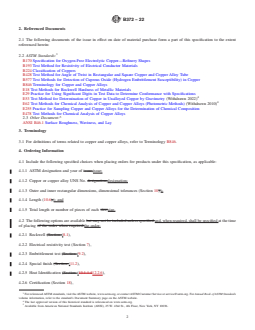
6.3 For alloys in which zinc is listed as “remainder,” either copper or zinc may be taken as the difference between the sum of
results of all other elements determined and 100 %. When all elements for C22000 in Table 1 are determined, the sum of the results
shall be 99.8 % minimum.
TABLE 1 Chemical Requirements
Composition, %
Copper Alloy
Copper UNS Nos.
Element
UNS No.
A B
C10100 C10200 C10300 C12000
C22000
C C
Copper 99.99 min 99.95 . 99.90 min 89.0–91.0
min
C
Copper, . . 99.95 . .
min
+ phosphorus
Phosphorus 0.0003 . 0.001– 0.004– .
max 0.005 0.012
Zinc 0.0001 . . . remainder
max
Lead, max 0.0005 . . . 0.05
Iron, max 0.0010 . . . 0.05
A
The following additional impurity maximum limits shall apply: As 0.0005%, Sb
0.0004%, Te 0.0002%, O 0.0005%, Bi 0.0001%, Cd 0.0001%, Mn 0.00005%, Ni
0.0010%, Se 0.0003%, Ag 0.0025%, S 0.0015% and Sn 0.0002%.
B
Oxygen in C10200 shall be 0.0010 % max.
C
Silver counting as copper.
B372 − 22
7. Physical Property Requirements
7.1 Electrical Resistivity Requirement:
7.1.1 When specified in the contract or purchase order, the product furnished shall conform to the electrical mass resistivity
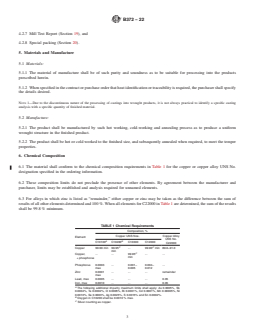
requirements prescribed in Table 2, when tested in accordance with Test Method B193.
NOTE 1—The International Annealed Copper Standard electrical conductivity equivalents are as follows:
Electrical Resistivity, Conductivity,
Ω·g/m %
0.15176 101.00
0.15328 100.00
0.15585 98.35
0.15614 98.16
0.15737 97.40
0.15940 96.16
0.17031 90
0.17418 88
8. Mechanical Property Requirements
8.1 Rockwell Hardness Requirements:
8.1.1 When specified in the contract or purchase order, the product shall conform to the Rockwell hardness requirement prescribed
in Table 3, when tested in accordance with Test Methods E18.
9. Performance Requirements
9.1 Microscopical Examination:
9.1.1 Samples of Copper UNS Nos. C10100, C10200, C10300, and C12000 shall be free of cuprous oxide as determined by
Procedure A of Test Methods B577. In case of a dispute, a referee method in accordance with Procedure C of Test Methods B577
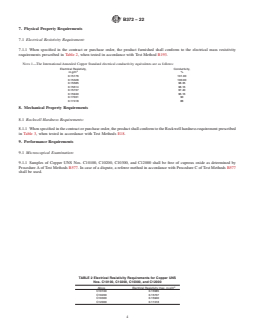
shall be used.
TABLE 2 Electrical Resistivity Requirements for Copper UNS
Nos. C10100, C10200, C10300, and C12000
Alloys Electrical Resistivity max. Ω·g/m
C10100 0.15585
C10200 0.15737
C10300 0.15940
C12000 0.17418
B372 − 22
TABLE 3 Hardness Requirements
Rockwell Hardness,
Copper or Copper Alloy UNS No.
A
30T Scale
C10100 30 min
C10200 30 min
C10300 30 min
C12000 30 min
C22000 43 to 66
A
The tube shall be split along the center line of its narrow side, and Rockwell
hardness readings then taken on its inner surface.
9.2 Hydrogen Embrittlement Test:
9.2.1 Samples of Copper UNS Nos. C10100, C10200, C10300, and C12000 shall be capable of passing the embrittlement test of
Procedure B of Test Methods B577. The actual performance of this test is not mandatory under the terms of this specification unless
definitely specified in the ordering information. In case of a dispute, a referee method in accordance with Procedure C shall be
employed.
10. Dimensions and Permissible Variations
10.1 General:
10.1.1 The standard method of specifying, ordering, and measuring rectangular waveguide tube shall be major by minor outer
dimension and major by minor inner dimension.
10.1.2 All cross-sectional measurements shall be made at the corners at a point at least ⁄2 in. (12.7 mm) from the ends.
10.1.3 For the purpose of determining conformance with the dimensional requirements prescribed in this specification, any
measured value outside the specified limiting values for any dimension may be cause for rejection.
10.2 Dimensional Tolerances:
10.2.1 Standard dimensions and tolerances of waveguide tube shall be as specified in Table 4.
TABLE 4 Dimensional Tolerances
Outer Dimensions, in. (mm) Inner Dimensions, in. (mm)
Nominal Wall
Tolerance,
Major Minor Major Minor Tolerance, plus and
Thickness, in. (mm)
plus and
Dimensions Dimensions Dimensions Dimensions minus
minus
0.420 (10.7) 0.250 (6.35) 0.003 (0.076) 0.340 (8.64) 0.170 (4.32) 0.002 (0.051) 0.040 (1.02)
0.500 (12.7) 0.250 (6.35) 0.003 (0.076) 0.420 (10.7) 0.170 (4.32) 0.002 (0.051) 0.040 (1.02)
0.590 (15.0) 0.335 (8.51) 0.003 (0.076) 0.510 (13.0) 0.255 (6.48) 0.002 (0.051) 0.040 (1.02)
0.702 (17.8) 0.391 (9.93) 0.003 (0.076) 0.622 (15.8) 0.311 (7.90) 0.002 (0.051) 0.040 (1.02)
0.850 (21.6) 0.475 (12.1) 0.003 (0.076) 0.750 (19.0) 0.375 (9.52) 0.003 (0.076) 0.050 (1.27)
1.000 (25.4) 0.500 (12.7) 0.004 (0.10) 0.900 (22.9) 0.400 (10.2) 0.004 (0.010) 0.050 (1.27)
1.250 (31.8) 0.625 (15.9) 0.004 (0.10) 1.122 (28.5) 0.497 (12.6) 0.004 (0.10) 0.064 (1.63)
1.500 (38.1) 0.750 (19.0) 0.004 (0.10) 1.372 (34.8) 0.622 (15.8) 0.004 (0.10) 0.064 (1.63)
1.718 (43.6) 0.923 (23.4) 0.005 (0.13) 1.590 (40.4) 0.795 (20.2) 0.005 (0.13) 0.064 (1.63)
2.000 (50.8) 1.000 (25.4) 0.005 (0.13) 1.872 (47.5) 0.872 (22.1) 0.005 (0.13) 0.064 (1.63)
2.418 (61.4) 1.273 (32.3) 0.006 (0.15) 2.290 (58.2) 1.145 (29.1) 0.006 (0.15) 0.064 (1.63)
3.000 (76.2) 1.500 (38.1) 0.006 (0.15) 2.840 (72.1) 1.340 (34.0) 0.006 (0.15) 0.080 (2.03)
3.560 (90.4) 1.860 (47.2) 0.006 (0.15) 3.400 (86.4) 1.700 (43.2) 0.006 (0.15) 0.080 (2.03)
4.460 (113) 2.310 (58.7) 0.008 (0.20) 4.300 (109) 2.150 (54.6) 0.008 (0.20) 0.080 (2.03)
5.260 (134) 2.710 (68.8) 0.008 (0.20) 5.100 (130) 2.550 (64.8) 0.008 (0.20) 0.080 (2.03)
6.660 (169) 3.410 (86.6) 0.008 (0.20) 6.500 (165) 3.250 (82.6) 0.008 (0.20) 0.080 (2.03)
B372 − 22
10.2.2 Other dimensions and tolerances shall be subject to agreement between the manufacturer or supplier and the purchaser.
10.3 Corner Radii—Outer corner radii shall be 0.015 in. (0.381 mm) min and 0.032 in. (0.813 mm) max. Maximum inner corner
radii shall be as specified in Table 5.
10.4 Eccentricity—The maximum allowable eccentricity, defined as one-half the difference between the maximum and minimum
opposite wall thicknesses as measured at any cross section perpendicular to the longitudinal axis, shall be in accordance with Table
6.
10.5 Rectangularity—The adjoining faces of the tube shall be as square in relation to each other as the best mill practice will
permit.
10.6 Length—Unless otherwise specified, waveguide tube shall be furnished in 12-ft (3.66-m)12 ft (3.66 m) standard (stock)
straight lengths with ends. The shortest permissible length of the ends shall not be less than 60 % of the nominal length (specific
and stock), and the maximum permissible weight of ends shall not exceed 25 % of the lot weight. Waveguide tube, ordered to
specific or stock lengths, with or without ends, shall conform to the tolerances prescribed in Table 7.
10.7 Squareness of Cut—The departure from the squareness of the end of any tube shall not exceed 0.010 in. (0.25 mm) for tube
up to ⁄8-in. (15.9-mm) in. (15.9 mm) dimension, inclusive, across the measured section, and 0.016 in./in. (0.41 mm/mm) of
distance between parallel surfaces for tube over ⁄8-in. in. dimension across the measured section.
10.8 Straightness—The maximum curvature (depth of arc) measured along any 2-ft (0.610-m)2 ft (0.610 m) portion of the total
length shall not exceed 0.010 in. (0.25 mm) edgewise and 0.020 in. (0.51 mm) flatwise on the concave external surfaces. The tube
shall be so positioned during measurement that gravity will not tend to increase the amount of bow. The edgewise and flatwise
bow shall be determined by using a suitable straightedge.
10.9 Twist—The maximum twist about the longitudinal axis of the finished tube shall not exceed 1°/ft of length on the face of any
surface, inside or outside. Determination of twist shall be in accordance with Test Method B428.
10.10 Surface Roughness—The average interior surface roughness of the finished tube, in accordance with ANSI B46.1, shall not
6 6
exceed 32 μin. A.A. for tube up to 4 in. (102 mm) major ID and 64 μin. A.A. for tube whose major ID is 4 in. or over.
11. Workmanship, Finish, and Appearance
11.1 The product shall be free of defects, but blemishes of a nature that do not interfere with the intended application are
acceptable. The finished tube shall be uniform in composition and wall thickness, straight and smooth from end to end, and shall
be free of internal or external mechanical imperfections in accordance with good commercial practice. In addition, the interior
surface of the tube shall be free of burrs, plug marks, chatter marks, dirt, grease, scale, and splinters. Scratches not more than
0.001-in. (0.025-mm)0.001 in. (0.025 mm) deep, as measured metallographically, will be permitted in the longitudinal direction of
the interior surfaces for tubes 0.622 in. (15.8 mm) by 0.311 in. (7.90 mm) and larger. For tubes smaller than 0.6220.622 in. by 0.311
...