

ASTM C1107/C1107M-20
(Specification)Standard Specification for Packaged Dry, Hydraulic-Cement Grout (Nonshrink)
General Information
- Abstract
ABSTRACT
This specification covers packaged dry, hydraulic cement grout (nonshrink) intended for use under applied load where a change in height below initial placement height is to be avoided. Grouts covered are composed of hydraulic cement, fine aggregate, and other ingredients. They require only the addition of mixing water for use. The materials used as ingredients in packaged, dry, grout include hydraulic cement, fine aggregate, and other ingredients. The performance requirements of the specimens are presented in details. Grout mixtures shall be produced using the conditions prescribed. For smaller quantities of grout, the mortar-mixing apparatus shall be as specified. Mixer for grout performance qualifications shall be clean, pre-wetted, and drained and essentially free of hardened mortar and other foreign material that can be removed with a trowel or by reasonably striking with a hammer. The procedures for preliminary adjustment mixing and grout performance qualification are presented in details. Consistency testing shall be performed on the grout mixture. Determine the yield of the grout using the 400-mL cylindrical measure described.
SCOPE
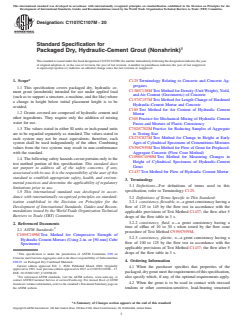
1.1 This specification covers packaged dry, hydraulic cement grout (nonshrink) intended for use under applied load (such as to support a structure, a machine, and the like) where a change in height below initial placement height is to be avoided.
1.2 Grouts covered are composed of hydraulic cement and other ingredients. They require only the addition of mixing water for use.
1.3 The values stated in either SI units or inch-pound units are to be regarded separately as standard. The values stated in each system may not be exact equivalents; therefore, each system shall be used independently of the other. Combining values from the two systems may result in non-conformance with the standard.
1.4 The following safety hazards caveat pertains only to the test method portion of this specification: This standard does not purport to address all of the safety concerns, if any, associated with its use. It is the responsibility of the user of this standard to establish appropriate safety, health, and environmental practices and determine the applicability of regulatory limitations prior to use.
1.5 This international standard was developed in accordance with internationally recognized principles on standardization established in the Decision on Principles for the Development of International Standards, Guides and Recommendations issued by the World Trade Organization Technical Barriers to Trade (TBT) Committee.
- Status
- Published
- Publication Date
- 31-Jan-2020
- Technical Committee
- C09 - Concrete and Concrete Aggregates
- Drafting Committee
- C09.43 - Packaged Dry Combined Materials
Buy Documents
ASTM C1107/C1107M-20 - Standard Specification for Packaged Dry, Hydraulic-Cement Grout (Nonshrink)
REDLINE ASTM C1107/C1107M-20 - Standard Specification for Packaged Dry, Hydraulic-Cement Grout (Nonshrink)
Overview
ASTM C1107/C1107M-20 is the internationally recognized standard specification for packaged dry, hydraulic-cement grout (nonshrink). Developed by ASTM International, this standard specifies the requirements for nonshrink grout intended for applications where maintaining height after placement is critical under applied loads, such as supporting structures and machinery. The grout covered by this specification is composed of hydraulic cement, fine aggregate, and other ingredients, needing only the addition of water for use. This document addresses performance, composition, sampling, mixing, testing, and certification to ensure the quality and reliability of nonshrink hydraulic-cement grout for demanding construction and industrial applications.
Key Topics
Nonshrink Grout Composition
Specifies the use of hydraulic cement, fine aggregate, and other materials to produce a prepackaged, dry grout that expands or remains dimensionally stable after placement.Mixing and Preparation
Provides requirements for mixing equipment, environmental conditioning, batching, and specified water-to-dry material ratios to achieve consistent results.Testing Procedures
Outlines precise methods for measuring key properties:- Consistency (fluidity, flowability, plasticity)
- Compressive strength at 1, 3, 7, and 28 days
- Height change (early age and hardened grout shrinkage/expansion)
- Yield determination and reporting
Performance Requirements
Includes minimum compressive strength values and strict limits on height change to classify as nonshrink.Certification and Product Marking
Details required package labeling and manufacturer certification to ensure traceability and conformity.Safety and Compliance
Emphasizes user responsibility for safety, health, and regulatory compliance during testing and application.
Applications
ASTM C1107/C1107M-20 nonshrink hydraulic-cement grout is widely used in construction and industrial settings where dimensional stability under load is required. Common applications include:
Supporting Machinery and Equipment
Grouting base plates, anchor bolts, and machine foundations where maintaining original placement height is essential to avoid misalignment or vibration issues.Structural Support
Underpinning columns, beams, and precast elements in commercial, infrastructure, and industrial projects.Filling Voids and Repairs
Nonshrink properties make this grout suitable for filling gaps and voids under precast panels, pipes, and structural bearings without risk of settlement.Post-Tensioning and Prestressed Structures
Where contact with stressed tendons or corrosion-sensitive elements dictates specialized material selection.Aggressive or Abnormal Environments
When specified for challenging environments, suitability must be established based on past performance and compliance with chemical content limits.
Related Standards
Adhering to ASTM C1107/C1107M-20 often involves additional ASTM standards referenced within its scope, including:
- ASTM C109/C109M: Test Method for Compressive Strength of Hydraulic Cement Mortars
- ASTM C125: Terminology Relating to Concrete and Concrete Aggregates
- ASTM C138/C138M: Test Method for Density, Yield, and Air Content of Concrete
- ASTM C157/C157M: Test Method for Length Change of Hardened Hydraulic-Cement Mortar and Concrete
- ASTM C185: Test Method for Air Content of Hydraulic Cement Mortar
- ASTM C305: Practice for Mechanical Mixing of Hydraulic Cement Pastes and Mortars
- ASTM C827/C827M: Test Method for Change in Height at Early Ages of Cylindrical Specimens of Cementitious Mixtures
- ASTM C939/C939M: Test Method for Flow of Grout for Preplaced-Aggregate Concrete
Practical Value
Compliance with ASTM C1107/C1107M-20 ensures reliable, durable, and safe performance of nonshrink hydraulic-cement grout in critical structural and industrial applications. Specifiers, contractors, and manufacturers rely on this standard for:
- Ensuring structural integrity and alignment
- Minimizing repair or maintenance due to shrinkage or settlement
- Enhancing quality assurance and traceability through standardized testing and certification
- Meeting project requirements for international construction and infrastructure development
For further guidance or to ensure full compliance, always consult the current edition of ASTM C1107/C1107M-20 and referenced standards.
Relations
- Replaces
ASTM C1107/C1107M-17 - Standard Specification for Packaged Dry, Hydraulic-Cement Grout (Nonshrink) - Effective Date
- 01-Feb-2020
- Effective Date
- 15-Dec-2023
- Effective Date
- 15-Jul-2020
- Effective Date
- 01-Apr-2020
- Effective Date
- 15-Dec-2019
- Effective Date
- 01-Dec-2019
- Effective Date
- 01-Jan-2019
- Effective Date
- 01-Oct-2018
- Effective Date
- 01-Jul-2018
- Effective Date
- 01-Jan-2018
- Effective Date
- 15-Aug-2017
- Effective Date
- 15-Dec-2016
- Effective Date
- 01-Feb-2016
- Effective Date
- 15-Dec-2015
- Effective Date
- 01-Jul-2015
Buy Documents
ASTM C1107/C1107M-20 - Standard Specification for Packaged Dry, Hydraulic-Cement Grout (Nonshrink)
REDLINE ASTM C1107/C1107M-20 - Standard Specification for Packaged Dry, Hydraulic-Cement Grout (Nonshrink)
Get Certified
Connect with accredited certification bodies for this standard

DIBt (Deutsches Institut für Bautechnik)
German Institute for Building Technology.
DIN CERTCO
DIN Group product certification.

Aboma Certification B.V.
Specialized in construction, metal, and transport sectors.
Sponsored listings
Frequently Asked Questions
ASTM C1107/C1107M-20 is a technical specification published by ASTM International. Its full title is "Standard Specification for Packaged Dry, Hydraulic-Cement Grout (Nonshrink)". This standard covers: ABSTRACT This specification covers packaged dry, hydraulic cement grout (nonshrink) intended for use under applied load where a change in height below initial placement height is to be avoided. Grouts covered are composed of hydraulic cement, fine aggregate, and other ingredients. They require only the addition of mixing water for use. The materials used as ingredients in packaged, dry, grout include hydraulic cement, fine aggregate, and other ingredients. The performance requirements of the specimens are presented in details. Grout mixtures shall be produced using the conditions prescribed. For smaller quantities of grout, the mortar-mixing apparatus shall be as specified. Mixer for grout performance qualifications shall be clean, pre-wetted, and drained and essentially free of hardened mortar and other foreign material that can be removed with a trowel or by reasonably striking with a hammer. The procedures for preliminary adjustment mixing and grout performance qualification are presented in details. Consistency testing shall be performed on the grout mixture. Determine the yield of the grout using the 400-mL cylindrical measure described. SCOPE 1.1 This specification covers packaged dry, hydraulic cement grout (nonshrink) intended for use under applied load (such as to support a structure, a machine, and the like) where a change in height below initial placement height is to be avoided. 1.2 Grouts covered are composed of hydraulic cement and other ingredients. They require only the addition of mixing water for use. 1.3 The values stated in either SI units or inch-pound units are to be regarded separately as standard. The values stated in each system may not be exact equivalents; therefore, each system shall be used independently of the other. Combining values from the two systems may result in non-conformance with the standard. 1.4 The following safety hazards caveat pertains only to the test method portion of this specification: This standard does not purport to address all of the safety concerns, if any, associated with its use. It is the responsibility of the user of this standard to establish appropriate safety, health, and environmental practices and determine the applicability of regulatory limitations prior to use. 1.5 This international standard was developed in accordance with internationally recognized principles on standardization established in the Decision on Principles for the Development of International Standards, Guides and Recommendations issued by the World Trade Organization Technical Barriers to Trade (TBT) Committee.
ABSTRACT This specification covers packaged dry, hydraulic cement grout (nonshrink) intended for use under applied load where a change in height below initial placement height is to be avoided. Grouts covered are composed of hydraulic cement, fine aggregate, and other ingredients. They require only the addition of mixing water for use. The materials used as ingredients in packaged, dry, grout include hydraulic cement, fine aggregate, and other ingredients. The performance requirements of the specimens are presented in details. Grout mixtures shall be produced using the conditions prescribed. For smaller quantities of grout, the mortar-mixing apparatus shall be as specified. Mixer for grout performance qualifications shall be clean, pre-wetted, and drained and essentially free of hardened mortar and other foreign material that can be removed with a trowel or by reasonably striking with a hammer. The procedures for preliminary adjustment mixing and grout performance qualification are presented in details. Consistency testing shall be performed on the grout mixture. Determine the yield of the grout using the 400-mL cylindrical measure described. SCOPE 1.1 This specification covers packaged dry, hydraulic cement grout (nonshrink) intended for use under applied load (such as to support a structure, a machine, and the like) where a change in height below initial placement height is to be avoided. 1.2 Grouts covered are composed of hydraulic cement and other ingredients. They require only the addition of mixing water for use. 1.3 The values stated in either SI units or inch-pound units are to be regarded separately as standard. The values stated in each system may not be exact equivalents; therefore, each system shall be used independently of the other. Combining values from the two systems may result in non-conformance with the standard. 1.4 The following safety hazards caveat pertains only to the test method portion of this specification: This standard does not purport to address all of the safety concerns, if any, associated with its use. It is the responsibility of the user of this standard to establish appropriate safety, health, and environmental practices and determine the applicability of regulatory limitations prior to use. 1.5 This international standard was developed in accordance with internationally recognized principles on standardization established in the Decision on Principles for the Development of International Standards, Guides and Recommendations issued by the World Trade Organization Technical Barriers to Trade (TBT) Committee.
ASTM C1107/C1107M-20 is classified under the following ICS (International Classification for Standards) categories: 91.100.10 - Cement. Gypsum. Lime. Mortar. The ICS classification helps identify the subject area and facilitates finding related standards.
ASTM C1107/C1107M-20 has the following relationships with other standards: It is inter standard links to ASTM C1107/C1107M-17, ASTM C109/C109M-23, ASTM C305-20, ASTM C185-20, ASTM C125-19a, ASTM C185-19, ASTM C125-19, ASTM C125-18b, ASTM C125-18a, ASTM C125-18, ASTM C157/C157M-17, ASTM C125-16, ASTM C939/C939M-16, ASTM C125-15b, ASTM C185-15. Understanding these relationships helps ensure you are using the most current and applicable version of the standard.
ASTM C1107/C1107M-20 is available in PDF format for immediate download after purchase. The document can be added to your cart and obtained through the secure checkout process. Digital delivery ensures instant access to the complete standard document.
Standards Content (Sample)
This international standard was developed in accordance with internationally recognized principles on standardization established in the Decision on Principles for the
Development of International Standards, Guides and Recommendations issued by the World Trade Organization Technical Barriers to Trade (TBT) Committee.
Designation:C1107/C1107M −20
Standard Specification for
Packaged Dry, Hydraulic-Cement Grout (Nonshrink)
ThisstandardisissuedunderthefixeddesignationC1107/C1107M;thenumberimmediatelyfollowingthedesignationindicatestheyear
of original adoption or, in the case of revision, the year of last revision. A number in parentheses indicates the year of last reapproval.
A superscript epsilon (´) indicates an editorial change since the last revision or reapproval.
1. Scope* C125 Terminology Relating to Concrete and Concrete Ag-
gregates
1.1 This specification covers packaged dry, hydraulic ce-
C138/C138M Test Method for Density (Unit Weight),Yield,
ment grout (nonshrink) intended for use under applied load
and Air Content (Gravimetric) of Concrete
(such as to support a structure, a machine, and the like) where
C157/C157M Test Method for Length Change of Hardened
a change in height below initial placement height is to be
Hydraulic-Cement Mortar and Concrete
avoided.
C185 Test Method for Air Content of Hydraulic Cement
1.2 Grouts covered are composed of hydraulic cement and
Mortar
other ingredients. They require only the addition of mixing
C305 Practice for Mechanical Mixing of Hydraulic Cement
water for use.
Pastes and Mortars of Plastic Consistency
1.3 The values stated in either SI units or inch-pound units C702/C702M Practice for Reducing Samples of Aggregate
to Testing Size
are to be regarded separately as standard. The values stated in
each system may not be exact equivalents; therefore, each C827/C827M Test Method for Change in Height at Early
Ages of Cylindrical Specimens of Cementitious Mixtures
system shall be used independently of the other. Combining
values from the two systems may result in non-conformance C939/C939M Test Method for Flow of Grout for Preplaced-
Aggregate Concrete (Flow Cone Method)
with the standard.
C1090/C1090M Test Method for Measuring Changes in
1.4 The following safety hazards caveat pertains only to the
Height of Cylindrical Specimens of Hydraulic-Cement
test method portion of this specification: This standard does
Grout
not purport to address all of the safety concerns, if any,
C1437 Test Method for Flow of Hydraulic Cement Mortar
associated with its use. It is the responsibility of the user of this
standard to establish appropriate safety, health, and environ-
3. Terminology
mental practices and determine the applicability of regulatory
3.1 Definitions—For definitions of terms used in this
limitations prior to use.
specification, refer to Terminology C125.
1.5 This international standard was developed in accor-
dance with internationally recognized principles on standard-
3.2 Definitions of Terms Specific to This Standard:
ization established in the Decision on Principles for the
3.2.1 consistency, flowable, n—a grout consistency having a
Development of International Standards, Guides and Recom-
flow of 125 to 145 by the flow test in accordance with the
mendations issued by the World Trade Organization Technical
applicable provisions of Test Method C1437; the flow after 5
Barriers to Trade (TBT) Committee.
drops of the flow table in 3 s.
3.2.2 consistency, fluid, n—a grout consistency having a
2. Referenced Documents
time of efflux of 10 to 30 s when tested by the flow cone
2.1 ASTM Standards:
procedure of Test Method C939/C939M.
C109/C109M Test Method for Compressive Strength of
3.2.3 consistency, plastic, n—a grout consistency having a
Hydraulic Cement Mortars (Using 2-in. or [50-mm] Cube
flow of 100 to 125 by the flow test in accordance with the
Specimens)
applicable provisions of Test Method C1437; the flow after 5
drops of the flow table in 3 s.
This specification is under the jurisdiction of ASTM Committee C09 on
Concrete and ConcreteAggregates and is the direct responsibility of Subcommittee
4. Ordering Information
C09.43 on Packaged Dry Combined Materials.
Current edition approved Feb. 1, 2020. Published March 2020. Originally
4.1 When the purchaser specifies that properties of the
approved in 1991. Last previous edition approved in 2017 as C1107/C1107M – 17.
packaged,drygroutmeettherequirementsofthisspecification,
DOI: 10.1520/C1107_C1107M-20.
For referenced ASTM standards, visit the ASTM website, www.astm.org, or also specify which, if any, of the optional requirements apply.
contact ASTM Customer Service at service@astm.org. For Annual Book of ASTM
4.2 When the grout is to be used in contact with stressed
Standards volume information, refer to the standard’s Document Summary page on
the ASTM website. tendons or other corrosion-sensitive, load-bearing structural
*A Summary of Changes section appears at the end of this standard
Copyright © ASTM International, 100 Barr Harbor Drive, PO Box C700, West Conshohocken, PA 19428-2959. United States
C1107/C1107M−20
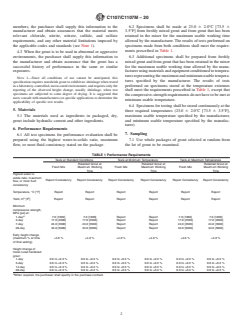
members, the purchaser shall supply this information to the 6.2 Specimens shall be made at 23.0 6 2.0°C [73.5 6
manufacturer and obtain assurances that the material meets 3.5°F] from freshly mixed grout and from grout that has been
relevant chloride, nitrite, nitrate, sulfide, and sulfate retained in the mixer for the maximum usable working time
requirements, and any other material limitations imposed by allowed by the manufacturer. The results of tests performed on
the applicable codes and standards (see Note 1). specimens made from both conditions shall meet the require-
ments prescribed in Table 1.
4.3 When the grout is to be used in abnormal or aggressive
environments, the purchaser shall supply this information to 6.3 Additional specimens shall be prepared from freshly
the manufacturer and obtain assurance that the grout has a mixed grout and from grout that has been retained in the mixer
successful history of performance in the same or similar for the maximum usable working time allowed by the manu-
exposures. facturerusingmaterialsandequipmentconditionedtotempera-
turesrepresentingthemaximumandminimumusabletempera-
NOTE 1—Since all conditions of use cannot be anticipated, this
tures specified by the manufacturer. The results of tests
specification requires nonshrink grout to exhibit no shrinkage when tested
performed on specimens stored at the temperature extremes
in a laboratory-controlled, moist-cured environment, and requires only the
reporting of the observed height change, usually shrinkage, when test
shall meet the requirements prescribed in Table 1, except that
specimens are subjected to some degree of drying. It is suggested that
thecompressive-strengthrequirementsdonothavetobemetat
users consult with manufacturers on specific applications to determine the
minimum usable temperature.
applicability of specific test results.
6.4 Specimens for testing shall be stored continuously at the
5. Materials
three required temperatures (23.0 6 2.0°C [73.5 6 3.5°F],
5.1 The materials used as ingredients in packaged, dry, maximum usable temperature specified by the manufacturer,
grout include hydraulic cement and other ingredients. and minimum usable temperature specified by the manufac-
turer).
6. Performance Requirements
7. Sampling
6.1 All test specimens for performance evaluation shall be
prepared using the highest water-to-solids ratio, maximum 7.1 Use whole packages of grout selected at random from
flow, or most fluid consistency stated on the package. the lot of grout to be examined.
TABLE 1 Performance Requirements
Tests at Standard Conditions Tests at Minimum Temperature Tests at Maximum Temperature
Retained Grout at Retained Grout at Retained Grout at
Fresh Mix Maximum Working Fresh Mix Maximum Working Fresh Mix Maximum Working
Time Time Time
Highest water to
solids ratio, maximum
Report Consistency Report Consistency Report Consistency Report Consistency Report Consistency Report Consistency
flow, or most fluid
consistency
Temperature, °C [°F] Report Report Report Report Report Report
3 3
Yield, m [ft ] Report Report Report Report Report Report
Minimum
compressive strength,
MPa [psi] at:
A
1-day 7.0 [1000] 7.0 [1000] Report Report 7.0 [1000] 7.0 [1000]
3-day 17.0 [2500] 17.0 [2500] Report Report 17.0 [2500] 17.0 [2500]
7-day 24.0 [3500] 24.0 [3500] Report Report 24.0 [3500] 24.0 [3500]
28-day 34.0 [5000] 34.0 [5000] Report Report 34.0 [5000] 34.0 [5000]
Early height change
(maximum % at time +4.0 % +4.0 % +4.0 % +4.0 % +4.0 % +4.0 %
of final setting)
Height change of
moist cured hardened
grout:
1-day 0.0 to +0.3 % 0.0 to +0.3 % 0.0 to +0.3 % 0.0 to +0.3 % 0.0 to +0.3 % 0.0 to +0.3 %
3-day 0.0 to +0.3 % 0.0 to +0.3 % 0.0 to +0.3 % 0.0 to +0.3 % 0.0 to +0.3 % 0.0 to +0.3 %
14-day 0.0 to +0.3 % 0.0 to +0.3 % 0.0 to +0.3 % 0.0 to +0.3 % 0.0 to +0.3 % 0.0 to +0.3 %
28-day 0.0 to +0.3 % 0.0 to +0.3 % 0.0 to +0.3 % 0.0 to +0.3 % 0.0 to +0.3 % 0.0 to +0.3 %
A
When required, the purchaser shall specify in the purchase contract.
C1107/C1107M−20
7.2 Where lesser quantities of grout will serve the purpose, required. The mortar mixer shall have a metal shell with
select 3000 g [7 lb] of dry grout from a whole package in horizontal mixing blades.The mixing blades shall be angled so
accordance with the mechanical-splitter method in Practice that adjacent paddle arms reverse the flow of the grout in the
C702/C702M. For high-density grouts, adjust the mass to mixing drum during rotation of the horizontal shaft. The
provide an equivalent volume. mixing blades shall have adjustable wiper blades that wipe the
inner surfaces of the mixing chamber. The wiper blades shall
8. Batching
berubberorotherflexible,wear-resistantmaterialthatdoesnot
8.1 Grout mixtures shall be produced in the following
deleteriously react with the grout mixture. The wiper blades
conditions:
shall be adjusted to continuously wipe the curved inner surface
8.1.1 Batch grout mixtures at temperature conditions corre-
of the mixing chamber below the grout level and the ends of
sponding to the maximum recommended temperature limit and
the chamber. The horizontal shaft shall rotate the mixing
at a temperature corresponding to the minimum temperature
paddles at 28 to 35 r/min.The mixer shall be clean, pre-wetted,
stated by the manufacturer.
and drained and essentially free of hardened mortar and other
8.1.2 For standard temperature testing, maintain the grout
foreign material that can be removed with a trowel or by
mixture and the testing equipment at a temperature of 23 6
reasonably striking with a hammer.
2°C [73.5 6 3.5°F].
NOTE 3—An electric motor-driven mixer is preferable in the laboratory
8.2 Bring all materials and equipment to be used in prepar-
to avoid noise and exhaust fumes. For greater safety, the mixer should be
ing test specimens to the specified test temperature, 63°C equipped with a lever-operated clutch.While these comments are selected
safety precautions, it is the user’s responsibility to see that any equipment
[65°F] prior to use.
in use is not hazardous in a physical or mechanical way to operators and
8.2.1 When the controlled-environment test room is too
attendant personnel, and that safe work practices are required at all times.
small to accommodate large equipment, immediately prior to
10.2 Mixing Procedure for Bench Scale Mixing:
use,bringthemixertothedesiredtestingtemperaturebyfilling
it with water at the appropriate temperature and agitating it by
10.2.1 Use a 3000-g [7-lb] sample to determine the consis-
turning the mixer on. When this water has stabilized at the
tency classification and to determine the water content of grout
desired temperature, discard it and start preparing the batch
tested at maximum flow or most fluid consistency.
immediately.
10.2.2 Weighallgroutonabalanceoronaplatformscaleto
the nearest 0.1 %.
8.3 The manufacturer is not prohibited from including, in
the package instructions, procedures for adjusting the mixing
10.2.3 Measure the water by mass or volume to the nearest
water temperature to achieve limitations imposed on the grout
0.1 %. If the manufacturer recommends maximum water
use temperatures. Use of this technique shall not abrogate the
content, calculate the percent water from the packaging infor-
extended mixing time requirement of this specification.
mation and use that amount of water to prepare the grout
mixture. If the manufacturer recommends maximum flow or
9. Proportioning
most fluid consistency, use the suggested water content as a
9.1 The minimum and maximum amount of water recom-
starting point and adjust water as necessary to achieve the
mended by the manufacturer on the package shall be used to
maximumflowormostfluidconsistencystatedonthepackage.
determine conformance with the requirements of this specifi-
If the required consistency has not been met, make additional
cation. If the manufacturer provides maximum flow (thinnest
adjustments to estimate the water content to use for the next
consistency) information on the package, conduct consistency
batch. Discard current batch and repeat with newly established
tests to an accuracy of 65 % to determine the amount of water
water content.
to be added for testing. In either case, express the weight of
10.2.4 Place water in the bowl. Start the mixer at speed 1.
water so determined as a ratio of water to dry grout material by
Add the dry grout material to the water over approximately 30
weight. If both are given, make tests at whichever involves the
sec. After 1 min, stop the mixer for 15 sec and scrape into the
larger amount of water by ratio of dry grout mixture.
batch any grout that may have collected on the side of the
bowl. Switch to speed 2 and mix for a total of 5 min as
10. Mixing
measured from first contact of dry material with water. Use
10.1 Either the mixer described in Practice C305 or the
other mixing procedures if recomm
...
This document is not an ASTM standard and is intended only to provide the user of an ASTM standard an indication of what changes have been made to the previous version. Because
it may not be technically possible to adequately depict all changes accurately, ASTM recommends that users consult prior editions as appropriate. In all cases only the current version
of the standard as published by ASTM is to be considered the official document.
Designation: C1107/C1107M − 17 C1107/C1107M − 20
Standard Specification for
Packaged Dry, Hydraulic-Cement Grout (Nonshrink)
This standard is issued under the fixed designation C1107/C1107M; the number immediately following the designation indicates the year
of original adoption or, in the case of revision, the year of last revision. A number in parentheses indicates the year of last reapproval.
A superscript epsilon (´) indicates an editorial change since the last revision or reapproval.
1. Scope*
1.1 This specification covers packaged dry, hydraulic cement grout (nonshrink) intended for use under applied load (such as to
support a structure, a machine, and the like) where a change in height below initial placement height is to be avoided.
1.2 Grouts covered are composed of hydraulic cement, fine aggregate, cement and other ingredients. They require only the
addition of mixing water for use.
1.3 The values stated in either SI units or inch-pound units are to be regarded separately as standard. The values stated in each
system may not be exact equivalents; therefore, each system shall be used independently of the other. Combining values from the
two systems may result in non-conformance with the standard.
1.4 The following safety hazards caveat pertains only to the test method portion of this specification: This standard does not
purport to address all of the safety concerns, if any, associated with its use. It is the responsibility of the user of this standard to
establish appropriate safety safety, health, and healthenvironmental practices and determine the applicability of regulatory
limitations prior to use.
1.5 This international standard was developed in accordance with internationally recognized principles on standardization
established in the Decision on Principles for the Development of International Standards, Guides and Recommendations issued
by the World Trade Organization Technical Barriers to Trade (TBT) Committee.
2. Referenced Documents
2.1 ASTM Standards:
C109/C109M Test Method for Compressive Strength of Hydraulic Cement Mortars (Using 2-in. or [50-mm] Cube Specimens)
C125 Terminology Relating to Concrete and Concrete Aggregates
C138/C138M Test Method for Density (Unit Weight), Yield, and Air Content (Gravimetric) of Concrete
C157/C157M Test Method for Length Change of Hardened Hydraulic-Cement Mortar and Concrete
C185 Test Method for Air Content of Hydraulic Cement Mortar
C305 Practice for Mechanical Mixing of Hydraulic Cement Pastes and Mortars of Plastic Consistency
C702/C702M Practice for Reducing Samples of Aggregate to Testing Size
C827/C827M Test Method for Change in Height at Early Ages of Cylindrical Specimens of Cementitious Mixtures
C939/C939M Test Method for Flow of Grout for Preplaced-Aggregate Concrete (Flow Cone Method)
C1090/C1090M Test Method for Measuring Changes in Height of Cylindrical Specimens of Hydraulic-Cement Grout
C1437 Test Method for Flow of Hydraulic Cement Mortar
3. Terminology
3.1 Definitions—For definitions of terms used in this specification, refer to Terminology C125.
3.2 Definitions of Terms Specific to This Standard:
3.2.1 consistency, flowable, n—a grout consistency having a flow of 125 to 145 by the flow test in accordance with the
applicable provisions of Test Method C1437; the flow after 5 drops of the flow table in 3 s.
3.2.2 consistency, fluid, n—a grout consistency having a time of efflux of 10 to 30 s when tested by the flow cone procedure
of Test Method C939/C939M.
This specification is under the jurisdiction of ASTM Committee C09 on Concrete and Concrete Aggregates and is the direct responsibility of Subcommittee C09.43 on
Packaged Dry Combined Materials.
Current edition approved Dec. 1, 2017Feb. 1, 2020. Published December 2017March 2020. Originally approved in 1991. Last previous edition approved in 20142017 as
C1107/C1107M – 14a.17. DOI: 10.1520/C1107_C1107M-17.10.1520/C1107_C1107M-20.
For referenced ASTM standards, visit the ASTM website, www.astm.org, or contact ASTM Customer Service at service@astm.org. For Annual Book of ASTM Standards
volume information, refer to the standard’s Document Summary page on the ASTM website.
*A Summary of Changes section appears at the end of this standard
Copyright © ASTM International, 100 Barr Harbor Drive, PO Box C700, West Conshohocken, PA 19428-2959. United States
C1107/C1107M − 20
3.2.3 consistency, plastic, n—a grout consistency having a flow of 100 to 125 by the flow test in accordance with the applicable
provisions of Test Method C1437; the flow after 5 drops of the flow table in 3 s.
4. Ordering Information
4.1 When the purchaser specifies that properties of the packaged, dry grout meet the requirements of this specification, also
specify which, if any, of the optional requirements apply.
4.2 When the grout is to be used in contact with stressed tendons or other corrosion-sensitive, load-bearing structural members,
the purchaser shall supply this information to the manufacturer and obtain assurances that the material meets relevant chloride,
nitrite, nitrate, sulfide, and sulfate requirements, and any other material limitations imposed by the applicable codes and standards
(see Note 1).
4.3 When the grout is to be used in abnormal or aggressive environments, the purchaser shall supply this information to the
manufacturer and obtain assurance that the grout has a successful history of performance in the same or similar exposures.
NOTE 1—Since all conditions of use cannot be anticipated, this specification requires nonshrink grout to exhibit no shrinkage when tested in a
laboratory-controlled, moist-cured environment, and requires only the reporting of the observed height change, usually shrinkage, when test specimens
are subjected to some degree of drying. It is suggested that users consult with manufacturers on specific applications to determine the applicability of
specific test results.
5. Materials
5.1 The materials used as ingredients in packaged, dry, grout include hydraulic cement, fine aggregate, cement and other
ingredients.
6. Performance Requirements
6.1 All test specimens for performance evaluation shall be prepared using the highest water-to-solids ratio, maximum flow, or
most fluid consistency stated on the package.
6.2 Specimens shall be made at 23.0 6 2.0°C [73.5 6 3.5°F] from freshly mixed grout and from grout that has been retained
in the mixer for the maximum usable working time allowed by the manufacturer. The results of tests performed on specimens made
from both conditions shall meet the requirements prescribed in Table 1.
TABLE 1 Performance Requirements
Tests at Standard Conditions Tests at Minimum Temperature Tests at Maximum Temperature
Retained Grout at Retained Grout at Retained Grout at
Fresh Mix Maximum Working Fresh Mix Maximum Working Fresh Mix Maximum Working
Time Time Time
Highest water to
solids ratio, maximum
Report Consistency Report Consistency Report Consistency Report Consistency Report Consistency Report Consistency
flow, or most fluid
consistency
Temperature, °C [°F] Report Report Report Report Report Report
3 3
Yield, m [ft ] Report Report Report Report Report Report
Minimum
compressive strength,
MPa [psi] at:
A
1-day 7.0 [1000] 7.0 [1000] Report Report 7.0 [1000] 7.0 [1000]
3-day 17.0 [2500] 17.0 [2500] Report Report 17.0 [2500] 17.0 [2500]
7-day 24.0 [3500] 24.0 [3500] Report Report 24.0 [3500] 24.0 [3500]
28-day 34.0 [5000] 34.0 [5000] Report Report 34.0 [5000] 34.0 [5000]
Early height change
(maximum % at time +4.0 % +4.0 % +4.0 % +4.0 % +4.0 % +4.0 %
of final setting)
Height change of
moist cured hardened
grout:
1-day 0.0 to +0.3 % 0.0 to +0.3 % 0.0 to +0.3 % 0.0 to +0.3 % 0.0 to +0.3 % 0.0 to +0.3 %
3-day 0.0 to +0.3 % 0.0 to +0.3 % 0.0 to +0.3 % 0.0 to +0.3 % 0.0 to +0.3 % 0.0 to +0.3 %
14-day 0.0 to +0.3 % 0.0 to +0.3 % 0.0 to +0.3 % 0.0 to +0.3 % 0.0 to +0.3 % 0.0 to +0.3 %
28-day 0.0 to +0.3 % 0.0 to +0.3 % 0.0 to +0.3 % 0.0 to +0.3 % 0.0 to +0.3 % 0.0 to +0.3 %
A
When required, the purchaser shall specify in the purchase contract.
C1107/C1107M − 20
6.3 Additional specimens shall be prepared from freshly mixed grout and from grout that has been retained in the mixer for the
maximum usable working time allowed by the manufacturer using materials and equipment conditioned to temperatures
representing the maximum and minimum usable temperatures specified by the manufacturer. The results of tests performed on
specimens stored at the temperature extremes shall meet the requirements prescribed in Table 1, except that the compressive-
strength requirements do not have to be met at minimum usable temperature.
6.4 Specimens for testing shall be stored continuously at the three required temperatures (23.0 6 2.0°C [73.5 6 3.5°F],
maximum usable temperature specified by the manufacturer, and minimum usable temperature specified by the manufacturer).
7. Sampling
7.1 Use whole packages of grout selected at random from the lot of grout to be examined.
7.2 Where lesser quantities of grout will serve the purpose, select 3000 g [7 lb] of dry grout from a whole package in accordance
with the mechanical-splitter method in Practice C702/C702M. For high-density grouts, adjust the mass to provide an equivalent
volume.
8. Batching
8.1 Grout mixtures shall be produced in the following conditions:
8.1.1 Batch grout mixtures at temperature conditions corresponding to the maximum recommended temperature limit and at a
temperature corresponding to the minimum temperature stated by the manufacturer.
8.1.2 For standard temperature testing, maintain the grout mixture and the testing equipment at a temperature of 23 6 2°C [73.5
6 3.5°F].
8.2 Bring all materials and equipment to be used in preparing test specimens to the specified test temperature, 63°C [65°F]
prior to use.
8.2.1 When the controlled-environment test room is too small to accommodate large equipment, immediately prior to use, bring
the mixer to the desired testing temperature by filling it with water at the appropriate temperature and agitating it by turning the
mixer on. When this water has stabilized at the desired temperature, discard it and start preparing the batch immediately.
8.3 The manufacturer is not prohibited from including, in the package instructions, procedures for adjusting the mixing water
temperature to achieve limitations imposed on the grout use temperatures. Use of this technique shall not abrogate the extended
mixing time requirement of this specification.
9. Proportioning
9.1 The minimum and maximum amount of water recommended by the manufacturer on the package shall be used to determine
conformance with the requirements of this specification. If the manufacturer provides maximum flow (thinnest consistency)
information on the package, conduct consistency tests to an accuracy of 65 % to determine the amount of water to be added for
testing. In either case, express the weight of water so determined as a ratio of water to dry grout material by weight. If both are
given, make tests at whichever involves the larger amount of water by ratio of dry grout mixture.
10. Mixing
10.1 Either the mixer described in Practice C305 or the mortar mixer described in 10.1.2 shall be used for performance
qualifications. In the event of a dispute, the mixer described in 10.1.2 shall be used for the referee test.
NOTE 2—The referee test is a test made to settle disagreement as to the conformance to the specified requirements.
10.1.1 Bench Scale Epicyclic Mixer—The mortar-mixing apparatus shall be as specified in Practice C305. However, the mixer
shall be provided with a bowl positioner to enable clearance of the largest sized aggregate in the mixture being tested.
10.1.2 Mortar Mixer—A110 to 125-L [4 to 4 ⁄2-ft ] capacity horizontal shaft stationary drum mortar mixer (see Note 3) is
required. The mortar mixer shall have a metal shell with horizontal mixing blades. The mixing blades shall be angled so that
adjacent paddle arms reverse the flow of the grout in the mixing drum during rotation of the horizontal shaft. The mixing blades
shall have adjustable wiper blades that wipe the inner surfaces of the mixing chamber. The wiper blades shall be rubber or other
flexible, wear-resistant material that does not deleteriously react with the grout mixture. The wiper blades shall be adjusted to
continuously wipe the curved inner surface of the mixing chamber below the grout level and the ends of the chamber. The
horizontal shaft shall rotate the mixing paddles at 28 to 35 r/min. The mixer shall be clean, pre-wetted, and drained and essentially
free of hardened mortar and other foreign material that can be removed with a trowel or by reasonably striking with a hammer.
NOTE 3—An electric motor-driven mixer is preferable in the laboratory to avoid noise and exhaust fumes. For greater safety, the mixer should be
equipped with a lever-operated clutch. While these comments are selected safety precautions, it is the user’s responsibility to see that any equipment in
use is not hazardous in a physical or mechanical way to operators and attendant personnel, and that safe work practices are required at all times.
10.2 Mixing Procedure for Bench Scale Mixing:
10.2.1 Use a 3000-g [7-lb] sample to determine the consistency classification and to determine the water content of grout tested
at maximum flow or most fluid consistency.
C1107/C1107M − 20
10.2.2 Weigh all grout on a balance or on a platform scale to the nearest 0.1 %.
10.2.3 Measure the water by mass or volume to the nearest 0.1 %. If the manufacturer recommends maximum water content,
calculate the percent water from the packaging information and use that amount of water to prepare the grout mixture. If the
manufacturer recommends maximum flow or most fluid consistency, use the suggested water content as a starting point and adjust
water as necessary to achieve the maximum flow
...