

ASTM C87/C87M-23
(Test Method)Standard Test Method for Effect of Organic Impurities in Fine Aggregate on Strength of Mortar
General Information
- Abstract
SIGNIFICANCE AND USE
5.1 This test method is of significance in making a final determination of the acceptability of fine aggregates with respect to the requirements of Specification C33/C33M concerning organic impurities.
5.2 This test method is applicable to those samples which, when tested in accordance with Test MethodC40/C40M, have produced a supernatant liquid with a color darker than the standard listed in Table 1 of C40/C40M (Organic plate No. 3, Gardner Color Standard No. 14, Circular Disk No. 14 or prepared color solution).
5.3 Many specifications provide for the acceptance of fine aggregate producing a darker color in the Test Method C40/C40M test, if testing by this test method indicates the strength of the mortar cubes prepared with the unwashed fine aggregate is comparable to the strength of mortar cubes made with the washed fine aggregate.
SCOPE
1.1 This test method covers the determination of the effect on mortar strength of the organic impurities in fine aggregate, whose presence is indicated using Test Method C40/C40M. Comparison is made between compressive strengths of mortar made with washed and unwashed fine aggregate.
1.2 The values stated in either SI units or inch-pound units are to be regarded separately as standard. The values stated in each system may not be exact equivalents; therefore, each system shall be used independently of the other. Combining values from the two systems may result in non-conformance with the standard. Some values have only SI units because the inch-pound equivalents are not used in the practice.
Note 1: Sieve size is identified by its standard designation in Specification E11. The alternative designation given in parentheses is for information only and does not represent a different standard sieve size
1.3 This standard does not purport to address all of the safety concerns, if any, associated with its use. It is the responsibility of the user of this standard to establish appropriate safety, health, and environmental practices and determine the applicability of regulatory limitations prior to use.(Warning—Fresh hydraulic cementitous mixtures are caustic and may cause chemical burns to exposed skin and tissue upon prolonged exposure.)2
1.4 This international standard was developed in accordance with internationally recognized principles on standardization established in the Decision on Principles for the Development of International Standards, Guides and Recommendations issued by the World Trade Organization Technical Barriers to Trade (TBT) Committee.
- Status
- Published
- Publication Date
- 31-May-2023
- Technical Committee
- C09 - Concrete and Concrete Aggregates
- Drafting Committee
- C09.20 - Aggregates
Buy Documents
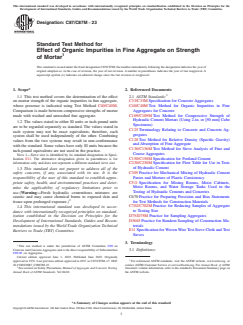
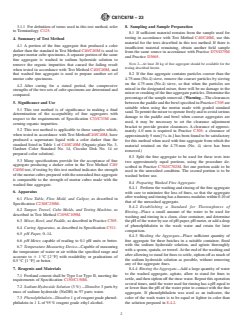
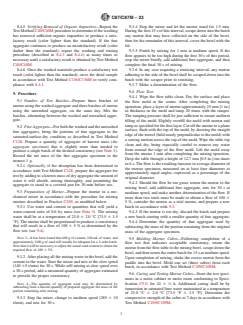

ASTM C87/C87M-23 - Standard Test Method for Effect of Organic Impurities in Fine Aggregate on Strength of Mortar
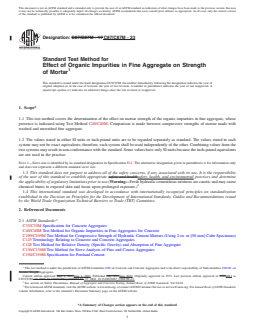
REDLINE ASTM C87/C87M-23 - Standard Test Method for Effect of Organic Impurities in Fine Aggregate on Strength of Mortar
Overview
ASTM C87/C87M-23: Standard Test Method for Effect of Organic Impurities in Fine Aggregate on Strength of Mortar is a leading standard developed by ASTM International. This test method is used to assess the impact of organic impurities found in fine aggregate (such as sand) on the compressive strength of mortar. Determining the presence and effect of organic impurities is crucial to ensuring the quality and performance of construction materials, particularly in applications where mortar strength is a critical factor. This standard supports compliance with Specification ASTM C33/C33M regarding organic impurities in fine aggregate.
Key Topics
- Purpose of the Standard
- Evaluates the effect of organic impurities in fine aggregate on mortar strength.
- Used as a final determination for the acceptability of aggregates that initially fail colorimetric tests for organic content.
- Scope of Applicability
- Samples tested by ASTM C40/C40M that show a supernatant color darker than the standard require further evaluation by this method.
- Compares compressive strength of mortar made with both washed and unwashed fine aggregates.
- Test Method Summary
- Mortar cubes are prepared using both types of aggregates.
- After a specified curing period, the compressive strengths of both sets of cubes are measured and compared.
- Measurement Units
- Procedures and reporting can use either SI units or inch-pound units, but not a combination of both.
- Safety Considerations
- The standard reminds users to adopt appropriate safety and environmental practices, as fresh hydraulic cement mixtures can be caustic.
Applications
The ASTM C87/C87M-23 test method is widely applied in the construction and materials testing industries to:
- Assess Aggregate Quality
- It is a critical part of quality control in ready-mix concrete, masonry mortar, and pre-cast concrete operations to ensure aggregates meet stringent organic impurity requirements.
- Acceptance Testing
- Frequently used by laboratories, contractors, and engineers when fine aggregate samples fail ASTM C40/C40M color tests. If mortar cube strengths from unwashed aggregates are comparable to those from washed samples, the material may still be deemed acceptable for use.
- Specification Compliance
- Facilitates compliance with ASTM C33/C33M by providing a reliable method to evaluate and report on the presence and impact of organic impurities.
- Supporting Construction Safety and Durability
- Ensures that construction materials will not suffer reduced performance or durability due to organic contaminants in the aggregate.
Related Standards
To ensure accurate and comprehensive testing, ASTM C87/C87M-23 makes reference to several other important standards, including:
- ASTM C33/C33M - Specification for Concrete Aggregates
- ASTM C40/C40M - Test Method for Organic Impurities in Fine Aggregates for Concrete
- ASTM C109/C109M - Test Method for Compressive Strength of Hydraulic Cement Mortars
- ASTM C136/C136M - Test Method for Sieve Analysis of Fine and Coarse Aggregates
- ASTM C150/C150M - Specification for Portland Cement
- ASTM C305 - Practice for Mechanical Mixing of Hydraulic Cement Pastes and Mortars
- ASTM D75/D75M, D3665, and C702/C702M - Practices for Sampling and Reducing Aggregates to Testing Size
Practical Value
By following ASTM C87/C87M-23, laboratories and construction professionals can ensure their fine aggregates are free from harmful levels of organic impurities that may compromise mortar or concrete strength. The method offers a robust protocol for final acceptability decisions, contributing to higher quality, safer, and more durable concrete structures. Adherence to this standard mitigates the risk of construction material failure due to undetected organic contaminants, ultimately supporting long-term infrastructure performance and compliance with industry best practices.
Relations
- Effective Date
- 01-Feb-2024
- Effective Date
- 01-Jan-2024
- Effective Date
- 15-Dec-2023
- Effective Date
- 15-Jul-2020
- Effective Date
- 15-Dec-2019
- Effective Date
- 01-Nov-2019
- Effective Date
- 01-Apr-2019
- Effective Date
- 01-Jan-2019
- Effective Date
- 01-Oct-2018
- Effective Date
- 01-Jul-2018
- Effective Date
- 01-Jan-2018
- Effective Date
- 15-Dec-2016
- Refers
ASTM C40/C40M-16 - Standard Test Method for Organic Impurities in Fine Aggregates for Concrete - Effective Date
- 01-Dec-2016
- Effective Date
- 15-Mar-2016
- Effective Date
- 01-Feb-2016
Buy Documents
ASTM C87/C87M-23 - Standard Test Method for Effect of Organic Impurities in Fine Aggregate on Strength of Mortar
REDLINE ASTM C87/C87M-23 - Standard Test Method for Effect of Organic Impurities in Fine Aggregate on Strength of Mortar
Get Certified
Connect with accredited certification bodies for this standard

DIBt (Deutsches Institut für Bautechnik)
German Institute for Building Technology.
DIN CERTCO
DIN Group product certification.

Aboma Certification B.V.
Specialized in construction, metal, and transport sectors.
Sponsored listings
Frequently Asked Questions
ASTM C87/C87M-23 is a standard published by ASTM International. Its full title is "Standard Test Method for Effect of Organic Impurities in Fine Aggregate on Strength of Mortar". This standard covers: SIGNIFICANCE AND USE 5.1 This test method is of significance in making a final determination of the acceptability of fine aggregates with respect to the requirements of Specification C33/C33M concerning organic impurities. 5.2 This test method is applicable to those samples which, when tested in accordance with Test MethodC40/C40M, have produced a supernatant liquid with a color darker than the standard listed in Table 1 of C40/C40M (Organic plate No. 3, Gardner Color Standard No. 14, Circular Disk No. 14 or prepared color solution). 5.3 Many specifications provide for the acceptance of fine aggregate producing a darker color in the Test Method C40/C40M test, if testing by this test method indicates the strength of the mortar cubes prepared with the unwashed fine aggregate is comparable to the strength of mortar cubes made with the washed fine aggregate. SCOPE 1.1 This test method covers the determination of the effect on mortar strength of the organic impurities in fine aggregate, whose presence is indicated using Test Method C40/C40M. Comparison is made between compressive strengths of mortar made with washed and unwashed fine aggregate. 1.2 The values stated in either SI units or inch-pound units are to be regarded separately as standard. The values stated in each system may not be exact equivalents; therefore, each system shall be used independently of the other. Combining values from the two systems may result in non-conformance with the standard. Some values have only SI units because the inch-pound equivalents are not used in the practice. Note 1: Sieve size is identified by its standard designation in Specification E11. The alternative designation given in parentheses is for information only and does not represent a different standard sieve size 1.3 This standard does not purport to address all of the safety concerns, if any, associated with its use. It is the responsibility of the user of this standard to establish appropriate safety, health, and environmental practices and determine the applicability of regulatory limitations prior to use.(Warning—Fresh hydraulic cementitous mixtures are caustic and may cause chemical burns to exposed skin and tissue upon prolonged exposure.)2 1.4 This international standard was developed in accordance with internationally recognized principles on standardization established in the Decision on Principles for the Development of International Standards, Guides and Recommendations issued by the World Trade Organization Technical Barriers to Trade (TBT) Committee.
SIGNIFICANCE AND USE 5.1 This test method is of significance in making a final determination of the acceptability of fine aggregates with respect to the requirements of Specification C33/C33M concerning organic impurities. 5.2 This test method is applicable to those samples which, when tested in accordance with Test MethodC40/C40M, have produced a supernatant liquid with a color darker than the standard listed in Table 1 of C40/C40M (Organic plate No. 3, Gardner Color Standard No. 14, Circular Disk No. 14 or prepared color solution). 5.3 Many specifications provide for the acceptance of fine aggregate producing a darker color in the Test Method C40/C40M test, if testing by this test method indicates the strength of the mortar cubes prepared with the unwashed fine aggregate is comparable to the strength of mortar cubes made with the washed fine aggregate. SCOPE 1.1 This test method covers the determination of the effect on mortar strength of the organic impurities in fine aggregate, whose presence is indicated using Test Method C40/C40M. Comparison is made between compressive strengths of mortar made with washed and unwashed fine aggregate. 1.2 The values stated in either SI units or inch-pound units are to be regarded separately as standard. The values stated in each system may not be exact equivalents; therefore, each system shall be used independently of the other. Combining values from the two systems may result in non-conformance with the standard. Some values have only SI units because the inch-pound equivalents are not used in the practice. Note 1: Sieve size is identified by its standard designation in Specification E11. The alternative designation given in parentheses is for information only and does not represent a different standard sieve size 1.3 This standard does not purport to address all of the safety concerns, if any, associated with its use. It is the responsibility of the user of this standard to establish appropriate safety, health, and environmental practices and determine the applicability of regulatory limitations prior to use.(Warning—Fresh hydraulic cementitous mixtures are caustic and may cause chemical burns to exposed skin and tissue upon prolonged exposure.)2 1.4 This international standard was developed in accordance with internationally recognized principles on standardization established in the Decision on Principles for the Development of International Standards, Guides and Recommendations issued by the World Trade Organization Technical Barriers to Trade (TBT) Committee.
ASTM C87/C87M-23 is classified under the following ICS (International Classification for Standards) categories: 91.100.10 - Cement. Gypsum. Lime. Mortar. The ICS classification helps identify the subject area and facilitates finding related standards.
ASTM C87/C87M-23 has the following relationships with other standards: It is inter standard links to ASTM C670-24a, ASTM C670-24, ASTM C109/C109M-23, ASTM C305-20, ASTM C125-19a, ASTM D75/D75M-19, ASTM C150/C150M-19, ASTM C125-19, ASTM C125-18b, ASTM C125-18a, ASTM C125-18, ASTM C125-16, ASTM C40/C40M-16, ASTM C150/C150M-16, ASTM C33/C33M-16e1. Understanding these relationships helps ensure you are using the most current and applicable version of the standard.
ASTM C87/C87M-23 is available in PDF format for immediate download after purchase. The document can be added to your cart and obtained through the secure checkout process. Digital delivery ensures instant access to the complete standard document.
Standards Content (Sample)
This international standard was developed in accordance with internationally recognized principles on standardization established in the Decision on Principles for the
Development of International Standards, Guides and Recommendations issued by the World Trade Organization Technical Barriers to Trade (TBT) Committee.
Designation: C87/C87M − 23
Standard Test Method for
Effect of Organic Impurities in Fine Aggregate on Strength
of Mortar
This standard is issued under the fixed designation C87/C87M; the number immediately following the designation indicates the year of
original adoption or, in the case of revision, the year of last revision. A number in parentheses indicates the year of last reapproval. A
superscript epsilon (´) indicates an editorial change since the last revision or reapproval.
1. Scope* 2. Referenced Documents
1.1 This test method covers the determination of the effect 2.1 ASTM Standards:
on mortar strength of the organic impurities in fine aggregate, C33/C33M Specification for Concrete Aggregates
whose presence is indicated using Test Method C40/C40M. C40/C40M Test Method for Organic Impurities in Fine
Comparison is made between compressive strengths of mortar Aggregates for Concrete
made with washed and unwashed fine aggregate. C109/C109M Test Method for Compressive Strength of
Hydraulic Cement Mortars (Using 2-in. or [50 mm] Cube
1.2 The values stated in either SI units or inch-pound units
Specimens)
are to be regarded separately as standard. The values stated in
C125 Terminology Relating to Concrete and Concrete Ag-
each system may not be exact equivalents; therefore, each
gregates
system shall be used independently of the other. Combining
C128 Test Method for Relative Density (Specific Gravity)
values from the two systems may result in non-conformance
and Absorption of Fine Aggregate
with the standard. Some values have only SI units because the
C136/C136M Test Method for Sieve Analysis of Fine and
inch-pound equivalents are not used in the practice.
Coarse Aggregates
NOTE 1—Sieve size is identified by its standard designation in Speci-
C150/C150M Specification for Portland Cement
fication E11. The alternative designation given in parentheses is for
information only and does not represent a different standard sieve size
C230/C230M Specification for Flow Table for Use in Tests
of Hydraulic Cement
1.3 This standard does not purport to address all of the
C305 Practice for Mechanical Mixing of Hydraulic Cement
safety concerns, if any, associated with its use. It is the
Pastes and Mortars of Plastic Consistency
responsibility of the user of this standard to establish appro-
C511 Specification for Mixing Rooms, Moist Cabinets,
priate safety, health, and environmental practices and deter-
Moist Rooms, and Water Storage Tanks Used in the
mine the applicability of regulatory limitations prior to
Testing of Hydraulic Cements and Concretes
use.(Warning—Fresh hydraulic cementitous mixtures are
C670 Practice for Preparing Precision and Bias Statements
caustic and may cause chemical burns to exposed skin and
for Test Methods for Construction Materials
tissue upon prolonged exposure.)
C702/C702M Practice for Reducing Samples of Aggregate
1.4 This international standard was developed in accor-
to Testing Size
dance with internationally recognized principles on standard-
D75/D75M Practice for Sampling Aggregates
ization established in the Decision on Principles for the
D3665 Practice for Random Sampling of Construction Ma-
Development of International Standards, Guides and Recom-
terials
mendations issued by the World Trade Organization Technical
E11 Specification for Woven Wire Test Sieve Cloth and Test
Barriers to Trade (TBT) Committee.
Sieves
3. Terminology
This test method is under the jurisdiction of ASTM Committee C09 on
Concrete and Concrete Aggregates and is the direct responsibility of Subcommittee 3.1 Definitions:
C09.20 on Aggregates.
Current edition approved June 1, 2023. Published June 2023. Originally
approved in 1931. Last previous edition approved in 2017 as C87/C87M–17. DOI: For referenced ASTM standards, visit the ASTM website, www.astm.org, or
10.1520/C0087_C0087M-23. contact ASTM Customer Service at service@astm.org. For Annual Book of ASTM
See section on Safety Precautions, Manual of Aggregate and Concrete Testing, Standards volume information, refer to the standard’s Document Summary page on
Annual Book of ASTM Standards, Vol 04.02. the ASTM website.
*A Summary of Changes section appears at the end of this standard
Copyright © ASTM International, 100 Barr Harbor Drive, PO Box C700, West Conshohocken, PA 19428-2959. United States
C87/C87M − 23
3.1.1 For definition of terms used in this test method, refer 8. Sampling and Sample Preparation
to Terminology C125.
8.1 If sufficient material remains from the sample used for
testing in accordance with Test Method C40/C40M, use this
4. Summary of Test Method
material for the tests described in this test method. If there is
4.1 A portion of the fine aggregate that produced a color
insufficient material remaining, obtain another field sample
darker than the standard in Test Method C40/C40M is used to
from the same source in accordance with Practice D75/D75M
prepare mortar cube specimens. A separate portion of the same
and Practice D3665.
fine aggregate is washed in sodium hydroxide solution to
NOTE 2—At least 20 kg of fine aggregate should be available for the
remove the organic impurities that caused the failing result
testing described herein.
when tested in accordance with Test Method C40/C40M, and
8.2 If the fine aggregate contains particles coarser than the
that washed fine aggregate is used to prepare another set of
4.75-mm (No.4) sieve, remove the coarser particles by sieving
mortar cube specimens.
on the 4.75-mm (No.4) sieve, so that when the particles are
4.2 After curing for a stated period, the compressive
mixed in the designated mixer, there will be no damage to the
strengths of the two sets of cube specimens are determined and
mixer or crushing of the fine aggregate particles. Determine the
compared.
percentage of the sample removed. (Warning—The clearances
between the paddle and the bowl specified in Practice C305 are
5. Significance and Use
suitable when using the mortar made with graded standard
5.1 This test method is of significance in making a final
sand. To permit the mixer to operate freely and to avoid serious
determination of the acceptability of fine aggregates with
damage to the paddle and bowl when coarser aggregates are
respect to the requirements of Specification C33/C33M con-
used, it may be necessary to set the clearance adjustment
cerning organic impurities.
bracket to provide greater clearances. A clearance of approxi-
5.2 This test method is applicable to those samples which,
mately 4.0 mm is required in Practice C305; a clearance of
when tested in accordance with Test MethodC40/C40M, have 3
approximately 5 mm [ ⁄16 in.] has been found to be satisfactory
produced a supernatant liquid with a color darker than the
for this method when used with fine aggregate from which the
standard listed in Table 1 of C40/C40M (Organic plate No. 3,
material retained on the 4.75-mm (No. 4) sieve has been
Gardner Color Standard No. 14, Circular Disk No. 14 or
removed.)
prepared color solution).
8.3 Split the fine aggregate to be used for these tests into
5.3 Many specifications provide for the acceptance of fine
two approximately equal portions, using the procedure de-
aggregate producing a darker color in the Test Method C40/
scribed in Practice C702/C702M. Set one portion aside to be
C40M test, if testing by this test method indicates the strength
used in the unwashed condition. The second portion is to be
of the mortar cubes prepared with the unwashed fine aggregate
washed before use.
is comparable to the strength of mortar cubes made with the
8.4 Preparing Washed Fine Aggregate:
washed fine aggregate.
8.4.1 Perform the washing and rinsing of the fine aggregate
6. Apparatus with care to minimize the loss of fines, so that the aggregate
after washing and rinsing has a fineness modulus within 0.10 of
6.1 Flow Table, Flow Mold, and Caliper, as described in
that of the unwashed aggregate.
Specification C230/C230M.
8.4.2 Establishing a Standard for Thoroughness of
6.2 Tamper, Trowel, Cube Molds, and Testing Machine, as
Rinsing—Place a small amount of the water to be used for
described in Test Method C109/C109M.
washing and rinsing in a clean, clear container, and determine
6.3 Mixer, Bowl, and Paddle, as described in Practice C305. the pH of the water by use of pH paper, pH meter, or add a drop
of phenolphthalein to the wash water and retain for later
6.4 Curing Apparatus, as described in Specification C511.
comparison.
6.5 pH Paper, 0–14.
8.4.3 Washing the Aggregate—Place sufficient quantity of
fine aggregate for three batches in a suitable container, flood
6.6 pH Meter, capable of reading to 0.1 pH units or better.
with the sodium hydroxide solution, and agitate thoroughly
6.7 Temperature Measuring Device—Capable of measuring
with a spoon, spatula, or trowel. At the end of the washing and
the temperature of water or air within the specified range and
after allowing to stand for fines to settle, siphon off as much of
accurate to 6 1 °C [2 °F] with readability or graduations of
the sodium hydroxide solution as possible, without removing
0.5 °C [1 °F] or better.
any of the aggregate fines.
7. Reagents and Materials
8.4.4 Rinsing the Aggregate—Add a large quantity of water
to the washed aggregate, agitate, allow to stand for fines to
7.1 Portland cement shall be Type I or Type II, meeting the
settle, and then siphon off the rinse water. Repeat this operation
requirements of Specification C150/C150M.
several times, until the water used for rinsing has a pH equal to
7.2 Sodium Hydroxide Solution (3 %) —Dissolve 3 parts by
or lower than the pH of the water prior to contact with the fine
mass of sodium h
...
This document is not an ASTM standard and is intended only to provide the user of an ASTM standard an indication of what changes have been made to the previous version. Because
it may not be technically possible to adequately depict all changes accurately, ASTM recommends that users consult prior editions as appropriate. In all cases only the current version
of the standard as published by ASTM is to be considered the official document.
Designation: C87/C87M − 17 C87/C87M − 23
Standard Test Method for
Effect of Organic Impurities in Fine Aggregate on Strength
of Mortar
This standard is issued under the fixed designation C87/C87M; the number immediately following the designation indicates the year of
original adoption or, in the case of revision, the year of last revision. A number in parentheses indicates the year of last reapproval. A
superscript epsilon (´) indicates an editorial change since the last revision or reapproval.
1. Scope*
1.1 This test method covers the determination of the effect on mortar strength of the organic impurities in fine aggregate, whose
presence is indicated using Test Method C40/C40M. Comparison is made between compressive strengths of mortar made with
washed and unwashed fine aggregate.
1.2 The values stated in either SI units or inch-pound units are to be regarded separately as standard. The values stated in each
system may not be exact equivalents; therefore, each system shall be used independently of the other. Combining values from the
two systems may result in non-conformance with the standard. Some values have only SI units because the inch-pound equivalents
are not used in the practice.
NOTE 1—Sieve size is identified by its standard designation in Specification E11. The alternative designation given in parentheses is for information only
and does not represent a different standard sieve size
1.3 This standard does not purport to address all of the safety concerns, if any, associated with its use. It is the responsibility
of the user of this standard to establish appropriate safety and healthsafety, health, and environmental practices and determine
the applicability of regulatory limitations prior to use.(Warning—Fresh hydraulic cementitous mixtures are caustic and may cause
chemical burns to exposed skin and tissue upon prolonged exposure.)
1.4 This international standard was developed in accordance with internationally recognized principles on standardization
established in the Decision on Principles for the Development of International Standards, Guides and Recommendations issued
by the World Trade Organization Technical Barriers to Trade (TBT) Committee.
2. Referenced Documents
2.1 ASTM Standards:
C33/C33M Specification for Concrete Aggregates
C40/C40M Test Method for Organic Impurities in Fine Aggregates for Concrete
C109/C109M Test Method for Compressive Strength of Hydraulic Cement Mortars (Using 2-in. or [50 mm] Cube Specimens)
C125 Terminology Relating to Concrete and Concrete Aggregates
C128 Test Method for Relative Density (Specific Gravity) and Absorption of Fine Aggregate
C136/C136M Test Method for Sieve Analysis of Fine and Coarse Aggregates
C150/C150M Specification for Portland Cement
This test method is under the jurisdiction of ASTM Committee C09 on Concrete and Concrete Aggregates and is the direct responsibility of Subcommittee C09.20 on
Normal Weight Aggregates.
Current edition approved May 1, 2017June 1, 2023. Published July 2017June 2023. Originally approved in 1931. Last previous edition approved in 20102017 as
C87/C87M–10. DOI: 10.1520/C0087_C0087M-17.–17. DOI: 10.1520/C0087_C0087M-23.
See section on Safety Precautions, Manual of Aggregate and Concrete Testing, Annual Book of ASTM Standards, Vol 04.02.
For referenced ASTM standards, visit the ASTM website, www.astm.org, or contact ASTM Customer Service at service@astm.org. For Annual Book of ASTM Standards
volume information, refer to the standard’s Document Summary page on the ASTM website.
*A Summary of Changes section appears at the end of this standard
Copyright © ASTM International, 100 Barr Harbor Drive, PO Box C700, West Conshohocken, PA 19428-2959. United States
C87/C87M − 23
C230/C230M Specification for Flow Table for Use in Tests of Hydraulic Cement
C305 Practice for Mechanical Mixing of Hydraulic Cement Pastes and Mortars of Plastic Consistency
C511 Specification for Mixing Rooms, Moist Cabinets, Moist Rooms, and Water Storage Tanks Used in the Testing of Hydraulic
Cements and Concretes
C670 Practice for Preparing Precision and Bias Statements for Test Methods for Construction Materials
C702/C702M Practice for Reducing Samples of Aggregate to Testing Size
D75/D75M Practice for Sampling Aggregates
D3665 Practice for Random Sampling of Construction Materials
E11 Specification for Woven Wire Test Sieve Cloth and Test Sieves
3. Terminology
3.1 Definitions:
3.1.1 For definition of terms used in this test method, refer to Terminology C125.
4. Summary of Test Method
4.1 A portion of the fine aggregate that produced a color darker than the standard in Test Method C40/C40M is used to prepare
mortar cube specimens. A separate portion of the same fine aggregate is washed in sodium hydroxide solution to remove the
organic impurities that caused the failing result when tested in accordance with Test Method C40/C40M, and that washed fine
aggregate is used to prepare another set of mortar cube specimens.
4.2 After curing for a stated period, the compressive strengths of the two sets of cube specimens are determined and compared.
5. Significance and Use
5.1 This test method is of significance in making a final determination of the acceptability of fine aggregates with respect to the
requirements of Specification C33/C33M concerning organic impurities.
5.2 This test method is applicable to those samples which, when tested in accordance with Test MethodC40/C40M, have produced
a supernatant liquid with a color darker than standard color the standard listed in Table 1 of C40/C40Mplate No. 3 or color solution.
(Organic plate No. 3, Gardner Color Standard No. 14, Circular Disk No. 14 or prepared color solution).
5.3 Many specifications provide for the acceptance of fine aggregate producing a darker color in the Test Method C40/C40M test,
if testing by this test method indicates the strength of the mortar cubes prepared with the unwashed fine aggregate is comparable
to the strength of mortar cubes made with the washed fine aggregate.
6. Apparatus
6.1 Flow Table, Flow Mold, and Caliper, as described in Specification C230/C230M.
6.2 Tamper, Trowel, Cube Molds, and Testing Machine, as described in Test Method C109/C109M.
6.3 Mixer, Bowl, and Paddle, as described in Practice C305.
6.4 Curing Apparatus, as described in Specification C511.
6.5 pH Paper, 0–14.
6.6 pH Meter, capable of reading to 0.1 pH units or better.
6.7 Temperature Measuring Device—Capable of measuring the temperature of water or air within the specified range and accurate
to 6 1 °C [2 °F] with readability or graduations of 0.5 °C [1 °F] or better.
C87/C87M − 23
7. Reagents and Materials
7.1 Portland cement shall be Type I or Type II, meeting the requirements of Specification C150/C150M.
7.2 Sodium Hydroxide Solution (3 %) —Dissolve 3 parts by mass of sodium hydroxide (NaOH) in 97 parts water.
7.3 Phenolphthalein—Dissolve 1 g of reagent grade phenolphthalein in 1 L of 95 % reagent grade ethyl alcohol.
8. Sampling and Sample Preparation
8.1 If sufficient material remains from the sample used for testing in accordance with Test Method C40/C40M, use this material
for the tests described in this test method. If there is insufficient material remaining, obtain another field sample from the same
source in accordance with Practice D75/D75M and Practice D3665.
NOTE 2—At least 20 kg of fine aggregate should be available for the testing described herein.
8.2 If the fine aggregate contains particles coarser than the 4.75-mm (No.4) sieve, remove the coarser particles by sieving on the
4.75-mm (No.4) sieve, so that when the particles are mixed in the designated mixer, there will be no damage to the mixer or
crushing of the fine aggregate particles. Determine the percentage of the sample removed. (Warning—The clearances between the
paddle and the bowl specified in Practice C305 are suitable when using the mortar made with graded standard sand. To permit the
mixer to operate freely and to avoid serious damage to the paddle and bowl when coarser aggregates are used, it may be necessary
to set the clearance adjustment bracket to provide greater clearances. A clearance of approximately 4.0 mm is required in Practice
C305; a clearance of approximately 5 mm [ ⁄16 in.] has been found to be satisfactory for this method when used with fine aggregate
from which the material retained on the 4.75-mm (No. 4) sieve has been removed.)
8.3 Split the fine aggregate to be used for these tests into two approximately equal portions, using the procedure described in
Practice C702/C702M. Set one portion aside to be used in the unwashed condition. The second portion is to be washed before use.
8.4 Preparing Washed Fine Aggregate:
8.4.1 Perform the washing and rinsing of the fine aggregate with care to minimize the loss of fines, so that the aggregate after
washing and rinsing has a fineness modulus within 0.10 of that of the unwashed aggregate.
8.4.2 Establishing a Standard for Thoroughness of Rinsing—Place a small amount of the water to be used for washing and rinsing
in a clean, clear container, and determine the pH of the water by use of pH paper, pH meter, or add a drop of phenolphthalein to
the wash water and retain for later comparison.
8.4.3 Washing the Aggregate—Place sufficient quantity of fine aggregate for three batches in a suitable container, flood with the
sodium hydroxide solution, and agitate thoroughly with a spoon, spatula, or trowel. At the end of the washing and after allowing
to stand for fines to settle, siphon off as much of the sodium hydroxide solution as possible, without removing any of the aggregate
fines.
8.4.4 Rinsing the Aggregate—Add a large quantity of water to the washed aggregate, agitate, allow to stand for fines to settle, and
then siphon off the rinse water. Repeat this operation several times, until the water used for rinsing has a p
...