

ASTM C827/C827M-23
(Test Method)Standard Test Method for Change in Height at Early Ages of Cylindrical Specimens of Cementitious Mixtures
General Information
- Abstract
SIGNIFICANCE AND USE
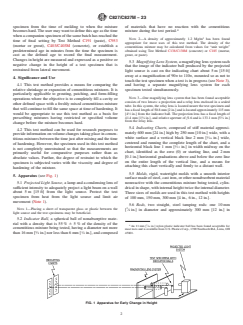
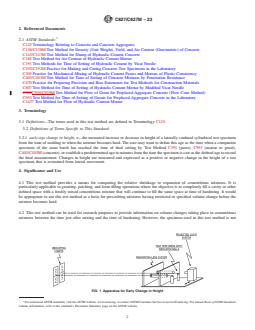
4.1 This test method provides a means for comparing the relative shrinkage or expansion of cementitious mixtures. It is particularly applicable to grouting, patching, and form-filling operations where the objective is to completely fill a cavity or other defined space with a freshly mixed cementitious mixture that will continue to fill the same space at time of hardening. It would be appropriate to use this test method as a basis for prescribing mixtures having restricted or specified volume change before the mixture becomes hard.
4.2 This test method can be used for research purposes to provide information on volume changes taking place in cementitious mixtures between the time just after mixing and the time of hardening. However, the specimen used in this test method is not completely unrestrained so that the measurements are primarily useful for comparative purposes rather than as absolute values. Further, the degree of restraint to which the specimen is subjected varies with the viscosity and degree of hardening of the mixture.
SCOPE
1.1 This test method covers the determination of change in height of cylindrical specimens from the time of molding until the mixture is hard.
1.2 This test method covers height change measurements at early ages for cementitious mixtures of paste, grout, mortar, and concrete.
1.3 This test method is intended for determination of changes in height that occur from the time of placement until the specimen is fully hard. These include shrinkage or expansion due to hydration, settlement, evaporation, and other physical and chemical effects.
1.4 The values stated in either SI units or inch-pound units are to be regarded separately as standard. The values stated in each system are not necessarily exact equivalents; therefore, to ensure conformance with the standard, each system shall be used independently of the other, and values from the two systems shall not be combined
1.5 The text of this test method refers to notes and footnotes that provide explanatory information. These notes and footnotes shall not be considered as requirements of the test method.
1.6 This standard does not purport to address all of the safety concerns, if any, associated with its use. It is the responsibility of the user of this standard to establish appropriate safety, health, and environmental practices and determine the applicability of regulatory limitations prior to use. (Warning—Fresh hydraulic cementitious mixtures are caustic and may cause chemical burns to exposed skin and tissue upon prolonged exposure.2)
1.7 This international standard was developed in accordance with internationally recognized principles on standardization established in the Decision on Principles for the Development of International Standards, Guides and Recommendations issued by the World Trade Organization Technical Barriers to Trade (TBT) Committee.
- Status
- Published
- Publication Date
- 14-Jun-2023
- Technical Committee
- C09 - Concrete and Concrete Aggregates
- Drafting Committee
- C09.68 - Volume Change
Buy Documents
ASTM C827/C827M-23 - Standard Test Method for Change in Height at Early Ages of Cylindrical Specimens of Cementitious Mixtures
REDLINE ASTM C827/C827M-23 - Standard Test Method for Change in Height at Early Ages of Cylindrical Specimens of Cementitious Mixtures
Overview
ASTM C827/C827M-23 is a widely recognized standard test method that specifies how to determine the change in height at early ages of cylindrical specimens of cementitious mixtures, including paste, grout, mortar, and concrete. Issued by ASTM International, this standard is essential for evaluating the early age volumetric stability in cement-based mixtures to assess shrinkage or expansion before hardening. The method is most relevant for grouting, patching, and form-filling operations, where achieving complete and durable fill within a defined space is critical to construction performance and longevity.
Key Topics
- Purpose: Provides a unified procedure for measuring early-age height change, indicating volumetric stability (shrinkage or expansion).
- Applicability: Covers a broad range of cementitious mixtures used in construction, such as paste, mortar, grout, and concrete.
- Scope of Measurement: Focuses on changes occurring from the time of placement/molding until the mixture hardens. Factors such as hydration, settlement, evaporation, and other physical or chemical effects are considered.
- Units: Allows use of either SI units or inch-pound units, but requires that each system be used independently to maintain standard compliance.
- Comparative Value: While the specimen is not entirely unrestrained, resulting measurements are most useful for comparing different mixtures rather than producing absolute values.
- Health and Safety: Highlights the need for appropriate safety measures, as fresh cementitious mixtures are caustic and can cause chemical burns upon skin contact.
- Precision: Specifies the expected variation in test results, underlining the repeatability of the method for materials such as cement paste and sand/cement mixtures.
Applications
The ASTM C827/C827M-23 standard delivers practical value across numerous cementitious product applications:
- Grouting Operations: Ensures that the grout will not shrink away from the cavity or formwork, which could lead to voids or incomplete filling.
- Patching and Repairs: Verifies that patching materials maintain contact and uniformity within repaired sections, reducing the risk of delamination or structural weakness.
- Form-Filling: Critical for precast and in-situ poured elements where full contact and adherence to designed fill geometry are essential.
- Mixture Development and Quality Control:
- Used to compare different mix designs and select recipes with minimized early-age shrinkage or expansiveness.
- Supports prescriptive specifications where restricted or specified volume change is required prior to hardening.
- Research and Development: Provides reliable data for laboratory investigations on the behavior of new cementitious products, admixtures, and construction techniques.
Related Standards
For thorough testing and evaluation of cementitious mixtures, ASTM C827/C827M-23 is often used alongside related ASTM standards, including:
- ASTM C125: Terminology Relating to Concrete and Concrete Aggregates
- ASTM C138/C138M: Test Method for Density (Unit Weight), Yield, and Air Content of Concrete
- ASTM C143/C143M: Test Method for Slump of Hydraulic-Cement Concrete
- ASTM C185: Test Method for Air Content of Hydraulic Cement Mortar
- ASTM C191: Test Methods for Time of Setting of Hydraulic Cement by Vicat Needle
- ASTM C192/C192M: Practice for Making and Curing Concrete Test Specimens in the Laboratory
- ASTM C305: Practice for Mechanical Mixing of Hydraulic Cement Pastes and Mortars
- ASTM C403/C403M: Test Method for Time of Setting of Concrete Mixtures by Penetration Resistance
- ASTM C670: Practice for Preparing Precision and Bias Statements
- ASTM C1437: Test Method for Flow of Hydraulic Cement Mortar
Practical Value
Using ASTM C827/C827M-23 in construction and research ensures:
- Direct comparison of different cementitious mixtures for early-age deformation characteristics
- Improved reliability and durability in patching, repair, and grouting applications
- Consistency in mixture quality and performance across projects
- Support for compliance with industry regulations and best practices in cement-based construction
This standard is an essential reference for material testing laboratories, construction contractors, quality control experts, and R&D professionals in the concrete and cement industries.
Relations
- Effective Date
- 01-Feb-2024
- Effective Date
- 01-Jan-2024
- Effective Date
- 15-Jul-2020
- Effective Date
- 01-Apr-2020
- Effective Date
- 15-Dec-2019
- Effective Date
- 01-Dec-2019
- Effective Date
- 01-Jan-2019
- Effective Date
- 01-Oct-2018
- Effective Date
- 01-Jul-2018
- Effective Date
- 01-Jan-2018
- Effective Date
- 15-Dec-2017
- Effective Date
- 15-Dec-2016
- Effective Date
- 01-Feb-2016
- Effective Date
- 01-Feb-2016
- Effective Date
- 15-Dec-2015
Buy Documents
ASTM C827/C827M-23 - Standard Test Method for Change in Height at Early Ages of Cylindrical Specimens of Cementitious Mixtures
REDLINE ASTM C827/C827M-23 - Standard Test Method for Change in Height at Early Ages of Cylindrical Specimens of Cementitious Mixtures
Get Certified
Connect with accredited certification bodies for this standard

DIBt (Deutsches Institut für Bautechnik)
German Institute for Building Technology.
DIN CERTCO
DIN Group product certification.

Aboma Certification B.V.
Specialized in construction, metal, and transport sectors.
Sponsored listings
Frequently Asked Questions
ASTM C827/C827M-23 is a standard published by ASTM International. Its full title is "Standard Test Method for Change in Height at Early Ages of Cylindrical Specimens of Cementitious Mixtures". This standard covers: SIGNIFICANCE AND USE 4.1 This test method provides a means for comparing the relative shrinkage or expansion of cementitious mixtures. It is particularly applicable to grouting, patching, and form-filling operations where the objective is to completely fill a cavity or other defined space with a freshly mixed cementitious mixture that will continue to fill the same space at time of hardening. It would be appropriate to use this test method as a basis for prescribing mixtures having restricted or specified volume change before the mixture becomes hard. 4.2 This test method can be used for research purposes to provide information on volume changes taking place in cementitious mixtures between the time just after mixing and the time of hardening. However, the specimen used in this test method is not completely unrestrained so that the measurements are primarily useful for comparative purposes rather than as absolute values. Further, the degree of restraint to which the specimen is subjected varies with the viscosity and degree of hardening of the mixture. SCOPE 1.1 This test method covers the determination of change in height of cylindrical specimens from the time of molding until the mixture is hard. 1.2 This test method covers height change measurements at early ages for cementitious mixtures of paste, grout, mortar, and concrete. 1.3 This test method is intended for determination of changes in height that occur from the time of placement until the specimen is fully hard. These include shrinkage or expansion due to hydration, settlement, evaporation, and other physical and chemical effects. 1.4 The values stated in either SI units or inch-pound units are to be regarded separately as standard. The values stated in each system are not necessarily exact equivalents; therefore, to ensure conformance with the standard, each system shall be used independently of the other, and values from the two systems shall not be combined 1.5 The text of this test method refers to notes and footnotes that provide explanatory information. These notes and footnotes shall not be considered as requirements of the test method. 1.6 This standard does not purport to address all of the safety concerns, if any, associated with its use. It is the responsibility of the user of this standard to establish appropriate safety, health, and environmental practices and determine the applicability of regulatory limitations prior to use. (Warning—Fresh hydraulic cementitious mixtures are caustic and may cause chemical burns to exposed skin and tissue upon prolonged exposure.2) 1.7 This international standard was developed in accordance with internationally recognized principles on standardization established in the Decision on Principles for the Development of International Standards, Guides and Recommendations issued by the World Trade Organization Technical Barriers to Trade (TBT) Committee.
SIGNIFICANCE AND USE 4.1 This test method provides a means for comparing the relative shrinkage or expansion of cementitious mixtures. It is particularly applicable to grouting, patching, and form-filling operations where the objective is to completely fill a cavity or other defined space with a freshly mixed cementitious mixture that will continue to fill the same space at time of hardening. It would be appropriate to use this test method as a basis for prescribing mixtures having restricted or specified volume change before the mixture becomes hard. 4.2 This test method can be used for research purposes to provide information on volume changes taking place in cementitious mixtures between the time just after mixing and the time of hardening. However, the specimen used in this test method is not completely unrestrained so that the measurements are primarily useful for comparative purposes rather than as absolute values. Further, the degree of restraint to which the specimen is subjected varies with the viscosity and degree of hardening of the mixture. SCOPE 1.1 This test method covers the determination of change in height of cylindrical specimens from the time of molding until the mixture is hard. 1.2 This test method covers height change measurements at early ages for cementitious mixtures of paste, grout, mortar, and concrete. 1.3 This test method is intended for determination of changes in height that occur from the time of placement until the specimen is fully hard. These include shrinkage or expansion due to hydration, settlement, evaporation, and other physical and chemical effects. 1.4 The values stated in either SI units or inch-pound units are to be regarded separately as standard. The values stated in each system are not necessarily exact equivalents; therefore, to ensure conformance with the standard, each system shall be used independently of the other, and values from the two systems shall not be combined 1.5 The text of this test method refers to notes and footnotes that provide explanatory information. These notes and footnotes shall not be considered as requirements of the test method. 1.6 This standard does not purport to address all of the safety concerns, if any, associated with its use. It is the responsibility of the user of this standard to establish appropriate safety, health, and environmental practices and determine the applicability of regulatory limitations prior to use. (Warning—Fresh hydraulic cementitious mixtures are caustic and may cause chemical burns to exposed skin and tissue upon prolonged exposure.2) 1.7 This international standard was developed in accordance with internationally recognized principles on standardization established in the Decision on Principles for the Development of International Standards, Guides and Recommendations issued by the World Trade Organization Technical Barriers to Trade (TBT) Committee.
ASTM C827/C827M-23 is classified under the following ICS (International Classification for Standards) categories: 91.100.10 - Cement. Gypsum. Lime. Mortar. The ICS classification helps identify the subject area and facilitates finding related standards.
ASTM C827/C827M-23 has the following relationships with other standards: It is inter standard links to ASTM C670-24a, ASTM C670-24, ASTM C305-20, ASTM C185-20, ASTM C125-19a, ASTM C185-19, ASTM C125-19, ASTM C125-18b, ASTM C125-18a, ASTM C125-18, ASTM C953-17, ASTM C125-16, ASTM C192/C192M-16, ASTM C939/C939M-16, ASTM C125-15b. Understanding these relationships helps ensure you are using the most current and applicable version of the standard.
ASTM C827/C827M-23 is available in PDF format for immediate download after purchase. The document can be added to your cart and obtained through the secure checkout process. Digital delivery ensures instant access to the complete standard document.
Standards Content (Sample)
This international standard was developed in accordance with internationally recognized principles on standardization established in the Decision on Principles for the
Development of International Standards, Guides and Recommendations issued by the World Trade Organization Technical Barriers to Trade (TBT) Committee.
Designation: C827/C827M − 23
Standard Test Method for
Change in Height at Early Ages of Cylindrical Specimens of
Cementitious Mixtures
This standard is issued under the fixed designation C827/C827M; the number immediately following the designation indicates the year
of original adoption or, in the case of revision, the year of last revision. A number in parentheses indicates the year of last reapproval.
A superscript epsilon (´) indicates an editorial change since the last revision or reapproval.
1. Scope* Development of International Standards, Guides and Recom-
mendations issued by the World Trade Organization Technical
1.1 This test method covers the determination of change in
Barriers to Trade (TBT) Committee.
height of cylindrical specimens from the time of molding until
the mixture is hard.
2. Referenced Documents
1.2 This test method covers height change measurements at
2.1 ASTM Standards:
early ages for cementitious mixtures of paste, grout, mortar,
C125 Terminology Relating to Concrete and Concrete Ag-
and concrete.
gregates
1.3 This test method is intended for determination of C138/C138M Test Method for Density (Unit Weight), Yield,
and Air Content (Gravimetric) of Concrete
changes in height that occur from the time of placement until
the specimen is fully hard. These include shrinkage or expan- C143/C143M Test Method for Slump of Hydraulic-Cement
Concrete
sion due to hydration, settlement, evaporation, and other
physical and chemical effects. C185 Test Method for Air Content of Hydraulic Cement
Mortar
1.4 The values stated in either SI units or inch-pound units
C191 Test Methods for Time of Setting of Hydraulic Cement
are to be regarded separately as standard. The values stated in
by Vicat Needle
each system are not necessarily exact equivalents; therefore, to
C192/C192M Practice for Making and Curing Concrete Test
ensure conformance with the standard, each system shall be
Specimens in the Laboratory
used independently of the other, and values from the two
C305 Practice for Mechanical Mixing of Hydraulic Cement
systems shall not be combined
Pastes and Mortars of Plastic Consistency
1.5 The text of this test method refers to notes and footnotes
C403/C403M Test Method for Time of Setting of Concrete
that provide explanatory information. These notes and foot-
Mixtures by Penetration Resistance
notes shall not be considered as requirements of the test
C670 Practice for Preparing Precision and Bias Statements
method.
for Test Methods for Construction Materials
1.6 This standard does not purport to address all of the C807 Test Method for Time of Setting of Hydraulic Cement
safety concerns, if any, associated with its use. It is the Mortar by Modified Vicat Needle
responsibility of the user of this standard to establish appro- C939/C939M Test Method for Flow of Grout for Preplaced-
priate safety, health, and environmental practices and deter- Aggregate Concrete (Flow Cone Method)
mine the applicability of regulatory limitations prior to use. C953 Test Method for Time of Setting of Grouts for
(Warning—Fresh hydraulic cementitious mixtures are caustic Preplaced-Aggregate Concrete in the Laboratory
and may cause chemical burns to exposed skin and tissue upon C1437 Test Method for Flow of Hydraulic Cement Mortar
prolonged exposure. )
3. Terminology
1.7 This international standard was developed in accor-
dance with internationally recognized principles on standard- 3.1 Definitions—The terms used in this test method are
ization established in the Decision on Principles for the defined in Terminology C125.
3.2 Definitions of Terms Specific to This Standard:
3.2.1 early-age change in height, n—the measured increase
This test method is under the jurisdiction of ASTM Committee C09 on
Concrete and Concrete Aggregates and is the direct responsibility of Subcommittee
or decrease in height of a laterally confined cylindrical test
C09.68 on Volume Change.
Current edition approved June 15, 2023. Published July 2023. Originally
approved in 1975. Last previous edition approved in 2016 as C827 – 16. DOI: For referenced ASTM standards, visit the ASTM website, www.astm.org, or
10.1520/C0827_C0827M-23. contact ASTM Customer Service at service@astm.org. For Annual Book of ASTM
See Section on Safety Precautions, Manual of Aggregate and Concrete Testing, Standards volume information, refer to the standard’s Document Summary page on
Annual Book of ASTM Standards, Vol. 04.02. the ASTM website.
*A Summary of Changes section appears at the end of this standard
Copyright © ASTM International, 100 Barr Harbor Drive, PO Box C700, West Conshohocken, PA 19428-2959. United States
C827/C827M − 23
specimen from the time of molding to when the mixture of materials that have no reaction with the cementitious
becomes hard. The user may want to define this age as the time mixture during the test period.
when a companion specimen of the same batch has reached the
NOTE 2—A density of approximately 1.2 Mg/m has been found
time of final setting by Test Method C191 (paste), C953
appropriate for most uses of this test method. The density of the
(mortar or grout), C403/C403M (concrete), or establish a
cementitious mixture may be calculated from values for “unit weight”
predetermined age in minutes from the time the specimen is obtained using Test Method C138/C138M (concrete) or C185 (mortar,
grout, or paste).
cast as the defined age to record the final measurement.
Changes in height are measured and expressed as a positive or
5.3 Magnifying Lens System, a magnifying lens system such
negative change in the height of a test specimen that is
that the image of the indicator ball produced by the projected
restrained from lateral movement.
light source is cast on the indicating chart about 5 m [15 ft]
away at a magnification of 90× to 110×, mounted so as not to
4. Significance and Use
touch the test specimen when a test is in progress (see Note 3),
4.1 This test method provides a means for comparing the
and having a separate magnifying lens system for each
relative shrinkage or expansion of cementitious mixtures. It is
specimen tested simultaneously.
particularly applicable to grouting, patching, and form-filling
NOTE 3—One magnifying lens system that has been found acceptable
operations where the objective is to completely fill a cavity or
consists of two lenses: a projection and a relay lens enclosed in a sealed
other defined space with a freshly mixed cementitious mixture
tube. In this system, the relay lens is located nearer the test specimen and
that will continue to fill the same space at time of hardening. It
has a focal length of 50.8 mm [2 in.] and is located approximately 115 mm
would be appropriate to use this test method as a basis for [4 ⁄2 in.] from the indicator ball. The projection lens has a focal length of
5 1
41.4 mm [1 ⁄8 in.], and relative aperture of f1.6 and is 133.1 mm [5 ⁄4 in.]
prescribing mixtures having restricted or specified volume
from the relay lens.
change before the mixture becomes hard.
5.4 Indicating Charts, composed of stiff material approxi-
4.2 This test method can be used for research purposes to
mately 600 mm [24 in.] high by 250 mm [10 in.] wide, with a
provide information on volume changes taking place in cemen-
white surface and a vertical black line 2 mm [ ⁄16 in.] wide,
titious mixtures between the time just after mixing and the time
centered and running the complete length of the chart, and a
of hardening. However, the specimen used in this test method
horizontal black line 1 mm [ ⁄32 in.] in width midway on the
is not completely unrestrained so that the measurements are
chart, identified as the zero (0) or starting line, and 2 mm
primarily useful for comparative purposes rather than as
[0.1 in.] horizontal graduations above and below the zero line
absolute values. Further, the degree of restraint to which the
on the entire length of the vertical line, and a means for
specimen is subjected varies with the viscosity and degree of
attaching this chart vertically and firmly to a distant wall.
hardening of the mixture.
5.5 Molds, rigid, watertight molds with a smooth interior
5. Apparatus (see Fig. 1)
surface made of steel, cast iron, or other nonabsorbent material
5.1 Projected Light Source, a lamp and a condensing lens of
nonreactive with the cementitious mixture being tested, cylin-
sufficient intensity to adequately project a light beam on a wall
drical in shape, with internal height twice the internal diameter.
about 5 m [15 ft] from the light source. Protect the test
Three sizes of molds are used in this test method with heights
specimen from heat from the light source and limit air
of 100 mm, 150 mm, 300 mm [4 in., 6 in., 12 in.].
movement (Note 1).
5.6 Rods, two straight, steel tamping rods: one 10 mm
NOTE 1—Placing a sheet of transparent glass or plastic between the
[ ⁄8 in.] in diameter and approximately 300 mm [12 in.] in
light source and the test specimens may be beneficial.
5.2 Indicator Ball, a spherical ball of nonabsorptive mate-
rial with a density that is 55 % 6 5 % of the density of the
An 11 mm [ ⁄16 in.] nylon plastic indicator ball has been found acceptable for
cementitious mixture being tested, having a diameter not more
most tests and is available from U.S. Plastics Corp., 1390 Neubrecht Rd., Lima, OH
5 1
than 16 mm [ ⁄8 in.] nor less than 6 mm [ ⁄4 in.], and composed 45801.
FIG. 1 Apparatus for Early Change in Height
C827/C827M − 23
length and the other 16 mm [ ⁄8 in.] in diameter and approxi- 8.2.1 Either hand mix or use a suitable mechanical mixer
mately 600 mm [24 in.] in length. The 10 mm rod shall be used (see Note 5) for a mixing time of 4 min, unless otherwise
with paste, grout, and mortar. The 16 mm rod shall be used recommended by the manufacturer. Place all the mixing water
with concrete. in the mixing bowl prior to introduction of the other materials
for the batch. For mortar materials that are not premixed, the
6. Test Specimen
sequence of mixing shall be in accordance with Practice C305.
6.1 Unless otherwise specified, prepare two test specimens
NOTE 5—The mechanical mixer described in Practice C305 is a suitable
from each batch to be tested simultaneously using duplicate mixer. However, the clearances between paddle and bowl specified in this
test method are suitable only for mortars made with fine aggregates that
test apparatus. For cement pastes, grouts, and mortars where all
are finer than the 850 μm (No. 20) sieve. Mortars made with aggregates
the aggregate will pass through a 4.75 mm (No. 4) sieve, use
containing particles coarser than the 850 μm sieve may require special
the 100 mm [4 in.] mold. For cementitious mixtures containing
clearances or a different type of paddle to permit the mixer to operate
aggregate that will not all pass through a 4.75 mm sieve, but
freely and to avoid damage to the paddle and bowl.
which will all pass the 12.5 mm [ ⁄2 in.] sieve, use the 150 mm
8.2.2 Determine the consistency of the mixtures by the flow
[6 in.] mold. For concrete mixtures having particles retained on
test in accordance with the applicable provisions of Test
the
...
This document is not an ASTM standard and is intended only to provide the user of an ASTM standard an indication of what changes have been made to the previous version. Because
it may not be technically possible to adequately depict all changes accurately, ASTM recommends that users consult prior editions as appropriate. In all cases only the current version
of the standard as published by ASTM is to be considered the official document.
Designation: C827/C827M − 16 C827/C827M − 23
Standard Test Method for
Change in Height at Early Ages of Cylindrical Specimens of
Cementitious Mixtures
This standard is issued under the fixed designation C827/C827M; the number immediately following the designation indicates the year
of original adoption or, in the case of revision, the year of last revision. A number in parentheses indicates the year of last reapproval.
A superscript epsilon (´) indicates an editorial change since the last revision or reapproval.
1. Scope*
1.1 This test method covers the determination of change in height of cylindrical specimens from the time of molding until the
mixture is hard.
1.2 This test method covers height change measurements at early ages for cementitious mixtures of paste, grout, mortar, and
concrete.
1.3 This test method is intended for determination of changes in height that occur from the time of placement until the specimen
is fully hard. These include shrinkage or expansion due to hydration, settlement, evaporation, and other physical and chemical
effects.
1.4 The values stated in either SI units or inch-pound units are to be regarded separately as standard. The values stated in each
system may not beare not necessarily exact equivalents; therefore, to ensure conformance with the standard, each system shall be
used independently of the other. Combiningother, and values from the two systems may result in non-conformance with the
standard.shall not be combined
1.5 This standard does not purport to address all of the safety concerns, if any, associated with its use. It is the responsibility
of the user of this standard to establish appropriate safety and health practices and determine the applicability of regulatory
limitations prior to use.
1.5 The text of this test method references refers to notes and footnotes that provide explanatory information. These notes and
footnotes shall not be considered as requirements of the test method.
1.6 This standard does not purport to address all of the safety concerns, if any, associated with its use. It is the responsibility of
the user of this standard to establish appropriate safety, health, and environmental practices and determine the applicability of
regulatory limitations prior to use. (Warning—Fresh hydraulic cementitious mixtures are caustic and may cause chemical burns
to exposed skin and tissue upon prolonged exposure. )
1.7 This international standard was developed in accordance with internationally recognized principles on standardization
established in the Decision on Principles for the Development of International Standards, Guides and Recommendations issued
by the World Trade Organization Technical Barriers to Trade (TBT) Committee.
This test method is under the jurisdiction of ASTM Committee C09 on Concrete and Concrete Aggregates and is the direct responsibility of Subcommittee C09.68 on
Volume Change.
Current edition approved April 1, 2016June 15, 2023. Published June 2016July 2023. Originally approved in 1975. Last previous edition approved in 20102016 as
C827 – 10.C827 – 16. DOI: 10.1520/C0827_C0827M-16.10.1520/C0827_C0827M-23.
See Section on Safety Precautions, Manual of Aggregate and Concrete Testing, Annual Book of ASTM Standards, Vol. 04.02.
*A Summary of Changes section appears at the end of this standard
Copyright © ASTM International, 100 Barr Harbor Drive, PO Box C700, West Conshohocken, PA 19428-2959. United States
C827/C827M − 23
2. Referenced Documents
2.1 ASTM Standards:
C125 Terminology Relating to Concrete and Concrete Aggregates
C138/C138M Test Method for Density (Unit Weight), Yield, and Air Content (Gravimetric) of Concrete
C143/C143M Test Method for Slump of Hydraulic-Cement Concrete
C185 Test Method for Air Content of Hydraulic Cement Mortar
C191 Test Methods for Time of Setting of Hydraulic Cement by Vicat Needle
C192/C192M Practice for Making and Curing Concrete Test Specimens in the Laboratory
C305 Practice for Mechanical Mixing of Hydraulic Cement Pastes and Mortars of Plastic Consistency
C403/C403M Test Method for Time of Setting of Concrete Mixtures by Penetration Resistance
C670 Practice for Preparing Precision and Bias Statements for Test Methods for Construction Materials
C807 Test Method for Time of Setting of Hydraulic Cement Mortar by Modified Vicat Needle
C939C939/C939M Test Method for Flow of Grout for Preplaced-Aggregate Concrete (Flow Cone Method)
C953 Test Method for Time of Setting of Grouts for Preplaced-Aggregate Concrete in the Laboratory
C1437 Test Method for Flow of Hydraulic Cement Mortar
3. Terminology
3.1 Definitions—The terms used in this test method are defined in Terminology C125.
3.2 Definitions of Terms Specific to This Standard:
3.2.1 early-age change in height, n—the measured increase or decrease in height of a laterally confined cylindrical test specimen
from the time of molding to when the mixture becomes hard. The user may want to define this age as the time when a companion
specimen of the same batch has reached the time of final setting by Test Method C191 (paste), C953 (mortar or grout),
C403/C403M (concrete), or establish a predetermined age in minutes from the time the specimen is cast as the defined age to record
the final measurement. Changes in height are measured and expressed as a positive or negative change in the height of a test
specimen that is restrained from lateral movement.
4. Significance and Use
4.1 This test method provides a means for comparing the relative shrinkage or expansion of cementitious mixtures. It is
particularly applicable to grouting, patching, and form-filling operations where the objective is to completely fill a cavity or other
defined space with a freshly mixed cementitious mixture that will continue to fill the same space at time of hardening. It would
be appropriate to use this test method as a basis for prescribing mixtures having restricted or specified volume change before the
mixture becomes hard.
4.2 This test method can be used for research purposes to provide information on volume changes taking place in cementitious
mixtures between the time just after mixing and the time of hardening. However, the specimen used in this test method is not
FIG. 1 Apparatus for Early Change in Height
For referenced ASTM standards, visit the ASTM website, www.astm.org, or contact ASTM Customer Service at service@astm.org. For Annual Book of ASTM Standards
volume information, refer to the standard’s Document Summary page on the ASTM website.
C827/C827M − 23
completely unrestrained so that the measurements are primarily useful for comparative purposes rather than as absolute values.
Further, the degree of restraint to which the specimen is subjected varies with the viscosity and degree of hardening of the mixture.
5. Apparatus (see Fig. 1)
5.1 Projected Light Source, a lamp and a condensing lens of sufficient intensity to adequately project a light beam on a wall about
5 m [15 ft] 5 m [15 ft] from the light source. Protect the test specimen from heat from the light source and limit air movement (Note
1).
NOTE 1—Placing a sheet of transparent glass or plastic between the light source and the test specimens may be beneficial.
5.2 Indicator Ball, a spherical ball of nonabsorptive material with a density that is 55 6 5 % 55 % 6 5 % of the density of the
5 1
cementitious mixture being tested, having a diameter not more than 16 mm [ ⁄8 in.] nor less than 6 mm [ ⁄4 in.], and composed of
materials that have no reaction with the cementitious mixture during the test period.
NOTE 2—A density of approximately 1.2 Mg/m has been found appropriate for most uses of this test method. The density of the cementitious mixture
may be calculated from values for “unit weight” obtained using Test Method C138/C138M (concrete) or C185 (mortar, grout, or paste).
5.3 Magnifying Lens System, a magnifying lens system such that the image of the indicator ball produced by the projected light
source is cast on the indicating chart about 5 m [15 ft] 5 m [15 ft] away at a magnification of 90–110×, 90× to 110×, mounted so
as not to touch the test specimen when a test is in progress (see Note 3), and having a separate magnifying lens system for each
specimen tested simultaneously.
NOTE 3—One magnifying lens system that has been found acceptable consists of two lenses: a projection and a relay lens enclosed in a sealed tube. In
this system, the relay lens is located nearer the test specimen and has a focal length of 50.8 mm [2 in.] and is located approximately 115 mm [4 ⁄2 in.]
5 1
from the indicator ball. The projection lens has a focal length of 41.4 mm [1 ⁄8 in.], and relative aperture of f1.6 and is 133.1 mm [5 ⁄4 in.] from the relay
lens.
5.4 Indicating Charts, composed of stiff material approximately 600 mm [24 in.] high by 250 mm [10 in.] wide, with a white
surface and a vertical black line 2 mm [ ⁄16 in.] wide, centered and running the complete length of the chart, and a horizontal black
line 1 mm [ ⁄32 in.] in width midway on the chart, identified as the zero (0) or starting line, and 2-mm [0.1-in.]2 mm [0.1 in.]
horizontal graduations above and below the zero line on the entire length of the vertical line, and a means for attaching this chart
vertically and firmly to a distant wall.
5.5 Molds, rigid, watertight molds with a smooth interior surface made of steel, cast iron, or other nonabsorbent material
nonreactive with the cementitious mixture being tested, cylindrical in shape, with internal height twice the internal diameter. Three
sizes of molds are used in this test method with heights of 100, 150, 300 mm [4, 6, 12 in.].100 mm, 150 mm, 300 mm [4 in., 6 in.,
12 in.].
5.6 Rods, two straight, steel tamping rods: one 10 mm 10 mm [ ⁄8 in.] in.] in diameter and approximately 300 mm [12 in.] in length
and the other 16 mm [ ⁄8 in.] in.] in diameter and approximately 600 mm [24 in.] in length. The 10-mm10 mm rod shall be used
with paste, grout, and mortar. The 16-mm16 mm rod shall be used with concrete.
6. Test Specimen
6.1 Unless otherwise specified, prepare two test specimens from each batch to be tested simultaneously using duplicate test
apparatus. For cement pastes, grouts, and mortars where all the aggregate will pass through a 4.75-mm4.75 mm (No. 4) sieve, use
the 100-mm [4-in.]100 mm [4 in.] mold. For cementitious mixtures containing aggregate that will not all pass through a
4.75-mm4.75 mm sieve, but which will all pass the 12.5-mm12.5 mm [ ⁄2-in.] in.] sieve, use the 150-mm [6-in.]150 mm [6 in.]
mold. For concrete mixtures having particles retained on the 12.5-mm12.5 mm [ ⁄2-in.] in.] sieve or larger, use the 300-mm
[12-in.]300 mm [12 in.] mold.
4 7
An 11-mm11 mm [ ⁄16-in.] in.] nylon plastic indicator ball has been found acceptable for most tests and is available from U.S. Plastics Corp., 1390 Neubrecht Rd., Lima,
OH 45801.
C827/C827M − 23
7. Calibration
7.1 General—Minimize any sources of light not required for the tests. Locate the test equipment and specimens on a surface
substantially free of vibration during the test. If desired, use a single projected light source for both test specimens with duplicate
magnifying lens systems and indicating charts.
7.2 Apparatus Calibration—Calibrate the entire apparatus prior to the start of each test. Darken the room, illuminate the projected
light source, and place the dummy test specimens (preferably hardened test specimens) in the light beam before each of the
magnifying lens systems. Adjust the location of each test specimen until a sharp, clear image of th
...