

ASTM C303-21
(Test Method)Standard Test Method for Dimensions and Density of Preformed Block and Board–Type Thermal Insulation
General Information
- Abstract
SIGNIFICANCE AND USE
5.1 Dimensional measurements of the product thermal insulation are essential in determining compliance of a product with specification limits. Dimensional measurements of various test specimens are also required by the specific test method.
5.2 Density measurements of the product insulation are useful in determining compliance of a product with specification limits, and in providing a relative gage of product weights. For any one kind of insulation, some important physical and mechanical properties, such as thermal conductivity, heat capacity, strength, etc., bear a specific relationship with its density. In order to design for equipment supports, check the material for the “as received density” where the moisture content of the product as received and then installed has the potential to be consequential.
SCOPE
1.1 This test method covers determination of the dimensions and density of block and board insulation as defined in Terminology C168.
1.2 The values stated in inch-pound units are to be regarded as standard. The values given in parentheses are mathematical conversions to SI units that are provided for information only and are not considered standard.
1.3 This standard does not purport to address all of the safety concerns, if any, associated with its use. It is the responsibility of the user of this standard to establish appropriate safety, health, and environmental practices and determine the applicability of regulatory limitations prior to use.
1.4 This international standard was developed in accordance with internationally recognized principles on standardization established in the Decision on Principles for the Development of International Standards, Guides and Recommendations issued by the World Trade Organization Technical Barriers to Trade (TBT) Committee.
- Status
- Published
- Publication Date
- 28-Feb-2021
- Technical Committee
- C16 - Thermal Insulation
- Drafting Committee
- C16.32 - Mechanical Properties
Buy Documents


ASTM C303-21 - Standard Test Method for Dimensions and Density of Preformed Block and Board–Type Thermal Insulation
REDLINE ASTM C303-21 - Standard Test Method for Dimensions and Density of Preformed Block and Board–Type Thermal Insulation
Overview
ASTM C303-21 is a globally recognized standard test method developed by ASTM International. It establishes uniform procedures for measuring the dimensions and density of preformed block- and board-type thermal insulation materials. Ensuring accurate measurement of these parameters is essential for confirming compliance with material specifications and achieving optimal thermal performance in construction and industrial applications.
This standard is widely used across industries to ensure product consistency, quality control, and compliance with regulatory and customer requirements. ASTM C303-21 is referenced in manufacturing, quality assurance, and research and development of thermal insulation products.
Key Topics
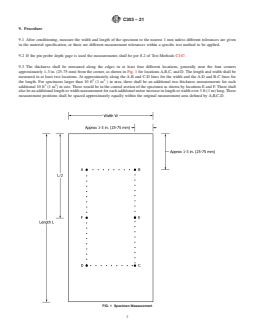
- Dimensional Measurement: Procedures for determining the length, width, and thickness of preformed insulation blocks and boards, including recommendations for measurement locations and instruments.
- Density Determination: Guidelines for calculating the density of insulation materials from measured mass and volume, including specifications for sample preparation and conditioning.
- Specimen Preparation: Requirements for sample size, trimming, and conditioning (e.g., dried or “as received”).
- Test Apparatus: Details on the tools required for accurate measurements, such as calipers, scales, and drying ovens, with tolerance requirements and calibration notes.
- Results Reporting: Instructions on reporting average density, dimensions, material identification, testing date, and conditioning state to ensure traceability and consistency.
- Significance and Use:
- Verifying compliance with specification limits for product acceptance.
- Assessing physical and mechanical properties, as density closely relates to strength, thermal conductivity, and heat capacity.
- Supporting engineering decisions, such as equipment support sizing, especially where moisture content in installed insulation is relevant.
Applications
ASTM C303-21 is essential for a range of practical uses, including:
- Manufacturing Quality Control: Provides a standardized approach to verify that thermal insulation products meet specified size and density requirements.
- Product Specification Compliance: Enables manufacturers and customers to confirm products adhere to technical specifications, regulatory codes, and contract requirements.
- Construction and HVAC: Central to the evaluation of insulation used in building envelopes, HVAC systems, and industrial equipment, impacting system energy efficiency and lifecycle cost.
- Research & Development: Used in materials testing to analyze properties like strength and insulating value in relation to density and dimensions.
- Product Certification and Acceptance: Forms the basis for third-party verification, procurement specifications, and field quality assurance programs.
Related Standards
Several ASTM standards complement C303-21 for a broader approach to thermal insulation testing:
- ASTM C167 - Test Methods for Thickness and Density of Blanket or Batt Thermal Insulations
- ASTM C168 - Terminology Relating to Thermal Insulation
- ASTM C390 - Practice for Sampling and Acceptance of Thermal Insulation Lots
- ASTM C870 - Practice for Conditioning of Thermal Insulating Materials
These standards support the full lifecycle of thermal insulation testing from terminology and sample preparation to specific material categories.
Keywords: ASTM C303-21, thermal insulation measurement, density testing, dimensional analysis, block insulation, board insulation, thermal insulating materials, insulation quality control, ASTM thermal insulation standards
Relations
- Effective Date
- 15-Apr-2024
- Effective Date
- 01-Mar-2024
- Effective Date
- 01-Mar-2024
- Effective Date
- 01-Sep-2019
- Effective Date
- 15-Apr-2018
- Effective Date
- 01-Jun-2017
- Effective Date
- 15-Apr-2017
- Effective Date
- 15-Oct-2015
- Effective Date
- 01-Sep-2015
- Effective Date
- 01-Jun-2015
- Effective Date
- 01-Nov-2013
- Effective Date
- 01-Apr-2013
- Effective Date
- 01-Apr-2011
- Effective Date
- 01-Jan-2010
- Effective Date
- 01-Apr-2009
Buy Documents
ASTM C303-21 - Standard Test Method for Dimensions and Density of Preformed Block and Board–Type Thermal Insulation
REDLINE ASTM C303-21 - Standard Test Method for Dimensions and Density of Preformed Block and Board–Type Thermal Insulation
Get Certified
Connect with accredited certification bodies for this standard

DIBt (Deutsches Institut für Bautechnik)
German Institute for Building Technology.
DIN CERTCO
DIN Group product certification.

Aboma Certification B.V.
Specialized in construction, metal, and transport sectors.
Sponsored listings
Frequently Asked Questions
ASTM C303-21 is a standard published by ASTM International. Its full title is "Standard Test Method for Dimensions and Density of Preformed Block and Board–Type Thermal Insulation". This standard covers: SIGNIFICANCE AND USE 5.1 Dimensional measurements of the product thermal insulation are essential in determining compliance of a product with specification limits. Dimensional measurements of various test specimens are also required by the specific test method. 5.2 Density measurements of the product insulation are useful in determining compliance of a product with specification limits, and in providing a relative gage of product weights. For any one kind of insulation, some important physical and mechanical properties, such as thermal conductivity, heat capacity, strength, etc., bear a specific relationship with its density. In order to design for equipment supports, check the material for the “as received density” where the moisture content of the product as received and then installed has the potential to be consequential. SCOPE 1.1 This test method covers determination of the dimensions and density of block and board insulation as defined in Terminology C168. 1.2 The values stated in inch-pound units are to be regarded as standard. The values given in parentheses are mathematical conversions to SI units that are provided for information only and are not considered standard. 1.3 This standard does not purport to address all of the safety concerns, if any, associated with its use. It is the responsibility of the user of this standard to establish appropriate safety, health, and environmental practices and determine the applicability of regulatory limitations prior to use. 1.4 This international standard was developed in accordance with internationally recognized principles on standardization established in the Decision on Principles for the Development of International Standards, Guides and Recommendations issued by the World Trade Organization Technical Barriers to Trade (TBT) Committee.
SIGNIFICANCE AND USE 5.1 Dimensional measurements of the product thermal insulation are essential in determining compliance of a product with specification limits. Dimensional measurements of various test specimens are also required by the specific test method. 5.2 Density measurements of the product insulation are useful in determining compliance of a product with specification limits, and in providing a relative gage of product weights. For any one kind of insulation, some important physical and mechanical properties, such as thermal conductivity, heat capacity, strength, etc., bear a specific relationship with its density. In order to design for equipment supports, check the material for the “as received density” where the moisture content of the product as received and then installed has the potential to be consequential. SCOPE 1.1 This test method covers determination of the dimensions and density of block and board insulation as defined in Terminology C168. 1.2 The values stated in inch-pound units are to be regarded as standard. The values given in parentheses are mathematical conversions to SI units that are provided for information only and are not considered standard. 1.3 This standard does not purport to address all of the safety concerns, if any, associated with its use. It is the responsibility of the user of this standard to establish appropriate safety, health, and environmental practices and determine the applicability of regulatory limitations prior to use. 1.4 This international standard was developed in accordance with internationally recognized principles on standardization established in the Decision on Principles for the Development of International Standards, Guides and Recommendations issued by the World Trade Organization Technical Barriers to Trade (TBT) Committee.
ASTM C303-21 is classified under the following ICS (International Classification for Standards) categories: 91.100.60 - Thermal and sound insulating materials. The ICS classification helps identify the subject area and facilitates finding related standards.
ASTM C303-21 has the following relationships with other standards: It is inter standard links to ASTM C168-24, ASTM C870-24, ASTM C390-08(2024), ASTM C390-08(2019), ASTM C168-18, ASTM C168-17, ASTM C870-11(2017), ASTM C168-15a, ASTM C167-15, ASTM C168-15, ASTM C390-08(2013), ASTM C168-13, ASTM C870-11, ASTM C168-10, ASTM C167-09. Understanding these relationships helps ensure you are using the most current and applicable version of the standard.
ASTM C303-21 is available in PDF format for immediate download after purchase. The document can be added to your cart and obtained through the secure checkout process. Digital delivery ensures instant access to the complete standard document.
Standards Content (Sample)
This international standard was developed in accordance with internationally recognized principles on standardization established in the Decision on Principles for the
Development of International Standards, Guides and Recommendations issued by the World Trade Organization Technical Barriers to Trade (TBT) Committee.
Designation: C303 − 21
Standard Test Method for
Dimensions and Density of Preformed Block and
Board–Type Thermal Insulation
This standard is issued under the fixed designation C303; the number immediately following the designation indicates the year of
original adoption or, in the case of revision, the year of last revision. A number in parentheses indicates the year of last reapproval. A
superscript epsilon (´) indicates an editorial change since the last revision or reapproval.
This standard has been approved for use by agencies of the U.S. Department of Defense.
1. Scope 3. Terminology
3.1 General—Terminology C168 shall be considered as
1.1 Thistestmethodcoversdeterminationofthedimensions
applicable to the terms used in this test method.
and density of block and board insulation as defined in
Terminology C168.
4. Summary of Test Method
1.2 The values stated in inch-pound units are to be regarded
4.1 The material shall be tested in the “dry” condition or in
as standard. The values given in parentheses are mathematical
the “as manufactured and received” condition (see Note 1) but
conversions to SI units that are provided for information only
the procedure must be consistent with that as given in the
and are not considered standard.
materialspecification.Ifthematerialistobetestedinthe“dry”
1.3 This standard does not purport to address all of the condition it shall be dried to constant mass. If the material
safety concerns, if any, associated with its use. It is the specification does not give conditioning instructions, Practice
responsibility of the user of this standard to establish appro-
C870 shall be used. From the measured mass and measured
priate safety, health, and environmental practices and deter- dimensions, the density of the product is calculated.
mine the applicability of regulatory limitations prior to use.
NOTE 1—Some materials may contain volatiles such as moisture when
1.4 This international standard was developed in accor-
manufactured or shipped, or both.
dance with internationally recognized principles on standard-
5. Significance and Use
ization established in the Decision on Principles for the
Development of International Standards, Guides and Recom-
5.1 Dimensional measurements of the product thermal in-
mendations issued by the World Trade Organization Technical
sulation are essential in determining compliance of a product
Barriers to Trade (TBT) Committee.
with specification limits. Dimensional measurements of vari-
ous test specimens are also required by the specific test
2. Referenced Documents
method.
5.2 Density measurements of the product insulation are
2.1 ASTM Standards:
useful in determining compliance of a product with specifica-
C167 Test Methods for Thickness and Density of Blanket or
tion limits, and in providing a relative gage of product weights.
Batt Thermal Insulations
For any one kind of insulation, some important physical and
C168 Terminology Relating to Thermal Insulation
mechanical properties, such as thermal conductivity, heat
C390 Practice for Sampling and Acceptance of Thermal
Insulation Lots capacity, strength, etc., bear a specific relationship with its
density. In order to design for equipment supports, check the
C870 Practice for Conditioning of Thermal Insulating Ma-
terials material for the “as received density” where the moisture
content of the product as received and then installed has the
potential to be consequential.
ThistestmethodisunderthejurisdictionofASTMCommitteeC16onThermal
6. Apparatus
Insulation and is the direct responsibility of Subcommittee C16.32 on Mechanical
Properties.
6.1 Steel measure, (ruler or tape), graduated in millimetres
Current edition approved March 1, 2021. Published March 2021. Originally
or better, suitable for measuring dimensions to 6 1.0 % (see
ε1
approved in 1952. Last previous edition approved in 2016 as C303 – 10 (2016) .
Note 2).
DOI: 10.1520/C0303-21.
For referenced ASTM standards, visit the ASTM website, www.astm.org, or
6.2 Instrument, such as caliper, dial gage, or micrometer
contact ASTM Customer Service at service@astm.org. For Annual Book of ASTM
graduated in millimetres or better, with a minimum plate
Standards volume information, refer to the standard’s Document Summary page on
the ASTM website. diameter of 6 mm, and a maximum plate of 1.0 by 1.0 in. (25
Copyright © ASTM International, 100 Barr Harbor Drive, PO Box C700, West Conshohocken, PA 19428-2959. United States
C303 − 21
by 25 mm).This instrument shall be suitable for measuring the there shall be an additional two thickness measurements for
2 2
dimensions to 61.0 %. This instrument shall not cause defor- each additional 10 ft (1 m ) in size. These would be in the
mation of the product when measuring it. Ensure that the central section of the specimen as shown by locations E and F.
pressure exerted by this measuring plate does not exceed 0.040 There shall also be an additional length or width measurement
psi or 5psf (0.245 kPa). for each additional meter increase in length or width over 3 ft
(1 m) long. These measurement positi
...
This document is not an ASTM standard and is intended only to provide the user of an ASTM standard an indication of what changes have been made to the previous version. Because
it may not be technically possible to adequately depict all changes accurately, ASTM recommends that users consult prior editions as appropriate. In all cases only the current version
of the standard as published by ASTM is to be considered the official document.
´1
Designation: C303 − 10 (Reapproved 2016) C303 − 21
Standard Test Method for
Dimensions and Density of Preformed Block and
Board–Type Thermal Insulation
This standard is issued under the fixed designation C303; the number immediately following the designation indicates the year of
original adoption or, in the case of revision, the year of last revision. A number in parentheses indicates the year of last reapproval. A
superscript epsilon (´) indicates an editorial change since the last revision or reapproval.
This standard has been approved for use by agencies of the U.S. Department of Defense.
ε NOTE—Editorially corrected 5.2 and 6.2 in November 2016.
1. Scope
1.1 This test method covers determination of the dimensions and density of block and board insulation as defined in Terminology
C168.
1.2 The values stated in inch-pound units are to be regarded as standard. The values given in parentheses are mathematical
conversions to SI units that are provided for information only and are not considered standard.
1.3 This standard does not purport to address all of the safety concerns, if any, associated with its use. It is the responsibility
of the user of this standard to establish appropriate safety safety, health, and healthenvironmental practices and determine the
applicability of regulatory limitations prior to use.
1.4 This international standard was developed in accordance with internationally recognized principles on standardization
established in the Decision on Principles for the Development of International Standards, Guides and Recommendations issued
by the World Trade Organization Technical Barriers to Trade (TBT) Committee.
2. Referenced Documents
2.1 ASTM Standards:
C167 Test Methods for Thickness and Density of Blanket or Batt Thermal Insulations
C168 Terminology Relating to Thermal Insulation
C390 Practice for Sampling and Acceptance of Thermal Insulation Lots
C870 Practice for Conditioning of Thermal Insulating Materials
3. Terminology
3.1 General—Terminology C168 shall be considered as applicable to the terms used in this test method.
4. Summary of Test Method
4.1 The material shall be tested in the “dry” condition or in the “as manufactured and received” condition (see Note 1) but the
This test method is under the jurisdiction of ASTM Committee C16 on Thermal Insulation and is the direct responsibility of Subcommittee C16.32 on Mechanical
Properties.
Current edition approved Oct. 15, 2016March 1, 2021. Published November 2016March 2021. Originally published as approved in 1952. Last previous edition approved
ε1
in 20102016 as C303 – 10.C303 – 10 (2016) . DOI: 10.1520/C0303-10R16E01.10.1520/C0303-21.
For referenced ASTM standards, visit the ASTM website, www.astm.org, or contact ASTM Customer Service at service@astm.org. For Annual Book of ASTM Standards
volume information, refer to the standard’s Document Summary page on the ASTM website.
Copyright © ASTM International, 100 Barr Harbor Drive, PO Box C700, West Conshohocken, PA 19428-2959. United States
C303 − 21
procedure must be consistent with that as given in the material specification. If the material is to be tested in the “dry” condition
it shall be dried to constant mass. If the material specification does not give conditioning instructions, a conditioning environment
of 73°F 6 4°F (23°C 6 2°C) and 50 6 5 % relative humidity per Practice C870 shall be used. From the measured mass and
measured dimensions, the density of the product is calculated.
NOTE 1—Some materials may contain volatiles such as moisture when manufactured or shipped, or both.
5. Significance and Use
5.1 Dimensional measurements of the product thermal insulation are essential in determining compliance of a product with
specification limits. Dimensional measurements of various test specimens are also required by the specific test method.
5.2 Density measurements of the product insulation are useful in determining compliance of a product with specification limits,
and in providing a relative gage of product weights. For any one kind of insulation, some important physical and mechanical
properties, such as thermal conductivity, heat capacity, strength, etc., bear a specific relationship with its density. In order to design
for equipment supports, check the material for the “as received density” where the moisture content of the product as received and
then installed has the potential to be consequential.
6. Apparatus
6.1 Steel measure, (ruler or tape), graduated in millimetres or better, suitable for measuring dimensions to 6 1.0 % (see Note 2).
6.2 Instrument, such as caliper, dial gage, or micrometer graduated in millimetres or better, with a minimum plate diameter of 6
mm, and a maximum plate of 1.0 by 1.0 in. (25 by 25 mm). This instrument shall be suitable for measuring the dimensions to
61.0 %. This instrument shall not cause deformation of the product when measuring it. Ensure that the pressure exerted by this
measuring plate does not exceed 0.040 psi or 5psf (0.245 kPa).
6.3 Pin probe depth gage per Test Methods C167.
6.4 Scales, accurate to within 0.0lb (5g) or within 1 % of the specimen mass (whichever is less). If the material specification calls
for a greater accuracy, this shall take precedence. If the samples are
...