

ASTM D7611/D7611M-21
(Practice)Standard Practice for Coding Plastic Manufactured Articles for Resin Identification
General Information
- Abstract
SIGNIFICANCE AND USE
4.1 Resin Identification Codes are used solely to identify the plastic resin used in a manufactured article. The intended manufactured articles include, but are not limited to, packaging.
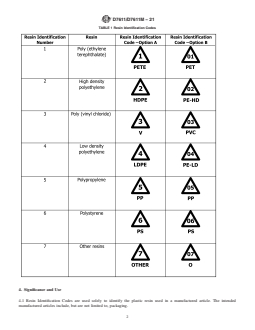
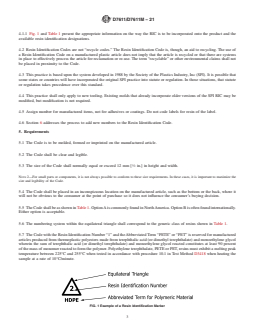
4.1.1 Fig. 1 and Table 1 present the appropriate information on the way the RIC is to be incorporated onto the product and the available resin identification designations.
FIG. 1 Example of a Resin Identification Marker
4.2 Resin Identification Codes are not “recycle codes.” The Resin Identification Code is, though, an aid to recycling. The use of a Resin Identification Code on a manufactured plastic article does not imply that the article is recycled or that there are systems in place to effectively process the article for reclamation or re-use. The term “recyclable” or other environmental claims shall not be placed in proximity to the Code.
4.3 This practice is based upon the system developed in 1988 by the Society of the Plastics Industry, Inc (SPI). It is possible that some states or countries will have incorporated the original SPI practice into statute or regulation. In those situations, that statute or regulation takes precedence over this standard.
4.4 This practice shall only apply to new tooling. Existing molds that already incorporate older versions of the SPI RIC may be modified, but modification is not required.
4.5 Assign number for manufactured items, not for adhesives or coatings. Do not code labels for resin of the label.
4.6 Section 6 addresses the process to add new numbers to the Resin Identification Code.
SCOPE
1.1 This practice stipulates the types, names, and sizes of Codes for those material types specified in Table 1.
1.2 The values stated in either SI units or inch-pound units are to be regarded separately as standard. The values stated in each system are likely not to be exact equivalents; therefore, each system shall be used independently of the other. Combining values from the two systems is likely to result in non-conformance with the standard.
1.3 This standard does not purport to address all of the safety concerns, if any, associated with its use. It is the responsibility of the user of this standard to establish appropriate safety, health, and environmental practices and determine the applicability of regulatory limitations prior to use.
Note 1: There is no known ISO equivalent to this standard.
1.4 This international standard was developed in accordance with internationally recognized principles on standardization established in the Decision on Principles for the Development of International Standards, Guides and Recommendations issued by the World Trade Organization Technical Barriers to Trade (TBT) Committee.
- Status
- Published
- Publication Date
- 30-Nov-2021
- Technical Committee
- D20 - Plastics
- Drafting Committee
- D20.95 - Recycled Plastics
Buy Documents

ASTM D7611/D7611M-21 - Standard Practice for Coding Plastic Manufactured Articles for Resin Identification
REDLINE ASTM D7611/D7611M-21 - Standard Practice for Coding Plastic Manufactured Articles for Resin Identification
Overview
ASTM D7611/D7611M-21 is the internationally recognized standard practice for coding plastic manufactured articles for resin identification. Developed by ASTM International, this standard specifies the system of Resin Identification Codes (RICs) used to distinguish the plastic resin material content in products. The RIC system serves a critical role in the identification of materials, supporting more efficient handling, sorting, and potential recycling of plastic articles. However, it is important to note that RICs are not recycling codes; rather, they are designed solely for resin identification.
Key Topics
- Resin Identification Codes (RIC): The hallmark of this standard is the application of codes-comprising a number enclosed in a triangle with an abbreviation beneath-on plastic articles, indicating the type of plastic resin used. These codes help industries and recyclers identify the major classes of resins, such as PET, HDPE, PVC, LDPE, PP, PS, and OTHER.
- Scope of Application: ASTM D7611/D7611M-21 applies to newly manufactured plastic products, especially packaging articles, and governs the size, placement, and legibility requirements of the identification codes.
- Regulatory Context: RICs are separate from recycling claims. The standard explicitly prohibits placing environmental claims like “recyclable” near the code, ensuring clarity for consumers and compliance with regulations.
- Legal and Historical Foundation: The practice is based on the original system developed by the Society of the Plastics Industry (SPI). Many jurisdictions, including several U.S. states and countries like China and the UK, reference these resin identification standards in their legislation.
- Process for Updates: The standard includes provisions for the addition of new resin types through a systematic process, ensuring relevance as polymers and plastics technology evolve.
Applications
The use of ASTM D7611/D7611M-21 is widespread in the plastics industry for:
- Product Marking: Manufacturers use RICs as a consistent method to label plastic articles for downstream supply chain, regulatory requirements, and waste sorting purposes.
- Recycling Support: While not directly recycling codes, RICs assist recyclers and material recovery facilities by providing essential information for sorting and processing plastics.
- Regulatory Compliance: Compliance with ASTM D7611/D7611M-21 may be required by law in certain regions, and helps ensure products align with both domestic and international market expectations.
- Material Identification: RICs offer a simple, visual cue for resin type, aiding decisions on processing, compatibility, and end-of-life management within manufacturing and recycling systems.
- Education and Communication: Provides clear material information for product designers, wholesalers, and consumers, supporting efforts toward responsible plastic use.
Related Standards
Several other ASTM standards and regulatory frameworks are relevant to the proper identification and management of plastics, including:
- ASTM D3418: Test Method for Transition Temperatures and Enthalpies of Fusion and Crystallization of Polymers by Differential Scanning Calorimetry.
- ASTM D4020: Specification for Ultra-High-Molecular-Weight Polyethylene Molding and Extrusion Materials.
- British Plastics Federation and PlasticsEurope Recommendations: For conformity within the European market.
- Regional and national legislation: Many jurisdictions reference or require use of the ASTM resin identification system in statutes regarding plastics.
Keywords: ASTM D7611, resin identification code, plastics coding, polymer identification standard, plastic recycling identification, SPI code, packaging material marking, plastics standardization.
Relations
- Effective Date
- 01-Aug-2012
- Effective Date
- 01-Aug-2012
- Effective Date
- 01-Sep-2011
- Effective Date
- 01-Jun-2005
- Effective Date
- 01-Dec-2003
- Effective Date
- 10-Nov-2001
- Effective Date
- 10-Nov-2001
- Effective Date
- 10-Nov-2001
- Effective Date
- 10-Apr-1999
Buy Documents
ASTM D7611/D7611M-21 - Standard Practice for Coding Plastic Manufactured Articles for Resin Identification
REDLINE ASTM D7611/D7611M-21 - Standard Practice for Coding Plastic Manufactured Articles for Resin Identification
Get Certified
Connect with accredited certification bodies for this standard

DIN CERTCO
DIN Group product certification.

Smithers Quality Assessments
US management systems and product certification.
Sponsored listings
Frequently Asked Questions
ASTM D7611/D7611M-21 is a standard published by ASTM International. Its full title is "Standard Practice for Coding Plastic Manufactured Articles for Resin Identification". This standard covers: SIGNIFICANCE AND USE 4.1 Resin Identification Codes are used solely to identify the plastic resin used in a manufactured article. The intended manufactured articles include, but are not limited to, packaging. 4.1.1 Fig. 1 and Table 1 present the appropriate information on the way the RIC is to be incorporated onto the product and the available resin identification designations. FIG. 1 Example of a Resin Identification Marker 4.2 Resin Identification Codes are not “recycle codes.” The Resin Identification Code is, though, an aid to recycling. The use of a Resin Identification Code on a manufactured plastic article does not imply that the article is recycled or that there are systems in place to effectively process the article for reclamation or re-use. The term “recyclable” or other environmental claims shall not be placed in proximity to the Code. 4.3 This practice is based upon the system developed in 1988 by the Society of the Plastics Industry, Inc (SPI). It is possible that some states or countries will have incorporated the original SPI practice into statute or regulation. In those situations, that statute or regulation takes precedence over this standard. 4.4 This practice shall only apply to new tooling. Existing molds that already incorporate older versions of the SPI RIC may be modified, but modification is not required. 4.5 Assign number for manufactured items, not for adhesives or coatings. Do not code labels for resin of the label. 4.6 Section 6 addresses the process to add new numbers to the Resin Identification Code. SCOPE 1.1 This practice stipulates the types, names, and sizes of Codes for those material types specified in Table 1. 1.2 The values stated in either SI units or inch-pound units are to be regarded separately as standard. The values stated in each system are likely not to be exact equivalents; therefore, each system shall be used independently of the other. Combining values from the two systems is likely to result in non-conformance with the standard. 1.3 This standard does not purport to address all of the safety concerns, if any, associated with its use. It is the responsibility of the user of this standard to establish appropriate safety, health, and environmental practices and determine the applicability of regulatory limitations prior to use. Note 1: There is no known ISO equivalent to this standard. 1.4 This international standard was developed in accordance with internationally recognized principles on standardization established in the Decision on Principles for the Development of International Standards, Guides and Recommendations issued by the World Trade Organization Technical Barriers to Trade (TBT) Committee.
SIGNIFICANCE AND USE 4.1 Resin Identification Codes are used solely to identify the plastic resin used in a manufactured article. The intended manufactured articles include, but are not limited to, packaging. 4.1.1 Fig. 1 and Table 1 present the appropriate information on the way the RIC is to be incorporated onto the product and the available resin identification designations. FIG. 1 Example of a Resin Identification Marker 4.2 Resin Identification Codes are not “recycle codes.” The Resin Identification Code is, though, an aid to recycling. The use of a Resin Identification Code on a manufactured plastic article does not imply that the article is recycled or that there are systems in place to effectively process the article for reclamation or re-use. The term “recyclable” or other environmental claims shall not be placed in proximity to the Code. 4.3 This practice is based upon the system developed in 1988 by the Society of the Plastics Industry, Inc (SPI). It is possible that some states or countries will have incorporated the original SPI practice into statute or regulation. In those situations, that statute or regulation takes precedence over this standard. 4.4 This practice shall only apply to new tooling. Existing molds that already incorporate older versions of the SPI RIC may be modified, but modification is not required. 4.5 Assign number for manufactured items, not for adhesives or coatings. Do not code labels for resin of the label. 4.6 Section 6 addresses the process to add new numbers to the Resin Identification Code. SCOPE 1.1 This practice stipulates the types, names, and sizes of Codes for those material types specified in Table 1. 1.2 The values stated in either SI units or inch-pound units are to be regarded separately as standard. The values stated in each system are likely not to be exact equivalents; therefore, each system shall be used independently of the other. Combining values from the two systems is likely to result in non-conformance with the standard. 1.3 This standard does not purport to address all of the safety concerns, if any, associated with its use. It is the responsibility of the user of this standard to establish appropriate safety, health, and environmental practices and determine the applicability of regulatory limitations prior to use. Note 1: There is no known ISO equivalent to this standard. 1.4 This international standard was developed in accordance with internationally recognized principles on standardization established in the Decision on Principles for the Development of International Standards, Guides and Recommendations issued by the World Trade Organization Technical Barriers to Trade (TBT) Committee.
ASTM D7611/D7611M-21 is classified under the following ICS (International Classification for Standards) categories: 83.140.01 - Rubber and plastics products in general. The ICS classification helps identify the subject area and facilitates finding related standards.
ASTM D7611/D7611M-21 has the following relationships with other standards: It is inter standard links to ASTM D3418-12, ASTM D3418-12e1, ASTM D4020-11, ASTM D4020-05, ASTM D3418-03, ASTM D4020-01a, ASTM D4020-01, ASTM D4020-00a, ASTM D3418-99. Understanding these relationships helps ensure you are using the most current and applicable version of the standard.
ASTM D7611/D7611M-21 is available in PDF format for immediate download after purchase. The document can be added to your cart and obtained through the secure checkout process. Digital delivery ensures instant access to the complete standard document.
Standards Content (Sample)
This international standard was developed in accordance with internationally recognized principles on standardization established in the Decision on Principles for the
Development of International Standards, Guides and Recommendations issued by the World Trade Organization Technical Barriers to Trade (TBT) Committee.
Designation:D7611/D7611M −21
Standard Practice for
Coding Plastic Manufactured Articles for Resin
Identification
This standard is issued under the fixed designation D7611/D7611M; the number immediately following the designation indicates the
year of original adoption or, in the case of revision, the year of last revision. A number in parentheses indicates the year of last
reapproval. A superscript epsilon (´) indicates an editorial change since the last revision or reapproval.
1. Scope* 2.2 ASTM Adjuncts:
Adjunct to D7611/D7611M Standard Practice for Coding
1.1 This practice stipulates the types, names, and sizes of
Plastic Manufactured Articles for Resin Identification
Codes for those material types specified in Table 1.
3. Terminology
1.2 The values stated in either SI units or inch-pound units
are to be regarded separately as standard. The values stated in
3.1 Definitions:
each system are likely not to be exact equivalents; therefore, 3.1.1 Resin Identification Code (RIC Code)—a molded,
each system shall be used independently of the other. Combin- imprinted or raised symbol or wording that consists of an
equilateral triangle, a Resin Identification Number, and an
ing values from the two systems is likely to result in non-
Abbreviated Term for polymeric material.
conformance with the standard.
1.3 This standard does not purport to address all of the
4. Significance and Use
safety concerns, if any, associated with its use. It is the
4.1 ResinIdentificationCodesareusedsolelytoidentifythe
responsibility of the user of this standard to establish appro-
plastic resin used in a manufactured article. The intended
priate safety, health, and environmental practices and deter-
manufactured articles include, but are not limited to, packag-
mine the applicability of regulatory limitations prior to use.
ing.
4.1.1 Fig. 1 and Table 1 present the appropriate information
NOTE 1—There is no known ISO equivalent to this standard.
on the way the RIC is to be incorporated onto the product and
1.4 This international standard was developed in accor-
the available resin identification designations.
dance with internationally recognized principles on standard-
4.2 Resin Identification Codes are not “recycle codes.” The
ization established in the Decision on Principles for the
Resin Identification Code is, though, an aid to recycling. The
Development of International Standards, Guides and Recom-
use of a Resin Identification Code on a manufactured plastic
mendations issued by the World Trade Organization Technical
article does not imply that the article is recycled or that there
Barriers to Trade (TBT) Committee.
are systems in place to effectively process the article for
reclamation or re-use. The term “recyclable” or other environ-
2. Referenced Documents
mental claims shall not be placed in proximity to the Code.
2.1 ASTM Standards:
4.3 This practice is based upon the system developed in
D3418 Test Method for Transition Temperatures and En-
1988 by the Society of the Plastics Industry, Inc (SPI). It is
thalpies of Fusion and Crystallization of Polymers by
possible that some states or countries will have incorporated
Differential Scanning Calorimetry
the original SPI practice into statute or regulation. In those
D4020 Specification for Ultra-High-Molecular-Weight Poly-
situations, that statute or regulation takes precedence over this
ethylene Molding and Extrusion Materials
standard.
4.4 This practice shall only apply to new tooling. Existing
molds that already incorporate older versions of the SPI RIC
This practice is under the jurisdiction ofASTM Committee D20 on Plastics and may be modified, but modification is not required.
is the direct responsibility of Subcommittee D20.95 on Recycled Plastics.
4.5 Assign number for manufactured items, not for adhe-
Current edition approved Dec. 1, 2021. Published January 2022. Originally
approved in 2010. Last previous edition approved in 2020 as D7611/D7611M – 20. sives or coatings. Do not code labels for resin of the label.
DOI:10.1520/D7611_D7611M-21.
For referenced ASTM standards, visit the ASTM website, www.astm.org, or
contact ASTM Customer Service at service@astm.org. For Annual Book of ASTM
Standards volume information, refer to the standard’s Document Summary page on Available from ASTM International Headquarters. Order Adjunct No.
the ASTM website. ADJD761114-EA. Original adjunct produced in 2010.Adjunct last revised in 2014.
*A Summary of Changes section appears at the end of this standard
Copyright © ASTM International, 100 Barr Harbor Drive, PO Box C700, West Conshohocken, PA 19428-2959. United States
D7611/D7611M−21
TABLE 1 Resin Identification Codes
D7611/D7611M−21
FIG. 1Example of a Resin Identification Marker
4.6 Section 6 addresses the process to add new numbers to 5.9 The Code with the Resin Identification Number “3” and
the Resin Identification Code. theAbbreviatedTerm“V”isreservedformanufacturedarticles
produced from vinyl chloride resins generally referred to as
5. Requirements
poly(vinyl chloride) or PVC.
5.1 The Code is to be molded, formed or imprinted on the
5.10 The Code with the Resin Identification Number Code
manufactured article.
“4” and the Abbreviated Term “LDPE” is reserved for manu-
factured articles produced from thermoplastic polyethylene
5.2 The Code shall be clear and legible.
plastics and exhibit a non-foamed, unfilled, resin-only portion
5.3 The size of the Code shall normally equal or exceed 12
of the structure density of less than 0.941 g/cm , measured or
mm [ ⁄2 in.] in height and width.
calculated. With ethylene always the majority monomer, other
NOTE 2—For small parts or components, it is not always possible to
alpha olefin comonomers are permitted as minority monomer
conform to these size requirements. In these cases, it is important to
components. Articles of LLDPE, VLDPE, and MDPE are
maximize the size and legibility of the Code.
grouped with LDPE as #4. LDPE articles are permitted to
5.4 The Code shall be placed in an inconspicuous location
contain minority amounts of other thermoplastic po
...
This document is not an ASTM standard and is intended only to provide the user of an ASTM standard an indication of what changes have been made to the previous version. Because
it may not be technically possible to adequately depict all changes accurately, ASTM recommends that users consult prior editions as appropriate. In all cases only the current version
of the standard as published by ASTM is to be considered the official document.
Designation: D7611/D7611M − 20 D7611/D7611M − 21
Standard Practice for
Coding Plastic Manufactured Articles for Resin
Identification
This standard is issued under the fixed designation D7611/D7611M; the number immediately following the designation indicates the
year of original adoption or, in the case of revision, the year of last revision. A number in parentheses indicates the year of last
reapproval. A superscript epsilon (´) indicates an editorial change since the last revision or reapproval.
1. Scope*
1.1 This practice stipulates the types, names, and sizes of Codes for those material types specified in Table 1.
1.2 The values stated in either SI units or inch-pound units are to be regarded separately as standard. The values stated in each
system are likely not to be exact equivalents; therefore, each system shall be used independently of the other. Combining values
from the two systems is likely to result in non-conformance with the standard.
1.3 This standard does not purport to address all of the safety concerns, if any, associated with its use. It is the responsibility
of the user of this standard to establish appropriate safety, health, and environmental practices and determine the applicability of
regulatory limitations prior to use.
NOTE 1—There is no known ISO equivalent to this standard.
1.4 This international standard was developed in accordance with internationally recognized principles on standardization
established in the Decision on Principles for the Development of International Standards, Guides and Recommendations issued
by the World Trade Organization Technical Barriers to Trade (TBT) Committee.
2. Referenced Documents
2.1 ASTM Standards:
D3418 Test Method for Transition Temperatures and Enthalpies of Fusion and Crystallization of Polymers by Differential
Scanning Calorimetry
D4020 Specification for Ultra-High-Molecular-Weight Polyethylene Molding and Extrusion Materials
2.2 ASTM Adjuncts:
Adjunct to D7611/D7611M Standard Practice for Coding Plastic Manufactured Articles for Resin Identification
3. Terminology
3.1 Definitions:
3.1.1 Resin Identification Code (RIC Code)—a molded, imprinted or raised symbol or wording that consists of an equilateral
triangle, a Resin Identification Number, and an Abbreviated Term for polymeric material.
This practice is under the jurisdiction of ASTM Committee D20 on Plastics and is the direct responsibility of Subcommittee D20.95 on Recycled Plastics.
Current edition approved Jan. 1, 2020Dec. 1, 2021. Published January 2020January 2022. Originally approved in 2010. Last previous edition approved in 20192020 as
D7611/D7611M – 19. DOI:10.1520/D7611_D7611M-20.20. DOI:10.1520/D7611_D7611M-21.
For referenced ASTM standards, visit the ASTM website, www.astm.org, or contact ASTM Customer Service at service@astm.org. For Annual Book of ASTM Standards
volume information, refer to the standard’s Document Summary page on the ASTM website.
Available from ASTM International Headquarters. Order Adjunct No. ADJD761114-EA. Original adjunct produced in 2010. Adjunct last revised in 2014.
*A Summary of Changes section appears at the end of this standard
Copyright © ASTM International, 100 Barr Harbor Drive, PO Box C700, West Conshohocken, PA 19428-2959. United States
D7611/D7611M − 21
TABLE 1 Resin Identification Codes
4. Significance and Use
4.1 Resin Identification Codes are used solely to identify the plastic resin used in a manufactured article. The intended
manufactured articles include, but are not limited to, packaging.
D7611/D7611M − 21
4.1.1 Fig. 1 and Table 1 present the appropriate information on the way the RIC is to be incorporated onto the product and the
available resin identification designations.
4.2 Resin Identification Codes are not “recycle codes.” The Resin Identification Code is, though, an aid to recycling. The use of
a Resin Identification Code on a manufactured plastic article does not imply that the article is recycled or that there are systems
in place to effectively process the article for reclamation or re-use. The term “recyclable” or other environmental claims shall not
be placed in proximity to the Code.
4.3 This practice is based upon the system developed in 1988 by the Society of the Plastics Industry, Inc (SPI). It is possible that
some states or countries will have incorporated the original SPI practice into statute or regulation. In those situations, that statute
or regulation takes precedence over this standard.
4.4 This practice shall only apply to new tooling. Existing molds that already incorporate older versions of the SPI RIC may be
modified, but modification is not required.
4.5 Assign number for manufactured items, not for adhesives or coatings. Do not code labels for resin of the label.
4.6 Section 6 addresses the process to add new numbers to the Resin Identification Code.
5. Requirements
5.1 The Code is to be molded, formed or imprinted on the manufactured article.
5.2 The Code shall be clear and legible.
5.3 The size of the Code shall normally equal or exceed 12 mm [ ⁄2 in.] in height and width.
NOTE 2—For small parts or components, it is not always possible to conform to these size requirements. In these cases, it is important to maximize the
size and legibility of the Code.
5.4 The Code shall be placed in an inconspicuous location on the manufactured article, such as the bottom or the back, where it
will not be obvious to the consumer at the point of purchase so it does not influence the consumer’s buying decision.
5.5 The Code shall be as shown in Table 1. Option A is commonly found in North America. Option B is often found internationally.
Either option is acceptable.
5.6 The numbering system within the equilateral triangle shall correspond to the generic class of resins shown in Table 1.
5.7 The Code with the Resin Identification Number “1” and the Abbreviated Term “PETE” or “PET” is reserved for manufactured
articles produced from thermoplastic polyesters made from terephthalic acid (or dimethyl terephthalate) and monoethylene glycol
wherein the sum of terephthalic acid (or dimethyl terephthalate) and monoethylene glycol reacted constitutes at least 90 percent
of the mass of monomer reacted to form the polymer. Polyethylene terephthalate, PETE or PET, resins must exhibit
...