

ASTM D5338-15(2021)
(Test Method)Standard Test Method for Determining Aerobic Biodegradation of Plastic Materials Under Controlled Composting Conditions, Incorporating Thermophilic Temperatures
General Information
- Abstract
SIGNIFICANCE AND USE
5.1 Biodegradation of a plastic within a composting unit is an important phenomenon because it may affect the decomposition of other materials enclosed by the plastic and the resulting quality and appearance of the composted material. Biodegradation of plastics will also allow the safe disposal of these plastics through large, professionally-managed composting plants and well-run residential units, where thermophilic temperatures are achieved. This procedure has been developed to permit the determination of the rate and degree of aerobic biodegradability of plastic products when placed in a controlled composting process.
5.2 Limitations—Because there is a wide variation in the construction and operation of composting facilities and because regulatory requirements for composting systems vary, this procedure is not intended to simulate the environment of any particular composting system. However, it is expected to resemble the environment of a composting process operated under optimum conditions where thermophilic temperatures are achieved. More specifically, the procedure is intended to create a standard laboratory environment that will permit a rapid and reproducible determination of the aerobic biodegradability under controlled composting conditions.
SCOPE
1.1 This test method determines the degree and rate of aerobic biodegradation of plastic materials on exposure to a controlled-composting environment under laboratory conditions, at thermophilic temperatures. This test method is designed to yield reproducible and repeatable test results under controlled conditions that resemble composting conditions, where thermophilic temperatures are achieved. The test substances are exposed to an inoculum that is derived from compost from municipal solid waste. The aerobic composting takes place in an environment where temperature, aeration and humidity are closely monitored and controlled.
Note 1: During composting, thermophilic temperatures are most readily achieved in large-scale, professionally-managed facilities. However, these temperatures may also be reached in smaller residential composting units, frequently referred to as “backyard” or “home” composting.
1.2 This test method is designed to yield a percentage of conversion of carbon in the sample to carbon dioxide. The rate of biodegradation is monitored as well.
1.3 This test method is designed to be applicable to all plastic materials, which are intended to be composted in facilities that achieve thermophilic temperatures.
1.4 The values stated in SI units are to be regarded as the standard.
1.5 This standard does not purport to address all of the safety concerns, if any, associated with its use. It is the responsibility of the user of this standard to establish appropriate safety, health, and environmental practices and determine the applicability of regulatory limitations prior to use. Specific hazard statements are given in Section 8.
1.6 This standard does not purport to address all of the safety concerns, if any, associated with its use. It is the responsibility of the user of this standard to establish appropriate safety and health practices and determine the applicability of regulatory limitations prior to use.
1.7 This test method is equivalent to ISO 14855.
1.8 This international standard was developed in accordance with internationally recognized principles on standardization established in the Decision on Principles for the Development of International Standards, Guides and Recommendations issued by the World Trade Organization Technical Barriers to Trade (TBT) Committee.
- Status
- Published
- Publication Date
- 14-Jan-2021
- Technical Committee
- D20 - Plastics
- Drafting Committee
- D20.96 - Environmentally Degradable Plastics and Biobased Products
Overview
ASTM D5338-15(2021) is an internationally recognized standard developed by ASTM International for assessing the aerobic biodegradation of plastic materials under controlled composting conditions with thermophilic temperatures. This test method is critical for determining both the rate and extent to which plastics are converted to carbon dioxide under optimized laboratory composting environments. Such evaluations support claims related to the compostability and environmental impact of plastic products intended for disposal in industrial composting facilities or well-managed residential composting units achieving thermophilic temperatures.
ASTM D5338 is widely referenced by manufacturers, regulatory authorities, and environmental organizations to demonstrate that plastic materials can break down safely and efficiently in a composting environment, supporting sustainable waste management practices.
Key Topics
- Purpose and Scope: The standard enables measurement of the rate and percentage of aerobic biodegradability of plastics by exposing them to compost derived from municipal solid waste at controlled temperatures, typically around 58°C.
- Controlled Composting Environment: Laboratory conditions simulate optimized composting processes, ensuring results that are both reproducible and repeatable.
- Measurement Method: Biodegradation is quantified by monitoring the conversion of carbon in the plastic to carbon dioxide over a set testing period.
- Test Applicability: Suitable for all types of plastic materials targeted for composting in environments where thermophilic temperatures are achieved.
- Limitations: This method does not replicate all types of composting systems but aims to reflect conditions in well-run, large-scale or home composting units.
- Comparability: The test method is equivalent to ISO 14855, supporting international alignment on testing procedures.
- Reporting: Results include the degree of biodegradation, standard deviation, controls used (including positive and negative reference materials), and key parameters such as inoculum details and composting conditions.
Applications
ASTM D5338-15(2021) provides practical value in multiple areas:
- Product Validation: Plastic producers rely on this standard to substantiate compostable or biodegradable claims for their materials and products, particularly in packaging, agricultural films, and single-use items.
- Regulatory Compliance: The method is commonly required or accepted by regulatory bodies when evaluating plastic biodegradability claims for labeling and market access.
- Eco-Label Certification: Environmental certification schemes use results from this test to verify that products meet compostability requirements.
- Research and Development: Researchers utilize this standard to compare the degradation profiles of new materials, analyze environmental impact, and optimize polymer formulas for end-of-life scenarios.
- Waste Management Planning: Facility operators and municipal planners assess the compatibility of different plastic waste streams with commercial or community composting processes using this method.
Related Standards
When implementing ASTM D5338-15(2021), stakeholders may also reference these complementary standards:
- ISO 14855: Plastics - Evaluation of the Ultimate Aerobic Biodegradability and Disintegration under Controlled Composting Conditions (method by analysis of released carbon dioxide); equivalent international method.
- ASTM D6400: Specification for compostable plastics.
- ASTM D883: Terminology relating to plastics.
- ASTM D618: Practice for conditioning plastics for testing.
- ASTM D1293/D3590/D4129: Additional test methods cited within D5338 for related analytical procedures.
Summary
By following ASTM D5338-15(2021), producers, researchers, and decision-makers gain reliable data on the biodegradability of plastic materials in composting environments. This supports sustainable product development, regulatory compliance, and environmentally responsible waste management, fostering a circular economy for plastics. For further effectiveness, ensure alignment with related standards and consider real-world composting conditions when interpreting results.
Relations
- Effective Date
- 01-Apr-2024
- Effective Date
- 01-Feb-2024
- Effective Date
- 01-Nov-2023
- Effective Date
- 01-Jan-2020
- Effective Date
- 01-Jan-2020
- Effective Date
- 01-Sep-2019
- Effective Date
- 01-Aug-2019
- Effective Date
- 15-Apr-2019
- Effective Date
- 01-Feb-2019
- Effective Date
- 01-Dec-2018
- Effective Date
- 01-Nov-2018
- Effective Date
- 15-Dec-2017
- Effective Date
- 15-Aug-2017
- Effective Date
- 01-Jun-2017
- Effective Date
- 15-Nov-2012
Get Certified
Connect with accredited certification bodies for this standard

DIN CERTCO
DIN Group product certification.

Smithers Quality Assessments
US management systems and product certification.
Sponsored listings
Frequently Asked Questions
ASTM D5338-15(2021) is a standard published by ASTM International. Its full title is "Standard Test Method for Determining Aerobic Biodegradation of Plastic Materials Under Controlled Composting Conditions, Incorporating Thermophilic Temperatures". This standard covers: SIGNIFICANCE AND USE 5.1 Biodegradation of a plastic within a composting unit is an important phenomenon because it may affect the decomposition of other materials enclosed by the plastic and the resulting quality and appearance of the composted material. Biodegradation of plastics will also allow the safe disposal of these plastics through large, professionally-managed composting plants and well-run residential units, where thermophilic temperatures are achieved. This procedure has been developed to permit the determination of the rate and degree of aerobic biodegradability of plastic products when placed in a controlled composting process. 5.2 Limitations—Because there is a wide variation in the construction and operation of composting facilities and because regulatory requirements for composting systems vary, this procedure is not intended to simulate the environment of any particular composting system. However, it is expected to resemble the environment of a composting process operated under optimum conditions where thermophilic temperatures are achieved. More specifically, the procedure is intended to create a standard laboratory environment that will permit a rapid and reproducible determination of the aerobic biodegradability under controlled composting conditions. SCOPE 1.1 This test method determines the degree and rate of aerobic biodegradation of plastic materials on exposure to a controlled-composting environment under laboratory conditions, at thermophilic temperatures. This test method is designed to yield reproducible and repeatable test results under controlled conditions that resemble composting conditions, where thermophilic temperatures are achieved. The test substances are exposed to an inoculum that is derived from compost from municipal solid waste. The aerobic composting takes place in an environment where temperature, aeration and humidity are closely monitored and controlled. Note 1: During composting, thermophilic temperatures are most readily achieved in large-scale, professionally-managed facilities. However, these temperatures may also be reached in smaller residential composting units, frequently referred to as “backyard” or “home” composting. 1.2 This test method is designed to yield a percentage of conversion of carbon in the sample to carbon dioxide. The rate of biodegradation is monitored as well. 1.3 This test method is designed to be applicable to all plastic materials, which are intended to be composted in facilities that achieve thermophilic temperatures. 1.4 The values stated in SI units are to be regarded as the standard. 1.5 This standard does not purport to address all of the safety concerns, if any, associated with its use. It is the responsibility of the user of this standard to establish appropriate safety, health, and environmental practices and determine the applicability of regulatory limitations prior to use. Specific hazard statements are given in Section 8. 1.6 This standard does not purport to address all of the safety concerns, if any, associated with its use. It is the responsibility of the user of this standard to establish appropriate safety and health practices and determine the applicability of regulatory limitations prior to use. 1.7 This test method is equivalent to ISO 14855. 1.8 This international standard was developed in accordance with internationally recognized principles on standardization established in the Decision on Principles for the Development of International Standards, Guides and Recommendations issued by the World Trade Organization Technical Barriers to Trade (TBT) Committee.
SIGNIFICANCE AND USE 5.1 Biodegradation of a plastic within a composting unit is an important phenomenon because it may affect the decomposition of other materials enclosed by the plastic and the resulting quality and appearance of the composted material. Biodegradation of plastics will also allow the safe disposal of these plastics through large, professionally-managed composting plants and well-run residential units, where thermophilic temperatures are achieved. This procedure has been developed to permit the determination of the rate and degree of aerobic biodegradability of plastic products when placed in a controlled composting process. 5.2 Limitations—Because there is a wide variation in the construction and operation of composting facilities and because regulatory requirements for composting systems vary, this procedure is not intended to simulate the environment of any particular composting system. However, it is expected to resemble the environment of a composting process operated under optimum conditions where thermophilic temperatures are achieved. More specifically, the procedure is intended to create a standard laboratory environment that will permit a rapid and reproducible determination of the aerobic biodegradability under controlled composting conditions. SCOPE 1.1 This test method determines the degree and rate of aerobic biodegradation of plastic materials on exposure to a controlled-composting environment under laboratory conditions, at thermophilic temperatures. This test method is designed to yield reproducible and repeatable test results under controlled conditions that resemble composting conditions, where thermophilic temperatures are achieved. The test substances are exposed to an inoculum that is derived from compost from municipal solid waste. The aerobic composting takes place in an environment where temperature, aeration and humidity are closely monitored and controlled. Note 1: During composting, thermophilic temperatures are most readily achieved in large-scale, professionally-managed facilities. However, these temperatures may also be reached in smaller residential composting units, frequently referred to as “backyard” or “home” composting. 1.2 This test method is designed to yield a percentage of conversion of carbon in the sample to carbon dioxide. The rate of biodegradation is monitored as well. 1.3 This test method is designed to be applicable to all plastic materials, which are intended to be composted in facilities that achieve thermophilic temperatures. 1.4 The values stated in SI units are to be regarded as the standard. 1.5 This standard does not purport to address all of the safety concerns, if any, associated with its use. It is the responsibility of the user of this standard to establish appropriate safety, health, and environmental practices and determine the applicability of regulatory limitations prior to use. Specific hazard statements are given in Section 8. 1.6 This standard does not purport to address all of the safety concerns, if any, associated with its use. It is the responsibility of the user of this standard to establish appropriate safety and health practices and determine the applicability of regulatory limitations prior to use. 1.7 This test method is equivalent to ISO 14855. 1.8 This international standard was developed in accordance with internationally recognized principles on standardization established in the Decision on Principles for the Development of International Standards, Guides and Recommendations issued by the World Trade Organization Technical Barriers to Trade (TBT) Committee.
ASTM D5338-15(2021) is classified under the following ICS (International Classification for Standards) categories: 83.080.01 - Plastics in general. The ICS classification helps identify the subject area and facilitates finding related standards.
ASTM D5338-15(2021) has the following relationships with other standards: It is inter standard links to ASTM D2908-91(2024), ASTM D883-24, ASTM D883-23, ASTM D883-20, ASTM D4129-05(2020), ASTM E260-96(2019), ASTM D883-19c, ASTM D883-19a, ASTM D883-19, ASTM D883-18a, ASTM D883-18, ASTM D2908-91(2017), ASTM D883-17, ASTM D3590-17, ASTM D883-12e1. Understanding these relationships helps ensure you are using the most current and applicable version of the standard.
ASTM D5338-15(2021) is available in PDF format for immediate download after purchase. The document can be added to your cart and obtained through the secure checkout process. Digital delivery ensures instant access to the complete standard document.
Standards Content (Sample)
This international standard was developed in accordance with internationally recognized principles on standardization established in the Decision on Principles for the
Development of International Standards, Guides and Recommendations issued by the World Trade Organization Technical Barriers to Trade (TBT) Committee.
Designation: D5338 − 15 (Reapproved 2021)
Standard Test Method for
Determining Aerobic Biodegradation of Plastic Materials
Under Controlled Composting Conditions, Incorporating
Thermophilic Temperatures
This standard is issued under the fixed designation D5338; the number immediately following the designation indicates the year of
original adoption or, in the case of revision, the year of last revision.Anumber in parentheses indicates the year of last reapproval.A
superscript epsilon (´) indicates an editorial change since the last revision or reapproval.
1. Scope responsibility of the user of this standard to establish appro-
priate safety and health practices and determine the applica-
1.1 This test method determines the degree and rate of
bility of regulatory limitations prior to use.
aerobic biodegradation of plastic materials on exposure to a
1.7 This test method is equivalent to ISO14855.
controlled-composting environment under laboratory
1.8 This international standard was developed in accor-
conditions, at thermophilic temperatures. This test method is
dance with internationally recognized principles on standard-
designedtoyieldreproducibleandrepeatabletestresultsunder
ization established in the Decision on Principles for the
controlled conditions that resemble composting conditions,
Development of International Standards, Guides and Recom-
where thermophilic temperatures are achieved. The test sub-
mendations issued by the World Trade Organization Technical
stances are exposed to an inoculum that is derived from
Barriers to Trade (TBT) Committee.
compost from municipal solid waste. The aerobic composting
takes place in an environment where temperature, aeration and
2. Referenced Documents
humidity are closely monitored and controlled.
2.1 ASTM Standards:
NOTE 1—During composting, thermophilic temperatures are most
D618Practice for Conditioning Plastics for Testing
readily achieved in large-scale, professionally-managed facilities.
D883Terminology Relating to Plastics
However, these temperatures may also be reached in smaller residential
composting units, frequently referred to as “backyard” or “home” com-
D1293Test Methods for pH of Water
posting.
D2908Practice for Measuring Volatile Organic Matter in
1.2 This test method is designed to yield a percentage of Water by Aqueous-Injection Gas Chromatography
conversion of carbon in the sample to carbon dioxide.The rate D3590Test Methods for Total Kjeldahl Nitrogen in Water
of biodegradation is monitored as well. D4129Test Method for Total and Organic Carbon in Water
by High Temperature Oxidation and by Coulometric
1.3 This test method is designed to be applicable to all
Detection
plastic materials, which are intended to be composted in
E260Practice for Packed Column Gas Chromatography
facilities that achieve thermophilic temperatures.
E355PracticeforGasChromatographyTermsandRelation-
1.4 The values stated in SI units are to be regarded as the
ships
standard.
2.2 APHA—AWWA—WPCF Standards:
1.5 This standard does not purport to address all of the
2540DTotal Suspended Solids Dried at 103 to 105°C
safety concerns, if any, associated with its use. It is the
2540EFixed and Volatile Solids Ignited at 550°C
responsibility of the user of this standard to establish appro-
2.3 ISO Standard:
priate safety, health, and environmental practices and deter-
ISO14855Plastics—Evaluation of the Ultimate Aerobic
mine the applicability of regulatory limitations prior to use.
Biodegradability and Disintegration Under Controlled
Specific hazard statements are given in Section 8.
Composting Conditions—Method by Analysis of Re-
1.6 This standard does not purport to address all of the
leased Carbon Dioxide
safety concerns, if any, associated with its use. It is the
For referenced ASTM standards, visit the ASTM website, www.astm.org, or
contact ASTM Customer Service at service@astm.org. For Annual Book of ASTM
ThistestmethodisunderthejurisdictionofASTMCommitteeD20onPlastics Standards volume information, refer to the standard’s Document Summary page on
and is the direct responsibility of Subcommittee D20.96 on Environmentally the ASTM website.
Degradable Plastics and Biobased Products. Standard Methods for the Examination of Water and Wastewater, 17th Edition,
Current edition approved Jan. 15, 2021. Published January 2021. Originally 1989,American Public HealthAssociation, 1740 Broadway, NewYork, NY19919.
approved in 1992. Last previous edition approved in 2015 as D5338-15. DOI: Available fromAmerican National Standards Institute (ANSI), 25 W. 43rd St.,
10.1520/D5338-15R21. 4th Floor, New York, NY 10036, http://www.ansi.org.
Copyright © ASTM International, 100 Barr Harbor Drive, PO Box C700, West Conshohocken, PA 19428-2959. United States
D5338 − 15 (2021)
3. Terminology
3.1 Definitions—Definitions of terms applying to this test
method appear in Terminology D883.
4. Summary of Test Method
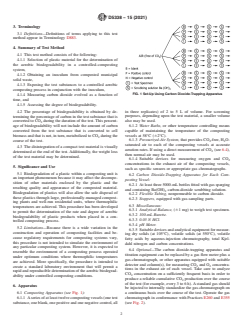
4.1 This test method consists of the following:
4.1.1 Selection of plastic material for the determination of
the aerobic biodegradability in a controlled-composting
system,
4.1.2 Obtaining an inoculum from composted municipal
solid waste,
4.1.3 Exposing the test substances to a controlled aerobic
composting process in conjunction with the inoculum,
FIG. 1 Set-Up Using Carbon Dioxide-Trapping Apparatus
4.1.4 Measuring carbon dioxide evolved as a function of
time, and
4.1.5 Assessing the degree of biodegradability.
4.2 The percentage of biodegradability is obtained by de- in three replicates) of 2 to 5 L of volume. For screening
purposes, depending upon the test material, a smaller volume
termining the percentage of carbon in the test substance that is
converted to CO during the duration of the test. This percent- also may be used.
6.1.2 Water Baths, or other temperature controlling means
age of biodegradability will not include the amount of carbon
capable of maintaining the temperature of the composting
converted from the test substance that is converted to cell
vessels at 58°C (62°C).
biomass and that is not, in turn, metabolized to CO during the
6.1.3 Pressurized-Air System, that provides CO -free, H O-
course of the test.
2 2
saturated air to each of the composting vessels at accurate
4.3 The disintegration of a compact test material is visually
aeration rates. If using a direct measurement of CO (see 6.4),
determined at the end of the test.Additionally, the weight loss
then normal air may be used.
of the test material may be determined.
6.1.4 Suitable devices for measuring oxygen and CO
concentrations in the exhaust air of the composting vessels,
5. Significance and Use
such as specific sensors or appropriate gas chromatographs.
5.1 Biodegradation of a plastic within a composting unit is
6.2 Carbon Dioxide-Trapping Apparatus for Each Com-
an important phenomenon because it may affect the decompo-
posting Vessel:
sition of other materials enclosed by the plastic and the
6.2.1 Atleastthree5000-mLbottlesfittedwithgassparging
resulting quality and appearance of the composted material.
and containing Ba(OH) carbon-dioxide scrubbing solution.
Biodegradation of plastics will also allow the safe disposal of
6.2.2 Flexible Tubing, nonpermeable to carbon dioxide.
these plastics through large, professionally-managed compost-
6.2.3 Stoppers, equipped with gas-sampling parts.
ing plants and well-run residential units, where thermophilic
6.3 Miscellaneous:
temperatures are achieved.This procedure has been developed
6.3.1 Analytical Balance, (61 mg) to weigh test specimen.
to permit the determination of the rate and degree of aerobic
6.3.2 100-mL Burette.
biodegradability of plastic products when placed in a con-
6.3.3 0.05 N HCl.
trolled composting process.
6.3.4 pH Meter.
5.2 Limitations—Because there is a wide variation in the
6.3.5 Suitabledevicesandanalyticalequipmentformeasur-
construction and operation of composting facilities and be-
ing dry solids (at 105°C), volatile solids (at 550°C), volatile
cause regulatory requirements for composting systems vary,
fatty acids by aqueous-injection chromatography, total Kjel-
this procedure is not intended to simulate the environment of
dahl nitrogen and carbon concentrations.
any particular composting system. However, it is expected to
6.4 Optional—The carbon dioxide-trapping apparatus and
resemble the environment of a composting process operated
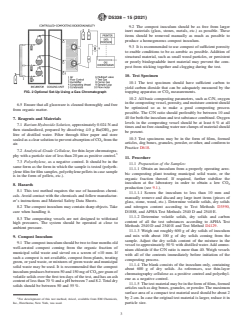
titration equipment can be replaced by a gas flow meter plus a
under optimum conditions where thermophilic temperatures
gas-chromatograph, or other apparatus equipped with suitable
are achieved. More specifically, the procedure is intended to
detector and column(s), for measuring CO and O concentra-
2 2
create a standard laboratory environment that will permit a
tions in the exhaust air of each vessel. Take care to analyze
rapidandreproducibledeterminationoftheaerobicbiodegrad-
CO concentration on a sufficiently frequent basis in order to
ability under controlled composting conditions.
produce a reliable cumulative CO production over the course
of the test (for example, every 3 to 6 h).Astandard gas should
6. Apparatus
be injected to internally standardize the gas-chromatograph on
6.1 Composting Apparatus (see Fig. 1):
a continuous basis over the course of the test. Operate the gas
6.1.1 Aseriesofatleasttwelvecompostingvessels(onetest chromatograph in conformance with Practices E260 and E355
substance,oneblank,onepositiveandonenegativecontrol,all (see Fig. 2).
D5338 − 15 (2021)
9.2 The compost inoculum should be as free from larger
inert materials (glass, stones, metals, etc.) as possible. These
items should be removed manually as much as possible to
produce a homogeneous compost inoculum.
9.3 It is recommended to use compost of sufficient porosity
to enable conditions to be as aerobic as possible. Addition of
structural material, such as small wood particles, or persistent
or poorly biodegradable inert material may prevent the com-
post from sticking together and clogging during the test.
10. Test Specimen
10.1 The test specimen should have sufficient carbon to
yield carbon dioxide that can be adequately measured by the
FIG. 2 Optional Set-Up Using a Gas Chromatograph
trapping apparatus or CO measurements.
10.2 All basic composting parameters, such as C/N, oxygen
inthecompostingvessel,porosity,andmoisturecontentshould
6.5 Ensure that all glassware is cleaned thoroughly and free
be optimized so as to make a good composting process
from organic matter.
possible. The C/N ratio should preferably be between 10 and
40forboththeinoculumandtestsubstancecombined.Oxygen
7. Reagents and Materials
levels in the composting vessel should be at least 6% at all
7.1 Barium Hydroxide Solution,approximately0.024Nand
timesandnofree-standingwaternorclumpsofmaterialshould
then standardized, prepared by dissolving 4.0 g Ba(OH) per
be present.
litre of distilled water. Filter through filter paper and store
10.3 Test specimens may be in the form of films, formed
sealedasaclearsolutiontopreventabsorptionofCO fromthe
articles, dog bones, granules, powder, or other, and conform to
air.
Practice D618.
7.2 Analytical-Grade Cellulose,forthin-layerchromatogra-
phy with a particle size of less than 20 µm as positive control.
11. Procedure
7.3 Polyethylene, as a negative control. It should be in the
11.1 Preparation of the Samples:
same form as the form in which the sample is tested (polyeth-
11.1.1 Obtain an inoculum from a properly operating aero-
ylenefilmforfilmsamples,polyethylenepelletsincasesample
bic composting plant treating municipal solid waste, or the
is in the form of pellets, etc.).
organic fraction thereof. If required, further stabilize the
inoculum at the laboratory in order to obtain a low CO
8. Hazards
production (see 9.1.).
8.1 This test method requires the use of hazardous chemi-
11.1.1.1 Screen the inoculum to less than 10 mm and
cals.Avoid contact with the chemicals and follow manufactur-
manually remove and discard any large inert items (pieces of
er’s instructions and Material Safety Data Sheets.
glass, stone, wood, etc.). Determine volatile solids, dry solids
and nitrogen content according to Test Methods D3590,
8.2 The compost inoculum may contain sharp objects. Take
care when handling it. D1888, and APHA Test Methods 2540D and 2540E.
11.1.2 Determine volatile solids, dry solids and carbon
8.3 The composting vessels are not designed to withstand
content of all the test substances according to APHA Test
high pressures. The system should be operated at close to
Methods 2540D and 2540E and Test Method D4129.
ambient pressure.
11.1.3 Weigh out roughly 600 g of dry solids of inoculum
and mix with about 100 g of dry solids coming from the
9. Compost Inoculum
sample. Adjust the dry solids content of the mixture in the
9.1 Thecompost
...