

ASTM F1041-20
(Guide)Standard Guide for Squeeze-Off of Polyolefin Gas Pressure Pipe and Tubing
General Information
- Abstract
SIGNIFICANCE AND USE
3.1 Squeeze-off is a technique used to control the flow of gas through a pipe by the compressing action of a mechanical or hydraulic device. Squeeze-off may be used to reduce the flow of gas to an acceptable rate.
3.2 Proper squeeze-off procedures result in significant time saving in the reduction of gas flow in an emergency and in the maintenance and operation, or both, of a gas distribution system. Improper squeeze-off can cause damage to the pipe or create a safety hazard, or both.
SCOPE
1.1 This guide describes general procedures for squeeze-off of polyolefin gas pressure pipe and tubing. Pipe and squeeze tool manufacturers shall be requested to supply recommendations for squeeze-off with materials or products.
1.2 Governing codes and project specifications should be consulted. Nothing in this document should be construed as recommending practices or systems at variance with governing codes and project specifications.
1.3 This guide covers squeeze-off of polyolefin pipe and tubing in accordance with Specification D2513.
1.4 Where applicable in this guide, “pipe” shall mean “pipe and tubing.”
1.5 Units–The values stated in inch-pound units are to be regarded as the standard. The values given in parentheses are mathematical conversions to SI units, which are provided for information only and are not considered the standard.
1.6 This standard does not purport to address all of the safety concerns, if any, associated with its use. It is the responsibility of the user of this standard to establish appropriate safety, health, and environmental practices and determine the applicability of regulatory limitations prior to use.
1.7 This international standard was developed in accordance with internationally recognized principles on standardization established in the Decision on Principles for the Development of International Standards, Guides and Recommendations issued by the World Trade Organization Technical Barriers to Trade (TBT) Committee.
- Status
- Published
- Publication Date
- 31-Jul-2020
- Technical Committee
- F17 - Plastic Piping Systems
- Drafting Committee
- F17.60 - Gas


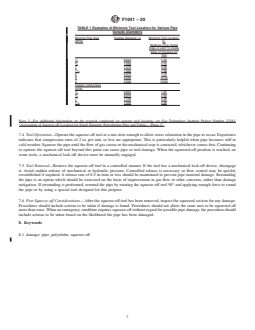

Overview
ASTM F1041-20 is the international standard guide that outlines general procedures for the squeeze-off of polyolefin gas pressure pipe and tubing. The squeeze-off technique controls or stops the flow of gas within a pressurized pipe or tubing by the compressive action of mechanical or hydraulic devices. Proper application of squeeze-off procedures is critical for gas utility operations, especially for performing maintenance or addressing emergencies in gas distribution systems. The standard provides practical guidance to operators, system owners, and maintenance personnel, emphasizing safety, tool use, and adherence to codes and specifications.
Key Topics
Scope and Application
- Applies to polyolefin gas pressure pipes and tubing, in line with Specification ASTM D2513
- Covers both maintenance and emergency operations for gas distribution systems
Squeeze-Off Procedure
- Recommends developing detailed, written procedures in conjunction with pipe and tool manufacturers
- Addresses critical factors such as pipe diameter, wall thickness, internal pressure, temperature, and environmental conditions
- Stresses importance of operator skill and adherence to qualified procedures (referencing ASTM F1734)
Safety Considerations
- Highlights safety protocols related to potential hazards like escaping gas and static electricity
- Suggests use of non-synthetic cloth or commercially available discharge fluids for static dissipation
- Requires tool checks and grounding before operation
Tool Selection and Use
- Specifies use of squeeze-off tools compliant with ASTM F1563
- Guides proper tool location: minimum distances from joints or fittings are essential to avoid damaging the pipe
- Recommends slow, controlled operation of tools to accommodate pipe stress relaxation
Post-Operation Inspection
- Calls for inspection of the pipe after squeeze-off for damage
- Procedure should specify actions if damage is found and prohibit squeezing the same area more than once
Applications
Squeeze-off is a key technique for operators and maintenance crews in the gas utility and pipeline industry. Practical applications include:
- Emergency Response: Rapidly isolating sections of the gas distribution system in case of leaks or damage, minimizing gas escape and reducing risk to personnel and property.
- Scheduled Maintenance: Temporarily restricting gas flow during scheduled repairs or upgrades to minimize service interruption.
- System Commissioning and Testing: Controlling flow for system pressure testing or startup operations.
- Safety Assurance: Following standard procedures helps reduce the risk of pipe damage and safety hazards during intervention.
The guidance supports both field operations and training programs, ensuring consistency and safety across gas utility networks.
Related Standards
Proper implementation of ASTM F1041-20 is enhanced by understanding and referencing related standards, including:
- ASTM D2513 - Specification for Polyethylene (PE) Gas Pressure Pipe, Tubing, and Fittings
- ASTM F1734 - Practice for Qualification of a Combination of Squeeze Tool, Pipe, and Squeeze-Off Procedures to Avoid Long-Term Damage in PE Gas Pipe
- ASTM F1563 - Specifications for Squeeze-Off Tools
- Industry Reports - Such as GTI Project 22245 and GRI-92/0147.2, which provide technical references on squeeze-off techniques and assessments
Practical Value
Implementing ASTM F1041-20 helps organizations:
- Ensure safe and effective gas flow control in polyolefin piping systems
- Reduce operational risks through standardized procedures and tool requirements
- Achieve efficiency during both emergency response and routine maintenance
- Comply with governing codes and industry best practices, minimizing liability and service disruption
Keywords: ASTM F1041-20, squeeze-off, polyolefin pipe, gas pressure pipe, gas distribution, pipeline safety, squeeze-off procedure, gas utility maintenance, pipe integrity, emergency gas operations.
Relations
- Replaces
ASTM F1041-02(2016) - Standard Guide for Squeeze-Off of Polyolefin Gas Pressure Pipe and Tubing - Effective Date
- 01-Aug-2020
- Effective Date
- 01-Apr-2024
- Effective Date
- 01-Jan-2019
- Refers
ASTM D2513-18 - Standard Specification for Polyethylene (PE) Gas Pressure Pipe, Tubing, and Fittings - Effective Date
- 15-Apr-2018
- Effective Date
- 15-Dec-2016
- Refers
ASTM D2513-16 - Standard Specification for Polyethylene (PE) Gas Pressure Pipe, Tubing, and Fittings - Effective Date
- 01-Dec-2016
- Effective Date
- 25-Apr-2014
- Effective Date
- 25-Apr-2014
- Refers
ASTM D2513-13 - Standard Specification for Polyethylene (PE) Gas Pressure Pipe, Tubing, and Fittings - Effective Date
- 01-Feb-2013
- Effective Date
- 01-Apr-2012
- Effective Date
- 01-Apr-2012
- Refers
ASTM D2513-12 - Standard Specification for Polyethylene (PE) Gas Pressure Pipe, Tubing, and Fittings - Effective Date
- 01-Feb-2012
- Effective Date
- 01-Dec-2011
- Effective Date
- 01-Nov-2011
- Effective Date
- 01-Aug-2011
Get Certified
Connect with accredited certification bodies for this standard

Institut za varilstvo d.o.o. (Welding Institute)
Slovenia's leading welding institute since 1952. ISO 3834, EN 1090, pressure equipment certification, NDT personnel, welder qualification. Only IIW Au
Sponsored listings
Frequently Asked Questions
ASTM F1041-20 is a guide published by ASTM International. Its full title is "Standard Guide for Squeeze-Off of Polyolefin Gas Pressure Pipe and Tubing". This standard covers: SIGNIFICANCE AND USE 3.1 Squeeze-off is a technique used to control the flow of gas through a pipe by the compressing action of a mechanical or hydraulic device. Squeeze-off may be used to reduce the flow of gas to an acceptable rate. 3.2 Proper squeeze-off procedures result in significant time saving in the reduction of gas flow in an emergency and in the maintenance and operation, or both, of a gas distribution system. Improper squeeze-off can cause damage to the pipe or create a safety hazard, or both. SCOPE 1.1 This guide describes general procedures for squeeze-off of polyolefin gas pressure pipe and tubing. Pipe and squeeze tool manufacturers shall be requested to supply recommendations for squeeze-off with materials or products. 1.2 Governing codes and project specifications should be consulted. Nothing in this document should be construed as recommending practices or systems at variance with governing codes and project specifications. 1.3 This guide covers squeeze-off of polyolefin pipe and tubing in accordance with Specification D2513. 1.4 Where applicable in this guide, “pipe” shall mean “pipe and tubing.” 1.5 Units–The values stated in inch-pound units are to be regarded as the standard. The values given in parentheses are mathematical conversions to SI units, which are provided for information only and are not considered the standard. 1.6 This standard does not purport to address all of the safety concerns, if any, associated with its use. It is the responsibility of the user of this standard to establish appropriate safety, health, and environmental practices and determine the applicability of regulatory limitations prior to use. 1.7 This international standard was developed in accordance with internationally recognized principles on standardization established in the Decision on Principles for the Development of International Standards, Guides and Recommendations issued by the World Trade Organization Technical Barriers to Trade (TBT) Committee.
SIGNIFICANCE AND USE 3.1 Squeeze-off is a technique used to control the flow of gas through a pipe by the compressing action of a mechanical or hydraulic device. Squeeze-off may be used to reduce the flow of gas to an acceptable rate. 3.2 Proper squeeze-off procedures result in significant time saving in the reduction of gas flow in an emergency and in the maintenance and operation, or both, of a gas distribution system. Improper squeeze-off can cause damage to the pipe or create a safety hazard, or both. SCOPE 1.1 This guide describes general procedures for squeeze-off of polyolefin gas pressure pipe and tubing. Pipe and squeeze tool manufacturers shall be requested to supply recommendations for squeeze-off with materials or products. 1.2 Governing codes and project specifications should be consulted. Nothing in this document should be construed as recommending practices or systems at variance with governing codes and project specifications. 1.3 This guide covers squeeze-off of polyolefin pipe and tubing in accordance with Specification D2513. 1.4 Where applicable in this guide, “pipe” shall mean “pipe and tubing.” 1.5 Units–The values stated in inch-pound units are to be regarded as the standard. The values given in parentheses are mathematical conversions to SI units, which are provided for information only and are not considered the standard. 1.6 This standard does not purport to address all of the safety concerns, if any, associated with its use. It is the responsibility of the user of this standard to establish appropriate safety, health, and environmental practices and determine the applicability of regulatory limitations prior to use. 1.7 This international standard was developed in accordance with internationally recognized principles on standardization established in the Decision on Principles for the Development of International Standards, Guides and Recommendations issued by the World Trade Organization Technical Barriers to Trade (TBT) Committee.
ASTM F1041-20 is classified under the following ICS (International Classification for Standards) categories: 23.040.20 - Plastics pipes. The ICS classification helps identify the subject area and facilitates finding related standards.
ASTM F1041-20 has the following relationships with other standards: It is inter standard links to ASTM F1041-02(2016), ASTM F1734-24, ASTM F1734-19, ASTM D2513-18, ASTM D2513-16a, ASTM D2513-16, ASTM D2513-14, ASTM D2513-14e1, ASTM D2513-13, ASTM D2513-12a, ASTM D2513-12ae1, ASTM D2513-12, ASTM D2513-11c, ASTM D2513-11b, ASTM D2513-11a. Understanding these relationships helps ensure you are using the most current and applicable version of the standard.
ASTM F1041-20 is available in PDF format for immediate download after purchase. The document can be added to your cart and obtained through the secure checkout process. Digital delivery ensures instant access to the complete standard document.
Standards Content (Sample)
This international standard was developed in accordance with internationally recognized principles on standardization established in the Decision on Principles for the
Development of International Standards, Guides and Recommendations issued by the World Trade Organization Technical Barriers to Trade (TBT) Committee.
Designation:F1041 −20 An American National Standard
Standard Guide for
Squeeze-Off of Polyolefin Gas Pressure Pipe and Tubing
This standard is issued under the fixed designation F1041; the number immediately following the designation indicates the year of
original adoption or, in the case of revision, the year of last revision.Anumber in parentheses indicates the year of last reapproval.A
superscript epsilon (´) indicates an editorial change since the last revision or reapproval.
1. Scope* F1734 Practice for Qualification of a Combination of
SqueezeTool, Pipe, and Squeeze-Off Procedures toAvoid
1.1 This guide describes general procedures for squeeze-off
Long-Term Damage in Polyethylene (PE) Gas Pipe
of polyolefin gas pressure pipe and tubing. Pipe and squeeze
2.2 Other Documents:
tool manufacturers shall be requested to supply recommenda-
GRI-92/0147.2Volume 2: Technical Reference on Squeeze-
tions for squeeze-off with materials or products.
off of Polyethylene Gas Pipes
1.2 Governing codes and project specifications should be
OTD Project 2.14c / GTI Project 22245“Assessment of
consulted. Nothing in this document should be construed as
Squeeze-off Location for Small Diameter Polyethylene
recommendingpracticesorsystemsatvariancewithgoverning 4
Pipe and Tubing – Phase 2”
codes and project specifications.
3. Significance and Use
1.3 This guide covers squeeze-off of polyolefin pipe and
3.1 Squeeze-off is a technique used to control the flow of
tubing in accordance with Specification D2513.
gas through a pipe by the compressing action of a mechanical
1.4 Where applicable in this guide, “pipe” shall mean “pipe
or hydraulic device. Squeeze-off may be used to reduce the
and tubing.”
flow of gas to an acceptable rate.
1.5 Units–The values stated in inch-pound units are to be
3.2 Proper squeeze-off procedures result in significant time
regarded as the standard. The values given in parentheses are
saving in the reduction of gas flow in an emergency and in the
mathematical conversions to SI units, which are provided for
maintenance and operation, or both, of a gas distribution
information only and are not considered the standard.
system. Improper squeeze-off can cause damage to the pipe or
1.6 This standard does not purport to address all of the
create a safety hazard, or both.
safety concerns, if any, associated with its use. It is the
responsibility of the user of this standard to establish appro- 4. Operator Experience
priate safety, health, and environmental practices and deter-
4.1 Each squeeze-off shall be made in accordance with
mine the applicability of regulatory limitations prior to use.
written procedures in accordance with Practice F1734, that
1.7 This international standard was developed in accor-
have been proven to produce safe squeeze-off. The person
dance with internationally recognized principles on standard-
actually responsible for the squeeze-off shall ensure that
ization established in the Decision on Principles for the
detailed procedures are developed in conjunction with the
Development of International Standards, Guides and Recom-
ownerofthepipesystem,themanufacturerofthepipe,andthe
mendations issued by the World Trade Organization Technical
manufacturer of the squeeze-off tools. These procedures shall
Barriers to Trade (TBT) Committee.
include safety precautions to be followed and are to be issued
before actual squeeze-off operations commence.
2. Referenced Documents
4.2 Skill and knowledge on the part of the operator are
2.1 ASTM Standards:
required to control the flow of gas to achieve a safe squeeze-
D2513Specification for Polyethylene (PE) Gas Pressure
off. This skill and knowledge shall be obtained by making
Pipe, Tubing, and Fittings
squeeze-offs in accordance with written procedures in accor-
dance with Practice F1734.
This guide is under the jurisdiction ofASTM Committee F17 on Plastic Piping
5. Pipe and Conditions
Systems and is the direct responsibility of Subcommittee F17.60 on Gas.
5.1 In order to obtain proper squeeze-off, it is necessary to
Current edition approved Aug. 1, 2020. Published August 2020. Originally
approved in 1987. Last previous edition approved in 2016 as F1041–02(2016).
consider the pipe diameter, wall thickness, pipe material,
DOI: 10.1520/F1041-20.
For referenced ASTM standards, visit the ASTM website, www.astm.org, or
contact ASTM Customer Service at service@astm.org. For Annual Book of ASTM GRI Document Fulfillment Center, 1510 Hubbard Dr. Batavia, IL 60510.
Standards volume information, refer to the standard’s Document Summary page on Available from GTI, 1700 S Mount Prospect Rd. Des Plaines, IL 60018
the ASTM website. https://www.gti.energy/.
*A Summary of Changes section appears at the end of this standard
Copyright © ASTM International, 100 Barr Harbor Drive, PO Box C700, West Conshohocken, PA 19428-2959. United States
F1041−20
TABLE 1 Examples of Minimum Tool Location for Various Pipe
internal pressure, squeeze tool(s), squeeze-off procedure and
Outside Diameters
environmental conditions. The user shall request the pipe
Nominal Pipe Size Outside Diameter, in Minimum Tool Location,
manufacturer to supply specific recommendations for the
(NPS) in.
squeeze-off of the manufacturer’s product based upon the
Distance From Inside
evaluation procedures outlined in Practice F1734 with addi-
Edge of Joint To Inside
Edge of Squeeze-off
tional considerations for internal pressure and ambient tem-
Tool
perature. The operator shall exercise caution during cold
⁄2 0.840 2.52
temperatures because the pipe may be more susceptible to
⁄4 1.050 3.15
squeeze off damage. 1 1.315 3.95
1 ⁄4 1.660 4.98
2 2.375 7.12
6. Apparatus
3 3.500 10.50
4 4.500 13.50
6.1 Tools to squeeze-off polyolefin gas pressure pipe and
Copper Tubing Si
...
This document is not an ASTM standard and is intended only to provide the user of an ASTM standard an indication of what changes have been made to the previous version. Because
it may not be technically possible to adequately depict all changes accurately, ASTM recommends that users consult prior editions as appropriate. In all cases only the current version
of the standard as published by ASTM is to be considered the official document.
Designation: F1041 − 02 (Reapproved 2016) F1041 − 20 An American National Standard
Standard Guide for
Squeeze-Off of Polyolefin Gas Pressure Pipe and Tubing
This standard is issued under the fixed designation F1041; the number immediately following the designation indicates the year of
original adoption or, in the case of revision, the year of last revision. A number in parentheses indicates the year of last reapproval. A
superscript epsilon (´) indicates an editorial change since the last revision or reapproval.
1. Scope Scope*
1.1 This guide describes general procedures for squeeze-off of polyolefin gas pressure pipe and tubing. Pipe and squeeze tool
manufacturers shall be requested to supply recommendations for squeeze-off with materials or products.
1.2 Governing codes and project specifications should be consulted. Nothing in this document should be construed as
recommending practices or systems at variance with governing codes and project specifications.
1.3 This guide covers squeeze-off of polyolefin pipe and tubing in accordance with Specification D2513.
1.4 Where applicable in this guide, “pipe” shall mean “pipe and tubing.”
1.5 Units–The values stated in inch-pound units are to be regarded as the standard. The values given in parentheses are
mathematical conversions to SI units, which are provided for information only and are not considered the standard.
1.6 This standard does not purport to address all of the safety problems,concerns, if any, associated with its use. It is the
responsibility of the user of this standard to establish appropriate safety safety, health, and healthenvironmental practices and
determine the applicability of regulatory limitations prior to use.
1.7 This international standard was developed in accordance with internationally recognized principles on standardization
established in the Decision on Principles for the Development of International Standards, Guides and Recommendations issued
by the World Trade Organization Technical Barriers to Trade (TBT) Committee.
2. Referenced Documents
2.1 ASTM Standards:
D2513 Specification for Polyethylene (PE) Gas Pressure Pipe, Tubing, and Fittings
F1734 Practice for Qualification of a Combination of Squeeze Tool, Pipe, and Squeeze-Off Procedures to Avoid Long-Term
Damage in Polyethylene (PE) Gas Pipe
2.2 Other Standards:Documents:
GRI-92/0147.2 Volume 2: Technical Reference on Squeeze-off of Polyethylene Gas Pipes
OTD Project 2.14c / GTI Project 22245 “Assessment of Squeeze-off Location for Small Diameter Polyethylene Pipe and Tubing
– Phase 2”
This guide is under the jurisdiction of ASTM Committee F17 on Plastic Piping Systems and is the direct responsibility of Subcommittee F17.60 on Gas.
Current edition approved May 1, 2016Aug. 1, 2020. Published May 2016August 2020. Originally approved in 1987. Last previous edition approved in 20082016 as
F1041 – 02(2008).(2016). DOI: 10.1520/F1041-02R16.10.1520/F1041-20.
For referenced ASTM standards, visit the ASTM website, www.astm.org, or contact ASTM Customer Service at service@astm.org. For Annual Book of ASTM Standards
volume information, refer to the standard’s Document Summary page on the ASTM website.
GRI Document Fulfillment Center, 1510 Hubbard Dr. Batavia, IL 60510.
Available from GTI, 1700 S Mount Prospect Rd. Des Plaines, IL 60018 https://www.gti.energy/.
*A Summary of Changes section appears at the end of this standard
Copyright © ASTM International, 100 Barr Harbor Drive, PO Box C700, West Conshohocken, PA 19428-2959. United States
F1041 − 20
3. Significance and Use
3.1 Squeeze-off is a technique used to control the flow of gas through a pipe by the compressing action of a mechanical or
hydraulic device. Squeeze-off may be used to reduce the flow of gas to an acceptable rate.
3.2 Proper squeeze-off procedures result in significant time saving in the reduction of gas flow in an emergency and in the
maintenance and operation, or both, of a gas distribution system. Improper squeeze-off can cause damage to the pipe or create a
safety hazard, or both.
4. Operator Experience
4.1 Each squeeze-off shall be made in accordance with written procedures in accordance with Practice F1734, that have been
proven to produce safe squeeze-off. The person actually responsible for the squeeze-off shall ensure that detailed procedures are
developed in conjunction with the owner of the pipe system, the manufacturer of the pipe, and the manufacturer of the squeeze-off
tools. These procedures shall include safety precautions to be followed and are to be issued before actual squeeze-off operations
commence.
4.2 Skill and knowledge on the part of the operator are required to control the flow of gas to achieve a safe squeeze-off. This skill
and knowledge shall be obtained by making squeeze-offs in accordance with written procedures in accordance with Practice F1734.
5. Pipe and Conditions
5.1 In order to obtain proper squeeze-off, it is necessary to consider the pipe diameter, wall thickness, pipe material, internal
pressure, squeeze tool(s), squeeze-off procedure and environmental conditions. The user shall request the pipe manufacturer to
supply specific recommendations for the squeeze-off of the manufacturer’s product based upon the evaluation procedures outlined
in Practice F1734 with additional considerations for internal pressure and ambient temperature. The operator shall exercise caution
during cold temperatures because the pipe may be more susceptible to squeeze off damage.
6. Apparatus
6.1 Tools to squeeze-off polyolefin gas pressure pipe and tubing shall conform to the requirements of F1563.
7. Procedure
7.1 Proper squeeze-off procedures developed in accordance with Practice F1734 shall address safety considerations, tool location,
tool operation, tool removal, and post squeeze-off considerations.
7.2 Safety Considerations—Pressure control situations requiring
...