

ASTM D6762-18(2023)
(Test Method)Standard Test Method for Determining the Hiding Power of Paint by Visual Evaluation of Spray Applied Coatings
General Information
- Abstract
SIGNIFICANCE AND USE
5.1 This test method determines hiding power of a test paint by visual evaluation of a spray applied coating.
Note 1: Test Method D2805 describes an instrumental method for determining hiding power. The paint film is applied at a uniform thickness (for example with a doctor blade), the film thickness is measured rigorously, and the opacity is determined photometrically. Hiding power is thereby determined with a high degree of precision.
5.2 Test Method D6762 is less precise than Test Method D2805, but is commonly used since it is more closely related to the application characteristics of the paint and is simpler in concept and evaluation.
SCOPE
1.1 This test method provides for the quantitative visual determination of the film thickness required to achieve full hiding. This film thickness is considered to be the hiding power of a test paint.
1.2 This method applies only to spray applied coatings but its concepts are valid for other methods of application as well.
1.3 The values stated in inch-pound units are to be regarded as standard. The values given in parentheses are mathematical conversions to SI units that are provided for information only and are not considered standard.
1.4 This standard does not purport to address all of the safety concerns, if any, associated with its use. It is the responsibility of the user of this standard to establish appropriate safety, health, and environmental practices and determine the applicability of regulatory limitations prior to use.
1.5 This international standard was developed in accordance with internationally recognized principles on standardization established in the Decision on Principles for the Development of International Standards, Guides and Recommendations issued by the World Trade Organization Technical Barriers to Trade (TBT) Committee.
- Status
- Published
- Publication Date
- 30-Jun-2023
- Technical Committee
- D01 - Paint and Related Coatings, Materials, and Applications
- Drafting Committee
- D01.26 - Optical Properties

Overview
ASTM D6762-18(2023) is an ASTM International standard test method that defines procedures for determining the hiding power of paint through visual evaluation of spray-applied coatings. The hiding power, also known as opacity, refers to the ability of a paint film to obscure the background when applied at a certain thickness. This standard provides a quantitative visual approach, directly assessing how much product is required for full coverage-information crucial for formulators, manufacturers, and end users of paints and coatings.
Unlike more instrumentally precise alternatives such as ASTM D2805, ASTM D6762 is valued for its close reflection of real-world application characteristics and its conceptual simplicity. It is particularly relevant for applications where spray application is the primary method but can conceptually apply to other coating methods as well.
Key Topics
- Hiding Power by Visual Evaluation: This method focuses on applying a test paint via spray to create a wedge-shaped film displaying varying thickness. The point at which the applied paint just obscures a reference pattern (black/white, black/gray, or red/gray) marks the hiding power.
- Spray Application: The procedure is tailored to spray-applied coatings, using either a hand spray gun or automatic spray machine to produce a range of film thicknesses on standardized panels.
- Film Thickness Measurement: The actual dry film thickness at the hiding point is quantitatively measured using approved nondestructive devices according to Test Methods such as ASTM D1005 or D7091.
- Standardized Test Surfaces and Lighting: The method prescribes specific panels and diffuse lighting conditions (as per ASTM D1729) to enhance repeatability and reduce variability due to testing environments.
- Reporting and Precision: The standard outlines requirements for reporting results in mils or micrometers and provides statistical guidelines for repeatability and reproducibility based on interlaboratory studies.
Applications
ASTM D6762-18(2023) is widely used in industries where paint opacity and efficient coverage are crucial, such as:
- Architectural and Industrial Paints: Ensures that products meet customer expectations for coverage and application speed, reducing material waste.
- Automotive Coatings: Assesses coverage for basecoats and primers, supporting effective color uniformity and hiding power in multilayer systems.
- Quality Control Laboratories: Offers a practical and cost-effective hiding power test that simulates end-use conditions more realistically than purely instrumental methods.
- Product Development and Comparative Testing: Enables formulators to benchmark new products against existing coatings, adjusting formulations for improved hiding power and spray characteristics.
- On-Site Evaluation and Specification Compliance: Simplifies on-site verification of product claims regarding coverage through a direct, visually validated approach.
Related Standards
For comprehensive assessment of coating opacity and application performance, the following ASTM standards are often referenced alongside or compared with ASTM D6762:
- ASTM D2805 - Standard Test Method for Hiding Power of Paints by Reflectometry (instrumental method)
- ASTM D1729 - Practice for Visual Appraisal of Colors and Color Differences of Diffusely-Illuminated Opaque Materials
- ASTM D1005 - Test Method for Measurement of Dry-Film Thickness of Organic Coatings
- ASTM D7091 - Practice for Nondestructive Measurement of Dry Film Thickness of Nonmagnetic Coatings
- ASTM D609 and ASTM D1730 - Practices for Preparation of Metal Panels for Paint Testing
- ASTM E691 - Practice for Conducting an Interlaboratory Study to Determine the Precision of a Test Method
By following ASTM D6762-18(2023), manufacturers and quality assurance professionals gain actionable, real-world data on the visual hiding power of spray-applied paints, ensuring product performance meets industry and customer expectations.
Relations
- Effective Date
- 01-Jan-2024
- Effective Date
- 01-Jun-2020
- Effective Date
- 01-May-2020
- Effective Date
- 01-Jul-2016
- Effective Date
- 01-Dec-2014
- Effective Date
- 01-Nov-2014
- Effective Date
- 01-May-2013
- Effective Date
- 01-Aug-2012
- Effective Date
- 01-Jun-2012
- Effective Date
- 01-Apr-2012
- Effective Date
- 01-Nov-2011
- Effective Date
- 01-Jun-2011
- Effective Date
- 01-Jun-2011
- Effective Date
- 01-Jan-2011
- Effective Date
- 01-Feb-2010
Frequently Asked Questions
ASTM D6762-18(2023) is a standard published by ASTM International. Its full title is "Standard Test Method for Determining the Hiding Power of Paint by Visual Evaluation of Spray Applied Coatings". This standard covers: SIGNIFICANCE AND USE 5.1 This test method determines hiding power of a test paint by visual evaluation of a spray applied coating. Note 1: Test Method D2805 describes an instrumental method for determining hiding power. The paint film is applied at a uniform thickness (for example with a doctor blade), the film thickness is measured rigorously, and the opacity is determined photometrically. Hiding power is thereby determined with a high degree of precision. 5.2 Test Method D6762 is less precise than Test Method D2805, but is commonly used since it is more closely related to the application characteristics of the paint and is simpler in concept and evaluation. SCOPE 1.1 This test method provides for the quantitative visual determination of the film thickness required to achieve full hiding. This film thickness is considered to be the hiding power of a test paint. 1.2 This method applies only to spray applied coatings but its concepts are valid for other methods of application as well. 1.3 The values stated in inch-pound units are to be regarded as standard. The values given in parentheses are mathematical conversions to SI units that are provided for information only and are not considered standard. 1.4 This standard does not purport to address all of the safety concerns, if any, associated with its use. It is the responsibility of the user of this standard to establish appropriate safety, health, and environmental practices and determine the applicability of regulatory limitations prior to use. 1.5 This international standard was developed in accordance with internationally recognized principles on standardization established in the Decision on Principles for the Development of International Standards, Guides and Recommendations issued by the World Trade Organization Technical Barriers to Trade (TBT) Committee.
SIGNIFICANCE AND USE 5.1 This test method determines hiding power of a test paint by visual evaluation of a spray applied coating. Note 1: Test Method D2805 describes an instrumental method for determining hiding power. The paint film is applied at a uniform thickness (for example with a doctor blade), the film thickness is measured rigorously, and the opacity is determined photometrically. Hiding power is thereby determined with a high degree of precision. 5.2 Test Method D6762 is less precise than Test Method D2805, but is commonly used since it is more closely related to the application characteristics of the paint and is simpler in concept and evaluation. SCOPE 1.1 This test method provides for the quantitative visual determination of the film thickness required to achieve full hiding. This film thickness is considered to be the hiding power of a test paint. 1.2 This method applies only to spray applied coatings but its concepts are valid for other methods of application as well. 1.3 The values stated in inch-pound units are to be regarded as standard. The values given in parentheses are mathematical conversions to SI units that are provided for information only and are not considered standard. 1.4 This standard does not purport to address all of the safety concerns, if any, associated with its use. It is the responsibility of the user of this standard to establish appropriate safety, health, and environmental practices and determine the applicability of regulatory limitations prior to use. 1.5 This international standard was developed in accordance with internationally recognized principles on standardization established in the Decision on Principles for the Development of International Standards, Guides and Recommendations issued by the World Trade Organization Technical Barriers to Trade (TBT) Committee.
ASTM D6762-18(2023) is classified under the following ICS (International Classification for Standards) categories: 87.040 - Paints and varnishes. The ICS classification helps identify the subject area and facilitates finding related standards.
ASTM D6762-18(2023) has the following relationships with other standards: It is inter standard links to ASTM D16-24, ASTM D1005-95(2020), ASTM D1730-09(2020), ASTM D16-16, ASTM D16-14, ASTM D1730-09(2014), ASTM E691-13, ASTM D16-12, ASTM D609-00(2012), ASTM D7091-12, ASTM E691-11, ASTM D16-11a, ASTM D2805-11, ASTM D16-11, ASTM D16-10. Understanding these relationships helps ensure you are using the most current and applicable version of the standard.
ASTM D6762-18(2023) is available in PDF format for immediate download after purchase. The document can be added to your cart and obtained through the secure checkout process. Digital delivery ensures instant access to the complete standard document.
Standards Content (Sample)
This international standard was developed in accordance with internationally recognized principles on standardization established in the Decision on Principles for the
Development of International Standards, Guides and Recommendations issued by the World Trade Organization Technical Barriers to Trade (TBT) Committee.
Designation: D6762 − 18 (Reapproved 2023)
Standard Test Method for
Determining the Hiding Power of Paint by Visual Evaluation
of Spray Applied Coatings
This standard is issued under the fixed designation D6762; the number immediately following the designation indicates the year of
original adoption or, in the case of revision, the year of last revision. A number in parentheses indicates the year of last reapproval. A
superscript epsilon (´) indicates an editorial change since the last revision or reapproval.
1. Scope D1729 Practice for Visual Appraisal of Colors and Color
Differences of Diffusely-Illuminated Opaque Materials
1.1 This test method provides for the quantitative visual
D1730 Practices for Preparation of Aluminum and
determination of the film thickness required to achieve full
Aluminum-Alloy Surfaces for Painting
hiding. This film thickness is considered to be the hiding power
D2805 Test Method for Hiding Power of Paints by Reflec-
of a test paint.
tometry
1.2 This method applies only to spray applied coatings but
D7091 Practice for Nondestructive Measurement of Dry
its concepts are valid for other methods of application as well.
Film Thickness of Nonmagnetic Coatings Applied to
1.3 The values stated in inch-pound units are to be regarded Ferrous Metals and Nonmagnetic, Nonconductive Coat-
ings Applied to Non-Ferrous Metals
as standard. The values given in parentheses are mathematical
conversions to SI units that are provided for information only E691 Practice for Conducting an Interlaboratory Study to
Determine the Precision of a Test Method
and are not considered standard.
1.4 This standard does not purport to address all of the
3. Terminology
safety concerns, if any, associated with its use. It is the
3.1 Definitions—For definitions of terms used in this test
responsibility of the user of this standard to establish appro-
method, refer to Terminology D16 and the Paint/Coatings
priate safety, health, and environmental practices and deter-
Dictionary.
mine the applicability of regulatory limitations prior to use.
1.5 This international standard was developed in accor-
4. Summary of Test Method
dance with internationally recognized principles on standard-
ization established in the Decision on Principles for the 4.1 The test paint is applied by means of spray application
Development of International Standards, Guides and Recom-
in a wedge-shaped film over a black and white, black and gray
mendations issued by the World Trade Organization Technical
or red and gray pattern so that a thickness variation is obtained,
Barriers to Trade (TBT) Committee.
which provides excess hiding at one end of the pattern and
partial hiding at the other end of the pattern.
2. Referenced Documents
4.2 The dry film is examined under standard illumination to
2.1 ASTM Standards:
select the point where the pattern just becomes obscured. The
D16 Terminology for Paint, Related Coatings, Materials, and
thickness of the film at this point is designated the hiding
Applications
power of the paint.
D609 Practice for Preparation of Cold-Rolled Steel Panels
for Testing Paint, Varnish, Conversion Coatings, and
5. Significance and Use
Related Coating Products
5.1 This test method determines hiding power of a test paint
D1005 Test Method for Measurement of Dry-Film Thick-
by visual evaluation of a spray applied coating.
ness of Organic Coatings Using Micrometers
NOTE 1—Test Method D2805 describes an instrumental method for
determining hiding power. The paint film is applied at a uniform thickness
(for example with a doctor blade), the film thickness is measured
This test method is under the jurisdiction of ASTM Committee D01 on Paint
rigorously, and the opacity is determined photometrically. Hiding power is
and Related Coatings, Materials, and Applications and is the direct responsibility of
thereby determined with a high degree of precision.
Subcommittee D01.26 on Optical Properties.
Current edition approved July 1, 2023. Published August 2023. Originally
5.2 Test Method D6762 is less precise than Test Method
approved in 2002. Last previous edition approved in 2018 as D6762 – 18. DOI:
D2805, but is commonly used since it is more closely related
10.1520/D6762-18R23.
For referenced ASTM standards, visit the ASTM website, www.astm.org, or
contact ASTM Customer Service at service@astm.org. For Annual Book of ASTM
Standards volume information, refer to the standard’s Document Summary page on Published by the Federation of Societies for Coatings Technology, 492
the ASTM website. Norristown Rd., Blue Bell, PA 19422.
Copyright © ASTM International, 100 Barr Harbor Drive, PO Box C700, West Conshohocken, PA 19428-2959. United States
D6762 − 18 (2023)
to the application characteristics of the paint and is simpler in
concept and evaluation.
6. Apparatus
6.1 Test Surface, a smooth-surfaced paper chart, approxi-
mately 2 by 11 in., with a test pattern having adjacent black and
white, black and gray or red and gray areas and coated with a
suitable coating so as to render the surface impervious to paint
liquids.
NOTE 2—The red, gray, white and black areas should fall in the
following colorimetric range:
A A
CIE-Y % C h
Red 4–7 10–18 26–38
Gray 28–34
White 80–83
Black 1 max
A 10 2
Valid for Illuminant D65 or C , with 0°/45° geometry.
6.2 Illumination, a light source providing diffuse light of
reasonable intensity, preferably northern sky light or an ap-
proximation of the same (see Practice D1729).
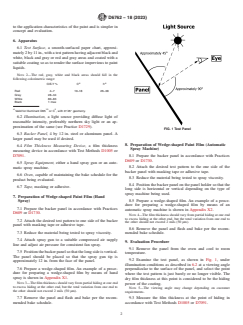
FIG. 1 Test Panel
6.3 Backer Panel, 4 by 12 in. steel or aluminum panel. A
larger panel may be used if desired.
8. Preparation of Wedge-shaped Paint Film (Automatic
6.4 Film Thickness Measuring Device, a film thickness
Spray Machine)
measuring device in accordance with Test Methods D1005 or
D7091.
8.1 Prepare the backer panel in accordance with Practices
D609 or D1730.
6.5 Spray Equipment, either a hand spray gun or an auto-
8.2 Attach the desired test pattern to the one side of the
matic spray machine.
backer panel with masking tape or adhesive tape.
6.6 Oven, capable of maintaining the bake schedule for the
8.3 Reduce the material being tested to spray viscosity.
product being evaluated.
8.4 Position the backer panel on the panel holder so that the
6.7 Tape, masking or adhesive.
long side is horizontal or vertical depending on the type of
spray machine being used.
7. Preparation of Wedge-shaped Paint Film (Hand
8.5 Prepare a wedge-shaped film. An example of a proce-
Spray)
dure for preparing a wedge-shaped film by means of an
7.1 Prepare the backer
...