

ASTM E2604-21
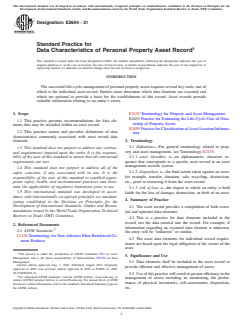
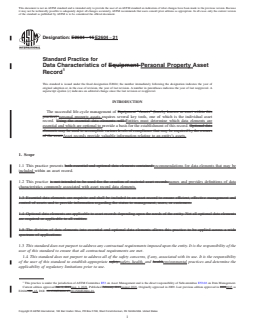
(Practice)Standard Practice for Data Characteristics of Personal Property Asset Record
General Information
- Abstract
SIGNIFICANCE AND USE
5.1 Data elements shall be included in the asset record to provide efficient and effective management of assets.
5.2 Use of this practice will result in greater efficiency in the management of assets including its monitoring, the performance of physical inventories, self-assessments, disposition, etc.
SCOPE
1.1 This practice presents recommendations for data elements that may be included within an asset record.
1.2 This practice names and provides definitions of data characteristics commonly associated with asset record data elements.
1.3 This standard does not purport to address any contractual requirements imposed upon the entity. It is the responsibility of the user of this standard to ensure that all contractual requirements are met.
1.4 This standard does not purport to address all of the safety concerns, if any, associated with its use. It is the responsibility of the user of this standard to establish appropriate safety, health, and environmental practices and determine the applicability of regulatory limitations prior to use.
1.5 This international standard was developed in accordance with internationally recognized principles on standardization established in the Decision on Principles for the Development of International Standards, Guides and Recommendations issued by the World Trade Organization Technical Barriers to Trade (TBT) Committee.
- Status
- Published
- Publication Date
- 31-Jul-2021
- Technical Committee
- E53 - Asset Management
- Drafting Committee
- E53.02 - Data Management


Overview
ASTM E2604-21: Standard Practice for Data Characteristics of Personal Property Asset Record provides comprehensive guidance on structuring asset records for personal property. Developed by ASTM International, this standard helps organizations identify and define essential and optional data elements needed for efficient personal property asset management. The standardized approach promotes lifecycle asset control, streamlined physical inventories, effective self-assessment, and improved disposition of assets.
Adhering to ASTM E2604-21 ensures that asset records contain consistent, relevant, and actionable information, supporting everything from daily operations to regulatory compliance requirements.
Key Topics
Essential and Optional Data Elements
- The standard defines both must-have (essential) and additional (optional) data elements for asset records.
- Essential data elements support basic asset monitoring, inventory, and management.
- Optional data elements allow flexibility for varying organizational needs and compliance levels.
Key Asset Record Data Characteristics
- Asset Identifier: Unique alphanumeric sequence linked to each asset.
- Acquisition & Financial Data: Purchase price, total acquisition cost, relevant financial transactions.
- Identification Numbers: Including serial, model, and part numbers.
- Lifecycle Dates: Manufacture date, date placed in service, receipt date, inventory date, and disposition date.
- Description and Status: Asset description, current lifecycle status (e.g., active, surplus, retired).
- Owner and User: Tracking ownership, user assignments, and related responsibilities.
- Location and Maintenance: Specific location data and maintenance records.
Record Format and Usage
- ASTM E2604-21 leaves formatting to the discretion of the entity, allowing records to fit diverse software systems and workflows.
- The focus is on clearly defined data elements, not their specific arrangement.
Compliance and Risk Management
- The standard addresses asset accountability, the risk of loss, and provides a foundation to meet owner or regulatory requirements.
Applications
Implementing ASTM E2604-21 brings tangible benefits across various sectors and organizational sizes. Key applications include:
- Asset Lifecycle Management
- Supports processes from asset acquisition, operation, and maintenance, to disposal and reporting.
- Physical Inventories and Audits
- Enables more accurate and efficient physical inventory processes and supports regular self-assessment.
- Disposition and Documentation
- Facilitates clear documentation and control during asset disposition (transfer, sale, donation, destruction).
- Regulatory and Financial Compliance
- Improves the ability to meet internal, owner-specific, or external regulatory standards.
- Data Quality and System Integration
- Provides standardized data characteristics that improve integration with property management and financial systems.
Organizations such as government agencies, educational institutions, healthcare providers, and private-sector firms managing substantial personal property inventories benefit from this standard. Use of ASTM E2604-21 helps ensure reliable asset information, reduce operational inefficiencies, and support strategic decision-making.
Related Standards
ASTM E2604-21 is used alongside several other ASTM standards and guides for comprehensive asset management:
- ASTM E2135: Terminology for Property and Asset Management
- ASTM E2306: Practice for Estimating Life-Cycle Cost of Ownership of Personal Property Assets
- ASTM E2379 (Withdrawn): Practice for Property Management for Career Development and Training
- ASTM E2499: Classification of Asset Location Information
- ASTM C1154: Terminology for Non-Asbestos Fiber-Reinforced Cement Products (for manufacturer definitions)
These related documents support and enhance an organization’s asset management, inventory control, and record-keeping processes.
Keywords: asset records, data elements, asset management, equipment, personal property, inventory, lifecycle management, ASTM E2604-21
Relations
- Refers
ASTM E2453-19 - Standard Practice for Estimating the Life-Cycle Cost of Ownership of Property Assets - Effective Date
- 01-May-2019
- Effective Date
- 01-Jul-2018
- Effective Date
- 01-May-2017
- Effective Date
- 15-Jul-2013
- Effective Date
- 01-Dec-2011
- Effective Date
- 15-Oct-2010
- Effective Date
- 15-Oct-2010
- Effective Date
- 15-Oct-2010
- Effective Date
- 01-Jul-2010
- Effective Date
- 15-Jun-2007
- Effective Date
- 15-Jun-2007
- Refers
ASTM E2499-06 - Standard Practice for Classification of Equipment Physical Location Information - Effective Date
- 01-Jun-2006
- Effective Date
- 15-Feb-2006
- Effective Date
- 01-Jul-2005
- Effective Date
- 01-Sep-2004
Get Certified
Connect with accredited certification bodies for this standard

BSI Group
BSI (British Standards Institution) is the business standards company that helps organizations make excellence a habit.

NYCE
Mexican standards and certification body.
Sponsored listings
Frequently Asked Questions
ASTM E2604-21 is a standard published by ASTM International. Its full title is "Standard Practice for Data Characteristics of Personal Property Asset Record". This standard covers: SIGNIFICANCE AND USE 5.1 Data elements shall be included in the asset record to provide efficient and effective management of assets. 5.2 Use of this practice will result in greater efficiency in the management of assets including its monitoring, the performance of physical inventories, self-assessments, disposition, etc. SCOPE 1.1 This practice presents recommendations for data elements that may be included within an asset record. 1.2 This practice names and provides definitions of data characteristics commonly associated with asset record data elements. 1.3 This standard does not purport to address any contractual requirements imposed upon the entity. It is the responsibility of the user of this standard to ensure that all contractual requirements are met. 1.4 This standard does not purport to address all of the safety concerns, if any, associated with its use. It is the responsibility of the user of this standard to establish appropriate safety, health, and environmental practices and determine the applicability of regulatory limitations prior to use. 1.5 This international standard was developed in accordance with internationally recognized principles on standardization established in the Decision on Principles for the Development of International Standards, Guides and Recommendations issued by the World Trade Organization Technical Barriers to Trade (TBT) Committee.
SIGNIFICANCE AND USE 5.1 Data elements shall be included in the asset record to provide efficient and effective management of assets. 5.2 Use of this practice will result in greater efficiency in the management of assets including its monitoring, the performance of physical inventories, self-assessments, disposition, etc. SCOPE 1.1 This practice presents recommendations for data elements that may be included within an asset record. 1.2 This practice names and provides definitions of data characteristics commonly associated with asset record data elements. 1.3 This standard does not purport to address any contractual requirements imposed upon the entity. It is the responsibility of the user of this standard to ensure that all contractual requirements are met. 1.4 This standard does not purport to address all of the safety concerns, if any, associated with its use. It is the responsibility of the user of this standard to establish appropriate safety, health, and environmental practices and determine the applicability of regulatory limitations prior to use. 1.5 This international standard was developed in accordance with internationally recognized principles on standardization established in the Decision on Principles for the Development of International Standards, Guides and Recommendations issued by the World Trade Organization Technical Barriers to Trade (TBT) Committee.
ASTM E2604-21 is classified under the following ICS (International Classification for Standards) categories: 35.240.60 - IT applications in transport. The ICS classification helps identify the subject area and facilitates finding related standards.
ASTM E2604-21 has the following relationships with other standards: It is inter standard links to ASTM E2453-19, ASTM E2499-18, ASTM E2135-10a(2017), ASTM E2453-13, ASTM E2499-11, ASTM E2135-10a, ASTM E2135-10ae2, ASTM E2135-10ae1, ASTM E2135-10, ASTM E2135-07, ASTM E2135-07e1, ASTM E2499-06, ASTM E2135-06, ASTM E2453-05, ASTM E2135-04. Understanding these relationships helps ensure you are using the most current and applicable version of the standard.
ASTM E2604-21 is available in PDF format for immediate download after purchase. The document can be added to your cart and obtained through the secure checkout process. Digital delivery ensures instant access to the complete standard document.
Standards Content (Sample)
This international standard was developed in accordance with internationally recognized principles on standardization established in the Decision on Principles for the
Development of International Standards, Guides and Recommendations issued by the World Trade Organization Technical Barriers to Trade (TBT) Committee.
Designation: E2604 − 21
Standard Practice for
Data Characteristics of Personal Property Asset Record
This standard is issued under the fixed designation E2604; the number immediately following the designation indicates the year of
original adoption or, in the case of revision, the year of last revision. A number in parentheses indicates the year of last reapproval. A
superscript epsilon (´) indicates an editorial change since the last revision or reapproval.
INTRODUCTION
The successful life-cycle management of personal property assets requires several key tools, one of
which is the individual asset record. Entities must determine which data elements are essential and
which are optional to provide a basis for the establishment of this record. Asset records provide
valuable information relating to an entity’s assets.
1. Scope E2135 Terminology for Property and Asset Management
E2453 Practice for Estimating the Life-Cycle Cost of Own-
1.1 This practice presents recommendations for data ele-
ership of Property Assets
ments that may be included within an asset record.
E2499 Practice for Classification ofAsset Location Informa-
1.2 This practice names and provides definitions of data
tion
characteristics commonly associated with asset record data
3. Terminology
elements.
3.1 Definitions—For general terminology related to prop-
1.3 This standard does not purport to address any contrac-
erty and asset management, see Terminology E2135.
tual requirements imposed upon the entity. It is the responsi-
3.1.1 asset identifier, n—an alphanumeric character se-
bility of the user of this standard to ensure that all contractual
quence that corresponds to a specific asset record in an asset
requirements are met.
management records system.
1.4 This standard does not purport to address all of the
3.1.2 disposition, n—the final action taken against an asset,
safety concerns, if any, associated with its use. It is the
for example, transfer, donation, sale, recycling, destruction,
responsibility of the user of this standard to establish appro-
etc., prior to removing it from the asset record.
priate safety, health, and environmental practices and deter-
mine the applicability of regulatory limitations prior to use.
3.1.3 risk of loss, n—the degree to which an entity is held
1.5 This international standard was developed in accor-
liable for the loss of damage, destruction, or theft of an asset.
dance with internationally recognized principles on standard-
4. Summary of Practice
ization established in the Decision on Principles for the
Development of International Standards, Guides and Recom-
4.1 The asset record provides a compilation of both essen-
mendations issued by the World Trade Organization Technical
tial and optional data elements.
Barriers to Trade (TBT) Committee.
4.2 This is a practice for data elements included in the
record, not the data entered into the record. For example, if
2. Referenced Documents
information regarding an essential data element is unknown,
2.1 ASTM Standards:
the entry will be “unknown” or similar.
C1154 Terminology for Non-Asbestos Fiber-Reinforced Ce-
4.3 The asset data elements for individual record require-
ment Products
ments are based upon the legal obligation of the owner of the
asset.
This practice is under the jurisdiction of ASTM Committee E53 on Asset
5. Significance and Use
Management and is the direct responsibility of Subcommittee E53.02 on Data
Management.
5.1 Data elements shall be included in the asset record to
Current edition approved Aug. 1, 2021. Published August 2021. Originally
provide efficient and effective management of assets.
approved in 2009. Last previous edition approved in 2015 as E2604–15. DOI:
10.1520/E2604-21.
5.2 Use of this practice will result in greater efficiency in the
For referenced ASTM standards, visit the ASTM website, www.astm.org, or
management of assets including its monitoring, the perfor-
contact ASTM Customer Service at service@astm.org. For Annual Book of ASTM
mance of physical inventories, self-assessments, disposition,
Standards volume information, refer to the standard’s Document Summary page on
the ASTM website. etc.
Copyright © ASTM International, 100 Barr Harbor Drive, PO Box C700, West Conshohocken, PA 19428-2959. United States
E2604 − 21
6. Data Elements 6.1.15 Owner—May be the entity, a line of business, a
department, or an individual.
6.1 Essential data elements are determined by an in-depth
6.1.16 Part Number—A combination of numbers, lette
...
This document is not an ASTM standard and is intended only to provide the user of an ASTM standard an indication of what changes have been made to the previous version. Because
it may not be technically possible to adequately depict all changes accurately, ASTM recommends that users consult prior editions as appropriate. In all cases only the current version
of the standard as published by ASTM is to be considered the official document.
Designation: E2604 − 15 E2604 − 21
Standard Practice for
Data Characteristics of Equipment Personal Property Asset
Record
This standard is issued under the fixed designation E2604; the number immediately following the designation indicates the year of
original adoption or, in the case of revision, the year of last revision. A number in parentheses indicates the year of last reapproval. A
superscript epsilon (´) indicates an editorial change since the last revision or reapproval.
INTRODUCTION
The successful life-cycle management of Equipment “Assets” (hereby known as asset within this
practice) personal property assets requires several key tools, one of which is the individual asset
record. Using the essential data elements will Entities must determine which data elements are
essential and which are optional to provide a basis for the establishment of this record. Optional data
elements may be used to accomplish various levels of compliance that may be required by the owners
of the asset.Asset records provide valuable information relating to an entity’s assets.
1. Scope
1.1 This practice presents both essential and optional data elements contained recommendations for data elements that may be
included within an asset record.
1.2 This practice is not intended to be used for the creation of material asset records.names and provides definitions of data
characteristics commonly associated with asset record data elements.
1.3 Essential data elements are requisite and shall be included in an asset record to ensure efficient, effective management and
control of assets and to provide information regarding the status to management, users, or customers.
1.4 Optional data elements are applicable to asset records depending upon the needs of the entity. Not all optional data elements
are required or applicable to all entities.
1.5 The division of data elements into essential and optional data elements allows this practice to be applied across a wide
spectrum of applications.
1.3 This standard does not purport to address any contractual requirements imposed upon the entity. It is the responsibility of the
user of this standard to ensure that all contractual requirements are met.
1.4 This standard does not purport to address all of the safety concerns, if any, associated with its use. It is the responsibility
of the user of this standard to establish appropriate safety safety, health, and healthenvironmental practices and determine the
applicability of regulatory limitations prior to use.
This practice is under the jurisdiction of ASTM Committee E53 on Asset Management and is the direct responsibility of Subcommittee E53.02 on Data Management.
Current edition approved Jan. 1, 2015Aug. 1, 2021. Published February 2015August 2021. Originally approved in 2009. Last previous edition approved in 20092015 as
E2604–09.–15. DOI: 10.1520/E2604-15.10.1520/E2604-21.
Copyright © ASTM International, 100 Barr Harbor Drive, PO Box C700, West Conshohocken, PA 19428-2959. United States
E2604 − 21
1.5 This international standard was developed in accordance with internationally recognized principles on standardization
established in the Decision on Principles for the Development of International Standards, Guides and Recommendations issued
by the World Trade Organization Technical Barriers to Trade (TBT) Committee.
2. Referenced Documents
2.1 ASTM Standards:
C1154 Terminology for Non-Asbestos Fiber-Reinforced Cement Products
E2135 Terminology for Property and Asset Management
E2306E2453 Guide for Disposal of Personal Practice for Estimating the Life-Cycle Cost of Ownership of Property Assets
E2379E2499 Practice for Property Management for Career Development and TrainingClassification of Asset Location
Information (Withdrawn 2013)
3. Terminology
3.1 Definitions—for—For general terminology related to property management systems, and asset management, see
Terminology E2135.
3.1.1 accountable entity,asset identifier, n—entity having the equipment and obliged to accept responsibility. an alphanumeric
character sequence that corresponds to a specific asset record in an asset management records system.
3.1.2 acquisition cost, n—purchase price paid for property and any appropriate subsequent improvements to it and includes cash
paid or fair value received and material amounts of preparation cost such as inspection, test, and installation. E2379
3.1.3 data element, n—individual fact collected to populate information for the equipment record.
3.1.4 date manufactured, n—year item was built by manufacturer that is usually displayed on the back of the item.
3.1.5 date placed in service, n—date the equipment is put into operation.
3.1.6 description, n—a statement or an account describing something.
3.1.7 disposal, n—processes involved in the removal of personal property from the property accounting system after assignment
for utilization, donation, sale, abandonment, or destruction. E2306
3.1.8 disposal method, n—a process utilized to transfer or dispose items.
3.1.9 disposition date, n—a specific date on which the item was disposed.
3.1.10 disposition document, n—document evidencing method of equipment record retirement.
3.1.11 financial data, n—items of information pertaining or relating to monetary expenditures.
3.1.12 identification (ID) number, n—an assigned identifier which one or more of the following can be ascertained: ownership,
classification, part, serial, model, description, contract, or unique organization designation.
3.1.2 location,disposition, n—a designated area for a specific purpose.the final action taken against an asset, for example, transfer,
donation, sale, recycling, destruction, etc., prior to removing it from the asset record.
3.1.14 manufacturer, n—party that manufactures, fabricates, or produces materials or products. C1154
3.1.15 model name, n—nomenclature used by the manufacturer to describe the product.
For referenced ASTM standards, visit the ASTM website, www.astm.org, or contact ASTM Customer Service at service@astm.org. For Annual Book of ASTM Standards
volume information, refer to the standard’s Document Summary page on the ASTM website.
E2604 − 21
3.1.16 model number, n—an item number for a finished good; this number may encompass other parts such as a user’s manual.
3.1.17 parent/child identification (ID) number, n—association of a uniquely identified item number whereby the child is the
lower-level item identification number and the parent is the higher-level item number.
3.1.18 part number, n—a combination of numbers, letters, and symbols assigned by a designer, a manufacture, or vendor to
identify a specific part or item of material.
3.1.19 receipt date, n—actual date equipment is received.
3.1.3 risk of loss, n—the degree to which an entity is held liable for the loss of damage, destruction, or theft of equipment.an asset.
3.1.21 serial number, n—a unique number assigned for identification of a single piece that will never be repeated for similar
pieces.
3.1.22 status, n—existing state of equipment during the
...