

ASTM D8231-19
(Practice)Standard Practice for the Use of a Low Voltage Electronic Scanning System for Detecting and Locating Breaches in Roofing and Waterproofing Membranes
General Information
- Abstract
SIGNIFICANCE AND USE
4.1 The failure to correct membrane breaches during and after its installation can cause premature failure of the membrane and damage to the structure. Root causes may include design deficiencies, faulty application of the membrane system, product failure, material incompatibility, and damage by other trades. Roof designs incorporating a waterproof membrane under overburden must be tested for breaches before overburden is installed.
4.2 This practice describes a low voltage (less than 50 V as defined by NFPA 70), dual sweep, scanning method using electronic leak detection to locate breaches in waterproof membranes. The method described includes testing procedures designed to provide a part of the quality assurance of roofing and waterproofing membranes.
4.3 The methods described in this practice may also be used for forensic testing of existing roofing and waterproofing membranes; however, specific limitations apply that are described later.
SCOPE
1.1 This practice describes standard procedures for using an electronic scanning system to locate membrane breaches on both horizontal and vertical surfaces to locate potential leaks in exposed roofing and waterproofing membranes.
1.2 This practice addresses the need for a detailed technical description of a scanning method and procedures that are used to test and verify the integrity of membranes.
1.3 This practice is not intended to replace visual or other methods of inspection. It is to be used in conjunction with other methods of roof inspection when specified.
1.4 This practice requires that the detection and location equipment, procedures, and survey parameters used are calibrated to meet established minimum leak detection sensitivity. The detection sensitivity calibration must be verified on a regular basis using the manufacturer’s procedures to assure maximum confidence in the results.
1.5 Scanning surveys can be used on membranes installed on roofs, plaza decks, pools, water features, covered reservoirs, and other roofing and waterproofing applications.
1.6 This practice is applicable for membranes made of electrically insulating materials and is used on certain moderately conductive membranes (see Test Method D4496).
1.7 This practice provides a description of the scanning method and equipment for locating membrane breaches using electric conductance and is intended to be used in conjunction with the manufacturer’s instructions for the proper operation and use of the equipment.
1.8 This standard does not purport to address all of the safety concerns, if any, associated with its use. It is the responsibility of the user of this standard to establish appropriate safety, health, and environmental practices and determine the applicability of regulatory limitations prior to use.
1.9 This international standard was developed in accordance with internationally recognized principles on standardization established in the Decision on Principles for the Development of International Standards, Guides and Recommendations issued by the World Trade Organization Technical Barriers to Trade (TBT) Committee.
- Status
- Published
- Publication Date
- 30-Jun-2019
- Technical Committee
- D08 - Roofing and Waterproofing
- Drafting Committee
- D08.22 - Waterproofing and Dampproofing Systems
Overview
ASTM D8231-19 specifies the standard practice for using a low voltage electronic scanning system to detect and locate breaches in roofing and waterproofing membranes. Developed by ASTM International, this standard guides the application of electronic leak detection (ELD) with dual sweep scanning methods, providing enhanced quality assurance in membrane installation and maintenance. With early detection of breaches, professionals can mitigate risks such as premature membrane failure, water damage, and costly property repairs.
Key Topics
Purpose and Significance
- Early detection and correction of membrane breaches safeguard the structural integrity of buildings.
- Addresses a wide range of breach causes, including design flaws, poor application, product failures, and incidental damage.
- Key in quality assurance, both during installation and in the maintenance of waterproofing systems.
Electronic Scanning System
- Utilizes low voltage (less than 50 V, as defined by NFPA 70) electronic leak detection.
- Incorporates calibrated dual sweep scanning platforms for precise location of membrane breaches.
- Requires conductive substrates below the membrane for effective electric conductance-based detection.
Testing Procedures
- Describes systematic surface wetting, electronic calibration, and scanning execution.
- Details methods for both horizontal and vertical membrane surfaces.
- Emphasizes regular calibration checks per manufacturer guidelines to assure detection sensitivity and accuracy.
Application and Limitations
- Applicable to electrically insulating membranes and certain moderately conductive membranes (requirements specified in ASTM D4496).
- Designed as a complementary practice alongside visual inspections and other test methods.
- Not intended for use under overburden or with membranes where substrates are insufficiently conductive.
- Mandates safety, health, and environmental considerations per site-specific conditions.
Applications
ASTM D8231-19 is fundamental for professionals involved in the installation, testing, and maintenance of roofing and waterproofing membranes. Its practical applications include:
New Construction and Renovations
- Verifying membrane integrity before overburden (e.g., soil, pavers, green roofs) is installed.
- Ensuring quality assurance during or immediately after installation to prevent premature failure.
Ongoing Maintenance
- Forensic testing of existing waterproofing systems to locate and address new or evolving breaches.
- Periodic membrane integrity tests on structures such as plaza decks, pools, water features, and covered reservoirs.
Record Keeping and Reporting
- Systematic documentation of scanned areas, identified breaches, repairs, and environmental conditions.
- Provides detailed daily field reports for owner review, regulatory compliance, and future reference.
Adhering to this standard helps minimize water intrusion risks, extend membrane service life, and maintain structure value.
Related Standards
To maximize the effectiveness and reliability of electronic membrane scanning, reference the following complementary standards:
- ASTM D1079 - Terminology Relating to Roofing and Waterproofing
- ASTM D4496 - Test Method for D-C Resistance or Conductance of Moderately Conductive Materials
- ASTM D7877 - Guide for Electronic Methods for Detecting and Locating Leaks in Waterproof Membranes
- NFPA 70 - National Electrical Code (for low voltage definition)
These standards support consistent terminology, establish conductivity requirements, and enhance inspection procedures within roofing and waterproofing applications.
Keywords: electronic leak detection, membrane breach, waterproofing, roofing membranes, ASTM D8231, low voltage scanning, ELD, membrane integrity, electronic scanning system, building envelope testing
Relations
- Effective Date
- 15-Jan-2024
- Effective Date
- 01-May-2020
- Effective Date
- 15-Dec-2018
- Effective Date
- 15-Dec-2018
- Effective Date
- 01-Feb-2016
- Effective Date
- 01-Mar-2013
- Effective Date
- 01-Mar-2013
- Effective Date
- 01-Sep-2010
- Effective Date
- 01-Jul-2009
- Effective Date
- 01-Feb-2008
- Effective Date
- 01-Jan-2008
- Effective Date
- 01-Jun-2007
- Effective Date
- 15-Jan-2007
- Effective Date
- 01-Aug-2006
- Effective Date
- 15-Sep-2005
Get Certified
Connect with accredited certification bodies for this standard

DIBt (Deutsches Institut für Bautechnik)
German Institute for Building Technology.
DIN CERTCO
DIN Group product certification.

Aboma Certification B.V.
Specialized in construction, metal, and transport sectors.
Sponsored listings
Frequently Asked Questions
ASTM D8231-19 is a standard published by ASTM International. Its full title is "Standard Practice for the Use of a Low Voltage Electronic Scanning System for Detecting and Locating Breaches in Roofing and Waterproofing Membranes". This standard covers: SIGNIFICANCE AND USE 4.1 The failure to correct membrane breaches during and after its installation can cause premature failure of the membrane and damage to the structure. Root causes may include design deficiencies, faulty application of the membrane system, product failure, material incompatibility, and damage by other trades. Roof designs incorporating a waterproof membrane under overburden must be tested for breaches before overburden is installed. 4.2 This practice describes a low voltage (less than 50 V as defined by NFPA 70), dual sweep, scanning method using electronic leak detection to locate breaches in waterproof membranes. The method described includes testing procedures designed to provide a part of the quality assurance of roofing and waterproofing membranes. 4.3 The methods described in this practice may also be used for forensic testing of existing roofing and waterproofing membranes; however, specific limitations apply that are described later. SCOPE 1.1 This practice describes standard procedures for using an electronic scanning system to locate membrane breaches on both horizontal and vertical surfaces to locate potential leaks in exposed roofing and waterproofing membranes. 1.2 This practice addresses the need for a detailed technical description of a scanning method and procedures that are used to test and verify the integrity of membranes. 1.3 This practice is not intended to replace visual or other methods of inspection. It is to be used in conjunction with other methods of roof inspection when specified. 1.4 This practice requires that the detection and location equipment, procedures, and survey parameters used are calibrated to meet established minimum leak detection sensitivity. The detection sensitivity calibration must be verified on a regular basis using the manufacturer’s procedures to assure maximum confidence in the results. 1.5 Scanning surveys can be used on membranes installed on roofs, plaza decks, pools, water features, covered reservoirs, and other roofing and waterproofing applications. 1.6 This practice is applicable for membranes made of electrically insulating materials and is used on certain moderately conductive membranes (see Test Method D4496). 1.7 This practice provides a description of the scanning method and equipment for locating membrane breaches using electric conductance and is intended to be used in conjunction with the manufacturer’s instructions for the proper operation and use of the equipment. 1.8 This standard does not purport to address all of the safety concerns, if any, associated with its use. It is the responsibility of the user of this standard to establish appropriate safety, health, and environmental practices and determine the applicability of regulatory limitations prior to use. 1.9 This international standard was developed in accordance with internationally recognized principles on standardization established in the Decision on Principles for the Development of International Standards, Guides and Recommendations issued by the World Trade Organization Technical Barriers to Trade (TBT) Committee.
SIGNIFICANCE AND USE 4.1 The failure to correct membrane breaches during and after its installation can cause premature failure of the membrane and damage to the structure. Root causes may include design deficiencies, faulty application of the membrane system, product failure, material incompatibility, and damage by other trades. Roof designs incorporating a waterproof membrane under overburden must be tested for breaches before overburden is installed. 4.2 This practice describes a low voltage (less than 50 V as defined by NFPA 70), dual sweep, scanning method using electronic leak detection to locate breaches in waterproof membranes. The method described includes testing procedures designed to provide a part of the quality assurance of roofing and waterproofing membranes. 4.3 The methods described in this practice may also be used for forensic testing of existing roofing and waterproofing membranes; however, specific limitations apply that are described later. SCOPE 1.1 This practice describes standard procedures for using an electronic scanning system to locate membrane breaches on both horizontal and vertical surfaces to locate potential leaks in exposed roofing and waterproofing membranes. 1.2 This practice addresses the need for a detailed technical description of a scanning method and procedures that are used to test and verify the integrity of membranes. 1.3 This practice is not intended to replace visual or other methods of inspection. It is to be used in conjunction with other methods of roof inspection when specified. 1.4 This practice requires that the detection and location equipment, procedures, and survey parameters used are calibrated to meet established minimum leak detection sensitivity. The detection sensitivity calibration must be verified on a regular basis using the manufacturer’s procedures to assure maximum confidence in the results. 1.5 Scanning surveys can be used on membranes installed on roofs, plaza decks, pools, water features, covered reservoirs, and other roofing and waterproofing applications. 1.6 This practice is applicable for membranes made of electrically insulating materials and is used on certain moderately conductive membranes (see Test Method D4496). 1.7 This practice provides a description of the scanning method and equipment for locating membrane breaches using electric conductance and is intended to be used in conjunction with the manufacturer’s instructions for the proper operation and use of the equipment. 1.8 This standard does not purport to address all of the safety concerns, if any, associated with its use. It is the responsibility of the user of this standard to establish appropriate safety, health, and environmental practices and determine the applicability of regulatory limitations prior to use. 1.9 This international standard was developed in accordance with internationally recognized principles on standardization established in the Decision on Principles for the Development of International Standards, Guides and Recommendations issued by the World Trade Organization Technical Barriers to Trade (TBT) Committee.
ASTM D8231-19 is classified under the following ICS (International Classification for Standards) categories: 91.100.50 - Binders. Sealing materials. The ICS classification helps identify the subject area and facilitates finding related standards.
ASTM D8231-19 has the following relationships with other standards: It is inter standard links to ASTM D7877-24, ASTM D1079-20, ASTM D1079-18e1, ASTM D1079-18, ASTM D1079-16, ASTM D1079-13e1, ASTM D1079-13, ASTM D1079-10, ASTM D1079-09, ASTM D1079-08a, ASTM D1079-08, ASTM D1079-07a, ASTM D1079-07, ASTM D1079-06, ASTM D1079-05a. Understanding these relationships helps ensure you are using the most current and applicable version of the standard.
ASTM D8231-19 is available in PDF format for immediate download after purchase. The document can be added to your cart and obtained through the secure checkout process. Digital delivery ensures instant access to the complete standard document.
Standards Content (Sample)
This international standard was developed in accordance with internationally recognized principles on standardization established in the Decision on Principles for the
Development of International Standards, Guides and Recommendations issued by the World Trade Organization Technical Barriers to Trade (TBT) Committee.
Designation:D8231 −19
Standard Practice for
the Use of a Low Voltage Electronic Scanning System for
Detecting and Locating Breaches in Roofing and
Waterproofing Membranes
This standard is issued under the fixed designation D8231; the number immediately following the designation indicates the year of
original adoption or, in the case of revision, the year of last revision. A number in parentheses indicates the year of last reapproval. A
superscript epsilon (´) indicates an editorial change since the last revision or reapproval.
1. Scope 1.9 This international standard was developed in accor-
dance with internationally recognized principles on standard-
1.1 This practice describes standard procedures for using an
ization established in the Decision on Principles for the
electronic scanning system to locate membrane breaches on
Development of International Standards, Guides and Recom-
bothhorizontalandverticalsurfacestolocatepotentialleaksin
mendations issued by the World Trade Organization Technical
exposed roofing and waterproofing membranes.
Barriers to Trade (TBT) Committee.
1.2 This practice addresses the need for a detailed technical
description of a scanning method and procedures that are used 2. Referenced Documents
to test and verify the integrity of membranes. 2
2.1 ASTM Standards:
1.3 This practice is not intended to replace visual or other D1079 Terminology Relating to Roofing and Waterproofing
methodsofinspection.Itistobeusedinconjunctionwithother
D4496 Test Method for D-C Resistance or Conductance of
methods of roof inspection when specified. Moderately Conductive Materials
D7877 Guide for Electronic Methods for Detecting and
1.4 This practice requires that the detection and location
Locating Leaks in Waterproof Membranes
equipment, procedures, and survey parameters used are cali-
2.2 NFPA Standards:
brated to meet established minimum leak detection sensitivity.
NFPA 70 National Electrical Code
The detection sensitivity calibration must be verified on a
regular basis using the manufacturer’s procedures to assure
3. Terminology
maximum confidence in the results.
3.1 Fordefinitionsofterms,seeTerminologyD1079andthe
1.5 Scanning surveys can be used on membranes installed
terminology section of Guide D7877.
onroofs,plazadecks,pools,waterfeatures,coveredreservoirs,
3.2 Definitions of Terms Specific to This Standard:
and other roofing and waterproofing applications.
3.2.1 membrane scanning, n—a method for locating mem-
1.6 This practice is applicable for membranes made of
brane breaches by passing a leak detection sensor over the
electrically insulating materials and is used on certain moder-
entire surface of the membrane being tested.
ately conductive membranes (see Test Method D4496).
3.2.2 moderately conductive, adj—materials that exhibit a
1.7 This practice provides a description of the scanning 3 7
surface resistivity in the range of 10 to 10 ohms-per-square.
method and equipment for locating membrane breaches using
3.2.3 ohms-per-square, n—the unit of measurement when
electric conductance and is intended to be used in conjunction
measuring the resistance of a thin film of a material using the
with the manufacturer’s instructions for the proper operation
fourpointprobetechnique.Itisequaltotheresistancebetween
and use of the equipment.
two electrodes on opposite sides of a theoretical square. The
1.8 This standard does not purport to address all of the
size of the square is unimportant.
safety concerns, if any, associated with its use. It is the
NOTE 1—Waterproofing membranes tested by electrical conductance
responsibility of the user of this standard to establish appro-
methods may be horizontal, sloped, or vertical.
priate safety, health, and environmental practices and deter-
NOTE 2—Examples of waterproofing membranes included in this
mine the applicability of regulatory limitations prior to use.
For referenced ASTM standards, visit the ASTM website, www.astm.org, or
ThispracticeisunderthejurisdictionofASTMCommitteeD08onRoofingand contact ASTM Customer Service at service@astm.org. For Annual Book of ASTM
Waterproofing and is the direct responsibility of Subcommittee D08.22 on Water- Standards volume information, refer to the standard’s Document Summary page on
proofing and Dampproofing Systems. the ASTM website.
Current edition approved July 1, 2019. Published July 2019. DOI: 10.1520/ Available from National Fire Protection Association (NFPA), 1 Batterymarch
D8231-19. Park, Quincy, MA 02169-7471, http://www.nfpa.org.
Copyright © ASTM International, 100 Barr Harbor Drive, PO Box C700, West Conshohocken, PA 19428-2959. United States
D8231−19
practice are: below-grade waterproofing membranes, above-grade water-
sweep scanning platform with an integrated sensitive receiver
proofing membranes, waterproofing membranes covered by wearing
detects the leakage current through a membrane breach to the
courses, vegetative roof membranes, planter waterproofing membranes, 4
substrate.
and protected roof membranes.
5.3 The substrate material directly below the membrane
must be sufficiently conductive (approximately 10 ohms-per-
4. Significance and Use
square or less as determined usingTest Method D4496) for the
4.1 The failure to correct membrane breaches during and
test method described in this practice to detect membrane
after its installation can cause premature failure of the mem-
breaches reliably. In most instances, a concrete substrate is
brane and damage to the structure. Root causes may include
sufficiently conductive to successfully detect membrane
designdeficiencies,faultyapplicationofthemembranesystem,
breaches using this method. In membrane assemblies, where
product failure, material incompatibility, and damage by other
the substrate is nonconductive, a conductive material can be
trades. Roof designs incorporating a waterproof membrane
placed directly under the membrane to facilitate testing.
under overburden must be tested for breaches before overbur-
5.4 This practice is applicable to moderately conductive
den is installed.
membranes characterized by surface conductivity equal to or
4.2 This practice describes a low voltage (less than 50 V as greater than 10 ohms-per-square as determined using Test
Method D4496.
defined by NFPA 70), dual sweep, scanning method using
electronic leak detection to locate breaches in waterproof
6. Horizontal Membrane Scanning Platform Basic
membranes. The method described includes testing procedures
Principles of Operation
designed to provide a part of the quality assurance of roofing
and waterproofing membranes. 6.1 The principle of the scanning platform method is to
establish an electric potential between the scanning platform
4.3 The methods described in this practice may also be used
and a conductive substrate under a roofing or waterproofing
for forensic testing of existing roofing and waterproofing
membrane and track any leakage current passing through a
membranes; however, specific limitations apply that are de-
breach in the membrane. This is accomplished by wetting the
scribed later.
surfaceofthemembranetobetested,generatingavoltagewith
respect to the substrate and then locating areas where electrical
5. Summary of Membrane Breach Detection Using
current flows from the scanning platform through membrane
Electronic Scanning
breaches to the substrate.
5.1 The principle of the electronic breach detection method,
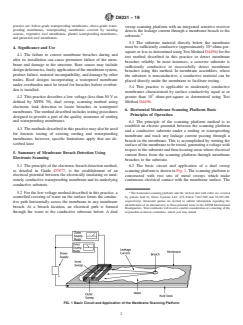
6.2 The basic circuit and application of a dual sweep
as detailed in Guide D7877, is the establishment of an
scanning platform is shown in Fig. 1. The scanning platform is
electrical potential between the electrically insulating or mod- constructed with two sets of metal sweeps which make
erately conductive waterproofing membrane and its underlying continuous electrical contact with the membrane surface. The
conductive substrate.
5.2 For the low voltage method described in this practice, a
The horizontal scanning platform and the vertical unit with roller are covered
by patents held by Detec Systems LLC (US Patent 7,847,560 and 10,345,188,
controlled covering of water on the surface forms the conduc-
respectively). Interested parties are invited to submit information regarding the
tive path horizontally across the membrane to any membrane
identification of an alternative(s) to these patented items to theASTM International
breach. At a breach location, an electrical path is formed
Headquarters.Your comments will receive careful consideration at a meeting of the
through the water to the conductive substrate below. A dual responsible technical committee, which you may attend.
FIG. 1Basic Circuit and Application of the Membrane Scanning Platform
D8231−19
outer sweep forms a continuous perimeter around the scanning D4496. The suitability of a moderately conductive membrane
platform with the inner sweep contained within the perimeter for electronic scanning is determined by lab testing or hand-
of the outer sweep. held commercial instruments that are suitable for field use.
This scanning method is not suited for scanning membranes
6.3 Thepositiveterminalofthevoltagesourceisattachedto
withoverburden.Checkwiththemanufacturerforconductivity
building electrical ground or the roof (concrete or metal)
levels with the specified membrane in this test.
deck/substrate and the negative terminal connects to the
conductive sweep of the scanning platform through the mea-
7. Vertical Membrane Surface Scanning Basic Principles
suring and indicator unit. Since the majority of roofing/
of Operation
waterproofing membranes are non-conductive, the electrical
7.1 Vertical scanning is a membrane breach locating system
potential applied to the scanning platform sweeps provides a
for vertical surfaces, corners, parapet walls, seams, etc.
path through the water over the wetted area of the membrane
to any breach thus completing the circuit to the substrate and 7.2 The vertical membrane scanning method employs a
back to the generator.
generator-receiver electronic unit, connected water-moistened
sensor,andgroundconnection.Thegenerator-receiversupplies
6.4 For a class of membranes which contain a high carbon
the electrical potential for the test circuit and generates audible
black loading and are moderately conductive (Test Method
alerts when a breach is detected (see Fig. 3).
D4496), the dual sweep scanning method is adjusted by a
selector switch to compensate for the inherent conductivity of
7.3 In operation, the moistened roller sensor, which is
the membrane.When the selector switch is set according to the
connected through a cable to the electric potential source in the
manufacturer’s instructions, a membrane breach test is carried
receiver, is pressed against the surface under test (Fig. 4). This
out successfully.
action forces water onto the membrane surface and into any
breaches.Aleakage current will flow from the ground connec-
6.5 During the membrane scan, a light spray of water is
tion through any breach location, returning to the receiver
appl
...