

ASTM F2489-06(2022)
(Guide)Standard Guide for Instrument and Precision Bearing Lubricants-Part 2 Greases
General Information
- Abstract
SIGNIFICANCE AND USE
4.1 The purpose of this guide is to report on the testing of, to discuss and compare the properties of, and to provide guidelines for the choice of lubricating greases for precision rolling element bearings (PREB). The PREB are, for the purposes of this guide, meant to include bearings of Annular Bearing Engineer's Committee (ABEC) 5 quality and above. This guide limits its scope to lubricating greases used in PREB.
4.2 The number of lubricating greases used in PREB increased dramatically from the early 1940s to the mid 1990s. In the beginning of this period, petroleum products were the only widely available base stocks. Later, synthetic base oils became available. They included synthetic hydrocarbons, esters, silicones, multiply alkylated cyclopentanes (MAC) and fluorinated materials, including perfluorinated ethers and the fluorosilicones. This broad spectrum of lubricant choices has led to the use of a large number of different lubricants in PREB applications. The U.S. Department of Defense, as a user of many PREB, has seen a significant increase in the logistics effort required to support the procurement and distribution of these items. In addition, as time has passed, some of the greases used in certain PREB are no longer available or require improved performances due to advanced bearing technology/requirements. This implies that replacement lubricating greases must be found, especially in this era of extending the lifetime of DoD assets, with the consequent and unprojected demand for sources of replacement parts.
4.3 One of the primary goals of this study was to take a broad spectrum of the lubricating greases used in PREB and do a comprehensive series of tests on them in order that their properties could be compared and, if necessary, potential replacement greases be identified. This study is also meant to be a design guide for choosing lubricating greases for future PREB applications. This guide represents a collective effort of many members of this co...
SCOPE
1.1 This guide is a tool to aid in the choice of lubricating grease for precision rolling element bearing applications. The recommendations in this guide are not intended for general purpose bearing applications There are two areas where this guide should have the greatest impact: (1) when lubricating grease is being chosen for a new bearing application and (2) when grease for a bearing has to be replaced because the original grease specified for the bearing can no longer be obtained. The Report (see Section 5) contains a series of tests on a wide variety of greases commonly used in bearing applications to allow comparisons of those properties of the grease that the committee thought to be most important when making a choice of lubricating grease. Each test was performed by the same laboratory. This guide contains a listing of the properties of greases by base oil type, that is, ester, perfluoropolyether (PFPE), polyalphaolefin (PAO), and so forth. This organization is necessary since the operational requirements in a particular bearing application may limit the choice of grease to a particular base oil type and thickener due to its temperature stability, viscosity index or temperature-vapor pressure characteristics, etc. The guide provides data to assist the user in selecting replacement greases for those greases tested that are no longer available. The guide also includes a glossary of terms used in describing/discussing the lubrication of precision and instrument bearings.
1.2 The lubricating greases presented in this guide are commonly used in precision rolling element bearings (PREB). These greases were selected for the testing based on the grease survey obtained from DoD, OEM and grease manufactures and evaluated according to the test protocol that was designed by Subcommittee F34 on Tribology. This test protocol covers the essential requirements identified for precision bearing greases. The performance requirem...
- Status
- Published
- Publication Date
- 31-Dec-2021
- Technical Committee
- F34 - Rolling Element Bearings
- Drafting Committee
- F34.02 - Tribology
Overview
ASTM F2489-06(2022): Standard Guide for Instrument and Precision Bearing Lubricants–Part 2: Greases provides a comprehensive framework for selecting lubricating greases specifically designed for precision rolling element bearings (PREB). This guide targets bearings of ABEC 5 quality and above, frequently used in critical aerospace, defense, and advanced industrial applications. Unlike general-purpose bearing greases, precision bearing greases require stringent properties such as low noise, high speed capability, long life, and minimal contamination-making their selection vital for asset longevity and reliability.
The guide features an extensive testing and evaluation protocol, compares properties of various lubricating greases, and delivers practical guidelines to assist in both initial selection and replacement when original greases are unobtainable. The document was developed through collaboration between bearing and lubricant manufacturers, procurement specialists, and the U.S. Department of Defense (DoD), ensuring wide credibility and applicability.
Key Topics
- Scope of Application: Focuses exclusively on lubricating greases for precision rolling element bearings in demanding environments.
- Testing and Comparison: Results from comprehensive laboratory testing allow side-by-side comparisons across a wide range of greases; properties evaluated include dropping point, worked stability, oxidation resistance, oil separation, corrosion prevention, low-temperature torque, noise, and more.
- Base Oil Types: Classification and performance analysis by base oil type, such as mineral, polyalphaolefin (PAO), esters, silicones, perfluoropolyether (PFPE), and multiply alkylated cyclopentanes (MAC).
- Replacement Guidance: Includes guidelines for finding suitable substitutes for legacy or unavailable greases, especially as asset lifetimes extend and supply chains evolve.
- Compatibility and Cleanliness: Emphasizes the importance of removing old grease, avoiding mixing incompatible greases, and using ultra-filtered greases to maximize bearing life.
- Practical Limitations: Discusses specific advantages and disadvantages of grease types, such as cost, cleaning needs, and operational range.
Applications
Precision & Instrument Bearings
- Aerospace and Defense: Used in high-speed gyroscopes, aircraft navigation systems, and other mission-critical military hardware; supports lifecycle extension programs by identifying qualified grease alternatives.
- Industrial Applications: Applies to robotics, laboratory instruments, precision spindles, and advanced manufacturing, where bearing performance directly affects accuracy and uptime.
- Asset Management: Facilitates maintenance, repair, and operations (MRO) decisions by providing a tested database of greases and detailed property profiles for informed procurement and substitution.
Grease Selection and Replacement
- New Designs: Assists engineers in the initial selection of precision bearing greases based on operating environment, performance targets, and compatibility.
- Obsolescence Solutions: Guides maintenance teams to qualified replacements for discontinued or hard-to-source greases, reducing risk and operational disruption.
- Quality Assurance: Offers a repeatable test protocol for evaluating new or alternative greases, supporting supplier validation and quality control programs.
Related Standards
- ASTM F2161 - Standard Guide for Instrument and Precision Bearing Lubricants-Part 1: Oils
- ASTM D217 - Cone Penetration of Lubricating Greases
- ASTM D1742/D4425 - Oil Separation Tests
- ASTM D972 - Evaporation Loss of Lubricating Greases
- ASTM D1264 - Water Washout Characteristics
- ASTM D1743 - Corrosion Preventive Properties
- ASTM D5483 - Oxidation Induction Time
- MIL-PRF-23827, MIL-PRF-81322, MIL-G-25537, etc. - Relevant government and DoD specifications for lubricating greases
By following ASTM F2489-06(2022), stakeholders ensure the selection and application of lubricating greases that deliver optimal performance, longevity, and safety for precision equipment in challenging operating environments. The guide supports industry best practices in lubrication technology, contributing to reliability, efficiency, and effective asset management.
Relations
- Refers
ASTM D4175-23a - Standard Terminology Relating to Petroleum Products, Liquid Fuels, and Lubricants - Effective Date
- 15-Dec-2023
- Refers
ASTM D4175-23e1 - Standard Terminology Relating to Petroleum Products, Liquid Fuels, and Lubricants - Effective Date
- 01-Jul-2023
- Effective Date
- 01-May-2020
- Refers
ASTM D1742-20 - Standard Test Method for Oil Separation from Lubricating Grease During Storage - Effective Date
- 01-May-2020
- Effective Date
- 15-Mar-2020
- Effective Date
- 01-Jul-2019
- Effective Date
- 01-Jun-2019
- Refers
ASTM D4048-19 - Standard Test Method for Detection of Copper Corrosion from Lubricating Grease - Effective Date
- 01-Jun-2019
- Effective Date
- 01-Jun-2019
- Effective Date
- 01-May-2019
- Effective Date
- 01-May-2019
- Effective Date
- 01-Sep-2018
- Effective Date
- 01-Sep-2018
- Effective Date
- 01-Jun-2018
- Refers
ASTM D1742-18 - Standard Test Method for Oil Separation from Lubricating Grease During Storage - Effective Date
- 01-Apr-2018
Get Certified
Connect with accredited certification bodies for this standard

Element Materials Technology
Materials testing and product certification.

ABS Group Brazil
ABS Group certification services in Brazil.

ABS Quality Evaluations Inc.
American Bureau of Shipping quality certification.
Sponsored listings
Frequently Asked Questions
ASTM F2489-06(2022) is a guide published by ASTM International. Its full title is "Standard Guide for Instrument and Precision Bearing Lubricants-Part 2 Greases". This standard covers: SIGNIFICANCE AND USE 4.1 The purpose of this guide is to report on the testing of, to discuss and compare the properties of, and to provide guidelines for the choice of lubricating greases for precision rolling element bearings (PREB). The PREB are, for the purposes of this guide, meant to include bearings of Annular Bearing Engineer's Committee (ABEC) 5 quality and above. This guide limits its scope to lubricating greases used in PREB. 4.2 The number of lubricating greases used in PREB increased dramatically from the early 1940s to the mid 1990s. In the beginning of this period, petroleum products were the only widely available base stocks. Later, synthetic base oils became available. They included synthetic hydrocarbons, esters, silicones, multiply alkylated cyclopentanes (MAC) and fluorinated materials, including perfluorinated ethers and the fluorosilicones. This broad spectrum of lubricant choices has led to the use of a large number of different lubricants in PREB applications. The U.S. Department of Defense, as a user of many PREB, has seen a significant increase in the logistics effort required to support the procurement and distribution of these items. In addition, as time has passed, some of the greases used in certain PREB are no longer available or require improved performances due to advanced bearing technology/requirements. This implies that replacement lubricating greases must be found, especially in this era of extending the lifetime of DoD assets, with the consequent and unprojected demand for sources of replacement parts. 4.3 One of the primary goals of this study was to take a broad spectrum of the lubricating greases used in PREB and do a comprehensive series of tests on them in order that their properties could be compared and, if necessary, potential replacement greases be identified. This study is also meant to be a design guide for choosing lubricating greases for future PREB applications. This guide represents a collective effort of many members of this co... SCOPE 1.1 This guide is a tool to aid in the choice of lubricating grease for precision rolling element bearing applications. The recommendations in this guide are not intended for general purpose bearing applications There are two areas where this guide should have the greatest impact: (1) when lubricating grease is being chosen for a new bearing application and (2) when grease for a bearing has to be replaced because the original grease specified for the bearing can no longer be obtained. The Report (see Section 5) contains a series of tests on a wide variety of greases commonly used in bearing applications to allow comparisons of those properties of the grease that the committee thought to be most important when making a choice of lubricating grease. Each test was performed by the same laboratory. This guide contains a listing of the properties of greases by base oil type, that is, ester, perfluoropolyether (PFPE), polyalphaolefin (PAO), and so forth. This organization is necessary since the operational requirements in a particular bearing application may limit the choice of grease to a particular base oil type and thickener due to its temperature stability, viscosity index or temperature-vapor pressure characteristics, etc. The guide provides data to assist the user in selecting replacement greases for those greases tested that are no longer available. The guide also includes a glossary of terms used in describing/discussing the lubrication of precision and instrument bearings. 1.2 The lubricating greases presented in this guide are commonly used in precision rolling element bearings (PREB). These greases were selected for the testing based on the grease survey obtained from DoD, OEM and grease manufactures and evaluated according to the test protocol that was designed by Subcommittee F34 on Tribology. This test protocol covers the essential requirements identified for precision bearing greases. The performance requirem...
SIGNIFICANCE AND USE 4.1 The purpose of this guide is to report on the testing of, to discuss and compare the properties of, and to provide guidelines for the choice of lubricating greases for precision rolling element bearings (PREB). The PREB are, for the purposes of this guide, meant to include bearings of Annular Bearing Engineer's Committee (ABEC) 5 quality and above. This guide limits its scope to lubricating greases used in PREB. 4.2 The number of lubricating greases used in PREB increased dramatically from the early 1940s to the mid 1990s. In the beginning of this period, petroleum products were the only widely available base stocks. Later, synthetic base oils became available. They included synthetic hydrocarbons, esters, silicones, multiply alkylated cyclopentanes (MAC) and fluorinated materials, including perfluorinated ethers and the fluorosilicones. This broad spectrum of lubricant choices has led to the use of a large number of different lubricants in PREB applications. The U.S. Department of Defense, as a user of many PREB, has seen a significant increase in the logistics effort required to support the procurement and distribution of these items. In addition, as time has passed, some of the greases used in certain PREB are no longer available or require improved performances due to advanced bearing technology/requirements. This implies that replacement lubricating greases must be found, especially in this era of extending the lifetime of DoD assets, with the consequent and unprojected demand for sources of replacement parts. 4.3 One of the primary goals of this study was to take a broad spectrum of the lubricating greases used in PREB and do a comprehensive series of tests on them in order that their properties could be compared and, if necessary, potential replacement greases be identified. This study is also meant to be a design guide for choosing lubricating greases for future PREB applications. This guide represents a collective effort of many members of this co... SCOPE 1.1 This guide is a tool to aid in the choice of lubricating grease for precision rolling element bearing applications. The recommendations in this guide are not intended for general purpose bearing applications There are two areas where this guide should have the greatest impact: (1) when lubricating grease is being chosen for a new bearing application and (2) when grease for a bearing has to be replaced because the original grease specified for the bearing can no longer be obtained. The Report (see Section 5) contains a series of tests on a wide variety of greases commonly used in bearing applications to allow comparisons of those properties of the grease that the committee thought to be most important when making a choice of lubricating grease. Each test was performed by the same laboratory. This guide contains a listing of the properties of greases by base oil type, that is, ester, perfluoropolyether (PFPE), polyalphaolefin (PAO), and so forth. This organization is necessary since the operational requirements in a particular bearing application may limit the choice of grease to a particular base oil type and thickener due to its temperature stability, viscosity index or temperature-vapor pressure characteristics, etc. The guide provides data to assist the user in selecting replacement greases for those greases tested that are no longer available. The guide also includes a glossary of terms used in describing/discussing the lubrication of precision and instrument bearings. 1.2 The lubricating greases presented in this guide are commonly used in precision rolling element bearings (PREB). These greases were selected for the testing based on the grease survey obtained from DoD, OEM and grease manufactures and evaluated according to the test protocol that was designed by Subcommittee F34 on Tribology. This test protocol covers the essential requirements identified for precision bearing greases. The performance requirem...
ASTM F2489-06(2022) is classified under the following ICS (International Classification for Standards) categories: 75.100 - Lubricants, industrial oils and related products. The ICS classification helps identify the subject area and facilitates finding related standards.
ASTM F2489-06(2022) has the following relationships with other standards: It is inter standard links to ASTM D4175-23a, ASTM D4175-23e1, ASTM D2596-20, ASTM D1742-20, ASTM E1131-20, ASTM D217-19a, ASTM D4425-19, ASTM D4048-19, ASTM D2265-19, ASTM D1831-19, ASTM D217-19, ASTM D1264-18e1, ASTM D1264-18, ASTM D1831-18, ASTM D1742-18. Understanding these relationships helps ensure you are using the most current and applicable version of the standard.
ASTM F2489-06(2022) is available in PDF format for immediate download after purchase. The document can be added to your cart and obtained through the secure checkout process. Digital delivery ensures instant access to the complete standard document.
Standards Content (Sample)
This international standard was developed in accordance with internationally recognized principles on standardization established in the Decision on Principles for the
Development of International Standards, Guides and Recommendations issued by the World Trade Organization Technical Barriers to Trade (TBT) Committee.
Designation: F2489 − 06 (Reapproved 2022)
Standard Guide for
Instrument and Precision Bearing Lubricants—Part 2
Greases
This standard is issued under the fixed designation F2489; the number immediately following the designation indicates the year of
original adoption or, in the case of revision, the year of last revision. A number in parentheses indicates the year of last reapproval. A
superscript epsilon (´) indicates an editorial change since the last revision or reapproval.
1. Scope The performance requirements of these greases are very
unique. They are dictated by the performance expectations of
1.1 This guide is a tool to aid in the choice of lubricating
precision bearings including high speed, low noise, extended
grease for precision rolling element bearing applications. The
life, and no contamination of surrounding components by the
recommendations in this guide are not intended for general
bearing’s lubricant system. To increase the reliability of test
purpose bearing applications There are two areas where this
data, all tests were performed by a DoD laboratory and three
guide should have the greatest impact: (1) when lubricating
independent testing laboratories. There were no grease manu-
grease is being chosen for a new bearing application and (2)
facturer’s data imported except for base oil viscosity. Most of
when grease for a bearing has to be replaced because the
tests were performed by U.S. Army Tank–Automotive
original grease specified for the bearing can no longer be
Research, Development and Engineering Center (TARDEC)
obtained. The Report (see Section 5) contains a series of tests
and three independent laboratories, and the results were moni-
on a wide variety of greases commonly used in bearing
tored by the Naval Research Laboratory (NRL). This continu-
applications to allow comparisons of those properties of the
ity of testing should form a solid basis for comparing the
grease that the committee thought to be most important when
properties of the multitude of lubricating greases tested by
makingachoiceoflubricatinggrease.Eachtestwasperformed
avoiding some of the variability introduced when greases are
by the same laboratory. This guide contains a listing of the
tested by different laboratories using different or even the
properties of greases by base oil type, that is, ester, perfluo-
“same” procedures. Additional test data will be considered for
ropolyether (PFPE), polyalphaolefin (PAO), and so forth. This
inclusion, provided the defined protocol is followed and the
organization is necessary since the operational requirements in
tests are performed by independent laboratories.
a particular bearing application may limit the choice of grease
toaparticularbaseoiltypeandthickenerduetoitstemperature 1.3 This study was a part of DoD Aging Aircraft Replace-
stability, viscosity index or temperature-vapor pressure ment Program and supported by Defense Logistic Agent
characteristics,etc.Theguideprovidesdatatoassisttheuserin (DLA) and Defense Supply Center Richmond (DSCR).
selecting replacement greases for those greases tested that are
1.4 The values stated in inch-pound units are to be regarded
nolongeravailable.Theguidealsoincludesaglossaryofterms
as standard. No other units of measurement are included in this
used in describing/discussing the lubrication of precision and
standard.
instrument bearings.
1.5 This standard does not purport to address all of the
1.2 The lubricating greases presented in this guide are
safety concerns, if any, associated with its use. It is the
commonly used in precision rolling element bearings (PREB).
responsibility of the user of this standard to establish appro-
These greases were selected for the testing based on the grease
priate safety, health, and environmental practices and deter-
surveyobtainedfromDoD,OEMandgreasemanufacturesand
mine the applicability of regulatory limitations prior to use.
evaluated according to the test protocol that was designed by
1.6 This international standard was developed in accor-
Subcommittee F34 on Tribology. This test protocol covers the
dance with internationally recognized principles on standard-
essential requirements identified for precision bearing greases.
ization established in the Decision on Principles for the
Development of International Standards, Guides and Recom-
mendations issued by the World Trade Organization Technical
This guide is under the jurisdiction of ASTM Committee F34 on Rolling
Barriers to Trade (TBT) Committee.
Element Bearings and is the direct responsibility of Subcommittee F34.02 on
Tribology.
Current edition approved Jan. 1, 2022. Published August 2022. Originally Rhee,In-Sik,“PrecisionBearingGreaseSelectionGuide,” U.S.Army TARDEC
approvedin2006.Lastpreviouseditionapprovedin2013asF2489–06(2013).DOI: Technical Report No. 15688, Defense Technical Information Center, 8725 John. J.
10.1520/F2489-06R22. Kingman Rd., Suite 0944, Ft. Belvoir, VA 22060–6218.
Copyright © ASTM International, 100 Barr Harbor Drive, PO Box C700, West Conshohocken, PA 19428-2959. United States
F2489 − 06 (2022)
2. Referenced Documents MIL-L-15719 High Temperature Electrical Bearing Grease
3 DoD-G-24508 Multipurpose Grease
2.1 ASTM Standards:
2.3 Industrial Standards:
D217 Test Methods for Cone Penetration of Lubricating
SKF Be-Quite Noise Test Method
Grease
TA Rheometry Procedure for Steady Shear Flow Curve
D972 Test Method for Evaporation Loss of Lubricating
Wet Shell Roll Test Method
Greases and Oils
D1264 Test Method for Determining the Water Washout
2.4 SAE Standard:
Characteristics of Lubricating Greases
SAE-AMS-G-81937 Grease, Instrument, Ultra-Clean, Met-
D1742 Test Method for Oil Separation from Lubricating
ric
Grease During Storage
D1743 Test Method for Determining Corrosion Preventive
3. Terminology
Properties of Lubricating Greases
3.1 For definition of standard terms used in this guide, see
D1831 Test Method for Roll Stability of Lubricating Grease
Terminology D4175 and F2488 or Compilation of ASTM
D2265 Test Method for Dropping Point of Lubricating
Standard Definitions.
Grease Over Wide Temperature Range
3.2 Definitions of Terms Specific to This Standard:
D2266 Test Method for Wear Preventive Characteristics of
3.2.1 esters, n—esters are formed from the reaction of acids
Lubricating Grease (Four-Ball Method)
and alcohols. Esters form a class of synthetic lubricants. Esters
D2596 Test Method for Measurement of Extreme-Pressure
of higher alcohols with divalent fatty acids form diester
Properties of Lubricating Grease (Four-Ball Method)
lubricants while esters of polyhydric alcohols are called the
D3527 Test Method for Life Performance of Automotive
polyolesterlubricants.Theselatterestershavehigherviscosity
Wheel Bearing Grease
and are more heat-resistant than diesters.
D4048 Test Method for Detection of Copper Corrosion from
Lubricating Grease
3.2.2 mineral oil, n—oils based on petroleum stocks. These
D4175 Terminology Relating to Petroleum Products, Liquid
oils come in two types, naphthenic and paraffinic. The naph-
Fuels, and Lubricants
thenic oils contain unsaturated hydrocarbons, usually in the
D4289 Test Method for Elastomer Compatibility of Lubri-
form of aromatic species. The paraffinic oils are primarily
cating Greases and Fluids
saturated hydrocarbons with only low levels of unsaturation.
D4425 Test Method for Oil Separation from Lubricating
3.2.3 perfluoropolyethers (PFPE or PFAE), n—fully fluo-
Grease by Centrifuging (Koppers Method)
rinated long-chain aliphatic ethers. The perfluoropolyethers
D4693 TestMethodforLow-TemperatureTorqueofGrease-
show some extraordinary properties like chemical inertness,
Lubricated Wheel Bearings
nonflammability, high thermal and oxidative resistance, very
D5483 Test Method for Oxidation Induction Time of Lubri-
good viscosity-temperature characteristics, and compatibility
catingGreasesbyPressureDifferentialScanningCalorim-
with a wide range of materials, including metals and plastics.
etry
The perfluoropolyethers, however, are not always suitable for
E1131 Test Method for CompositionalAnalysis by Thermo-
metal alloys at elevated temperatures (contact temperatures
gravimetry
higher than about 550 °F). The perfluoropolyethers are not
F2161 Guide for Instrument and Precision Bearing
miscible with other types of synthetic fluids and mineral oils
Lubricants—Part 1 Oils
and cannot dissolve common lubricant additives.
F2488 Terminology for Rolling Element Bearings
3.2.4 silicone oils, n—synthetic fluids composed of organic
2.2 Government Documents:
esters of long chain complex silicic acids. Silicone oils have
Federal Standard Test Method 791C, 3005.4 Dirt Content of
better physical properties than mineral oils. However, silicone
Grease
oils have poorer lubrication properties, lower load-carrying
MIL-G-25537 Aircraft Helicopter Bearing Grease
capacity, and a strong tendency to spread on surfaces (see
MIL-PRF-23827 Aircraft and instrument Grease
surface tension).
MIL-PRF-81322 Aircraft Wide Temperature Range Grease
3.2.5 synthetic fluids, n—lubricating fluids produced by
MIL-PRF-83261 Aircraft Extreme Pressure
chemical synthesis. The synthetic route to formulate these
MIL-PRF-10924 Grease, Automotive and Artillery
lubricants allows the manufacturer to introduce those chemical
MIL-G-27617 Grease, Aircraft and Instrument, Fuel and
structures into the lubricant molecule that will impart specific
Oxidizer Resistant
properties into the resultant fluid such as very low pour point,
MIL-G-21164 Molybdenum Disulfide Grease
MIL-G-25760 Grease, Aircraft, Ball and Roller Bearing,
Wide Temperature Range
Available from SKF North American Technical Center, 46815 Port St.,
Plymouth, MI 48170.
3 6
For referenced ASTM standards, visit the ASTM website, www.astm.org, or Available from TA Instruments Company, 109 Lukens Drive, New Castle, DE
contact ASTM Customer Service at service@astm.org. For Annual Book of ASTM 19720-2765.
Standards volume information, refer to the standard’s Document Summary page on Available from Southwest Petro-Chem Division, Witco Corp., P.O. Box 1974,
the ASTM website. Olathe, KS 66061.
4 8
Available from DLA Document Services, Building 4/D, 700 Robbins Ave., Available from Society of Automotive Engineers (SAE), 400 Commonwealth
Philadelphia, PA 19111-5094, http://quicksearch.dla.mil. Dr., Warrendale, PA 15096-0001.
F2489 − 06 (2022)
good viscosity-temperature relationship, low evaporation loss, the previous study (Guide F2161). This study included a
long lubricating lifetime, and so forth. discussion of elastohydrodynamic lubrication theory.
3.2.6 lubricating grease, n—a semi-fluid to solid product of
5. Report
a dispersion of a thickener in a liquid lubricant.
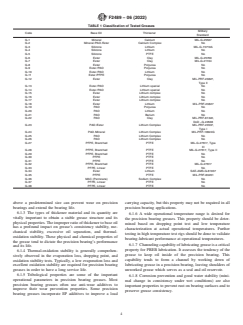
5.1 The test results are summarized in Tables 1–3. Table 1
presents the classification of base oils, thickener types, and
4. Significance and Use
militaryspecificationproductsevaluatedinthisprogram.Table
4.1 The purpose of this guide is to report on the testing of,
2 lists the test protocol for this study and covers the test
to discuss and compare the properties of, and to provide
methods, their test conditions, and the testing laboratories.
guidelines for the choice of lubricating greases for precision
Table 3 (A-C) provides the test results of the 38 precision
rolling element bearings (PREB). The PREB are, for the
bearing greases tested. Each grease tested was assigned a code
purposes of this guide, meant to include bearings of Annular
tomasktheirsourcetomitigateanypotentialbiasinthetesting
Bearing Engineer’s Committee (ABEC) 5 quality and above.
results. The tradename of each grease is listed in Research
ThisguidelimitsitsscopetolubricatinggreasesusedinPREB.
Report RR:F34-1000. For the evaluation, each grease was
testedfordroppingpoint,consistency,waterandworkstability,
4.2 The number of lubricating greases used in PREB in-
oxidation stability, oil separation, evaporation loss, wear, EP
creased dramatically from the early 1940s to the mid 1990s. In
properties, corrosion prevention, low temperature
the beginning of this period, petroleum products were the only
characteristics, cleanliness, apparent viscosity, grease noise,
widely available base stocks. Later, synthetic base oils became
and grease life. Compatibility testing with elastomers incorpo-
available. They included synthetic hydrocarbons, esters,
rated into PREB and their environments were not done due to
silicones, multiply alkylated cyclopentanes (MAC) and fluori-
the large number of combinations that would require testing to
nated materials, including perfluorinated ethers and the fluo-
span the potential mixes of greases and elastomer components
rosilicones.This broad spectrum of lubricant choices has led to
that might occur in bearing applications. It is recommended
the use of a large number of different lubricants in PREB
that the user verify grease/elastomer compatibility when
applications. The U.S. Department of Defense, as a user of
needed.
many PREB, has seen a significant increase in the logistics
effort required to support the procurement and distribution of
5.2 In these tables, some of the data may not agree with
these items. In addition, as time has passed, some of the
those of manufacturers due to the variation of the test methods
greasesusedincertainPREBarenolongeravailableorrequire
and their test apparatuses (that is, noise test). All tests were
improved performances due to advanced bearing technology/
performed by a government laboratory and three independent
requirements.Thisimpliesthatreplacementlubricatinggreases
laboratories. No grease manufacturers performed any of these
must be found, especially in this era of extending the lifetime
tests except for the base oil viscosities of greases. To increase
of DoD assets, with the consequent and unprojected demand
the availability of precision bearing greases, these tables will
for sources of replacement parts.
be revised periodically to include new greases as long as the
manufacturer submits test results on their product following
4.3 One of the primary goals of this study was to take a
precisely the protocol defined in the document.
broadspectrumofthelubricatinggreasesusedinPREBanddo
a comprehensive series of tests on them in order that their
6. Application Considerations
properties could be compared and, if necessary, potential
replacement greases be identified. This study is also meant to
6.1 This guide applies only to precision bearing greases.
be a design guide for choosing lubricating greases for future
The other types of greases such as industrial greases or
PREB applications. This guide represents a collective effort of
automotive general purpose greases are not covered by this
manymembersofthiscommunitywhospanthespectrumfrom
guide.
bearing manufacturers, original equipment manufactures
6.1.1 Precision bearing greases contain base oil to which a
(OEMs), grease manufacturers and suppliers, procurement
thickener has been added to prevent oil migration from the
specialists, and quality assurance representatives (QARs) from lubrication site and various additives to improve its operating
DoD and end users both inside and outside DoD.
performance.Currently,manytechnicalarticlesoftendesignate
types of lubricating greases based on their thickeners.
4.4 Itisstronglyrecommendthat,priortoreplacingagrease
However, the operative properties of precision bearing greases
in a PREB, all of the existing grease should be removed from
depend on the combination of base oil, thickener, and additive
the bearing. Reactions may occur between incompatible
formulation. This guide distinguishes lubricating greases by
greases resulting in severely degraded performance. When
their base oil types.
users have more than one type of grease in service, mainte-
6.1.2 Cleanliness is critical to bearing life. Even micro-
nance practices must be in place to avoid accidental mixing of
scopic contamination can determine the wear processes that
greases. In addition, all fluids used specifically to prolong
impact bearing life/performance and result in bearing failure.
storage life of PREBs (preservatives) should be removed prior
Clean greases or ultra-filtered greases that exclude particles
to lubricating the bearings. Reactions may occur which would
degrade the grease.
4.5 The base oils, thickeners, and additives dictates grease
Supporting data have been filed at ASTM International Headquarters and may
performances.Thepropertiesofmanybaseoilscanbefoundin be obtained by requesting Research Report RR:F34-1000.
F2489 − 06 (2022)
TABLE 1 Classification of Tested Greases
Military
Code Base Oil Thickener
Standard
G-1 Mineral Calcium MIL-G-25537
G-2 Mineral ⁄PAO ⁄Ester Calcium Complex No
G-3 Silicone Lithium MIL-G-15719A
G-4 Silicone Lithium No
G-5 Silicone PTFE No
G-6 Ester Clay MIL-G-25760
G-7 Ester Clay MIL-G-21164
G-8 Ester Polyurea No
G-9 Ester ⁄PAO Polyurea No
G-10 Ester ⁄PAO Lithium No
G-11 Ester ⁄PFPE Polyurea No
G-12 Ester Clay MIL-PRF-23827,
Type II
G-13 Ester ⁄PAO Lithium special No
G-14 Ester ⁄PAO Lithium special No
G-15 Ester Lithium complex No
G-16 Ester Lithium complex No
G-17 Ester Lithium complex No
G-18 Ester Lithium MIL-PRF-23827
G-19 PAO Polyurea No
G-20 PAO Lithium No
G-21 PAO Barium No
G-22 PAO Clay MIL-PRF-81322,
DoD –G-24508
G-23 PAO ⁄Ester Lithium Complex MIL-PRF-23537,
Type I
G-24 PAO ⁄Mineral Lithium Complex MIL-PRF-10924G
G-25 PAO Lithium Complex No
G-26 PAO Lithium Complex No
G-27 PFPE, Branched PTFE MIL-G-27617, Type
III
G-28 PFPE, Branched PTFE MIL-G-27617, Type II
G-29 PFPE, Branched PTFE No
G-30 PFPE PTFE No
G-31 PFPE PTFE No
G-32 PFPE, Branched PTFE MIL-G-27617
G-33 PFPE, Linear PTFE No
G-34 Ester Lithium SAE-AMS-G-81937
G-35 PFPE PTFE MIL-PRF-83261
G-36 MAC (Pennzane) Sodium Complex No
G-37 PFPE, Linear PTFE No
G-38 PFPE, Linear PTFE No
above a predetermined size can prevent wear on precision carrying capacity, but this property may not be required in all
bearings and extend the bearing life. precision bearing applications.
6.1.3 The types of thickener material and its quantity are
6.1.6 A wide operational temperature range is desired for
vitally important to obtain a stable grease structure and its
the precision bearing greases. This property should be deter-
physical properties. The improper ratio of thickener to base oil
mined based on dropping point test and low temperature
has a profound impact on grease’s consistency stability, me-
characterization at actual operational temperatures. Further
chanical stability, excessive oil separation, and thermal-
testing in high temperature test rigs should be done to validate
oxidation stability. These physical and chemical properties of
bearing-lubricant performance at operational temperatures.
the grease tend to dictate the precision bearing’s performance
6.1.7 Channelingcapabilityoflubricatinggreaseisacritical
and its life.
property for PREB lubrication. It assesses the tendency of the
6.1.4 Thermal-oxidation stability is generally comprehen-
grease to keep oil inside of the precision bearing. This
sively observed in the evaporation loss, dropping point, and
capability tends to form a channel by working down of
oxidation stability tests. Typically, a low evaporation loss and
lubricating grease in a precision bearing, leaving shoulders of
excellent oxidation stability are required for precision bearing
unworked grease which serves as a seal and oil reservoir.
greases in order to have a long service life.
6.1.5 Tribological properties are some of the important
6.1.8 Corrosion prevention and good water stability (mini-
operational parameters in precision bearing greases. Most
mal change in consistency under wet conditions) are also
precision bearing greases often use anti-wear additives to
important properties to prevent rust on bearing surfaces and to
improve their wear prevention properties. Some precision
preserve grease consistency.
bearing greases incorporate EP additives to improve a load
F2489 − 06 (2022)
TABLE 2 Test Protocol
Test Method Test Condition Testing Laboratory Evaluation
Dropping Point ASTM Test Method Standard U.S. Army TARDEC Measure the temperature at which the first drop of grease
D2265 falls from the cup
Oil Separation ASTM Test Method Standard U.S. Army TARDEC Measure the oil separation of grease under normal storage
(static) D1742 conditions
Oil Separation (Dy- ASTM Test Method 40°C, 2h U.S. Army TARDEC Measure the oil separation of grease by a high speed
namic) D4425 centrifuge force
Work ASTM Test Methods Standard U.S. Army TARDEC Measure the consistency of the grease. Higher number
Penetration D217 indicates a soft grease
Copper ASTM Test Method Standard U.S. Army TARDEC Measure corrosion on copper metal in comparison to the
Corrosion D4048 ASTM Copper Strip Corrosion Standards. The 1a and 1b
ratings indicate no corrosion
Rust Preventive ASTM Test Method Standard U.S. Army TARDEC Determine the rust preventive properties of greases using
D1743 grease lubricated tapered roller bearings stored under wet
conditions (flash water). No corrosion is pass rating.
Water Stability MIL-PRF-10924 Standard U.S. Army TARDEC Measure water stability of greases by using a full scale
grease worker. The change in consistency after being
subjected to water is a measure of the water stability of
the grease. Small difference indicates better water stability.
Water Washout ASTM Test Method Standard Petro-Luburicants Measure the percentage weight of grease washed out from a
D1264 Testing Lab bearing at the test temperature.
Oxidation ASTM Test Method Standard U.S. Army TARDEC Measure the oxidation induction time of grease under oxygen
Stability D5483 environments. A longer induction time indicates better
oxidation stability.
Evaporation ASTM Test Method Standard U.S. Army TARDEC Measure the evaporation loss of greases at 99 °C.
Loss D972
High Temperature ASTM Test Method 1 h U.S. Army TARDEC Measure the evaporation loss of grease at 180 °C.
Evaporation Loss at E1131
180 °C (TGA)
Channeling Ability ASTM Test Method Visual check after U.S. Army TARDEC Determine channeling capability of a grease in a lubricated
D4693 bearing test tapered roller bearing.
Apparent Dynamic Vis- TA At 25 °C ICI Paints Strongsville Measure apparent dynamic viscosity of a grease at 25 °C
cosity Rheometer Research Center
Wet Shell Roll Wet Shell Roll Test Standard U.S. Army TARDEC Measure water stability of greases using a roll stability test
Stability apparatus, small sample required. The difference in cone
penetration before and after being worked in the presence of
water is a measure of the effect of water on the grease.
Small difference indicates better water stability.
Work Stability ASTM Test Methods Standard U.S. Army TARDEC Determine the work stability using a grease worker.
D217 The difference between the cone penetration before and
after working is a measure of the worked stability of the
grease. Small difference indicates better worked stability.
Roll Stability ASTM Test Method Standard U.S. Army TARDEC Determine the roll stability of grease. The difference between
D1831 the cone penetration before and after rolling is a measure of
the roll stability of the grease. Small difference indicates
better roll stability.
Four Ball Wear ASTM Test Method Standard U.S. Army TARDEC Determine the wear preventive characteristics of greases in
Test D2266 sliding- steel-on-steel applications. Measure the diameters of
wear scars after the test. A small diameter indicates less
wear.
Four Ball EP ASTM Test Method Standard U.S. Army TARDEC Determine the load-carrying properties of greases. It
Test D2596 measures Load –wear index (LWI). A high LWI number
indicates a better load-carrying property.
Grease Life ASTM Test Method Standard U.S. Army TARDEC Measure grease life at the test temperature.
D3527
Low ASTM Test Method Test temperatures, U.S. Army TARDEC Measure low temperature property of grease. It measures
Temperature D4693 -20 °C, -40 °C, -54 °C initial torque and running torque at 1 and 5 min. A lower
Torque number indicates a better low temperature property.
Rolling SKF Be-quite Standard SKF Measure noise level using an acoustic instrument. The
Bearing rakings are : very noisy (GNX)>noisy (GN1)>standard
Noise noise (GN2)>quite (GN3)>very quite(GN4)
Dirt Count FTM 3005.4 Standard U.S. Army TARDEC Measure the cleanness of greases. Zero indicates no dirt
contamination.
6.1.9 Apparent dynamic viscosity tends to indicate the 6.1.11 A high level of noise generated from a precision
usable temperature range of a lubricating grease for high speed bearing is usually caused by surface defects or damage of the
precision bearing applications. anti-friction components (balls, races), due to the solid or
6.1.10 Long grease life is desired in precision bearing semi-solid particles present in lubricating greases. Quiet
applications. Most precision bearings are not re-lubricated greases that are formulated with few very small particles
during their lifetime.Also, the grease life is also dependent on particulates or filtered to remove particulates are typically
the operational temperature. required for precision bearing applications.
F2489 − 06 (2022)
TABLE 3 Grease Test Data (A)
Oil
Worked Water Wet Shell
Dropping Separation Copper Rust Work Stability Roll Stability Four ball Grease life
Code Penetration Stability Roll Stability
point (c) (Dynamic) Corrosion Preventive (1/10 mm) (1/10 mm) wear (mm) (h)
(mm) (1/10 mm) (1/10 mm)
(%)
G-1 151 39 284 1a Pass 62 53 47 37 0.36 27
G-2 215 24 284 1a Pass . . . 12 . . . 22 0.56 225
G-3 217 0.5 263 1b Pass -11 -8 40 3 2.20 295
G-4 218 3 285 1b Pass 14 8 16 12 1.24 423
G-5 334 43 268 1b Pass . . . -3 . . . -4 2.27 354
G-6 321 45 295 1a Pass 132 119 82 76 0.58 394
G-7 263 42 302 1a Pass 25 37 59 49 0.49 231
G-8 286 5 259 1b Pass . . . 58 . . . 36 0.36 397
G-9 279 6 252 1a Pass . . . 69 . . . 45 0.40 300
G-10 338 24 266 1a Pass . . . 55 --- 57 0.60 180
G-11 269 0.4 286 1a Pass . . . 21 . . . 10 0.44 371
G-12 282 45 321 1a Pass 29 23 36 42 0.54 110
G-13 323 14 290 1b Pass . . . 11 . . . 4 0.47 90
G-14 279 13 249 1a Pass . . . 18 . . . 5 0.52 100
G-15 273 25 244 1b Pass . . . 83 . . . 25 0.49 240
G-16 195 32 318 3a Pass . . . 39 . . . 18 0.51 210
G-17 203 11 260 1b Pass . . . 113 . . . 47 0.85 170
G-18 187 34 271 1a Pass . . . >162 41 24 0.91 100
G-19 213 5 274 1a Pass 9 1 17 -8 0.48 400
G-20 194 57 257 1b Pass . . . 37 . . . 20 0.58 171
G-21 279 28 266 1b Pass . . . 7 . . . 3 0.48 120
G-22 310 47 290 1a Pass 125 97 37 97 0.69 271
G-23 242 53 297 1a Pass 7 7 12 10 0.52 140
G-24 256 13 281 1a Pass -2 -3 28 26 0.48 150
G-25 227 21 291 1b Pass . . . 38 . . . 22 0.35 49
G-26 225 8 213 2c Pass . . . 41 . . . 3 0.40 161
G-27 243 16 266 1b Pass . . . 11 . . . 19 0.83 397
G-28 191 33 260 1b Pass . . . 38 . . . 13 0.72 400
G-29 213 29 263 1b Pass . . . 42 . . . 22 1.00 450
G-30 293 13 275 1b Pass . . . -4 . . . 30 0.87 365
G-31 217 31 256 1a Pass . . . 59 . . . 46 0.68 >500
G-32 221 33 303 1b Pass . . . 17 . . . 12 0.90 309
G-33 199 35 279 1a Pass . . . -13 . . . 8 1.13 >500
G-34 207 19 218 1a Pass . . . 137 . . . 94 0.77 60
G-35 187 14 307 4a Pass . . . 21 . . . 34 1.41 >500
G-36 318 24 232 1b Pass . . . 80 . . . 70 0.37 >500
G-37 239 22 281 1b Pass . . . 10 . . . 1 0.77 >500
G-38 235 22 290 1b Pass . . . 1 . . . 6 0.87 >500
TABLE 3 Grease Test Data (B)
Dirt Count
Low Temperature Torque
Evaporation
Particles per mL
Oil Evaporation Water
Four Ball Loss at
Code Separation Loss (%) Washout
Test
EPLWI 180 °C, %
25 to 75 75 to 125 125+ Breakaway 1min 5min
(Static) (%) At 99 °C (%)
temperature
(TGA)
microns microns microns (Nm) (Nm) (Nm)
°C
G-1 16.5 23 0.88 500 200 100 5.63 41.2 -54 4.93 1.9 1.63
G-2 3.0 53 0.23 650 100 0 1.53 3.6 -40 2.47 1.27 0.93
G-3 0.3 28 0.26 350 100 50 1.46 1.3 -40 2.18 1.4 1.12
G-4 1.4 29 0.46 350 50 0 2.31 1.3 -54 0.86 0.43 0.4
G-5 0.9 22 0.14 50 0 0 1.00 0.4 -40 5.85 1.97 1.64
G-6 0.6 66 0.35 100 0 0 2.67 2.4 -54 3.98 1.83 1.46
G-7 6.1 68 0.60 250 50 0 1.69 5.2 -54 0.82 0.53 0.47
G-8 0.5 25 0.06 100 50 0 2.97 2.6 -40 2.79 1.72 1.59
G-9 0.9 39 0.19 50 0 0 2.16 3.6 -40 0.9 0.43 0.39
G-10 5.3 39 0.20 0 0 0 5.40 2.6 -54 1.92 1.22 1.09
G-11 0.01 38 0.10 0 0 0 0.61 2.3 -20 2.67 1.61 1.41
G-12 2.6 39 0.53 400 0 0 1.47 6.4 -54 0.74 0.52 0.5
G-13 0.0 20 0.26 100 0 0 3.19 2.0 -54 2.34 1.53 1.19
G-14 0.8 20 0.36 0 0 0 2.43 2.5 -54 2.56 1.47 1.16
G-15 10.3 25 0.35 100 0 0 9.64 2.4 -54 7.1 3.29 2.99
G-16 10.8 20 0.22 100 50 0 6.83 2.1 -54 0.95 0.55 0.49
G-17 5.3 26 0.18 100 0 0 5.49 0.2 -54 36.0 3.48 3.2
G-18 17.1 39 0.58 150 50 0 8.68 11.7 -54 0.91 0.47 0.36
G-19 0.01 21 0.31 0 0 0 0.95 2.0 -40 2.67 1.67 1.47
G-20 7.6 25 0.22 0 0 0 1.51 5.0 -54 0.98 0.5 0.43
G-21 0.5 36 0.10 50 0 0 0.30 1.9 -40 1.27 0.71 0.56
G-22 9.9 39 0.14 400 0 0 0.79 1.8 -54 1.46 1.12 1.01
G-2
...