

ASTM E132-17
(Test Method)Standard Test Method for Poisson’s Ratio at Room Temperature
General Information
- Abstract
SIGNIFICANCE AND USE
4.1 When uniaxial force is applied to a solid, it deforms in the direction of the applied force, but also expands or contracts laterally depending on whether the force is tensile or compressive. If the solid is homogeneous and isotropic, and the material remains elastic under the action of the applied force, the lateral strain bears a constant relationship to the axial strain. This constant, called Poisson’s ratio, is an intrinsic material property just like Young’s modulus and Shear modulus.
4.2 Poisson's ratio is used for design of structures where all dimensional changes resulting from application of force need to be taken into account, and in the application of the generalized theory of elasticity to structural analysis.
4.3 In this test method, the value of Poisson's ratio is obtained from strains resulting from uniaxial stress only.
4.4 Above the proportional limit, the ratio of transverse strain to axial strain will depend on the average stress and on the stress range for which it is measured and, hence, should not be regarded as Poisson’s ratio. If this ratio is reported, nevertheless, as a value of “Poisson’s ratio” for stresses below the proportional limit, the range of stress should be reported.
4.5 Deviations from isotropy should be suspected if the Poisson’s ratio, μ, determined by the method described below differs significantly from that determined when the ratio E/G of Young’s modulus, E, to shear modulus, G, is substituted in the following equation:
where E and G must be measured with greater precision than the precision desired in the measurement of μ.
4.6 The accuracy of the determination of Poisson's ratio is usually limited by the accuracy of the transverse strain measurements because the percentage errors in these measurements are usually greater than in the axial strain measurements. Since a ratio rather than an absolute quantity is measured, it is only necessary to know accurately the relative value of the calibration ...
SCOPE
1.1 This test method covers the determination of Poisson’s ratio from tension tests of structural materials at room temperature. This test method is limited to specimens of rectangular section and to materials in which and stresses at which creep is negligible compared to the strain produced immediately upon loading.
1.2 The values stated in inch-pound units are to be regarded as standard. The values given in parentheses are mathematical conversions to SI units that are provided for information only and are not considered standard.
1.3 This standard does not purport to address all of the safety concerns, if any, associated with its use. It is the responsibility of the user of this standard to establish appropriate safety, health, and environmental practices and determine the applicability of regulatory limitations prior to use.
1.4 This international standard was developed in accordance with internationally recognized principles on standardization established in the Decision on Principles for the Development of International Standards, Guides and Recommendations issued by the World Trade Organization Technical Barriers to Trade (TBT) Committee.
- Status
- Published
- Publication Date
- 14-Jul-2017
- Technical Committee
- E28 - Mechanical Testing
- Drafting Committee
- E28.04 - Uniaxial Testing

Overview
ASTM E132-17: Standard Test Method for Poisson’s Ratio at Room Temperature sets out procedures for determining the Poisson’s ratio of structural materials using tension tests at room temperature. Poisson's ratio, a fundamental material property, describes the relationship between longitudinal and transverse strain when a material is subjected to uniaxial stress. This standard ensures accuracy and repeatability when measuring Poisson’s ratio for materials that are homogeneous, isotropic, and exhibit negligible creep under test conditions. The standard is widely used in engineering and material science for characterizing mechanical properties relevant to structural analysis and design.
Key Topics
- Definition of Poisson’s Ratio: Ratio of transverse strain to axial strain in a material under stress below its proportional limit.
- Test Conditions: Applicable to rectangular specimens at room temperature where creep is negligible, ensuring results reflect intrinsic material properties.
- Measurement Requirements:
- Forces applied by verified dead weights or calibrated testing machines.
- Use of Class B-1 extensometers per ASTM E83 for both longitudinal and transverse strain.
- Key focus on accuracy of transverse strain measurement as it highly affects result precision.
- Specimen preparation, including dimensional accuracy and optional stress-relief annealing, to minimize residual stresses.
- Test Procedure:
- Record simultaneous applied force and strains.
- Maintain stress within linear (elastic) range of the material.
- Perform and interpret data using graphical (least squares) or numerical regression methods.
- Data Reporting:
- Material and specimen details, preparation steps, testing apparatus, and methods used.
- Temperature during test and stress-strain diagrams included.
Applications
- Structural Design and Analysis: Poisson’s ratio is essential for engineers to accurately calculate and predict material behavior under load in construction, aerospace, automotive, and other industries.
- Elasticity Theory: Used in theorical and computational models that require input of elastic constants, including finite element analysis (FEA) and other simulation tools.
- Material Characterization: Provides critical data for selecting materials in applications where dimensional changes due to loading must be precisely managed.
- Quality Assurance and Specification: Assists in verifying that materials supplied meet mechanical performance requirements before being used in critical components.
Related Standards
- ASTM E4: Practices for Force Verification of Testing Machines - Essential for proper calibration of testing equipment.
- ASTM E6: Terminology Relating to Methods of Mechanical Testing - Reference terminology for consistent use across standards.
- ASTM E8: Test Methods for Tension Testing of Metallic Materials - Common method referenced for uniaxial testing.
- ASTM E83: Practice for Verification and Classification of Extensometer Systems - Specifies performance criteria for strain-measuring devices.
- ASTM E111: Test Method for Young’s Modulus, Tangent Modulus, and Chord Modulus - Often used alongside Poisson’s ratio determinations.
- ASTM E177: Practice for Use of the Terms Precision and Bias in ASTM Test Methods - Guides reporting accuracy-related terminology.
- ASTM E1012: Practice for Verification of Testing Frame and Specimen Alignment Under Tensile and Compressive Axial Force Application.
Keywords: Poisson’s ratio, ASTM E132-17, mechanical testing, room temperature, axial strain, transverse strain, structural materials, modulus of elasticity, material properties, tensile test, elasticity, extensometer, stress-strain diagram, engineering standards, material characterization.
Relations
- Effective Date
- 15-Jul-2017
- Effective Date
- 01-Jun-2014
- Effective Date
- 01-May-2014
- Effective Date
- 01-May-2013
- Effective Date
- 01-Jun-2012
- Effective Date
- 01-Jun-2012
- Effective Date
- 01-Oct-2010
- Refers
ASTM E111-04(2010) - Standard Test Method for Young's Modulus, Tangent Modulus, and Chord Modulus - Effective Date
- 15-Sep-2010
- Effective Date
- 01-Jun-2010
- Effective Date
- 01-Jun-2010
- Effective Date
- 01-Jan-2010
- Effective Date
- 01-Nov-2009
- Effective Date
- 15-May-2009
- Effective Date
- 15-May-2009
- Effective Date
- 01-Apr-2009
Get Certified
Connect with accredited certification bodies for this standard

IMP NDT d.o.o.
Non-destructive testing services. Radiography, ultrasonic, magnetic particle, penetrant, visual inspection.
Inštitut za kovinske materiale in tehnologije
Institute of Metals and Technology. Materials testing, metallurgical analysis, NDT.
Q Techna d.o.o.
NDT and quality assurance specialist. 30+ years experience. NDT personnel certification per ISO 9712, nuclear and thermal power plant inspections, QA/
Sponsored listings
Frequently Asked Questions
ASTM E132-17 is a standard published by ASTM International. Its full title is "Standard Test Method for Poisson’s Ratio at Room Temperature". This standard covers: SIGNIFICANCE AND USE 4.1 When uniaxial force is applied to a solid, it deforms in the direction of the applied force, but also expands or contracts laterally depending on whether the force is tensile or compressive. If the solid is homogeneous and isotropic, and the material remains elastic under the action of the applied force, the lateral strain bears a constant relationship to the axial strain. This constant, called Poisson’s ratio, is an intrinsic material property just like Young’s modulus and Shear modulus. 4.2 Poisson's ratio is used for design of structures where all dimensional changes resulting from application of force need to be taken into account, and in the application of the generalized theory of elasticity to structural analysis. 4.3 In this test method, the value of Poisson's ratio is obtained from strains resulting from uniaxial stress only. 4.4 Above the proportional limit, the ratio of transverse strain to axial strain will depend on the average stress and on the stress range for which it is measured and, hence, should not be regarded as Poisson’s ratio. If this ratio is reported, nevertheless, as a value of “Poisson’s ratio” for stresses below the proportional limit, the range of stress should be reported. 4.5 Deviations from isotropy should be suspected if the Poisson’s ratio, μ, determined by the method described below differs significantly from that determined when the ratio E/G of Young’s modulus, E, to shear modulus, G, is substituted in the following equation: where E and G must be measured with greater precision than the precision desired in the measurement of μ. 4.6 The accuracy of the determination of Poisson's ratio is usually limited by the accuracy of the transverse strain measurements because the percentage errors in these measurements are usually greater than in the axial strain measurements. Since a ratio rather than an absolute quantity is measured, it is only necessary to know accurately the relative value of the calibration ... SCOPE 1.1 This test method covers the determination of Poisson’s ratio from tension tests of structural materials at room temperature. This test method is limited to specimens of rectangular section and to materials in which and stresses at which creep is negligible compared to the strain produced immediately upon loading. 1.2 The values stated in inch-pound units are to be regarded as standard. The values given in parentheses are mathematical conversions to SI units that are provided for information only and are not considered standard. 1.3 This standard does not purport to address all of the safety concerns, if any, associated with its use. It is the responsibility of the user of this standard to establish appropriate safety, health, and environmental practices and determine the applicability of regulatory limitations prior to use. 1.4 This international standard was developed in accordance with internationally recognized principles on standardization established in the Decision on Principles for the Development of International Standards, Guides and Recommendations issued by the World Trade Organization Technical Barriers to Trade (TBT) Committee.
SIGNIFICANCE AND USE 4.1 When uniaxial force is applied to a solid, it deforms in the direction of the applied force, but also expands or contracts laterally depending on whether the force is tensile or compressive. If the solid is homogeneous and isotropic, and the material remains elastic under the action of the applied force, the lateral strain bears a constant relationship to the axial strain. This constant, called Poisson’s ratio, is an intrinsic material property just like Young’s modulus and Shear modulus. 4.2 Poisson's ratio is used for design of structures where all dimensional changes resulting from application of force need to be taken into account, and in the application of the generalized theory of elasticity to structural analysis. 4.3 In this test method, the value of Poisson's ratio is obtained from strains resulting from uniaxial stress only. 4.4 Above the proportional limit, the ratio of transverse strain to axial strain will depend on the average stress and on the stress range for which it is measured and, hence, should not be regarded as Poisson’s ratio. If this ratio is reported, nevertheless, as a value of “Poisson’s ratio” for stresses below the proportional limit, the range of stress should be reported. 4.5 Deviations from isotropy should be suspected if the Poisson’s ratio, μ, determined by the method described below differs significantly from that determined when the ratio E/G of Young’s modulus, E, to shear modulus, G, is substituted in the following equation: where E and G must be measured with greater precision than the precision desired in the measurement of μ. 4.6 The accuracy of the determination of Poisson's ratio is usually limited by the accuracy of the transverse strain measurements because the percentage errors in these measurements are usually greater than in the axial strain measurements. Since a ratio rather than an absolute quantity is measured, it is only necessary to know accurately the relative value of the calibration ... SCOPE 1.1 This test method covers the determination of Poisson’s ratio from tension tests of structural materials at room temperature. This test method is limited to specimens of rectangular section and to materials in which and stresses at which creep is negligible compared to the strain produced immediately upon loading. 1.2 The values stated in inch-pound units are to be regarded as standard. The values given in parentheses are mathematical conversions to SI units that are provided for information only and are not considered standard. 1.3 This standard does not purport to address all of the safety concerns, if any, associated with its use. It is the responsibility of the user of this standard to establish appropriate safety, health, and environmental practices and determine the applicability of regulatory limitations prior to use. 1.4 This international standard was developed in accordance with internationally recognized principles on standardization established in the Decision on Principles for the Development of International Standards, Guides and Recommendations issued by the World Trade Organization Technical Barriers to Trade (TBT) Committee.
ASTM E132-17 is classified under the following ICS (International Classification for Standards) categories: 19.060 - Mechanical testing. The ICS classification helps identify the subject area and facilitates finding related standards.
ASTM E132-17 has the following relationships with other standards: It is inter standard links to ASTM E132-04(2010), ASTM E4-14, ASTM E177-14, ASTM E177-13, ASTM E1012-12, ASTM E1012-12e1, ASTM E177-10, ASTM E111-04(2010), ASTM E4-10, ASTM E83-10a, ASTM E83-10, ASTM E4-09a, ASTM E6-09be1, ASTM E6-09b, ASTM E4-09. Understanding these relationships helps ensure you are using the most current and applicable version of the standard.
ASTM E132-17 is available in PDF format for immediate download after purchase. The document can be added to your cart and obtained through the secure checkout process. Digital delivery ensures instant access to the complete standard document.
Standards Content (Sample)
This international standard was developed in accordance with internationally recognized principles on standardization established in the Decision on Principles for the
Development of International Standards, Guides and Recommendations issued by the World Trade Organization Technical Barriers to Trade (TBT) Committee.
Designation: E132 − 17
Standard Test Method for
Poisson’s Ratio at Room Temperature
This standard is issued under the fixed designation E132; the number immediately following the designation indicates the year of
original adoption or, in the case of revision, the year of last revision. A number in parentheses indicates the year of last reapproval. A
superscript epsilon (´) indicates an editorial change since the last revision or reapproval.
This standard has been approved for use by agencies of the U.S. Department of Defense.
1. Scope E111 Test Method for Young’s Modulus, Tangent Modulus,
and Chord Modulus
1.1 This test method covers the determination of Poisson’s
E1012 Practice for Verification of Testing Frame and Speci-
ratio from tension tests of structural materials at room tem-
men Alignment Under Tensile and Compressive Axial
perature. This test method is limited to specimens of rectan-
Force Application
gular section and to materials in which and stresses at which
creep is negligible compared to the strain produced immedi-
3. Terminology
ately upon loading.
3.1 Definitions:Terms common to mechanical testing.
1.2 The values stated in inch-pound units are to be regarded
3.1.1 The definitions of mechanical testing terms that ap-
as standard. The values given in parentheses are mathematical
pear in Terminology E6 apply to this test method. These terms
conversions to SI units that are provided for information only
include extensometer and stress-strain diagram.
and are not considered standard.
3.1.2 In addition, the following common terms that appear
1.3 This standard does not purport to address all of the
in Terminology E6 apply to this test method.
safety concerns, if any, associated with its use. It is the
3.1.3 The terms accuracy, bias, and precision are used as
responsibility of the user of this standard to establish appro-
defined in E177.
priate safety, health, and environmental practices and deter-
3.1.4 axial strain, n—linear strain in a plane parallel to the
mine the applicability of regulatory limitations prior to use.
longitudinal axis of the specimen.
1.4 This international standard was developed in accor-
3.1.5 Poisson’s ratio, µ, n—the negative of the ratio of
dance with internationally recognized principles on standard-
transverse strain to the corresponding axial strain resulting
ization established in the Decision on Principles for the
from an axial stress below the proportional limit of the
Development of International Standards, Guides and Recom-
material.
mendations issued by the World Trade Organization Technical
3.1.5.1 Discussion—Poisson’s ratio may be negative for
Barriers to Trade (TBT) Committee.
some materials. For example, a tensile transverse strain will
2. Referenced Documents
result from a tensile axial strain.
3.1.5.2 Discussion—Poisson’s ratio will have more than one
2.1 ASTM Standards:
value if the material is not isotropic.
E4 Practices for Force Verification of Testing Machines
-2
E6 Terminology Relating to Methods of Mechanical Testing
3.1.6 proportional limit, [FL ], n—thegreateststressthata
E177 Practice for Use of the Terms Precision and Bias in
material is capable of sustaining without any deviation from
ASTM Test Methods
proportionality of stress to strain (Hooke’s Law).
E8 Test Methods for Tension Testing of Metallic Materials
3.1.6.1 Discussion—Many experiments have shown that
E83 Practice for Verification and Classification of Exten-
values observed for the proportional limit vary greatly with the
someter Systems
sensitivity and accuracy of the testing equipment, eccentricity
of loading, the scale to which the stress-strain diagram is
plotted, and other factors. When determination of the propor-
This test method is under the jurisdiction of ASTM Committee E28 on
tional limit is required, the procedure and the sensitivity of the
Mechanical Testing and is the direct responsibility of Subcommittee E28.04 on
test equipment should be specified.
Uniaxial Testing.
Current edition approved July 15, 2017. Published September 2017. Originally
3.1.7 transverse strain, ε,n—linear strain in a plane per-
t
approvedin1958.Lastpreviouseditionapprovedin2010asE132 – 04(2010).DOI:
pendicular to the axis of the specimen.
10.1520/E0132-17.
For referenced ASTM standards, visit the ASTM website, www.astm.org, or 3.1.7.1 Discussion—Transversestrainmaydifferwithdirec-
contact ASTM Customer Service at service@astm.org. For Annual Book of ASTM
tion in anisotropic materials.
Standards volume information, refer to the standard’s Document Summary page on
the ASTM website. 3.2 Definitions of Terms Specific to This Standard:
Copyright © ASTM International, 100 Barr Harbor Drive, PO Box C700, West Conshohocken, PA 19428-2959. United States
E132 − 17
the transverse sensitivity of bonded resistance gages.
3.2.1 longitudinal strain, ε,n—the strain in the direction of
l
the major axis of the specimen and parallel to the direction of
5.2.1 At least two pairs of extensometers should be used—
the applied uniaxial force.
one pair for measuring longitudinal strain and the other for
transverse strain, with the extensometers of each pair parallel
4. Significance and Use
to each other and on opposite sides of the specimen.Additional
extensometers may be used to check on alignment or to obtain
4.1 When uniaxial force is applied to a solid, it deforms in
better average strains in the case of unavoidable variations in
the direction of the applied force, but also expands or contracts
thickness. The extensometers should be placed on the speci-
laterally depending on whether the force is tensile or compres-
men with a free distance of at least one specimen width
sive. If the solid is homogeneous and isotropic, and the
between any extensometer and the nearest fillet, and at least
material remains elastic under the action of the applied force,
two specimen widths between any extensometer and the
thelateralstrainbearsaconstantrelationshiptotheaxialstrain.
nearest grip.
This constant, called Poisson’s ratio, is an intrinsic material
property just like Young’s modulus and Shear modulus.
4.2 Poisson’s ratio is used for design of structures where all
dimensional changes resulting from application of force need
to be taken into account, and in the application of the
generalized theory of elasticity to structural analysis.
4.3 In this test method, the value of Poisson’s ratio is
obtained from strains resulting from uniaxial stress only.
4.4 Above the proportional limit, the ratio of transverse
strain to axial strain will depend on the average stress and on
the stress range for which it is measured and, hence, should not
be regarded as Poisson’s ratio. If this ratio is reported,
nevertheless, as a value of “Poisson’s ratio” for stresses below
the proportional limit, the range of stress should be reported.
4.5 Deviations from isotropy should be suspected if the
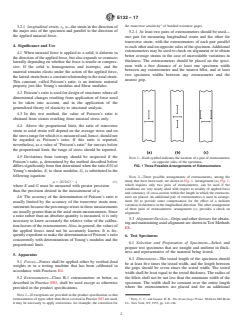
NOTE 1—Each symbol indicates the location of a pair of extensometers
Poisson’s ratio, µ, determined by the method described below
on opposite sides of the specimen.
differssignificantlyfromthatdeterminedwhentheratio E/Gof FIG. 1 Three Possible Arrangements of Extensometers
Young’s modulus, E, to shear modulus, G, is substituted in the
following equation:
NOTE 2—Three possible arrangements of extensometers, among the
many that have been used, are shown in Fig. 1. Arrangement (a), Fig. 1,
µ 5 E/2G 21 (1)
~ !
which requires only two pairs of extensometers, can be used if the
where E and G must be measured with greater precision
conditions are very nearly ideal with respect to axiality of applied force
than the precision desired in the measurement of µ.
and constancy of cross-section within the length in which the extensom-
eters are placed. An additional pair of extensometers is used in arrange-
4.6 The accuracy of the determination of Poisson’s ratio is
ment (b) to provide some compensation for the effect of a uniform
usually limited by the accuracy of the transverse strain mea-
variation in thickness in the longitudinal direction. The other arrangement
surementsbecausethepercentageerrorsinthesemeasurements
of three pairs of extensometers, arrangement (c), provid
...
This document is not an ASTM standard and is intended only to provide the user of an ASTM standard an indication of what changes have been made to the previous version. Because
it may not be technically possible to adequately depict all changes accurately, ASTM recommends that users consult prior editions as appropriate. In all cases only the current version
of the standard as published by ASTM is to be considered the official document.
Designation: E132 − 04 (Reapproved 2010) E132 − 17
Standard Test Method for
Poisson’s Ratio at Room Temperature
This standard is issued under the fixed designation E132; the number immediately following the designation indicates the year of
original adoption or, in the case of revision, the year of last revision. A number in parentheses indicates the year of last reapproval. A
superscript epsilon (´) indicates an editorial change since the last revision or reapproval.
This standard has been approved for use by agencies of the U.S. Department of Defense.
1. Scope
1.1 This test method covers the determination of Poisson’s ratio from tension tests of structural materials at room temperature.
This test method is limited to specimens of rectangular section and to materials in which and stresses at which creep is negligible
compared to the strain produced immediately upon loading.
1.2 The values stated in inch-pound units are to be regarded as standard. The values given in parentheses are mathematical
conversions to SI units that are provided for information only and are not considered standard.
1.3 This standard does not purport to address all of the safety concerns, if any, associated with its use. It is the responsibility
of the user of this standard to establish appropriate safety safety, health, and healthenvironmental practices and determine the
applicability of regulatory limitations prior to use.
1.4 This international standard was developed in accordance with internationally recognized principles on standardization
established in the Decision on Principles for the Development of International Standards, Guides and Recommendations issued
by the World Trade Organization Technical Barriers to Trade (TBT) Committee.
2. Referenced Documents
2.1 ASTM Standards:
E4 Practices for Force Verification of Testing Machines
E6 Terminology Relating to Methods of Mechanical Testing
E177 Practice for Use of the Terms Precision and Bias in ASTM Test Methods
E8 Test Methods for Tension Testing of Metallic Materials
E83 Practice for Verification and Classification of Extensometer Systems
E111 Test Method for Young’s Modulus, Tangent Modulus, and Chord Modulus
E1012 Practice for Verification of Testing Frame and Specimen Alignment Under Tensile and Compressive Axial Force
Application
3. Terminology
3.1 Definitions:Terms common to mechanical testing.
3.1.1 The definitions of mechanical testing terms that appear in Terminology E6 apply to this test method. These terms include
extensometer and stress-strain diagram.
3.1.2 In addition, the following common terms that appear in Terminology E6 apply to this test method.
3.1.3 The terms accuracy, bias, and precision are used as defined in E177.
3.1.4 axial strain, n—linear strain in a plane parallel to the longitudinal axis of the specimen.
3.1.5 Poisson’s ratio—ratio, μ, n—the negative of the ratio of transverse strain to the corresponding axial strain resulting from
an axial stress below the proportional limit of the material.
This test method is under the jurisdiction of ASTM Committee E28 on Mechanical Testing and is the direct responsibility of Subcommittee E28.04 on Uniaxial Testing.
Current edition approved Sept. 1, 2010July 15, 2017. Published November 2010September 2017. Originally approved in 1958. Last previous edition approved in 20042010
as E132 – 04.E132 – 04(2010). DOI: 10.1520/E0132-04R10.10.1520/E0132-17.
For referenced ASTM standards, visit the ASTM website, www.astm.org, or contact ASTM Customer Service at service@astm.org. For Annual Book of ASTM Standards
volume information, refer to the standard’s Document Summary page on the ASTM website.
3.1.5.1 Discussion—
Copyright © ASTM International, 100 Barr Harbor Drive, PO Box C700, West Conshohocken, PA 19428-2959. United States
E132 − 17
Poisson’s ratio may be negative for some materials. For example, a tensile transverse strain will result from a tensile axial strain.
3.1.5.2 Discussion—
Poisson’s ratio will have more than one value if the material is not isotropic.
-2
3.1.6 Discussion—proportional limit, [FL ], n—Above the proportional limit, the ratio of transverse strain to axial strain will
depend on the average stress and on the stress range for which it is measured and, hence, should not be regarded as Poisson’s ratio.
If this ratio is reported, nevertheless, as a value of “Poisson’s ratio” for stresses beyond the proportional limit, the range of stress
should be stated.the greatest stress that a material is capable of sustaining without any deviation from proportionality of stress to
strain (Hooke’s Law).
3.1.6.1 Discussion—
Many experiments have shown that values observed for the proportional limit vary greatly with the sensitivity and accuracy of the
testing equipment, eccentricity of loading, the scale to which the stress-strain diagram is plotted, and other factors. When
determination of the proportional limit is required, the procedure and the sensitivity of the test equipment should be specified.
3.1.7 Discussion—transverse strain, ε , n—Poisson’s ratio will have more than one value if the material is not isotropic.
t
Deviations from isotropy should be suspected if the Poisson’s ratio, μ, determined by the method described below differs
significantly from that determined when the ratio linear strain in a plane perpendicular to E/G of Young’s modulus, E, to shear
modulus, G, is substituted in the following equation:the axis of
μ 5 ~E/2G! 2 1 (1)
the specimen.
where E and G must be measured with greater precision than the precision desired in the measurement of μ.
3.1.7.1 Discussion—
Transverse strain may differ with direction in anisotropic materials.
3.2 Definitions of Terms Specific to This Standard:
3.2.1 longitudinal strain, ε , n—the strain in the direction of the major axis of the specimen and parallel to the direction of the
l
applied uniaxial force.
4. Significance and Use
4.1 When uniaxial force is applied to a solid, it deforms in the direction of the applied force, but also expands or contracts
laterally depending on whether the force is tensile or compressive. If the solid is homogeneous and isotropic, and the material
remains elastic under the action of the applied force, the lateral strain bears a constant relationship to the axial strain. This constant,
called Poisson’s ratio, is an intrinsic material property just like Young’s modulus and Shear modulus.
4.2 Poisson’s ratio is used for design of structures where all dimensional changes resulting from application of force need to
be taken into account, and in the application of the generalized theory of elasticity to structural analysis.
4.3 In this test method, the value of Poisson’s ratio is obtained from strains resulting from uniaxial stress only.
4.4 Above the proportional limit, the ratio of transverse strain to axial strain will depend on the average stress and on the stress
range for which it is measured and, hence, should not be regarded as Poisson’s ratio. If this ratio is reported, nevertheless, as a
value of “Poisson’s ratio” for stresses below the proportional limit, the range of stress should be reported.
4.5 Deviations from isotropy should be suspected if the Poisson’s ratio, μ, determined by the method described below differs
significantly from that determined when the ratio E/G of Young’s modulus, E, to shear modulus, G, is substituted in the following
equation:
μ 5 E/2G 2 1 (1)
~ !
where E and G must be measured with greater precision than the precision desired in the measurement of μ.
4.6 The accuracy of the determination of Poisson’s ratio is usually limited by the accuracy of the transverse strain measurements
because the percentage errors in these measurements are usually greater than in the axial strain measurements. Since a ratio rather
than an absolute quantity is measured, it is only necessary to know accurately the relative value of the calibration factors of the
extensometers. Also, in general, the values of the applied forces need not be accurately known. It is frequently expedient to make
the determination of Poisson’s ratio concurrently with determinations of Young’s modulus and the proportional limit.
E132 − 17
5. General Considerations
5.1 The accuracy of the determination of Poisson’s ratio is usually limited by the accuracy of the transverse strain measurements
because the percentage errors in these measurements are usually greater than in the axial strain measurements. Since a ratio rather
than an absolute quantity is measured, it is only necessary to know accurately the relative value of the calibration factors of the
extensometers. Also, in general, the values of the applied forces need not be accurately known. It is frequently expedient to make
the determination of Poisson’s ratio concurrently with determinations of Young’s modulus and the proportional limit.
5. Apparatus
5.1 Forces—Forces shall be applied either by verified dead weights or in a testing machine that has been calibrated in
accordance with Practices E4.
5.2 Extensometers—Class B-1 extensometers or better, as described in Practice E83, shall be used except as otherwise provided
in the product specifications.
NOTE 1—If exceptions are provided in the product specification so that extensometers of types other than those covered in Practice E83 are used, it
may be necessary to apply corrections, for example, the correction for the transverse sensitivity of bonded resistance gages.
5.2.1 It is recommended that at At least two pairs of extensometers should be used—one pair for measuring axiallongitudinal
strain and the other for transverse strain, with the extensometers of each pair parallel to each other and on opposite sides of the
specimen. Additional extensometers may be used to check on alignment or to obtain better average strains in the case of
unavoidable variations in thickness. The extensometers should be placed on the specimen with a free distan
...