

ASTM C1468-19a
(Test Method)Standard Test Method for Transthickness Tensile Strength of Continuous Fiber-Reinforced Advanced Ceramics at Ambient Temperature
General Information
- Abstract
SIGNIFICANCE AND USE
4.1 This test method may be used for material development, material comparison, quality assurance, characterization, and design data generation.
4.2 Continuous fiber-reinforced ceramic matrix composites generally are characterized by glass or fine grain-sized (ZX, τZY) in advanced ceramics, there is significant difficulty in test specimen machining and testing. Improperly prepared notches can produce nonuniform stress distribution in the shear test specimens and can lead to ambiguity of interpretation of strength results. In addition, these shear test specimens also rarely produce a gage section that is in a state of pure shear. Uniaxially forced transthickness tensile strength tests measure the tensile interlaminar strength avoid the complications listed above, and provide information on mechanical behavior and strength for a uniformly stressed material. The ultimate strength value measured is not a direct measure of the matrix strength, but a combination of the strength of the matrix and the level of bonding between the fiber, fiber/matrix interphase, and the matrix.
4.3 CFCCs tested in a transthickness tensile test (TTT) may fail from a single dominant flaw or from a cumulative damage process; therefore, the volume of material subjected to a uniform tensile stress for a single uniaxially forced TTT may be a significant factor in determining the ultimate strength of CFCCs. The probabilistic nature of the strength distributions of the brittle matrices of CFCCs requires a sufficient number of test specimens at each testing condition for statistical analysis and design, with guidelines for test specimen size and sufficient numbers provided in this test method. Studies to determine the exact influence of test specimen volume on strength distributions for CFCCs have not been completed. It should be noted that strengths obtained using other recommended test specimens with different volumes and areas may vary due to these volume differences.
4.4 The results of ...
SCOPE
1.1 This test method covers the determination of transthickness tensile strength under monotonic uniaxial tensile loading of continuous fiber-reinforced ceramics (CFCC) at ambient temperature. This test method addresses, but is not restricted to, various suggested test specimen geometries, test fixtures, data collection, and reporting procedures. In general, round or square test specimens are tensile tested in the direction normal to the thickness by bonding appropriate hardware to the samples and performing the test. For a Cartesian coordinate system, the x-axis and the y-axis are in the plane of the test specimen. The transthickness direction is normal to the plane and is labeled the z-axis for this test method. For CFCCs, the plane of the test specimen normally contains the larger of the three dimensions and is parallel to the fiber layers for unidirectional, bidirectional, and woven composites. Note that transthickness tensile strength as used in this test method refers to the tensile strength obtained under monotonic uniaxial tensile loading, where “monotonic” refers to a continuous nonstop test rate with no reversals from test initiation to final fracture.
1.2 This test method is intended primarily for use with all advanced ceramic matrix composites with continuous fiber reinforcement: unidirectional (1D), bidirectional (2D), woven, and tridirectional (3D). In addition, this test method also may be used with glass (amorphous) matrix composites with 1D, 2D, and 3D continuous fiber reinforcement. This test method does not directly address discontinuous fiber-reinforced, whisker-reinforced, or particulate-reinforced ceramics, although the test methods detailed here may be equally applicable to these composites. It should be noted that 3D architectures with a high volume fraction of fibers in the “z” direction may be difficult to test successfully.
1.3 Values are in accordance with the International System of Un...
- Status
- Published
- Publication Date
- 30-Jun-2019
- Technical Committee
- C28 - Advanced Ceramics
- Drafting Committee
- C28.07 - Ceramic Matrix Composites
Buy Documents
ASTM C1468-19a - Standard Test Method for Transthickness Tensile Strength of Continuous Fiber-Reinforced Advanced Ceramics at Ambient Temperature
REDLINE ASTM C1468-19a - Standard Test Method for Transthickness Tensile Strength of Continuous Fiber-Reinforced Advanced Ceramics at Ambient Temperature
Overview
ASTM C1468-19a provides a standardized test method for measuring the transthickness tensile strength of continuous fiber-reinforced advanced ceramics (CFCC) and glass matrix composites at ambient temperature. This test is vital for material development, comparison, quality assurance, and the generation of design data. The method covers specimen preparation, test equipment, data acquisition, and reporting procedures for both round and square test specimens loaded perpendicular to their thickness. It is particularly relevant for evaluating mechanical performance in advanced ceramic matrix composites (CMCs) with unidirectional, bidirectional, woven, or tridirectional continuous fiber reinforcement.
Key Topics
- Test Scope: The method is applicable to all advanced ceramic matrix composites with continuous fiber reinforcement and glass matrix composites with similar architectures. It defines “transthickness” as the tensile direction normal to the main plane of fiber layup (typically the z-axis in Cartesian coordinates).
- Purpose and Utility:
- Provides a direct measurement of tensile interlaminar strength, avoiding issues such as nonuniform stress distributions inherent to shear testing.
- Results are used for characterizing the combined effects of matrix strength, fiber strength, and fiber-matrix bond strength.
- Test Procedure:
- Test specimens (round or square) are bonded to fixtures and loaded in tension.
- Proper alignment of the load train, gripping, and data acquisition methods are specified to ensure uniform stress and accurate results.
- Attention is given to the impact of bending, surface preparation, and environmental conditions (such as humidity).
- Statistical Considerations:
- Due to the probabilistic strength distribution in brittle matrices, adequate sample size and specimen volume are emphasized for meaningful statistical evaluation.
- Safety and Handling:
- Guidance includes precautions for handling brittle materials and adhesives, with recommendations for personal protective equipment and specimen containment.
Applications
- Material Screening and Comparison: Manufacturers and researchers can compare the mechanical performance of different CFCCs or evaluate new material formulations.
- Quality Control: Standardized measurement enables consistent quality assurance for production lots of advanced ceramics and composites.
- Design Data Generation: Mechanical property data from this test support the engineering design of high-temperature and structural components in industries such as aerospace, energy, and advanced manufacturing.
- Component Characterization: Data help in understanding the mechanical integrity and failure modes of composite parts intended for extreme environments.
- R&D and Performance Testing: The method is essential for materials testing laboratories and research facilities developing next-generation ceramic composites.
Related Standards
- ASTM C1145: Terminology of Advanced Ceramics
- ASTM C1239: Practice for Reporting Uniaxial Strength Data and Estimating Weibull Distribution Parameters for Advanced Ceramics
- ASTM C1275: Test Method for Monotonic Tensile Behavior of Continuous Fiber-Reinforced Advanced Ceramics
- ASTM D3878: Terminology for Composite Materials
- ASTM E4: Practices for Force Verification of Testing Machines
- ASTM E1012: Practice for Verification of Testing Frame and Specimen Alignment Under Tensile and Compressive Axial Force Application
Practical Value
Implementing ASTM C1468-19a ensures reliable, comparable measurements of transthickness tensile strength in advanced ceramics and glass matrix composites. It supports innovative material development, helps maintain product performance standards, and enables safer, more robust engineering designs. By following an internationally recognized standard, users can confidently report and interpret strength data for a wide variety of advanced ceramic composite systems, paving the way for cutting-edge solutions in demanding applications.
Relations
- Effective Date
- 15-Oct-2019
- Effective Date
- 01-Jul-2019
- Effective Date
- 01-Jul-2019
- Effective Date
- 15-Apr-2019
- Effective Date
- 15-Feb-2019
- Effective Date
- 01-Jul-2018
- Effective Date
- 01-Apr-2018
- Effective Date
- 01-Jan-2018
- Effective Date
- 01-Dec-2016
- Effective Date
- 01-Aug-2016
- Effective Date
- 01-Jul-2015
- Effective Date
- 01-Jul-2015
- Effective Date
- 01-Jun-2014
- Effective Date
- 01-May-2014
- Effective Date
- 01-Aug-2013
Buy Documents
ASTM C1468-19a - Standard Test Method for Transthickness Tensile Strength of Continuous Fiber-Reinforced Advanced Ceramics at Ambient Temperature
REDLINE ASTM C1468-19a - Standard Test Method for Transthickness Tensile Strength of Continuous Fiber-Reinforced Advanced Ceramics at Ambient Temperature
Frequently Asked Questions
ASTM C1468-19a is a standard published by ASTM International. Its full title is "Standard Test Method for Transthickness Tensile Strength of Continuous Fiber-Reinforced Advanced Ceramics at Ambient Temperature". This standard covers: SIGNIFICANCE AND USE 4.1 This test method may be used for material development, material comparison, quality assurance, characterization, and design data generation. 4.2 Continuous fiber-reinforced ceramic matrix composites generally are characterized by glass or fine grain-sized (ZX, τZY) in advanced ceramics, there is significant difficulty in test specimen machining and testing. Improperly prepared notches can produce nonuniform stress distribution in the shear test specimens and can lead to ambiguity of interpretation of strength results. In addition, these shear test specimens also rarely produce a gage section that is in a state of pure shear. Uniaxially forced transthickness tensile strength tests measure the tensile interlaminar strength avoid the complications listed above, and provide information on mechanical behavior and strength for a uniformly stressed material. The ultimate strength value measured is not a direct measure of the matrix strength, but a combination of the strength of the matrix and the level of bonding between the fiber, fiber/matrix interphase, and the matrix. 4.3 CFCCs tested in a transthickness tensile test (TTT) may fail from a single dominant flaw or from a cumulative damage process; therefore, the volume of material subjected to a uniform tensile stress for a single uniaxially forced TTT may be a significant factor in determining the ultimate strength of CFCCs. The probabilistic nature of the strength distributions of the brittle matrices of CFCCs requires a sufficient number of test specimens at each testing condition for statistical analysis and design, with guidelines for test specimen size and sufficient numbers provided in this test method. Studies to determine the exact influence of test specimen volume on strength distributions for CFCCs have not been completed. It should be noted that strengths obtained using other recommended test specimens with different volumes and areas may vary due to these volume differences. 4.4 The results of ... SCOPE 1.1 This test method covers the determination of transthickness tensile strength under monotonic uniaxial tensile loading of continuous fiber-reinforced ceramics (CFCC) at ambient temperature. This test method addresses, but is not restricted to, various suggested test specimen geometries, test fixtures, data collection, and reporting procedures. In general, round or square test specimens are tensile tested in the direction normal to the thickness by bonding appropriate hardware to the samples and performing the test. For a Cartesian coordinate system, the x-axis and the y-axis are in the plane of the test specimen. The transthickness direction is normal to the plane and is labeled the z-axis for this test method. For CFCCs, the plane of the test specimen normally contains the larger of the three dimensions and is parallel to the fiber layers for unidirectional, bidirectional, and woven composites. Note that transthickness tensile strength as used in this test method refers to the tensile strength obtained under monotonic uniaxial tensile loading, where “monotonic” refers to a continuous nonstop test rate with no reversals from test initiation to final fracture. 1.2 This test method is intended primarily for use with all advanced ceramic matrix composites with continuous fiber reinforcement: unidirectional (1D), bidirectional (2D), woven, and tridirectional (3D). In addition, this test method also may be used with glass (amorphous) matrix composites with 1D, 2D, and 3D continuous fiber reinforcement. This test method does not directly address discontinuous fiber-reinforced, whisker-reinforced, or particulate-reinforced ceramics, although the test methods detailed here may be equally applicable to these composites. It should be noted that 3D architectures with a high volume fraction of fibers in the “z” direction may be difficult to test successfully. 1.3 Values are in accordance with the International System of Un...
SIGNIFICANCE AND USE 4.1 This test method may be used for material development, material comparison, quality assurance, characterization, and design data generation. 4.2 Continuous fiber-reinforced ceramic matrix composites generally are characterized by glass or fine grain-sized (ZX, τZY) in advanced ceramics, there is significant difficulty in test specimen machining and testing. Improperly prepared notches can produce nonuniform stress distribution in the shear test specimens and can lead to ambiguity of interpretation of strength results. In addition, these shear test specimens also rarely produce a gage section that is in a state of pure shear. Uniaxially forced transthickness tensile strength tests measure the tensile interlaminar strength avoid the complications listed above, and provide information on mechanical behavior and strength for a uniformly stressed material. The ultimate strength value measured is not a direct measure of the matrix strength, but a combination of the strength of the matrix and the level of bonding between the fiber, fiber/matrix interphase, and the matrix. 4.3 CFCCs tested in a transthickness tensile test (TTT) may fail from a single dominant flaw or from a cumulative damage process; therefore, the volume of material subjected to a uniform tensile stress for a single uniaxially forced TTT may be a significant factor in determining the ultimate strength of CFCCs. The probabilistic nature of the strength distributions of the brittle matrices of CFCCs requires a sufficient number of test specimens at each testing condition for statistical analysis and design, with guidelines for test specimen size and sufficient numbers provided in this test method. Studies to determine the exact influence of test specimen volume on strength distributions for CFCCs have not been completed. It should be noted that strengths obtained using other recommended test specimens with different volumes and areas may vary due to these volume differences. 4.4 The results of ... SCOPE 1.1 This test method covers the determination of transthickness tensile strength under monotonic uniaxial tensile loading of continuous fiber-reinforced ceramics (CFCC) at ambient temperature. This test method addresses, but is not restricted to, various suggested test specimen geometries, test fixtures, data collection, and reporting procedures. In general, round or square test specimens are tensile tested in the direction normal to the thickness by bonding appropriate hardware to the samples and performing the test. For a Cartesian coordinate system, the x-axis and the y-axis are in the plane of the test specimen. The transthickness direction is normal to the plane and is labeled the z-axis for this test method. For CFCCs, the plane of the test specimen normally contains the larger of the three dimensions and is parallel to the fiber layers for unidirectional, bidirectional, and woven composites. Note that transthickness tensile strength as used in this test method refers to the tensile strength obtained under monotonic uniaxial tensile loading, where “monotonic” refers to a continuous nonstop test rate with no reversals from test initiation to final fracture. 1.2 This test method is intended primarily for use with all advanced ceramic matrix composites with continuous fiber reinforcement: unidirectional (1D), bidirectional (2D), woven, and tridirectional (3D). In addition, this test method also may be used with glass (amorphous) matrix composites with 1D, 2D, and 3D continuous fiber reinforcement. This test method does not directly address discontinuous fiber-reinforced, whisker-reinforced, or particulate-reinforced ceramics, although the test methods detailed here may be equally applicable to these composites. It should be noted that 3D architectures with a high volume fraction of fibers in the “z” direction may be difficult to test successfully. 1.3 Values are in accordance with the International System of Un...
ASTM C1468-19a is classified under the following ICS (International Classification for Standards) categories: 81.060.30 - Advanced ceramics. The ICS classification helps identify the subject area and facilitates finding related standards.
ASTM C1468-19a has the following relationships with other standards: It is inter standard links to ASTM D3878-19a, ASTM C1468-19a, ASTM C1145-19, ASTM D3878-19, ASTM C1468-19, ASTM C1239-13(2018), ASTM D3878-18, ASTM C1275-18, ASTM C1275-16, ASTM D3878-16, ASTM D3878-15, ASTM C1275-15, ASTM E4-14, ASTM E177-14, ASTM C1239-13. Understanding these relationships helps ensure you are using the most current and applicable version of the standard.
ASTM C1468-19a is available in PDF format for immediate download after purchase. The document can be added to your cart and obtained through the secure checkout process. Digital delivery ensures instant access to the complete standard document.
Standards Content (Sample)
This international standard was developed in accordance with internationally recognized principles on standardization established in the Decision on Principles for the
Development of International Standards, Guides and Recommendations issued by the World Trade Organization Technical Barriers to Trade (TBT) Committee.
Designation: C1468 − 19a
Standard Test Method for
Transthickness Tensile Strength of Continuous Fiber-
Reinforced Advanced Ceramics at Ambient Temperature
This standard is issued under the fixed designation C1468; the number immediately following the designation indicates the year of
original adoption or, in the case of revision, the year of last revision. A number in parentheses indicates the year of last reapproval. A
superscript epsilon (´) indicates an editorial change since the last revision or reapproval.
1. Scope* 1.4 This standard does not purport to address all of the
safety concerns, if any, associated with its use. It is the
1.1 This test method covers the determination of transthick-
responsibility of the user of this standard to establish appro-
T
ness tensile strength S under monotonic uniaxial tensile
~ !
U
priate safety, health, and environmental practices and deter-
loading of continuous fiber-reinforced ceramics (CFCC) at
mine the applicability of regulatory limitations prior to use.
ambient temperature. This test method addresses, but is not
Additionalrecommendationsareprovidedin6.7andSection7.
restricted to, various suggested test specimen geometries, test
1.5 This international standard was developed in accor-
fixtures, data collection, and reporting procedures. In general,
round or square test specimens are tensile tested in the dance with internationally recognized principles on standard-
ization established in the Decision on Principles for the
direction normal to the thickness by bonding appropriate
hardware to the samples and performing the test. For a Development of International Standards, Guides and Recom-
Cartesiancoordinatesystem,the x-axisandthe y-axisareinthe mendations issued by the World Trade Organization Technical
plane of the test specimen. The transthickness direction is Barriers to Trade (TBT) Committee.
normal to the plane and is labeled the z-axis for this test
method. For CFCCs, the plane of the test specimen normally
2. Referenced Documents
containsthelargerofthethreedimensionsandisparalleltothe
2.1 ASTM Standards:
fiber layers for unidirectional, bidirectional, and woven com-
C1145 Terminology of Advanced Ceramics
posites. Note that transthickness tensile strength as used in this
C1239 Practice for Reporting Uniaxial Strength Data and
test method refers to the tensile strength obtained under
Estimating Weibull Distribution Parameters forAdvanced
monotonic uniaxial tensile loading, where “monotonic” refers
Ceramics
to a continuous nonstop test rate with no reversals from test
C1275 Test Method for Monotonic Tensile Behavior of
initiation to final fracture.
Continuous Fiber-Reinforced Advanced Ceramics with
1.2 This test method is intended primarily for use with all
Solid Rectangular Cross-Section Test Specimens at Am-
advanced ceramic matrix composites with continuous fiber
bient Temperature
reinforcement: unidirectional (1D), bidirectional (2D), woven,
C1468 Test Method for Transthickness Tensile Strength of
and tridirectional (3D). In addition, this test method also may
Continuous Fiber-Reinforced Advanced Ceramics at Am-
be used with glass (amorphous) matrix composites with 1D,
bient Temperature
2D, and 3D continuous fiber reinforcement. This test method
D3878 Terminology for Composite Materials
does not directly address discontinuous fiber-reinforced,
E4 Practices for Force Verification of Testing Machines
whisker-reinforced, or particulate-reinforced ceramics, al-
E6 Terminology Relating to Methods of Mechanical Testing
though the test methods detailed here may be equally appli-
E177 Practice for Use of the Terms Precision and Bias in
cable to these composites. It should be noted that 3D architec-
ASTM Test Methods
tures with a high volume fraction of fibers in the “z” direction
E337 Test Method for Measuring Humidity with a Psy-
may be difficult to test successfully.
chrometer (the Measurement of Wet- and Dry-Bulb Tem-
1.3 Values are in accordance with the International System
peratures)
of Units (SI) and IEEE/ASTM SI 10.
E691 Practice for Conducting an Interlaboratory Study to
Determine the Precision of a Test Method
This test method is under the jurisdiction of ASTM Committee C28 on
Advanced Ceramics and is the direct responsibility of Subcommittee C28.07 on
Ceramic Matrix Composites. For referenced ASTM standards, visit the ASTM website, www.astm.org, or
Current edition approved July 1, 2019. Published July 2019. Originally approved contact ASTM Customer Service at service@astm.org. For Annual Book of ASTM
in 2000. Last previous edition approved in 2019 as C1468 – 19. DOI: 10.1520/ Standards volume information, refer to the standard’s Document Summary page on
C1468-19A. the ASTM website.
*A Summary of Changes section appears at the end of this standard
Copyright © ASTM International, 100 Barr Harbor Drive, PO Box C700, West Conshohocken, PA 19428-2959. United States
C1468 − 19a
E1012 Practice for Verification of Testing Frame and Speci- 3.2.2 transthickness, n—the direction parallel to the
men Alignment Under Tensile and Compressive Axial thickness, that is, out-of-plane dimension, as identified in 1.1,
Force Application and also typically normal to the plies for 1D, 2D laminate, and
IEEE/ASTM SI 10 American National Standard for Metric woven cloth. For 3D laminates, this direction is typically taken
Practice to be normal to the thickness and associated with the “z”
direction.
3. Terminology
4. Significance and Use
3.1 Definitions:
3.1.1 The definitions of terms relating to tensile testing 4.1 This test method may be used for material development,
appearing in Terminology E6 apply to the terms used in this material comparison, quality assurance, characterization, and
test method. The definitions of terms relating to advanced design data generation.
ceramics appearing in Terminology C1145 apply to the terms
4.2 Continuous fiber-reinforced ceramic matrix composites
used in this test method. The definitions of terms relating to
generally are characterized by glass or fine grain-sized
fiber-reinforced composites appearing in Terminology D3878
(<50 µm) ceramic matrices and ceramic fiber reinforcements.
applytothetermsusedinthistestmethod.Pertinentdefinitions
CFCCs are candidate materials for high-temperature structural
as listed in Practice E1012 and Terminologies C1145, D3878,
applications requiring high degrees of corrosion and oxidation
and E6 are shown in the following with the appropriate source
resistance, wear and erosion resistance, and inherent damage
given in brackets. Terms used in conjunction with this test
tolerance, that is, toughness. In addition, continuous fiber-
method are defined as follows:
reinforced glass (amorphous) matrix composites are candidate
3.1.2 advanced ceramic, n—a highly engineered, high-
materials for similar but possibly less demanding applications.
performance, predominately nonmetallic, inorganic, ceramic
Although shear test methods are used to evaluate shear
material having specific functional attributes. [C1145]
interlaminar strength (τ , τ ) in advanced ceramics, there is
ZX ZY
–1
3.1.3 bending strain [LL ], n—the difference between the
significant difficulty in test specimen machining and testing.
strain at the surface and the axial strain. [E1012]
Improperly prepared notches can produce nonuniform stress
distribution in the shear test specimens and can lead to
3.1.4 breaking force [F], n—the force at which fracture
ambiguity of interpretation of strength results. In addition,
occurs, P , is the breaking force in units of N. [E6]
max
these shear test specimens also rarely produce a gage section
3.1.5 ceramic matrix composite (CMC), n—a material con-
that is in a state of pure shear. Uniaxially forced transthickness
sisting of two or more materials (insoluble in one another), in
tensile strength tests measure the tensile interlaminar strength
which the major, continuous component (matrix component) is
T
~S !, avoid the complications listed above, and provide infor-
U
a ceramic, while the secondary component(s) (reinforcing
mation on mechanical behavior and strength for a uniformly
component) may be ceramic, glass-ceramic, glass, metal, or
stressed material. The ultimate strength value measured is not
organic in nature. These components are combined on a
a direct measure of the matrix strength, but a combination of
macroscale to form a useful engineering material possessing
the strength of the matrix and the level of bonding between the
certain properties or behavior not possessed by the individual
fiber, fiber/matrix interphase, and the matrix.
constituents. [C1145]
4.3 CFCCs tested in a transthickness tensile test (TTT) may
3.1.6 continuous fiber-reinforced ceramic matrix composite
fail from a single dominant flaw or from a cumulative damage
(CFCC), n—a ceramic matrix composite in which the reinforc-
process; therefore, the volume of material subjected to a
ing phase consists of continuous filaments, fibers, yarn, or
uniform tensile stress for a single uniaxially forced TTT may
knitted or woven fabrics. [C1145]
be a significant factor in determining the ultimate strength of
3.1.7 gage length [L], n—the original length [L ] of that
GL
CFCCs.Theprobabilisticnatureofthestrengthdistributionsof
portion of the test specimen over which strain or change of
the brittle matrices of CFCCs requires a sufficient number of
length is determined. [E6]
test specimens at each testing condition for statistical analysis
–2
3.1.8 modulus of elasticity [FL ], n—the ratio of stress to
anddesign,withguidelinesfortestspecimensizeandsufficient
corresponding strain below the proportional limit. [E6]
numbers provided in this test method. Studies to determine the
exact influence of test specimen volume on strength distribu-
3.1.9 percent bending, n—the bending strain times 100
tions for CFCCs have not been completed. It should be noted
divided by the axial strain. [E1012]
–2 that strengths obtained using other recommended test speci-
3.1.10 tensile strength [FL ], n—the maximum tensile
mens with different volumes and areas may vary due to these
stress which a material is capable of sustaining. Tensile
volume differences.
strengthiscalculatedfromthemaximumforceduringatension
test carried to rupture and the original cross-sectional area of 4.4 The results of TTTs of test specimens fabricated to
standardized dimensions from a particular material, or selected
the test specimen. [E6]
portions of a part, or both, may not totally represent the
3.2 Definitions of Terms Specific to This Standard:
strength and deformation properties of the entire full-size end
3.2.1 fixturing, n—fixturing is referred to as the device(s)
product or its in-service behavior in different environments.
bonded to the test specimen. It is this device(s) that is actually
gripped or pinned to the load train. The fixturing transmits the 4.5 For quality control purposes, results derived from stan-
applied force to the test specimen. dardized TTT specimens may be considered indicative of the
C1468 − 19a
levels along the sides and interior of the test specimen were found to be
response of the material from which they were taken for given
uniform.
primary processing conditions and post-processing heat treat-
ments.
6. Apparatus
4.6 The strength of CFCCs is dependent on their inherent
6.1 Testing Machines—Machines used for TTT shall con-
resistance to fracture, the presence of flaws, damage accumu-
form to the requirements of Practices E4. The forces used in
lation processes, or a combination thereof.Analysis of fracture
determining tensile strength shall be accurate within 61%at
surfaces and fractography, though beyond the scope of this test
anyforcewithintheselectedforcerangeofthetestingmachine
method, is highly recommended.
as defined in Practices E4. A schematic showing pertinent
features of the TTT apparatus for two possible forcing con-
5. Interferences
figurations is shown in Figs. 1 and 2.
5.1 Test environment (vacuum, inert gas, ambient air, etc.)
6.1.1 Values for transthickness tensile strength can range a
including moisture content, for example, relative humidity,
great deal for different types of CFCC. Therefore, it is helpful
may have an influence on the measured strength. In particular,
to know an expected strength value in order to properly select
the behavior of materials susceptible to slow crack growth
a force range. Approximate transthickness tensile strength
fracture will be strongly influenced by test environment and
values (1) for several CFCCs are as follows: porous oxide/
testingrate.Testingtoevaluatethemaximumstrengthpotential
oxide composites range from 2 to 10 MPa; hot-pressed, fully
of a material should be conducted in inert environments or at
dense SiC/MAS-5 glass-ceramic composites range from 14 to
sufficiently rapid testing rates, or both, so as to minimize slow
27 MPa; Polymer Infiltrated and Pyrolyzed (PIP) SiC/SiNC
crack growth effects. Conversely, testing can be conducted in
range from 15 to 32 MPa; and hot-pressed SCS-6/Si N ranges
3 4
environments and testing modes and rates representative of
from 30 to 43 MPa.
service conditions to evaluate material performance under use
6.1.2 Foranytestingapparatus,theloadtrainwillneedtobe
conditions. When testing is conducted in uncontrolled ambient
aligned for angularity and concentricity. Alignment of the
air with the intent of evaluating maximum strength potential,
testing system will need to be measured and is detailed inA1.1
relative humidity and temperature must be monitored and
of Test Method C1275.
reported. Testing at humidity levels >65 % RH is not recom-
6.2 Gripping Devices:
mended and any deviations from this recommendation must be
6.2.1 General—Various types of gripping devices may be
reported.
used to transmit the force applied by the testing machine to the
5.2 Surface and edge preparation of test specimens can
test fixtures and into the test specimens. The brittle nature of
introducefabricationflawswhichmayhavepronouncedeffects
the matrices of CFCCs requires accurate alignment. Bending
on the measured transthickness strength (1). Machining dam-
moments can produce stresses leading to premature crack
age introduced during test specimen preparation can be either
initiation and fracture of the test specimen. Gripping devices
a random interfering factor in the determination of strength of
can be classified generally as those employing active and those
pristine material, that is, increased frequency of surface-
employing passive grip interfaces as discussed in the following
initiatedfracturescomparedtovolume-initiatedfractures,oran
inherent part of the strength characteristics. Universal or
standardized test methods of surface and edge preparation do
not exist. It should be understood that final machining steps
may, or may not, negate machining damage introduced during
the initial machining; thus, test specimen fabrication history
may play an important role in the measured strength distribu-
tions and should be reported. In addition, the nature of
fabrication used for certain composites, for example, chemical
vaporinfiltrationorhotpressing,mayrequirethetestingoftest
specimens in the as-processed condition.
5.3 Bending in uniaxial TTTs can cause or promote nonuni-
form stress distributions with maximum stresses occurring at
the test specimen edge, leading to nonrepresentative fractures.
Similarly, fracture from edge flaws may be accentuated or
suppressed by the presence of the nonuniform stresses caused
by bending.
NOTE 1—Finite element calculations were performed for the square
cross section test specimen for the forcing conditions and test specimen
thickness investigated in Reference (1). Stress levels along the four corner
edgeswerefoundtobelowerthantheinterior,exceptforthecornersatthe
bond lines where the stress was slightly higher than the interior. Stress
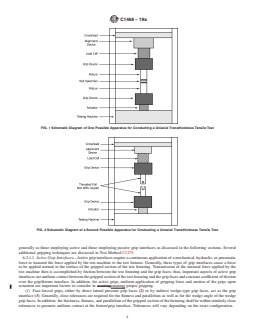
The boldface numbers in parentheses refers to the list of references at the end FIG. 1 Schematic Diagram of One Possible Apparatus for Con-
of this standard. ducting a Uniaxial Transthickness Tensile Test
C1468 − 19a
6.2.1.2 Passive Grip Interfaces—Passive grip interfaces
transmit the force applied by the test machine through a direct
mechanical link (4). Generally, these mechanical links transmit
the test forces to the test specimen via geometrical features of
the test fixturing. Passive grips may act through pin forcing via
pins at holes in the fixturing. Generally, close tolerances of
linear dimensions are required to promote uniform contact as
well as to provide for noneccentric forcing. In addition,
moderately close tolerances are required for center-line coin-
cidence and diameter [D] of the pins and holes.
6.3 Load Train Couplers:
6.3.1 General—Various types of devices (load train cou-
plers) may be used to attach the active or passive grip interface
assemblies to the testing machine (1, 5-7). The load train
couplers, in conjunction with the type of gripping device, play
major roles in the alignment of the load train, and thus,
subsequent bending imposed in the test specimen. Load train
couplers can be classified generally as fixed and non-fixed as
discussed in the following sections. Note that use of well-
FIG. 2 Schematic Diagram of a Second Possible Apparatus for
aligned fixed or self-aligning non-fixed couplers does not
Conducting a Uniaxial Transthickness Tensile Test
automatically guarantee low bending in the test specimen. The
type and operation of grip interfaces, as well as the as-
sections. Several additional gripping techniques are discussed
fabricated dimensions of the test specimen, can add signifi-
in Test Method C1275.
cantly to the final bending imposed in the test specimen.
6.2.1.1 Active Grip Interfaces—Active grip interfaces re-
Additional information pertaining to couplers can be found in
quire a continuous application of a mechanical, hydraulic, or
Test Method C1275.
pneumatic force to transmit the force applied by the test
6.3.1.1 Verifyalignmentofthetestingsystemasaminimum
machine to the test fixtures. Generally, these types of grip
at the beginning and end of a test series as detailed in A1.1 of
interfaces cause a force to be applied normal to the surface of
Test Method C1275, unless the conditions for verifying align-
the gripped section of the test fixturing. Transmission of the
ment additional times are met.Atest series is a discrete group
uniaxialforceappliedbythetestmachinethenisaccomplished
of tests on individual test specimens conducted within a
by friction between the test fixturing and the grip faces; thus,
discrete period of time on a particular material configuration,
important aspects of active grip interfaces are uniform contact
test specimen geometry, test condition, or other uniquely
between the gripped section of the test fixturing and the grip
definable qualifier. For example, a test series composed of
faces and constant coefficient of friction over the grip/fixture
MaterialAcomprisingtentestspecimensofGeometryBtested
interface. In addition, for active grips, uniform application of
at a fixed rate in force control to final fracture in ambient air.
gripping force and motion of the grips upon actuation are
An additional verification of alignment is recommended, al-
important factors to consider in ensuring proper gripping.
though not required, at the middle of the test series. Measure
(1) Face-forced grips, either by direct lateral pressure grip
alignment with a dummy test specimen and the alignment
faces (2) or by indirect wedge-type grip faces, act as the grip
verification procedures detailed in Test Method C1275.Allow-
interface (3). Generally, close tolerances are required for the
able bending values are discussed in 6.4. Alignment test
flatness and parallelism as well as for the wedge angle of the
specimens used for verification should be equipped with a
wedge grip faces. In addition, the thickness, flatness, and
recommended eight separate longitudinal strain gages to deter-
parallelism of the gripped section of the fixturing shall be
mine bending contributions from both concentric and angular
within similarly close tolerances to promote uniform contact at
misalignment of the grip heads. The length of the alignment
the fixture/grip interface. Tolerances will vary depending on
test specimen should be approximately the same length as the
the exact configuration.
test specimen and fixturing. Use a material (isotropic,
(2) Sufficient lateral pressure should be applied to prevent
homogeneous, continuous) with similar elastic modulus and
slippage between the grip face and the fixturing. Grip surfaces
elastic strain capability to the CFCC being tested.
that are scored or serrated with a pattern similar to that of a
single-cut file have been found satisfactory. A fine serration 6.3.2 Fixed Load Train Couplers—Fixed couplers may
appears to be the most satisfactory. The serrations should be incorporate devices which require either a one-time, pre-test
keptcleanandwelldefinedbutnotoverlysharp.Thelength[L] alignment adjustment of the load train which remains constant
and width [W] of the grip faces should be equal to or greater for all subsequent tests, or an in-situ, pre-test alignment of the
than the respective length and width of the fixturing to be load train which is conducted separately for each test specimen
gripped. and each test. Such devices (8) usually employ angularity and
(3) Grip inserts, called wedges, can be machined to accept concentricity adjusters to accommodate inherent load train
flatorroundfixturing.Thisallowsforawiderangeoffixturing misalignments. Fixed load trains have two translational de-
to be utilized. grees of freedom and three degrees of rotational freedom fixed.
C1468 − 19a
Regardless of which method is used, verify the alignment as a non-fixed load train is shown in Fig. 4, and this arrangement
discussed in 6.3.1.1. A schematic diagram of one possible corresponds to the load train identified in Fig. 2.
arrangement for a fixed load train is shown in Fig. 3, and this
NOTE 2—The use of non-fixed load train couplers allows for many test
arrangement corresponds to the load train identified in Fig. 1.
specimens to be prepared ahead of time using an alignment device. Once
6.3.2.1 Fixed load train couplers often are preferred for
the test specimens are bonded to the fixturing, they can all be tested in a
veryshortperiodoftime.Thisgreatlyincreasesthroughputandminimizes
monotonic testing CFCCs. During the fracture process, the
machine time.
fixed coupler tends to hold the test specimen in an aligned
position, and thus, provides a continuous uniform stress across 6.3.3.1 The forcing configuration shown in Fig. 4 uses
the remaining ligament of the gage section. For TTT, however, universal rod ends (sometimes called ball joint rod ends) at
this is not an issue, allowing for use of both methods. both ends of the fixtured test specimen. The universal rods
6.3.2.2 The use of fixed load train couplers typically will allow for a full range of angular motion and will allow for
require that the test specimens be bonded to the fixturing after some concentricity and angularity misalignment of the grips.A
the fixturing has been mounted in the test frame or grips. photograph showing assembly of the fixturing, test specimen,
CFCCs in general have low transthickness tensile strength, as and universal rod ends is shown in Fig. 5.
stated in 6.1.1, and this requirement will minimize the possi-
6.4 Allowable Bending—Analytical and empirical studies
bility of inducing bending when the fixturing is gripped. One
(11) have concluded that for negligible effects on the estimates
drawback to mounting the test specimen in the force frame is
of the strength distribution parameters (for example, Weibull
that it will reduce productivity. There will be a waiting period
modulus, mˆ, and characteristic strength, σ ) of monolithic
θ
astheadhesivecures.Caremustbetakentoensurethatthetest
advanced ceramics, allowable percent bending as defined in
specimen does not move on the fixturing during the cure cycle
Practice E1012 should not exceed five. Conclusions arrived at
of the adhesive.
in Ref (11) for the uniaxial tension strength along one of the
6.3.3 Non-Fixed Load Train Couplers—Non-fixed couplers
directions of reinforcement are also supposed to be valid for
may incorporate devices which promote self-alignment of the
thetransthicknesscase.Applyingtheseconclusionsforthistest
load train during the movement of the crosshead or actuator.
method (11) assumes that transthickness tensile strength frac-
Generally, such devices rely upon freely moving linkages to
tures are due to single fracture origins in the volume of the
eliminate applied moments as the load train components are
material, all test specimens experience the same level of
forced. Knife edges, universal joints, hydraulic couplers, or air
bending, and that Weibull modulus, mˆ, was constant.
bearings are examples (5, 9, 10) of such devices. Although
6.4.1 Studies of the effect of bending on the transthickness
non-fixed load train couplers are intended to be self-aligning,
tensile strength distributions of CFCCs do not exist. Until such
the operation of the couplers must be verified as discussed in
information is forthcoming for CFCCs, this test method adopts
6.3.1.1. A schematic diagram of one possible arrangement for
FIG. 4 Schematic Diagram of One Possible Arrangement for a
FIG. 3 Schematic Diagram of One Possible Arrangement for a Non-Fixed Load Train That Uses Couplers and Ball Joint Rod
Fixed Load Train End Adapters
C1468 − 19a
performing the TTT on just the adhesive. The tensile strength
of the adhesive then can be determined as described in 10.3.
6.7.2 Single-part adhesives that air cure at room tempera-
ture are the easiest to use, but generally exhibit low strength.
6.7.3 Two-part adhesives require a bulk resin, along with a
catalyst to activate curing. These adhesives demonstrate mod-
erate strength, and often require glass beads of a specific size
to produce a bond line of specific thickness for optimum
bonding.Often,thereisexcessadhesivepresentwhentryingto
ensure a complete bond line, and this can pose a problem, as
adhesive should not flow up or down the edges of the test
specimen; therefore, care should be taken in the amount of
adhesive used.
6.7.4 Single-partadhesivesthatcureatanelevatedtempera-
ture are very easy to handle and generally produce very
high-strength bonds. Several of these elevated temperature
FIG. 5 Photograph of a Transthickness Tensile Test Specimen
Bonded to Fixturing, With Fixturing Assembled with Universal
curing adhesives are produced in sheets that easily are cut to
Rod Ends (Ball Joint Rod Ends) for Improved Alignment
the desired shape using scissors or cutting blades.Atack agent
is often used to keep the film in place on the fixturing. Excess
film extending beyond the test specimen can easily be trimmed
the recommendations for tensile testing of monolithic ad-
off before the fixturing is placed in a furnace for cure. Use of
vanced ceramics and uniaxial tensile testing of CFCCs. The
thesetypesofadhesivesresultsinthesameamountofadhesive
recommended maximum allowable percent bending at the
being used during each test, thus minimizing the influence of
onset of the cumulative fracture process, for example, matrix
adhesives on transthickness strength.
cracking stress, for test specimens tested under this standard is
6.7.4.1 Adhesives that cure at an elevated temperature are
five at the anticipated fracture force.
usually sensitive to the maximum temperature; therefore,
6.5 Data Acquisition—At minimum, make an autographic
thermocouples should be attached to the fixturing (1) to ensure
recordofmaximumforce;however,itisdesirabletoalsomake
that the cure temperature is reached and maintained, and the
a record, where applicable, of applied force, crosshead
overall cure cycle is followed.
displacement, strain, and time. Use either digital data acquisi-
tion systems or analog chart recorders for this purpose, NOTE 4—Adhesives that cure at elevated temperature must reach the
cure temperature in order to be activated. Extra care should be used in
although a digital record is recommended for ease of later data
documenting that the temperature of the adhesive bond has been reached.
analysis. Recording devices shall be accurate to 1.0 % of full
It is not acceptable to simply record the temperature of the furnace and
scale. Data acquisition rates will depend on the forcing rates
assumethatthefixturingandadhesivehavereachedthesametemperature.
used to conduct the test. A data acquisition rate of at least
Improper curing of the adhesive (1) has been found to be the number one
20 Hz should be used, and the acquisition rate should be fast cause of bond line failures.
enough to capture the maximum force within 1 %.
6.7.5 Porous CFCCs may allow the adhesive to penetrate
6.6 Dimension-Measuring Devices—Micrometers and other into the interior of the CMC. Care must be taken to determine
iftheviscosityoftheadhesivewillallowittopenetrateintothe
devices used for measuring linear dimensions shall be accurate
and precise to at least one half the smallest unit to which the test specimen. For porous CFCC systems, extra material or a
spare test specimen should be bonded to blocks that are of the
individual dimension is required to be measured. For the
purposes of this test method, measure cross-sectional dimen- same material as the fixture, and then sectioned metallographi-
sions to within 0.02 mm, requiring measuring devices with cally to determine the depth of penetration of the adhesive into
accuracy of 0.01 mm. thetestspecimen.Theadhesiveshouldnotpenetratemorethan
one fiber ply or more than 10 % of the specimen thickness (6)
6.7 Adhesives—In conducting a TTT, an adhesive is re-
from each face.
quired to bond the test specimen to the fixturing, as it is not
normally possible to directly grip the test specimen. There are
6.8 Measurementofdisplacementonthickersamplescanbe
many types of adhesives available, and care should be taken to madeusingaverysmallgagelength[L ]extensometer,strain
GL
select an adhesive strong enough to conduct the test.
gages, video extensometers, or noncontacting laser extensom-
etry. No data exists to determine what effect the contacting
NOTE 3—Many adhesives contain hazardous chemicals. Manufacturers
measurement devices have on measured transthickness tensile
of adhesives routinely provide listings of the possible hazards associated
strength. Displacement measurements can be used to calculate
with particular adhesives, and commonly provide Material Safety Data
Sheets (MSDS) on their products. Read all safety handling requirements
a transthickness elastic modulus [E ] value.All displacement
ZZ
and follow the manufacturer’s recommended handling procedures. In
measurements are to be made directly on the test specimen.
general, always utilize protective face, eye, hand, and body gear. If the
adhesive produces gases, use only in vented hoods certified for those
7. Precautionary Statements
specific gases.
6.7.1 The strength of the adhesive can be evaluated by 7.1 Duringtheconductofthistestmethod,thepossibilityof
bonding the fixturing together without the test specimen and flying fragments of broken test material may be high. The
C1468 − 19a
brittle nature of advanced ceramics and the release of strain
energy contribute to the potential release of uncontrolled
fragments upon fracture. Means for containment and retention
of these fragments for later fractographic reconstruction and
analysis is highly recommended.
7.2 Exposed fibers at the edges of CFCC test specimens
present a hazard due to the sharpness and brittleness of the
NOTE 1—Faces of test specimen can be as processed or machined flat.
ceramic fiber. All persons required to handle these materials
All dimensions are in mm, and tolerances are: x.x 6 0.1, x.xx 6 0.03.
should be well informed of such conditions and the proper
handling techniques.
FIG. 6 Drawing of a Circular Cross Section Transthickness Ten-
sile Test Specimen 19.0 mm in Diameter
8. Test Specimen
8.1 Test Specimen Geometry:
8.1.1 General—The geometry of TTT specimens is depen- 8.1.1.2 Generally, circular cross section test specimens are
dent on the dimensions of the available material. For example, preferred. Test specimens using a diameter [D] of 19 mm have
if the strength of an as-fabricated component is required, then been shown to provide consistent results when compared to
the dimension of the resulting test specimen may reflect the other test specimen geometries having a similar cross-sectional
thickness and width of the component, up to limits of the area. Such test specimens generally incorporate more than two
testing machine and test fixturing available. If it is desired to unit cells of typical fiber weaves. A typical fiber weave for
evaluatepreviouslyconditionedtestspecimens,thenthesizeof CMCs is the eight harness satin weave (8HSW). An engineer-
the transthickness test specimen will be limited by the size of ing drawing of a circular cross section TTT specimen, 19 mm
the conditioned test specimen. One example of a previously in diameter, is shown in Fig. 6.
conditioned test specimen would be a tensile fatigue test 8.1.1.3 There may be instances when square or rectangular
specimen that was fatigued for a set number of cycles and the cross section test specimens may be desirable, especially when
test stopped before failure occurred.ATTT specimen could be testing sections cut out of other larger test specimens that have
machined out of the fatigued test specimen but would be been conditioned or tested using other test methods. For square
limited in size to the width of the fatigue test specimen. Size cross section test specimens, a width [W] and length [L]ofat
should not be determined without the consideration of the size least 16.8 mm have been shown to provide consistent results
of the fiber and the fiber preform architecture. when compared to other test specimen geometries having a
8.1.1.1 The following sections discuss the most common similar cross-sectional area (1). As the test specimen cross-
test specimen geometries. Test specimens must have a mini- sectional area is decreased, defects at the corners or edges may
mum cross-sectional dimension greater than the unit cell of the have more of an influence on the measured strength. For fully
fiber architecture, or a minimum of 10 mm. Any larger size is dense CFCC test specimens at least 16.8 mm square, the
acceptable if the required forces meet the machine limitations. strength appears to be controlled by the microstructure of the
Deviations from the recommended geometries may be neces- CFCC and not the geometry of the test specimen (1).An
sary depending upon the particular geometry of the available engineering drawing of a square cross section TTT specimen
material. 16.8 mm on a side is shown in Fig. 7.Adimension of 16.8 mm
NOTE 1—Faces of test specimen can be as processed or machined flat. All dimensions are in mm, and tolerances are x.x 6 0.1, x.xx 6 0.03.
FIG. 7 Drawing of a Square Cross Section Transthickness Tensile Test Specimen 16.8 mm Wide
C1468 − 19a
was selected as it is approximately the width of two unit cells both faces of the material and by using appropriate cutting and
of an 8HSW cloth woven produced with either silicon carbide grinding rates. These rates will have to be determined for each
or oxide fiber tows containing fibers with a diameter of 15 µm CFCC system.
or less. Both the circular and square cross section test speci-
8.2.5.2 The cutting and grinding should be performed in an
mens have been used and have been shown to be effective in
initial and final grinding operation using appropriate diamond
eliminating test specimen geometry effects for a fully dense
tooling. The initial rough grinding should use a material
CFCC if the cross-sectional area is maintained at approxi-
removal rate of 0.03 mm per pass and a 180 to 240 grit
mately 282 mm (1).
diamond grinding wheel for the entire initial rough grinding
process. Initial rough grinding should stop when 0.25 mm of
8.2 Test Specimen Preparation:
material remains to be removed. Final grinding should then be
8.2.1 Depending upon the intended application of the test
performed using a material removal rate of 0.015 mm per pass
results, use one of the following test specimen preparation
and a 320 to 400 grit diamond wheel. If a finer finish is
procedures. Regardless of the preparation procedure used,
requested, the 400 grit diamond wheel can be substituted with
sufficient details regarding the procedure must be reported to
a 600 grit diamond wheel.
allow replication.
8.2.5.3 TTT specimens using the circular cross section can
8.2.2 As-Fabricated—The TTT specimen should simulate
becoredrilledtoanoversizeddiameteranddiamondgroundto
the surface/edge conditions and processing route of an appli-
thefinaldimensionsusingthefinalgrindingprocedurelistedin
cation where no machining is used; for example, as-cast,
8.2.5.2.
sintered, hot-pressed, or injection-molded part. No additional
machining specifications are relevant. 8.2.5.4 Final grinding should be performed with the grind-
ing wheel rotating in a plane parallel to the plies in the x- and
NOTE 5—As-processed test specimens might possess rough surface
y-directions to avoid fraying the reinforcing ceramic fibers.
textures and non-parallel edges and may be prone to premature failure if
Machining should not be performed in the z-direction. Appro-
there are stress concentrations at the edges of the test specimen.
priate care should be taken to not damage the test specimen
8.2.3 Application-Matched Machining—The TTT specimen
during clamping of the material.
should have the same surface/edge preparation as that given to
8.2.5.5 The machined edges shall not be beveled.
the component. Unless the process is proprietary, the report
should be specific about the stages of material removal, wheel
8.3 Coated Material—CFCCs sometimes have a protective
grits, wheel bonding, amount of material removed per pass,
seal coat applied to the outer surface of the composite. In these
and type of coolant used.
instances, the coating should be removed prior to testing if
8.2.4 Customary Practices—Ininstanceswhereacustomary
determination of the transthickness tensile strength of the
machining procedure has been developed that is satisfactory
substrate CFCC is required. The procedures discussed in 8.2.2
for a class of materials (that is, it induces no unwanted
– 8.2.5 may be used to remove this exterior coating.
surface/subsurface damage or residual stresses), this procedure
8.3.1 Sometimes the seal coatings are an integral part of the
should be used.
CFCC, and the determination of the tensile adhesive strength
8.2.4.1 ItiscustomarytomachineonlytheedgesoftheTTT
between the seal coating and the substrate CFCC may be of
specimen. However, the faces can be machined to make them
interest. In this case, the seal coating should be retained.
parallel, to reduce the surface roughness, or to remove high
8.3.2 Sufficient details regarding the coating must be in-
spots.Suchmachiningwillfacilitatetheprocessofbondingthe
cluded in the report. The report should list if a seal coat was
testspecimentothefixturing.Itisimportanttonotethathigher
originally present, whether or not it was removed, and the
surface roughness may decrease bonding integrity. In addition,
procedure used to remove it if applicable.
machining the faces will generally damage fibers the surface
8.4 Handling Precaution—Exercise care in storing and
plies, and any machining of the faces should be reported.
handling finished test specimens to avoid the introduction of
8.2.5 Recommended Procedure—In instances where 8.2.2 –
random and severe flaws. In addition, give attention to pre-test
8.2.4 are not appropriate, 8.2.5 applies. Studies to evaluate the
storage of test specimens in controlled environments or desic-
machinability of CFCCs have not been completed.
cators to avoid unquantifiable environmental degradation of
NOTE 6—Several commercial machining companies were contacted to
test specimens prior to testing.
determine the optimum procedure for machining test specimens out of
CFCC material. This information has been condensed into 8.2.5. The 8.5 Number of Valid Tests—Aminimum of ten valid tests is
recommended procedure of 8.2.5 can be viewed as starting-point guide-
required for the purpose of estimating a mean. A greater
lines. A more stringent procedure may be necessary.
number of valid tests may be necessary if estimates regarding
8.2.5.1 Conduct grinding or cutting with an ample supply of the form of the strength distribution are required. The number
appropriate filtered coolant to keep the test material and of valid tests required by this test method has been established
grindingwheelconstantlyfloodedandparticlesflushed.Grind- with the intent of determining not only reasonable confidence
ing can be done in at least two stages, ranging from coarse to limits on strength distribution parameters, but also to discern
fine rate of material removal. All cutting can be done in one multiple fracture mechanisms. If material cost or test specimen
stage appropriate for the depth of cut. Care must be taken availability limits the number of tests to be conducted, a
during cutting and grinding to avoid “fraying” the edges of the minimum of three valid tests can be conducted to determine an
test specimen. Fraying can be avoided by supporting one or indication of material properties.
C1468 − 19a
8.6 Valid Tests—A valid individual test is one which meets 8.8 Bonding of Test Specimens to Fixturing:
all the following requirements: all the test requirements of this
8.8.1 It is extremely hard to grip a test specimen directly to
test method, and failure occurs within the test specimen (not at
conduct a TTT. Therefore, fixturing must be bonded to the test
the test specimen adhesive interface, or at any point or fraction
specimens. This fixturing is then gripped or connected to the
of the adhesive interface).
load train by pins and couplers. If fixed gripping is utilized,
then the test specimen normally is bonded to the fixturing
8.7 Test Specimen Dimensions—Conduct 100 % inspection/
directly in the force frame as discussed in 6.3.2.2. Engineering
measurements of all test specimens and test specimen dimen-
drawings for fixturing that accepts a 19.0-mm circular,
sions to ensure compliance with the drawing specifications.
16.8-mm square, and 10-mm square cross section test speci-
Generally, high-resolution optical methods or high-resolution
menareshowninFigs.8-10,respectively.Thedrawingsarefor
digital point contact methods are satisfactory as long as the
a pin and clevis arrangement, but can be easily modified to
equipment meets the specifications in 6.6.
acceptauniversalrodend.Itisrecommendedthatthefixturing
8.7.1 Determinethethicknessandwidthordiameterofeach
be made out of stainless steel to minimize oxidation during
test specimen to within 0.02 mm. Measurements should be
adhesive cure or adhesive removal.
made on at least three different cross-sectional planes at
8.8.1.1 Thoroughly clean the mounting surfaces of the
equally spaced locations around the test specimen. To avoid
fixture. Adhesive remaining on the fixturing can easily be
damage in the critical gage section area, make these measure-
removed by an intermediate temperature heat treatment to char
ments either optically or mechanically using a flat, anvil-type
the adhesive or a diamond honing stick. After the adhesive is
micrometer. In either case, the resolution of the instrument
removed, thoroughly clean the fixturing. In some cases, a very
shallbeasspecifiedin6.6.Exerciseextremecautiontoprevent
light sand blasting may be used to clean the mounting surface.
damage to the test specimen edges. Ball-tipped or sharp-anvil
Exercise care in using sandblasting, as it will slowly erode the
micrometers are not recommended because edge damage can
fixturing. The fixturing will need to be refaced if they get out
be induced. Record and report the measured dimensions and
of tolerance. Once all adhesive and residue are removed,
locations of the measurements for use in the calculation of the
thoroughly clean the bonding faces of the fixturing using
tensile stress. Use the average of the multiple
...
This document is not an ASTM standard and is intended only to provide the user of an ASTM standard an indication of what changes have been made to the previous version. Because
it may not be technically possible to adequately depict all changes accurately, ASTM recommends that users consult prior editions as appropriate. In all cases only the current version
of the standard as published by ASTM is to be considered the official document.
Designation: C1468 − 19 C1468 − 19a
Standard Test Method for
Transthickness Tensile Strength of Continuous Fiber-
Reinforced Advanced Ceramics at Ambient Temperature
This standard is issued under the fixed designation C1468; the number immediately following the designation indicates the year of
original adoption or, in the case of revision, the year of last revision. A number in parentheses indicates the year of last reapproval. A
superscript epsilon (´) indicates an editorial change since the last revision or reapproval.
1. Scope*
T
1.1 This test method covers the determination of transthickness tensile strength S under monotonic uniaxial tensile loading
~ !
U
of continuous fiber-reinforced ceramics (CFCC) at ambient temperature. This test method addresses, but is not restricted to, various
suggested test specimen geometries, test fixtures, data collection, and reporting procedures. In general, round or square test
specimens are tensile tested in the direction normal to the thickness by bonding appropriate hardware to the samples and
performing the test. For a Cartesian coordinate system, the x-axis and the y-axis are in the plane of the test specimen. The
transthickness direction is normal to the plane and is labeled the z-axis for this test method. For CFCCs, the plane of the test
specimen normally contains the larger of the three dimensions and is parallel to the fiber layers for unidirectional, bidirectional,
and woven composites. Note that transthickness tensile strength as used in this test method refers to the tensile strength obtained
under monotonic uniaxial tensile loading, where “monotonic” refers to a continuous nonstop test rate with no reversals from test
initiation to final fracture.
1.2 This test method is intended primarily for use with all advanced ceramic matrix composites with continuous fiber
reinforcement: unidirectional (1D), bidirectional (2D), woven, and tridirectional (3D). In addition, this test method also may be
used with glass (amorphous) matrix composites with 1D, 2D, and 3D continuous fiber reinforcement. This test method does not
address directly address discontinuous fiber-reinforced, whisker-reinforced, or particulate-reinforced ceramics, although the test
methods detailed here may be equally applicable to these composites. It should be noted that 3D architectures with a high volume
fraction of fibers in the “z” direction may be difficult to test successfully.
1.3 Values are in accordance with the International System of Units (SI) and IEEE/ASTM SI 10.
1.4 This standard does not purport to address all of the safety concerns, if any, associated with its use. It is the responsibility
of the user of this standard to establish appropriate safety, health, and environmental practices and determine the applicability of
regulatory limitations prior to use. Additional recommendations are provided in 6.7 and Section 7.
1.5 This international standard was developed in accordance with internationally recognized principles on standardization
established in the Decision on Principles for the Development of International Standards, Guides and Recommendations issued
by the World Trade Organization Technical Barriers to Trade (TBT) Committee.
2. Referenced Documents
2.1 ASTM Standards:
C1145 Terminology of Advanced Ceramics
C1239 Practice for Reporting Uniaxial Strength Data and Estimating Weibull Distribution Parameters for Advanced Ceramics
C1275 Test Method for Monotonic Tensile Behavior of Continuous Fiber-Reinforced Advanced Ceramics with Solid
Rectangular Cross-Section Test Specimens at Ambient Temperature
C1468 Test Method for Transthickness Tensile Strength of Continuous Fiber-Reinforced Advanced Ceramics at Ambient
Temperature
D3878 Terminology for Composite Materials
E4 Practices for Force Verification of Testing Machines
E6 Terminology Relating to Methods of Mechanical Testing
This test method is under the jurisdiction of ASTM Committee C28 on Advanced Ceramics and is the direct responsibility of Subcommittee C28.07 on Ceramic Matrix
Composites.
Current edition approved Feb. 15, 2019July 1, 2019. Published February 2019July 2019. Originally approved in 2000. Last previous edition approved in 20132019 as
C1468 – 13.C1468 – 19. DOI: 10.1520/C1468-19.10.1520/C1468-19A.
For referenced ASTM standards, visit the ASTM website, www.astm.org, or contact ASTM Customer Service at service@astm.org. For Annual Book of ASTM Standards
volume information, refer to the standard’s Document Summary page on the ASTM website.
*A Summary of Changes section appears at the end of this standard
Copyright © ASTM International, 100 Barr Harbor Drive, PO Box C700, West Conshohocken, PA 19428-2959. United States
C1468 − 19a
E177 Practice for Use of the Terms Precision and Bias in ASTM Test Methods
E337 Test Method for Measuring Humidity with a Psychrometer (the Measurement of Wet- and Dry-Bulb Temperatures)
E691 Practice for Conducting an Interlaboratory Study to Determine the Precision of a Test Method
E1012 Practice for Verification of Testing Frame and Specimen Alignment Under Tensile and Compressive Axial Force
Application
IEEE/ASTM SI 10 American National Standard for Metric Practice
3. Terminology
3.1 Definitions:
3.1.1 The definitions of terms relating to tensile testing appearing in Terminology E6 apply to the terms used in this test method.
The definitions of terms relating to advanced ceramics appearing in Terminology C1145 apply to the terms used in this test method.
The definitions of terms relating to fiber-reinforced composites appearing in Terminology D3878 apply to the terms used in this
test method. Pertinent definitions as listed in Practice E1012 and Terminologies C1145, D3878, and E6 are shown in the following
with the appropriate source given in brackets. Terms used in conjunction with this test method are defined as follows:
3.1.2 advanced ceramic, n—a highly engineered, high-performance, predominately nonmetallic, inorganic, ceramic material
having specific functional attributes. [C1145]
–1
3.1.3 bending strain [LL ], n—the difference between the strain at the surface and the axial strain. [E1012]
3.1.4 breaking force [F], n—the force at which fracture occurs, P , is the breaking force in units of N. [E6]
max
3.1.5 ceramic matrix composite (CMC), n—a material consisting of two or more materials (insoluble in one another), in which
the major, continuous component (matrix component) is a ceramic, while the secondary component(s) (reinforcing component)
may be ceramic, glass-ceramic, glass, metal, or organic in nature. These components are combined on a macroscale to form a useful
engineering material possessing certain properties or behavior not possessed by the individual constituents. [C1145]
3.1.6 continuous fiber-reinforced ceramic matrix composite (CFCC), n—a ceramic matrix composite in which the reinforcing
phase consists of continuous filaments, fibers, yarn, or knitted or woven fabrics. [C1145]
3.1.7 gage length [L], n—the original length [L ] of that portion of the test specimen over which strain or change of length
GL
is determined. [E6]
–2
3.1.8 modulus of elasticity [FL ], n—the ratio of stress to corresponding strain below the proportional limit. [E6]
3.1.9 percent bending, n—the bending strain times 100 divided by the axial strain. [E1012]
–2
3.1.10 tensile strength [FL ], n—the maximum tensile stress which a material is capable of sustaining. Tensile strength is
calculated from the maximum force during a tension test carried to rupture and the original cross-sectional area of the test
specimen. [E6]
3.2 Definitions of Terms Specific to This Standard:
3.2.1 fixturing, n—fixturing is referred to as the device(s) bonded to the test specimen. It is this device(s) that is actually gripped
or pinned to the load train. The fixturing transmits the applied force to the test specimen.
3.2.2 transthickness, n—the direction parallel to the thickness, that is, out-of-plane dimension, as identified in 1.1, and also
typically normal to the plies for 1D, 2D laminate, and woven cloth. For 3D laminates, this direction is typically taken to be normal
to the thickness and associated with the “z” direction.
4. Significance and Use
4.1 This test method may be used for material development, material comparison, quality assurance, characterization, and
design data generation.
4.2 Continuous fiber-reinforced ceramic matrix composites generally are characterized by glass or fine grain-sized (<50 μm)
ceramic matrices and ceramic fiber reinforcements. CFCCs are candidate materials for high-temperature structural applications
requiring high degrees of corrosion and oxidation resistance, wear and erosion resistance, and inherent damage tolerance, that is,
toughness. In addition, continuous fiber-reinforced glass (amorphous) matrix composites are candidate materials for similar but
possibly less demanding applications. Although shear test methods are used to evaluate shear interlaminar strength (τ , τ ) in
ZX ZY
advanced ceramics, there is significant difficulty in test specimen machining and testing. Improperly prepared notches can produce
nonuniform stress distribution in the shear test specimens and can lead to ambiguity of interpretation of strength results. In
addition, these shear test specimens also rarely produce a gage section that is in a state of pure shear. Uniaxially forced
T
transthickness tensile strength tests measure the tensile interlaminar strength ~S !, avoid the complications listed above, and provide
U
information on mechanical behavior and strength for a uniformly stressed material. The ultimate strength value measured is not
a direct measure of the matrix strength, but a combination of the strength of the matrix and the level of bonding between the fiber,
fiber/matrix interphase, and the matrix.
4.3 CFCCs tested in a transthickness tensile test (TTT) may fail from a single dominant flaw or from a cumulative damage
process; therefore, the volume of material subjected to a uniform tensile stress for a single uniaxially forced TTT may be a
C1468 − 19a
significant factor in determining the ultimate strength of CFCCs. The probabilistic nature of the strength distributions of the brittle
matrices of CFCCs requires a sufficient number of test specimens at each testing condition for statistical analysis and design, with
guidelines for test specimen size and sufficient numbers provided in this test method. Studies to determine the exact influence of
test specimen volume on strength distributions for CFCCs have not been completed. It should be noted that strengths obtained
using other recommended test specimens with different volumes and areas may vary due to these volume differences.
4.4 The results of TTTs of test specimens fabricated to standardized dimensions from a particular material, or selected portions
of a part, or both, may not totally represent the strength and deformation properties of the entire,entire full-size end product or its
in-service behavior in different environments.
4.5 For quality control purposes, results derived from standardized TTT specimens may be considered indicative of the response
of the material from which they were taken for given primary processing conditions and post-processing heat treatments.
4.6 The strength of CFCCs is dependent on their inherent resistance to fracture, the presence of flaws, or damage accumulation
processes, or a combination thereof. Analysis of fracture surfaces and fractography, though beyond the scope of this test method,
is highly recommended.
5. Interferences
5.1 Test environment (vacuum, inert gas, ambient air, etc.) including moisture content, for example, relative humidity, may have
an influence on the measured strength. In particular, the behavior of materials susceptible to slow crack growth fracture will be
strongly influenced by test environment and testing rate. Testing to evaluate the maximum strength potential of a material should
be conducted in inert environments or at sufficiently rapid testing rates, or both, so as to minimize slow crack growth effects.
Conversely, testing can be conducted in environments and testing modes and rates representative of service conditions to evaluate
material performance under use conditions. When testing is conducted in uncontrolled ambient air with the intent of evaluating
maximum strength potential, relative humidity and temperature must be monitored and reported. Testing at humidity levels >65 %
RH is not recommended and any deviations from this recommendation must be reported.
5.2 Surface and edge preparation of test specimens can introduce fabrication flaws which may have pronounced effects on the
measured transthickness strength (1). Machining damage introduced during test specimen preparation can be either a random
interfering factor in the determination of strength of pristine material, that is, increased frequency of surface-initiated fractures
compared to volume-initiated fractures, or an inherent part of the strength characteristics. Universal or standardized test methods
of surface and edge preparation do not exist. It should be understood that final machining steps may, or may not, negate machining
damage introduced during the initial machining; thus, test specimen fabrication history may play an important role in the measured
strength distributions and should be reported. In addition, the nature of fabrication used for certain composites, for example,
chemical vapor infiltration or hot pressing, may require the testing of test specimens in the as-processed condition.
5.3 Bending in uniaxial TTTs can cause or promote nonuniform stress distributions with maximum stresses occurring at the test
specimen edge, leading to nonrepresentative fractures. Similarly, fracture from edge flaws may be accentuated or suppressed by
the presence of the nonuniform stresses caused by bending.
NOTE 1—Finite element calculations were performed for the square cross section test specimen for the forcing conditions and test specimen thickness
investigated in Reference (1). Stress levels along the four corner edges were found to be lower than the interior, except for the corners at the bond lines
where the stress was slightly higher than the interior. Stress levels along the sides and interior of the test specimen were found to be uniform.
6. Apparatus
6.1 Testing Machines—Machines used for TTT shall conform to the requirements of Practices E4. The forces used in
determining tensile strength shall be accurate within 61 % at any force within the selected force range of the testing machine as
defined in Practices E4. A schematic showing pertinent features of the TTT apparatus for two possible forcing configurations is
shown in Figs. 1 and 2.
6.1.1 Values for transthickness tensile strength can range a great deal for different types of CFCC. Therefore, it is helpful to
know an expected strength value in order to properly select a force range. Approximate transthickness tensile strength values (1)
for several CFCCs are as follows: porous oxide/oxide composites range from 2 to 10 MPa; hot-pressed, fully dense SiC/MAS-5
glass-ceramic composites range from 14 to 27 MPa; Polymer Infiltrated and Pyrolyzed (PIP) SiC/SiNC range from 15 to 32 MPa;
and hot-pressed SCS-6/Si N ranges from 30 to 43 MPa.
3 4
6.1.2 For any testing apparatus, the load train will need to be aligned for angularity and concentricity. Alignment of the testing
system will need to be measured and is detailed in A1.1 of Test Method C1275.
6.2 Gripping Devices:
6.2.1 General—Various types of gripping devices may be used to transmit the force applied by the testing machine to the test
fixtures and into the test specimens. The brittle nature of the matrices of CFCCs requires accurate alignment. Bending moments
can produce stresses leading to premature crack initiation and fracture of the test specimen. Gripping devices can be classified
The boldface numbers in parentheses refers to the list of references at the end of this standard.
C1468 − 19a
FIG. 1 Schematic Diagram of One Possible Apparatus for Conducting a Uniaxial Transthickness Tensile Test
FIG. 2 Schematic Diagram of a Second Possible Apparatus for Conducting a Uniaxial Transthickness Tensile Test
generally as those employing active and those employing passive grip interfaces as discussed in the following sections. Several
additional gripping techniques are discussed in Test Method C1275.
6.2.1.1 Active Grip Interfaces—Active grip interfaces require a continuous application of a mechanical, hydraulic, or pneumatic
force to transmit the force applied by the test machine to the test fixtures. Generally, these types of grip interfaces cause a force
to be applied normal to the surface of the gripped section of the test fixturing. Transmission of the uniaxial force applied by the
test machine then is accomplished by friction between the test fixturing and the grip faces; thus, important aspects of active grip
interfaces are uniform contact between the gripped section of the test fixturing and the grip faces and constant coefficient of friction
over the grip/fixture interface. In addition, for active grips, uniform application of gripping force and motion of the grips upon
actuation are important factors to consider in assuringensuring proper gripping.
(1) Face-forced grips, either by direct lateral pressure grip faces (2) or by indirect wedge-type grip faces, act as the grip
interface (3). Generally, close tolerances are required for the flatness and parallelism as well as for the wedge angle of the wedge
grip faces. In addition, the thickness, flatness, and parallelism of the gripped section of the fixturing shall be within similarly close
tolerances to promote uniform contact at the fixture/grip interface. Tolerances will vary depending on the exact configuration.
C1468 − 19a
(2) Sufficient lateral pressure should be applied to prevent slippage between the grip face and the fixturing. Grip surfaces that
are scored or serrated with a pattern similar to that of a single-cut file have been found satisfactory. A fine serration appears to be
the most satisfactory. The serrations should be kept clean and well defined but not overly sharp. The length [L] and width [W] of
the grip faces should be equal to or greater than the respective length and width of the fixturing to be gripped.
(3) Grip inserts, called wedges, can be machined to accept flat or round fixturing. This allows for a wide range of fixturing
to be utilized.
6.2.1.2 Passive Grip Interfaces—Passive grip interfaces transmit the force applied by the test machine through a direct
mechanical link (4). Generally, these mechanical links transmit the test forces to the test specimen via geometrical features of the
test fixturing. Passive grips may act through pin forcing via pins at holes in the fixturing. Generally, close tolerances of linear
dimensions are required to promote uniform contact as well as to provide for noneccentric forcing. In addition, moderately close
tolerances are required for center-line coincidence and diameter [D] of the pins and holes.
6.3 Load Train Couplers:
6.3.1 General—Various types of devices (load train couplers) may be used to attach the active or passive grip interface
assemblies to the testing machine (1, 5-7). The load train couplers, in conjunction with the type of gripping device, play major roles
in the alignment of the load train, and thus, subsequent bending imposed in the test specimen. Load train couplers can be classified
generally as fixed and non-fixed as discussed in the following sections. Note that use of well-aligned fixed or self-aligning
non-fixed couplers does not automatically guarantee low bending in the test specimen. The type and operation of grip interfaces,
as well as the as-fabricated dimensions of the test specimen, can add significantly to the final bending imposed in the test specimen.
Additional information pertaining to couplers can be found in Test Method C1275.
6.3.1.1 Verify alignment of the testing system as a minimum at the beginning and end of a test series as detailed in A1.1 of Test
Method C1275, unless the conditions for verifying alignment additional times are met. A test series is a discrete group of tests on
individual test specimens conducted within a discrete period of time on a particular material configuration, test specimen geometry,
test condition, or other uniquely definable qualifier. For example, a test series composed of Material A comprising ten test
specimens of Geometry B tested at a fixed rate in force control to final fracture in ambient air. An additional verification of
alignment is recommended, although not required, at the middle of the test series. Measure alignment with a dummy test specimen
and the alignment verification procedures detailed in Test Method C1275. Allowable bending values are discussed in 6.4.
Alignment test specimens used for verification should be equipped with a recommended eight separate longitudinal strain gages
to determine bending contributions from both concentric and angular misalignment of the grip heads. The length of the alignment
test specimen should be approximately the same length as the test specimen and fixturing. Use a material (isotropic, homogeneous,
continuous) with similar elastic modulus and elastic strain capability to the CFCC being tested.
6.3.2 Fixed Load Train Couplers—Fixed couplers may incorporate devices which require either a one-time, pre-test alignment
adjustment of the load train which remains constant for all subsequent tests, or an in-situ, pre-test alignment of the load train which
is conducted separately for each test specimen and each test. Such devices (8) usually employ angularity and concentricity adjusters
to accommodate inherent load train misalignments. Fixed load trains have two translational degrees of freedom and three degrees
of rotational freedom fixed. Regardless of which method is used, verify the alignment as discussed in 6.3.1.1. A schematic diagram
of one possible arrangement for a fixed load train is shown in Fig. 3, and this arrangement corresponds to the load train identified
in Fig. 1.
6.3.2.1 Fixed load train couplers often are preferred for monotonic testing CFCCs. During the fracture process, the fixed coupler
tends to hold the test specimen in an aligned position, and thus, provides a continuous uniform stress across the remaining ligament
of the gage section. For TTT, however, this is not an issue, allowing for use of both methods.
6.3.2.2 The use of fixed load train couplers typically will require that the test specimens be bonded to the fixturing after the
fixturing has been mounted in the test frame or grips. CFCCs in general have low transthickness tensile strength, as stated in 6.1.1,
and this requirement will minimize the possibility of inducing bending when the fixturing is gripped. One drawback to mounting
the test specimen in the force frame is that it will reduce productivity. There will be a waiting period as the adhesive cures. Care
must be taken to ensure that the test specimen does not move on the fixturing during the cure cycle of the adhesive.
6.3.3 Non-Fixed Load Train Couplers—Non-fixed couplers may incorporate devices which promote self-alignment of the load
train during the movement of the crosshead or actuator. Generally, such devices rely upon freely moving linkages to eliminate
applied moments as the load train components are forced. Knife edges, universal joints, hydraulic couplers, or air bearings are
examples (5, 9, 10) of such devices. Although non-fixed load train couplers are intended to be self-aligning, the operation of the
couplers must be verified as discussed in 6.3.1.1. A schematic diagram of one possible arrangement for a non-fixed load train is
shown in Fig. 4, and this arrangement corresponds to the load train identified in Fig. 2.
NOTE 2—The use of non-fixed load train couplers allows for many test specimens to be prepared ahead of time using an alignment device. Once the
test specimens are bonded to the fixturing, they can all be tested in a very short period of time. This greatly increases throughput and minimizes machine
time.
6.3.3.1 The forcing configuration shown in Fig. 4 uses universal rod ends (sometimes called ball joint rod ends) at both ends
of the fixtured test specimen. The universal rods allow for a full range of angular motion and will allow for some concentricity
and angularity misalignment of the grips. A photograph showing assembly of the fixturing, test specimen, and universal rod ends
is shown in Fig. 5.
C1468 − 19a
FIG. 3 Schematic Diagram of One Possible Arrangement for a Fixed Load Train
FIG. 4 Schematic Diagram of One Possible Arrangement for a Non-Fixed Load Train That Uses Couplers and Ball Joint Rod End Adapt-
ers
6.4 Allowable Bending—Analytical and empirical studies (11) have concluded that for negligible effects on the estimates of the
strength distribution parameters (for example, Weibull modulus, mˆ, and characteristic strength, σ ) of monolithic advanced
θ
ceramics, allowable percent bending as defined in Practice E1012 should not exceed five. Conclusions arrived at in Ref (11) for
the uniaxial tension strength along one of the directions of reinforcement are also supposed to be valid for the transthickness case.
C1468 − 19a
FIG. 5 Photograph of a Transthickness Tensile Test Specimen Bonded to Fixturing, With Fixturing Assembled with Universal Rod Ends
(Ball Joint Rod Ends) for Improved Alignment
Applying these conclusions for this test method (11) assumes that transthickness tensile strength fractures are due to single fracture
origins in the volume of the material, all test specimens experience the same level of bending, and that Weibull modulus, mˆ, was
constant.
6.4.1 Studies of the effect of bending on the transthickness tensile strength distributions of CFCCs do not exist. Until such
information is forthcoming for CFCCs, this test method adopts the recommendations for tensile testing of monolithic advanced
ceramics and uniaxial tensile testing of CFCCs. The recommended maximum allowable percent bending at the onset of the
cumulative fracture process, for example, matrix cracking stress, for test specimens tested under this standard is five at the
anticipated fracture force.
6.5 Data Acquisition—At minimum, make an autographic record of maximum force; however, it is desirable to also make a
record, where applicable, of applied force, crosshead displacement, strain, and time. Use either digital data acquisition systems or
analog chart recorders for this purpose, although a digital record is recommended for ease of later data analysis. Recording devices
shall be accurate to 1.0 % of full scale. Data acquisition rates will depend on the forcing rates used to conduct the test. A data
acquisition rate of at least 20 Hz should be used, and the acquisition rate should be fast enough to capture the maximum force
within 1 %.
6.6 Dimension-Measuring Devices—Micrometers and other devices used for measuring linear dimensions shall be accurate and
precise to at least one half the smallest unit to which the individual dimension is required to be measured. For the purposes of this
test method, measure cross-sectional dimensions to within 0.02 mm, requiring measuring devices with accuracy of 0.01 mm.
6.7 Adhesives—In conducting a TTT, an adhesive is required to bond the test specimen to the fixturing, as it is not normally
possible to directly grip the test specimen. There are many types of adhesives available, and care should be taken to select an
adhesive strong enough to conduct the test.
NOTE 3—Many adhesives contain hazardous chemicals. Manufacturers of adhesives routinely provide listings of the possible hazards associated with
particular adhesives, and commonly provide Material Safety Data Sheets (MSDS) on their products. Read all safety handling requirements and follow
the manufacturer’s recommended handling procedures. In general, always utilize protective face, eye, hand, and body gear. If the adhesive produces gases,
use only in vented hoods certified for those specific gases.
6.7.1 The strength of the adhesive can be evaluated by bonding the fixturing together without the test specimen and performing
the TTT on just the adhesive. The tensile strength of the adhesive then can be determined as described in 10.3.
6.7.2 Single-part adhesives that air cure at room temperature are the easiest to use, but generally exhibit low strength.
6.7.3 Two-part adhesives require a bulk resin, along with a catalyst to activate curing. These adhesives demonstrate moderate
strength, and often require glass beads of a specific size to produce a bond line of specific thickness for optimum bonding. Often,
there is excess adhesive present when trying to ensure a complete bond line, and this can pose a problem, as adhesive should not
flow up or down the edges of the test specimen; therefore, care should be taken in the amount of adhesive used.
6.7.4 Single-part adhesives that cure at an elevated temperature are very easy to handle and generally produce very
high-strength bonds. Several of these elevated temperature curing adhesives are produced in sheets that easily are cut to the desired
shape using scissors or cutting blades. A tack agent is often used to keep the film in place on the fixturing. Excess film extending
beyond the test specimen can easily be trimmed off before the fixturing is placed in a furnace for cure. Use of these types of
adhesives results in the same amount of adhesive being used during each test, thus minimizing the influence of adhesives on
transthickness strength.
C1468 − 19a
6.7.4.1 Adhesives that cure at an elevated temperature are usually sensitive to the maximum temperature; therefore,
thermocouples should be attached to the fixturing (1) to ensure that the cure temperature is reached and maintained, and the overall
cure cycle is followed.
NOTE 4—Adhesives that cure at elevated temperature must reach the cure temperature in order to be activated. Extra care should be used in
documenting that the temperature of the adhesive bond has been reached. It is not acceptable to simply record the temperature of the furnace and assume
that the fixturing and adhesive have reached the same temperature. Improper curing of the adhesive (1) has been found to be the number one cause of
bond line failures.
6.7.5 Porous CFCCs may allow the adhesive to penetrate into the interior of the CMC. Care must be taken to determine if the
viscosity of the adhesive will allow it to penetrate into the test specimen. For porous CFCC systems, extra material or a spare test
specimen should be bonded to blocks that are of the same material as the fixture, and then sectioned metallographically to
determine the depth of penetration of the adhesive into the test specimen. The adhesive should not penetrate more than one fiber
ply or more than 10 % of the specimen thickness (6) from each face.
6.8 Measurement of displacement on thicker samples can be made using a very small gage length [L ] extensometer, strain
GL
gages, video extensometers, or noncontacting laser extensometry. No data exists to determine what effect the contacting
measurement devices have on measured transthickness tensile strength. Displacement measurements can be used to calculate a
transthickness elastic modulus [E ] value. All displacement measurements are to be made directly on the test specimen.
ZZ
7. Precautionary Statements
7.1 During the conduct of this test method, the possibility of flying fragments of broken test material may be high. The brittle
nature of advanced ceramics and the release of strain energy contribute to the potential release of uncontrolled fragments upon
fracture. Means for containment and retention of these fragments for later fractographic reconstruction and analysis is highly
recommended.
7.2 Exposed fibers at the edges of CFCC test specimens present a hazard due to the sharpness and brittleness of the ceramic
fiber. All persons required to handle these materials should be well informed of such conditions and the proper handling techniques.
8. Test Specimen
8.1 Test Specimen Geometry:
8.1.1 General—The geometry of TTT specimens is dependent on the dimensions of the available material. For example, if the
strength of an as-fabricated component is required, then the dimension of the resulting test specimen may reflect the thickness and
width of the component, up to limits of the testing machine and test fixturing available. If it is desired to evaluate previously
conditioned test specimens, then the size of the transthickness test specimen will be limited by the size of the conditioned test
specimen. One example of a previously conditioned test specimen would be a tensile fatigue test specimen that was fatigued for
a set number of cycles and the test stopped before failure occurred. A TTT specimen could be machined out of the fatigued test
specimen but would be limited in size to the width of the fatigue test specimen. Size should not be determined without the
consideration of the size of the fiber and the fiber preform architecture.
8.1.1.1 The following sections discuss the most common test specimen geometries. Test specimens must have a minimum
cross-sectional dimension greater than the unit cell of the fiber architecture, or a minimum of 10 mm. Any larger size is acceptable
if the required forces meet the machine limitations. Deviations from the recommended geometries may be necessary depending
upon the particular geometry of the available material.
8.1.1.2 Generally, circular cross section test specimens are preferred. Test specimens using a diameter [D] of 19 mm have been
shown to provide consistent results when compared to other test specimen geometries having a similar cross-sectional area. Such
test specimens generally incorporate more than two unit cells of typical fiber weaves. A typical fiber weave for CMCs is the eight
harness satin weave (8HSW). An engineering drawing of a circular cross section TTT specimen, 19 mm in diameter, is shown in
Fig. 6.
8.1.1.3 There may be instances when square or rectangular cross section test specimens may be desirable, especially when
testing sections cut out of other larger test specimens that have been conditioned or tested using other test methods. For square
NOTE 1—Faces of test specimen can be as processed or machined flat. All dimensions are in mm, and tolerances are: x.x 6 0.1, x.xx 6 0.03.
FIG. 6 Drawing of a Circular Cross Section Transthickness Tensile Test Specimen 19.0 mm in Diameter
C1468 − 19a
cross section test specimens, a width [W] and length [L] of at least 16.8 mm have been shown to provide consistent results when
compared to other test specimen geometries having a similar cross-sectional area (1). As the test specimen cross-sectional area is
decreased, defects at the corners or edges may have more of an influence on the measured strength. For fully dense CFCC test
specimens at least 16.8 mm square, the strength appears to be controlled by the microstructure of the CFCC and not the geometry
of the test specimen (1). An engineering drawing of a square cross section TTT specimen 16.8 mm on a side is shown in Fig. 7.
A dimension of 16.8 mm was selected as it is approximately the width of two unit cells of an 8HSW cloth woven produced with
either silicon carbide or oxide fiber tows containing fibers with a diameter of 15 μm or less. Both the circular and square cross
section test specimens have been used and have been shown to be effective in eliminating test specimen geometry effects for a fully
dense CFCC if the cross-sectional area is maintained at approximately 282 mm (1).
8.2 Test Specimen Preparation:
8.2.1 Depending upon the intended application of the test results, use one of the following test specimen preparation procedures.
Regardless of the preparation procedure used, sufficient details regarding the procedure must be reported to allow replication.
8.2.2 As-Fabricated—The TTT specimen should simulate the surface/edge conditions and processing route of an application
where no machining is used; for example, as-cast, sintered, hot-pressed, or injection-molded part. No additional machining
specifications are relevant.
NOTE 5—As-processed test specimens might possess rough surface textures and non-parallel edges and may be prone to premature failure if there are
stress concentrations at the edges of the test specimen.
8.2.3 Application-Matched Machining—The TTT specimen should have the same surface/edge preparation as that given to the
component. Unless the process is proprietary, the report should be specific about the stages of material removal, wheel grits, wheel
bonding, amount of material removed per pass, and type of coolant used.
8.2.4 Customary Practices—In instances where a customary machining procedure has been developed that is satisfactory for
a class of materials (that is, it induces no unwanted surface/subsurface damage or residual stresses), this procedure should be used.
8.2.4.1 It is customary to machine only the edges of the TTT specimen. However, the faces can be machined to make them
parallel, to reduce the surface roughness, or to remove high spots. Such machining will facilitate the process of bonding the test
specimen to the fixturing. It is important to note that higher surface roughness may decrease bonding integrity. In addition,
machining the faces will generally damage fibers the surface plies, and any machining of the faces should be reported.
8.2.5 Recommended Procedure—In instances where 8.2.2 – 8.2.4 are not appropriate, 8.2.5 applies. Studies to evaluate the
machinability of CFCCs have not been completed.
NOTE 6—Several commercial machining companies were contacted to determine the optimum procedure for machining test specimens out of CFCC
material. This information has been condensed into 8.2.5. The recommended procedure of 8.2.5 can be viewed as starting-point guidelines. A more
stringent procedure may be necessary.
8.2.5.1 Conduct grinding or cutting with an ample supply of appropriate filtered coolant to keep the test material and grinding
wheel constantly flooded and particles flushed. Grinding can be done in at least two stages, ranging from coarse to fine rate of
material removal. All cutting can be done in one stage appropriate for the depth of cut. Care must be taken during cutting and
grinding to avoid “fraying” the edges of the test specimen. Fraying can be avoided by supporting one or both faces of the material
and by using appropriate cutting and grinding rates. These rates will have to be determined for each CFCC system.
NOTE 1—Faces of test specimen can be as processed or machined flat. All dimensions are in mm, and tolerances are x.x 6 0.1, x.xx 6 0.03.
FIG. 7 Drawing of a Square Cross Section Transthickness Tensile Test Specimen 16.8 mm Wide
C1468 − 19a
8.2.5.2 The cutting and grinding should be performed in an initial and final grinding operation using appropriate diamond
tooling. The initial rough grinding should use a material removal rate of 0.03 mm per pass and a 180 to 240 grit diamond grinding
wheel for the entire initial rough grinding process. Initial rough grinding should stop when 0.25 mm of material remains to be
removed. Final grinding should then be performed using a material removal rate of 0.015 mm per pass and a 320 to 400 grit
diamond wheel. If a finer finish is requested, the 400 grit diamond wheel can be substituted with a 600 grit diamond wheel.
8.2.5.3 TTT specimens using the circular cross section can be core drilled to an oversized diameter and diamond ground to the
final dimensions using the final grinding procedure listed in 8.2.5.2.
8.2.5.4 Final grinding should be performed with the grinding wheel rotating in a plane parallel to the plies in the x- and
y-directions to avoid fraying the reinforcing ceramic fibers. Machining should not be performed in the z-direction. Appropriate care
should be taken to not damage the test specimen during clamping of the material.
8.2.5.5 The machined edges shall not be beveled.
8.3 Coated Material—CFCCs sometimes have a protective seal coat applied to the outer surface of the composite. In these
instances, the coating should be removed prior to testing if determination of the transthickness tensile strength of the substrate
CFCC is required. The procedures discussed in 8.2.2 – 8.2.5 may be used to remove this exterior coating.
8.3.1 Sometimes the seal coatings are an integral part of the CFCC, and the determination of the tensile adhesive strength
between the seal coating and the substrate CFCC may be of interest. In this case, the seal coating should be retained.
8.3.2 Sufficient details regarding the coating must be included in the report. The report should list if a seal coat was originally
present, whether or not it was removed, and the procedure used to remove it if applicable.
8.4 Handling Precaution—Exercise care in storing and handling finished test specimens to avoid the introduction of random and
severe flaws. In addition, give attention to pre-test storage of test specimens in controlled environments or desiccators to avoid
unquantifiable environmental degradation of test specimens prior to testing.
8.5 Number of Valid Tests—A minimum of ten valid tests is required for the purpose of estimating a mean. A greater number
of valid tests may be necessary if estimates regarding the form of the strength distribution are required. The number of valid tests
required by this test method has been established with the intent of determining not only reasonable confidence limits on strength
distribution parameters, but also to discern multiple fracture mechanisms. If material cost or test specimen availability limitlimits
the number of tests to be conducted, a minimum of three valid tests can be conducted to determine an indication of material
properties.
8.6 Valid Tests—A valid individual test is one which meets all the following requirements: all the test requirements of this test
method, and failure occurs within the test specimen (not at the test specimen adhesive interface, or at any point or fraction of the
adhesive interface).
8.7 Test Specimen Dimensions—Conduct 100 % inspection/measurements of all test specimens and test specimen dimensions
to ensure compliance with the drawing specifications. Generally, high-resolution optical methods or high-resolution digital point
contact methods are satisfactory as long as the equipment meets the specifications in 6.6.
8.7.1 Determine the thickness and width or diameter of each test specimen to within 0.02 mm. Measurements should be made
on at least three different cross-sectional planes at equally spaced locations around the test specimen. To avoid damage in the
critical gage-section gage section area, make these measurements either optically or mechanically using a flat, anvil-type
micrometer. In either case, the resolution of the instrument shall be as specified in 6.6. Exercise extreme caution to prevent damage
to the test specimen edges. Ball-tipped or sharp-anvil micrometers are not recommended because edge damage can be induced.
Record and report the measured dimensions and locations of the measurements for use in the calculation of the tensile stress. Use
the average of the multiple measurements in the stress calculations.
8.7.2 In some cases it is desirable, but not required, to measure surface finish roughness to quantify the surface condition. Such
methods as contacting profilometry can be used to determine surface roughness parallel to the tensile axis. Surface roughness can
have an effect on how the adhesive bonds to the test specimen. Measurement of the surface finish on the edges can provide an
indication of internal defects, such as macro-porosity, which can have a very large effect on measured strength. When quantified,
report surface roughness measurements.
8.8 Bonding of Test Specimens to Fixturing:
8.8.1 It is extremely hard to grip a test specimen directly to conduct a TTT. Therefore, fixturing must be bonded to the test
specimens. This fixturing is then gripped or connected to th
...