

ASTM D2573/D2573M-18
(Test Method)Standard Test Method for Field Vane Shear Test in Saturated Fine-Grained Soils
General Information
- Abstract
SIGNIFICANCE AND USE
5.1 This test method provides an indication of in-situ undrained shear strength of saturated fine-grained soils (clays and silts) or other saturated fine-grained geomaterials, such as mine tailings and organic muck. The test is applicable to soils with undrained strengths of less than 200 kPa [2 tsf]. Very sensitive soils can be remolded during vane insertion.
5.2 This test method is used extensively in a variety of geotechnical explorations to evaluate rapid loading strength for total stress analysis of saturated fine-grained clays and silts. Since vane shear strength values are most always higher than field strengths for analyses (5.3) they often are checked or compared with other methods of measuring undrained shear strength. Cone Penetrometer Tests (Test Method D5778) and Unconsolidated Undrained Triaxial Compression (D2850) tests are most often performed for direct comparison to the vane shear strength data. Unconfined Compression (D2166/D2166M) testing could also be performed, but suffers from many possible errors from disturbance especially in fissured clays, and should only be performed with experience. For more information on how these tests are used for soft ground site exploration refer to Ladd and DeGroot.(1)4
5.3 The peak undrained shear resistance of the vane test is commonly corrected to determine the undrained shear strength for geotechnical analysis. The agency requesting the testing must interpret these data to determine applicability for strength analysis. It is beyond the scope of this standard to recommend applicability of vane testing for geotechnical analysis. For information on the general use of these correction factors, consult Appendix X1.
5.4 This method is not applicable in unsaturated soils or in non-plastic silts, sands, gravels, or other high permeability soils. With the shearing rates described in this standard, sand lenses, if present, will allow total or partial drainage. Unsaturated soils and soils with higher permeabilit...
SCOPE
1.1 This test method covers the field vane test in saturated clay and silt soils for determination of undrained shear strength. Knowledge of the nature of the soil in which each vane test is to be made is necessary for assessment of the applicability and interpretation of the test. The test is not applicable for sandy soils or non-plastic silts, which may allow drainage during the test.
1.2 This test method addresses testing on land and for testing in drill holes or by self-drilling or continuous push methods from the ground surface. This method does not address specifically marine testing where special test requirements or variations in equipment may be required. The user is referred to ASTM STP 1014 for additional information on in-place vane shear testing used in marine exploration.2
1.3 This method is often used in conjunction with fluid rotary drilling (D5783), hollow-stem augers (D6151/D6151M), or cone penetration testing (D5778). Some apparatuses have the vane retracted in a protective shoe for advancement and incremental testing. Sampling, such as with thin wall tubes (D1587/D1587M) is often combined with vane testing. Subsurface geotechnical explorations are reported in accordance with Practice (D5434).
1.4 Undrained shear strength and sensitivity of cohesive soils can also be measured in Laboratory Vane Test (D4648/D4648M).
1.5 Units—The values stated in either SI units or inch-pound units [presented in brackets] are to be regarded separately as standard. The values in each system may not be exact equivalents; therefore, each system shall be used independently of the other. Combining values from the two systems may result in non-conformance with the standard. Reporting of test results in units other than SI shall not be regarded as nonconformance with this test method.
1.5.1 The gravitational system of inch-pound units is used when dealing with inch-pound units. In this system, the pound (lbf) re...
- Status
- Published
- Publication Date
- 30-Nov-2018
- Technical Committee
- D18 - Soil and Rock
- Drafting Committee
- D18.02 - Sampling and Related Field Testing for Soil Evaluations
Buy Documents
ASTM D2573/D2573M-18 - Standard Test Method for Field Vane Shear Test in Saturated Fine-Grained Soils
REDLINE ASTM D2573/D2573M-18 - Standard Test Method for Field Vane Shear Test in Saturated Fine-Grained Soils
Overview
ASTM D2573/D2573M-18: Standard Test Method for Field Vane Shear Test in Saturated Fine-Grained Soils is a widely referenced geotechnical field procedure developed by ASTM International. This standard outlines the recommended method for performing vane shear tests in the field to determine the in-situ undrained shear strength of saturated fine-grained soils, primarily clays and silts. The results from these tests are essential for assessing soil behavior under rapid loadings, supporting safe and efficient design and construction in geotechnical engineering projects.
Key Topics
- In-Situ Undrained Shear Strength: The method offers a direct assessment of undrained shear strength in natural, undisturbed, saturated fine-grained soils, including materials such as clays, silts, organic muck, and mine tailings.
- Testing Scope: ASTM D2573/D2573M-18 is applicable to soils with undrained strengths less than 200 kPa [2 tsf]. It is not suitable for unsaturated soils or coarse materials (e.g., sandy soils, non-plastic silts, and gravel) where drainage renders the result unreliable.
- Test Methodology: The standard covers procedures for land-based testing and for tests performed in pre-drilled holes, using self-drilling or continuous push from the ground surface. Special requirements for marine environments fall outside its scope.
- Comparative Testing: Results from the field vane test are often compared with other methods such as the Cone Penetrometer Test (ASTM D5778), Unconsolidated Undrained Triaxial Compression (ASTM D2850), and Unconfined Compression (ASTM D2166/D2166M) to improve reliability.
- Data Interpretation: The test provides raw shear strength values which are commonly corrected using empirical factors for use in geotechnical analysis, especially in the context of embankment design or soft ground engineering.
Applications
ASTM D2573/D2573M-18 is extensively used in geotechnical investigations for:
- Site Characterization: Determining soil strength profiles for construction projects such as embankments, foundations, and earthworks on or in soft ground.
- Design and Stability Analysis: Supporting stability calculations for earth structures by providing rapid-loading total stress parameters.
- Comparison and Quality Control: Validating and calibrating results with laboratory-based test data to ensure robust analysis and quality assurance.
- Environmental and Geotechnical Exploration: Used alongside rotary drilling, hollow-stem auger, and cone penetration techniques to provide comprehensive subsurface characterizations.
- Sensitivity Analysis: Measuring remolded and peak strengths to assess the sensitivity of soft soils, which is crucial for predicting potential ground movement or failures.
Related Standards
Several related ASTM and international standards support and complement ASTM D2573/D2573M-18:
- ASTM D653: Terminology Relating to Soil, Rock, and Contained Fluids
- ASTM D5778: Test Method for Electronic Friction Cone and Piezocone Penetration Testing of Soils
- ASTM D2850: Test Method for Unconsolidated-Undrained Triaxial Compression Test on Cohesive Soils
- ASTM D2166/D2166M: Test Method for Unconfined Compressive Strength of Cohesive Soil
- ASTM D1587/D1587M: Practice for Thin-Walled Tube Sampling of Fine-Grained Soils for Geotechnical Purposes
- ASTM D5434: Guide for Field Logging of Subsurface Explorations of Soil and Rock
- ASTM D4648/D4648M: Laboratory Miniature Vane Shear Test for Saturated Fine-Grained Clayey Soil
- EuroCode 7: Geotechnical Design – Part 3: Design Assisted by Field Testing
Practical Value
The field vane shear test, as specified in ASTM D2573/D2573M-18, provides quick, reliable, and cost-effective means to assess the undrained shear strength of fine-grained soils in-situ. This method is crucial for ensuring safety, stability, and optimal design in geotechnical and civil engineering projects, making it a standard and indispensable tool for engineers, consultants, and contractors engaged in subsurface investigations. The field vane shear test results directly inform decisions related to construction feasibility, risk management, and long-term performance of structures built on or in soft, saturated soils.
Relations
- Effective Date
- 01-Dec-2018
- Effective Date
- 15-Jan-2024
- Effective Date
- 01-Nov-2023
- Effective Date
- 01-Jun-2020
- Effective Date
- 01-Oct-2019
- Effective Date
- 01-Jan-2018
- Effective Date
- 15-Jul-2017
- Effective Date
- 01-Jan-2016
- Effective Date
- 15-Nov-2015
- Effective Date
- 01-Jul-2015
- Effective Date
- 01-Aug-2014
- Refers
ASTM D2166/D2166M-13 - Standard Test Method for Unconfined Compressive Strength of Cohesive Soil - Effective Date
- 15-May-2013
- Effective Date
- 01-Feb-2013
- Effective Date
- 01-Sep-2012
- Effective Date
- 01-May-2012
Buy Documents
ASTM D2573/D2573M-18 - Standard Test Method for Field Vane Shear Test in Saturated Fine-Grained Soils
REDLINE ASTM D2573/D2573M-18 - Standard Test Method for Field Vane Shear Test in Saturated Fine-Grained Soils
Get Certified
Connect with accredited certification bodies for this standard

Zavod za gradbeništvo Slovenije (ZAG) - Inšpekcija
ZAG inspection body for construction products, structures, and materials.
Sponsored listings
Frequently Asked Questions
ASTM D2573/D2573M-18 is a standard published by ASTM International. Its full title is "Standard Test Method for Field Vane Shear Test in Saturated Fine-Grained Soils". This standard covers: SIGNIFICANCE AND USE 5.1 This test method provides an indication of in-situ undrained shear strength of saturated fine-grained soils (clays and silts) or other saturated fine-grained geomaterials, such as mine tailings and organic muck. The test is applicable to soils with undrained strengths of less than 200 kPa [2 tsf]. Very sensitive soils can be remolded during vane insertion. 5.2 This test method is used extensively in a variety of geotechnical explorations to evaluate rapid loading strength for total stress analysis of saturated fine-grained clays and silts. Since vane shear strength values are most always higher than field strengths for analyses (5.3) they often are checked or compared with other methods of measuring undrained shear strength. Cone Penetrometer Tests (Test Method D5778) and Unconsolidated Undrained Triaxial Compression (D2850) tests are most often performed for direct comparison to the vane shear strength data. Unconfined Compression (D2166/D2166M) testing could also be performed, but suffers from many possible errors from disturbance especially in fissured clays, and should only be performed with experience. For more information on how these tests are used for soft ground site exploration refer to Ladd and DeGroot.(1)4 5.3 The peak undrained shear resistance of the vane test is commonly corrected to determine the undrained shear strength for geotechnical analysis. The agency requesting the testing must interpret these data to determine applicability for strength analysis. It is beyond the scope of this standard to recommend applicability of vane testing for geotechnical analysis. For information on the general use of these correction factors, consult Appendix X1. 5.4 This method is not applicable in unsaturated soils or in non-plastic silts, sands, gravels, or other high permeability soils. With the shearing rates described in this standard, sand lenses, if present, will allow total or partial drainage. Unsaturated soils and soils with higher permeabilit... SCOPE 1.1 This test method covers the field vane test in saturated clay and silt soils for determination of undrained shear strength. Knowledge of the nature of the soil in which each vane test is to be made is necessary for assessment of the applicability and interpretation of the test. The test is not applicable for sandy soils or non-plastic silts, which may allow drainage during the test. 1.2 This test method addresses testing on land and for testing in drill holes or by self-drilling or continuous push methods from the ground surface. This method does not address specifically marine testing where special test requirements or variations in equipment may be required. The user is referred to ASTM STP 1014 for additional information on in-place vane shear testing used in marine exploration.2 1.3 This method is often used in conjunction with fluid rotary drilling (D5783), hollow-stem augers (D6151/D6151M), or cone penetration testing (D5778). Some apparatuses have the vane retracted in a protective shoe for advancement and incremental testing. Sampling, such as with thin wall tubes (D1587/D1587M) is often combined with vane testing. Subsurface geotechnical explorations are reported in accordance with Practice (D5434). 1.4 Undrained shear strength and sensitivity of cohesive soils can also be measured in Laboratory Vane Test (D4648/D4648M). 1.5 Units—The values stated in either SI units or inch-pound units [presented in brackets] are to be regarded separately as standard. The values in each system may not be exact equivalents; therefore, each system shall be used independently of the other. Combining values from the two systems may result in non-conformance with the standard. Reporting of test results in units other than SI shall not be regarded as nonconformance with this test method. 1.5.1 The gravitational system of inch-pound units is used when dealing with inch-pound units. In this system, the pound (lbf) re...
SIGNIFICANCE AND USE 5.1 This test method provides an indication of in-situ undrained shear strength of saturated fine-grained soils (clays and silts) or other saturated fine-grained geomaterials, such as mine tailings and organic muck. The test is applicable to soils with undrained strengths of less than 200 kPa [2 tsf]. Very sensitive soils can be remolded during vane insertion. 5.2 This test method is used extensively in a variety of geotechnical explorations to evaluate rapid loading strength for total stress analysis of saturated fine-grained clays and silts. Since vane shear strength values are most always higher than field strengths for analyses (5.3) they often are checked or compared with other methods of measuring undrained shear strength. Cone Penetrometer Tests (Test Method D5778) and Unconsolidated Undrained Triaxial Compression (D2850) tests are most often performed for direct comparison to the vane shear strength data. Unconfined Compression (D2166/D2166M) testing could also be performed, but suffers from many possible errors from disturbance especially in fissured clays, and should only be performed with experience. For more information on how these tests are used for soft ground site exploration refer to Ladd and DeGroot.(1)4 5.3 The peak undrained shear resistance of the vane test is commonly corrected to determine the undrained shear strength for geotechnical analysis. The agency requesting the testing must interpret these data to determine applicability for strength analysis. It is beyond the scope of this standard to recommend applicability of vane testing for geotechnical analysis. For information on the general use of these correction factors, consult Appendix X1. 5.4 This method is not applicable in unsaturated soils or in non-plastic silts, sands, gravels, or other high permeability soils. With the shearing rates described in this standard, sand lenses, if present, will allow total or partial drainage. Unsaturated soils and soils with higher permeabilit... SCOPE 1.1 This test method covers the field vane test in saturated clay and silt soils for determination of undrained shear strength. Knowledge of the nature of the soil in which each vane test is to be made is necessary for assessment of the applicability and interpretation of the test. The test is not applicable for sandy soils or non-plastic silts, which may allow drainage during the test. 1.2 This test method addresses testing on land and for testing in drill holes or by self-drilling or continuous push methods from the ground surface. This method does not address specifically marine testing where special test requirements or variations in equipment may be required. The user is referred to ASTM STP 1014 for additional information on in-place vane shear testing used in marine exploration.2 1.3 This method is often used in conjunction with fluid rotary drilling (D5783), hollow-stem augers (D6151/D6151M), or cone penetration testing (D5778). Some apparatuses have the vane retracted in a protective shoe for advancement and incremental testing. Sampling, such as with thin wall tubes (D1587/D1587M) is often combined with vane testing. Subsurface geotechnical explorations are reported in accordance with Practice (D5434). 1.4 Undrained shear strength and sensitivity of cohesive soils can also be measured in Laboratory Vane Test (D4648/D4648M). 1.5 Units—The values stated in either SI units or inch-pound units [presented in brackets] are to be regarded separately as standard. The values in each system may not be exact equivalents; therefore, each system shall be used independently of the other. Combining values from the two systems may result in non-conformance with the standard. Reporting of test results in units other than SI shall not be regarded as nonconformance with this test method. 1.5.1 The gravitational system of inch-pound units is used when dealing with inch-pound units. In this system, the pound (lbf) re...
ASTM D2573/D2573M-18 is classified under the following ICS (International Classification for Standards) categories: 93.020 - Earthworks. Excavations. Foundation construction. Underground works. The ICS classification helps identify the subject area and facilitates finding related standards.
ASTM D2573/D2573M-18 has the following relationships with other standards: It is inter standard links to ASTM D2573/D2573M-15e1, ASTM D4648/D4648M-24, ASTM D3740-23, ASTM D5778-20, ASTM D3740-19, ASTM D5783-18, ASTM D2488-17, ASTM D4648/D4648M-16, ASTM D1587/D1587M-15, ASTM D6151/D6151M-15, ASTM D653-14, ASTM D2166/D2166M-13, ASTM D4648/D4648M-13, ASTM D5783-95(2012), ASTM D3740-12a. Understanding these relationships helps ensure you are using the most current and applicable version of the standard.
ASTM D2573/D2573M-18 is available in PDF format for immediate download after purchase. The document can be added to your cart and obtained through the secure checkout process. Digital delivery ensures instant access to the complete standard document.
Standards Content (Sample)
This international standard was developed in accordance with internationally recognized principles on standardization established in the Decision on Principles for the
Development of International Standards, Guides and Recommendations issued by the World Trade Organization Technical Barriers to Trade (TBT) Committee.
Designation: D2573/D2573M − 18
Standard Test Method for
Field Vane Shear Test in Saturated Fine-Grained Soils
This standard is issued under the fixed designation D2573/D2573M; the number immediately following the designation indicates the
year of original adoption or, in the case of revision, the year of last revision. A number in parentheses indicates the year of last
reapproval. A superscript epsilon (´) indicates an editorial change since the last revision or reapproval.
This standard has been approved for use by agencies of the U.S. Department of Defense.
1. Scope* 1.5.1 The gravitational system of inch-pound units is used
when dealing with inch-pound units. In this system, the pound
1.1 This test method covers the field vane test in saturated
(lbf)representsaunitofforce(weight),whiletheunitformass
clay and silt soils for determination of undrained shear
isslugs.Therationalizedslugunitisnotgiven,unlessdynamic
strength. Knowledge of the nature of the soil in which each
(F = ma) calculations are involved.
vane test is to be made is necessary for assessment of the
applicability and interpretation of the test. The test is not 1.6 All observed and calculated values shall conform to the
applicableforsandysoilsornon-plasticsilts,whichmayallow guidelines for significant digits and rounding established in
drainage during the test. Practice D6026.
1.6.1 Theproceduresusedtospecifyhowdataarecollected/
1.2 This test method addresses testing on land and for
recorded or calculated in this standard are regarded as the
testing in drill holes or by self-drilling or continuous push
industry standard. In addition they are representative of the
methods from the ground surface. This method does not
significant digits that generally should be retained. The proce-
address specifically marine testing where special test require-
dures used do not consider material variation, purpose for
ments or variations in equipment may be required. The user is
obtaining the data, special purpose studies, or any consider-
referred to ASTM STP 1014 for additional information on
ations for the user’s objectives, and it is common practice to
in-place vane shear testing used in marine exploration.
increase or reduce significant digits or reported data to be
1.3 This method is often used in conjunction with fluid
commensuratewiththeseconsiderations.Itisbeyondthescope
rotary drilling (D5783), hollow-stem augers (D6151/
of this standard to consider significant digits used in analytical
D6151M), or cone penetration testing (D5778). Some appara-
methods for engineering design.
tuses have the vane retracted in a protective shoe for advance-
1.7 This standard does not purport to address all of the
mentandincrementaltesting.Sampling,suchaswiththinwall
safety concerns, if any, associated with its use. It is the
tubes (D1587/D1587M) is often combined with vane testing.
responsibility of the user of this standard to establish appro-
Subsurface geotechnical explorations are reported in accor-
priate safety, health, and environmental practices and deter-
dance with Practice (D5434).
mine the applicability of regulatory limitations prior to use.
1.4 Undrained shear strength and sensitivity of cohesive
1.8 This international standard was developed in accor-
soils can also be measured in Laboratory Vane Test (D4648/
dance with internationally recognized principles on standard-
D4648M).
ization established in the Decision on Principles for the
Development of International Standards, Guides and Recom-
1.5 Units—The values stated in either SI units or inch-
mendations issued by the World Trade Organization Technical
pound units [presented in brackets] are to be regarded sepa-
Barriers to Trade (TBT) Committee.
rately as standard.The values in each system may not be exact
equivalents;therefore,eachsystemshallbeusedindependently
2. Referenced Documents
of the other. Combining values from the two systems may
result in non-conformance with the standard. Reporting of test
2.1 ASTM Standards:
results in units other than SI shall not be regarded as noncon-
D653Terminology Relating to Soil, Rock, and Contained
formance with this test method.
Fluids
D1587/D1587MPractice forThin-WalledTube Sampling of
Fine-Grained Soils for Geotechnical Purposes
ThistestmethodisunderthejurisdictionofASTMCommitteeD18onSoiland
Rock and is the direct responsibility of Subcommittee D18.02 on Sampling and
Related Field Testing for Soil Evaluations.
Current edition approved Dec. 1, 2018. Published December 2018. Originally For referenced ASTM standards, visit the ASTM website, www.astm.org, or
approved in 1967. Last previous edition approved in 2015 as D2573/ contact ASTM Customer Service at service@astm.org. For Annual Book of ASTM
ɛ1
D2573M–15 . DOI: 10.1520/D2573_D2573M-18. Standards volume information, refer to the standard’s Document Summary page on
ASTM STP 1014 on Vane Shear Strength Testing in Soils (1988). the ASTM website.
*A Summary of Changes section appears at the end of this standard
Copyright © ASTM International, 100 Barr Harbor Drive, PO Box C700, West Conshohocken, PA 19428-2959. United States
D2573/D2573M − 18
D2166/D2166MTest Method for Unconfined Compressive
Strength of Cohesive Soil
D2488Practice for Description and Identification of Soils
(Visual-Manual Procedures)
D2850Test Method for Unconsolidated-Undrained Triaxial
Compression Test on Cohesive Soils
D3740Practice for Minimum Requirements for Agencies
Engaged in Testing and/or Inspection of Soil and Rock as
Used in Engineering Design and Construction
D4648/D4648MTest Methods for Laboratory Miniature
Vane Shear Test for SaturatedFine-Grained Clayey Soil
D5434Guide for Field Logging of Subsurface Explorations
of Soil and Rock
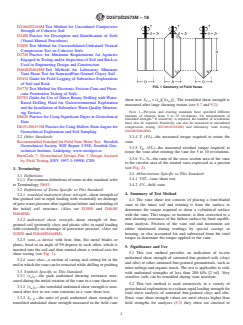
FIG. 1 Geometry of Field Vanes
D5778Test Method for Electronic Friction Cone and Piezo-
cone Penetration Testing of Soils
D5783Guide for Use of Direct Rotary Drilling with Water-
shear test: S =(s )f /(s )f . The remolded shear strength is
Tfv u v ur v
Based Drilling Fluid for Geoenvironmental Exploration
measured after large shearing strains (see 8.7 and 9.2).
and the Installation of SubsurfaceWater-Quality Monitor-
NOTE 1—Previous and existing standards have specified different
ing Devices
amounts of rotation, from 5 to 25 revolutions, for measurement of
D6026Practice for Using Significant Digits in Geotechnical
remolded strength. If sensitivity is reported, the number of revolutions
Data
must also be reported. Sensitivity can also be measured in unconfined
D6151/D6151MPracticeforUsingHollow-StemAugersfor
compression testing (D2166/D2166M) and laboratory vane testing
(D4648/D4648M).
Geotechnical Exploration and Soil Sampling
2.2 Other Standards: 3.3.4 T, (FL)—the measured torque required to rotate the
RecommendedStandardforFieldVaneShearTest, Swedish vane.
Geotechnical Society, SGF Report 2:93E, Swedish Geo-
3.3.5 T , (FL)—the measured residual torque required to
R
technical Institute, Linköping: www.swedgeo.se
rotate the vane after rotating the vane for 5 to 10 revolutions.
EuroCode 7: Geotechnical Design–Part 3 Design Assisted
3.3.6 V –%—the ratio of the cross section area of the vane
A
by Field Testing,ENV 1997-3:1999E, CEN
to the circular area of the rotated vane expressed as a percent
(see Fig. 2).
3. Terminology
3.4 Abbreviations Specific to This Standard:
3.1 Definitions:
3.4.1 VST—vane shear test.
3.1.1 Forcommondefinitionsoftermsinthisstandard,refer
to Terminology D653.
3.4.2 FV—field vane.
3.2 Definitions of Terms Specific to This Standard:
4. Summary of Test Method
3.2.1 remolded undrained shear strength—shear strength of
fine-grained soil in rapid loading with essentially no drainage
4.1 The vane shear test consists of placing a four-bladed
ofporewaterpressureaftersignificantfailureandremoldingof
vane in the intact soil and rotating it from the surface to
the initial soil structure. (Also see D2850 and D4648/
determine the torque required to shear a cylindrical surface
D4648M).
with the vane. This torque, or moment, is then converted to a
unit shearing resistance of the failure surface by limit equilib-
3.2.2 undrained shear strength—shear strength of fine-
rium analysis. Friction of the vane rod and instrument are
grained soil (primarily clays and plastic silts) in rapid loading
either minimized during readings by special casings or
with essentially no drainage of porewater pressure. (Also see
housing, or else accounted for and subtracted from the total
D2850 and D4648/D4648M).
torque to determine the torque applied to the vane.
3.2.3 vane—a device with four, thin, flat metal blades or
plates, fixed at an angle of 90 degrees to each other, which is
5. Significance and Use
inserted into the soil and then rotated about a vertical axis for
5.1 This test method provides an indication of in-situ
shear testing (see Fig. 1).
undrained shear strength of saturated fine-grained soils (clays
3.2.4 vane shoe—a section of casing and cutting bit at the
and silts) or other saturated fine-grained geomaterials, such as
endinwhichthevanecanberetractedwhiledrillingorpushing
mine tailings and organic muck. The test is applicable to soils
3.3 Symbols Specific to This Standard:
with undrained strengths of less than 200 kPa [2 tsf]. Very
3.3.1 (s ) —the peak undrained shearing resistance mea-
u fv sensitive soils can be remolded during vane insertion.
suredduringtheinitialrotationofthevaneinavanesheartest.
5.2 This test method is used extensively in a variety of
3.3.2 (s ) —the remolded undrained shear strength is mea-
ur fv
geotechnicalexplorationstoevaluaterapidloadingstrengthfor
sured after five to ten vane rotations in a vane shear test.
total stress analysis of saturated fine-grained clays and silts.
3.3.3 S —the ratio of peak undrained shear strength to Since vane shear strength values are most always higher than
Tfv
remolded undrained shear strength measured in the field vane field strengths for analyses (5.3) they often are checked or
D2573/D2573M − 18
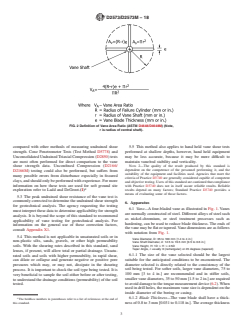
FIG. 2 Definition of Vane Area Ratio (ASTM D4648/D4648M) (Note,
r is radius of central shaft).
compared with other methods of measuring undrained shear 5.5 This method also applies to hand held vane shear tests
strength. Cone Penetrometer Tests (Test Method D5778) and performed at shallow depths, however, hand held equipment
UnconsolidatedUndrainedTriaxialCompression(D2850)tests may be less accurate, because it may be more difficult to
are most often performed for direct comparison to the vane maintain vane/rod stability and verticality.
NOTE 2—The quality of the result produced by this standard is
shear strength data. Unconfined Compression (D2166/
dependent on the competence of the personnel performing it, and the
D2166M) testing could also be performed, but suffers from
suitability of the equipment and facilities used. Agencies that meet the
many possible errors from disturbance especially in fissured
criteria of Practice D3740 are generally considered capable of competent
clays,andshouldonlybeperformedwithexperience.Formore
andobjectivetesting.Usersofthisstandardarecautionedthatcompliance
information on how these tests are used for soft ground site
with Practice D3740 does not in itself assure reliable results. Reliable
results depend on many factors; Standard Practice D3740 provides a
exploration refer to Ladd and DeGroot.(1)
means of evaluating some of those factors.
5.3 The peak undrained shear resistance of the vane test is
commonly corrected to determine the undrained shear strength
6. Apparatus
for geotechnical analysis. The agency requesting the testing
6.1 Vane—Afour-bladed vane as illustrated in Fig. 1.Vanes
mustinterpretthesedatatodetermineapplicabilityforstrength
are normally constructed of steel. Different alloys of steel such
analysis. It is beyond the scope of this standard to recommend
as nickel-chromium, or steel treatment processes such as
applicability of vane testing for geotechnical analysis. For
hardening, can be used to reduce blade thickness. The ends of
information on the general use of these correction factors,
thevanemaybeflatortapered.Vanedimensionsareasfollows
consult Appendix X1.
with notation from Fig. 1.
5.4 This method is not applicable in unsaturated soils or in
Vane Diameter, D: 35 to 100 mm [1.4 to 4 in.]
non-plastic silts, sands, gravels, or other high permeability
Vane Shaft Diameter, d: 12.5 to 16.5 mm [0.5 to 0.6 in.]
Vane Height, H: 1D# H# 2.5D
soils. With the shearing rates described in this standard, sand
Taper Angle, i: usually 0 (rectangular) or 45 degrees (tapered)
lenses, if present, will allow total or partial drainage. Unsatu-
6.1.1 The size of the vane selected should be the largest
rated soils and soils with higher permeability, in rapid shear,
suitable for the anticipated conditions to be encountered. The
can dilate or collapse and generate negative or positive pore
diameter selected is directly related to the consistency of the
pressures which may, or may not, dissipate in the shearing
soil being tested. For softer soils, larger vane diameters, 75 to
process. It is important to check the soil type being tested. It is
100 mm [3 to 4 in.] are recommended and in stiffer soils,
very beneficial to sample the soil either before or after testing,
smaller vane diameters, 35 to 50 mm [1.5 to 2 in.] are required
tounderstandthedrainageconditions(permeability)ofthesoil
toavoiddamagetothetorquemeasurementdevice(6.2).When
tested.
usedindrillholes,themaximumvanesizeisdependentonthe
inside diameter of the boring or casing.
6.1.2 Blade Thickness—The vane blade shall have a thick-
The boldface numbers in parentheses refer to a list of references at the end of
this standard. nessof0.8to3mm[0.031to0.118in.].Theaveragethickness
D2573/D2573M − 18
oftherod.Iftwistiscalculated,thematerialpropertyassumptionmustbe
shall be 2 mm [0.08 in.]. Vane blade edge or dimension (e) on
reported.
Fig. 2 can be tapered to be thinner at the edges to reduce
disturbance from insertion.
6.3.1 Protective Casing and Vane Shoe—When using con-
6.1.3 Thevaneshaftdiameter,d(shownalsoas2rinFig.1)
ventional drilling methods, torque rods can be sleeved in a
abovethetopofthevanebladesshallbelessthan20mm[0.75
small diameter casing to reduce rod friction. If a torque rod
in.].The vane shaft diameter (d) shall not exceed 14 mm [0.55
sleeveorcasingandvaneshoeisused,thetorquerodsshallbe
in.] at the center of the vane.
equipped-with well-lubricated bearings where they pass
6.1.4 Vane Area Ratio (V )—As shown on the detail in Fig.
through the housing. These bearings shall be provided with
A
2, the vane blade edges and fillet rod and welds shall be
seals that prevent soil from entering them. The casing may
sufficientlysmalltominimizesoildisturbanceduringinsertion.
require venting of water pressures.The test setup shall prevent
The Vane Area Ratio must be less than 10%.
frictionfromdevelopingbetweenthetorquerodsandthewalls
6.1.5 The distance from the top edge of the vane to an
of the casing or the boring (for example, by guiding the torque
increase in torque rod diameter (6.3) is 5d where d is the vane
rods).
shaftdiameteratthetopofthevane.Ifalargediameterfriction
6.3.2 Rod friction measurements under no-load conditions
couplerortorquerodsleeveisused,distanceis150mm[6-in.].
can be performed by replacing the vanes with a blank stem
6.1.6 Avanewiththeuppertaperededgeshastheadvantage
only if the torque is applied by a balanced moment that does
that the vane will not get caught on an exterior casing upon
notresultinasidethrust.Somepractitionerssuggesttheuseof
withdrawal.
a vane that allows some free rotation of the rod prior to
6.1.7 The bottom edge of the vane blades can be sharpened
loading.Whilethiscouldbedonetomeasurerodfrictionunder
to facilitate penetration into the soil. The edges of the blades
no-load condition, it is not a recommended practice.As torque
can be sharpened and beveled to counter-rotate against a
becomes greater during a test, a side thrust in the instrument
friction coupler (6.4).
willresultinanincreaseinfrictionthatisnotaccountedforby
initial no-load readings. Instruments involving side thrust are
6.2 Torque Measurement Device—Torque shall be applied
not allowable.
to the rods, hence to the vane. This is accomplished with a
clampingdeviceandtorqueapplicationapparatussetatthetop
6.4 Friction Coupling—The connection between the vane
of the rods. The accuracy of the torque reading shall be such
and the rods may include a friction coupling or slip coupling
that it will produce a variation not to exceed 61.0 kPa [621
device. This device is used with single rod systems where the
lb/ft ] in computing undrained shear strength.
vane may be advanced far in advance of the protective casing.
6.2.1 It is preferable to apply torque to the vane with a
This device is designed not to engage the vane until a certain
geared drive. In the absence of a geared drive, it is acceptable
amountofrotation,typically15degreeshasoccurred,andthus
to apply the torque directly by hand with a torque wrench or
allowsfordeterminationofrodfrictionpriortothetest.Useof
equivalent. If torque is applied by hand an asterisk shall be
this coupling is preferred over blank rod testing for determi-
placed next to the resultant shear stress and “hand torqued”
nationofrodfriction,becausemeasurementsaremadedirectly
shall be noted. The duration of the test shall be controlled by
in the soil tested.
the requirements of 8.6.
6.5 Centralizers—For tests performed in drill holes, it will
6.2.2 Some torque measurement devices are capable of
benecessarytoequipthetorquerodswithcentralizerstoassure
making hard copy or computer records of the load-
a vertical push and to prevent torque rod buckling. They are
displacement history. Other manually read systems use torque
designedtosupporttherods,whileminimizinganyrodfriction
rings and dial gauges. These automatic reading systems have
when deflected. Centralizers must be smaller in diameter than
an advantage over manually read systems, because operator
the drill hole. They shall be designed to allow the passage of
error is reduced.
drill fluids.
6.3 Torque Rods—The vane shall be connected to the
surface by means of steel torque rods. Typical rod diameters
6.6 Advancement Equipment—When used in drill holes, the
rangefrom18to36mm[0.75to1.5in.].Theserodsshallhave driveheadandpull-downcapabilityofthedrillrigcanbeused
sufficient diameter such that their elastic limit is not exceeded
to push the vane below the base of the hole. Some equipment
whenthevaneisstressedtoitscapacity(Note3).Theyshallbe isdesignedtopushthevane
...
This document is not an ASTM standard and is intended only to provide the user of an ASTM standard an indication of what changes have been made to the previous version. Because
it may not be technically possible to adequately depict all changes accurately, ASTM recommends that users consult prior editions as appropriate. In all cases only the current version
of the standard as published by ASTM is to be considered the official document.
´1
Designation: D2573/D2573M − 15 D2573/D2573M − 18
Standard Test Method for
Field Vane Shear Test in Saturated Fine-Grained Soils
This standard is issued under the fixed designation D2573/D2573M; the number immediately following the designation indicates the
year of original adoption or, in the case of revision, the year of last revision. A number in parentheses indicates the year of last
reapproval. A superscript epsilon (´) indicates an editorial change since the last revision or reapproval.
This standard has been approved for use by agencies of the U.S. Department of Defense.
ε NOTE—Editorially corrected Eq 1 and 2 in February 2018.
1. Scope*
1.1 This test method covers the field vane test in saturated clay and silt soils for determination of undrained shear strength.
Knowledge of the nature of the soil in which each vane test is to be made is necessary for assessment of the applicability and
interpretation of the test. The test is not applicable for sandy soils or non-plastic silts, which may allow drainage during the test.
1.2 This test method addresses testing on land and for testing in drill holes or by self-drilling or continuous push methods from
the ground surface. This method does not address specifically marine testing where special test requirements or variations in
equipment may be required. The user is referred to ASTM STP 1014 for additional information on in-place vane shear testing used
in marine exploration.
1.3 This method is often used in conjunction with fluid rotary drilling (D5783), hollow-stem augers (D6151D6151/D6151M),
or cone penetration testing (D5778). Some apparatuses have the vane retracted in a protective shoe for advancement and
incremental testing. Sampling, such as with thin wall tubes (D1587D1587/D1587M) is often combined with vane testing.
Subsurface geotechnical explorations are reported in accordance with Practice (D5434).
1.4 Undrained shear strength and sensitivity of cohesive soils can also be measured in Laboratory Vane Test (D4648D4648/
D4648M).
1.5 Units—The values stated in either SI units or inch-pound units [presented in brackets] are to be regarded separately as
standard. The values in each system may not be exact equivalents; therefore, each system shall be used independently of the other.
Combining values from the two systems may result in non-conformance with the standard. Reporting of test results in units other
than SI shall not be regarded as nonconformance with this test method.
1.5.1 The gravitational system of inch-pound units is used when dealing with inch-pound units. In this system, the pound (lbf)
represents a unit of force (weight), while the unit for mass is slugs. The rationalized slug unit is not given, unless dynamic (F =
ma) calculations are involved.
1.6 All observed and calculated values shall conform to the guidelines for significant digits and rounding established in Practice
D6026.
1.6.1 The procedures used to specify how data are collected/ recorded or calculated in this standard are regarded as the industry
standard. In addition they are representative of the significant digits that generally should be retained. The procedures used do not
consider material variation, purpose for obtaining the data, special purpose studies, or any considerations for the user’s objectives,
and it is common practice to increase or reduce significant digits or reported data to be commensurate with these considerations.
It is beyond the scope of this standard to consider significant digits used in analytical methods for engineering design.
1.7 This standard does not purport to address all of the safety concerns, if any, associated with its use. It is the responsibility
of the user of this standard to establish appropriate safety, health, and environmental practices and determine the applicability of
regulatory limitations prior to use.
1.8 This international standard was developed in accordance with internationally recognized principles on standardization
established in the Decision on Principles for the Development of International Standards, Guides and Recommendations issued
by the World Trade Organization Technical Barriers to Trade (TBT) Committee.
This test method is under the jurisdiction of ASTM Committee D18 on Soil and Rock and is the direct responsibility of Subcommittee D18.02 on Sampling and Related
Field Testing for Soil Evaluations.
Current edition approved July 1, 2015Dec. 1, 2018. Published July 2015December 2018. Originally approved in 1967. Last previous edition approved in 20082015 as
ɛ1
D2573 – 08.D2573/D2573M – 15 . DOI: 10.1520/D2573_D2573M-15E01.10.1520/D2573_D2573M-18.
ASTM STP 1014 on Vane Shear Strength Testing in Soils (1988).
*A Summary of Changes section appears at the end of this standard
Copyright © ASTM International, 100 Barr Harbor Drive, PO Box C700, West Conshohocken, PA 19428-2959. United States
D2573/D2573M − 18
2. Referenced Documents
2.1 ASTM Standards:
D653 Terminology Relating to Soil, Rock, and Contained Fluids
D1587D1587/D1587M Practice for Thin-Walled Tube Sampling of Fine-Grained Soils for Geotechnical Purposes
D2166D2166/D2166M Test Method for Unconfined Compressive Strength of Cohesive Soil
D2488 Practice for Description and Identification of Soils (Visual-Manual Procedures)
D2850 Test Method for Unconsolidated-Undrained Triaxial Compression Test on Cohesive Soils
D3740 Practice for Minimum Requirements for Agencies Engaged in Testing and/or Inspection of Soil and Rock as Used in
Engineering Design and Construction
D4648D4648/D4648M Test Methods for Laboratory Miniature Vane Shear Test for SaturatedFine-Grained Clayey Soil
D5434 Guide for Field Logging of Subsurface Explorations of Soil and Rock
D5778 Test Method for Electronic Friction Cone and Piezocone Penetration Testing of Soils
D5783 Guide for Use of Direct Rotary Drilling with Water-Based Drilling Fluid for Geoenvironmental Exploration and the
Installation of Subsurface Water-Quality Monitoring Devices
D6026 Practice for Using Significant Digits in Geotechnical Data
D6151D6151/D6151M Practice for Using Hollow-Stem Augers for Geotechnical Exploration and Soil Sampling
2.2 Other Standards:
Recommended Standard for Field Vane Shear Test, Swedish Geotechnical Society, SGF Report 2:93E, Swedish Geotechnical
Institute, Linköping: www.swedgeo.se
EuroCode 7: Geotechnical Design–Part 3 Design Assisted by Field Testing, ENV 1997-3:1999E, CEN
3. Terminology
3.1 Definitions:
3.1.1 For common definitions of terms in this standard, refer to Terminology D653.
3.2 Definitions of Terms Specific to This Standard:
3.2.1 remolded undrained shear strength—shear strength of fine-grained soil in rapid loading with essentially no drainage of
pore water pressure after significant failure and remolding of the initial soil structure. (Also see D2850 and D4648D4648/
D4648M).
3.2.2 undrained shear strength—shear strength of fine-grained soil (primarily clays and plastic silts) in rapid loading with
essentially no drainage of porewater pressure. (Also see D2850 and D4648D4648/D4648M).
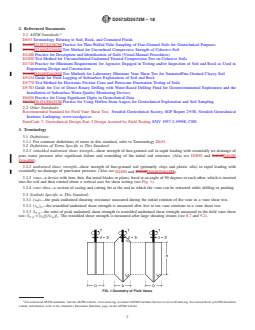
3.2.3 vane—a device with four, thin, flat metal blades or plates, fixed at an angle of 90 degrees to each other, which is inserted
into the soil and then rotated about a vertical axis for shear testing (see Fig. 1).
3.2.4 vane shoe—a section of casing and cutting bit at the end in which the vane can be retracted while drilling or pushing
3.3 Symbols Specific to This Standard:
3.3.1 (s ) —the peak undrained shearing resistance measured during the initial rotation of the vane in a vane shear test.
u fv
3.3.2 (s ) —the remolded undrained shear strength is measured after five to ten vane rotations in a vane shear test.
ur fv
3.3.3 S —the ratio of peak undrained shear strength to remolded undrained shear strength measured in the field vane shear
T fv
test: S = (s )f /(s )f . The remolded shear strength is measured after large shearing strains (see 8.7 and 9.2).
T fv u v ur v
FIG. 1 Geometry of Field Vanes
For referenced ASTM standards, visit the ASTM website, www.astm.org, or contact ASTM Customer Service at service@astm.org. For Annual Book of ASTM Standards
volume information, refer to the standard’s Document Summary page on the ASTM website.
D2573/D2573M − 18
NOTE 1—Previous and existing standards have specified different amounts of rotation, from 5 to 25 revolutions, for measurement of remolded strength.
If sensitivity is reported, the number of revolutions must also be reported. Sensitivity can also be measured in unconfined compression testing
(D2166D2166/D2166M) and laboratory vane testing (D4648D4648/D4648M).
3.3.4 T, (FL)—the measured torque required to rotate the vane.
3.3.5 T , (FL)—the measured residual torque required to rotate the vane after rotating the vane for 5 to 10 revolutions.
R
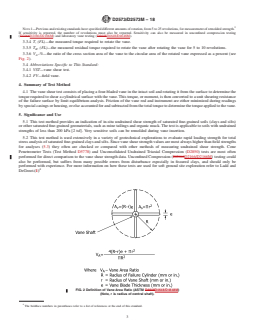
3.3.6 V –%—the ratio of the cross section area of the vane to the circular area of the rotated vane expressed as a percent (see
A
Fig. 2).
3.4 Abbreviations Specific to This Standard:
3.4.1 VST—vane shear test.
3.4.2 FV—field vane.
4. Summary of Test Method
4.1 The vane shear test consists of placing a four-bladed vane in the intact soil and rotating it from the surface to determine the
torque required to shear a cylindrical surface with the vane. This torque, or moment, is then converted to a unit shearing resistance
of the failure surface by limit equilibrium analysis. Friction of the vane rod and instrument are either minimized during readings
by special casings or housing, or else accounted for and subtracted from the total torque to determine the torque applied to the vane.
5. Significance and Use
5.1 This test method provides an indication of in-situ undrained shear strength of saturated fine-grained soils (clays and silts)
or other saturated fine-grained geomaterials, such as mine tailings and organic muck. The test is applicable to soils with undrained
strengths of less than 200 kPa [2 tsf]. Very sensitive soils can be remolded during vane insertion.
5.2 This test method is used extensively in a variety of geotechnical explorations to evaluate rapid loading strength for total
stress analysis of saturated fine-grained clays and silts. Since vane shear strength values are most always higher than field strengths
for analyses (5.3) they often are checked or compared with other methods of measuring undrained shear strength. Cone
Penetrometer Tests (Test Method D5778) and Unconsolidated Undrained Triaxial Compression (D2850) tests are most often
performed for direct comparison to the vane shear strength data. Unconfined Compression (D2166D2166/D2166M) testing could
also be performed, but suffers from many possible errors from disturbance especially in fissured clays, and should only be
performed with experience. For more information on how these tests are used for soft ground site exploration refer to Ladd and
DeGroot.(1)
FIG. 2 Definition of Vane Area Ratio (ASTM D4648D4648/D4648M)
(Note, r is radius of central shaft).
The boldface numbers in parentheses refer to a list of references at the end of this standard.
D2573/D2573M − 18
5.3 The peak undrained shear resistance of the vane test is commonly corrected to determine the undrained shear strength for
geotechnical analysis. The agency requesting the testing must interpret these data to determine applicability for strength analysis.
It is beyond the scope of this standard to recommend applicability of vane testing for geotechnical analysis. For information on
the general use of these correction factors, consult Appendix X1.
5.4 This method is not applicable in unsaturated soils or in non-plastic silts, sands, gravels, or other high permeability soils. With
the shearing rates described in this standard, sand lenses, if present, will allow total or partial drainage. Unsaturated soils and soils
with higher permeability, in rapid shear, can dilate or collapse and generate negative or positive pore pressures which may, or may
not, dissipate in the shearing process. It is important to check the soil type being tested. It is very beneficial to sample the soil either
before or after testing, to understand the drainage conditions (permeability) of the soil tested.
5.5 This method also applies to hand held vane shear tests performed at shallow depths, however, hand held equipment may
be less accurate, because it may be more difficult to maintain vane/rod stability and verticality.
NOTE 2—The quality of the result produced by this standard is dependent on the competence of the personnel performing it, and the suitability of the
equipment and facilities used. Agencies that meet the criteria of Practice D3740 are generally considered capable of competent and objective testing. Users
of this standard are cautioned that compliance with Practice D3740 does not in itself assure reliable results. Reliable results depend on many factors;
Standard Practice D3740 provides a means of evaluating some of those factors.
6. Apparatus
6.1 Vane—A four-bladed vane as illustrated in Fig. 1. Vanes are normally constructed of steel. Different alloys of steel such as
nickel-chromium, or steel treatment processes such as hardening, can be used to reduce blade thickness. The ends of the vane may
be flat or tapered. Vane dimensions are as follows with notation from Fig. 1.
Vane Diameter, D: 35 to 100 mm [1.4 to 4 in.]
Vane Shaft Diameter, d: 12.5 to 16.5 mm [0.5 to 0.6 in.]
Vane Height, H: 1D # H # 2.5D
Taper Angle, i: usually 0 (rectangular) or 45 degrees (tapered)
6.1.1 The size of the vane selected should be the largest suitable for the anticipated conditions to be encountered. The diameter
selected is directly related to the consistency of the soil being tested. For softer soils, larger vane diameters, 75 to 100 mm [3 to
4 in.] are recommended and in stiffer soils, smaller vane diameters, 35 to 50 mm [1.5 to 2 in.] are required to avoid damage to
the torque measurement device (6.2). When used in drill holes, the maximum vane size is dependent on the inside diameter of the
boring or casing.
6.1.2 Blade Thickness—The vane blade shall have a thickness of 0.8 to 3 mm [0.031 to 0.118 in.]. The average thickness shall
be 2 mm [0.08 in.]. Vane blade edge or dimension (e) on Fig. 2 can be tapered to be thinner at the edges to reduce disturbance
from insertion.
6.1.3 The vane shaft diameter, d (shown also as 2r in Fig. 1) above the top of the vane blades shall be less than 20 mm [0.75
in.]. The vane shaft diameter (d) shall not exceed 14 mm [0.55 in.] at the center of the vane.
6.1.4 Vane Area Ratio (V )—As shown on the detail in Fig. 2, the vane blade edges and fillet rod and welds shall be sufficiently
A
small to minimize soil disturbance during insertion. The Vane Area Ratio must be less than 10 %.
6.1.5 The distance from the top edge of the vane to an increase in torque rod diameter (6.3) is 5d where d is the vane shaft
diameter at the top of the vane. If a large diameter friction coupler or torque rod sleeve is used, distance is 150 mm [6-in.].
6.1.6 A vane with the upper tapered edges has the advantage that the vane will not get caught on an exterior casing upon
withdrawal.
6.1.7 The bottom edge of the vane blades can be sharpened to facilitate penetration into the soil. The edges of the blades can
be sharpened and beveled to counter-rotate against a friction coupler (6.4).
6.2 Torque Measurement Device—Torque shall be applied to the rods, hence to the vane. This is accomplished with a clamping
device and torque application apparatus set at the top of the rods. The accuracy of the torque reading shall be such that it will
produce a variation not to exceed 61.0 kPa [621 lb/ft ] in computing undrained shear strength.
6.2.1 It is preferable to apply torque to the vane with a geared drive. In the absence of a geared drive, it is acceptable to apply
the torque directly by hand with a torque wrench or equivalent. If torque is applied by hand an asterisk shall be placed next to the
resultant shear stress and “hand torqued” shall be noted. The duration of the test shall be controlled by the requirements of 8.6.
6.2.2 Some torque measurement devices are capable of making hard copy or computer records of the load-displacement history.
Other manually read systems use torque rings and dial gauges. These automatic reading systems have an advantage over manually
read systems, because operator error is reduced.
6.3 Torque Rods—The vane shall be connected to the surface by means of steel torque rods. Typical rod diameters range from
18 to 36 mm [0.75 to 1.5 in.]. These rods shall have sufficient diameter such that their elastic limit is not exceeded when the vane
is stressed to its capacity (Note 3). They shall be so coupled that the shoulders of the male and female ends meet to prevent any
possibility of the coupling tightening when the torque is applied during the test. Most steel torque rods meeting the requirements
in this standard do twist during testing and requires a correction if vane rotation is to be determined.
NOTE 3—If torque versus rotation curves are to be determined, the torque rods can be calibrated. The amount of rod twist is established in degrees
per metre [foot] per unit torque. This correction becomes progressively more important as the depth of the test increases and the calibration must be made
D2573/D2573M − 18
at least to the maximum depth of testing anticipated. Alternately, rod twist can be calculated based on the properties of the rod. If twist is calculated, the
material property assumption must be reported.
6.3.1 Protective Casing and Vane Shoe—When using conventional drilling methods, torque rods can be sleeved in a small
diameter casing to reduce rod friction. If a torque rod sleeve or casing and vane shoe is used, the torque rods shall be equipped-with
well-lubricated bearings where they pass through the housing. These bearings shall be provided with seals that prevent soil from
entering them. The casing may require venting of water pressures. The test setup shall prevent friction from developing between
the torque rods and the walls of the casing or the boring (for example, by guiding the torque rods).
6.3.2 Rod friction measurements under no-load conditions can be performed by replacing the vanes with a blank stem only if
the torque is applied by a balanced moment that does not result in a side thrust. Some practitioners suggest the use of a vane that
allows some free rotation of the rod prior to loading. While this could be done to measure rod friction under no-load condition,
it is not a recommended practice. As torque becomes greater during a test, a side thrust in the instrument will result in an increase
in friction that is not accounted for by initial no-load readings. Instruments involving side thrust are not allowable.
6.4 Friction Coupling—The connection between the vane and the rods may include a friction coupling or slip coupling device.
This device is used with single rod systems where the vane may be advanced far in advance of the protective casing. This device
is designed not to engage the vane until a certain amount of rotation, typically 15 degrees has occurred, and thus allows for
determination of rod friction prior to the test. Use of this coupling is preferred over blank rod testing for determination of rod
friction, because measurements are made directly in the soil tested.
...